⚠ Evidence warning: Clinical trials or other evidence do not support the claims that eating an organ feeds the same human organ, that organ meats beat any supplement, that beef heart outdoes all other foods combined for coenzyme Q10, and that bone marrow and broth repair joints, skin and gut lining. This page keeps it as a report of what people, websites or other media say.
Organ Meats — Benefits Deep Dive
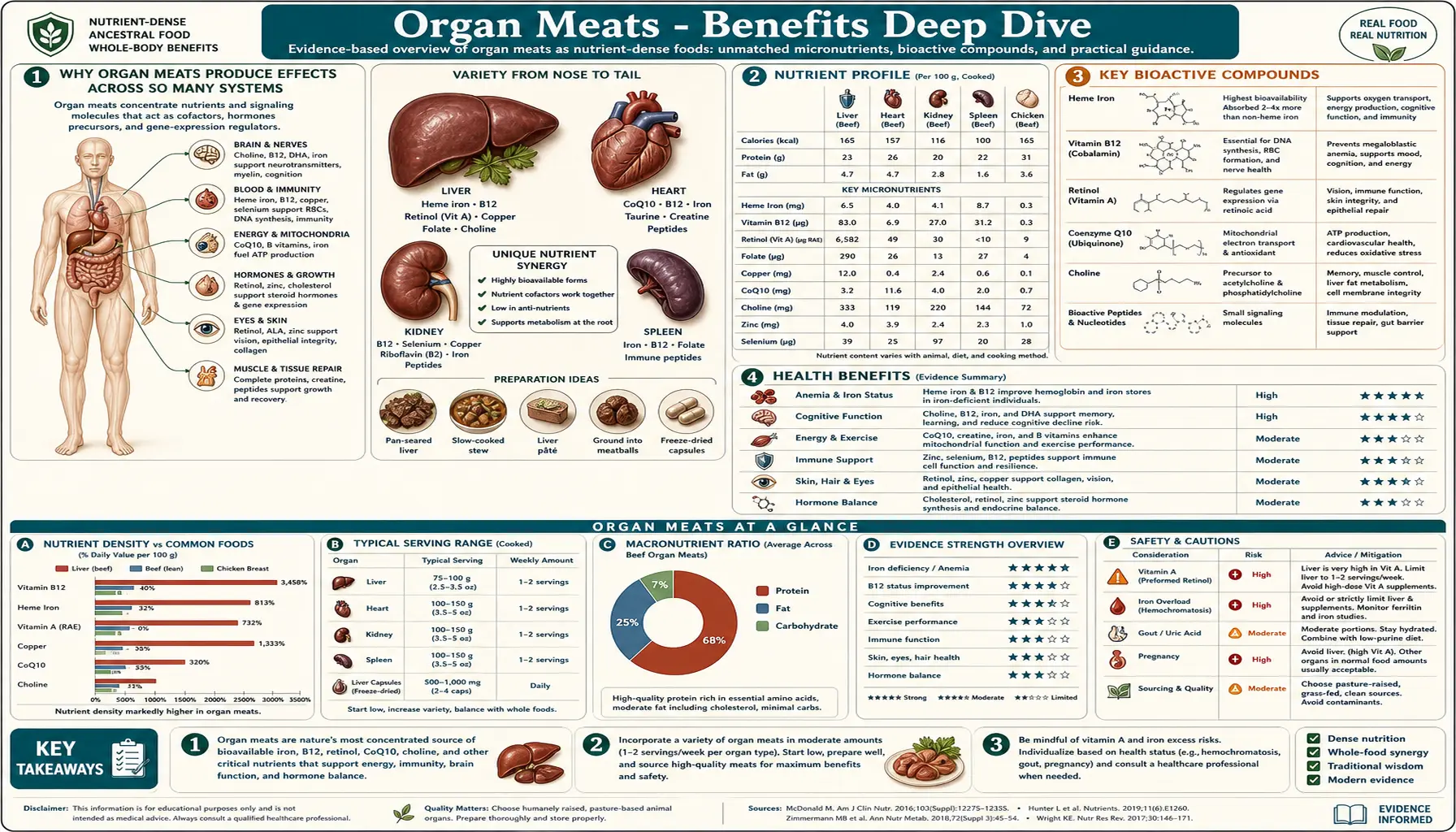
Organ meats are the most nutrient-dense foods in the human food supply. A three-ounce serving of beef liver contains more bioavailable Vitamin A, Vitamin B12, folate, copper, and heme iron than any vegetable, fruit, or commercial multivitamin. Organ-meat advocates describe a serving of beef heart as delivering more coenzyme Q10 (CoQ10) than every Western-diet food combined; a 2023 food-analysis review lists vegetable oils, fish oil, organs, and meat as the richest sources. Lamb and beef brain contain preformed plasmalogens and are described as a source of meaningful concentrations of phosphatidylserine, though brain is not the only plasmalogen source: a 2021 study measured total plasmalogen of 530.83-944.94 nmol/g in livestock and poultry meat, 46.08-399.75 nmol/g in fish, and 10.00-384.76 nmol/g in mollusks. Advocates describe bone marrow as a concentrated source of glycine-rich gelatin, conjugated linoleic acid, and bioavailable retinol-binding fats. Popular writing also says US per-capita organ-meat consumption has collapsed from roughly twelve pounds per person per year in 1940 to under one pound today — a 92% decline — while micronutrient deficiencies have spread in lockstep; no published source for these figures, or for that link, was found for this page. The four benefit pages below explore the four organs where the clinical-nutrition case is strongest: the liver as concentrated multivitamin, the heart as coenzyme Q10 and taurine source, the brain as docosahexaenoic acid (DHA) and plasmalogen source, and bone marrow as glycine and gelatin source for joint and connective-tissue repair.
Deep-Dive Articles
Liver and Vitamins
Beef and chicken liver as the densest dietary sources of preformed Vitamin A (retinol), Vitamin B12, folate, copper, heme iron, and choline. How common BCMO1 gene variants reduce beta-carotene conversion in carriers (a 2009 study in female volunteers measured falls of 32% and 69% after a large dose, and conversion is reported to be highly variable in up to 45% of healthy people), the Weston A. Price Foundation case for liver, desiccated liver capsules as a low-flavor alternative, how often people eat it (one 3-oz serving per week is a figure advocates often give), and the upper-bound Vitamin A facts, especially in pregnancy.
Read the deep dive →Heart and Coenzyme Q10
Beef heart contains the highest coenzyme Q10 concentration of any common food (~113 mg/kg), supplies cardiolipin-bound coenzyme Q10 in its native phospholipid context, and is rich in taurine (the conditionally-essential amino acid concentrated in cardiac tissue), B-complex vitamins, and selenium. Why coenzyme Q10 declines with age, the statin-CoQ10 depletion mechanism, and the case for heart muscle as a whole-food alternative to ubiquinol capsules.
Read the deep dive →Brain and Docosahexaenoic Acid
Lamb and beef brain as concentrated dietary sources of docosahexaenoic acid (DHA), phosphatidylserine, ethanolamine plasmalogens, and cholesterol — the four lipid classes that comprise the bulk of human brain mass. The hard-won safety lesson of bovine spongiform encephalopathy (BSE), why some people choose lamb brain, and what has been claimed for dietary brain in children and older people.
Read the deep dive →Bone Marrow and Collagen
Beef and lamb bone marrow, described by advocates as the richest dietary source of conjugated linoleic acid (CLA), retinol-soluble fats, glycine-rich gelatin from the surrounding connective tissue, and mesenchymal-stem-cell-derived signaling lipids; no measurement of these in marrow as a food was found for this page. The Weston A. Price Foundation tradition of bone-marrow consumption, roasted-marrow preparation methods, and the joint-and-skin-repair clinical literature on bone-broth glycine.
Read the deep dive →Table of Contents
- Deep-Dive Articles
- Why Organ Meats Produce Effects Across So Many Systems
- Research Papers: Liver and Vitamins
- Research Papers: Heart and Coenzyme Q10
- Research Papers: Brain and Docosahexaenoic Acid
- Research Papers: Bone Marrow and Collagen
- Research Papers: Cross-Cutting (Nutrient Density, Safety, History)
- External Resources
- Connections
- Featured Videos
Why Organ Meats Produce Effects Across So Many Systems
Muscle meat — the steaks, chops, and ground meat that dominate Western consumption — is essentially storage protein with relatively little micronutrient density. The internal organs of grazing and grass-fed animals are where the metabolic action happens, and consequently where the cofactor density is concentrated. Three structural facts explain why organ meats produce benefits across so many systems that no single supplement can replicate.
- Concentration of fat-soluble vitamins where they are made or stored — the liver is the body's storage organ for Vitamin A (retinyl palmitate in hepatic stellate cells) and Vitamin D (cholecalciferol). Storage does not make liver a rich vitamin D food: USDA lists pan-fried beef liver at 49 IU per 100 g, against 193 IU per 100 g in canned sardines. It also packages Vitamin K2 (menaquinone) and a substantial fraction of total-body folate and B12. A grass-fed cow that has spent years extracting these nutrients from forage and converting them to bioactive forms presents them to the human consumer in already-bioavailable concentrations that no synthetic supplement can match. This is the structural argument for liver as a concentrated whole-food multivitamin.
- Tissue-specific bioactive compounds that the body uses for the same purpose — tissues that are metabolically expensive to maintain (heart, brain, kidney) concentrate the cofactors required for their own function: heart muscle is rich in coenzyme Q10, taurine, and cardiolipin; brain tissue is rich in docosahexaenoic acid, phosphatidylserine, plasmalogens, and cholesterol; kidney is rich in selenium and B12. When a human eats these tissues, the same compounds are absorbed and used preferentially in the corresponding human organ system — the principle behind the heart-tissue coenzyme Q10 case and the brain-tissue docosahexaenoic acid and plasmalogen case.
- Connective-tissue building blocks in their native conformation — bone marrow, cartilage, tendon, and skin contain glycine, proline, hydroxyproline, and gelatin in approximately the proportions the human body needs for its own connective-tissue maintenance. Glycine in particular is conditionally essential and is under-supplied by muscle-meat-dominant diets that lack the surrounding gristle and bone. This is the structural argument for bone marrow and bone broth in joint, skin, and gut-lining repair.
The historical complication is that 20th-century American food culture progressively excluded organ meats from mainstream consumption. Pre-1940, organ meats were a routine part of working-class American and European diets — chicken liver pate, beef heart roasts, sweetbreads, kidney pie, brain scrambles, and bone-marrow toast were unremarkable. Two events accelerated the disappearance: the post-WWII rise of supermarket pre-portioned muscle cuts (which left butchers without an organ-meat market) and the 1980s-1990s bovine spongiform encephalopathy (BSE / “mad cow disease”) crisis (which made central nervous system tissue specifically taboo). US rules at 21 CFR 189.5 now bar the brain, skull, and spinal cord of cattle 30 months and older, and the tonsils and last part of the small intestine of all cattle, from human food. The Weston A. Price Foundation, the Sally Fallon Morell-led traditional foods movement, and the resurgence of nose-to-tail butchery in the last fifteen years have begun to reverse this — with desiccated liver capsules as a particularly accessible entry point for adults who cannot get past the flavor of beef liver itself.
A note on safety: because organ meats are so nutrient-dense, the upper-limit calculations matter. A single 3-oz serving of beef liver contains roughly 6,500 mcg RAE of preformed Vitamin A — more than double the adult tolerable upper intake level (3,000 mcg RAE/day) and approximately 8× the recommended dietary allowance (700-900 mcg RAE/day). That limit is a daily figure, so one serving passes it on the day it is eaten. Advocates describe one serving per week as within a safe range for vitamin A; at one serving per day, chronic hypervitaminosis A becomes a real risk. The research raises a specific concern in pregnancy. Among 22,748 pregnant women, certain birth defects were 3.5 times as common in babies of women taking in more than 15,000 IU of preformed vitamin A a day from food and supplements as in those taking 5,000 IU or less, with an apparent threshold near 10,000 IU a day of supplemental vitamin A (Rothman 1995). The UK National Health Service pregnancy page says: “Liver and foods containing liver have high levels of vitamin A, which can be harmful to your baby.”
Liver is also very high in copper. USDA lists 14.6 mg of copper per 100 g of pan-fried beef liver, about 12.4 mg in its 85 g (3-oz) portion, and the adult upper limit set by the US Food and Nutrition Board is 10 mg a day from food and supplements combined. So one serving can pass that limit on the day it is eaten.
Organ meats also count among the purine-rich foods linked to gout. In 47,150 men followed for 12 years, the highest fifth of meat intake carried a relative risk of gout of 1.41 and the highest fifth of seafood intake 1.51, compared with the lowest fifth; the study abstract gives no separate figure for organ meats (Choi 2004). Each sub-article spells out the relevant safety bounds for that organ.
Research Papers: Liver and Vitamins
- Leung WC, Hessel S, Méplan C, et al. Two common single nucleotide polymorphisms in the gene encoding beta-carotene 15,15'-monoxygenase alter beta-carotene metabolism in female volunteers. FASEB Journal. 2009;23(4):1041-1053. — PubMed PMID: 19103647
- Beef liver Vitamin A (retinol) content and bioavailability — PubMed: Liver retinol bioavailability
- BCMO1 polymorphism and beta-carotene conversion to retinol — PubMed: BCMO1 polymorphism
- Beef liver as a dietary source of bioavailable iron — PubMed: Liver heme iron
- Copper content of liver and dietary copper requirements — PubMed: Liver copper content
- Vitamin B12 (cobalamin) concentration in animal organ tissues — PubMed: B12 in organ meats
- Folate content of liver and natural-form folate versus synthetic folic acid — PubMed: Liver natural folate
- Choline content of liver and egg yolk for methyl-donor pool — PubMed: Choline in liver
- Hypervitaminosis A from chronic high liver consumption (polar-explorer case reports) — PubMed: Polar liver hypervitaminosis A
- Rothman KJ, Moore LL, Singer MR, Nguyen US, Mannino S, Milunsky A. Teratogenicity of high vitamin A intake. New England Journal of Medicine. 1995;333(21):1369-1373. — PubMed PMID: 7477116
- Desiccated liver supplements and clinical micronutrient repletion — PubMed: Desiccated liver
Research Papers: Heart and Coenzyme Q10
- CoQ10 (ubiquinone) content of beef heart and other meats — PubMed: CoQ10 in beef heart
- Mortensen SA, Rosenfeldt F, Kumar A, et al. The effect of coenzyme Q10 on morbidity and mortality in chronic heart failure: results from Q-SYMBIO: a randomized double-blind trial. JACC Heart Failure. 2014;2(6):641-649. — PubMed PMID: 25282031
- Podar AS, Semeniuc CA, Ionescu SR, et al. An Overview of Analytical Methods for Quantitative Determination of Coenzyme Q10 in Foods. Metabolites. 2023;13(2):272. — PubMed PMID: 36837891
- Statin-induced CoQ10 depletion mechanism — PubMed: Statin CoQ10 depletion
- Taurine concentration in heart muscle and cardiac function — PubMed: Taurine in heart muscle
- Taurine supplementation in congestive heart failure — PubMed: Taurine and CHF
- Cardiolipin biosynthesis and CoQ10 mitochondrial integration — PubMed: Cardiolipin and CoQ10
- Age-related decline in tissue CoQ10 concentrations — PubMed: CoQ10 age-related decline
- Ubiquinol versus ubiquinone bioavailability comparison — PubMed: Ubiquinol vs ubiquinone
- Selenium concentration in organ meats and Keshan disease prevention — PubMed: Organ-meat selenium
- L-carnitine concentration in heart muscle and cardiac energy metabolism — PubMed: L-carnitine in heart muscle
Research Papers: Brain and Docosahexaenoic Acid
- Wu Y, Chen Z, Jia J, Chiba H, Hui SP. Quantitative and Comparative Investigation of Plasmalogen Species in Daily Foodstuffs. Foods. 2021;10(1):124. — PubMed PMID: 33435634
- DHA (docosahexaenoic acid) content of brain tissue and dietary brain — PubMed: Brain tissue DHA
- Phosphatidylserine in brain tissue and cognitive function — PubMed: Phosphatidylserine in brain
- Plasmalogen biology and brain phospholipid biochemistry — PubMed: Brain plasmalogens
- Cholesterol in brain tissue and CNS myelin formation — PubMed: Brain cholesterol
- BSE (bovine spongiform encephalopathy) and prion disease history — PubMed: BSE history
- Variant Creutzfeldt-Jakob disease and dietary exposure risk — PubMed: vCJD dietary risk
- DHA supplementation and infant neurodevelopment — PubMed: Infant DHA
- Phosphatidylserine supplementation in age-related cognitive decline — PubMed: PS in cognitive decline
- Plasmalogen deficiency in Alzheimer's disease — PubMed: Plasmalogens in Alzheimer's
- Lamb brain as a traditional food in Middle Eastern and Mediterranean cuisine — PubMed: Lamb brain tradition
Research Papers: Bone Marrow and Collagen
- Conjugated linoleic acid (CLA) content in beef bone marrow and tallow — PubMed: CLA in bone marrow
- Glycine as a conditionally essential amino acid — PubMed: Glycine conditional essentiality
- Bone broth gelatin amino acid composition (glycine, proline, hydroxyproline) — PubMed: Bone broth amino acids
- Collagen peptide supplementation and skin elasticity — PubMed: Collagen peptides and skin
- Collagen peptide supplementation in osteoarthritis — PubMed: Collagen in OA
- Glycine supplementation in sleep architecture and core body temperature — PubMed: Glycine and sleep
- Type II collagen for joint repair (UC-II clinical trials) — PubMed: UC-II joint trials
- Bone marrow mesenchymal stem cells and signaling lipids — PubMed: Marrow MSCs and lipids
- Gelatin and gut barrier integrity (intestinal permeability) — PubMed: Gelatin and gut barrier
- Weston Price Foundation traditional foods nutrient density analysis — PubMed: WAPF traditional foods
Research Papers: Cross-Cutting (Nutrient Density, Safety, History)
- Choi HK, Atkinson K, Karlson EW, Willett W, Curhan G. Purine-rich foods, dairy and protein intake, and the risk of gout in men. New England Journal of Medicine. 2004;350(11):1093-1103. — PubMed PMID: 15014182
- Nutrient density scoring of organ meats versus muscle meats — PubMed: Nutrient density scoring
- USDA FoodData Central organ meat nutrient analyses — PubMed: USDA organ meat data
- Purine content of organ meats and gout risk — PubMed: Organ meats and gout
- Choi HK et al. dietary patterns and hyperuricemia (NHANES analysis) — PubMed: Choi diet and uric acid
- Grass-fed versus grain-fed beef nutrient comparison — PubMed: Grass-fed vs grain-fed
- Historical American organ meat consumption decline (1940-2010) — PubMed: Organ meat decline
- Heavy metal accumulation in liver and kidney tissue — PubMed: Heavy metals in organ tissue
- Vitamin A and Vitamin D synergy (fat-soluble vitamin balance) — PubMed: A and D synergy
- Nose-to-tail eating and dietary diversity epidemiology — PubMed: Nose-to-tail nutrition
- Sally Fallon Morell & Weston A. Price Foundation dietary recommendations — PubMed: WAPF dietary research
External Resources
- Weston A. Price Foundation — The Liver Files (the foundation's own article on organ meat consumption)
- U.S. Department of Agriculture (USDA) FoodData Central — nutrient profiles of beef liver, heart, kidney, brain, and bone marrow
- Linus Pauling Institute — Vitamin A Micronutrient Information Center
- U.S. National Institutes of Health (NIH) Office of Dietary Supplements — Vitamin and Mineral Fact Sheets
- PubMed — All research on organ meats and offal nutrition
Connections
- All Food
- Organ Meats (Main Page)
- Organ Meats for Liver Vitamins
- Organ Meats for Heart and Coenzyme Q10
- Organ Meats for Brain and Docosahexaenoic Acid
- Organ Meats for Bone Marrow and Collagen
- Bone Broth
- Collagen
- Creatine
- Vitamin A (Retinol)
- Vitamin B12
- Vitamin K2
- Iron
- Copper
- Selenium
- Taurine
- Glycine
- Omega-3 Fatty Acids (Docosahexaenoic Acid)
- Eggs
- Iron-Deficiency Anemia
- Congestive Heart Failure
- Alzheimer's Disease
- Weston A. Price Diet: Nutrient-Dense Foods
- History
- Nutrients