⚠ Evidence warning: Clinical trials or other evidence do not support the claims that coenzyme Q10 at 100-200 mg/day is considered for statin muscle symptoms, that beef heart is a useful adjunct for people taking a statin, that one serving a week stays clear of purine and saturated-fat concerns, and that two servings a week is reasonable for coenzyme Q10-relevant conditions. This page keeps it as a report of what people, websites or other media say.
Organ Meats for Heart and Coenzyme Q10 (CoQ10)
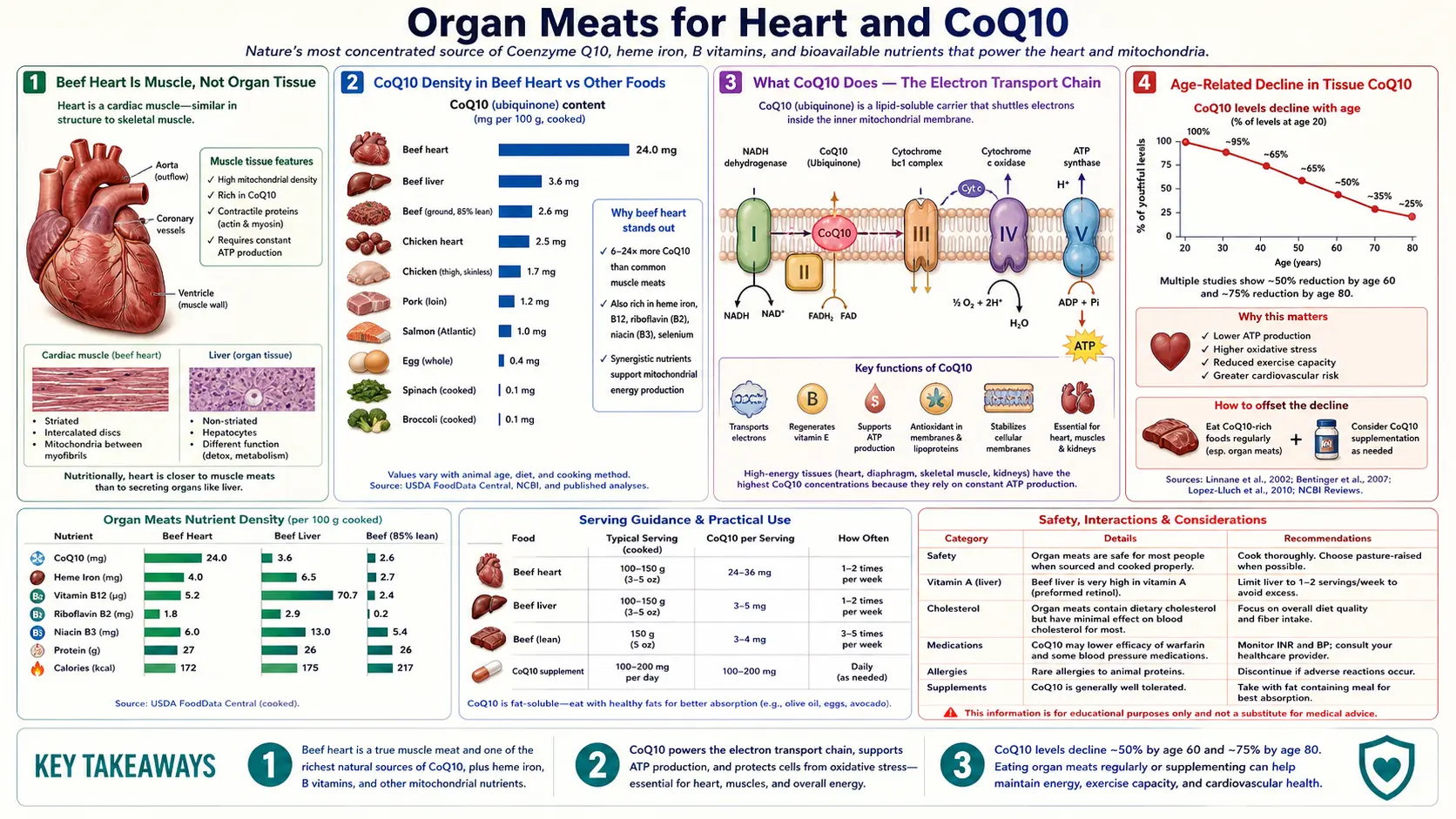
Beef heart is one of the richest food sources of coenzyme Q10 (CoQ10, ubiquinone), at approximately 113 mg/kg fresh weight — a single 3-oz serving provides roughly 10 mg of coenzyme Q10, comparable to a low-dose supplement capsule, embedded in its native cardiolipin-bound phospholipid context. Heart muscle is also exceptionally rich in taurine (the conditionally essential amino acid concentrated in cardiac tissue), L-carnitine (required for mitochondrial fatty-acid oxidation), selenium, B-complex vitamins, and the entire mitochondrial protein machinery that the human heart needs to maintain itself. Beef heart is leaner than steak (the cut is muscle, not organ in the traditional sense), tender when properly cooked, and grills like skirt or flank with a mild, slightly beefy flavor that is much more accessible than liver. The idea behind eating heart is that it supplies the same nutrients, in the same food context, that another animal's heart muscle used for its own energy work. This deep-dive walks through the coenzyme Q10 case, the statin-induced coenzyme Q10 depletion picture, the taurine and L-carnitine contribution, and what one serving of beef heart provides.
Table of Contents
- Beef Heart Is Muscle, Not Organ Tissue
- Coenzyme Q10 Density in Beef Heart vs Other Foods
- What Coenzyme Q10 Does — The Electron Transport Chain
- Age-Related Decline in Tissue Coenzyme Q10
- Statin-Induced Coenzyme Q10 Depletion
- The Q-SYMBIO Trial — Coenzyme Q10 in Heart Failure
- Taurine — The Conditionally Essential Cardiac Amino Acid
- L-Carnitine — Mitochondrial Fatty Acid Transport
- Cardiolipin and the Native Phospholipid Context
- Cooking Beef Heart and What One Serving Provides
- Cautions
- Key Research Papers
- Connections
- Featured Videos
Beef Heart Is Muscle, Not Organ Tissue
One of the most useful facts to communicate to a beef-heart-curious eater is that the heart is anatomically muscle — specifically a specialized cardiac striated muscle — and it cooks, tastes, and chews like very lean steak. It is not the soft, custard-like texture of liver, nor the strong flavor of kidney. Beef heart has a tighter, slightly chewier grain than ribeye but a remarkably similar flavor profile: a deep, mineral-rich beefiness without the strong “organ” notes that turn off many liver-averse eaters.
This matters because the cultural barrier to organ-meat consumption is largely a flavor and texture barrier. Beef heart slides past most of that resistance. A trimmed beef heart, sliced thin against the grain, marinated for a couple of hours in olive oil, garlic, and herbs, and seared briefly on a hot grill or cast-iron pan, eats like a particularly flavorful skirt steak. Argentine asado tradition treats grilled beef heart (corazon) as a delicacy on par with the best cuts of muscle meat. Peruvian anticuchos — skewered marinated beef heart grilled over charcoal — have been a national street food for centuries.
What makes beef heart special is not its texture (which is mainstream-acceptable) but its nutrient density (which is far above mainstream cuts of beef). Per ounce, beef heart provides several-fold more coenzyme Q10, taurine, riboflavin, B12, and selenium than ribeye, sirloin, or chuck. The combination of accessible flavor and exceptional nutrient density makes it arguably the best “gateway organ meat” for adults trying to expand beyond muscle cuts.
Coenzyme Q10 Density in Beef Heart vs Other Foods
Coenzyme Q10 concentration varies enormously across foods. The general principle is that tissues with high mitochondrial density (which is to say, tissues that work hard metabolically) carry the most coenzyme Q10. Mature human hearts contain approximately 110-130 mg/kg; the same tissue in cattle is similar. Beef heart at 113 mg/kg is therefore among the densest food sources of coenzyme Q10 in the Western food supply, alongside pork heart. For comparison:
- Beef heart: ~113 mg/kg (10 mg per 3-oz serving)
- Beef liver: ~40 mg/kg
- Beef muscle (steak): ~25-30 mg/kg
- Pork heart: ~120 mg/kg (similar to beef)
- Chicken thigh: ~25 mg/kg
- Sardines and herring: ~5-25 mg/kg (variable)
- Spinach: ~2-4 mg/kg
- Broccoli: ~5-9 mg/kg
- Most fruits and grains: trace amounts
A 2010 review of coenzyme Q10 in foods (Pravst and colleagues) found that meat, fish, nuts and some oils are the richest sources and put the average dietary intake at only 3-6 mg a day. A single 3-oz serving of beef heart approximately triples that. The groups most often discussed as having higher coenzyme Q10 needs are older adults, people taking a statin, and people with heart failure or migraine; for them, a meal of beef heart in place of muscle meat adds coenzyme Q10 at the cost of food rather than of a supplement.
For the full discussion of coenzyme Q10 biology and supplementation see our coenzyme Q10 page.
What Coenzyme Q10 Does — The Electron Transport Chain
Coenzyme Q10 (ubiquinone in its oxidized form, ubiquinol in its reduced form) is a small, lipid-soluble quinone that sits in the inner mitochondrial membrane and serves as the mobile electron carrier between Complex I (or Complex II) and Complex III of the electron transport chain. Without functional coenzyme Q10, the proton-pumping electron transport that generates the proton-motive force driving adenosine triphosphate (ATP) synthesis cannot proceed. Cells that fail mitochondrial energy production die rapidly, and tissues that are particularly metabolically demanding — heart, kidney, liver, brain, and skeletal muscle — suffer first.
Coenzyme Q10 has a secondary role as a lipid-soluble antioxidant, scavenging reactive oxygen species in mitochondrial and cellular membranes, regenerating Vitamin E, and protecting membrane phospholipids from peroxidation. Both functions are essential, and both decline together when coenzyme Q10 is depleted.
Coenzyme Q10 synthesis from the cholesterol/mevalonate pathway is the body's primary source for most adults, but biosynthesis declines with age (typical 50-year-old hearts contain about half the coenzyme Q10 of typical 20-year-old hearts in autopsy series), with chronic illness, and with HMG-CoA reductase inhibitor (statin) therapy. Dietary coenzyme Q10 intake supplements endogenous synthesis modestly — the absolute absorbed dose is small, but bioavailability of food-form coenzyme Q10 in beef heart is somewhat better than dry-powder supplement forms because the lipid context aids absorption.
Age-Related Decline in Tissue Coenzyme Q10
The age-related decline in tissue coenzyme Q10 concentration is one of the most consistent biochemical findings in human aging. Kalén and colleagues (Lipids, 1989) measured coenzyme Q10 (ubiquinone) in human lung, heart, spleen, liver, kidney, pancreas and adrenal tissue from people aged one day to 81 years. In most of these organs the level peaked at about 20 years of age and was followed by a continuous decrease with further aging; in the pancreas and adrenal the peak came at one year of age. Brain coenzyme Q10 also declines but less dramatically.
The mechanism is multifactorial: reduced biosynthesis from the mevalonate pathway, increased oxidative consumption of coenzyme Q10 as cellular oxidative stress rises, accumulated mitochondrial DNA damage reducing functional mitochondrial mass, and reduced dietary coenzyme Q10 intake in the elderly (who often eat fewer organ meats, fish, and meat in general). The functional consequence is reduced mitochondrial adenosine triphosphate output per gram of tissue, which contributes to the well-documented decline in cardiac contractile reserve, exercise capacity, and skeletal muscle quality with age.
Supplementation studies have shown that oral coenzyme Q10 modestly raises plasma and tissue concentrations, and clinical trials of coenzyme Q10 in age-related conditions (heart failure, neurodegenerative disease, migraine) have generated mixed but cumulatively encouraging results. Beef heart consumption provides a parallel dietary route that may be equally effective, with the added benefit of providing taurine, L-carnitine, and B vitamins in the same meal.
Statin-Induced Coenzyme Q10 Depletion
Statins (atorvastatin, simvastatin, rosuvastatin, pravastatin, and the others) work by inhibiting HMG-CoA reductase, the rate-limiting enzyme in the mevalonate pathway. The mevalonate pathway produces cholesterol — the intended target — but it also produces coenzyme Q10, dolichols, isoprenoids, and several other essential metabolites. Inhibition of HMG-CoA reductase reduces all of these downstream products in proportion to dose and duration of therapy.
A 2015 meta-analysis by Banach and colleagues pooled 8 placebo-controlled treatment arms and found that statins lowered plasma coenzyme Q10 by an average of 0.44 µmol/L. The fall was significant for all four statins studied (atorvastatin, simvastatin, rosuvastatin and pravastatin), and in trials both shorter and longer than 12 weeks. Tissue coenzyme Q10 concentrations also fall, though the extent of muscle and heart tissue depletion has been harder to measure directly in humans. The clinical correlate — statin-induced myopathy, ranging from mild muscle aches to rare severe rhabdomyolysis — is plausibly driven in part by coenzyme Q10 depletion in skeletal muscle mitochondria.
Whether coenzyme Q10 supplements help statin muscle symptoms is debated, and the two meta-analyses on the question disagree. Banach and colleagues (2015; 6 trials, 302 patients) found that coenzyme Q10 “had no significant effect on muscle pain” and no significant change in creatine kinase (a blood marker of muscle damage), and concluded that the results “do not suggest any significant benefit.” Qu and colleagues (2018; 12 trials, 575 patients) found that coenzyme Q10 eased muscle pain, weakness, cramps and tiredness compared with placebo, again with no change in creatine kinase. The European Atherosclerosis Society's 2015 consensus statement on statin muscle symptoms (Stroes and colleagues) makes no coenzyme Q10 recommendation in its summary. Coenzyme Q10 supplementation (typically 100-200 mg/day) is considered for patients experiencing statin-related muscle symptoms.
For dietary support, replacing one or two weekly meals of muscle meat with beef heart provides supplemental dietary coenzyme Q10 alongside the rest of the cardiac-supportive nutrient profile — a particularly useful adjunct for the statin-using patient who would also benefit from increased taurine and L-carnitine intake. Beef heart supplies dietary coenzyme Q10 together with taurine and L-carnitine; the trials above tested coenzyme Q10 supplements, not food.
The Q-SYMBIO Trial — Coenzyme Q10 in Heart Failure
The Q-SYMBIO trial (Mortensen et al., JACC Heart Failure 2014) is the largest and most rigorous trial of coenzyme Q10 supplementation in heart failure. Investigators randomized 420 patients with moderate to severe heart failure to coenzyme Q10 100 mg three times daily versus placebo for two years, in addition to standard guideline-directed medical therapy.
Results favored the coenzyme Q10 arm substantially:
- Major adverse cardiovascular events (the primary 2-year endpoint, a composite of unplanned hospitalization, cardiovascular death, urgent transplant, mechanical assist device, and resuscitated cardiac arrest): 15% of patients on coenzyme Q10 versus 26% on placebo (hazard ratio 0.50)
- Cardiovascular death 9% versus 16%, all-cause death 10% versus 18%, and fewer hospital stays for heart failure
- Improvement in New York Heart Association (NYHA) functional class after 2 years
- No significant changes in the 16-week short-term endpoints (NYHA class, 6-minute walk test and N-terminal pro-B-type natriuretic peptide, a heart-failure blood marker)
- No significant adverse events attributable to coenzyme Q10
Q-SYMBIO was a smaller trial than the typical heart-failure trial (the major statin and beta-blocker trials enrolled 4,000-20,000 patients), and its results have not been reproduced at the same magnitude in larger follow-on studies. But Q-SYMBIO remains the strongest single piece of evidence that coenzyme Q10 has a measurable clinical effect in heart failure, and it forms part of the rationale behind dietary coenzyme Q10 strategies for cardiac-compromised patients.
A 2024 meta-analysis by Xu and colleagues pooled 33 randomized trials of coenzyme Q10 in heart failure. Compared with control groups, coenzyme Q10 was linked to lower all-cause death (risk ratio 0.64) and fewer hospital stays for heart failure (risk ratio 0.50), both graded moderate-quality evidence, and to a longer 6-minute walk (31.7 metres further, moderate quality). Small improvements in ejection fraction (the share of blood the heart pumps out with each beat), NYHA class and brain natriuretic peptide level were graded low-quality evidence. The authors reported no major adverse effects.
For the broader treatment of heart failure see our Congestive Heart Failure page.
Taurine — The Conditionally Essential Cardiac Amino Acid
Taurine is a sulfur-containing amino acid that the human body can synthesize in small amounts from cysteine but typically needs dietary supplementation to maintain optimal levels. It is the most abundant free amino acid in the heart, brain, and skeletal muscle — in heart muscle it accounts for approximately 50% of the total free amino acid pool. Taurine is conditionally essential, meaning that under conditions of stress, chronic illness, or increased metabolic demand, dietary intake becomes necessary.
The cardiac functions of taurine include calcium handling (taurine modulates the L-type calcium channel and sarcoplasmic reticulum calcium reuptake), osmotic regulation (intracellular taurine balances cytoplasmic osmolarity), bile acid conjugation (relevant to fat absorption), and direct antioxidant effects. Cats — which cannot synthesize taurine endogenously — develop dilated cardiomyopathy on a taurine-deficient diet, and the discovery in the 1980s that taurine supplementation reversed this dilated cardiomyopathy was a major veterinary cardiology landmark.
In humans, two small trials in congestive heart failure have tested taurine. In a 4-week double-blind crossover trial in 14 patients (Azuma 1985), taurine improved NYHA functional class, lung crackles and chest X-ray findings compared with placebo. In a 2-week trial (Beyranvand 2011), 15 patients took 500 mg of taurine three times a day (1.5 g a day) and 14 took a placebo; exercise time, exercise capacity in metabolic equivalents (METs) and exercise distance rose in the taurine group but not in the placebo group. Beef heart is the densest dietary source of taurine in common Western foods (approximately 650 mg per 3-oz serving), substantially higher than muscle meat (200-400 mg) or fish (150-300 mg). For taurine biology see our Taurine page.
L-Carnitine — Mitochondrial Fatty Acid Transport
L-carnitine is required to shuttle long-chain fatty acids across the mitochondrial inner membrane via the carnitine palmitoyltransferase (CPT-I and CPT-II) system. Without adequate L-carnitine, long-chain fatty acids accumulate in the cytoplasm and cannot be oxidized for adenosine triphosphate production. The heart, which derives 60-90% of its adenosine triphosphate from fatty acid oxidation, is particularly vulnerable to L-carnitine deficiency.
The body synthesizes L-carnitine from lysine and methionine in the liver and kidney, but dietary intake supplements endogenous synthesis substantially. Red meat is the primary food source (the name “carnitine” derives from carnis, the Latin for flesh). Beef heart is particularly dense (approximately 90 mg per 3-oz serving). Strict vegetarians have measurably lower plasma carnitine concentrations than omnivores, though this is rarely clinically symptomatic at typical activity levels.
L-carnitine supplementation has been studied in heart failure, intermittent claudication (peripheral arterial disease), and myocardial infarction recovery, with several meta-analyses suggesting modest benefit in mortality and functional outcomes (the DiNicolantonio 2013 meta-analysis pooled 13 trials and 3,629 patients with acute myocardial infarction (MI) and found a 27% reduction in all-cause mortality with L-carnitine supplementation, though the result has been debated). For beef heart consumers, the L-carnitine content adds to the broader picture of mitochondrial support.
Cardiolipin and the Native Phospholipid Context
One of the underappreciated advantages of eating heart tissue versus taking dry coenzyme Q10 supplements is that the coenzyme Q10 in heart muscle is embedded in its native cardiolipin-containing phospholipid context. Cardiolipin is a tetra-acyl phospholipid unique to the inner mitochondrial membrane, where it interacts intimately with Complex III, Complex IV, and the F1F0 adenosine triphosphate synthase. Cardiolipin scaffolds the supercomplexes of the electron transport chain and is essential for efficient electron flow.
Dietary cardiolipin from heart consumption is largely hydrolyzed during digestion to free fatty acids and glycerophosphoglycerol, but the lipid context during absorption may improve the bioavailability of co-absorbed coenzyme Q10 versus dry powder forms. The combination of food-form coenzyme Q10 plus the broader lipid context of cardiac muscle may produce somewhat better tissue uptake than equivalent dose of dry supplement — though direct comparative bioavailability studies are limited.
Beef heart is a food source of coenzyme Q10 that sits alongside the supplements used in the trials, rather than a tested substitute for them. Some people with high coenzyme Q10 needs use both.
Cooking Beef Heart and What One Serving Provides
Beef heart is sold whole (typically 3-5 pounds) or trimmed and butterflied at well-stocked butcher shops. Trimming involves removing the heavy fascia, larger blood vessels, and any remaining valve tissue from the interior. The remaining muscle is lean, dense, and divides naturally into chambers that can be cut into steaks (approximately 1/2 inch thick) or strips for stir-fry or skewers.
Cooking principles:
- Cook hot and fast. Beef heart is lean and toughens with prolonged cooking. The ideal preparation is high heat for short time — sear on a hot grill or cast-iron pan, internal temperature to medium-rare (60°C / 140°F), rest briefly, slice against the grain.
- Marinate first. A 2-12 hour marinade in acid (lemon, vinegar, or wine) plus oil, garlic, and herbs tenderizes the muscle and adds flavor. Argentine chimichurri is the traditional pairing for grilled heart.
- Slice thin against the grain. Cardiac muscle has a tighter grain than most cuts; slicing thinly across the grain dramatically improves tenderness.
- Alternative: slow-braise. If hot-and-fast is not an option, the opposite extreme also works — cube the heart and braise in red wine and stock for 2-3 hours, like a beef stew.
What one serving provides: one 3-oz serving of beef heart provides approximately 10 mg of dietary coenzyme Q10, 650 mg of taurine and 90 mg of L-carnitine, plus B-complex vitamins and selenium. Compared with a meal of muscle steak, a serving of beef heart carries much more of these mitochondrial cofactors. One 3-oz serving of beef heart per week provides these amounts without crossing into purine or saturated-fat concerns. For patients with documented coenzyme Q10-relevant conditions (heart failure, statin-induced myopathy, migraine, age-related fatigue) two servings per week is reasonable.
Cautions
- Purine content and gout — beef heart, like other organ meats, is relatively high in purines. The body breaks purines down to uric acid, the substance that forms gout crystals and uric acid kidney stones, so the purine load matters most for people with gout or those stones.
- Cholesterol content — cooked (simmered) beef heart contains 212 mg of cholesterol per 100 g, according to USDA FoodData Central (about 180 mg in a 3-oz, 85 g serving, computed from that figure). For the great majority of adults this is not a concern (dietary cholesterol does not meaningfully drive serum low-density lipoprotein (LDL) in most people); the exceptions are people with familial hypercholesterolemia or a documented high low-density lipoprotein response to dietary cholesterol.
- Sourcing — beef heart is sold both from grass-fed, pasture-raised cattle and from feedlot cattle. Industrial feedlot beef heart can carry hormone, antibiotic, and contaminant residues that grass-fed sources avoid. Premium grass-fed beef heart from local farms typically costs $6-12 per pound — substantially cheaper than equivalent cuts of muscle steak from the same animals.
- Drug interactions with coenzyme Q10 — coenzyme Q10 has structural similarity to Vitamin K and may modestly affect warfarin anticoagulation; the concern raised is with abruptly adding or removing large amounts of coenzyme Q10, which can shift warfarin's effect. Coenzyme Q10 does not appear to interact meaningfully with the direct oral anticoagulants (rivaroxaban, apixaban, dabigatran).
- Pregnancy — unlike beef liver, beef heart does not have a Vitamin A teratogenicity concern. For pregnant women this means the nutrient density of organ meats without the retinol issue.
- Storage — raw beef heart is more perishable than muscle steaks due to its high enzyme content. It is usually kept no more than 1-2 days in the refrigerator, or frozen in trimmed portions.
Key Research Papers
- Mortensen SA et al. (2014). The effect of coenzyme Q10 on morbidity and mortality in chronic heart failure: results from Q-SYMBIO: a randomized double-blind trial. JACC: Heart Failure. — PubMed PMID: 25282031
- Kalen A, Appelkvist EL, Dallner G (1989). Age-related changes in the lipid compositions of rat and human tissues. Lipids. — PubMed PMID: 2779364
- Banach M et al. (2015). Statin therapy and plasma coenzyme Q10 concentrations — a systematic review and meta-analysis of placebo-controlled trials. Pharmacological Research. — PubMed PMID: 26192349
- Banach M et al. (2015). Effects of coenzyme Q10 on statin-induced myopathy: a meta-analysis of randomized controlled trials. Mayo Clinic Proceedings. — PubMed PMID: 25440725
- Qu H, Guo M, Chai H, Wang WT, Gao ZY, Shi DZ (2018). Effects of coenzyme Q10 on statin-induced myopathy: an updated meta-analysis of randomized controlled trials. Journal of the American Heart Association. — PubMed PMID: 30371340
- Stroes ES et al. (2015). Statin-associated muscle symptoms: impact on statin therapy — European Atherosclerosis Society Consensus Panel Statement on Assessment, Aetiology and Management. European Heart Journal. — PubMed PMID: 25694464
- Xu J, Xiang L, Yin X, Song H, Chen C, Yang B, Ye H, Gu Z (2024). Efficacy and safety of coenzyme Q10 in heart failure: a meta-analysis of randomized controlled trials. BMC Cardiovascular Disorders. — PubMed PMID: 39462324
- DiNicolantonio JJ et al. (2013). L-carnitine in the secondary prevention of cardiovascular disease: systematic review and meta-analysis. Mayo Clinic Proceedings. — PubMed PMID: 23597877
- Beyranvand MR et al. (2011). Effect of taurine supplementation on exercise capacity of patients with heart failure. Journal of Cardiology. — PubMed PMID: 21334852
- Azuma J et al. (1985). Therapeutic effect of taurine in congestive heart failure: a double-blind crossover trial. Clinical Cardiology. — PubMed PMID: 3888464
- Pravst I, Zmitek K, Zmitek J (2010). Coenzyme Q10 contents in foods and fortification strategies. Critical Reviews in Food Science and Nutrition. — PubMed PMID: 20301015
- Mantle D, Hargreaves IP (2019). Coenzyme Q10 and degenerative disorders affecting longevity: an overview. Antioxidants. — PubMed PMID: 30781472
- Schaffer S, Kim HW (2018). Effects and mechanisms of taurine as a therapeutic agent. Biomolecules & Therapeutics. — PubMed PMID: 29631391
- Pepe S et al. (2007). Coenzyme Q10 in cardiovascular disease. Mitochondrion. — PubMed PMID: 17485243
PubMed Topic Searches
Connections
- All Food
- Organ Meats Overview
- Organ Meats Benefits Hub
- Organ Meats for Liver and Vitamins
- Organ Meats for Brain and DHA
- Organ Meats for Bone Marrow and Collagen
- Coenzyme Q10
- Taurine
- Carnitine — the mitochondrial fatty-acid shuttle concentrated in beef heart.
- Selenium
- Magnesium (Cardiac)
- Congestive Heart Failure
- Atrial Fibrillation
- Coronary Artery Disease
- Statins
- Fermented Foods
- Covered in depth on its own page: Heart Failure
- History
- Nutrients