Spinach: Nutrient Profile
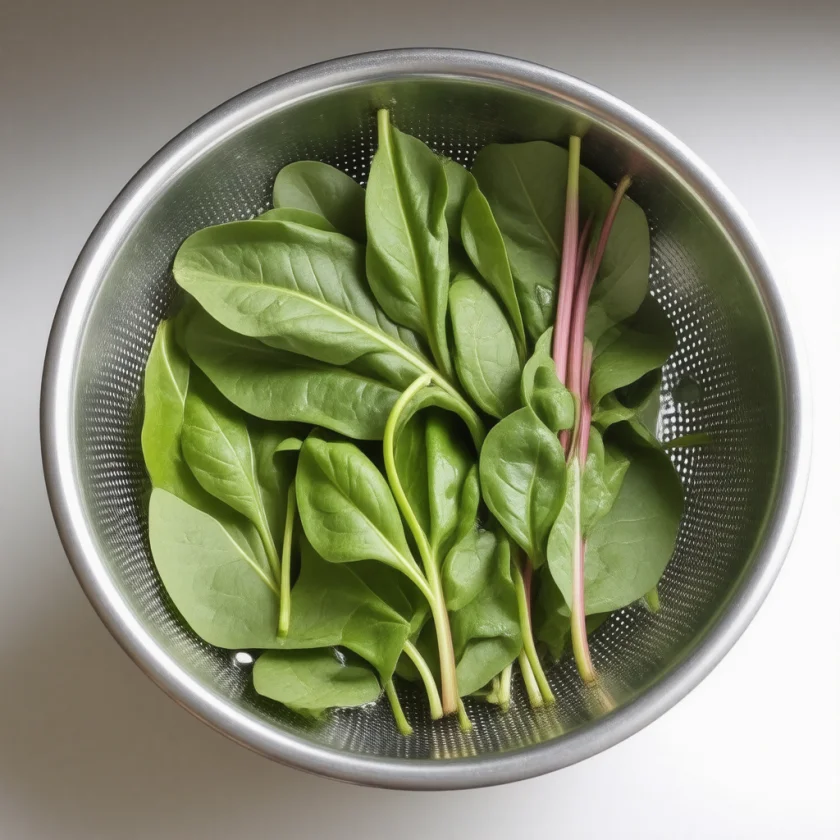
What is Spinach richest in? Below are the vitamins, minerals and amino acids that 100 g of Spinach delivers in the highest amounts. Each one links to that nutrient’s own page listing the best foods to get it from.
| Spinach: Richest Nutrients (per 100 g) | ||||
|---|---|---|---|---|
| Rank | Nutrient | Per 100 g | %DV / 100g | Purpose |
| Vitamins | ||||
| 1 | Vitamin K | 494 mcg | 🟢 412% | Blood clotting & bone |
| 2 | Vitamin A | 524 mcg | 🟢 58% | Vision, skin & immunity |
| 3 | Vitamin B9 (Folate) | 146 mcg DFE | 🟡 36% | Cell division; pregnancy |
| 4 | Vitamin B2 (Riboflavin) | 0.2 mg | 🟡 18% | Energy & cell health |
| 5 | Vitamin B6 | 0.2 mg | 🟡 14% | Brain & metabolism |
| 6 | Vitamin E | 2.1 mg | 🟡 14% | Protects cells (antioxidant) |
| 7 | Vitamin C | 9.8 mg | 🟡 11% | Antioxidant; builds collagen |
| Minerals | ||||
| 1 | Manganese | 0.9 mg | 🟡 41% | Bone & metabolism |
| 2 | Magnesium | 87 mg | 🟡 21% | Muscle, nerves & energy |
| 3 | Iron | 3.6 mg | 🟡 20% | Carries oxygen in blood |
| 4 | Copper | 0.2 mg | 🟡 19% | Iron use; connective tissue |
| 5 | Calcium | 136 mg | 🟡 10% | Bones & teeth |
| Amino Acids — ranked by amount (no Daily Value) | ||||
| 1 | Glutamic acid | 0.4 g | 🟢 | Brain signaling (glutamate) |
| 2 | Aspartic acid | 0.2 g | 🟢 | Cellular energy & detox |
| 3 | Leucine | 0.2 g | 🟢 | Builds muscle (branched-chain amino acid, BCAA) |
| 4 | Lysine | 0.2 g | 🟢 | Collagen & immunity |
| 5 | Valine | 0.2 g | 🟡 | Muscle & energy (branched-chain amino acid) |
| 6 | Arginine | 0.2 g | 🟡 | Blood flow (nitric oxide) |
| 7 | Isoleucine | 0.2 g | 🟡 | Muscle & energy (branched-chain amino acid) |
| 8 | Alanine | 0.1 g | 🟡 | Energy (glucose cycle) |
| 9 | Glycine | 0.1 g | 🟡 | Collagen, calm & sleep |
| 10 | Phenylalanine | 0.1 g | 🟡 | Dopamine & focus |
| 11 | Threonine | 0.1 g | 🟡 | Collagen & gut lining |
| 12 | Proline | 0.1 g | 🟡 | Collagen & joints |
| 13 | Tyrosine | 0.1 g | 🟡 | Dopamine & thyroid |
| 14 | Serine | 0.1 g | 🟡 | Cell membranes & brain |
Values are per 100 g of the U.S. Department of Agriculture (USDA) FoodData Central record FDC 168463, “Spinach, cooked, boiled, drained, without salt” (SR Legacy). %DV is the amount per 100 g divided by the adult Daily Value in 21 CFR 101.9.
Not in the table: the same USDA record lists 11,300 mcg of lutein plus zeaxanthin per 100 g of boiled spinach. These are the yellow carotenoid pigments of the eye’s macula; they have no Daily Value, so they are not ranked above.
How Much of Spinach’s Calcium the Body Absorbs
Spinach also contains oxalate, which binds calcium. In a randomized crossover study of 13 healthy adults, test meals of spinach or milk each carried 200 mg of tracer-labeled calcium. The test spinach held a very slight excess of oxalate, so practically all of its calcium was bound, and absorption averaged 5.1% from spinach against 27.6% from milk; absorption was higher from milk in every person tested.
Cooking changes the oxalate. In a laboratory analysis of nine vegetables, boiling — the cooking method behind the figures in the table — lowered soluble oxalate by 30–87%, more than steaming (5–53%), and almost all of the oxalate lost was recovered in the cooking water.
Vitamin K and Blood Thinners
The 494 mcg of vitamin K in 100 g of boiled spinach matters for people taking warfarin-type (coumarin) blood thinners. In a 2004 study of 39 anticoagulation-clinic patients, vitamin K intake was independently linked to both over- and under-anticoagulation. In the study’s randomized crossover part, 12 patients with stable anticoagulation spent 4 days in hospital on diets with a 500% increase or an 80% decrease in vitamin K: the INR clotting test fell from 3.1 to 2.8 on the vitamin K-enriched diet and rose from 2.6 to 3.3 on the vitamin K-depleted diet. The authors concluded that the interaction between vitamin K and coumarin is a clinically relevant, major independent factor in anticoagulation stability.
Key Research Papers
- Heaney RP, Weaver CM, Recker RR. “Calcium absorbability from spinach.” Am J Clin Nutr. 1988;47:707–709. — PubMed PMID: 3354496
- Chai W, Liebman M. “Effect of different cooking methods on vegetable oxalate content.” J Agric Food Chem. 2005;53:3027–3030. — PubMed PMID: 15826055
- Franco V, Polanczyk CA, Clausell N, Rohde LE. “Role of dietary vitamin K intake in chronic oral anticoagulation: prospective evidence from observational and randomized protocols.” Am J Med. 2004;116:651–656. — PubMed PMID: 15121490