Prunes for Bone Health and Osteoporosis
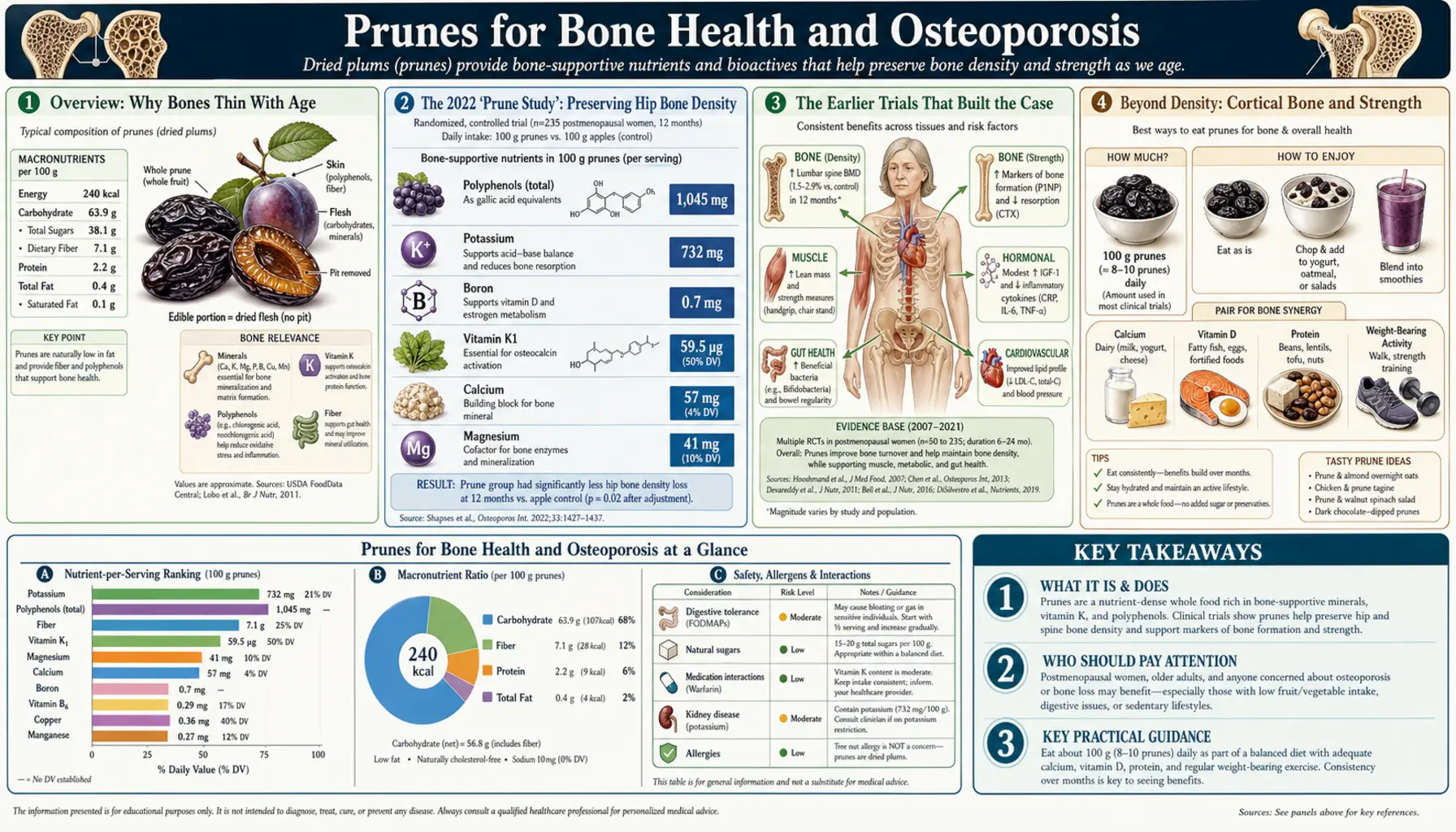
Of all the claims made about everyday foods, "prunes are good for your bones" is one of the rare ones backed by real human trials — not just test tubes and mice. In carefully run studies, postmenopausal women who ate a modest daily handful of prunes held onto more bone mineral density than women who ate none, whose bone quietly kept slipping away. This is the standout health benefit of the dried plum, and this page lays out, in plain language, exactly what the research shows, how prunes are thought to slow bone loss through their polyphenols and nutrients like boron and vitamin K — and, just as importantly, what prunes can and cannot do for osteoporosis.
Table of Contents
- Overview: Why Bones Thin With Age
- The 2022 "Prune Study": Preserving Hip Bone Density
- The Earlier Trials That Built the Case
- Beyond Density: Cortical Bone and Strength
- How Prunes May Protect Bone
- The Bone-Relevant Nutrients in Prunes
- Honest Dosing: How Many Prunes, How Often
- Practical How-To and Who Benefits Most
- Honest Caveats: What Prunes Can and Cannot Do
- Key Research Papers
- Connections
- Featured Videos
Overview: Why Bones Thin With Age
It is easy to think of the skeleton as a fixed, finished structure — but bone is living tissue, constantly being torn down and rebuilt throughout life. Two kinds of cells run this remodeling crew: osteoclasts, which break down (resorb) old bone, and osteoblasts, which build new bone in its place. For most of early adulthood these two are roughly in balance, and the skeleton stays strong. The trouble begins when the breakdown side starts to outpace the rebuilding side, so that a little more bone is removed than is replaced — year after year, that small deficit adds up to thinner, weaker bone.
This shift is especially sharp in women around and after menopause. The hormone estrogen normally helps restrain the bone-removing osteoclasts, and when estrogen drops at menopause, those cells become more active. The result is a period of accelerated bone loss in the years right after the final period — which is why postmenopausal women are the group at highest risk for osteoporosis, the condition in which bone mineral density falls low enough that bones become fragile and prone to fracture. A broken hip or spine in later life is not a minor event; it can mean lasting pain, lost independence, and serious decline.
The cornerstones of protecting bone are well established and not in dispute: enough calcium and vitamin D, regular weight-bearing and resistance exercise, not smoking, moderate alcohol, and — when the risk is high enough — prescription medication. The interesting question this page answers is whether a simple food can add something useful on top of that foundation. For prunes (dried plums), the answer, unusually for a food, is backed by genuine clinical trials — and it is a cautiously encouraging yes.
The 2022 "Prune Study": Preserving Hip Bone Density
The most important single piece of evidence is a 12-month randomized controlled trial led by Mary Jane De Souza and colleagues, published in 2022 in The American Journal of Clinical Nutrition and known simply as the "Prune Study." A randomized controlled trial is the gold standard of nutrition research: participants are assigned by chance to either eat the food or not, which removes most of the bias that plagues simple observational surveys. Here, healthy postmenopausal women were randomized to eat prunes daily for a full year or to a control group that ate none, and their bone mineral density was measured before and after.
The headline result: women who ate roughly 50 grams of prunes a day — about five or six prunes — preserved the bone mineral density of their hip over the 12 months, while the women in the control group lost bone at the hip over the same period. In other words, the prune-eaters held steady where the comparison group declined. The hip is a particularly meaningful site to protect, because hip fractures are among the most serious and life-altering consequences of osteoporosis.
It is worth being precise about what this does and does not say. The trial showed that prunes helped women hold onto bone they already had — it slowed or halted the expected bone loss — rather than dramatically rebuilding a thinning skeleton. "Preserve" is the operative word. For a food, even that is a striking result, because doing nothing was not neutral: the control group's bones measurably declined over the year. The study also tested a higher amount and looked at compliance, which feeds into the honest dosing discussion further down this page.
The Earlier Trials That Built the Case
The 2022 Prune Study did not appear out of nowhere. It rested on more than a decade of earlier human research, much of it from the same group of investigators, that steadily built the case that dried plums are unusually good for bone.
The pivotal early trial came from Shirin Hooshmand and colleagues in 2011, published in the British Journal of Nutrition. In this study, postmenopausal women were assigned to eat either dried plums (prunes) or dried apples each day for a year, with both groups also receiving calcium and vitamin D. The dried-plum group came out ahead: they showed greater improvements in markers of bone turnover and better outcomes for bone mineral density than the dried-apple comparison group. Using dried apple as the comparison was clever — it controlled for the general effects of eating a dried fruit, so that any extra benefit could be pinned more specifically on the prune itself.
A follow-up question was practical: do you really need a large daily dose, or will a smaller, more livable amount work? Hooshmand and colleagues addressed this in a 2016 dose-finding randomized controlled trial in Osteoporosis International, which compared two different daily amounts of dried plum in women with low bone mass (osteopenia). The encouraging finding was that a more modest daily portion appeared to offer bone benefits comparable to the larger one — important news, because a smaller serving is far easier to stick with over months and years, and a food only helps if people actually keep eating it.
Pulling this literature together, Taylor Wallace published a comprehensive review in 2017 in the journal Nutrients, titled "Dried Plums, Prunes and Bone Health." The review concluded that the evidence linking prunes to better bone health — and to protection against bone loss in postmenopausal women — was among the strongest for any single food, while also calling for further large trials. The 2022 Prune Study was, in effect, the larger and more rigorous trial that the field had been calling for.
Beyond Density: Cortical Bone and Strength
Bone mineral density, measured by a standard DXA scan, is the number doctors usually use to diagnose osteoporosis — but it is not the whole story of whether a bone will break. Two bones with the same density can differ in their internal architecture and therefore in their actual mechanical strength. So a fair question is whether prunes help with bone quality and strength, not just the density score.
A 2024 analysis by Kristen Koltun and colleagues, published in Osteoporosis International from the same 12-month randomized controlled trial, looked deeper using a more detailed imaging technique. It reported that eating prunes helped preserve the cortical density and the estimated strength of the tibia (the shinbone) over the year. Cortical bone is the dense, hard outer shell of a bone — the part that bears much of the mechanical load — so preserving its density and estimated strength is meaningful for resisting fracture, not just for keeping a test number from dropping.
Taken together with the hip-density finding, this adds a second, complementary line of evidence: prunes appear to help protect both how much bone is present and aspects of how strong that bone is. As with the rest of this evidence, the honest framing is preservation — slowing the decline that otherwise happens with age — rather than a large rebuilding of bone that has already been lost.
How Prunes May Protect Bone
Why would a dried fruit affect the skeleton at all? The leading explanation centers on the balance between bone breakdown and bone building described earlier. Much of the bone loss after menopause is driven by osteoclasts — the cells that resorb, or break down, old bone — becoming overactive. The best-supported idea is that prunes help suppress bone resorption: they appear to dial back the activity of those bone-removing cells, so that less bone is lost. In several trials, prune eaters showed lower levels of blood and urine markers that signal bone breakdown, which fits this resorption-slowing mechanism.
The active ingredients are thought to be the prune's rich load of polyphenols — natural plant compounds (including chlorogenic and neochlorogenic acids) that act as antioxidants. Their effect on bone is believed to run through two overlapping channels:
- Antioxidant effects. Oxidative stress — an excess of reactive molecules in the body — promotes the formation and activity of bone-resorbing osteoclasts. By mopping up some of those reactive molecules, the polyphenols in prunes may reduce one of the signals that drive bone breakdown.
- Anti-inflammatory effects. Chronic, low-grade inflammation also spurs bone resorption, partly through inflammatory signaling molecules that activate osteoclasts. Prune polyphenols appear to dampen some of this inflammatory signaling, taking pressure off the bone-removing side of the equation.
On top of the polyphenols, prunes supply several nutrients with established or plausible roles in bone metabolism — boron, vitamin K, potassium, copper, and magnesium — discussed in the next section. The likely truth is that no single compound explains the benefit; rather, the whole package of polyphenols plus minerals and vitamins works together. It is also fair to say that the precise mechanism in humans is still being worked out: the resorption-slowing, antioxidant, and anti-inflammatory picture is well supported and consistent with the trial results, but it is a best current explanation rather than a fully closed case.
The Bone-Relevant Nutrients in Prunes
Beyond their polyphenols, prunes carry a modest but genuinely relevant mix of bone-supporting micronutrients. None of these is present in spectacular amounts, and a prune is not the best single source of any of them — but together they help explain why the whole food behaves the way it does in trials.
- Boron. Prunes are one of the better dietary sources of boron, a trace mineral involved in how the body handles calcium, magnesium, and vitamin D, and in the function of bone. Boron is not as famous as calcium, but it has a real supporting role in bone metabolism, and the prune's relatively high boron content is one reason researchers became interested in it for bone in the first place. For more, see the Boron page.
- Vitamin K. Prunes provide some vitamin K, a vitamin needed to activate proteins (such as osteocalcin) that help bind calcium into the bone matrix. In other words, vitamin K helps direct calcium into bone where it belongs. See Vitamin K for detail.
- Potassium. The potassium in prunes may help bone indirectly by buffering dietary acid, which can otherwise prompt the body to draw calcium out of bone. Potassium-rich whole foods are generally regarded as bone-friendly for this reason.
- Copper and magnesium. Prunes also supply small amounts of copper and magnesium, both of which are needed for normal bone formation — copper as a cofactor for enzymes that cross-link and strengthen the bone's collagen framework, magnesium as a structural component of bone and a partner to calcium and vitamin D.
The honest framing is that these nutrient contributions are modest but real. You would not eat prunes as your primary source of boron, vitamin K, potassium, copper, or magnesium — a varied diet covers those better. Their value here is as part of the prune's overall bone-friendly package, working alongside the polyphenols rather than as standout amounts in their own right.
Honest Dosing: How Many Prunes, How Often
The most useful, evidence-grounded number to remember is about 50 grams of prunes a day — roughly five to six prunes. That is the amount used in the bone-preserving arm of the 2022 Prune Study, and it lines up with the kind of livable portion that the 2016 dose-finding trial suggested is enough. It is small, affordable, and easy to fold into an ordinary day.
Some of the earlier work also tested a larger amount — on the order of 100 grams a day (around ten or eleven prunes) — and while that higher dose was studied, the practical lesson from the research is that bigger is not necessarily better when people cannot keep it up. A larger daily portion is harder to sustain, adds more calories and natural sugar, and is more likely to cause loose stools or bloating. Since a food only helps bone if you actually eat it month after month, the ~50 g/day serving is the sensible target for most people: enough to match the trial evidence, small enough to stick with.
A note on starting out: prunes are famously good for digestion, which means a sudden jump to several a day can loosen the bowels at first. The simple fix is to start with one or two prunes and build up gradually over a week or two, giving your gut time to adjust. Consistency over the long haul matters far more than hitting the exact gram count on any single day.
Practical How-To and Who Benefits Most
Getting the bone benefit from prunes is refreshingly low-tech — it is mostly about making a daily handful a comfortable habit. A few practical ideas:
- Aim for about five to six a day. That matches the trial dose (~50 g). Keep a bag or jar somewhere visible so it becomes routine rather than something you have to remember.
- Spread them out. Two or three with breakfast and two or three later in the day is gentler on digestion than eating them all at once, and helps keep blood sugar steadier.
- Work them into food you already eat. Chop prunes into oatmeal or yogurt, stir them into a salad, blend them into a smoothie, or add them to a tagine or stew — their natural sweetness reduces the need for added sugar.
- Pair them with the rest of a bone-healthy diet. Prunes work best alongside adequate calcium and vitamin D, plenty of protein, and other fruits and vegetables — not as a stand-in for any of them.
- Stay hydrated and add gradually. Because prunes are rich in dietary fiber and natural sorbitol, drink enough water and build your intake up slowly to avoid loose stools.
Who stands to gain the most? The clinical evidence is strongest, and most directly applicable, for postmenopausal women — the group studied in the trials and the group at highest risk for bone loss and osteoporosis. That is where the case for a deliberate daily "bone dose" of prunes is best supported. For everyone else — younger women, and men — the direct bone-specific trial evidence is thinner, but prunes remain a wholesome, fiber-rich fruit that fits comfortably into the kind of mineral-rich, plant-forward eating pattern that supports a healthy skeleton at any age. In short: a strong, evidence-based case for postmenopausal women, and a sensible, low-risk habit for the rest.
Honest Caveats: What Prunes Can and Cannot Do
This is one of the better food-and-bone evidence bases in all of nutrition — but it deserves to be described accurately, not oversold. A few honest qualifications:
- Prunes complement; they do not replace. The proven foundations of bone health remain calcium, vitamin D, weight-bearing and resistance exercise, and, when warranted, prescription medication. Prunes are an add-on to that foundation, not a substitute for it. If you have osteoporosis or are at high fracture risk, prunes are no reason to skip treatment your clinician recommends.
- The effect is preservation, not a dramatic rebuild. The trials show that prunes help slow or stop the bone loss that otherwise occurs — preserving the bone mineral density you have — rather than substantially regrowing a thinned skeleton. That is genuinely valuable, but it is a different and more modest claim than "reverses osteoporosis."
- The strongest evidence is in postmenopausal women. That is who the key randomized trials enrolled. The benefit is most confidently stated for that group; it should not be over-extrapolated to men or younger people, in whom the bone-specific trial data are limited.
- Mind the calories and sugar. Prunes are calorie- and sugar-dense by weight because the water has been removed. A handful is healthful; a whole bag is not. Portion sense (around five or six a day) keeps the benefit without the downside.
- Digestion and FODMAPs. Prunes are high in dietary fiber and sorbitol — the very things that make them good for constipation — so they can cause gas, bloating, or loose stools, especially if you ramp up quickly. They are also high in FODMAPs, which can trigger symptoms in people with irritable bowel syndrome; if that is you, introduce them cautiously and in small amounts.
The fair bottom line: for postmenopausal women, a small daily serving of prunes is one of the few foods with real randomized controlled trial evidence that it helps preserve bone density and slow bone loss — a genuine, inexpensive, side-effect-light habit to add on top of the proven basics. Just keep the claim honest: prunes help protect the bone you have, they work best alongside calcium, vitamin D, exercise, and any prescribed treatment, and the case is strongest in the women the studies actually enrolled.
Key Research Papers
- De Souza MJ, et al. Prunes preserve hip bone mineral density in a 12-month randomized controlled trial in postmenopausal women: the Prune Study. The American Journal of Clinical Nutrition. 2022. doi:10.1093/ajcn/nqac189 — the pivotal 12-month RCT showing ~50 g/day prunes preserved hip bone mineral density while controls lost bone.
- Wallace TC. Dried Plums, Prunes and Bone Health: A Comprehensive Review. Nutrients. 2017. doi:10.3390/nu9040401 — review concluding prunes have among the strongest single-food evidence for protecting against bone loss in postmenopausal women.
- Hooshmand S, et al. Comparative effects of dried plum and dried apple on bone in postmenopausal women. British Journal of Nutrition. 2011. doi:10.1017/S000711451100119X — year-long trial in which dried plum outperformed dried apple on bone markers and bone density.
- Hooshmand S, et al. The effect of two doses of dried plum on bone density and bone biomarkers in osteopenic postmenopausal women: a randomized, controlled trial. Osteoporosis International. 2016. doi:10.1007/s00198-016-3524-8 — dose-finding RCT suggesting a smaller, more sustainable daily portion can match a larger one for bone.
- Koltun KJ, et al. Prunes preserve cortical density and estimated strength of the tibia in a 12-month randomized controlled trial. Osteoporosis International. 2024. doi:10.1007/s00198-024-07031-6 — showed prunes preserved cortical bone density and estimated bone strength at the tibia, not just the DXA density number.
- Stacewicz-Sapuntzakis M, et al. Chemical composition and potential health effects of prunes: a functional food? Critical Reviews in Food Science and Nutrition. 2001. doi:10.1080/20014091091814 — foundational review of the prune's polyphenols, boron, and other components and their possible health roles.
PubMed Topic Searches
- PubMed: Dried plum / prune & bone mineral density
- PubMed: Prune, postmenopausal osteoporosis & randomized trials
- PubMed: Boron & bone health
- PubMed: Polyphenols & bone resorption
Connections
- All Food
- Prunes (Main Page)
- Prunes Benefits Hub
- Prunes for Digestion & Constipation Relief
- Prunes for Heart Health & Cholesterol
- Prunes for Blood Sugar, Weight & Antioxidants
- Osteoporosis
- Postmenopausal Osteoporosis & Hormone Therapy
- Boron
- Calcium
- Vitamin K