Milk — Benefits Deep Dive
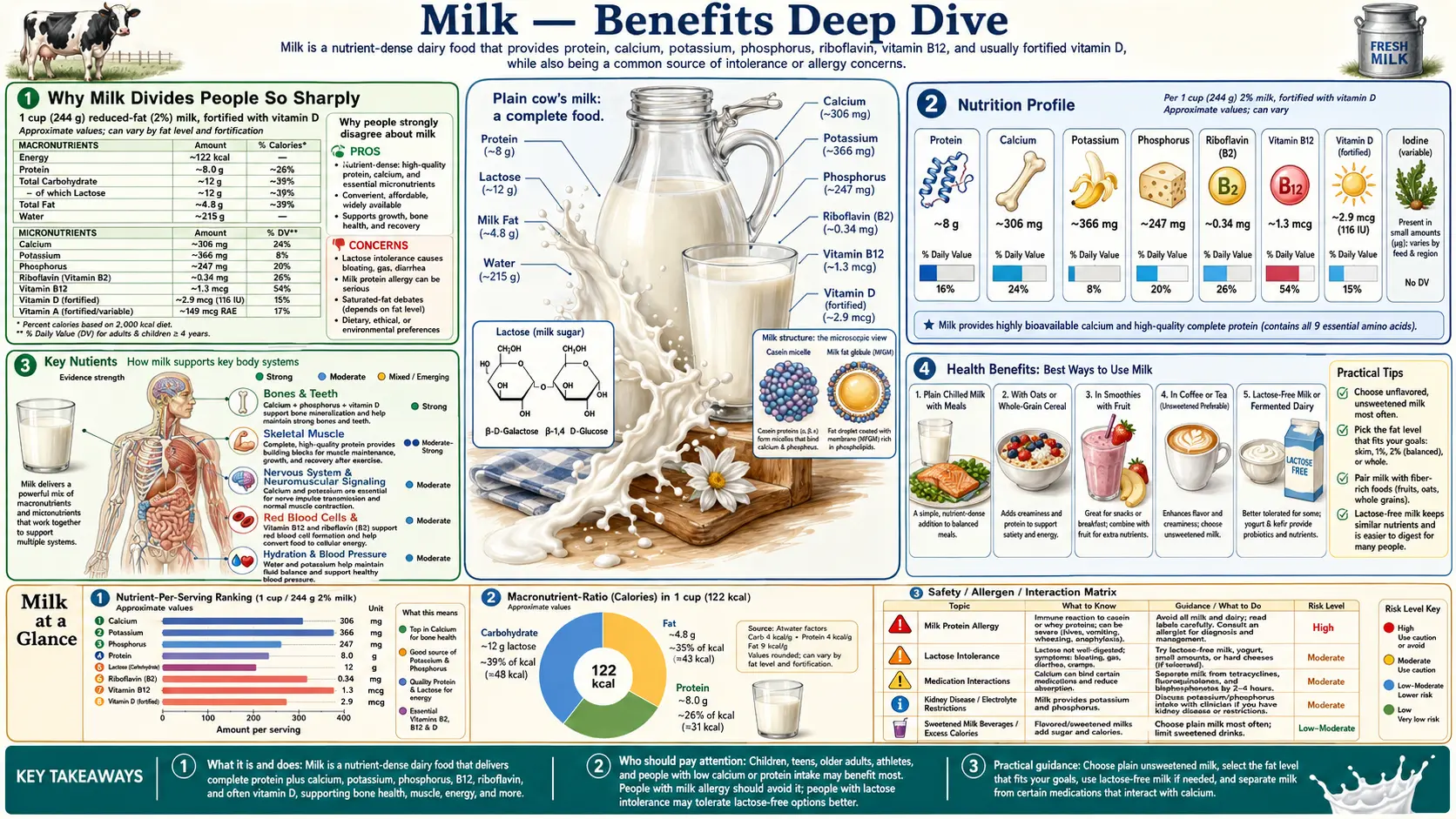
Cow's milk is one of the most consumed and most debated foods in the modern diet. Whole milk supplies complete protein, calcium, vitamin B12, riboflavin and iodine, and most US milk has added vitamin D (measured amounts are on the main Milk page). What a given carton contains, and how a given person responds to it, varies along four axes — the cow's beta-casein variant (A1 vs A2), processing (raw vs pasteurized), the cow's feed (pasture vs grain-based ration), and the drinker's own lactase genotype. The four deep-dive pages below examine each axis, with the underlying biochemistry and what the published trials and reviews report.
Deep-Dive Articles
A1 vs A2 Casein
A1 and A2 beta-casein differ at position 67 of the protein chain — histidine in A1, proline in A2 — and in laboratory digestion A1 yields the opioid-like peptide beta-casomorphin-7 (BCM-7) while A2 does not. Why A1 is the most frequent variant in Holstein-Friesian cattle while A2 predominates in Guernsey and Jersey cattle, and what the published randomized trials and systematic reviews report about digestive symptoms, transit time and inflammatory markers.
Read the deep dive →Raw vs Pasteurized
What high-temperature short-time (HTST) pasteurization, ultra-pasteurization and UHT treatment, and vat pasteurization do to milk proteins, vitamins and pathogens. What a meta-analysis found about vitamin losses with pasteurization, and the FDA and CDC data on illness and outbreaks linked to raw milk, including listeriosis, brucellosis and hemolytic uremic syndrome (HUS) in children.
Read the deep dive →Grass-Fed & CLA
How milk from cows on pasture differs from milk from cows on a total mixed ration in omega-3, conjugated linoleic acid (CLA), beta-carotene and vitamin K. In a US comparison, the omega-6:omega-3 ratio was 5.77 in conventional milk and 0.95 in milk from cows on a nearly 100% forage-based diet, which had 125% more CLA; cows on grass silage had more beta-carotene in their milk than cows switched to hay. What the human evidence does and does not support.
Read the deep dive →Lactose Intolerance
The −13910 C>T variant upstream of the LCT (lactase) gene linked to lactase persistence in people of Northern European descent, and the other variants found in African and Middle Eastern populations; the difference between lactose intolerance and milk-protein allergy; the 12–15 g of lactose (about one cup of milk) that a systematic review found most people with lactose intolerance or malabsorption tolerate; the bacterial beta-galactosidase in yogurt and kefir; and lactase enzyme supplements.
Read the deep dive →Table of Contents
- Deep-Dive Articles
- Why Milk Divides People So Sharply
- Research Papers: A1 vs A2 Casein
- Research Papers: Raw vs Pasteurized
- Research Papers: Grass-Fed and CLA
- Research Papers: Lactose Intolerance
- Research Papers: Cross-Cutting (Bone, Cardiovascular, Cancer)
- External Authoritative Resources
- Connections
- Featured Videos
Why Milk Divides People So Sharply
Milk is unusual among foods in that its biological effect on any given individual depends on three different layers of genetic and biochemical variability — one in the cow, one in the processor, and one in the consumer.
- The cow's casein genotype. A1 and A2 beta-casein, products of variants of the beta-casein gene (CSN2), differ by histidine versus proline at position 67 of the protein chain (Sun et al. 2024). In laboratory digestion, A1 (and the less common B variant) yields the seven-amino-acid opioid-like peptide beta-casomorphin-7 (BCM-7) while A2 does not, and hydrolysed A1 milk contained about 4-fold more BCM-7 than A2 milk (Kamiński et al. 2007). A2 is described as the progenitor type (Ho et al. 2014). A1 is the most frequent variant in Holstein-Friesian (allele frequency 0.310–0.660), Ayrshire and Red cattle, while A2 predominates in Guernsey (0.880–0.970) and Jersey (0.490–0.721) cattle (Kamiński et al. 2007). In rodents, A1 delays intestinal transit through an opioid-mediated mechanism and is linked to inflammatory markers; in humans, a limited number of studies have linked A1 to delayed transit (1 study) and looser stools (2 studies) (Brooke-Taylor et al. 2017, whose authors disclose consulting ties to A2 milk marketers). A 2019 systematic review rated the certainty of evidence as moderate for adverse digestive effects of A1 compared with A2 beta-casein, and as low or very low for other health outcomes (Küllenberg de Gaudry et al. 2019); an earlier critical review found no convincing evidence of harm from A1 for type 1 diabetes or heart disease (Truswell 2005). The first deep-dive page walks through the biochemistry and the human-trial evidence on GI symptoms.
- The processor's thermal regimen. Under the US federal standard of identity for milk, pasteurization includes heating to 161°F for 15 seconds (the high-temperature short-time, or HTST, method), and ultra-pasteurization means heating to 280°F for at least 2 seconds (21 CFR 131.3). Pasteurization reduces the number of viable pathogenic bacteria. A meta-analysis of 40 studies found that it lowered vitamins B1, B2, C and folate (and, in a qualitative summary, B12 and E) and raised vitamin A, and judged the effect on milk's nutritive value minimal because many of these vitamins occur in milk at relatively low levels, while noting that milk is an important dietary source of vitamin B2 (Macdonald et al. 2011). The CDC lists Campylobacter, Cryptosporidium, E. coli, Listeria, Brucella and Salmonella among the germs raw milk can carry; in some studies up to a third of raw milk samples contained pathogens (Lucey 2015), and US outbreaks caused by nonpasteurized milk rose from 30 in 2007–2009 to 51 in 2010–2012, most caused by Campylobacter (Mungai et al. 2015). In the PASTURE birth cohort of 983 rural European infants, raw farm milk consumption compared with UHT milk was associated with less rhinitis, respiratory infection, otitis and fever; this was an observational study, and the authors framed the potential benefit as conditional on overcoming raw milk's health hazards (Loss et al. 2015). The second deep-dive page covers the trade-offs in detail.
- The consumer's lactase genotype. In people of Northern European descent, lactase persistence — continued production of the lactase enzyme into adulthood — is linked to the −13910 C>T variant, located in intron 13 of the MCM6 gene about 13.9 kb upstream of the LCT (lactase) gene (Enattah et al. 2002; Janukonyté et al. 2010); in people of African and Middle Eastern descent, other nearby variants are associated with the trait. Lactase persistence is common in people of European ancestry and in some African, Middle Eastern and South Asian groups, but rare or absent elsewhere (Itan et al. 2010). In people who malabsorb lactose, the likelihood of symptoms such as abdominal pain, bloating and diarrhoea depends on the lactose dose, lactase expression and the intestinal microbiome (Misselwitz et al. 2019), and a systematic review of randomized trials found moderate-quality evidence that most adults with lactose intolerance or malabsorption tolerate 12 to 15 g of lactose, about one cup of milk (Shaukat et al. 2010). The fourth deep-dive page covers the genetics, tolerated doses, and fermented and lactose-reduced options.
A fourth axis — the cow's feed and pasture access — changes the fatty-acid profile (omega-6:omega-3 ratio, CLA content) and the beta-carotene and vitamin K content of the milk fat. This axis is independent of the casein and lactose questions. Because these compounds are carried in the fat, the differences apply to whole milk, butter, cream and full-fat cheese, and little of them remains in skim milk.
For these reasons the research gives no single answer to "is milk good for you?". The same carton can differ in beta-casein type, heat treatment and fatty-acid profile, and the people drinking it differ in lactase persistence. In two randomized crossover trials in China, milk containing only A2 beta-casein was associated with fewer digestive symptoms than conventional milk containing A1 and A2: one in 45 Han Chinese adults with self-reported milk intolerance over 14-day periods (Jianqin et al. 2016), and one over 5-day periods in preschool children with mild-to-moderate milk intolerance (Sheng et al. 2019). The four deep-dive pages set out what the research reports on each axis.
Research Papers: A1 vs A2 Casein
- Kamiński S, Cieślińska A, Kostyra E, Polymorphism of bovine beta-casein and its potential effect on human health (J Appl Genet 2007;48(3):189-198) — PubMed PMID: 17666771
- Jianqin S et al., Effects of milk containing only A2 beta casein versus milk containing both A1 and A2 beta casein on gastrointestinal physiology, symptoms of discomfort, and cognitive behavior (Nutr J 2016;15:35) — PubMed PMID: 27039383
- Ho S et al., Comparative effects of A1 versus A2 beta-casein on gastrointestinal measures: a blinded randomised cross-over pilot study (Eur J Clin Nutr 2014;68(9):994-1000) — PubMed PMID: 24986816
- Brooke-Taylor S et al., Systematic review of the gastrointestinal effects of A1 compared with A2 beta-casein (Adv Nutr 2017;8(5):739-748) — PubMed PMID: 28916574
- Sheng X et al., Effects of conventional milk versus milk containing only A2 beta-casein on digestion in Chinese children: a randomized study (J Pediatr Gastroenterol Nutr 2019;69(3):375-382) — PubMed PMID: 31305326
- Pal S et al., Milk intolerance, beta-casein and lactose (Nutrients 2015;7(9):7285-7297) — PubMed PMID: 26404362
- Beta-casomorphin-7 (BCM-7) opioid activity and gut release PubMed: BCM-7 search
- Küllenberg de Gaudry D et al., Milk A1 β-casein and health-related outcomes in humans: a systematic review (Nutr Rev 2019;77(5):278-306) — PubMed PMID: 30722004
- Truswell AS, The A2 milk case: a critical review (Eur J Clin Nutr 2005;59(5):623-631) — PubMed PMID: 15867940
- Cieslinska A et al., Beta-casomorphins and human health (Peptides 2012) PubMed: Cieslinska BCM review (editorial note: a paper with this title, author and journal was not found in PubMed or Crossref; the link is a topic search)
- Sun Y et al., Recent advances in the bovine β-casein gene mutants on functional characteristics and nutritional health of dairy products: status, challenges, and prospects (Food Chem 2024;443:138510) — PubMed PMID: 38281416
Research Papers: Raw vs Pasteurized
- Lucey JA, Raw milk consumption: risks and benefits (Nutr Today 2015;50(4):189-193) — PubMed PMID: 27340300
- Mungai EA, Behravesh CB, Gould LH, Increased outbreaks associated with nonpasteurized milk, United States, 2007-2012 (Emerg Infect Dis 2015;21(1):119-122) — PubMed PMID: 25531403
- Macdonald LE et al., A systematic review and meta-analysis of the effects of pasteurization on milk vitamins, and evidence for raw milk consumption and other health-related outcomes (J Food Prot 2011;74(11):1814-1832) — PubMed PMID: 22054181
- Headrick ML et al., The epidemiology of raw milk-associated foodborne disease outbreaks reported in the United States, 1973 through 1992 (Am J Public Health 1998;88(8):1219-1221) — PubMed PMID: 9702153
- Loss G et al., Consumption of unprocessed cow's milk protects infants from common respiratory infections (PASTURE study; J Allergy Clin Immunol 2015;135(1):56-62) — PubMed PMID: 25441645
- Pasteurization effects on milk whey proteins (denaturation kinetics) PubMed: Whey denaturation
- Listeria monocytogenes and raw milk outbreaks PubMed: Listeria raw milk
- Brucellosis from raw dairy consumption PubMed: Brucellosis raw milk
- Shiga-toxin-producing E. coli and pediatric HUS from raw dairy PubMed: STEC raw milk HUS
- Vitamin B12, folate, and B6 retention in pasteurized vs UHT milk PubMed: B vitamins UHT
Research Papers: Grass-Fed and CLA
- Benbrook CM et al., Enhancing the fatty acid profile of milk through forage-based rations, with nutrition modeling of diet outcomes (Food Sci Nutr 2018;6(3):681-700) — PubMed PMID: 29876120
- Dewhurst RJ et al., Increasing the concentrations of beneficial polyunsaturated fatty acids in milk produced by dairy cows in high-forage systems (Anim Feed Sci Technol 2006;131:168-206) — doi:10.1016/j.anifeedsci.2006.04.016 (topic search kept: PubMed: Dewhurst forage omega-3)
- Couvreur S et al., The linear relationship between the proportion of fresh grass in the cow diet, milk fatty acid composition, and butter properties (J Dairy Sci 2006;89(6):1956-1969) — PubMed PMID: 16702259
- Ip C, Scimeca JA, Thompson HJ, Conjugated linoleic acid: a powerful anticarcinogen from animal fat sources (Cancer 1994;74(3 Suppl):1050-1054; a review of rat mammary-tumor studies) — PubMed PMID: 8039138
- Belury MA, Dietary conjugated linoleic acid in health: physiological effects and mechanisms of action (Annu Rev Nutr 2002;22:505-531) — PubMed PMID: 12055356
- Smit LA et al., Conjugated linoleic acid in adipose tissue and risk of myocardial infarction (Am J Clin Nutr 2010;92(1):34-40) — PubMed PMID: 20463040
- Vitamin K2 (MK-4) content of pasture-fed dairy PubMed: K2 in pasture dairy
- Beta-carotene transfer from pasture to milk fat (yellow butterfat) PubMed: Carotenoid transfer
- Rumenic acid (cis-9, trans-11 CLA) endogenous synthesis from vaccenic acid PubMed: Vaccenic to rumenic
- Omega-6:Omega-3 ratio in conventional vs grass-fed dairy PubMed: O6/O3 dairy ratio
Research Papers: Lactose Intolerance
- Enattah NS et al., Identification of a variant associated with adult-type hypolactasia (Nat Genet 2002;30(2):233-237) — PubMed PMID: 11788828
- Tishkoff SA et al., Convergent adaptation of human lactase persistence in Africa and Europe (Nat Genet 2007;39(1):31-40) — PubMed PMID: 17159977
- Suchy FJ et al., NIH consensus development conference statement: lactose intolerance and health (Ann Intern Med 2010;152(12):792-796) — PubMed PMID: 20404261
- Savaiano DA, Lactose digestion from yogurt: mechanism and relevance (Am J Clin Nutr 2014;99(5 Suppl):1251S-1255S) — PubMed PMID: 24695892
- Misselwitz B et al., Update on lactose malabsorption and intolerance: pathogenesis, diagnosis and clinical management (Gut 2019;68(11):2080-2091) — PubMed PMID: 31427404
- Retracted. Storhaug CL, Fosse SK, Fadnes LT, Country, regional, and global estimates for lactose malabsorption in adults: a systematic review and meta-analysis (Lancet Gastroenterol Hepatol 2017;2(10):738-746) — PubMed PMID: 28690131 (editorial note: the journal issued an expression of concern in 2024 and retracted the paper in 2025, PubMed PMID: 39674208; it is not used as a source for any figure on this page)
- Hertzler SR, Savaiano DA, Colonic adaptation to daily lactose feeding in lactose maldigesters reduces lactose intolerance (Am J Clin Nutr 1996;64(2):232-236) — PubMed PMID: 8694025
- Lactase enzyme supplementation efficacy trials PubMed: Lactase supplements
- Hydrogen breath test for lactose malabsorption diagnosis PubMed: H2 breath test
- Hertzler SR, Clancy SM, Kefir improves lactose digestion and tolerance in adults with lactose maldigestion (J Am Diet Assoc 2003;103(5):582-587) — PubMed PMID: 12728216
- Shaukat A et al., Systematic review: effective management strategies for lactose intolerance (Ann Intern Med 2010;152(12):797-803) — PubMed PMID: 20404262
- Itan Y et al., A worldwide correlation of lactase persistence phenotype and genotypes (BMC Evol Biol 2010;10:36) — PubMed PMID: 20144208
- Janukonyté J et al., High-resolution melting analysis using unlabeled probe and amplicon scanning simultaneously detects several lactase persistence variants (Scand J Clin Lab Invest 2010;70(8):535-540) — PubMed PMID: 21028949
Research Papers: Cross-Cutting (Bone, Cardiovascular, Cancer)
- Weaver CM, Heaney RP, Calcium in human health (book chapters / NIH reviews) PubMed: Weaver/Heaney calcium
- Soedamah-Muthu SS et al., Milk and dairy consumption and incidence of cardiovascular diseases and all-cause mortality: dose-response meta-analysis of prospective cohort studies (Am J Clin Nutr 2011;93(1):158-171) — PubMed PMID: 21068345
- Drouin-Chartier JP et al., Systematic review of the association between dairy product consumption and risk of cardiovascular-related clinical outcomes (Adv Nutr 2016;7(6):1026-1040) — PubMed PMID: 28140321
- Aune D et al., Dairy products and the risk of type 2 diabetes: a systematic review and dose-response meta-analysis of cohort studies (Am J Clin Nutr 2013;98(4):1066-1083) — PubMed PMID: 23945722
- Aune D et al., Dairy products, calcium, and prostate cancer risk: a systematic review and meta-analysis of cohort studies (Am J Clin Nutr 2015;101(1):87-117) — PubMed PMID: 25527754
- Bischoff-Ferrari HA et al., Milk intake and risk of hip fracture in men and women: meta-analysis of prospective cohort studies (J Bone Miner Res 2011;26(4):833-839) — PubMed PMID: 20949604
- Aune D et al., Dairy products and colorectal cancer risk: a systematic review and meta-analysis of cohort studies (Ann Oncol 2012;23(1):37-45) — PubMed PMID: 21617020
- Rautiainen S et al., Dairy consumption in association with weight change and risk of becoming overweight or obese in middle-aged and older women: a prospective cohort study (Am J Clin Nutr 2016;103(4):979-988) — PubMed PMID: 26912496
- Insulin-like growth factor 1 (IGF-1) response to milk consumption PubMed: Milk and IGF-1
- Dairy fat (whole vs low-fat) and cardiometabolic outcomes review PubMed: Whole vs low-fat dairy
External Authoritative Resources
- NIH Office of Dietary Supplements — Calcium Fact Sheet (Health Professionals)
- CDC — Raw Milk Q&A (outbreak data, regulatory background)
- FDA — Raw Milk Misconceptions and the Danger of Raw Milk Consumption
- US Code of Federal Regulations — 21 CFR 131.3 (definitions of pasteurized and ultra-pasteurized)
- NIH NIA — Lactose Intolerance Information
- MedlinePlus — Lactose Intolerance
- PubMed — All research on milk and dairy health