Guava
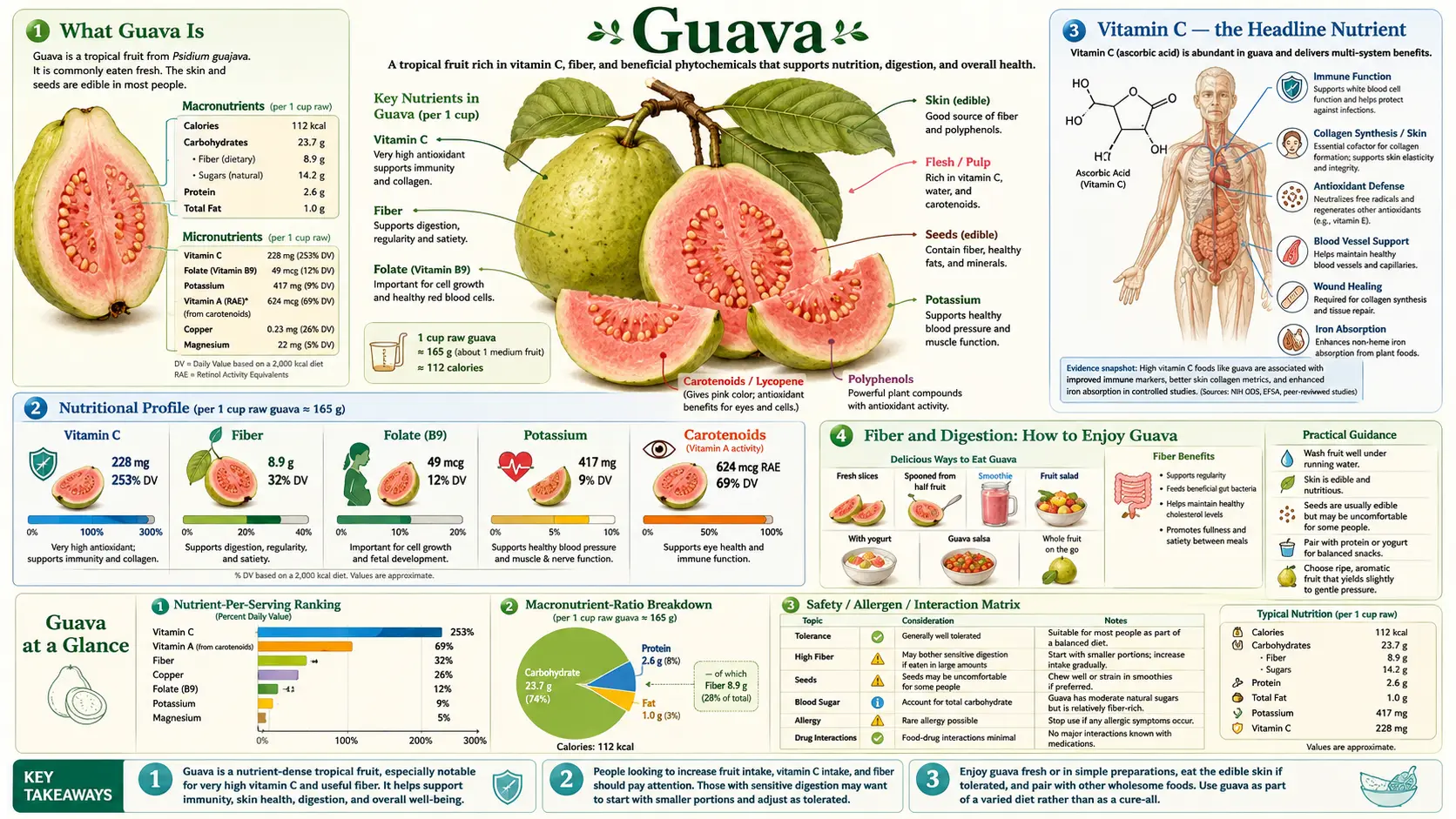
Guava (Psidium guajava) is a small, round-to-oval tropical fruit with a fragrant aroma, a thin edible skin, and soft flesh that may be white, pink, or deep red depending on the variety. It grows across the tropics and subtropics — from Central and South America, where it originated, to India, Southeast Asia, Africa, and the warmer parts of the United States. What makes guava remarkable is its nutrition: gram for gram it carries several times the vitamin C of an orange, along with a lot of fiber, useful potassium and folate, and — in the pink and red types — the same red-orange pigment (lycopene) found in tomatoes. This page explains what is really in a guava, where the science is strong and where it is thin, and it draws a clear line between the fruit (a genuinely nutritious food) and the leaf (a traditional remedy that shows modest promise for blood sugar in small studies but is not the same thing as eating the fruit).
Table of Contents
- What Guava Is
- Nutritional Profile
- Vitamin C — the Headline Nutrient
- Fiber and Digestion
- Antioxidants and Lycopene
- Blood Sugar and the Guava Leaf
- Heart Health and Blood Pressure
- How to Choose and Eat Guava
- Safety and Cautions
- Research Papers
- Connections
- Featured Videos
What Guava Is
Guava is the fruit of Psidium guajava, a shrubby evergreen tree in the myrtle family (the same botanical family as cloves and eucalyptus). The fruit is usually the size of a small apple or a large egg, with a slightly bumpy green-to-yellow skin that turns softer and more fragrant as it ripens. Cut one open and you find soft, juicy flesh studded with small, hard seeds toward the center. The flesh color depends on the cultivar:
- White or cream guava — often crisper and less sweet, sometimes with a sharper, more floral taste.
- Pink guava — softer, sweeter, and rich in the pigment that gives it its rosy color.
- Red guava — the deepest-colored types, which tend to carry the most lycopene.
The entire fruit is edible. Unlike a melon or an orange, you do not peel a guava — the thin skin is where a large share of its vitamin C and fiber sits, and it is eaten right along with the flesh. The seeds are also edible, though hard; some people eat them whole, and others scoop out the seedy core if they find it too crunchy. Ripe guava smells sweet and musky from several feet away, which is often the easiest way to tell it is ready.
Nutritional Profile
Guava is one of those fruits that quietly outperforms its reputation. It is low to moderate in calories, high in fiber, and unusually rich in vitamin C. The numbers below are approximate values for about 100 grams (roughly one medium fruit or a little more) of raw guava. Exact figures shift with the variety, the ripeness, and how the fruit was grown, so treat these as a realistic guide rather than a fixed measurement.
- Calories: about 68 kcal per 100 g — modest for the volume of food you get.
- Vitamin C: roughly 200–230 mg per 100 g — several times the amount in the same weight of orange, and well beyond a full day's target in a single serving.
- Fiber: about 5 g per 100 g — very high for a fruit, most of it from the skin, flesh, and seeds.
- Potassium: around 400 mg per 100 g — a meaningful contribution to the mineral most of us fall short on.
- Folate: roughly 45–50 mcg per 100 g — useful, especially in pregnancy.
- Vitamin A activity: a modest amount from carotenoids, higher in the pink and red types.
- Lycopene: present in notable amounts in pink and red guava — comparable to, and in some analyses higher than, tomatoes gram for gram.
- Protein: about 2.5 g per 100 g — on the high side for a fruit, though still small in the diet overall.
- Natural sugars: around 9 g per 100 g, balanced by the fruit's high fiber.
Reviews of guava's composition confirm this general picture — a fruit that is genuinely dense in vitamin C, fiber, potassium, and colorful antioxidant pigments while staying light in calories (Naseer and colleagues, 2018; Gutiérrez and colleagues, 2008). Because the vitamin C and much of the fiber sit in and just under the skin, eating guava whole rather than juicing or peeling it captures the most nutrition.
Vitamin C — the Headline Nutrient
If guava is famous for one thing, it is vitamin C. Weight for weight, guava carries roughly three to four times the vitamin C of an orange, and a single fruit can deliver more than a full day's recommended intake. That matters because humans cannot make vitamin C and cannot store much of it, so we need a steady supply from food.
Vitamin C does several jobs that are easy to feel the value of:
- Immune support. Vitamin C helps immune cells work and function normally. It is not a cure for colds, but a body that is consistently well supplied handles everyday immune demands better than one that is running low.
- Skin and collagen. Vitamin C is required to build collagen, the protein that holds skin, gums, blood vessels, and connective tissue together. This is why severe vitamin C deficiency (scurvy) shows up first as bleeding gums and poor wound healing.
- Iron absorption. Vitamin C converts the plant form of iron into a form the gut absorbs more easily. Eating guava alongside beans, greens, or grains helps your body take up more of the iron in that meal — a simple, free trick for people who tend to run low on iron.
- Antioxidant defense. Vitamin C is itself an antioxidant, helping neutralize reactive molecules and recycle other antioxidants such as vitamin E.
One practical caveat: vitamin C is fragile. It breaks down with heat, long storage, and exposure to air, so a ripe guava eaten fresh delivers far more than one that has been cooked into jam or left cut open on the counter for a day. See our dedicated page on Vitamin C for the full story.
Fiber and Digestion
Guava is one of the higher-fiber fruits you can eat, carrying roughly 5 grams in a 100-gram serving — more than most apples, oranges, or grapes of the same weight. The fiber comes as a mix of the soft, gel-forming kind (soluble fiber, mostly pectin) and the coarse, structural kind (insoluble fiber, concentrated in the skin and seeds).
That combination does useful things in the gut. Soluble fiber slows digestion, feeds beneficial gut bacteria, and helps blunt the rise in blood sugar after a meal. Insoluble fiber adds bulk and helps keep things moving, which supports regularity. For most people, guava's fiber load is one of the strongest reasons to eat the whole fruit rather than drink strained guava juice, which leaves much of the fiber behind.
There is also a long folk tradition — documented across Latin America, Asia, and Africa — of using guava for the opposite problem: diarrhea. Traditionally it is the leaf, brewed as a tea, that is used to firm up loose stools, though the unripe fruit has been used too. Reviews of guava's ethnomedicine catalog this antidiarrheal use widely, and it is one of the plant's most consistent traditional applications (Gutiérrez and colleagues, 2008; Díaz-de-Cerio and colleagues, 2017). The likely explanation is the plant's tannins and other astringent compounds, which can tighten tissue and slow gut motility. It is worth being clear about the two directions here: the fiber in the ripe fruit supports regularity, while the astringent leaf preparations are the traditional remedy for diarrhea. They are not the same thing.
Antioxidants and Lycopene
Guava is colorful for a reason. Its flesh and skin are packed with plant compounds — polyphenols, flavonoids, vitamin C, and carotenoids — that act as antioxidants, meaning they help mop up the reactive molecules that build up as a normal byproduct of living and are involved in aging and chronic disease. When researchers measured the antioxidant capacity of guava fruit across several cultivars, they found it consistently high and closely tied to its content of vitamin C and phenolic compounds (Flores and colleagues, 2015).
The standout pigment in pink and red guava is lycopene, the same deep-red carotenoid that colors tomatoes and watermelon. Analyses of guava confirm meaningful lycopene levels in the colored varieties, alongside its ascorbic acid (vitamin C) content (Brito and colleagues, 2009). In some measurements, red guava rivals or exceeds tomatoes for lycopene gram for gram. Lycopene has been studied for its role in heart and prostate health, though most of that evidence comes from tomatoes and supplements rather than guava specifically. The honest summary is that pink and red guava are a genuinely good dietary source of lycopene, and eating them adds to your overall intake — but guava has not itself been tested as a lycopene "treatment." Our Lycopene page covers what that pigment does and does not do.
Blood Sugar and the Guava Leaf
This is the section where it matters most to keep two things apart: the guava fruit and the guava leaf.
The fruit is a whole food. Its fiber slows how quickly sugar enters the bloodstream, so guava tends to raise blood sugar more gently than many sweeter fruits or refined snacks. That makes it a reasonable choice within a balanced diet — but eating guava is not a treatment for diabetes, and the fruit still contains natural sugars.
The leaf is a different story, and it is where the interesting research lives. Guava leaf tea and guava leaf extracts have a long traditional use for blood sugar, and modern studies give that tradition partial support:
- In a human study, drinking guava leaf tea with a meal reduced the spike in blood sugar afterward compared with the same meal without it; the same body of work also reported improvements in blood fats (Deguchi and Miyazaki, 2010).
- In diabetic animals, guava leaf extract lowered blood sugar and eased markers of oxidative stress (Jayachandran and colleagues, 2018), and purified components of the leaf showed both antioxidant and anti-diabetic activity in laboratory work (Luo and colleagues, 2019).
- A decade-spanning review of guava leaf research concluded that the leaf's polyphenols can slow the digestion of carbohydrates — partly by inhibiting the gut enzymes that break starch and sugars down — which helps explain the gentler post-meal glucose rise (Díaz-de-Cerio and colleagues, 2017).
So what should an ordinary reader take from this? The evidence for the leaf is real but modest. The human trials are small and short, the extract doses used in research are often stronger and more standardized than a casual cup of tea, and product quality varies a lot from brand to brand. Guava leaf tea is not a substitute for prescribed diabetes medication, and it should not be treated as one. If you take medication for blood sugar and want to try guava leaf tea, the caution in the safety section below applies: the two can add together and push blood sugar too low.
Heart Health and Blood Pressure
Guava's makeup lines up well with what supports the cardiovascular system: it is high in potassium and fiber, rich in vitamin C and antioxidants, and low in sodium and calories. Potassium helps balance sodium and relax blood vessel walls, and soluble fiber can help nudge cholesterol downward — both of which are gentle, food-level effects rather than drug-level ones.
There is one often-cited older human trial worth knowing about. Singh and colleagues (1992) had participants substantially increase their guava fruit intake for twelve weeks and reported lower total cholesterol and triglycerides, higher "good" HDL cholesterol, and modestly lower blood pressure compared with a control group. It is a genuinely interesting result, and it is frequently quoted as evidence that guava is heart-friendly. It also deserves honest framing: it is a single trial from the early 1990s, some of the benefit may come simply from guava displacing less healthy foods, and it has not been repeated at scale with modern methods. The reasonable conclusion is that guava fits comfortably into a heart-healthy eating pattern — not that guava alone lowers cardiovascular risk. As always, no single fruit does the heavy lifting; the overall diet does.
How to Choose and Eat Guava
Choosing a good guava is mostly about smell and give:
- Ripeness. A ripe guava yields slightly to gentle pressure, like a ripe peach, and gives off a strong sweet, musky fragrance. Rock-hard, unscented fruit is underripe; let it sit at room temperature for a few days to soften.
- Skin. Look for skin that has turned from deep green toward a lighter green or yellow, without large bruises or dark soft spots. Minor blemishes on the skin are cosmetic and fine.
- Storage. Ripen at room temperature, then refrigerate to slow things down once soft. Because vitamin C fades with time and heat, fresher and less-cooked means more nutrition.
Eating guava is simple: wash it and bite in, skin and all, the way you would an apple. The skin holds much of the vitamin C and fiber, so peeling throws away some of the best of the fruit. The seeds are edible but hard; eat them whole if they do not bother you, or slice the guava and scoop out the seedy center if you prefer. Guava also works sliced into fruit salads, blended into smoothies (which keeps the fiber, unlike strained juice), or paired with a little salt and chili, a popular way to eat it in Latin America and Asia. If you want other high-vitamin-C tropical options, see Papaya and Mango.
Safety and Cautions
As a food, guava is very safe. It is a common everyday fruit for hundreds of millions of people, and for the vast majority it can be eaten freely as part of a normal diet. A few practical points are worth keeping in mind:
- The seeds are hard. Guava seeds are small but firm. Most people swallow them without trouble, but anyone prone to dental issues or with difficulty chewing may prefer to scoop them out.
- Fiber and portions. Because guava is so high in fiber, eating a large amount at once can cause gas or a loose stomach in sensitive people. A normal serving is fine; moderation is only relevant if you are eating a lot of it.
- Guava leaf extract and blood sugar. This is the main real caution, and it applies to the concentrated leaf, not the fruit. Because guava leaf preparations can lower blood sugar, combining them with diabetes medication (such as insulin or sulfonylureas) could push blood sugar too low. If you take blood-sugar medication and want to try guava leaf tea or extract, talk to your prescriber first and monitor your levels.
- Guava leaf and blood pressure. For the same reason, guava leaf preparations may add to the effect of blood-pressure-lowering medication. Use caution if you are on such drugs.
- Surgery. Because of the possible effect on blood sugar, it is sensible to stop concentrated guava leaf products a couple of weeks before scheduled surgery.
- Pregnancy. Eating guava fruit in normal food amounts is considered fine and even helpful for its folate and vitamin C. Concentrated guava leaf extracts have not been well studied in pregnancy, so the fruit is the safer choice.
None of these cautions apply to simply enjoying the fruit. The distinction to remember throughout this page is straightforward: the fruit is a nourishing food, while the leaf is a traditional remedy that, because it can genuinely move blood sugar and blood pressure, deserves the same respect and caution you would give any active supplement.
Research Papers
- Gutiérrez RMP, Mitchell S, Solis RV. Psidium guajava: a review of its traditional uses, phytochemistry and pharmacology. Journal of Ethnopharmacology. 2008;117(1):1–27. doi:10.1016/j.jep.2008.01.025 — a broad review documenting guava's chemistry and its many traditional uses, including the widespread antidiarrheal use of the leaf.
- Naseer S, Hussain S, Naeem N, Pervaiz M, Rahman M. The phytochemistry and medicinal value of Psidium guajava (guava). Clinical Phytoscience. 2018;4:32. doi:10.1186/s40816-018-0093-8 — summarizes guava's nutrients and active compounds and reviews its reported health effects.
- Kumar M, Tomar M, Amarowicz R, et al. Guava (Psidium guajava L.) leaves: nutritional composition, phytochemical profile, and health-promoting bioactivities. Foods. 2021;10(4):752. doi:10.3390/foods10040752 — a detailed look at the guava leaf's makeup and its studied biological activities.
- Díaz-de-Cerio E, Verardo V, Gómez-Caravaca AM, Fernández-Gutiérrez A, Segura-Carretero A. Health effects of Psidium guajava L. leaves: an overview of the last decade. International Journal of Molecular Sciences. 2017;18(4):897. doi:10.3390/ijms18040897 — reviews a decade of guava leaf research, including its polyphenols and effects on carbohydrate digestion and blood sugar.
- Deguchi Y, Miyazaki K. Anti-hyperglycemic and anti-hyperlipidemic effects of guava leaf extract. Nutrition & Metabolism. 2010;7:9. doi:10.1186/1743-7075-7-9 — reports that guava leaf tea reduced post-meal blood sugar and improved blood fats, including human data.
- Luo Y, Peng B, Wei W, Tian X, Wu Z. Antioxidant and anti-diabetic activities of polysaccharides from guava leaves. Molecules. 2019;24(7):1343. doi:10.3390/molecules24071343 — isolated guava leaf polysaccharides and found both antioxidant and anti-diabetic activity in laboratory tests.
- Jayachandran M, Vinayagam R, Ambati RR, Xu B, Chung SSM. Guava leaf extract diminishes hyperglycemia and oxidative stress in streptozotocin-induced diabetic rats. BioMed Research International. 2018;2018:4601649. doi:10.1155/2018/4601649 — an animal study showing lower blood sugar and reduced oxidative-stress markers with guava leaf extract.
- Singh RB, Rastogi SS, Singh R, Ghosh S, Niaz MA. Effects of guava intake on serum total and high-density lipoprotein cholesterol levels and on systemic blood pressure. The American Journal of Cardiology. 1992;70(15):1287–1291. doi:10.1016/0002-9149(92)90763-o — a controlled trial in which increased guava fruit intake was associated with improved cholesterol, triglycerides, and blood pressure.
- Flores G, Wu SB, Negrin A, Kennelly EJ. Chemical composition and antioxidant activity of seven cultivars of guava (Psidium guajava) fruits. Food Chemistry. 2015;170:327–335. doi:10.1016/j.foodchem.2014.08.076 — measured antioxidant activity across guava varieties and linked it to vitamin C and phenolic content.
- Brito CAK de, Siqueira PB, Souza JCD, Bolini HMA. In vitro antioxidant capacity, phenolic, ascorbic acid and lycopene content of guava (Psidium guajava). Boletim do Centro de Pesquisa de Processamento de Alimentos. 2009;27(2). doi:10.5380/cep.v27i2.16529 — documents guava's vitamin C and lycopene content alongside its antioxidant capacity.
- PubMed topic search: guava leaf and blood glucose — browse current studies on guava leaf and blood sugar.
- PubMed topic search: guava, antioxidants, and vitamin C — browse current studies on guava's antioxidant and vitamin C content.
Connections
- All Food
- Vitamin C
- Lycopene
- Papaya
- Mango
- Pineapple
- Oranges
- Strawberries
- Tomatoes
- Bell Peppers
- Potassium
- Vitamin A
- Type 2 Diabetes