Bananas: Resistant Starch — Green vs Ripe
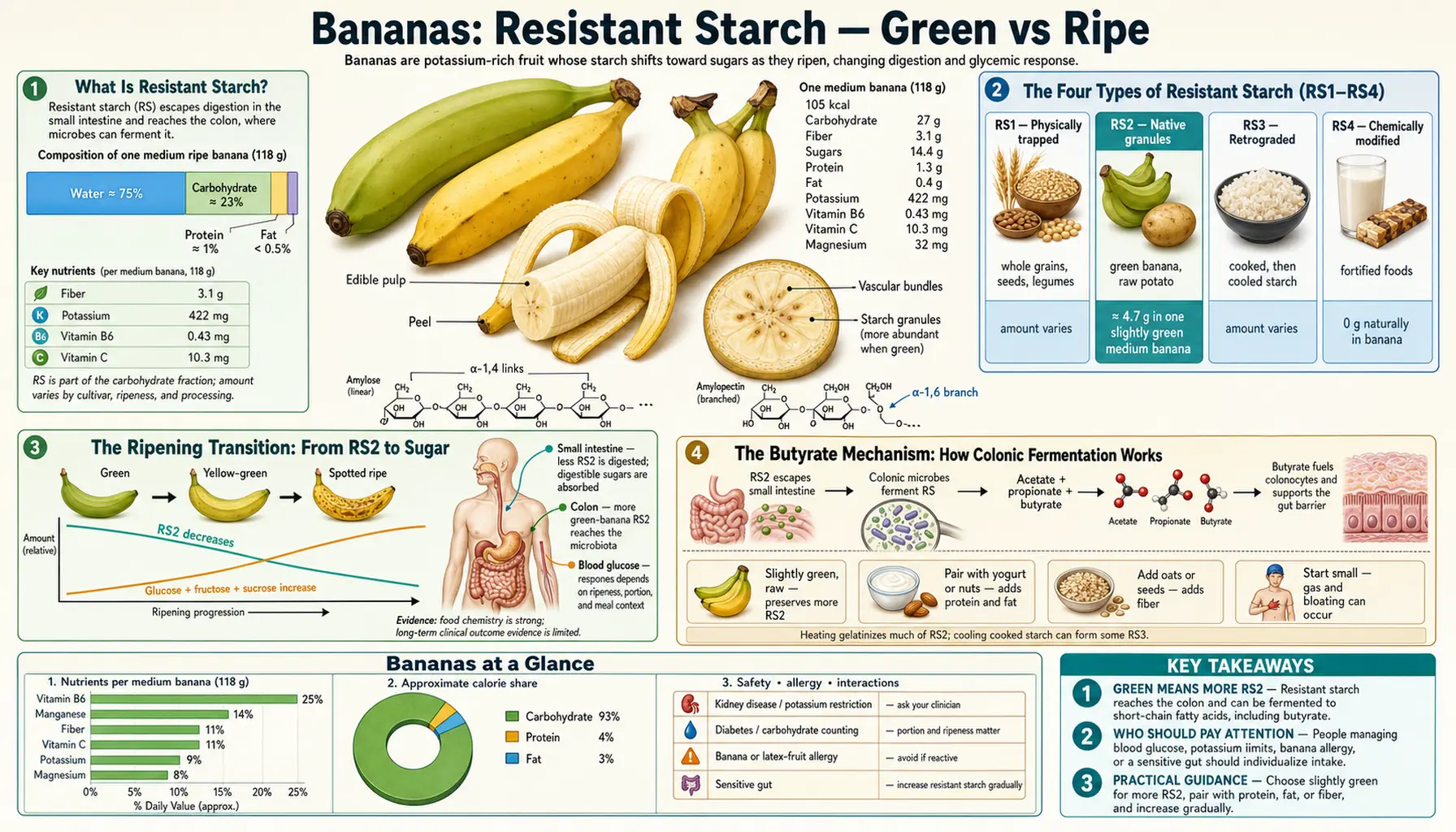
A green banana and a ripe banana differ mainly in their carbohydrate. In under-ripe bananas, starch makes up 80-90% of the carbohydrate, and as the fruit ripens this starch changes into free sugars (Hermansen 1992). Much of the starch in green banana is resistant starch (RS2), which escapes digestion in the small intestine: when six healthy volunteers ate freeze-dried green banana flour, 83.7% of the ingested alpha-glucans reached the end of the small intestine and were then almost totally fermented in the colon (Faisant 1995). Colonic bacteria ferment resistant starch to short-chain fatty acids, including butyrate. In ten people with type 2 diabetes, under-ripe banana had a glycaemic index of 43 and over-ripe banana a glycaemic index of 74 (Hermansen 1992). The same fruit is therefore digested differently depending on how ripe it is.
Table of Contents
- What Is Resistant Starch?
- The Four Types of Resistant Starch (RS1-RS4)
- The Ripening Transition: From RS2 to Sugar
- The Butyrate Mechanism: How Colonic Fermentation Works
- Glycemic Effects and the Second-Meal Phenomenon
- Gut Health: IBS, IBD, and Pediatric Diarrhea
- Colorectal Cancer Risk
- Green Banana Flour as a Therapeutic Food
- Ripeness and What the Research Reports
- Cautions: FODMAPs, Biogenic Amines, Latex Allergy, Crop Disease
- Key Research Papers
- Connections
- Featured Videos
What Is Resistant Starch?
Resistant starch is defined operationally: the fraction of dietary starch that resists hydrolysis by salivary amylase, pancreatic amylase, and small-intestinal brush-border enzymes, and therefore reaches the colon in undigested form. The colon-resident bacteria treat resistant starch the same way they treat soluble fiber — as a fermentable substrate that yields short-chain fatty acids (acetate, propionate, butyrate), gases (hydrogen, carbon dioxide, methane), and a modest amount of bacterial biomass.
Because it is not absorbed as glucose in the small intestine, resistant starch behaves nutritionally more like a fermentable fiber than like a digestible starch: it is fermented by the colonic microbiota rather than absorbed by the host in the small intestine. Butyrate, one of the short-chain fatty acids produced, is a preferred substrate for colonocytes and appears to promote a normal phenotype in these cells (Topping and Clifton 2001).
The Four Types of Resistant Starch (RS1-RS4)
Englyst, Kingman and Cummings (1992) classified dietary starch as rapidly digestible, slowly digestible or resistant, and divided resistant starch into three categories according to the reason it resists digestion (RS1-RS3). Later reviews add chemical modification as a further reason (RS4; Topping and Clifton 2001):
- RS1 (physically inaccessible): starch trapped within an intact cell wall, as in whole or partially milled grains, seeds, and legumes. Cooking or chewing can convert RS1 to digestible starch.
- RS2 (granular, native crystalline): starch in a tightly packed B-type crystalline form that resists enzyme attack. Native granular form of green bananas, raw potatoes, and high-amylose maize starches. Cooking with water gelatinizes much of the granular structure and makes it more digestible.
- RS3 (retrograded): starch that has been gelatinized by cooking and then re-crystallized on cooling. The classic example is cooked-then-cooled potato, rice, or pasta. The retrograded amylose is partially resistant to re-digestion even if reheated.
- RS4 (chemically modified): starches with chemical cross-links or substituent groups that resist enzyme hydrolysis. Used as ingredients in some processed foods.
Most of the resistant starch in green banana is the native granular RS2 form. Heating with water gelatinizes much of it, but cooked green banana is not free of resistant starch: in one trial, 40 g of cooked green banana biomass supplied approximately 4.5 g of resistant starch (Costa 2019), and the Bangladeshi diarrhoea trial described below used cooked green banana (Rabbani 2001). Green banana is studied as flour and as cooked pulp or “biomass”: of the 18 studies in a 2019 systematic review, 10 used green banana flour and 8 used green banana pulp/biomass (Falcomer 2019).
The Ripening Transition: From RS2 to Sugar
Banana ripening is coordinated by the plant hormone ethylene. The starch granules are broken down by enzymes that include alpha-amylase and beta-amylase associated with the granule surface (Peroni-Okita 2013). Starch falls and soluble sugars accumulate as the fruit softens, to an extent that depends on the cultivar (Shiga 2011); plantain starch is more resistant to enzymes than dessert-banana starch, and plantains keep more starch when ripe (Soares 2011). Published measurements at different points along the way include:
- Under-ripe banana: starch makes up 80-90% of the carbohydrate (Hermansen 1992).
- Green banana flour: an unripe banana flour (var. Nanicão) dried under specific conditions contained 48.99 g of resistant starch per 100 g dry weight, within 56.24 g of total dietary fiber (Menezes 2011). In banana flour at ripening stage 1, resistant starch measured in vitro reached 81% (Yang 2020).
- Ripe banana (food-composition table): USDA FoodData Central, “Bananas, raw” (SR Legacy, FDC ID 173944) lists, per 100 g, 5.38 g starch, 12.23 g total sugars (glucose 4.98 g, fructose 4.85 g, sucrose 2.39 g) and 2.6 g total dietary fiber. The record does not state the ripeness of the samples analysed.
These measurements describe a shift from a starch-rich, slowly digested fruit to a sugar-rich one. How far and how fast the shift goes depends on the cultivar and on storage conditions; cold storage of green bananas, for example, changed how the starch was degraded during later ripening (Peroni-Okita 2013).
The Butyrate Mechanism: How Colonic Fermentation Works
Colonic bacteria ferment resistant starch in steps. In laboratory work with four dominant starch-degrading colon bacteria, Ruminococcus bromii and Bifidobacterium adolescentis used RS2 and RS3 resistant starches far better than Eubacterium rectale or Bacteroides thetaiotaomicron, and R. bromii was unique in stimulating resistant-starch use by the other three — the authors called it a “keystone species” for resistant-starch degradation (Ze 2012). Other bacteria feed on the products: acetate made by bifidobacteria can be converted by butyrate-producing colon bacteria (shown during growth on oligofructose; Falony 2006). Acetate is the principal short-chain fatty acid in human colonic contents (Cummings 1987), and fermentation of some resistant-starch types favors butyrate production (Topping and Clifton 2001; Bird 2010).
In isolated human colonic cells given n-butyrate as the only substrate, butyrate accounted for 73% (ascending colon) and 75% (descending colon) of oxygen consumption (Roediger 1980). Butyrate also acts as a histone deacetylase inhibitor in the colonic epithelium at physiological concentrations, with documented effects on cell-cycle regulation, apoptosis, and tight-junction protein expression. The contributions to mucosal health include:
- Maintenance of the colonocyte tight junctions (claudins, occludin) that prevent bacterial translocation
- Induction of mucin production by goblet cells
- Promotion of T regulatory cell differentiation in the colonic lamina propria, dampening inflammatory tone
- Pro-apoptotic effect on transformed (early malignant) colonocytes, while supporting normal colonocyte survival
- Lower pH in the colonic lumen (pH and short-chain fatty acid concentrations were inversely related in human colonic contents; Cummings 1987)
Much of the evidence for these mucosal effects comes from cell-culture and animal studies.
The resistant-starch content of a whole banana varies with cultivar, ripeness and preparation. For comparison, the supplement trials described below gave 30 g of resistant starch per day (Robertson 2005; Burn 2008), while 40 g of cooked green banana biomass supplied approximately 4.5 g (Costa 2019).
Glycemic Effects and the Second-Meal Phenomenon
In ten people with type 2 diabetes who ate 120 g of under-ripe banana, 120 g of over-ripe banana or 40 g of white bread on separate days, the glycaemic index (white bread as reference) was 43 ± 10 for the under-ripe banana and 74 ± 9 for the over-ripe banana, a significant difference (P < 0.01). The blood-glucose response area was lower after both bananas than after white bread, while insulin response areas were similar across the three meals. The authors attributed the lower response to under-ripe banana to its high starch content (Hermansen 1992).
A “second-meal effect” was described by Wolever, Jenkins and colleagues in 1988: in healthy subjects, low-glycaemic-index dinners lowered the glycaemic response to the next morning's breakfast compared with high-glycaemic-index dinners of the same nutrient composition (Wolever 1988). In a later study in 15 healthy subjects, evening meals with barley-kernel bread, or with white bread enriched with barley fiber and resistant starch, improved glucose tolerance at the next breakfast; the breakfast glucose response was inversely correlated with colonic fermentation (measured by breath hydrogen) and with GLP-1 (Nilsson 2008). Neither study tested bananas.
In a 4-week placebo-controlled trial in 10 healthy subjects, 30 g per day of resistant starch raised insulin sensitivity measured by euglycaemic-hyperinsulinaemic clamp (9.7 vs 8.5 × 10⁻² mg glucose/kg/min per mU insulin/L; P = 0.03), and insulin sensitivity during a meal tolerance test was 33% higher (P = 0.05) (Robertson 2005, American Journal of Clinical Nutrition). In an acute crossover study in 20 healthy young men, 48 g of resistant starch divided between two meals lowered energy intake at a later ad libitum test meal (5,241 vs 5,606 kJ) and over 24 hours (12,603 vs 13,949 kJ) compared with a matched placebo, without changing subjective appetite ratings (Bodinham 2010). The resistant starch in these trials was a supplement, not banana.
Gut Health: IBS, IBD, and Pediatric Diarrhea
The gut-health literature on bananas is mixed because the same fruit can act in opposite directions depending on ripeness and the underlying condition. Three patient populations have specific evidence:
- Pediatric persistent diarrhea (low-resource settings): in a double-blind trial in Dhaka, Bangladesh, Rabbani et al. (Gastroenterology 2001) randomized 62 boys aged 5-12 months with persistent diarrhea to a rice-based diet containing 250 g/L of cooked green banana (n = 22), the same diet with 4 g/kg pectin (n = 19), or the rice diet alone (n = 21) for 7 days. By day 3, 55% of the green-banana group, 59% of the pectin group and 15% of controls had recovered; by day 4 the figures were 78%, 82% and 23% (P < 0.001 versus controls). Green banana and pectin also reduced stool amounts, oral rehydration and intravenous fluid needs, vomiting and the duration of diarrhea. A 2024 meta-analysis of nine randomized trials in 3,996 children aged 8-34 months found green-banana-based foods, added to standard treatment, associated with faster resolution of diarrhea (HR 1.96, 95% CI 1.62-2.37); the hazard ratio was 2.34 for persistent and 1.74 for acute diarrhea (Gallo Ruelas 2024).
- Ulcerative colitis: the green-banana-flour evidence here comes from animal models. In rats with chemically induced (TNBS) colitis, diets containing 10% or 20% green dwarf banana flour had protective effects, and 10% banana flour combined with prednisolone had a stronger effect than either alone (Scarminio 2012). Human trial data are limited, and green banana flour is not part of ulcerative colitis guidelines.
- Irritable bowel syndrome (FODMAP-sensitive): the Monash University FODMAP programme rates ripe bananas as higher in FODMAPs than firm, less-ripe bananas, with ratings that depend on serving size. In people with IBS who are sensitive to FODMAPs, these can trigger symptoms. Ripe banana does not carry an excess of fructose over glucose: FDC 173944 lists 4.85 g fructose and 4.98 g glucose per 100 g.
In this research, green and ripe banana behave as different foods for people with IBS or IBD.
Colorectal Cancer Risk
The colorectal cancer hypothesis for resistant starch has been widely studied. Cassidy, Bingham and Cummings (1994) compared diet with colorectal cancer incidence in 12 populations worldwide and found strong inverse associations between starch consumption and large-bowel cancer incidence (r = -0.70; colon r = -0.76), with no significant relation for non-starch polysaccharides alone. The authors linked this to the hypothesis that colonic fermentation is protective; as a comparison between populations, it shows association rather than cause.
The CAPP2 trial randomized people with Lynch syndrome (hereditary nonpolyposis colorectal cancer), in a two-by-two design, to 600 mg aspirin and/or 30 g per day of resistant starch, or placebo, for up to four years. Among the 727 participants in the resistant-starch comparison, colorectal adenoma or carcinoma developed in 18.7% on resistant starch and 18.4% on placebo over a mean of 29 months (relative risk 1.0) (Burn 2008). At a median follow-up of 52.7 months, with 463 participants randomized to resistant starch and 455 to placebo, resistant starch had no detectable effect on colorectal cancer (27 vs 26 participants; HR 1.40, 95% CI 0.78-2.56) (Mathers 2012). The planned 10-year follow-up, supplemented by cancer-registry data to 20 years, again found no difference in colorectal cancer (52 vs 53 diagnosed), but fewer participants with non-colorectal Lynch syndrome cancers in the resistant-starch group (27 vs 48; incidence rate ratio 0.52, 95% CI 0.32-0.84), most marked for upper gastrointestinal cancers (5 vs 21 diagnoses). The reduction was detectable in the first 10 years and continued in the next decade (Mathers 2022).
CAPP2 used a 30 g daily resistant-starch supplement, not banana; its findings apply to that dose and to people with Lynch syndrome.
Green Banana Flour as a Therapeutic Food
Green banana flour is made by drying and milling unripe bananas, and its resistant-starch content depends on the drying conditions (Tribess 2009). One unripe banana flour (var. Nanicão) contained 48.99 g of resistant starch per 100 g dry weight (Menezes 2011).
Reported findings with green banana flour or cooked green banana biomass include:
- Pre-diabetes and type 2 diabetes: in a 24-week randomized trial in 113 middle-aged adults, 40 g per day of green banana biomass (approximately 4.5 g resistant starch) plus nutritional support was associated with reductions in HbA1c, fasting glucose, body weight and fat-mass percentage within that group. The control group (diet alone) also lowered its HbA1c, and in exploratory analyses the percentage reductions in HbA1c and fasting glucose did not differ significantly (Costa 2019).
- Functional constipation in children: in a randomized study of 80 children and adolescents, green banana biomass alone reduced the proportion with hard stools (Bristol 1-2), straining, painful defecation and abdominal pain, though not fecal incontinence; combined with laxatives, many children needed lower laxative doses (87% with sodium picosulfate, 63% with PEG 3350) (Cassettari 2019).
- Overall picture: a 2019 systematic review of 18 studies found most studied benefits related to gastrointestinal symptoms, followed by glucose/insulin metabolism and weight control; it called for standardized dose-effect data by age group and for reporting of banana variety and ripeness (Falcomer 2019).
Heating the flour with water above its starch's gelatinization temperature, as in cooking and baking, converts much of the RS2 to digestible starch; the amount that survives depends on the process.
Ripeness and What the Research Reports
| Topic | Ripeness studied | What was reported |
|---|---|---|
| Blood glucose in type 2 diabetes | Under-ripe vs over-ripe | Glycaemic index 43 vs 74 in 10 people with type 2 diabetes (Hermansen 1992) |
| Starch reaching the colon | Green (freeze-dried flour) | 83.7% of ingested alpha-glucans reached the terminal ileum in 6 healthy subjects (Faisant 1995) |
| Pediatric diarrhea (low-resource settings) | Green, cooked | Faster recovery than a rice diet alone (Rabbani 2001); HR 1.96 for resolution in a 9-trial meta-analysis (Gallo Ruelas 2024) |
| Pre-diabetes / type 2 diabetes | Green, cooked biomass | Within-group falls in HbA1c and fasting glucose; between-group differences not significant in exploratory analyses (Costa 2019) |
| Functional constipation in children | Green, cooked biomass | Fewer hard stools; lower laxative doses when combined with laxatives (Cassettari 2019) |
| IBS with FODMAP sensitivity | Firm vs ripe | Monash University FODMAP ratings place ripe bananas higher in FODMAPs than firm bananas |
Cautions: FODMAPs, Biogenic Amines, Latex Allergy, Crop Disease
- FODMAP-sensitive IBS: the Monash University FODMAP programme rates ripe bananas as higher in FODMAPs than firm, less-ripe bananas. In people with IBS who are sensitive to FODMAPs, these can cause bloating, gas or diarrhea.
- Biogenic amines and MAO inhibitors: in the pulp of 20 banana and plantain genotypes, tyramine, histamine, dopamine and serotonin decreased during ripening in most genotypes, and peels contained higher levels of these amines than pulps (Borges 2019). In a laboratory analysis of foods that appear on diet lists for people taking monoamine oxidase inhibitors, bananas and banana peels were tested and were not among the foods the authors found to have dangerously high tyramine (6 mg or more per serving) (Walker 1996).
- Migraine: bananas appear on some migraine-trigger food lists, possibly due to tyramine, dopamine, or other vasoactive amines. The evidence for this is observational and inconsistent.
- Latex-fruit syndrome: approximately 30-50% of people allergic to natural rubber latex show an associated hypersensitivity to some plant-derived foods, especially freshly eaten fruits; banana, avocado, chestnut and kiwi are among the foods involved. Class I chitinases with a hevein-like domain are one of the cross-reacting protein types (Wagner and Breiteneder 2002).
- Tropical Race 4 (crop disease): Cavendish cultivars are the source of 99% of banana exports. Tropical race 4 (TR4) of the soil fungus Fusarium oxysporum f. sp. cubense attacks Cavendish clones and many other banana varieties, and since 2010 it has spread from East and Southeast Asia into South Asia, the Middle East and Africa (Dita 2018).
Key Research Papers
- Englyst HN, Kingman SM, Cummings JH. Classification and measurement of nutritionally important starch fractions. Eur J Clin Nutr. 1992;46 Suppl 2:S33-50. — PubMed PMID: 1330528
- Birt DF et al., Resistant starch: promise for improving human health (Adv Nutr 2013) — PubMed PMID: 24228189
- Cassidy A, Bingham SA, Cummings JH. Starch intake and colorectal cancer risk: an international comparison. Br J Cancer. 1994;69(5):937-942. — PubMed PMID: 8180027
- Rabbani GH, Teka T, Zaman B, Majid N, Khatun M, Fuchs GJ. Clinical studies in persistent diarrhea: dietary management with green banana or pectin in Bangladeshi children. Gastroenterology. 2001;121(3):554-560. — PubMed PMID: 11522739
- Robertson MD, Bickerton AS, Dennis AL, Vidal H, Frayn KN. Insulin-sensitizing effects of dietary resistant starch and effects on skeletal muscle and adipose tissue metabolism. Am J Clin Nutr. 2005;82(3):559-567. — PubMed PMID: 16155268
- Burn J, Bishop DT, Mecklin JP, Macrae F, Möslein G, Olschwang S, et al.; CAPP2 Investigators. Effect of aspirin or resistant starch on colorectal neoplasia in the Lynch syndrome. N Engl J Med. 2008;359(24):2567-2578. — PubMed PMID: 19073976
- Mathers JC, Movahedi M, Macrae F, Mecklin JP, Moeslein G, Olschwang S, et al.; CAPP2 Investigators. Long-term effect of resistant starch on cancer risk in carriers of hereditary colorectal cancer: an analysis from the CAPP2 randomised controlled trial. Lancet Oncol. 2012;13(12):1242-1249. — PubMed PMID: 23140761
- Tribess TB, Hernández-Uribe JP, Méndez-Montealvo MGC, Menezes EW, Bello-Perez LA, Tadini CC. Thermal properties and resistant starch content of green banana flour (Musa cavendishii) produced at different drying conditions. LWT - Food Sci Technol. 2009;42(5):1022-1025. — doi:10.1016/j.lwt.2008.12.017
- Cassettari VMG, Machado NC, Lourenção PLTA, Carvalho MA, Ortolan EVP. Combinations of laxatives and green banana biomass on the treatment of functional constipation in children and adolescents: a randomized study. J Pediatr (Rio J). 2019;95(1):27-33. — PubMed PMID: 29309737
- Topping DL, Clifton PM. Short-chain fatty acids and human colonic function: roles of resistant starch and nonstarch polysaccharides. Physiol Rev. 2001;81(3):1031-1064. — PubMed PMID: 11427691
- Falony G, Vlachou A, Verbrugghe K, De Vuyst L. Cross-feeding between Bifidobacterium longum BB536 and acetate-converting, butyrate-producing colon bacteria during growth on oligofructose. Appl Environ Microbiol. 2006;72(12):7835-7841. — PubMed PMID: 17056678
- Bird AR, Conlon MA, Christophersen CT, Topping DL. Resistant starch, large bowel fermentation and a broader perspective of prebiotics and probiotics. Benef Microbes. 2010;1(4):423-431. — PubMed PMID: 21831780
- Mathers JC, Elliott F, Macrae F, Mecklin JP, Möslein G, McRonald FE, et al.; CAPP2 Investigators. Cancer Prevention with Resistant Starch in Lynch Syndrome Patients in the CAPP2-Randomized Placebo Controlled Trial: Planned 10-Year Follow-up. Cancer Prev Res (Phila). 2022;15(9):623-634. — PubMed PMID: 35878732
- Hermansen K, Rasmussen O, Gregersen S, Larsen S. Influence of ripeness of banana on the blood glucose and insulin response in type 2 diabetic subjects. Diabet Med. 1992;9(8):739-743. — PubMed PMID: 1395467
- Faisant N, Buléon A, Colonna P, Molis C, Lartigue S, Galmiche JP, et al.. Digestion of raw banana starch in the small intestine of healthy humans: structural features of resistant starch. Br J Nutr. 1995;73(1):111-123. — PubMed PMID: 7857906
- Menezes EW, Tadini CC, Tribess TB, Zuleta A, Binaghi J, Pak N, et al.. Chemical composition and nutritional value of unripe banana flour (Musa acuminata, var. Nanicão). Plant Foods Hum Nutr. 2011;66(3):231-237. — PubMed PMID: 21732181
- Yang J, Bi Y, Liang S, Gu Z, Cheng L, Li C, et al.. The in vivo digestibility study of banana flour with high content of resistant starch at different ripening stages. Food Funct. 2020;11(12):10945-10953. — PubMed PMID: 33245312
- Shiga TM, Soares CA, Nascimento JR, Purgatto E, Lajolo FM, Cordenunsi BR. Ripening-associated changes in the amounts of starch and non-starch polysaccharides and their contributions to fruit softening in three banana cultivars. J Sci Food Agric. 2011;91(8):1511-1516. — PubMed PMID: 21445854
- Soares CA, Peroni-Okita FH, Cardoso MB, Shitakubo R, Lajolo FM, Cordenunsi BR. Plantain and banana starches: granule structural characteristics explain the differences in their starch degradation patterns. J Agric Food Chem. 2011;59(12):6672-6681. — PubMed PMID: 21591784
- Peroni-Okita FH, Cardoso MB, Agopian RG, Louro RP, Nascimento JR, Purgatto E, et al.. The cold storage of green bananas affects the starch degradation during ripening at higher temperature. Carbohydr Polym. 2013;96(1):137-147. — PubMed PMID: 23688463
- Costa ES, França CN, Fonseca FAH, Kato JT, Bianco HT, Freitas TT, et al.. Beneficial effects of green banana biomass consumption in patients with pre-diabetes and type 2 diabetes: a randomised controlled trial. Br J Nutr. 2019;121(12):1365-1375. — PubMed PMID: 30887937
- Falcomer AL, Riquette RFR, de Lima BR, Ginani VC, Zandonadi RP. Health Benefits of Green Banana Consumption: A Systematic Review. Nutrients. 2019;11(6):1222. — PubMed PMID: 31146437
- Gallo Ruelas M, Gomez-Herrera GP, Noa-Peralta KF, Regalado-Palacios G, Soria-Mamani M, Rojas-Armas JP. Role of green banana consumption in the treatment of acute and persistent diarrhea in children: a systematic review and meta-analysis of randomized controlled trials. Eur J Pediatr. 2024;183(9):3705-3718. — PubMed PMID: 38972965
- Wolever TM, Jenkins DJ, Ocana AM, Rao VA, Collier GR. Second-meal effect: low-glycemic-index foods eaten at dinner improve subsequent breakfast glycemic response. Am J Clin Nutr. 1988;48(4):1041-1047. — PubMed PMID: 2844076
- Nilsson AC, Ostman EM, Holst JJ, Björck IM. Including indigestible carbohydrates in the evening meal of healthy subjects improves glucose tolerance, lowers inflammatory markers, and increases satiety after a subsequent standardized breakfast. J Nutr. 2008;138(4):732-739. — PubMed PMID: 18356328
- Bodinham CL, Frost GS, Robertson MD. Acute ingestion of resistant starch reduces food intake in healthy adults. Br J Nutr. 2010;103(6):917-922. — PubMed PMID: 19857367
- Roediger WE. Role of anaerobic bacteria in the metabolic welfare of the colonic mucosa in man. Gut. 1980;21(9):793-798. — PubMed PMID: 7429343
- Cummings JH, Pomare EW, Branch WJ, Naylor CP, Macfarlane GT. Short chain fatty acids in human large intestine, portal, hepatic and venous blood. Gut. 1987;28(10):1221-1227. — PubMed PMID: 3678950
- Ze X, Duncan SH, Louis P, Flint HJ. Ruminococcus bromii is a keystone species for the degradation of resistant starch in the human colon. ISME J. 2012;6(8):1535-1543. — PubMed PMID: 22343308
- Scarminio V, Fruet AC, Witaicenis A, Rall VL, Di Stasi LC. Dietary intervention with green dwarf banana flour (Musa sp AAA) prevents intestinal inflammation in a trinitrobenzenesulfonic acid model of rat colitis. Nutr Res. 2012;32(3):202-209. — PubMed PMID: 22464807
- Borges CV, Belin MAF, Amorim EP, Minatel IO, Monteiro GC, Gomez Gomez HA, et al.. Bioactive amines changes during the ripening and thermal processes of bananas and plantains. Food Chem. 2019;298:125020. — PubMed PMID: 31260965
- Walker SE, Shulman KI, Tailor SA, Gardner D. Tyramine content of previously restricted foods in monoamine oxidase inhibitor diets. J Clin Psychopharmacol. 1996;16(5):383-388. — PubMed PMID: 8889911
- Wagner S, Breiteneder H. The latex-fruit syndrome. Biochem Soc Trans. 2002;30(Pt 6):935-940. — PubMed PMID: 12440950
- Dita M, Barquero M, Heck D, Mizubuti ESG, Staver CP. Fusarium Wilt of Banana: Current Knowledge on Epidemiology and Research Needs Toward Sustainable Disease Management. Front Plant Sci. 2018;9:1468. — PubMed PMID: 30405651