Natto for Vitamin K2 (MK-7)
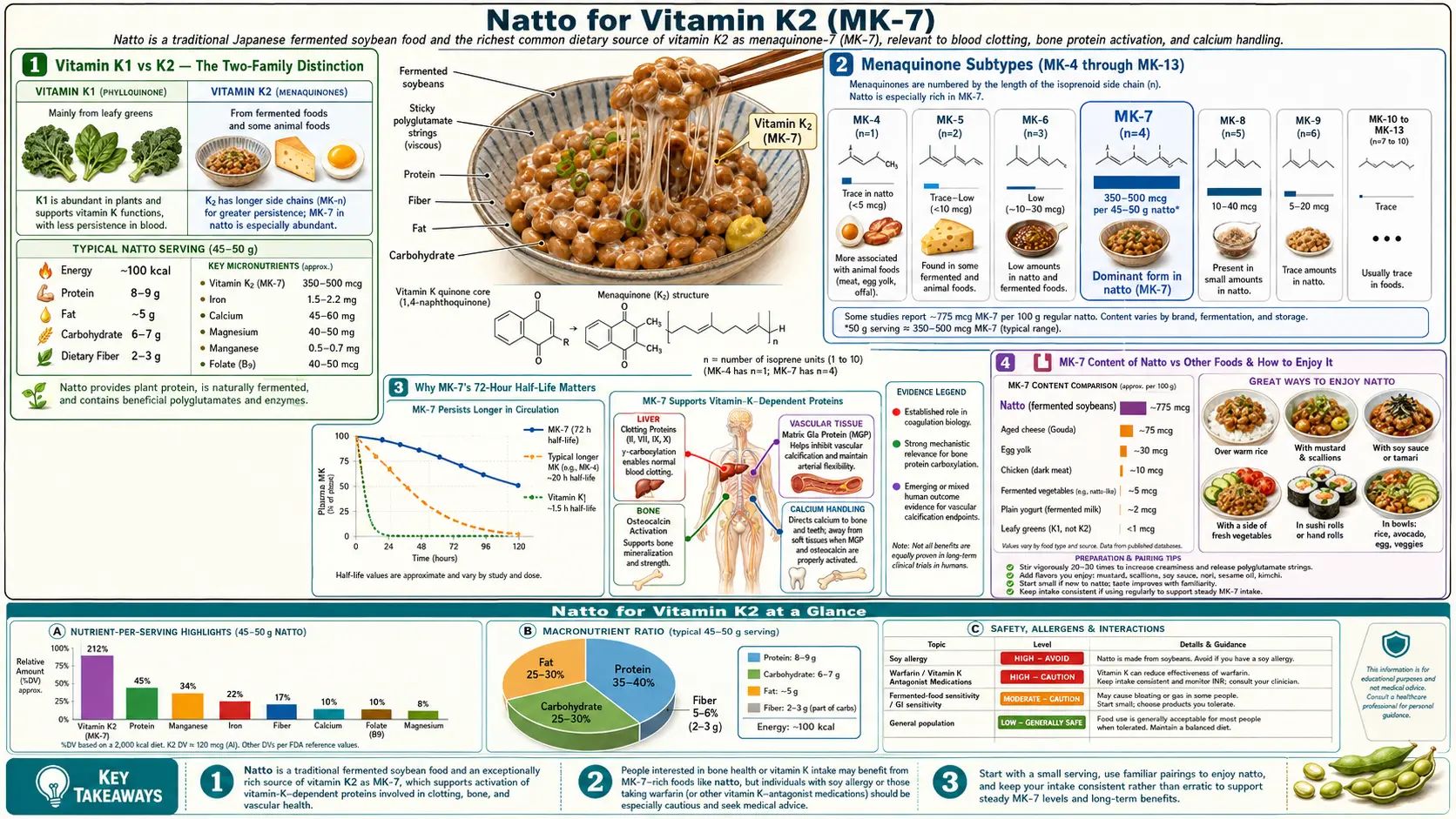
Natto, soybeans fermented with Bacillus subtilis var. natto, is the richest measured food source of menaquinone-7 (MK-7), a form of vitamin K2: food analyses have measured 939 µg of MK-7 per 100 g in Japan (Kamao 2007) and 996.5 µg per 100 g in the Netherlands (Vermeer 2018). MK-7 has a long side chain and a circulating half-life of about 3 days, against 1–2 hours for the MK-4 form found in meat and other animal foods (Knapen 2007). This page sets out the K1/K2 distinction, the menaquinone subtypes, what food analyses have measured, the vitamin K-dependent proteins osteocalcin and matrix Gla protein, the Rotterdam Study and other cohort data on menaquinone intake, the doses used in the MK-7 trials, and what the research reports about the interaction with warfarin.
Table of Contents
- Vitamin K1 vs K2 — The Two-Family Distinction
- Menaquinone Subtypes (MK-4, MK-7 and Longer Chains)
- MK-7's Half-Life of About Three Days
- Vitamin K2 Content of Natto vs Other Foods
- Osteocalcin Gamma-Carboxylation (Bone Mineralization)
- Matrix Gla Protein and Arterial Calcification
- Menaquinone Intake and Heart Disease: Rotterdam and Other Cohorts
- Doses Used in the Research
- Warfarin and Vitamin K Antagonists
- Key Research Papers
- Connections
- Featured Videos
Vitamin K1 vs K2 — The Two-Family Distinction
Vitamin K is not a single molecule but a family of structurally related naphthoquinone compounds, divided into two principal subgroups. Vitamin K1 (phylloquinone) is synthesized by plants and is the dominant form in green leafy vegetables — kale, spinach, collards, broccoli. K1 has a single phytyl side chain and is involved primarily in the synthesis of hepatic clotting factors II, VII, IX, and X. In Western diets most vitamin K intake is K1: in a Dutch cohort of 16,057 women, mean intake was 211.7 µg a day of K1 and 29.1 µg a day of K2 (Gast 2009).
Vitamin K2 (menaquinone) is synthesized by bacteria, including the bacteria in fermented foods and the flora of the human large intestine. Its side chain is built from repeating isoprene units, and the number of units defines the menaquinone subtype — MK-4 has four units, MK-7 has seven, MK-9 has nine, and so on. Different bacteria produce different menaquinone subtypes; the Bacillus subtilis var. natto used to ferment natto produces MK-7, which a Japanese food analysis found “characteristically in fermented soybean products such as natto” (Kamao 2007).
K1 and K2 are handled differently after absorption. Knapen and colleagues (2007) summarise volunteer studies in which both K1 and K2 were carried to the liver in triglyceride-rich lipoproteins, but only the K2 vitamins (MK-4 and MK-7) were also incorporated into LDL, the fraction that carries them to tissues outside the liver; in animal experiments K1 mainly accumulated in the liver. Theuwissen and colleagues (2012) note that while the clotting factors are essentially fully carboxylated under normal conditions, 10–40% of osteocalcin and matrix Gla protein — the bone and arterial vitamin K-dependent proteins — remains undercarboxylated.
In that trial, 42 healthy Dutch adults aged 18–45 were randomised to placebo or MK-7 at 10, 20, 45, 90, 180 or 360 µg a day. MK-7 at doses around the EU recommended daily allowance increased the carboxylation of circulating osteocalcin and matrix Gla protein, with no adverse effect on thrombin generation (Theuwissen 2012). That trial had no K1 arm; Schurgers 2007, which compared synthetic K1 with natto-derived MK-7 directly, found that MK-7 induced more complete carboxylation of osteocalcin.
Menaquinone Subtypes (MK-4, MK-7 and Longer Chains)
Within the K2 menaquinone family, side-chain length shapes how long the molecule stays in the blood: Knapen and colleagues (2007) describe a circulating half-life of about 1–2 hours for MK-4 and about 3 days for MK-7.
- MK-4 (menatetrenone) — four isoprene units, and the form found in meat and other animal foods. In a Dutch analysis, meat contained almost exclusively MK-4, probably originating from the synthetic menadione added to animal feed (Vermeer 2018). Half-life about 1–2 hours (Knapen 2007). In Japan, menatetrenone at 45 mg a day is used as a prescription osteoporosis drug; the bone trials gave it as three 15 mg doses a day (Knapen 2007).
- MK-7 — seven isoprene units, and the dominant menaquinone in natto: 996.5 of the 1,098.5 µg of total K2 per 100 g measured in natto (Vermeer 2018). Cheese carries only small amounts of MK-7 (1.6 µg per 100 g in Gouda ripened 26 weeks; none detected in Edam). Half-life about 3 days (Knapen 2007). The MK-7 trials discussed on this page used 10 to 360 µg a day.
- MK-8, MK-9 and MK-10 — longer chains made by the bacteria used in cheese-making. MK-9 was the largest single menaquinone in most of the Dutch cheeses analysed by Vermeer and colleagues (2018), alongside MK-4 and MK-8, and MK-10 appeared in a few cheeses such as Emmenthal. In the Prospect-EPIC cohort, the inverse association between K2 intake and coronary heart disease was mainly due to MK-7, MK-8 and MK-9 (Gast 2009). Most intervention trials have used MK-7 or MK-4, not these longer forms.
Natto's vitamin K2 is overwhelmingly MK-7. Vermeer and colleagues (2018) found that, except for natto, cheese had the highest menaquinone concentrations of the foods they measured, and that sauerkraut, the other fermented vegetable tested, had a total menaquinone content 200-fold lower than natto. The figures for individual foods are in the food-content section below.
MK-7's Half-Life of About Three Days
The pharmacokinetic profile of a Vitamin K subtype determines how long dietary or supplemental intake stays available to the Vitamin K-dependent extra-hepatic proteins (osteocalcin, matrix Gla protein, Gas6, periostin, and others). Activation requires the gamma-carboxylase enzyme to add a carboxyl group to specific glutamic acid residues, converting them to gamma-carboxyglutamate (Gla) residues. The Gla residues then bind calcium and carry out the protein's biological function.
Knapen and colleagues (2007) note that MK-4's very short half-life of 1–2 hours is the reason it was given three times a day, at 15 mg per dose, in the 45 mg-a-day bone trials, and that even this regimen results in fluctuating serum levels, which may explain the requirement for a high dose. For MK-7 they describe a half-life in the circulation of 3 days, resulting in more constant plasma levels and accumulation in the blood and tissues.
Schurgers and colleagues (2007) measured this in healthy volunteers. Synthetic K1 and natto-derived MK-7 were both absorbed well, with peak serum concentrations 4 hours after intake; the major difference was MK-7's very long half-life, which produced much more stable serum levels and accumulation to 7- to 8-fold higher levels during prolonged intake. In Kaneki 2001, natto intake resulted in a marked, sustained increase in serum MK-7.
Sato and colleagues (2012) gave healthy Japanese women a single 420 µg dose of MK-4 or MK-7 with a standardized breakfast. MK-7 reached its maximal serum level at 6 hours and was detected up to 48 hours after intake; MK-4 was not detectable in serum at any time point. At 60 µg a day for 7 days, MK-4 did not raise serum MK-4, while MK-7 raised serum MK-7 significantly in all subjects. On the food matrix: in six healthy men, circulating K2 after a meal of 200 g of natto was about 10 times higher than K1 after a meal of 400 g of spinach, and pure K1 was absorbed faster than food-bound vitamin K (serum peaks at 4 vs 6 hours) (Schurgers & Vermeer 2000).
Vitamin K2 Content of Natto vs Other Foods
The figures below come from one Dutch analysis that measured each menaquinone separately (Vermeer 2018). The paper reports nanograms per gram; they are given here as micrograms per 100 g (1 ng/g = 0.1 µg per 100 g). Natto's K2 was almost all MK-7, the cheeses carried mostly MK-9, along with MK-4 and MK-8, and little MK-7, and the meats carried only MK-4. The authors note that the menaquinone content of cheese varies substantially with the type of cheese, the ripening time, the fat content and the region where it is made.
- Natto, fermented soybean — 1,098.5 µg of total K2 per 100 g, of which 996.5 µg was MK-7 (Vermeer 2018); a Japanese analysis measured 939 µg of MK-7 per 100 g (Kamao 2007)
- Gouda, ripened 26 weeks — 72.9 µg per 100 g, mostly MK-9, then MK-4 (MK-7 1.6 µg)
- Camembert — 68.1 µg per 100 g, mostly MK-9, then MK-8 (MK-7 3.2 µg)
- Edam — 64.7 µg per 100 g, mostly MK-9 (no MK-7 detected)
- Cheddar — 23.5 µg per 100 g (MK-7 1.9 µg)
- Brie — 12.5 µg per 100 g, all MK-4
- Chicken meat — 10.1 µg per 100 g, all MK-4
- Parmesan (grana padano) — 0.3 µg per 100 g, which the authors describe as almost negligible
- Sauerkraut — 5.5 µg per 100 g, the only other fermented vegetable tested
Natto's MK-7 shows up in the blood of the people who eat it. Kaneki and colleagues (2001) measured serum MK-7 of 5.26 ng/mL in postmenopausal women in Tokyo, where natto is eaten frequently, 1.22 in Hiroshima, where it is seldom eaten, and 0.37 in British women; frequent natto eaters had significantly higher serum MK-7. The same study (covered on the Bone Density deep dive) found a statistically significant inverse correlation between hip-fracture incidence in women and natto consumption across Japan's prefectures. The authors suggest that higher MK-7 from natto may contribute to a lower fracture risk; this is an ecological correlation, not proof that natto prevents fractures.
Natto is a whole-soybean fermented food, and as a soy food it matters for people with soy allergy. In Japan, MK-7 from pulses (including fermented soybean foods) supplied 24.9% of total vitamin K intake in young women in eastern Japan (Kamao 2007).
Osteocalcin Gamma-Carboxylation (Bone Mineralization)
Osteocalcin is a small protein secreted by osteoblasts (bone-building cells). It contains three glutamic acid residues that are gamma-carboxylated in its active form. The Gla residues of the vitamin K-dependent proteins confer a high affinity for calcium, phosphate and hydroxyapatite crystals, the mineral components of the skeletal matrix (Munroe 1999). Undercarboxylated osteocalcin (ucOC) binds mineral poorly.
Circulating ucOC, or the ratio of undercarboxylated to carboxylated osteocalcin, is used in the research as a marker of vitamin K status (Knapen 2013). In the EPIDOS study of independently living French women over 75, women with ucOC in the highest quartile had an odds ratio of 1.9 (95% CI 1.2–3.0) for hip fracture, and 1.8 after adjustment for femoral neck bone density and gait speed; total osteocalcin was not associated with hip fracture (Vergnaud 1997). In a Japanese dose-finding trial, 60 postmenopausal women took 0, 50, 100 or 200 µg of MK-7 daily for 4 weeks: MK-7 raised the carboxylated-to-undercarboxylated osteocalcin ratio dose-dependently, with significant effects in the 100 and 200 µg groups compared with 0 µg. In a second trial in 120 adults aged 20–69, 100 µg a day for 12 weeks lowered ucOC compared with placebo, and the authors suggested that MK-7 intake of 100 µg a day or more improves osteocalcin carboxylation (Inaba 2015).
Vergnaud and colleagues proposed that ucOC measurement could be combined with bone-density measurement to improve the assessment of hip-fracture risk in elderly women. The studies cited here did not test whether a high ucOC predicts a response to MK-7 or to natto.
In the 3-year Dutch trial in 244 healthy postmenopausal women, 180 µg of MK-7 a day improved vitamin K status and decreased the age-related decline in bone mineral content and density at the lumbar spine and femoral neck, but not at the total hip; bone strength was also favourably affected (Knapen 2013). See the Bone Density deep dive for that trial and the regional Japanese hip fracture data.
Matrix Gla Protein and Arterial Calcification
Matrix Gla protein (MGP) is a vitamin K-dependent, mineral-binding protein made by vascular smooth-muscle cells and chondrocytes (Luo 1997). A 2008 review describes it as generally accepted to be a potent inhibitor of arterial calcification, although its mechanism at the molecular level is not completely understood, and notes that there seems to be no effective alternative mechanism for calcification inhibition in the vasculature; circulating uncarboxylated MGP has been studied as a biomarker of cardiovascular calcification (Schurgers 2008).
The evidence for MGP's role comes partly from loss of the protein. Mice lacking MGP develop to term but die within two months from arterial calcification that leads to blood-vessel rupture (Luo 1997; an animal study). In humans, mutations predicting a non-functional MGP cause Keutel syndrome, characterized by abnormal cartilage calcification, peripheral pulmonary stenosis and midfacial hypoplasia (Munroe 1999). And in a Dutch cross-sectional study of 19 patients under 55 who had used coumarin anticoagulants for more than 10 years, compared with 18 matched controls, the odds ratio for femoral arterial calcification was 8.5 (95% CI 2.01–35.95); the authors suggest inhibition of MGP carboxylation as a possible mechanism (Rennenberg 2010).
Two Dutch studies looked at menaquinone and the arteries directly. In a cross-sectional study of 564 postmenopausal women, the highest quartile of dietary menaquinone intake was associated with less coronary calcification than the lowest (RR 0.80, 95% CI 0.65–0.98), while phylloquinone intake was not associated (RR 1.17) (Beulens 2009). In a 3-year randomised trial in 244 healthy postmenopausal women, 180 µg of MK-7 a day decreased carotid-femoral pulse wave velocity and the stiffness index β in the total group, improved further measures of carotid stiffness in women whose baseline stiffness index was above the median, and lowered circulating desphospho-uncarboxylated MGP by 50% compared with placebo (Knapen 2015).
Products combining vitamin K2, vitamin D3 and calcium are promoted on the reasoning that vitamin D raises calcium absorption while vitamin K-dependent proteins govern where calcium is deposited. The trials cited on this page did not test whether adding K2 changes the cardiovascular outcomes of calcium or vitamin D supplements.
Related pages: Atherosclerosis and Vitamin K2.
Menaquinone Intake and Heart Disease: Rotterdam and Other Cohorts
The Rotterdam Study is a population-based Dutch cohort. Geleijnse and colleagues (2004) analysed 4,807 participants with dietary data and no history of myocardial infarction at baseline (1990–1993), followed until January 1, 2000, comparing tertiles of energy-adjusted vitamin K intake estimated by food-frequency questionnaire. Compared with the lowest tertile of menaquinone intake, the highest tertile had, after adjustment for age, gender, BMI, smoking, diabetes, education and dietary factors:
- a relative risk of 0.43 (95% CI 0.24–0.77) for coronary heart disease mortality
- a relative risk of 0.74 (0.59–0.92) for all-cause mortality
- an odds ratio of 0.48 (0.32–0.71) for severe aortic calcification
Phylloquinone (K1) intake was not related to any of these outcomes. These are observational associations with menaquinone from the whole Dutch diet, not from natto; Vermeer and colleagues (2018) describe cheese and curd as the most important sources of long-chain menaquinones in the Western diet.
Later cohorts:
- Prospect-EPIC (Netherlands) — 16,057 women aged 49–70, followed for a mean of 8.1 years with 480 incident cases of coronary heart disease. Each 10 µg a day of K2 intake carried a hazard ratio of 0.91 (95% CI 0.85–1.00), mainly due to MK-7, MK-8 and MK-9; K1 intake was not significantly related (Gast 2009).
- Hordaland Health Study (Norway) — 2,987 adults aged 46–49, median follow-up 11 years, 112 incident cases. The highest vs lowest quartile of K2 intake had a hazard ratio of 0.52 (0.29–0.94), attenuated to 0.58 (0.28–1.19) after further adjustment for dietary confounders; K1 was not associated (Haugsgjerd 2020).
- Danish Diet, Cancer and Health Study — 53,372 adults followed for a median of 21 years. The highest vs lowest K2 intake had a hazard ratio of 0.86 (0.81–0.91) for hospitalization with atherosclerotic cardiovascular disease; in this cohort K1 intake was also inversely associated (0.79, 0.74–0.84) (Bellinge 2021).
None of these cohorts studied natto. Their associations concern menaquinone from Western diets and do not show that eating natto prevents heart disease, and the studies cited on this page include no trial of natto itself on cardiovascular events.
Doses Used in the Research
The figures below are what reference values and trials report, not a recommended intake.
- Reference intakes: recommendations for total vitamin K intake are between 90 and 120 µg a day, based on the liver's requirement for clotting-factor synthesis (Knapen 2007). There is no separate official requirement for K2.
- MK-7 trials: 180 µg a day for 3 years in the Dutch bone-loss and arterial-stiffness trials in healthy postmenopausal women (Knapen 2013, 2015); 10 to 360 µg a day in the Dutch dose-response trial (Theuwissen 2012); 50 to 200 µg a day for 4 weeks and 100 µg a day for 12 weeks in the Japanese trials (Inaba 2015). Schurgers 2007 compared natto-derived MK-7 with synthetic K1 and found MK-7 lasted far longer in the blood and carboxylated osteocalcin more completely.
- Natto as food: natto has been measured at 939 µg of MK-7 per 100 g (Kamao 2007), and eating it produced a marked, sustained rise in serum MK-7 (Kaneki 2001). The trials above used MK-7 capsules, not natto, so their outcomes are for the isolated vitamin.
- MK-4 (Japanese pharmaceutical): 45 mg a day of menatetrenone, given as three 15 mg doses, in the Japanese and Dutch bone trials; at this dose, Knapen and colleagues note, the vitamin is used as a drug rather than as a food supplement (Knapen 2007).
Vitamin K is fat-soluble, and the absorption studies cited here gave their doses with a meal (Sato 2012: a standardized breakfast). The interaction with warfarin is covered in the next section.
Broader context on vitamin K2 supplementation is on the Vitamin K2 page.
Warfarin and Vitamin K Antagonists
Warfarin and the other vitamin K antagonists (VKAs) inhibit the vitamin K epoxide reductase complex (VKORC1), limiting the reduced vitamin K available to the gamma-carboxylase enzyme. This reduces the gamma-carboxylation of clotting factors II, VII, IX, and X, producing anticoagulation. The extra-hepatic proteins are affected too: in healthy volunteers, the VKA acenocoumarol raised uncarboxylated osteocalcin and desphospho-uncarboxylated MGP (Theuwissen 2013), and long-term coumarin use was associated with more femoral arterial calcification (Rennenberg 2010).
Added vitamin K, K1 or K2, opposes the drug: the INR (international normalized ratio, the warfarin monitoring test) falls and anticoagulation weakens. Fluctuations in INR are often ascribed to dietary changes in vitamin K intake (Schurgers & Vermeer 2000).
What the research reports for natto and MK-7:
- Natto. Japanese researchers describe natto, with its high MK-7 content, as a food that “must be avoided by warfarin-dependent patients” (Nakajima 2021). In their trial, a natto made with a mutant B. subtilis strain yielding 19–24% of the normal MK-7 content did not change PT-INR in 10 warfarin-dependent patients over 7 days at up to 20 g a day (46 µg of MK-7), although 20 g a day did raise plasma MK-7.
- Low MK-7 doses. Schurgers and colleagues (2007) concluded that preparations supplying 50 µg a day or more of MK-7 “may interfere with oral anticoagulant treatment in a clinically relevant way.” In Theuwissen 2013, 18 healthy volunteers were anticoagulated with acenocoumarol (15 reached a target INR of 2.0); 45 µg a day of MK-7 lowered the group mean INR by about 40%, and 10 and 20 µg a day were judged by two hematologists to cause a clinically relevant INR lowering in at least 40% and 60% of subjects.
- Long half-life. MK-7's circulating half-life of about 3 days (Knapen 2007) means it stays in the blood for days after intake.
- Direct oral anticoagulants (apixaban, rivaroxaban, dabigatran, edoxaban) inhibit factor Xa or thrombin directly rather than acting on the vitamin K cycle; the interaction studies above tested vitamin K antagonists only.
- K2 alongside a VKA. It has been proposed that extra K2 might offset a VKA's effect on the bone and arterial proteins without affecting clotting. In Theuwissen 2013, 10–45 µg a day of MK-7 lowered the INR but did not change circulating uncarboxylated osteocalcin or MGP, and the authors concluded that “the use of MK-7 supplements needs to be avoided in patients receiving VKA therapy.”
Decisions about vitamin K intake, especially alongside anticoagulants, belong with a clinician.
Nattokinase, a separate fibrinolytic enzyme from natto, is not vitamin K2 and is covered on the Nattokinase deep dive. A case report describes a patient with a mechanical aortic valve who substituted nattokinase for warfarin; after nearly a year without warfarin, thrombus formed on the valve and the valve was replaced again (Elahi 2015).
Key Research Papers
- Schurgers LJ, Vermeer C (2000). Determination of phylloquinone and menaquinones in food. Effect of food matrix on circulating vitamin K concentrations. Haemostasis 30(6):298-307. — PubMed PMID: 11356998
- Vermeer C, Raes J, van 't Hoofd C, Knapen MHJ, Xanthoulea S (2018). Menaquinone Content of Cheese. Nutrients 10(4):446. — PubMed PMID: 29617314
- Schurgers LJ et al. (2007). Vitamin K-containing dietary supplements: comparison of synthetic vitamin K1 and natto-derived menaquinone-7. Blood 109(8):3279-83. — PubMed PMID: 17158229
- Sato T, Schurgers LJ, Uenishi K (2012). Comparison of menaquinone-4 and menaquinone-7 bioavailability in healthy women. Nutrition Journal 11:93. — PubMed PMID: 23140417
- Geleijnse JM et al. (2004). Dietary intake of menaquinone is associated with a reduced risk of coronary heart disease: the Rotterdam Study. J Nutr 134(11):3100-5. — PubMed PMID: 15514282
- Gast GC et al. (2009). A high menaquinone intake reduces the incidence of coronary heart disease. Nutr Metab Cardiovasc Dis 19(7):504-10. — PubMed PMID: 19179058
- Beulens JW et al. (2009). High dietary menaquinone intake is associated with reduced coronary calcification. Atherosclerosis 203(2):489-93. — PubMed PMID: 18722618
- Knapen MH, Drummen NE, Smit E, Vermeer C, Theuwissen E (2013). Three-year low-dose menaquinone-7 supplementation helps decrease bone loss in healthy postmenopausal women. Osteoporosis Int 24(9):2499-507. — PubMed PMID: 23525894
- Knapen MH, Braam LA, Drummen NE, Bekers O, Hoeks AP, Vermeer C (2015). Menaquinone-7 supplementation improves arterial stiffness in healthy postmenopausal women. A double-blind randomised clinical trial. Thromb Haemost 113(5):1135-44. — PubMed PMID: 25694037
- Theuwissen E et al. (2012). Low-dose menaquinone-7 supplementation improved extra-hepatic vitamin K status, but had no effect on thrombin generation in healthy subjects. Br J Nutr 108(9):1652-7. — PubMed PMID: 22289649
- Inaba N, Sato T, Yamashita T (2015). Low-dose daily intake of vitamin K2 (menaquinone-7) improves osteocalcin γ-carboxylation: a double-blind, randomized controlled trials. J Nutr Sci Vitaminol 61(6):471-80. — PubMed PMID: 26875489
- Schurgers LJ, Cranenburg EC, Vermeer C (2008). Matrix Gla-protein: the calcification inhibitor in need of vitamin K. Thromb Haemost 100(4):593-603. — PubMed PMID: 18841280
- Halder M et al. (2019). Vitamin K: double bonds beyond coagulation insights into differences between vitamin K1 and K2 in health and disease. Int J Mol Sci 20(4):896. — PubMed PMID: 30791399
- Kamao M et al. (2007). Vitamin K content of foods and dietary vitamin K intake in Japanese young women. J Nutr Sci Vitaminol 53(6):464-70. — PubMed PMID: 18202532
- Knapen MH, Schurgers LJ, Vermeer C (2007). Vitamin K2 supplementation improves hip bone geometry and bone strength indices in postmenopausal women. Osteoporosis Int 18(7):963-72. — PubMed PMID: 17287908
- Kaneki M et al. (2001). Japanese fermented soybean food as the major determinant of the large geographic difference in circulating levels of vitamin K2: possible implications for hip-fracture risk. Nutrition 17(4):315-21. — PubMed PMID: 11369171
- Vergnaud P et al. (1997). Undercarboxylated osteocalcin measured with a specific immunoassay predicts hip fracture in elderly women: the EPIDOS Study. J Clin Endocrinol Metab 82(3):719-24. — PubMed PMID: 9062471
- Luo G et al. (1997). Spontaneous calcification of arteries and cartilage in mice lacking matrix GLA protein. Nature 386(6620):78-81. — PubMed PMID: 9052783
- Munroe PB et al. (1999). Mutations in the gene encoding the human matrix Gla protein cause Keutel syndrome. Nat Genet 21(1):142-4. — PubMed PMID: 9916809
- Rennenberg RJ et al. (2010). Chronic coumarin treatment is associated with increased extracoronary arterial calcification in humans. Blood 115(24):5121-3. — PubMed PMID: 20354170
- Haugsgjerd TR et al. (2020). Association of dietary vitamin K and risk of coronary heart disease in middle-age adults: the Hordaland Health Study Cohort. BMJ Open 10(5):e035953. — PubMed PMID: 32444431
- Bellinge JW et al. (2021). Vitamin K intake and atherosclerotic cardiovascular disease in the Danish Diet Cancer and Health Study. J Am Heart Assoc 10(16):e020551. — PubMed PMID: 34369182
- Theuwissen E et al. (2013). Effect of low-dose supplements of menaquinone-7 (vitamin K2) on the stability of oral anticoagulant treatment: dose-response relationship in healthy volunteers. J Thromb Haemost 11(6):1085-92. — PubMed PMID: 23530987
- Nakajima T et al. (2021). First clinical trial of a newly developed, low menaquinone-7, fermented soybean natto in warfarin-dependent patients. J Med Food 24(8):860-5. — PubMed PMID: 34406879
- Elahi MM, Choi CH, Konda S, Shake JG (2015). Consequence of patient substitution of nattokinase for warfarin after aortic valve replacement with a mechanical prosthesis. Proc (Bayl Univ Med Cent) 28(1):81-2. — PubMed PMID: 25552810