Natto for Nattokinase and Fibrinolysis
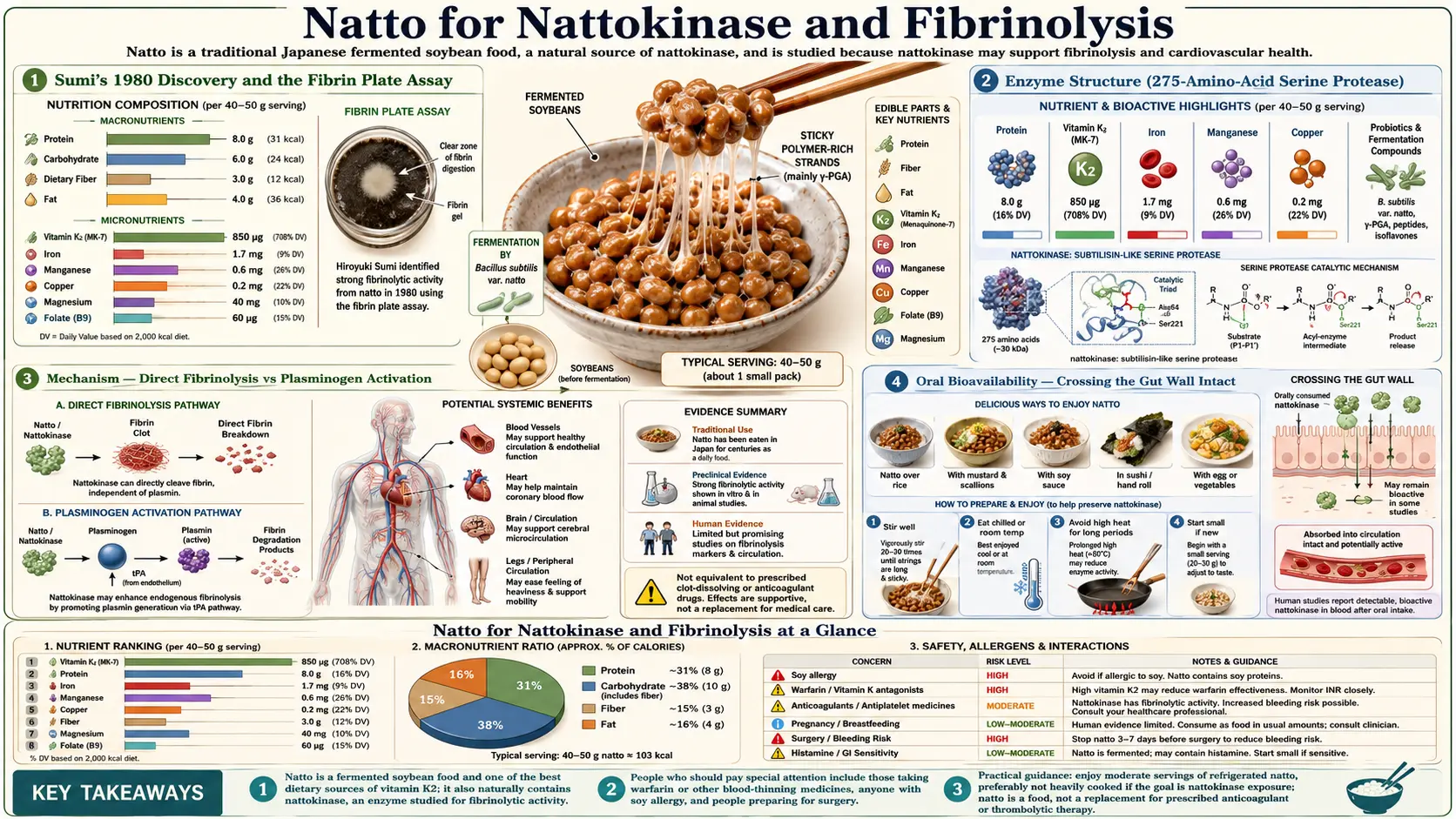
Nattokinase is a fibrin-digesting enzyme made by Bacillus subtilis var. natto when soybeans are fermented into natto. Sumi and colleagues reported it in 1987, and Fujita and colleagues purified and sequenced it in 1993: a subtilisin-like serine protease of 275 amino acids. The human evidence is small. Short studies found falls in clotting factors, rises in clot-breakdown markers and a modest fall in blood pressure (Hsia 2009; Kurosawa 2015; Kim 2008), while the longest trial, in 265 adults followed for a median of 3 years, found no effect on carotid artery thickening, blood pressure or any laboratory measure (Hodis 2021). How much of the enzyme reaches the bloodstream after a capsule is unresolved (Chen 2018), and case reports describe serious bleeding in people taking nattokinase, one of them also taking aspirin. This page covers the discovery, the enzyme, its proposed mechanisms, absorption, the FU activity unit, the human studies, one long-haul-flight trial, and the bleeding reports.
Table of Contents
- Sumi's Discovery and the 1987 Report
- Enzyme Structure (275-Amino-Acid Serine Protease)
- Mechanism — Direct Fibrinolysis vs Plasminogen Activation
- Oral Bioavailability — What Is Known About Absorption
- FU Activity Units and the Doses Used in Studies
- Human Studies — Hsia, Kurosawa, Kim and the NEAT Trial
- Long-Haul Flights and Venous Thrombosis — One Trial
- Natto as a Food and Nattokinase Capsules
- Bleeding Reports and Drug Interactions
- Key Research Papers
- Connections
- Featured Videos
Sumi's Discovery and the 1987 Report
A 2017 review dates the discovery to 1980, when Hiroyuki Sumi, then a researcher at a medical school in Chicago, found that natto dissolves artificial fibrin (Weng 2017). The first report of the enzyme was published in Experientia in 1987 by Sumi and colleagues at Miyazaki Medical College in Japan. They measured a strong fibrinolytic activity in natto, about 40 CU (plasmin units) per gram of wet weight, extracted the enzyme with saline and named it nattokinase. In that report its molecular weight was about 20,000 and its isoelectric point 8.6; the enzyme digested fibrin and a synthetic plasmin substrate (S-2251), and diisopropyl fluorophosphate strongly inhibited it (Sumi 1987).
In a 1990 report the same group described a mild enhancement of fibrinolytic activity in plasma, with production of tissue plasminogen activator, after oral nattokinase or natto. In dogs with experimentally induced thrombosis, nattokinase capsules given by mouth were followed by lysis of the thrombi on angiography (Sumi 1990).
Despite the name, nattokinase is not a kinase: Fujita and colleagues characterised it as a subtilisin-like serine protease (Fujita 1993). Urano and colleagues refer to the same enzyme as subtilisin NAT, formerly designated BSP (Urano 2001).
Enzyme Structure (275-Amino-Acid Serine Protease)
Fujita and colleagues purified nattokinase from natto by three chromatography steps and sequenced it by Edman degradation. It consisted of 275 amino acid residues, with a molecular weight of 27,728, and showed high homology with the subtilisins. It digested fibrin and several synthetic substrates, the most sensitive being the subtilisin substrate Suc-Ala-Ala-Pro-Phe-pNA, and the serine-protease inhibitor PMSF blocked both its fibrinolytic and its amidolytic activity (Fujita 1993). Urano and colleagues measured a molecular mass of 27.7 kDa for the enzyme they purified (Urano 2001).
A 2017 review states that nattokinase resists a temperature of 50°C and pH up to 10, and that the bacterium B. subtilis (natto) itself maintains activity at pH 6–12 and resists temperatures up to 60°C (Weng 2017).
Mechanism — Direct Fibrinolysis vs Plasminogen Activation
In the body's own fibrinolytic system, the inactive proenzyme plasminogen is converted to the active enzyme plasmin, and plasmin degrades fibrin into soluble fibrin degradation products. Two physiological plasminogen activators carry out that conversion, tissue-type (t-PA) and urokinase-type (u-PA). The system is held in check by plasminogen activator inhibitors (PAI) and, at the level of plasmin, mainly by alpha-2-antiplasmin (Lijnen 2001). The clot-dissolving drugs used in hospitals include the first-generation agents streptokinase and urokinase and recombinant plasminogen activators such as alteplase (Kotb 2014).
Laboratory studies describe nattokinase acting at more than one point in this system:
- Direct digestion of fibrin — seen in fibrin assays (Sumi 1987; Fujita 1993), and in a clot-lysis experiment in which the enhancement seen without PAI-1 was attributed to direct fibrin dissolution (Urano 2001).
- Conversion of pro-urokinase to urokinase — described in two reviews (Weng 2017; Chen 2018).
- Cleavage of PAI-1 — nattokinase cut recombinant PAI-1 at its reactive site and inactivated it, and it enhanced tPA-induced fibrin clot lysis by 48% without PAI-1 and by 78% with PAI-1 present, at 1 nM (Urano 2001).
In an animal study, natto extract containing nattokinase, added to the diet of rats, suppressed thickening of the artery lining after endothelial injury, and thrombi near the vessel wall showed lysis (Suzuki 2003). In another, nattokinase inhibited collagen- and thrombin-induced aggregation of rabbit platelets in the test tube, and in rats given nattokinase by mouth for a week it delayed chemically induced carotid artery occlusion in a dose-dependent manner, doubling the occlusion time at 160 mg/kg (Jang 2013). Pais and colleagues incubated blood samples with nattokinase for 30 minutes and found dose-dependent decreases in red-blood-cell aggregation and low-shear blood viscosity; this was an in vitro study, not a study of people given the enzyme (Pais 2006).
These are laboratory and animal findings. Whether the same mechanisms operate in people after oral nattokinase depends on how much of the enzyme reaches the blood, which is covered next.
Oral Bioavailability — What Is Known About Absorption
Whether an enzyme of this size survives digestion and crosses the gut wall is the main open question about oral nattokinase. A 2018 review states that there is no convincing data on the bioavailability and metabolism of nattokinase taken by mouth, that the pilot pharmacokinetic data are inconsistent and mismatched with the measured effects, and that several groups consider the molecule generally too large for oral absorption through the gut (Chen 2018).
The animal evidence comes from rats: nattokinase placed directly into the duodenum at 80 mg/kg was followed by breakdown of fibrinogen in plasma, markedly prolonged plasma recalcification times, and detection of the enzyme in plasma at 3 and 5 hours (Fujita 1995). The 2018 review notes that this route bypassed gastric fluid and that the dose was high in pharmacological terms (Chen 2018).
In people, a pilot study gave 11 healthy adults a single 2,000 FU capsule; an immunoassay detected nattokinase in serum, with a peak at about 13.3 hours. The authors called for a larger pharmacokinetic study and for work on whether intact enzyme or nattokinase peptides were being measured (Ero 2013). The human studies below measured clotting and fibrinolysis markers rather than the enzyme itself.
FU Activity Units and the Doses Used in Studies
Nattokinase activity is expressed in fibrinolytic units (FU). The human studies on this page used capsules of 2,000 FU, and in one pilot study each 2,000 FU capsule contained approximately 100 mg of nattokinase (Ero 2013). The doses reported:
- One dose: a single 2,000 FU dose, in the crossover study of 12 young men (Kurosawa 2015) and the pilot absorption study (Ero 2013).
- 2,000 FU capsules for 8 weeks: the blood-pressure trial (Kim 2008).
- Two 2,000 FU capsules a day for 2 months: the fibrinogen study (Hsia 2009).
- 2,000 FU or placebo for a median of 3 years: the NEAT trial (Hodis 2021).
Sumi's 1987 report expressed natto's own activity in a different unit, about 40 CU (plasmin units) per gram of wet weight (Sumi 1987). The studies cited here give no conversion between that unit and FU, and none reports the FU content of a serving of natto. A 2017 review notes that measured nattokinase activity varies with the purification method used (Weng 2017).
Human Studies — Hsia, Kurosawa, Kim and the NEAT Trial
- Hsia CH et al. (2009) — Nutrition Research. An open-label, self-controlled study with no placebo group. Forty-five people in three groups (healthy volunteers, people with cardiovascular risk factors, and people on dialysis) took two 2,000 FU capsules of nattokinase a day for 2 months. Fibrinogen, factor VII and factor VIII declined over time in all groups: by 9%, 14% and 17% in the healthy group; by 7%, 13% and 19% in the cardiovascular-risk group; and by 10%, 7% and 19% in the dialysis group. Blood lipids did not change, and no notable adverse events were observed.
- Kurosawa Y et al. (2015) — Scientific Reports. A double-blind, placebo-controlled crossover study in 12 healthy young men given a single 2,000 FU dose. D-dimer rose at 6 and 8 hours and fibrin/fibrinogen degradation products at 4 hours; factor VIII activity fell at 4 and 6 hours; antithrombin was higher at 2 and 4 hours; and the activated partial thromboplastin time was prolonged at 2 and 4 hours. All of these changes stayed within the normal range.
- Kim JY et al. (2008) — Hypertension Research. A randomized, double-blind, placebo-controlled trial in 86 people aged 20 to 80 with untreated systolic pressure of 130 to 159 mmHg (pre-hypertension or stage 1 hypertension), given 2,000 FU nattokinase capsules or placebo for 8 weeks; 73 completed it. Compared with placebo, the net change was −5.55 mmHg systolic (95% CI −10.5 to −0.57) and −2.84 mmHg diastolic (95% CI −5.33 to −0.33), with a net change in renin activity of −1.17 ng/mL/h.
- Hodis HN et al. (2021) — the Nattokinase Atherothrombotic Prevention Study (NEAT), Clinical Hemorheology & Microcirculation. A double-blind trial in 265 people, median age 65.3, without clinical cardiovascular disease, randomized to nattokinase 2,000 FU or matching placebo. Carotid intima-media thickness and carotid arterial stiffness were measured by ultrasound every 6 months. After a median of 3 years, their rates of change did not differ significantly between nattokinase and placebo, and there was no significant effect on blood pressure or on any laboratory measure, including blood rheology, coagulation and fibrinolysis factors and inflammatory markers. The authors concluded that nattokinase had a null effect on subclinical atherosclerosis progression in healthy people at low cardiovascular risk.
- Pais E et al. (2006) — Clinical Hemorheology & Microcirculation. Not a human trial: blood samples were incubated with nattokinase in the test tube, and red-blood-cell aggregation and low-shear viscosity fell in a dose-dependent manner. The authors described the data as preliminary and called for clinical trials.
Taken together, the short studies were small: Hsia's had no placebo group, Kurosawa's tested one dose in 12 people, and Kim's ran for 8 weeks. The one long trial, NEAT, found no effect on carotid artery thickening or stiffness, blood pressure, or any laboratory measure over a median of 3 years. A 2018 review describes nattokinase as an ideal drug candidate for cardiovascular disease (Chen 2018); the NEAT results were published three years later.
Long-Haul Flights and Venous Thrombosis — One Trial
One randomized trial has tested a nattokinase-containing product on long-haul flights. In the LONFLIT-FLITE study (Angiology, 2003), Cesarone and colleagues gave high-risk passengers on 7–8 hour flights either an oral profibrinolytic tablet, described in the abstract as 150 mg “pinokinase”, or placebo; PubMed indexes the tablet as a drug combination of nattokinase and pine bark extract. Both groups followed an exercise program. Of 300 people screened, 204 were randomized, and 94 of 101 in the treatment group and 92 of 103 controls completed the study. Leg veins were scanned by ultrasound before and within 90 minutes after the flights. No deep vein thrombosis was seen in the treatment group; in the control group 5 people (5.4%) had a deep vein thrombosis and 2 had a superficial thrombosis. In the intention-to-treat analysis, which counted people lost to follow-up as failures, the failure rate was 19.6% among controls and 7.4% with the tablet (p < 0.05). All the events were asymptomatic (Cesarone 2003).
A 2021 systematic review of foods and supplements marketed for air travel found this to be the only study of the tablet and rated it at high risk of bias (Chan 2021). Because the tablet combined two ingredients, the trial does not show which of them, if either, accounted for the result. As of October 2026, neither PubMed nor Crossref lists a retraction, expression of concern or correction for this paper.
Thrombosis during travel is covered on the Deep Vein Thrombosis page.
Natto as a Food and Nattokinase Capsules
The human studies on this page tested nattokinase as capsules (Hsia 2009; Kurosawa 2015; Kim 2008; Hodis 2021); Sumi's 1990 report used nattokinase or natto (Sumi 1990). None of the studies cited here compared a serving of natto with a nattokinase capsule.
- Activity: natto's fibrinolytic activity was reported as about 40 CU per gram in 1987 (Sumi 1987), while capsules are described in FU; no conversion between the two is given in the studies cited here.
- Vitamin K2: natto also supplies menaquinone-7 (MK-7), measured at 939 µg per 100 g in a Japanese analysis (Kamao 2007). MK-7 is covered on the Vitamin K2 deep dive, and its interaction with warfarin is described in the next section.
- Taste and texture: natto's aroma and sticky threads are covered in the Acquired Taste Tips deep dive.
Bleeding Reports and Drug Interactions
A 2018 review states that potential drug interactions and contraindications of nattokinase in humans are not currently known (Chen 2018). What the published reports describe:
- Aspirin — a case report describes an acute cerebellar hemorrhage in a patient taking aspirin for secondary stroke prevention, after 7 days of nattokinase at 400 mg a day; brain MRI also showed multiple microbleeds. The authors suggest that nattokinase may increase the risk of intracerebral hemorrhage in people with bleeding-prone cerebral microangiopathy who are taking another antithrombotic agent (Chang 2008).
- Fatal bleeding — a case report describes hemoperitoneum in an elderly woman taking nattokinase, who died; the authors warn against herbal supplements, especially nattokinase (Ramachandran 2021).
- Warfarin replaced by nattokinase — a patient with a mechanical aortic valve substituted nattokinase for warfarin; after nearly a year, thrombus formed on the valve and it was replaced again. The authors strongly discourage nattokinase for this purpose (Elahi 2015).
- Clotting tests — a single 2,000 FU dose prolonged the activated partial thromboplastin time, within the normal range (Kurosawa 2015); over a median of 3 years, the NEAT trial found no significant effect on any laboratory measure, including coagulation and fibrinolysis factors (Hodis 2021).
- Natto, vitamin K and warfarin — Japanese researchers write that natto, because of its MK-7 content, “must be avoided by warfarin-dependent patients”. In their 7-day trial in 10 warfarin-dependent patients, a natto made with a low-MK-7 strain did not change PT-INR at up to 20 g a day (Nakajima 2021). This concerns the vitamin K in the food, not nattokinase.
- Natto allergy — anaphylaxis from nattokinase has been reported in a patient with natto allergy (Awatani-Yoshidome 2022).
- Adverse events in the trials — Hsia and colleagues observed no notable adverse events over 2 months (Hsia 2009).
Apart from the aspirin case report, the studies cited here did not test nattokinase together with warfarin, direct oral anticoagulants or antiplatelet drugs. Decisions about nattokinase alongside these drugs belong with a clinician.
Key Research Papers
- Sumi H, Hamada H, Tsushima H, Mihara H, Muraki H (1987). A novel fibrinolytic enzyme (nattokinase) in the vegetable cheese Natto; a typical and popular soybean food in the Japanese diet. Experientia 43(10):1110–1111. — PubMed PMID: 3478223
- Sumi H, Hamada H, Nakanishi K, Hiratani H (1990). Enhancement of the fibrinolytic activity in plasma by oral administration of nattokinase. Acta Haematologica 84(3):139–143. — PubMed PMID: 2123064
- Fujita M, Nomura K, Hong K, Ito Y, Asada A, Nishimuro S (1993). Purification and characterization of a strong fibrinolytic enzyme (nattokinase) in the vegetable cheese natto, a popular soybean fermented food in Japan. Biochemical and Biophysical Research Communications 197(3):1340–1347. — PubMed PMID: 8280151
- Hsia CH, Shen MC, Lin JS, Wen YK, Hwang KL, Cham TM, Yang NC (2009). Nattokinase decreases plasma levels of fibrinogen, factor VII, and factor VIII in human subjects. Nutrition Research 29(3):190–196. — PubMed PMID: 19358933
- Kurosawa Y, Nirengi S, Homma T, Esaki K, Ohta M, Clark JF, Hamaoka T (2015). A single-dose of oral nattokinase potentiates thrombolysis and anti-coagulation profiles. Scientific Reports 5:11601. — PubMed PMID: 26109079
- Kim JY, Gum SN, Paik JK, Lim HH, Kim KC, Ogasawara K, et al. (2008). Effects of nattokinase on blood pressure: a randomized, controlled trial. Hypertension Research 31(8):1583–1588. — PubMed PMID: 18971533
- Chen H, McGowan EM, Ren N, Lal S, Nassif N, Shad-Kaneez F, et al. (2018). Nattokinase: a promising alternative in prevention and treatment of cardiovascular diseases. Biomarker Insights 13:1177271918785130. — PubMed PMID: 30013308 (review)
- Jang JY, Kim TS, Cai J, Kim J, Kim Y, Shin K, et al. (2013). Nattokinase improves blood flow by inhibiting platelet aggregation and thrombus formation. Laboratory Animal Research 29(4):221–225. — PubMed PMID: 24396387 (rabbit platelets and rats)
- Suzuki Y, Kondo K, Matsumoto Y, Zhao BQ, Otsuguro K, Maeda T, et al. (2003). Dietary supplementation of fermented soybean, natto, suppresses intimal thickening and modulates the lysis of mural thrombi after endothelial injury in rat femoral artery. Life Sciences 73(10):1289–1298. — PubMed PMID: 12850244 (rats)
- Pais E, Alexy T, Holsworth RE Jr, Meiselman HJ (2006). Effects of nattokinase, a pro-fibrinolytic enzyme, on red blood cell aggregation and whole blood viscosity. Clinical Hemorheology and Microcirculation 35(1–2):139–142. — PubMed PMID: 16899918 (in vitro study)
- Cesarone MR, Belcaro G, Nicolaides AN, Ricci A, Geroulakos G, Ippolito E, et al. (2003). Prevention of venous thrombosis in long-haul flights with [a nattokinase and pine bark combination tablet]: the LONFLIT-FLITE randomized, controlled trial. Angiology 54(5):531–539. — PubMed PMID: 14565628 (product name in the published title replaced by its category; rated at high risk of bias in Chan 2021)
- Weng Y, Yao J, Sparks S, Wang KY (2017). Nattokinase: an oral antithrombotic agent for the prevention of cardiovascular disease. International Journal of Molecular Sciences 18(3):523. — PubMed PMID: 28264497 (review)
- Hodis HN, Mack WJ, Meiselman HJ, Kalra V, Liebman H, Hwang-Levine J, et al. (2021). Nattokinase atherothrombotic prevention study: a randomized controlled trial. Clinical Hemorheology and Microcirculation 78(4):339–353. — PubMed PMID: 33843667
- Urano T, Ihara H, Umemura K, Suzuki Y, Oike M, Akita S, et al. (2001). The profibrinolytic enzyme subtilisin NAT purified from Bacillus subtilis cleaves and inactivates plasminogen activator inhibitor type 1. Journal of Biological Chemistry 276(27):24690–24696. — PubMed PMID: 11325965 (laboratory study)
- Fujita M, Hong K, Ito Y, Misawa S, Takeuchi N, Kariya K, Nishimuro S (1995). Transport of nattokinase across the rat intestinal tract. Biological and Pharmaceutical Bulletin 18(9):1194–1196. — PubMed PMID: 8845803 (rats)
- Ero MP, Ng CM, Mihailovski T, Harvey NR, Lewis BH (2013). A pilot study on the serum pharmacokinetics of nattokinase in humans following a single, oral, daily dose. Alternative Therapies in Health and Medicine 19(3):16–19. — PubMed PMID: 23709455
- Lijnen HR (2001). Elements of the fibrinolytic system. Annals of the New York Academy of Sciences 936:226–236. — PubMed PMID: 11460480 (review)
- Kotb E (2014). The biotechnological potential of fibrinolytic enzymes in the dissolution of endogenous blood thrombi. Biotechnology Progress 30(3):656–672. — PubMed PMID: 24799449 (review)
- Chan V, Wang L, Allman-Farinelli M (2021). Efficacy of functional foods, beverages, and supplements claiming to alleviate air travel symptoms: systematic review and meta-analysis. Nutrients 13(3):961. — PubMed PMID: 33809656
- Kamao M, Suhara Y, Tsugawa N, Uwano M, Yamaguchi N, Uenishi K, et al. (2007). Vitamin K content of foods and dietary vitamin K intake in Japanese young women. Journal of Nutritional Science and Vitaminology 53(6):464–470. — PubMed PMID: 18202532
- Chang YY, Liu JS, Lai SL, Wu HS, Lan MY (2008). Cerebellar hemorrhage provoked by combined use of nattokinase and aspirin in a patient with cerebral microbleeds. Internal Medicine 47(5):467–469. — PubMed PMID: 18310985 (case report)
- Ramachandran L, Aqeel A, Jafri A, Sidhu Y, Mohamed Djirdeh T (2021). Nattokinase-associated hemoperitoneum in an elderly woman. Cureus 13(12):e20074. — PubMed PMID: 35003944 (case report)
- Elahi MM, Choi CH, Konda S, Shake JG (2015). Consequence of patient substitution of nattokinase for warfarin after aortic valve replacement with a mechanical prosthesis. Proceedings (Baylor University Medical Center) 28(1):81–82. — PubMed PMID: 25552810 (case report)
- Nakajima T, Taya Y, Nishikawa T, Kitamura Y, Kato H, Mathis BJ, Hiramatsu Y (2021). First clinical trial of a newly developed, low menaquinone-7, fermented soybean natto in warfarin-dependent patients. Journal of Medicinal Food 24(8):860–865. — PubMed PMID: 34406879
- Awatani-Yoshidome K, Hashimoto T, Satoh T (2022). Anaphylaxis from nattokinase in a patient with fermented soybean (natto) allergy. Allergology International 71(1):153–154. — PubMed PMID: 34452810 (case report)