Natto for Bone Density
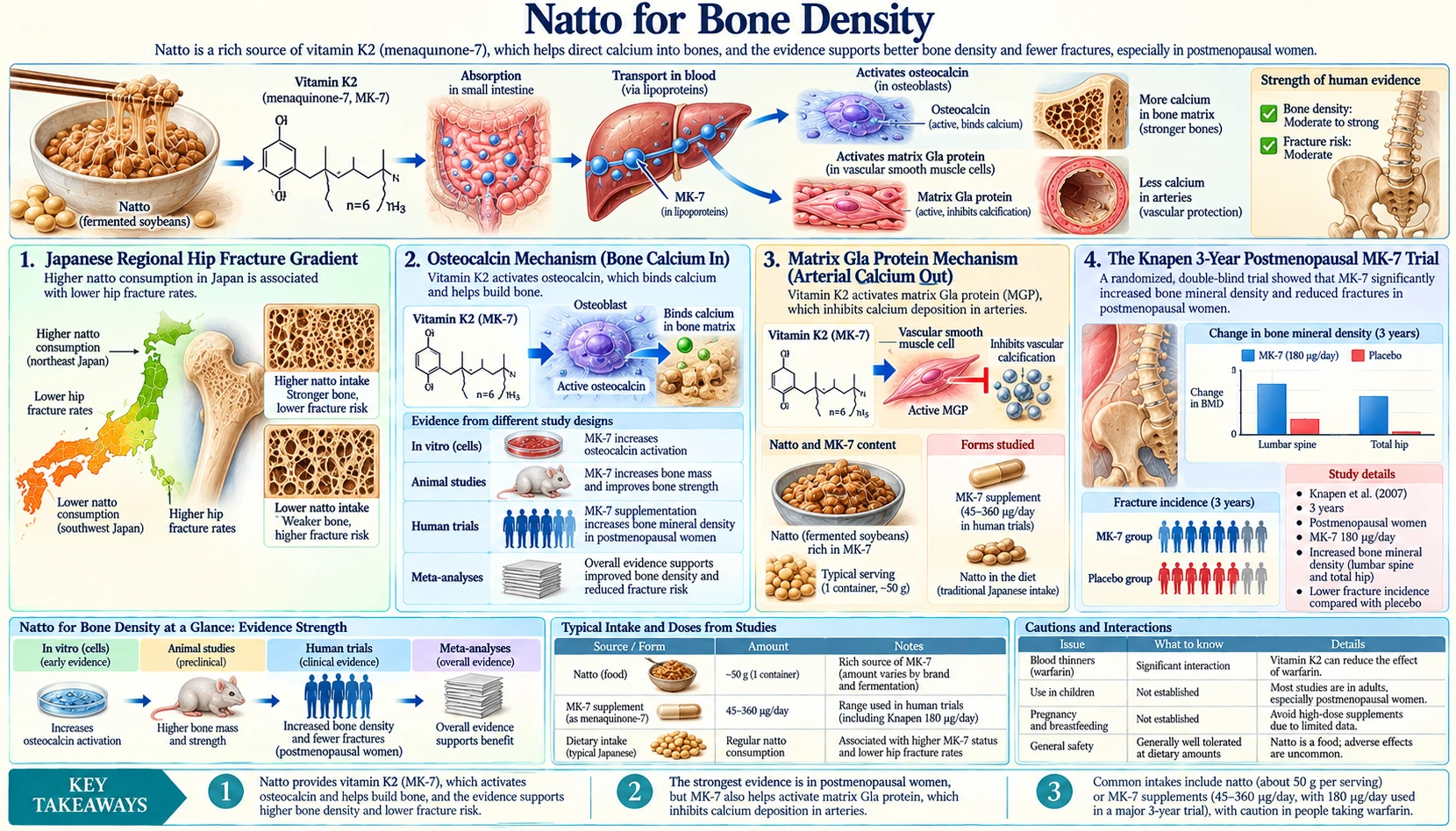
Natto, soybeans fermented with Bacillus subtilis var. natto, has been measured at 939 µg of menaquinone-7 (MK-7, a form of vitamin K2) per 100 g (Kamao 2007), and the research on natto and bone runs along two lines. Japanese population studies link eating natto to higher blood MK-7, less bone loss and a lower risk of osteoporotic fracture (Kaneki 2001; Ikeda 2006; Kojima 2020). Randomised trials of vitamin K2 as a supplement are mixed: a 3-year Dutch MK-7 trial found a smaller decline in bone density at the spine and femoral neck (Knapen 2013), while Norwegian and Danish MK-7 trials found no effect on bone density (Emaus 2010; Rønn 2021), and none of the MK-7 trials cited on this page reported fewer fractures. The large fracture reductions came from Japanese trials of high-dose menatetrenone (MK-4), part of which have since been retracted or flagged, and the 2019 update of the main meta-analysis judged the fracture evidence insufficient to confirm a benefit (Mott 2019). This page sets out the regional and cohort data from Japan, the osteocalcin and matrix Gla protein mechanism, the MK-7 and MK-4 trials, the meta-analyses and their integrity problems, and what the large calcium and vitamin D trials found.
Table of Contents
- Natto in Japan: Regional and Cohort Studies
- Osteocalcin Mechanism (Bone Calcium In)
- Matrix Gla Protein Mechanism (Arterial Calcium Out)
- The Knapen 3-Year Trial and Other MK-7 Trials
- Japanese Menatetrenone (MK-4) Fracture Trials
- Meta-Analyses of Vitamin K and Fractures
- Vitamin K2 Alongside Vitamin D and Magnesium
- Calcium Supplements: What the Large Trials Found
- Osteopenia and Osteoporosis: What the Trials in Patients Found
- Key Research Papers
- Connections
- Featured Videos
Natto in Japan: Regional and Cohort Studies
Kaneki and colleagues (2001) measured serum MK-7 in postmenopausal women: a mean of 5.26 ng/mL in Tokyo, where natto is eaten frequently, 1.22 ng/mL in Hiroshima, where it is seldom eaten, and 0.37 ng/mL in British women. Frequent natto eaters had significantly higher serum MK-7, and eating natto produced a marked, sustained rise in serum MK-7. Across Japan's prefectures, the authors found a statistically significant inverse correlation between the incidence of hip fractures in women and natto consumption, and suggested that higher MK-7 from natto may contribute to the relatively lower fracture risk of Japanese women.
That prefecture comparison is an ecological correlation — regional averages, not individuals — and on its own it cannot show that natto prevents fractures. Two analyses of one Japanese cohort, the Japanese Population-Based Osteoporosis (JPOS) Study, looked at individual women:
- Bone density (Ikeda 2006): 944 women aged 20–79 had bone density measured at the spine, hip and forearm at baseline and 3 years later, and reported their natto intake on a food-frequency questionnaire. In the postmenopausal women, total hip bone density at baseline rose with habitual natto intake (P for trend = 0.0034), though not at the other sites, and natto intake was positively associated with the rate of change in bone density at the femoral neck (P < 0.0001) and the distal radius (P = 0.0002) — that is, with less bone loss. The femoral-neck association persisted after adjustment for covariates. Tofu and other soybean products showed no significant association. The authors suggested MK-7, or bioavailable isoflavones, both more abundant in natto than in other soybean products, as possible explanations.
- Fractures (Kojima 2020): 1,417 postmenopausal women aged 45 or over were followed for a median of 15.2 years, and 172 had an osteoporotic fracture. Compared with less than one pack (about 40 g) of natto a week, the hazard ratios after adjustment for age and total-hip bone density were 0.72 (95% CI 0.52–0.98) for 1–6 packs a week and 0.51 (0.30–0.87) for 7 or more. After further adjustment for body-mass index, fracture history, heart attack or stroke, diabetes, smoking, alcohol, other soy foods and dietary calcium, they were 0.79 (0.56–1.10), no longer statistically significant, and 0.56 (0.32–0.99). Tofu and other soybean products were not associated with fracture risk. The authors concluded that habitual natto intake “may be associated” with a reduced risk of osteoporotic fractures independent of bone density; a corrigendum to the paper was published in 2021.
In 396 healthy Japanese women, MK-7 was on average the highest of the three circulating forms of vitamin K measured, and both K1 and MK-7 correlated inversely with undercarboxylated osteocalcin, a marker of low vitamin K status in bone (Tsugawa 2006). A 2006 Japanese review describes MK-7 as stimulating bone formation by osteoblasts and inhibiting bone resorption by osteoclasts, and supplementation as preventing bone loss in ovariectomized rats, an animal model of osteoporosis (Yamaguchi 2006).
These are observational and laboratory findings. Whether natto itself protects bone has not been tested in a randomised trial of natto as food; the trials below used vitamin K capsules.
Osteocalcin Mechanism (Bone Calcium In)
Osteocalcin is a bone protein that needs vitamin K for its gamma-carboxylation; vitamin K is a cofactor in that step, and carboxylated osteocalcin promotes the mineralization of bone (Rønn 2021). Circulating undercarboxylated osteocalcin (ucOC), or its ratio to carboxylated osteocalcin (cOC), is used in the research as a marker of vitamin K status (Knapen 2013).
Inaba and colleagues (2015) ran two Japanese trials of how much MK-7 it takes to move this marker. In the first, 60 postmenopausal women aged 50–69 ate a controlled diet and took 0, 50, 100 or 200 µg of MK-7 a day for 4 weeks. In the 0 µg group, whose diet met the Japanese recommended intake of vitamin K, the cOC/ucOC ratio fell significantly from baseline. MK-7 raised the ratio dose-dependently, with significant effects in the 100 and 200 µg groups compared with 0 µg. In the second trial, 120 adults aged 20–69 took 0 or 100 µg a day for 12 weeks; ucOC fell and the cOC/ucOC ratio rose significantly with MK-7 compared with placebo. The authors suggested that 100 µg a day or more of MK-7 improves osteocalcin carboxylation.
Lowering ucOC has been consistent across the vitamin K trials — with MK-7 (Knapen 2013; Emaus 2010; Rønn 2016, 2021), MK-4 (Shiraki 2000) and K1 (Booth 2008). Bone density has not followed it consistently. In the Norwegian, Danish and US trials described further down, ucOC fell but bone density did not differ from placebo.
Some trials have looked at bone geometry and structure beyond density. In a 3-year Dutch trial of 325 postmenopausal women, 45 mg a day of MK-4 did not affect DXA bone density, but bone mineral content and femoral neck width increased relative to placebo, and hip bone strength stayed unchanged while it decreased significantly on placebo (Knapen 2007). In a Danish trial of 148 women with osteopenia, 375 µg a day of MK-7 for 12 months preserved trabecular structure at the tibia compared with placebo, with no difference in bone density at any site (Rønn 2016); after 3 years, changes in microstructure were similar in the two groups (Rønn 2021).
Matrix Gla Protein Mechanism (Arterial Calcium Out)
The second vitamin K-dependent protein in this story is matrix Gla protein (MGP), which acts in the artery wall rather than in bone. A 2008 review describes MGP as generally accepted to be a potent inhibitor of arterial calcification, although its mechanism at the molecular level is not completely understood, and describes uncarboxylated MGP as a promising biomarker for detecting cardiovascular calcification (Schurgers 2008).
The idea that links the two proteins — sometimes called the “calcium paradox” — is that vitamin K-dependent proteins govern where calcium is deposited: carboxylated osteocalcin in bone, carboxylated MGP holding calcium out of the artery wall, so that low vitamin K status would leave both inactive. The diagram above draws that proposed mechanism. The studies cited on this page measured bone and arterial outcomes separately; none tested whether low vitamin K status moves calcium from bone into the arteries.
On the arterial side, a 3-year Dutch trial gave 244 healthy postmenopausal women placebo (124) or 180 µg of MK-7 a day (120). MK-7 decreased carotid-femoral pulse wave velocity and the stiffness index β in the total group, improved further measures of carotid stiffness in women whose baseline stiffness index was above the median of 10.8, and lowered circulating desphospho-uncarboxylated MGP (dp-ucMGP) by 50% compared with placebo; it did not change markers of inflammation or endothelial dysfunction (Knapen 2015). The bone results of the same 3-year MK-7 design are in the next section.
For the cardiovascular calcification angle in depth, see our Atherosclerosis page. For the bone calcium pathway, see Osteoporosis.
The Knapen 3-Year Trial and Other MK-7 Trials
The Knapen et al. 2013 Osteoporosis International trial gave 244 healthy postmenopausal women placebo or 180 µg of MK-7 a day in capsules for 3 years. Bone density at the lumbar spine, total hip and femoral neck was measured by DXA at baseline and after 1, 2 and 3 years; femoral-neck strength indices were calculated; vertebral fracture assessment was done by DXA; and the ucOC/cOC ratio served as the marker of vitamin K status. The abstract reports that MK-7:
- significantly improved vitamin K status;
- decreased the age-related decline in bone mineral content and density at the lumbar spine and femoral neck, but not at the total hip;
- favourably affected bone strength;
- significantly decreased the loss of vertebral height in the lower thoracic region at the mid-site of the vertebrae.
The abstract gives no fracture-rate difference and no figures for the size of the bone-density effect. The authors wrote that whether the results extend to other groups, such as children and men, needs further investigation.
Other MK-7 trials in postmenopausal women did not find a bone-density effect:
- Norway (Emaus 2010): 334 healthy women aged 50–60, 1–5 years after menopause, took 360 µg of MK-7 a day as natto-derived capsules or placebo for 12 months. There were no differences in bone loss at the total hip or any other site, although cOC rose and ucOC fell with MK-7 (p < 0.001).
- Denmark, 1 year (Rønn 2016): 148 women with osteopenia, all taking calcium and vitamin D, took 375 µg of MK-7 a day or placebo. ucOC fell by a median of 65.6% with MK-7 against 6.4% with placebo at 3 months. At the tibia, trabecular number, spacing and thickness were unchanged with MK-7 and changed with placebo, consistent with age-related deterioration; there were no differences at the radius or in bone density at any site.
- Denmark, 3 years (Rønn 2021): 142 women with osteopenia took 375 µg of MK-7 a day or placebo on top of 800 mg of calcium and 38 µg of vitamin D3. ucOC fell with MK-7, but after 3 years bone density had decreased at all sites without differences between the groups, and bone turnover markers and microstructure changed similarly in both.
So the MK-7 trials conflict on bone density, although all of them lowered ucOC. They differed in population (healthy women or women with osteopenia), length (1 or 3 years) and dose (180, 360 or 375 µg a day). All of them used MK-7 capsules rather than natto as a food.
Japanese Menatetrenone (MK-4) Fracture Trials
Menatetrenone is the MK-4 form of vitamin K2. The Japanese fracture trials gave it at 45 mg a day (Shiraki 2000); the Dutch MK-4 trial used the same 45 mg a day (Knapen 2007).
- Shiraki 2000: 241 patients with osteoporosis were randomised, open label, to no treatment (121) or 45 mg a day of menatetrenone (120) for 24 months. Clinical fractures were more frequent in the untreated group (p = 0.0273). Lumbar spine bone density fell by 3.3% in the untreated group and by 0.5% in the treated group at 24 months; the authors noted that the treated group “failed to increase” in bone density, and suggested that menatetrenone prevents new fractures.
- Inoue 2009 (OF study): an open-label trial with blinded evaluation randomised 4,378 osteoporotic postmenopausal women aged 50 or over to calcium alone (2,193) or calcium plus menatetrenone (2,185). The primary endpoint, new vertebral fractures over 36 months, did not differ between the groups. New clinical fractures over 48 months were lower with menatetrenone, but not significantly. Women with at least five vertebral fractures at baseline had a lower risk of new vertebral fractures with menatetrenone, and adverse events were more frequent in the menatetrenone group. The authors concluded that menatetrenone “was not effective for preventing vertebral fractures in the full analysis set,” while the results suggested it may prevent them in more advanced osteoporosis.
The review this page previously gave as “Iwamoto 2005” is Iwamoto and colleagues' review in Nutrition Research, published in 2009. It selected 7 randomised trials of vitamin K1 or K2 in postmenopausal women with about 50 or more subjects per group and 2 years or longer. It reported that supplementation lowered ucOC regardless of dose, had inconsistent effects on total osteocalcin and no effect on bone resorption, and that despite no significant change or only a modest increase in bone density, high-dose K1 and K2 improved femoral-neck strength indices and reduced the incidence of clinical fractures (Iwamoto 2009). The abstract gives no pooled percentages and makes no comparison with bisphosphonates.
Direct comparisons with bisphosphonates are few and small. A preliminary Japanese trial randomised 72 women with osteoporosis to the bisphosphonate etidronate (25), menatetrenone 45 mg a day (23) or calcium (24) for 2 years. Etidronate raised forearm bone density more than menatetrenone did, and the authors concluded that both agents may have the potential to reduce vertebral fractures; the abstract's sentence on fracture rates, as published, describes them as significantly higher in both treated groups than in the calcium group, which does not match that conclusion (Iwamoto 2001). The larger Yamaguchi Osteoporosis Prevention Study, which compared vitamin K with etidronate and other osteoporosis treatments, was the subject of published integrity concerns in 2020 and was retracted in 2025 (Ishida 2004; Avenell 2020).
Several vitamin K2 bone papers from one Japanese author group have been retracted. They include a 2005 trial of menatetrenone with vitamin D2 for nonvertebral fractures in elderly women with Alzheimer's disease (Bone, retracted 2018) and a 2011 trial of menatetrenone with risedronate for hip-fracture prevention in Alzheimer's disease, retracted “because of scientific misconduct” (Kurume Medical Journal). A 2004 review of vitamin K2 and osteoporosis by the same group was retracted in 2021 because its text, data and some figures came from sources that had been retracted or were under investigation for data fabrication and falsification, among other reasons. The 2009 Nutrition Research review shares authors with these papers; PubMed and Crossref show no retraction or correction notice on it.
Meta-Analyses of Vitamin K and Fractures
No Cochrane review of vitamin K for osteoporosis or fracture prevention is indexed in PubMed. The one Cochrane review of vitamin K and bone found there concerns people with cystic fibrosis: it included 3 small trials (70 participants) and was very uncertain whether vitamin K has any effect on bone density (Jagannath 2020).
The Cockayne et al. 2006 Archives of Internal Medicine systematic review (not a Cochrane review) identified 13 randomized controlled trials with bone-loss data, 7 of which reported fractures — all of those 7 Japanese and all using menaquinone. Pooling the 7, it reported an odds ratio of 0.40 (95% CI 0.25-0.65) for vertebral fractures and 0.23 (95% CI 0.12-0.47) for hip fractures. These figures are not settled. In 2018 the journal published a notice, “Caution of Conclusions of a Meta-analysis Including Problematic Trials”: 3 of the 7 fracture trials came from a single center whose trial data have since been found to be problematic or retracted, and the authors asked readers to take into account only the sensitivity analysis in the paper's Figure 4. Retraction Watch records the notice as an expression of concern, and the review's senior author published a letter cautioning readers the same year (Torgerson 2018).
Two later meta-analyses:
- Huang 2015 (Osteoporosis International) pooled 19 randomised trials of vitamin K2 with 6,759 postmenopausal participants. In women with osteoporosis, vertebral bone density improved with K2 in medium- and long-term results; in women without osteoporosis there was no significant difference. Pooling the 7 trials with fracture data showed no significant difference in fractures (RR 0.63, p = 0.08); after removing the study that caused heterogeneity, the difference became significant (RR 0.50, p = 0.0005). The K2 groups seemed to have a higher rate of adverse reactions (RR 1.22, p = 0.06). The authors called for further high-quality, large trials. This analysis was published before the 2018–2025 integrity notices.
- Mott 2019 (Osteoporosis International), the update by the Cockayne group, written because “the integrity of some of the previous evidence has been questioned”, identified 36 studies. In postmenopausal or osteoporotic patients, the odds of any clinical fracture were lower with vitamin K (OR 0.72, 95% CI 0.55–0.95), but restricting the analysis to trials at low risk of bias gave an OR of 0.76 (0.58–1.01). There was no difference in vertebral fractures (OR 0.96, 0.83–1.11). Lumbar spine bone density was higher with vitamin K at 2 years (mean difference 1.63%, 95% CI 0.10–3.16), but removing trials at high risk of bias tended to give smaller differences that were not statistically significant. The authors concluded that for postmenopausal or osteoporotic patients there is no evidence that vitamin K affects bone density or vertebral fractures, that it may reduce clinical fractures, but that the evidence is insufficient to confirm this. In 2020 they issued a correction adjusting every estimate that had included the Yamaguchi Osteoporosis Prevention Study, after concerns were raised about its integrity.
The Booth 2008 Journal of Clinical Endocrinology & Metabolism trial in 452 men and women aged 60–80, all taking calcium and vitamin D, found no difference in bone density at any site after 3 years of 500 µg a day of phylloquinone (K1), although the K1 group had lower undercarboxylated osteocalcin. The trial tested K1, not K2.
Taken together: the large fracture reductions came from high-dose MK-4 trials in Japan, part of which have had their integrity questioned or been retracted; no MK-7 trial cited here reported fewer fractures; and the most recent update judged the evidence for a fracture benefit insufficient to confirm (Mott 2019). The K1 trial above found no effect on bone loss. Trials that do not distinguish between K1 and K2 forms produce results that are harder to interpret.
Vitamin K2 Alongside Vitamin D and Magnesium
Vitamin K2 is often discussed together with vitamin D and magnesium. A 2018 review describes magnesium as assisting in the activation of vitamin D, which helps regulate calcium and phosphate balance, and states that all of the enzymes that metabolize vitamin D seem to require magnesium as a cofactor in the liver and kidneys (Uwitonze 2018).
Several vitamin K trials gave the vitamin on top of calcium and vitamin D, which makes them tests of whether vitamin K adds anything to that combination:
- K1 with calcium and vitamin D (Booth 2008): 500 µg a day of phylloquinone on top of 600 mg of calcium and 400 IU of vitamin D gave no additional benefit for bone density at the spine or hip over 3 years.
- MK-7 with calcium and vitamin D3 (Rønn 2021): 375 µg a day of MK-7 on top of 800 mg of calcium and 38 µg of vitamin D3 increased osteocalcin carboxylation but did not affect bone turnover, bone density or microarchitecture over 3 years in women with osteopenia.
Combination products of K2, D3 and magnesium are promoted on the reasoning that vitamin D raises calcium absorption while vitamin K-dependent proteins govern where the calcium goes. The studies cited on this page did not test a combined K2, D3 and magnesium regimen against its parts.
For a deeper dive into the magnesium piece, see our Magnesium page. For the D3 piece, see Vitamin D3.
Calcium Supplements: What the Large Trials Found
In the Women's Health Initiative, 36,282 postmenopausal women aged 50–79 were randomly assigned to 1,000 mg of calcium (as calcium carbonate) with 400 IU of vitamin D3 a day, or placebo, and followed for an average of 7.0 years. Hip bone density was 1.06% higher in the supplemented group. In the intention-to-treat analysis the hazard ratio for hip fracture was 0.88 (95% CI 0.72–1.08), not statistically significant; restricting the analysis to women while they kept taking the study pills gave 0.71 (0.52–0.97). The supplements increased the risk of kidney stones (Jackson 2006).
A 2010 meta-analysis of randomised trials of calcium supplements given without vitamin D found more heart attacks in people allocated to calcium: a hazard ratio of 1.31 (95% CI 1.02–1.67) in the five trials with patient-level data, and a pooled relative risk of 1.27 (1.01–1.59) in the trial-level analysis. Increases in stroke, the composite of heart attack, stroke or sudden death, and death were not statistically significant. The authors called for a reassessment of the role of calcium supplements in osteoporosis management (Bolland 2010).
The proposal that adding vitamin K2 would redirect supplemental calcium from the arteries to bone comes from the osteocalcin and matrix Gla protein biology above. Bolland's analysis did not examine vitamin K, and none of the trials cited on this page tested whether adding K2 changes the cardiovascular or fracture outcomes of calcium supplements.
Osteopenia and Osteoporosis: What the Trials in Patients Found
For people who already have low bone density, the trials cited on this page report:
- Osteopenia, MK-7: in Danish women with osteopenia, 375 µg a day of MK-7 preserved tibial trabecular structure at 1 year (Rønn 2016), but after 3 years bone density, turnover markers and microstructure did not differ from placebo (Rønn 2021).
- Osteoporosis, MK-4 (menatetrenone 45 mg a day): an open-label 2-year trial of 241 patients reported fewer clinical fractures (Shiraki 2000); the 4,378-woman OF study found no difference in new vertebral fractures in its full analysis, with a possible benefit in women with at least five baseline vertebral fractures and more adverse events with menatetrenone (Inoue 2009).
- Meta-analyses: vertebral bone density improved with K2 in women with osteoporosis in Huang 2015; Mott 2019 found no evidence of an effect on bone density or vertebral fractures and judged the evidence on clinical fractures insufficient to confirm a benefit.
- Anticoagulants: vitamin K opposes warfarin and other vitamin K antagonists. The research on natto, MK-7 and these drugs is set out on the Vitamin K2 (MK-7) page.
Decisions about osteoporosis treatment, and about vitamin K alongside it, belong with a clinician. For the wider picture, see our Osteoporosis page.
Key Research Papers
- Kaneki M, Hodges SJ, Hosoi T, Fujiwara S, Lyons A, Crean SJ, et al. (2001). Japanese fermented soybean food as the major determinant of the large geographic difference in circulating levels of vitamin K2: possible implications for hip-fracture risk. Nutrition 17(4):315–321. — PubMed PMID: 11369171
- Yamaguchi M (2006). Regulatory mechanism of food factors in bone metabolism and prevention of osteoporosis. Yakugaku Zasshi 126(11):1117–1137. — PubMed PMID: 17077614
- Knapen MH, Drummen NE, Smit E, Vermeer C, Theuwissen E (2013). Three-year low-dose menaquinone-7 supplementation helps decrease bone loss in healthy postmenopausal women. Osteoporos Int 24(9):2499–2507. — PubMed PMID: 23525894
- Knapen MH, Braam LA, Drummen NE, Bekers O, Hoeks AP, Vermeer C (2015). Menaquinone-7 supplementation improves arterial stiffness in healthy postmenopausal women. A double-blind randomised clinical trial. Thromb Haemost 113(5):1135–1144. — PubMed PMID: 25694037
- Iwamoto J, Sato Y, Takeda T, Matsumoto H (2009). High-dose vitamin K supplementation reduces fracture incidence in postmenopausal women: a review of the literature. Nutrition Research 29(4):221–228. — PubMed PMID: 19410972
- Cockayne S et al. (2006). Vitamin K and the prevention of fractures: systematic review and meta-analysis of randomized controlled trials. Arch Intern Med 166(12):1256–1261. — PubMed PMID: 16801507 — Expression of concern (JAMA Intern Med 2018, “Caution of Conclusions of a Meta-analysis Including Problematic Trials”: PubMed PMID: 29582046)
- Mott A, Bradley T, Wright K, Cockayne ES, Shearer MJ, Adamson J, Lanham-New SA, Torgerson DJ (2019). Effect of vitamin K on bone mineral density and fractures in adults: an updated systematic review and meta-analysis of randomised controlled trials. Osteoporosis International 30(8):1543–1559. — PubMed PMID: 31076817 — correction 2020: PubMed PMID: 32965511
- Inaba N, Sato T, Yamashita T (2015). Low-dose daily intake of vitamin K2 (menaquinone-7) improves osteocalcin γ-carboxylation: a double-blind, randomized controlled trials. J Nutr Sci Vitaminol 61(6):471–480. — PubMed PMID: 26875489
- Plaza SM, Lamson DW (2005). Vitamin K2 in bone metabolism and osteoporosis. Altern Med Rev 10(1):24–35. — PubMed PMID: 15771560
- Booth SL, Dallal G, Shea MK, Gundberg C, Peterson JW, Dawson-Hughes B (2008). Effect of vitamin K supplementation on bone loss in elderly men and women. J Clin Endocrinol Metab 93(4):1217–1223. — PubMed PMID: 18252784
- Tsugawa N, Shiraki M, Suhara Y, Kamao M, Tanaka K, Okano T (2006). Vitamin K status of healthy Japanese women: age-related vitamin K requirement for gamma-carboxylation of osteocalcin. Am J Clin Nutr 83(2):380–386. — PubMed PMID: 16469998
- Bolland MJ, Avenell A, Baron JA, Grey A, MacLennan GS, Gamble GD, Reid IR (2010). Effect of calcium supplements on risk of myocardial infarction and cardiovascular events: meta-analysis. BMJ 341:c3691. — PubMed PMID: 20671013
- Schurgers LJ, Cranenburg EC, Vermeer C (2008). Matrix Gla-protein: the calcification inhibitor in need of vitamin K. Thromb Haemost 100(4):593–603. — PubMed PMID: 18841280
- Kamao M, Suhara Y, Tsugawa N, Uwano M, Yamaguchi N, Uenishi K, Ishida H, Sasaki S, Okano T (2007). Vitamin K content of foods and dietary vitamin K intake in Japanese young women. J Nutr Sci Vitaminol 53(6):464–470. — PubMed PMID: 18202532
- Ikeda Y, Iki M, Morita A, Kajita E, Kagamimori S, Kagawa Y, Yoneshima H (2006). Intake of fermented soybeans, natto, is associated with reduced bone loss in postmenopausal women: Japanese Population-Based Osteoporosis (JPOS) Study. J Nutr 136(5):1323–1328. — PubMed PMID: 16614424
- Kojima A, Ikehara S, Kamiya K, Kajita E, Sato Y, Kouda K, Tamaki J, Kagamimori S, Iki M (2020). Natto intake is inversely associated with osteoporotic fracture risk in postmenopausal Japanese women. J Nutr 150(3):599–605. — PubMed PMID: 31825069 — corrigendum 2021: PubMed PMID: 33704500
- Emaus N, Gjesdal CG, Almås B, Christensen M, Grimsgaard AS, Berntsen GK, Salomonsen L, Fønnebø V (2010). Vitamin K2 supplementation does not influence bone loss in early menopausal women: a randomised double-blind placebo-controlled trial. Osteoporos Int 21(10):1731–1740. — PubMed PMID: 19937427
- Rønn SH, Harsløf T, Pedersen SB, Langdahl BL (2016). Vitamin K2 (menaquinone-7) prevents age-related deterioration of trabecular bone microarchitecture at the tibia in postmenopausal women. Eur J Endocrinol 175(6):541–549. — PubMed PMID: 27625301
- Rønn SH, Harsløf T, Oei L, Pedersen SB, Langdahl BL (2021). The effect of vitamin MK-7 on bone mineral density and microarchitecture in postmenopausal women with osteopenia, a 3-year randomized, placebo-controlled clinical trial. Osteoporos Int 32(1):185–191. — PubMed PMID: 33030563
- Knapen MH, Schurgers LJ, Vermeer C (2007). Vitamin K2 supplementation improves hip bone geometry and bone strength indices in postmenopausal women. Osteoporos Int 18(7):963–972. — PubMed PMID: 17287908
- Shiraki M, Shiraki Y, Aoki C, Miura M (2000). Vitamin K2 (menatetrenone) effectively prevents fractures and sustains lumbar bone mineral density in osteoporosis. J Bone Miner Res 15(3):515–521. — PubMed PMID: 10750566
- Inoue T, Fujita T, Kishimoto H, Makino T, Nakamura T, Nakamura T, Sato T, Yamazaki K (2009). Randomized controlled study on the prevention of osteoporotic fractures (OF study): a phase IV clinical study of 15-mg menatetrenone capsules. J Bone Miner Metab 27(1):66–75. — PubMed PMID: 19082528
- Iwamoto J, Takeda T, Ichimura S (2001). Effect of menatetrenone on bone mineral density and incidence of vertebral fractures in postmenopausal women with osteoporosis: a comparison with the effect of etidronate. J Orthop Sci 6(6):487–492. — PubMed PMID: 11793169
- Ishida Y, Kawai S (2004). Comparative efficacy of hormone replacement therapy, etidronate, calcitonin, alfacalcidol, and vitamin K in postmenopausal women with osteoporosis: the Yamaguchi Osteoporosis Prevention Study. Am J Med 117(8):549–555. — PubMed PMID: 15465502 — Retracted (retraction notice: PubMed PMID: 40222753)
- Avenell A, Grey A, Gamble GD, Bolland MJ (2020). Concerns about the integrity of the Yamaguchi Osteoporosis Prevention Study (YOPS) report, Am J Med. 2004;117:549-555. Am J Med 133(6):e311–e314. — PubMed PMID: 32532372
- Sato Y, Kanoko T, Satoh K, Iwamoto J (2005). Menatetrenone and vitamin D2 with calcium supplements prevent nonvertebral fracture in elderly women with Alzheimer's disease. Bone 36(1):61–68. — PubMed PMID: 15664003 — Retracted (retraction notice: PubMed PMID: 29150013)
- Sato Y, Honda Y, Umeno K, Hayashida N, Iwamoto J, Takeda T, Matsumoto H (2011). The prevention of hip fracture with menatetrenone and risedronate plus calcium supplementation in elderly patients with Alzheimer disease: a randomized controlled trial. Kurume Med J 57(4):117–124. — PubMed PMID: 21778673 — Retracted (retraction notice: PubMed PMID: 28408729)
- Iwamoto J, Takeda T, Sato Y (2004). Effects of vitamin K2 on osteoporosis. Curr Pharm Des 10(21):2557–2576. — PubMed PMID: 15320745 — Retracted (retraction notice: PubMed PMID: 34264184)
- Torgerson DJ (2018). Caution to readers about systematic review on vitamin K and prevention of fractures that included problematic trials. JAMA Intern Med 178(6):863–864. — PubMed PMID: 29582044
- Huang ZB, Wan SL, Lu YJ, Ning L, Liu C, Fan SW (2015). Does vitamin K2 play a role in the prevention and treatment of osteoporosis for postmenopausal women: a meta-analysis of randomized controlled trials. Osteoporos Int 26(3):1175–1186. — PubMed PMID: 25516361
- Jagannath VA, Thaker V, Chang AB, Price AI (2020). Vitamin K supplementation for cystic fibrosis. Cochrane Database Syst Rev 6:CD008482. — PubMed PMID: 32497260
- Jackson RD, LaCroix AZ, Gass M, et al.; Women's Health Initiative Investigators (2006). Calcium plus vitamin D supplementation and the risk of fractures. N Engl J Med 354(7):669–683. — PubMed PMID: 16481635
- Uwitonze AM, Razzaque MS (2018). Role of magnesium in vitamin D activation and function. J Am Osteopath Assoc 118(3):181–189. — PubMed PMID: 29480918