Fermented Foods for Gut Microbiome Diversity
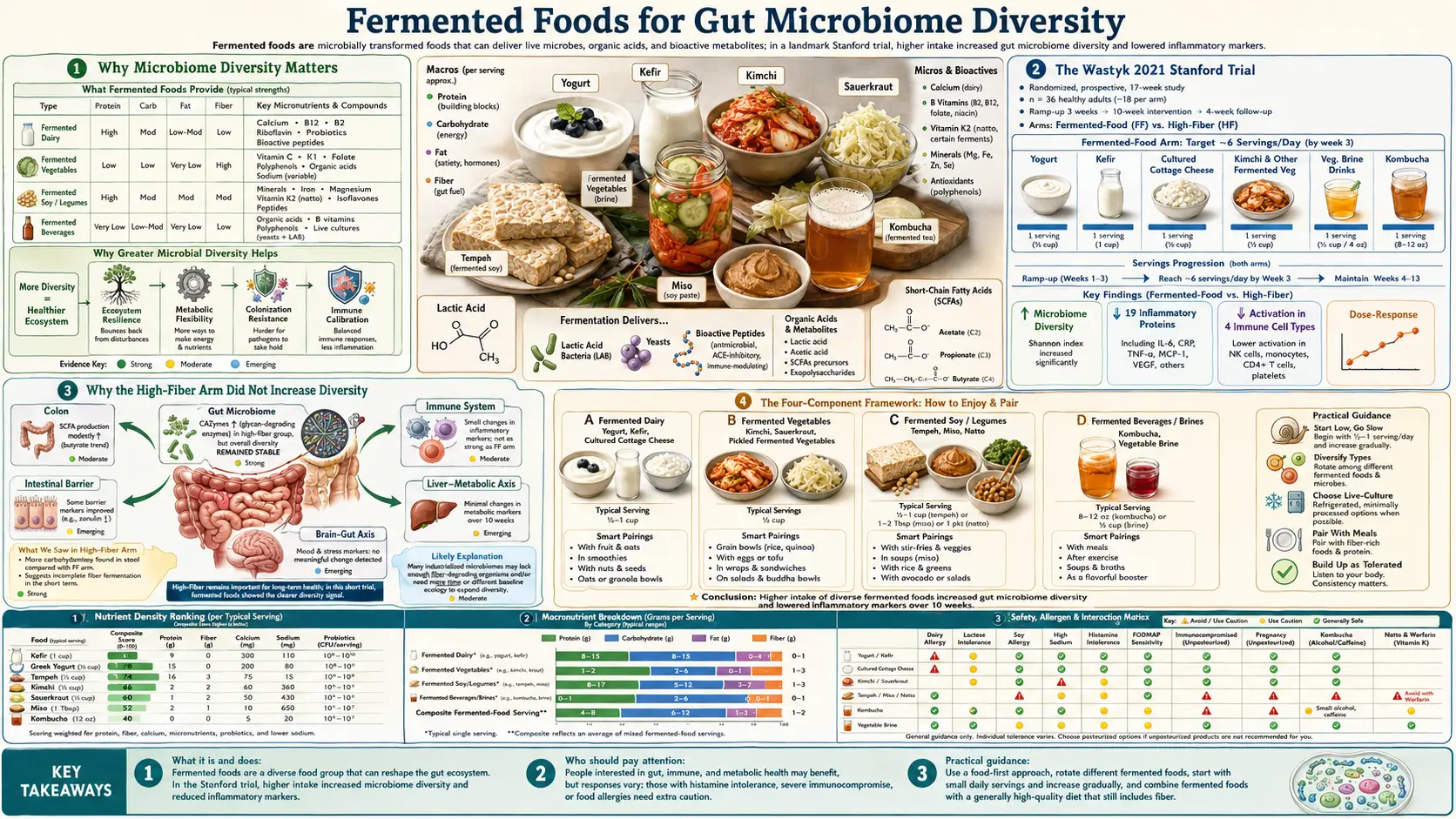
Microbiome diversity — the variety of distinct microbes in the gut — is lower in industrialized populations, and the authors of the 2021 Wastyk trial note that low diversity is associated with many chronic diseases, such as obesity and diabetes. That Stanford trial, published in Cell, randomized healthy adults (18 per arm) to a high-fiber or a high-fermented-food diet over 17 weeks. Fermented-food intake, built up to about six servings a day, steadily raised gut microbiota diversity and lowered 19 of 93 measured inflammatory proteins; the high-fiber diet did not raise diversity. This page covers the trial design and results, the mechanisms proposed by the ISAPP consensus panel, how fermented foods differ from probiotic capsules, what the research shows about colonization, and the safety concerns described in the literature.
Table of Contents
- Why Microbiome Diversity Matters
- The Wastyk 2021 Stanford Trial
- Why the High-Fiber Arm Did Not Increase Diversity
- Proposed Mechanisms
- Fermented Foods vs Probiotic Supplements
- Species Coverage Across Different Ferments
- Colonization vs Transit Effects
- The Six-Serving Target in the Trial
- Diversity as Ecosystem Resilience
- Cautions and Special Populations
- Key Research Papers
- Connections
- Featured Videos
Why Microbiome Diversity Matters
The gut microbiota is immensely diverse, varies between individuals and can fluctuate over time, especially during disease and early development; a 2012 review in Nature argued that viewing it from an ecological perspective could show how to promote health by targeting this community (PubMed PMID: 22972295). Two common measures are alpha-diversity (the variety of microbes within one person, counted in the Wastyk trial as observed sequence variants, Shannon diversity and phylogenetic diversity) and beta-diversity (how different one person's gut community is from another's). Alpha-diversity is the measure the Wastyk trial reported moving.
The Wastyk authors summarize the link to disease this way: low microbiota diversity is associated with many non-communicable chronic diseases, such as obesity and diabetes, and with industrialized lifestyles. Population studies point the same way. A 2012 study of 531 people from the Amazonas of Venezuela, rural Malawi and US metropolitan areas found pronounced differences in bacterial assemblages and functional gene repertoires between US residents and those in the other two countries, evident from early infancy through adulthood (PubMed PMID: 22699611). The Hadza hunter-gatherers of Tanzania had higher microbial richness and biodiversity than urban Italian controls (PubMed PMID: 24736369).
A 2014 review by the Sonnenburgs proposed that the Western microbiota may itself be dysbiotic: a diet low in microbiota-accessible carbohydrates (MACs, the fermentable part of dietary fiber) has selected for a microbiota with altered membership and function compared with groups living traditional lifestyles, and leads to poor production of short-chain fatty acids (SCFAs), which attenuate inflammation in mouse models (PubMed PMID: 25156449). The same review notes that studies of modern and traditional societies, combined with animal models, are still needed to separate a microbiota that raises disease risk from one that causes disease.
The Wastyk 2021 Stanford Trial
The Wastyk et al. 2021 paper in Cell (Gut-microbiota-targeted diets modulate human immune status; the Fermented and Fiber-rich Food, or FeFiFo, study) came from the Sonnenburg and Gardner groups at Stanford. Its design, as the paper reports it:
- Population: healthy adults; people already eating more than 20 g of fiber a day or more than 2 servings of fermented foods a day were excluded. Of 381 people assessed, 39 were assigned: 21 to the high-fiber diet (19 randomized, 2 not) and 18 to the high-fermented-food diet (the abstract gives n = 18 per arm).
- Phases (17 weeks in all): a 3-week baseline, a 4-week ramp phase in which intake was gradually increased, a 6-week maintenance phase at high intake, and a 4-week “choice” period in which participants kept the diet to the extent they wished.
- Targets and intake: the fiber arm aimed to add at least 20 g of fiber a day and went from 21.5 g to 45.1 g a day on average; the fermented-food arm aimed for 6 servings a day and went from 0.4 to 6.3 servings a day on average.
- Fermented foods eaten: yogurt, kefir, fermented cottage cheese, fermented vegetables such as kimchi, vegetable brine drinks, kombucha and other fermented non-alcoholic drinks.
- Outcomes: the registered primary outcome was the change in a cytokine response score; the study also profiled the stool microbiome, serum inflammatory proteins and immune cells.
The results, as reported: the cytokine response score (the primary outcome) did not change. In the fermented-food arm, alpha-diversity (observed sequence variants, phylogenetic diversity and Shannon diversity) rose steadily over the intervention, and the rise was sustained during the choice period, when intake was still above baseline but below the maintenance level. An inflammation panel found 19 of 93 cytokines, chemokines and other inflammatory serum proteins decreased over the fermented-food intervention, including IL-6, IL-10 and IL-12b; none of those 19 changed in the high-fiber arm. In the high-fiber arm, community diversity stayed stable, while microbiome-encoded carbohydrate-degrading enzymes (CAZymes) increased, and the participants split into three distinct immune trajectories that corresponded to their baseline microbiota diversity.
The paper is indexed in PubMed (PubMed PMID: 34256014). The authors conclude that fermented foods may be valuable in countering the decreased microbiome diversity and increased inflammation pervasive in industrialized society. With 18 people per arm and healthy volunteers only, it is a small trial.
Why the High-Fiber Arm Did Not Increase Diversity
The Wastyk authors discuss several possible reasons for the flat diversity result in the fiber arm:
- Time scale. The authors write that fiber-induced diversity increases may be a slower process requiring longer than the six weeks of sustained high intake achieved in the study, and that a longer intervention might have allowed the microbiota to remodel and recruit microbes from outside.
- Remodeling without new species. High fiber intake did increase stool microbial protein density, carbohydrate-degrading capacity and altered SCFA production, which the authors read as remodeling within the study time frame, “just not through an increase in total species”.
- Limited capacity to digest the extra fiber. More fiber eaten went with more carbohydrate left in the stool, which the authors interpret as microbial degradation being insufficient for the added fiber, consistent with analyses of industrialized microbiomes. They suggest the deliberate introduction of fiber-consuming microbes may be needed to raise that capacity.
- Lost taxa. In a 2016 study in mice carrying a human microbiota, a low-MAC diet caused changes that were largely reversible within one generation, but over several generations caused a progressive loss of diversity that was not recovered by bringing dietary MACs back; restoring the original microbiota required giving the missing taxa together with MACs (PubMed PMID: 26762459). This is an animal study; the Wastyk authors cite it as one reason diversity may be constrained in industrialized people.
The authors do not frame this as fiber being unimportant: the two diets changed the microbiome and immune system in distinct ways. They describe whether a diet combining high fiber and fermented foods could act together as “an exciting possibility that remains to be determined”.
Proposed Mechanisms
A 2017 review by Marco and colleagues describes fermented foods as having enhanced nutritional and functional properties because of the transformation of substrates and the formation of bioactive or bioavailable end-products; many also contain living microorganisms, some genetically similar to strains used as probiotics. The review notes that only a limited number of clinical studies on fermented foods have been performed (PubMed PMID: 27998788). The 2021 ISAPP (International Scientific Association for Probiotics and Prebiotics) consensus statement defines fermented foods as “foods made through desired microbial growth and enzymatic conversions of food components” and proposes several routes to health effects (PubMed PMID: 33398112):
- Live microorganisms. The panel cites studies in humans showing that microorganisms in fermented foods can survive gastric transit and reach the colon, and notes up to 1011 lactic acid bacteria in a single serving of many fermented foods with live cultures, such as yogurt or kefir. These microbes are unlikely to stay long-term, but some are metabolically active in the gut, and the panel suggests short-term presence could be enough to make bioactive compounds, inhibit pathogens and act on the gut lining (for example through Toll-like receptors). The species involved depend on the ferment (see the Probiotic Strains deep-dive).
- Compounds made during fermentation. The panel lists bioactive peptides, conjugated linoleic acid, organic acids, bacteriocins, vitamins, amino-acid derivatives and cofactors, and, for particular microbes, gamma-aminobutyric acid (GABA). A separate ISAPP panel defines a postbiotic as a “preparation of inanimate microorganisms and/or their components that confers a health benefit on the host” (PubMed PMID: 33948025).
- Prebiotic substrates. Fermented foods made from plants can carry beta-glucans, oligosaccharides and polyphenols, and some microbes form exopolysaccharides with prebiotic activity during dairy and cereal fermentations.
- Transformed nutrients. Fermentation can improve nutritive value, for example through phytate breakdown (described for sourdough, where it improves calcium, magnesium, iron and zinc bioavailability) and vitamin synthesis. Natto, made from whole soybeans, is fermented by Bacillus subtilis.
The panel also states that research on how fermented foods affect human physiology is limited, and that, although milk kefir modulates immune responses in many animal models, trials on the human immune system had yet to be performed when the statement was written.
Fermented Foods vs Probiotic Supplements
The ISAPP panel draws a line between the two: a probiotic is a characterized strain at a dose shown to work, whereas a traditional sauerkraut likely holds several strains of Lactiplantibacillus plantarum that are uncharacterized and present at unknown doses, so it would not qualify as a probiotic. On probiotic capsules, the 2018 Zmora study (below) concluded that empiric probiotic supplementation “may be limited in universally and persistently impacting the gut mucosa” (PubMed PMID: 30193112).
| Feature | Fermented Foods | Probiotic Capsules |
|---|---|---|
| Live microbes | Present in yogurt, kefir, most cheeses, miso, natto, tempeh, non-heated fermented vegetables and most kombuchas; absent after heat treatment or pasteurization (ISAPP) | The product's defined strains |
| Strains and dose | Often uncharacterized strains at unknown doses (ISAPP) | Characterized strains at a stated dose |
| Other fermentation products | Organic acids, peptides, vitamins and other compounds formed in the food (ISAPP) | Only what is formulated in |
| Wastyk-trial evidence | Direct: about six servings a day of fermented foods raised diversity | Not tested in that trial |
The Wastyk trial tested whole fermented foods, not capsules, so its diversity and inflammatory-marker findings cannot be assumed to carry over to a capsule. Strain-specific clinical uses of probiotics are covered on the Probiotics page.
Species Coverage Across Different Ferments
Different ferments are made by different microbes. The ISAPP consensus statement gives these examples:
- Yogurt: the Codex Alimentarius standard specifies Streptococcus thermophilus and Lactobacillus delbrueckii subsp. bulgaricus
- Kefir: under the same standard, Lentilactobacillus kefiri and species of Leuconostoc, Lactococcus and Acetobacter, plus lactose-fermenting yeasts (Kluyveromyces marxianus) and non-lactose-fermenting yeasts (Saccharomyces unisporus, S. cerevisiae, S. exiguus)
- Sauerkraut and kimchi: fermentations of cabbage and other leafy greens are initiated by Leuconostoc mesenteroides, followed by Lactiplantibacillus species and Levilactobacillus brevis, whether the product is called sauerkraut, kimchi, suan-cai or sinki
- Kombucha: made by acetic acid bacteria; the panel notes that evidence for health effects of kombucha is mostly limited to chemical analyses and animal and cell studies
- Natto: whole soybeans fermented by Bacillus subtilis
- Miso: made from koji, which is produced by fungi; the panel names domesticated Aspergillus oryzae among food-fermenting fungi and notes that mycotoxin-producing Aspergillus lineages have been effectively eliminated from koji
- Tempeh: listed by the panel among fermented foods that contain live microorganisms; Rhizopus is among the molds the panel names for fermented soy products
In the Wastyk trial, total fermented-food servings correlated with diversity, and yogurt and vegetable brine drinks correlated most strongly; the authors note these two were eaten more often than the others, which may explain the stronger correlation.
Colonization vs Transit Effects
A common question is whether the bacteria from fermented foods settle in the gut or pass through. The ISAPP panel describes fermented-food lactic acid bacteria as transiently making up between 0.1% and 1% of large-intestine bacteria, depending on diet, and as unlikely to maintain long-term residence.
The 2018 Cell study by Zmora and colleagues (the Segal and Elinav groups at the Weizmann Institute) measured colonization directly with invasive sampling of the gut lining during an 11-strain probiotic or placebo. The probiotics stayed viable through the gut. Colonized mice showed marked mucosal colonization resistance, while germ-free mice did not. In people, colonization was person-, region- and strain-specific, was predicted by baseline host and microbiome features, and could not be told apart by the presence of probiotics in stool; the effect on the mucosal community and gut gene expression was transient and individual (PubMed PMID: 30193112).
The Wastyk trial addressed the same question for fermented foods. Only a small share of the new microbial variants that appeared in participants matched those found in the fermented foods; the overlap peaked early at 5.4%, and later it was no different from the high-fiber arm. The authors conclude that the diversity increase “was not primarily due to consumed microbes, but rather a result of shifts in or new acquisitions to the resident community”. Because diversity stayed raised through the 4-week choice period at lower intake, they suggest it reflects gut ecosystem remodeling rather than an immediate reflection of the amount eaten. The trial did not follow participants beyond that period, so how long the effect lasts after intake stops was not measured.
The Six-Serving Target in the Trial
The Wastyk protocol asked the fermented-food arm to build up over 4 weeks to 6 servings a day, and encouraged more if tolerated; participants met a dietitian at baseline, at the end of the ramp and every 2 weeks during high intake. The trial defined one serving as:
- 6 oz of kombucha, yogurt, kefir, buttermilk or kvass
- 1/4 cup of kimchi, sauerkraut or other fermented vegetables
- 2 oz of a vegetable brine drink
Average intake in that arm went from 0.4 servings a day at baseline to 6.3 at the end of maintenance. Participants reported more bloating from baseline to the end of the ramp phase, a change that was no longer significant by the end of maintenance. Despite more fermented vegetables and brine drinks, total sodium intake in the fermented-food arm did not change from baseline. The arm's animal-protein intake rose because of the extra fermented dairy. Servings correlated with the rise in diversity, but less strongly than time on the diet did.
Whether a product still carries live microbes depends on processing: the ISAPP panel lists heat-treated or pasteurized fermented vegetables, soy sauce and some kombuchas among fermented foods with no live microorganisms, and says such products can be labelled “foods made by fermentation”. Traditional preparation methods are covered in the History and Cultures deep-dive.
Diversity as Ecosystem Resilience
The diversity-as-health argument is ecological. The 2012 Nature review by Lozupone and colleagues frames the gut microbiota as a complex ecological community whose collective metabolic activities and host interactions influence normal physiology and susceptibility to disease, and argues that an ecological view could provide insight into how to promote health by targeting this community in clinical treatments (PubMed PMID: 22972295). The Wastyk authors also cite earlier work showing a general resilience of the human microbiota over days to months, with each person keeping a highly individual microbiome identity.
The clearest clinical example of restoring a disrupted community is fecal microbiota transplant (FMT) for recurrent or refractory Clostridioides difficile infection. A 2017 meta-analysis of 37 studies (7 randomized trials and 30 case series) found FMT more effective than vancomycin and reported clinical resolution of 92% across all studies, with serious adverse events uncommon (PubMed PMID: 28707337). FMT is a medical procedure, not a diet; whether everyday fermented-food intake changes how a gut community recovers from antibiotics or infection was not tested in the Wastyk trial.
Cautions and Special Populations
The ISAPP panel states that, with few exceptions, food-fermenting lactic acid bacteria, yeasts and molds are non-pathogenic, and that properly made fermented foods are rarely associated with gastroenteritis. It and other research also describe specific concerns:
- Biogenic amines. Histamine, tyramine and other biogenic amines are formed by some lactic acid bacteria during the fermentation of cheese, meats, vegetables, soybeans and wine; in the absence of the body's detoxification systems these amines can cause effects ranging from mild to more severe, such as migraines (ISAPP).
- Critically ill patients. A 2019 genomic study reported a markedly higher risk of Lactobacillus bacteremia in intensive-care patients given probiotics than in those not given them, with blood isolates genetically inseparable from the strains in the probiotic product (PubMed PMID: 31700189). That study concerned a probiotic product given in hospital, not fermented foods.
- Contamination. The ISAPP panel notes that some cheeses and low-acid fermented foods can pose a risk if contaminated with Listeria monocytogenes, Salmonella, Clostridium botulinum or other foodborne pathogens.
- Bloating. In the Wastyk trial, the fermented-food arm reported more bloating during the 4-week ramp; it was no longer significant by the end of maintenance. People with active SIBO are covered on the SIBO page.
- Alcohol and salt. The ISAPP panel describes alcohol (wine, beer, liquor) and salt (for example soy sauce or kimchi) as inherent constituents of some fermented foods.
- Antibiotic-resistance genes. Some microbes associated with long-ripened cheeses, sausages and other fermented foods can carry transmissible antibiotic-resistance genes (ISAPP).
Decisions about diet changes during illness, pregnancy or immune suppression belong with a clinician.
Key Research Papers
- Wastyk HC et al. (2021). Gut-microbiota-targeted diets modulate human immune status. Cell 184(16):4137-4153.e14. — PubMed PMID: 34256014
- Marco ML et al. (2017). Health benefits of fermented foods: microbiota and beyond. Current Opinion in Biotechnology 44:94-102. — PubMed PMID: 27998788
- Marco ML et al. (2021). The International Scientific Association for Probiotics and Prebiotics (ISAPP) consensus statement on fermented foods. Nat Rev Gastroenterol Hepatol 18(3):196-208. — PubMed PMID: 33398112
- Zmora N et al. (2018). Personalized gut mucosal colonization resistance to empiric probiotics is associated with unique host and microbiome features. Cell 174(6):1388-1405.e21. — PubMed PMID: 30193112
- Sonnenburg ED, Sonnenburg JL (2014). Starving our microbial self: the deleterious consequences of a diet deficient in microbiota-accessible carbohydrates. Cell Metabolism 20(5):779-786. — PubMed PMID: 25156449
- Sonnenburg ED et al. (2016). Diet-induced extinctions in the gut microbiota compound over generations. Nature 529(7585):212-215. — PubMed PMID: 26762459
- David LA et al. (2014). Diet rapidly and reproducibly alters the human gut microbiome. Nature 505(7484):559-563. — PubMed PMID: 24336217
- Yatsunenko T et al. (2012). Human gut microbiome viewed across age and geography. Nature 486(7402):222-227. — PubMed PMID: 22699611
- Schnorr SL et al. (2014). Gut microbiome of the Hadza hunter-gatherers. Nature Communications 5:3654. — PubMed PMID: 24736369
- Hill C et al. (2014). The International Scientific Association for Probiotics and Prebiotics consensus statement on the scope and appropriate use of the term probiotic. Nat Rev Gastroenterol Hepatol 11(8):506-514. — PubMed PMID: 24912386
- Salminen S et al. (2021). The International Scientific Association of Probiotics and Prebiotics (ISAPP) consensus statement on the definition and scope of postbiotics. Nat Rev Gastroenterol Hepatol 18(9):649-667. — PubMed PMID: 33948025
- Lozupone CA et al. (2012). Diversity, stability and resilience of the human gut microbiota. Nature 489(7415):220-230. — PubMed PMID: 22972295
- Quraishi MN et al. (2017). Systematic review with meta-analysis: the efficacy of faecal microbiota transplantation for the treatment of recurrent and refractory Clostridium difficile infection. Aliment Pharmacol Ther 46(5):479-493. — PubMed PMID: 28707337
- Yelin I et al. (2019). Genomic and epidemiological evidence of bacterial transmission from probiotic capsule to blood in ICU patients. Nature Medicine 25(11):1728-1732. — PubMed PMID: 31700189
PubMed Topic Searches
Connections
- All Food
- Fermented Foods Overview
- Fermented Foods Benefits Hub
- Fermented Foods for Immune Function
- Probiotic Strains in Ferments
- History and Cultures
- Probiotics
- Gut Microbiome
- Resistant Starches
- Gut Healing
- Gut-Brain Axis
- Kimchi
- Kefir
- Yogurt
- Natto
- Irritable Bowel Syndrome
- SIBO
- Covered in depth on its own page: Fermented Foods
- History