Fermented Foods for Immune Function
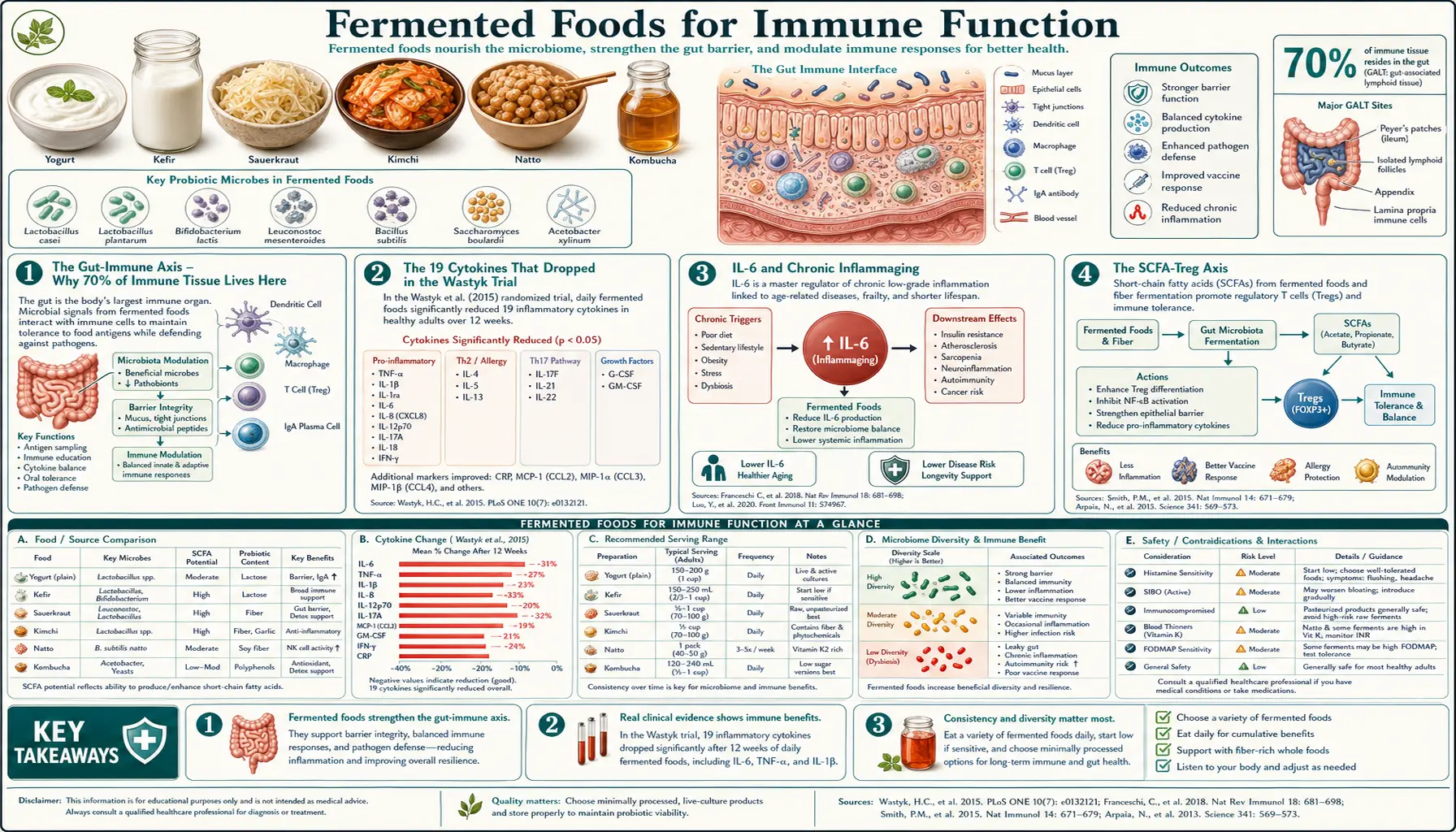
The 2021 consensus statement on fermented foods from the International Scientific Association for Probiotics and Prebiotics (ISAPP) notes that approximately 70% of the human immune system is located in the gastrointestinal tract, which makes foods and drinks the main point of contact between outside antigens and the body. The 2021 Wastyk et al. Stanford trial published in Cell assigned 39 healthy adults to a high-fiber or a high-fermented-food diet over a 17-week protocol. In the fermented-food arm, where intake was built up to about six servings a day, 19 of 93 measured inflammatory proteins fell, including IL-6, IL-10 and IL-12b; none of those 19 changed in the high-fiber arm, and the trial’s primary outcome, a cytokine response score, did not change in either arm. This page covers the gut-immune axis, the trial’s inflammatory-marker results, the short-chain fatty acid, regulatory T cell and IgA pathways (described mostly in animal studies), three traditional uses of fermented foods and what has been studied about them, allergy and autoimmunity research, and the cautions described in the literature.
Table of Contents
- The Gut-Immune Axis and the 70% Estimate
- The 19 Inflammatory Proteins That Fell in the Wastyk Trial
- IL-6 and Chronic Inflammation
- The SCFA-Treg Axis
- Mucosal IgA and the Antibody Response
- Bacteriocins and Pathogen Resistance
- Traditional Uses and the Metchnikoff Hypothesis
- Sauerkraut, Vitamin C and Colds
- Kefir After Childbirth: What Has Been Studied
- Miso Soup and Illness: What Has Been Studied
- Fermented Foods, Allergy, and Atopic Disease
- Fermented Foods and Autoimmunity
- Cautions and Caveats
- Key Research Papers
- Connections
- Featured Videos
The Gut-Immune Axis and the 70% Estimate
The 2021 ISAPP consensus statement on fermented foods states that approximately 70% of the human immune system is located in the gastrointestinal tract, so that foods and beverages are the major conduit of contact between external antigens and the body (PubMed PMID: 33398112). A 2009 review by Round and Mazmanian describes the gut-associated lymphoid tissues (GALT) as the lymphoid structures associated with the intestinal mucosa — the tonsils, Peyer’s patches, lymphoid follicles, appendix or cecal patch and mesenteric lymph nodes — which provide the first line of defence against pathogens entering through the mucosal barrier; Peyer’s patches are groups of lymphoid nodules in the small intestine, usually the ileum. The same review calls the gastrointestinal tract the primary site of interaction between the host immune system and microorganisms, both symbiotic and pathogenic (PubMed PMID: 19343057).
A 2014 review by Belkaid and Hand describes how the body limits contact between gut microbes and the epithelial surface: epithelial cells, mucus, IgA, antimicrobial peptides and immune cells together form what has been called the “mucosal firewall”. The review states that the microbiota plays a fundamental role in the induction, training and function of the immune system, and that when this alliance operates optimally it allows protective responses to pathogens while maintaining tolerance to innocuous antigens. In germ-free animals, raised without live microbes, the review notes smaller Peyer’s patches and fewer CD4+ T cells and IgA-producing plasma cells (PubMed PMID: 24679531).
The ISAPP panel describes several routes by which fermented foods could act on this system:
- Live microorganisms. Fermented-food microbes are unlikely to maintain long-term residence in the intestine, but short-term colonization could be enough to make bioactive compounds, inhibit intestinal pathogens and act on the gut lining, for example through Toll-like receptors.
- Microbial cell components. Peptidoglycan, surface proteins, exopolysaccharides and lipoteichoic acid from fermentation microbes are known to be immune reactive in animal and in vitro studies.
- Compounds formed during fermentation. Peptides, bacteriocins, amino acids, conjugated linoleic acid and organic acids can interact with the gut microbiota, the intestinal epithelium or the immune system.
The panel adds that, although milk kefir has been shown to modulate immune responses in numerous animal models, randomized trials or prospective studies on the human immune system had yet to be performed when it wrote the statement. The Wastyk trial, published the same year, is the main human study on this page.
The 19 Inflammatory Proteins That Fell in the Wastyk Trial
The Wastyk et al. 2021 trial in Cell came from Stanford. Of 381 people assessed, 39 were assigned: 21 to a high-fiber diet and 18 to a high-fermented-food diet (the abstract gives n = 18 per arm). The 17-week protocol had a 3-week baseline, a 4-week ramp in which intake was gradually increased, a 6-week maintenance phase at high intake and a 4-week choice period in which participants kept the diet to the extent they wished. The fermented-food arm aimed for six servings a day; the design is described in full on the Gut Microbiome Diversity page (PubMed PMID: 34256014).
Using an inflammation panel of serum proteins, the authors identified 19 of 93 cytokines, chemokines and other inflammatory serum proteins that decreased over the fermented-food intervention, including IL-6, IL-10 and IL-12b; the paper’s text names only these three, and the full set is shown in one of its figures. None of the 19 changed in the high-fiber arm. The size of the changes did not differ significantly between participants grouped as “high” and “low” fermented-food consumers, and no change correlated with BMI.
The trial also looked at immune cells. In the fermented-food arm, activation fell in 14 of 60 cell type-specific signaling responses across CD4+ T cells, CD8+ T cells, B cells and classical monocytes, with one signaling increase; effector memory CD4+ T cells increased and non-classical monocytes decreased. When the researchers stimulated CD4+ T cells, CD8+ T cells and B cells outside the body to test the strength of the response to an immune stimulus, they found no change in signaling capacity in either diet arm. The authors describe these data as consistent with an overall cohort-wide decrease in inflammation in the fermented-food arm. The registered primary outcome, a cytokine response score, did not change significantly in either arm.
The trial enrolled healthy adults only, with 18 people per arm in the abstract. Whether the same marker changes occur in people with an established inflammatory disease was not tested in it.
IL-6 and Chronic Inflammation
The Wastyk authors describe IL-6 as a key mediator of chronic inflammation that is elevated in several chronic inflammatory conditions, such as rheumatoid arthritis, type 2 diabetes and chronic stress, and as a commonly used measure of inflammation, citing a 2014 review by Tanaka, Narazaki and Kishimoto. That review describes IL-6 as produced promptly and transiently in response to infections and tissue injuries, contributing to host defence through acute-phase responses, blood-cell formation and immune reactions. It states that dysregulated, continual IL-6 synthesis has a pathological effect on chronic inflammation and autoimmunity, and that this led to the development of tocilizumab, a humanized antibody against the IL-6 receptor, approved for rheumatoid arthritis and juvenile idiopathic arthritis (PubMed PMID: 25190079).
In the Wastyk trial, IL-6 was one of the 19 proteins that fell in the fermented-food arm, in healthy adults. The trial measured markers rather than disease outcomes, and it did not measure how much of the IL-6 change originated in the gut.
The SCFA-Treg Axis
Short-chain fatty acids (SCFAs) are produced by the intestinal microbiota when it ferments dietary fibre, and they bind the G-protein-coupled receptor GPR43 (also called FFAR2). In a 2009 Nature study by Maslowski and colleagues, mice lacking GPR43 showed exacerbated or unresolving inflammation in models of colitis, arthritis and asthma, and germ-free mice, which have little or no SCFAs, showed a similar dysregulation of certain inflammatory responses. The authors propose that GPR43 binding of SCFAs is a molecular link between diet, gut bacterial metabolism and immune and inflammatory responses (PubMed PMID: 19865172).
Three 2013 studies, all in mice, connected SCFAs to regulatory T cells (Tregs) — T cells that express the transcription factor Foxp3 and have a key role in limiting inflammatory responses in the intestine:
- Smith and colleagues (Science) found that SCFAs regulated the size and function of the colonic Treg pool and protected against colitis, in a manner that depended on the receptor Ffar2 (PubMed PMID: 23828891).
- Furusawa and colleagues (Nature) found that butyrate, a large-bowel fermentation product, induced the differentiation of colonic Tregs in vitro and in vivo and lessened colitis in a T-cell transfer model; butyrate increased histone H3 acetylation at the Foxp3 gene, a possible mechanism (PubMed PMID: 24226770).
- Arpaia and colleagues (Nature) found that butyrate made by commensal microbes during starch fermentation helped generate Tregs outside the thymus; propionate, another SCFA able to inhibit histone deacetylases (HDACs), did the same, while acetate, which lacks that activity, did not (PubMed PMID: 24226773).
Furusawa and colleagues describe colonic Tregs as having a central role in the suppression of inflammatory and allergic responses. In people, the importance of Foxp3 is shown by IPEX syndrome (immune dysregulation, polyendocrinopathy, enteropathy, X-linked inheritance), a fatal disorder caused by mutations of the human FOXP3 gene (PubMed PMID: 11137993).
On the fermented-food side, the ISAPP panel lists organic acids among compounds formed during fermentation, and reports prebiotics (substrates selectively utilized by host microorganisms that confer a health benefit) in several fermented foods, including fermented grains and vegetables. The SCFA–Treg findings above come from mouse studies; the sources on this page do not show the same pathway at work in people eating fermented foods. In the Wastyk trial, a subset of fecal SCFAs decreased in the high-fiber arm, and the authors did not observe the increase in butyrate reported in some fiber studies.
The gut-brain side of microbial signaling is covered on the Gut-Brain Axis page.
Mucosal IgA and the Antibody Response
Secretory immunoglobulin A (sIgA) is an antibody found in the intestine. The 2009 review by Round and Mazmanian notes that one of the first immune deficiencies observed in germ-free mice was a profound reduction in intestinal sIgA, and that colonizing mice with single bacterial species increases IgA. Because sIgA coats commensal and pathogenic bacteria, some researchers have proposed that it limits the penetration of bacteria into host tissues; mice that cannot class-switch to IgA show lymphoid hyperplasia of the gut and an altered microbiota (PubMed PMID: 19343057).
Belkaid and Hand describe IgA specific for commensals as produced with the help of intestinal dendritic cells, which sample commensals at the epithelium and interact with B and T cells in the Peyer’s patches. They also note that colostrum and breast milk contain live microbes, metabolites, IgA, immune cells and cytokines, and that maternal IgA restricts immune activation and microbial attachment by binding nutritional and microbial antigens (PubMed PMID: 24679531).
These IgA findings come mainly from animal studies of the resident microbiota. The sources on this page do not report a measured change in IgA from eating fermented foods.
Bacteriocins and Pathogen Resistance
Bacteriocins are antimicrobial peptides made by bacteria, with narrow or broad host ranges. A 2005 review by Cotter, Hill and Ross notes that many are produced by food-grade lactic acid bacteria, which lets food scientists direct or prevent the growth of specific bacteria in food, and describes them as conferring “a rudimentary form of innate immunity to foodstuffs” (PubMed PMID: 16205711). The ISAPP panel states that many lactic acid bacteria, whether native to the food or added as starter cultures, produce bacteriocins that inhibit undesirable bacteria, including Listeria, Staphylococcus and Clostridium, and that fermentation microbes usually out-compete potential pathogenic and spoilage organisms.
Two bacteriocins with their own literature:
- Nisin — an antimicrobial peptide produced by Lactococcus lactis; a 2025 systematic review discusses its established role in food preservation (PubMed PMID: 40531107).
- Pediocins — produced by some Pediococcus bacteria; a 2021 review describes pediocins as active against Gram-positive bacteria, especially Listeria monocytogenes, by forming pores in the cell membrane, and as keeping their activity during heat treatment (PubMed PMID: 34603234).
Inside the gut, the ISAPP panel suggests that short-term colonization by fermented-food microbes “could be sufficient” to inhibit intestinal pathogens; it presents this as a possibility rather than a measured effect.
Traditional Uses and the Metchnikoff Hypothesis
The ISAPP panel writes that fermented foods have been consumed for thousands of years and were adopted by nearly every culture worldwide. The three sections below take three traditional uses named on this page — sauerkraut for colds, kefir after childbirth and miso soup during illness — and set out what has been studied about each. The cultural history of fermented foods is covered on the History and Cultures page.
The best-known early scientific idea about fermented foods and health came from Élie Metchnikoff, who described the cells he called phagocytes and received a Nobel Prize in 1908. A 2013 review by Mackowiak describes how, over a century ago, Metchnikoff theorized that health could be enhanced and senility delayed by manipulating the intestinal microbiome with host-friendly bacteria found in yogurt; his regimen used soured milk prepared with lactic bacteria or pure cultures of the “Bulgarian bacillus” (Lactobacillus bulgaricus), and he followed it himself. The review states that the theory flourished for a time, drifted to the fringe of medical practice and re-emerged in the mid-1990s as a concept worthy of mainstream medical attention, and that Metchnikoff also predicted bacterial translocation and anticipated theories linking chronic inflammation with atherosclerosis and other disorders of the aged (PubMed PMID: 24350221). His 1907 book was The Prolongation of Life: Optimistic Studies.
Sauerkraut, Vitamin C and Colds
Sauerkraut appears in naval medical history: a 2005 history note in the Finnish medical journal Duodecim is titled “Captain Cook used sauerkraut to prevent scurvy” (PubMed PMID: 15991750; in Finnish, with no abstract in PubMed). USDA FoodData Central lists canned sauerkraut, solids and liquids (SR Legacy, FDC ID 169279), at 14.7 mg of vitamin C and 661 mg of sodium per 100 g.
The ISAPP panel describes fermentations of cabbage and other leafy greens as initiated by Leuconostoc mesenteroides and followed by Lactiplantibacillus species and Levilactobacillus brevis, whether the product is called sauerkraut, kimchi, suan-cai or sinki. It notes that traditional, spontaneously fermented sauerkraut likely contains several uncharacterized strains of Lactiplantibacillus plantarum at unknown doses, lists heat-treated or pasteurized fermented vegetables among fermented foods with no live microorganisms, and counts sauerkraut among the fermented foods investigated in at least one randomized trial.
A PubMed search made for this page found no human trial of sauerkraut or sauerkraut brine for colds.
Kefir After Childbirth: What Has Been Studied
Kefir is a fermented milk. Under the Codex Alimentarius standard cited by the ISAPP panel, it consists of Lentilactobacillus kefiri and species of Leuconostoc, Lactococcus and Acetobacter, together with lactose-fermenting yeasts (Kluyveromyces marxianus) and non-lactose-fermenting yeasts (Saccharomyces unisporus, S. cerevisiae and S. exiguus). The panel states that milk kefir has been shown to modulate immune responses in numerous animal models, but that randomized trials or prospective studies on the human immune system had yet to be performed (PubMed PMID: 33398112).
A PubMed search made for this page found no human trial of kefir for recovery after childbirth. The closest record was a 2025 study in rats, in which the authors report that maternal kefir intake during lactation was associated with differences in the breast milk and gut microbiota of the offspring (PubMed PMID: 39895284). It is an animal study.
Miso Soup and Illness: What Has Been Studied
Miso is a fermented soy food. The ISAPP panel notes that the fungi responsible for koji, the starting material for soy sauce and miso, use aerobic metabolism; that domestication and careful strain selection have effectively eliminated mycotoxin-producing lineages of Aspergillus and Penicillium from koji, cheese and other fermented foods; and that the human attraction to flavour-enhancing nucleotides and amino acids enriched in foods such as soy sauce and miso could have evolved from the safety and nutritional benefits of those foods in early diets. The panel lists miso among fermented foods that contain live microorganisms, and heat-treated or pasteurized fermented foods and soy sauce among those that do not.
A PubMed search made for this page found no human trial of miso soup for colds or other acute illness.
Fermented Foods, Allergy, and Atopic Disease
The hygiene hypothesis attributes the rise in atopic disease in western societies to reduced microbial exposure in early life, as summarized in a 2001 trial report by Kalliomäki and colleagues (PubMed PMID: 11297958). Belkaid and Hand propose that, in high-income countries, overuse of antibiotics, changes in diet and the elimination of constitutive partners such as nematodes may have selected for a microbiota lacking the resilience and diversity needed for balanced immune responses, and that this may account for some of the rise in autoimmune and inflammatory disorders (PubMed PMID: 24679531).
The evidence the ISAPP panel cites for fermented foods here is observational:
- In one cross-sectional study, fermented-vegetable intake in early childhood was associated with a reduced risk of childhood atopy.
- In another epidemiological study, fermented-food intake combined with common daily-life exposures (for example, hand rather than machine dishwashing) was associated with a reduced risk of childhood allergies.
- An anthroposophic lifestyle (low antibiotic use and vaccinations, and high intake of fermented vegetables) was associated with differences in infant microbiome structure, including a higher abundance and diversity of lactic acid bacteria.
- Fermented-food intake is one of the factors associated with a farming upbringing, which has consistently been associated with reduced allergy and asthma risk.
The panel describes these associations as possibly indicating that a lack of fermented foods in industrialized societies is a substantial loss in exposure to non-harmful microorganisms important for immune development.
A randomized trial tested a single probiotic strain, not a fermented food. Kalliomäki and colleagues gave Lactobacillus GG before birth to mothers who had at least one first-degree relative or partner with atopic eczema, allergic rhinitis or asthma, and for 6 months after birth to their infants. At age 2, atopic eczema had been diagnosed in 15 of 64 children (23%) in the probiotic group and 31 of 68 (46%) in the placebo group (relative risk 0.51, 95% CI 0.32–0.84) (PubMed PMID: 11297958).
None of these studies tested fermented foods as a treatment for an existing food allergy.
Fermented Foods and Autoimmunity
Belkaid and Hand describe the gastrointestinal tract as home to the largest population of commensal organisms in the body, with immunoregulatory mechanisms that prevent unnecessary activation of the immune system against harmless antigens, including those of the microbiota. A breakdown in these mechanisms, they write, results in the chronic inflammatory conditions known as inflammatory bowel disease, and both Crohn’s disease and ulcerative colitis are associated with a reduced complexity of the commensal microbiota (PubMed PMID: 24679531). The mouse studies above link microbial SCFAs to Tregs, and IPEX syndrome shows what happens in people when Foxp3 is mutated.
The human studies on this page enrolled healthy adults (Wastyk) or infants at high risk of atopy (Kalliomäki); none tested fermented foods in people with an autoimmune disease. The ISAPP panel’s 2021 statement that trials on the human immune system had yet to be performed applies here as well. Decisions about diet changes alongside treatment for an autoimmune disease belong with a clinician.
Cautions and Caveats
- Biogenic amines. The ISAPP panel notes that histamine, tyramine and other biogenic amines are formed by some lactic acid bacteria during the fermentation of cheese, meats, vegetables, soybeans and wine, and that in the absence of the body’s detoxification systems these amines can cause effects ranging from mild to more severe, such as migraines. Producers reduce them through hygiene and starter cultures that lack the enzymes that make them.
- MAO-inhibitor drugs and tyramine. Tyramine can raise blood pressure in people taking monoamine oxidase inhibitors (the pressor response). A 2018 review by Gillman reports that few modern foods contain problematically high tyramine levels, largely because of starter cultures and hygiene regulations, that in past decades cheese was the only food associated with documented fatalities, and that pressor sensitivity varies between individuals; it reviews fish and soy sauces, salami-type sausages, beers and wines among other foods (PubMed PMID: 30255284).
- Natto and warfarin. A 2021 trial report describes natto as containing high vitamin K2 levels, mostly as menaquinone-7 (MK-7), and as a food that “must be avoided by warfarin-dependent patients”. The same report tested a natto made with a low-MK-7 strain (19–24% of the usual MK-7 content) in 10 warfarin-dependent patients for 7 days; at up to 20 g a day it did not change the INR (PubMed PMID: 34406879). The Natto page has more.
- Critically ill patients and probiotic products. A 2019 genomic study reported a markedly higher risk of Lactobacillus bacteremia in intensive-care patients given probiotics than in those not given them, with blood isolates genetically inseparable from the strains in the probiotic product (PubMed PMID: 31700189). That study concerned a probiotic product given in hospital, not fermented foods.
- Listeria and other contamination. The ISAPP panel notes that properly made fermented foods are rarely associated with gastroenteritis, but that some cheeses and low-acid fermented foods can pose a risk if contaminated with Listeria monocytogenes, Salmonella, Clostridium botulinum or other foodborne pathogens. MedlinePlus (US National Library of Medicine) states that Listeria can be found in foods made from unpasteurized milk and that listeriosis is most likely to affect pregnant women and unborn babies, older adults and people with weak immune systems, and lists avoiding raw milk and raw-milk products among ways to reduce the risk (MedlinePlus: Listeria Infections).
- Salt and alcohol. The ISAPP panel describes salt (for example in soy sauce or kimchi) and alcohol (wine, beer, liquor) as inherent constituents of some fermented foods. In the Wastyk trial, total sodium intake in the fermented-food arm did not change from baseline despite more fermented vegetables and vegetable brine drinks.
- Antibiotic-resistance genes. Some microbes associated with long-ripened cheeses, sausages and other fermented foods can carry transmissible antibiotic-resistance genes (ISAPP).
- SIBO. Small intestinal bacterial overgrowth is covered on the SIBO page.
Decisions about diet changes during illness, pregnancy or immune suppression belong with a clinician.
Key Research Papers
- Wastyk HC et al. (2021). Gut-microbiota-targeted diets modulate human immune status. Cell 184(16):4137-4153.e14. — PubMed PMID: 34256014
- Marco ML et al. (2017). Health benefits of fermented foods: microbiota and beyond. Current Opinion in Biotechnology 44:94-102. — PubMed PMID: 27998788
- Arpaia N et al. (2013). Metabolites produced by commensal bacteria promote peripheral regulatory T-cell generation. Nature 504(7480):451-455. — PubMed PMID: 24226773
- Smith PM et al. (2013). The microbial metabolites, short-chain fatty acids, regulate colonic Treg cell homeostasis. Science 341(6145):569-573. — PubMed PMID: 23828891
- Maslowski KM et al. (2009). Regulation of inflammatory responses by gut microbiota and chemoattractant receptor GPR43. Nature 461(7268):1282-1286. — PubMed PMID: 19865172
- Furusawa Y et al. (2013). Commensal microbe-derived butyrate induces the differentiation of colonic regulatory T cells. Nature 504(7480):446-450. — PubMed PMID: 24226770
- Metchnikoff E (1907). The Prolongation of Life: Optimistic Studies. London: Heinemann; New York: Putnam. (book; Wellcome Library scan of the 1907 English edition) — Internet Archive: b31363994
- Hill C et al. (2014). The International Scientific Association for Probiotics and Prebiotics consensus statement on the scope and appropriate use of the term probiotic. Nat Rev Gastroenterol Hepatol 11(8):506-514. — PubMed PMID: 24912386
- Round JL, Mazmanian SK (2009). The gut microbiota shapes intestinal immune responses during health and disease. Nat Rev Immunol 9(5):313-323. — PubMed PMID: 19343057
- Belkaid Y, Hand TW (2014). Role of the microbiota in immunity and inflammation. Cell 157(1):121-141. — PubMed PMID: 24679531
- Ahn S et al. (2025). Effects of fermented kimchi consumption on anthropometric and blood cardiometabolic indicators: a systematic review and meta-analysis of intervention studies and prospective cohort studies. Nutr Rev 83(7):e1441-e1457. — PubMed PMID: 39545368
- Bordoni A et al. (2017). Dairy products and inflammation: A review of the clinical evidence. Crit Rev Food Sci Nutr 57(12):2497-2525. — PubMed PMID: 26287637
- Plovier H et al. (2017). A purified membrane protein from Akkermansia muciniphila or the pasteurized bacterium improves metabolism in obese and diabetic mice. Nature Medicine 23(1):107-113. — PubMed PMID: 27892954
- Marco ML et al. (2021). The International Scientific Association for Probiotics and Prebiotics (ISAPP) consensus statement on fermented foods. Nat Rev Gastroenterol Hepatol 18(3):196-208. — PubMed PMID: 33398112
- Tanaka T, Narazaki M, Kishimoto T (2014). IL-6 in inflammation, immunity, and disease. Cold Spring Harb Perspect Biol 6(10):a016295. — PubMed PMID: 25190079
- Bennett CL et al. (2001). The immune dysregulation, polyendocrinopathy, enteropathy, X-linked syndrome (IPEX) is caused by mutations of FOXP3. Nat Genet 27(1):20-21. — PubMed PMID: 11137993
- Cotter PD, Hill C, Ross RP (2005). Bacteriocins: developing innate immunity for food. Nat Rev Microbiol 3(10):777-788. — PubMed PMID: 16205711
- Wang X et al. (2025). Nisin: harnessing nature's preservative for the future of food safety and beyond. Crit Rev Food Sci Nutr 65(34):9045-9070. — PubMed PMID: 40531107
- Khorshidian N et al. (2021). Antibacterial activity of pediocin and pediocin-producing bacteria against Listeria monocytogenes in meat products. Front Microbiol 12:709959. — PubMed PMID: 34603234
- Mackowiak PA (2013). Recycling Metchnikoff: probiotics, the intestinal microbiome and the quest for long life. Front Public Health 1:52. — PubMed PMID: 24350221
- Saloheimo P (2005). [Captain Cook used sauerkraut to prevent scurvy]. Duodecim 121(9):1014-1015. (in Finnish) — PubMed PMID: 15991750
- Costa de Almeida T et al. (2025). Maternal kefir intake during lactation impacts the breast milk and gut microbiota of the Wistar rat's offspring. Int J Food Sci Nutr 76(2):179-193. — PubMed PMID: 39895284
- Kalliomäki M et al. (2001). Probiotics in primary prevention of atopic disease: a randomised placebo-controlled trial. Lancet 357(9262):1076-1079. — PubMed PMID: 11297958
- Gillman PK (2018). A reassessment of the safety profile of monoamine oxidase inhibitors: elucidating tired old tyramine myths. J Neural Transm (Vienna) 125(11):1707-1717. — PubMed PMID: 30255284
- Nakajima T et al. (2021). First clinical trial of a newly developed, low menaquinone-7, fermented soybean natto in warfarin-dependent patients. J Med Food 24(8):860-865. — PubMed PMID: 34406879
- Yelin I et al. (2019). Genomic and epidemiological evidence of bacterial transmission from probiotic capsule to blood in ICU patients. Nature Medicine 25(11):1728-1732. — PubMed PMID: 31700189
PubMed Topic Searches
Connections
- All Food
- Fermented Foods Overview
- Fermented Foods Benefits Hub
- Gut Microbiome Diversity
- Probiotic Strains
- History and Cultures
- Immune Boosting
- Gut Healing
- Gut-Brain Axis
- Probiotics
- Gut Microbiome
- Sauerkraut — the cabbage ferment behind the Captain Cook vitamin C story above.
- Kimchi
- Kefir
- Yogurt
- Natto
- Irritable Bowel Syndrome
- SIBO
- Vitamin A for Immune Function
- Covered in depth on its own page: Fermented Foods
- History