Caffeine Cutoff Timing and Sleep
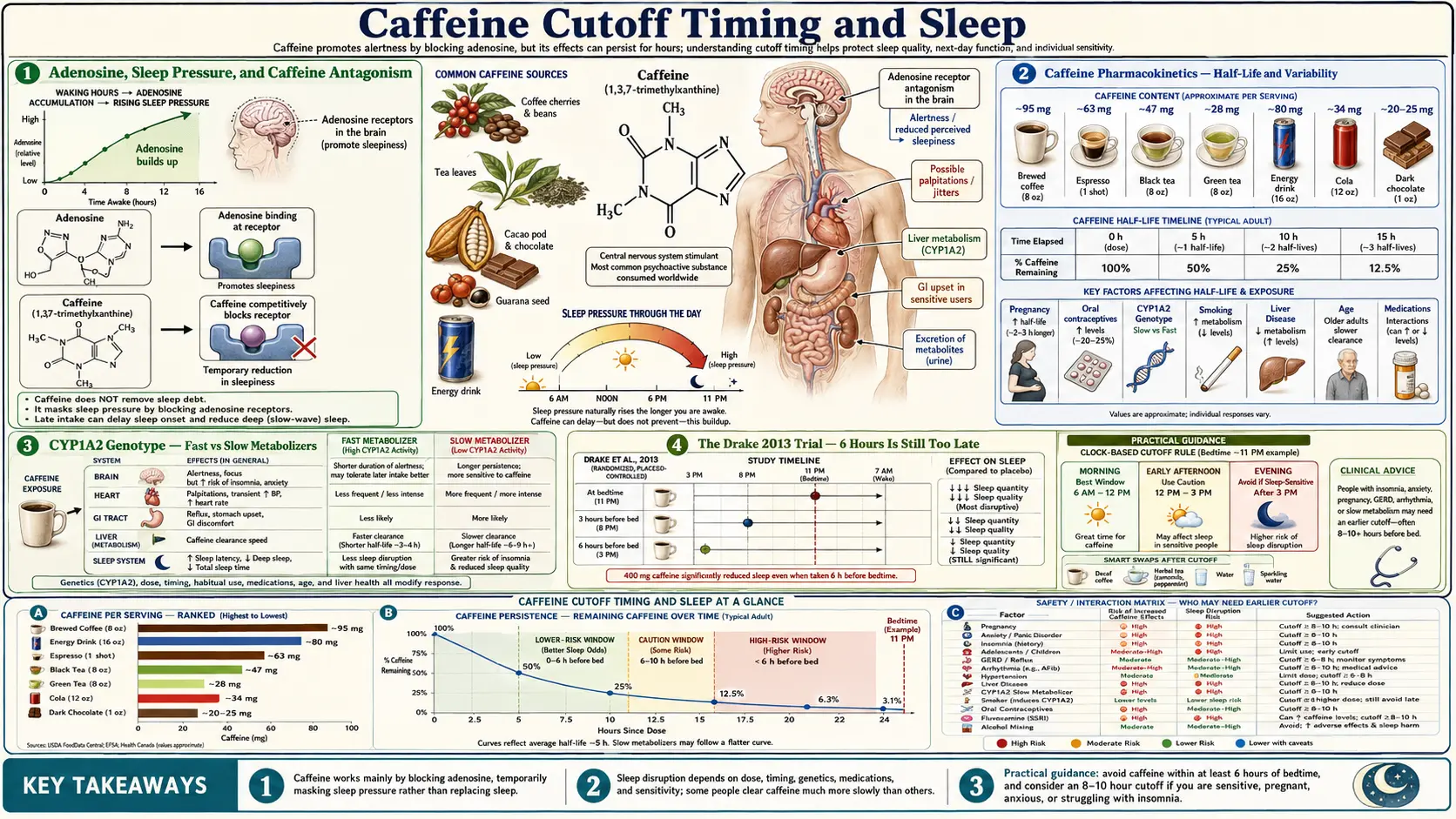
Caffeine is the most widely used psychoactive drug in the world, and the most underappreciated cause of insomnia in self-identified "non-sensitive" adults. The Drake et al. 2013 trial (J Clin Sleep Med, PubMed PMID: 24235903) is the single cleanest demonstration: 400 mg of caffeine (roughly 3 cups of brewed coffee) consumed 6 hours before bed reduced objectively measured total sleep time by more than 1 hour, while the participants' own sleep diaries did not register a significant change. Subjective perception of caffeine sensitivity is unreliable; objectively measured sleep is disrupted even when the drinker does not notice. Caffeine has a 5-hour half-life and an 8-10 hour quarter-life, with substantial individual variation — smoking, pregnancy, oral contraceptives, liver disease and some medicines all change it, and the CYP1A2 gene (rs762551 polymorphism) is studied as a further factor. Drake and colleagues concluded that their results support refraining from substantial caffeine use for a minimum of 6 hours before bedtime. This page walks through the pharmacology, the trial evidence, the genetic variability, and how cutoff times are worked out.
Interactive Visualization Caffeine, Adenosine & Why Coffee Stops Working Caffeine doesn’t give you energy — it blocks the tiredness signal while adenosine keeps piling up behind the blockade. Move your coffee to 2 p.m. and watch your deep sleep vanish. Launch →
Table of Contents
- Adenosine, Sleep Pressure, and Caffeine Antagonism
- Caffeine Pharmacokinetics — Half-Life and Variability
- CYP1A2 Genotype — Fast vs Slow Metabolizers
- The Drake 2013 Trial — 6 Hours Is Still Too Late
- Effects on Sleep Architecture (REM, SWS)
- Tolerance vs Dependence vs Withdrawal
- Caffeine Content of Common Sources
- Cutoff Times Counted Back From Bedtime
- Hidden Sources — Decaf, Chocolate, Medications
- Cautions
- Key Research Papers
- Connections
- Featured Videos
Adenosine, Sleep Pressure, and Caffeine Antagonism
Sleep pressure (Process S in Borbely's two-process model) is the mounting drive to sleep that accumulates throughout the waking day. The neurochemical correlate is adenosine, a nucleoside that is a byproduct of cellular adenosine triphosphate (ATP) metabolism. As neurons fire all day, they produce adenosine triphosphate, which is dephosphorylated to ADP, AMP, and ultimately adenosine. Extracellular adenosine accumulates in the basal forebrain and the ventrolateral preoptic area, where it binds A1 and A2A adenosine receptors. A1 activation inhibits arousal-promoting nuclei; A2A activation directly promotes sleep-active neurons.
Caffeine (1,3,7-trimethylxanthine) is a competitive antagonist at both A1 and A2A receptors. It does not destroy adenosine; it simply binds the receptor with similar affinity and prevents adenosine from triggering its physiological signal. The accumulated sleep pressure is still there — it just is not being perceived by the brain. When caffeine is metabolized and clears the receptor, the adenosine that has continued to accumulate floods the receptors and produces the famous "caffeine crash."
The key implication: caffeine does not give you energy; it borrows alertness from your future self by masking accumulating sleep pressure. The debt is repaid one way or another — either through the post-caffeine crash, or through disrupted sleep that night.
Caffeine Pharmacokinetics — Half-Life and Variability
Caffeine is absorbed rapidly through the gastrointestinal tract with peak plasma concentration at 30–60 minutes after ingestion (faster on an empty stomach). Distribution is essentially body-wide; caffeine crosses the blood-brain barrier and the placenta freely.
Metabolism is almost entirely hepatic, primarily by the CYP1A2 isoform of cytochrome P450, with minor contributions from cytochrome P450 2E1 (CYP2E1) and cytochrome P450 3A4 (CYP3A4). The primary metabolites are paraxanthine (active, similar effects to caffeine), theobromine, and theophylline (also active).
The population mean half-life is approximately 5 hours, but this varies substantially:
- Healthy adult non-smoker: 4–6 hours
- Smokers: 2–3 hours (smoking induces CYP1A2)
- Pregnancy (third trimester): 10–15 hours (CYP1A2 suppressed)
- Oral contraceptive users: 6–12 hours (estrogen inhibits CYP1A2)
- Severe liver disease: >24 hours (impaired hepatic clearance)
- Newborns (especially preterm): 80–100 hours (CYP1A2 not fully expressed until ~6 months)
- Fluvoxamine (a selective serotonin reuptake inhibitor): caffeine half-life rose from 5 to 31 hours in one study and from 4.9 to 56 hours in another, via CYP1A2 inhibition; the related drugs citalopram, fluoxetine and paroxetine produced no significant change in a caffeine metabolic-ratio study
The "quarter-life" — time for caffeine to drop to 25% of peak — is roughly 10 hours for a typical adult. This means a 200 mg coffee at 2 PM still has 50 mg of caffeine on board at midnight — well above the threshold for sleep effects.
CYP1A2 Genotype — Fast vs Slow Metabolizers
The CYP1A2 gene is highly polymorphic. The single-nucleotide polymorphism rs762551 is the variant behind the usual “fast” and “slow” caffeine-metabolizer labels. In the 1999 study that described it (Sachse and colleagues), caffeine metabolism did not differ significantly between the three genotypes in 185 non-smokers; differences appeared only among 51 smokers, where the authors suggested the A/A genotype “may represent a CYP1A2 high inducibility genotype.”
- A/A genotype (labelled CYP1A2*1A/*1A in the Cornelis 2006 study): "Fast metabolizers." Approximately 45% of Caucasians.
- A/C heterozygote: Approximately 45%. Intermediate metabolism.
- C/C homozygote: "Slow metabolizers" (Cornelis 2006 counts every carrier of the C allele, which it labels *1F, as slow). Approximately 10%.
The Cornelis et al. JAMA 2006 study (PubMed PMID: 16522833) showed that slow metabolizers had increased risk of myocardial infarction with high coffee consumption, while fast metabolizers had no such risk (and possibly slightly reduced risk). This is the clearest demonstration that the metabolic distinction is not just academic — it has hard clinical consequences.
Some direct-to-consumer genetic tests, or third-party tools that read their raw data, report CYP1A2 rs762551 status. Given the Sachse finding in non-smokers, the genotype alone is a weaker guide to caffeine clearance than the smoking, pregnancy, contraceptive and medication effects listed above.
The Drake 2013 Trial — 6 Hours Is Still Too Late
The Drake et al. trial (J Clin Sleep Med 2013, PubMed PMID: 24235903) is the most cited dose-timing experiment in the sleep-and-caffeine literature. Twelve healthy adults received 400 mg of caffeine (or placebo) in a double-blind crossover at three times: at bedtime, 3 hours before bedtime, and 6 hours before bedtime. Sleep was measured at home with a sleep diary and an in-home headband monitor that recorded a single channel of brain activity from the forehead; polysomnography was not performed.
Findings:
- Monitor-measured sleep: 400 mg at bedtime, 3 hours before bed, and 6 hours before bed each reduced total sleep time by 1.1 to 1.2 hours vs placebo, with no significant difference between the three caffeine times.
- Sleep diaries: total sleep time fell significantly with caffeine at bedtime and 3 hours before bed; at 6 hours the self-reported reduction was 41 minutes, which approached significance (p = 0.08).
- The gap: at 6 hours, only the objective monitor detected the disruption — what the authors called a lack of subjective awareness of caffeine-induced sleep disturbance.
The 6-hour finding is the surprise. Even at 6 hours, the monitor showed more than an hour of lost sleep; sleep efficiency was reduced in every caffeine condition, and wake time during sleep rose significantly in the 3-hour (+27.6 min) and 6-hour (+8 min) conditions. The authors described the device's sleep-stage results as preliminary, and suggested that the lack of perceived disruption may be one reason people do not follow sleep-hygiene advice about caffeine close to bedtime.
Note that 400 mg is the high end of typical consumption — roughly three 8-oz cups of brewed coffee. The trial tested a single fixed dose of 400 mg, so it does not show how smaller doses behave; the authors cite earlier dose-response studies in which increasing doses taken at or near bedtime were associated with significant sleep disturbance.
Effects on Sleep Architecture (REM, SWS)
Caffeine does not just delay sleep onset — it alters the architecture of the sleep that follows. Landolt and colleagues demonstrated by quantitative electroencephalogram (EEG) analysis that caffeine specifically suppresses the low-frequency delta (0.75–4.5 Hz) activity that characterizes slow-wave (deep) sleep. This is the most restorative stage, when growth hormone is pulsed, when glymphatic clearance is most active, and when memory consolidation of explicit/declarative information occurs.
Caffeine also tends to reduce REM sleep duration and shift the REM/NREM ratio. Since REM is concentrated in the second half of the night, even modest reductions can have outsized effects on emotional regulation, creativity, and mood the following day.
Together, these architectural changes can explain why a habitual late-afternoon-coffee drinker may sleep their usual 7–8 hours but wake unrefreshed, brain-fogged, or low in mood — the total time is fine but the quality is degraded.
Tolerance vs Dependence vs Withdrawal
Regular caffeine users develop pharmacological tolerance — the brain upregulates adenosine receptors to compensate for the chronic antagonism. This is why a 4-cup-a-day drinker no longer feels the "jolt" of the morning coffee; the receptor density has shifted to require caffeine just to feel normal.
Caffeine withdrawal is real and well-characterized:
- Headache: The classic symptom, reported in 50% of people in experimental studies; withdrawal symptoms typically begin 12–24 hours after the last caffeine and peak at 20–51 hours (Juliano and Griffiths 2004); mediated by adenosine-driven cerebral vasodilation.
- Fatigue and somnolence: Reflects accumulated sleep pressure suddenly being perceived.
- Difficulty concentrating, irritability, low mood: Typically lasts 2–9 days.
- Flu-like symptoms: Muscle aches, nausea, even vomiting in heavy users abruptly stopping.
Tapering rather than abrupt cessation reduces withdrawal severity; a 25% reduction every 3–5 days is a commonly described schedule. Abstinence from doses as low as 100 mg/day has produced withdrawal symptoms (Juliano and Griffiths 2004).
Caffeine Content of Common Sources
- Drip coffee, 8 oz: 95–165 mg (highly variable by bean and brew strength)
- Espresso, 1 oz shot: 60–75 mg
- Large coffee-chain brewed coffee, 12 oz (one chain's published figure): ~235 mg
- Large coffee-chain brewed coffee, 16 oz: ~310 mg
- Large coffee-chain brewed coffee, 20 oz: ~410 mg
- Cold brew, 16 oz: 200–300 mg
- Black tea, 8 oz: 40–70 mg
- Green tea, 8 oz: 25–45 mg
- Matcha, 1 tsp powder: 60–80 mg
- Yerba mate, 8 oz: 70–90 mg
- Standard energy drink, 8 oz: 70–100 mg; many "large" cans pack 200–300 mg
- Cola, 12 oz: 35–55 mg
- Diet cola, 12 oz: 45–75 mg
- Pre-workout supplement (typical scoop): 150–400 mg
- Over-the-counter caffeine tablet: 200 mg each
- Over-the-counter combination headache tablet (one tablet): 65 mg
- Dark chocolate, 1 oz (70% cacao): 20–25 mg
- Decaf coffee, 8 oz: 2–5 mg (yes, decaf has some caffeine)
Cutoff Times Counted Back From Bedtime
Drake and colleagues concluded that their results support sleep-hygiene recommendations to refrain from substantial caffeine use for a minimum of 6 hours before bedtime, and suggested restricting afternoon caffeine to before 17:00 (5 PM) at a minimum. Counting back further, 8–10 hours — about the caffeine quarter-life given above for a typical adult — gives these clock times:
- 10 PM bedtime, counting back 8 hours: 2 PM.
- 10 PM bedtime, counting back 10 hours: 12 noon.
- 10 PM bedtime, the 6-hour minimum from the Drake trial: 4 PM.
- Midnight bedtime, counting back 8 hours: 4 PM.
- Shift worker (night shift, sleep 8 AM–4 PM), counting back 8 hours: midnight.
- Pregnancy: ACOG's limit is 200 mg/day in total; the third-trimester half-life is 10–15 hours (see above).
The Drake trial did not test a self-experiment such as two weeks without caffeine after noon compared against a usual schedule with a sleep tracker. What it showed is that at 6 hours before bed the participants' own sleep diaries did not register disruption that the in-home monitor detected — so the feeling that "caffeine doesn't affect my sleep" was not a reliable guide in that study.
Hidden Sources — Decaf, Chocolate, Medications
Caffeine hides in places most consumers do not look:
- Decaf coffee: 2–15 mg per cup, sometimes more. Several cups of decaf in the evening can produce a 30–40 mg cumulative dose — non-trivial for slow metabolizers.
- Chocolate: Dark chocolate especially. A 3-oz bar of 70% cacao can deliver 70–90 mg caffeine plus 200+ mg theobromine (which has similar but milder adenosine-antagonist effects with a longer half-life).
- Ice cream: Coffee, chocolate, and mocha ice cream all contain caffeine. Coffee ice cream can have 30–80 mg per half-cup serving.
- Over-the-counter (OTC) pain medications: some combination pain relievers contain 65 mg caffeine per tablet, and several other combination analgesics contain caffeine.
- Over-the-counter weight-loss products: Many contain green tea extract, guarana, or yerba mate — all caffeine sources, sometimes 100–300 mg per serving.
- Prescription medications: an ergotamine–caffeine combination for migraine contains 100 mg caffeine per dose. Several combination headache pills do as well.
- Pre-workout supplements: Often 200–400 mg per scoop. Evening workouts using these supplements regularly destroy sleep.
Cautions
- Cardiovascular: Caffeine acutely raises blood pressure by 5–15 mmHg. In well-controlled hypertension, regular caffeine use is generally safe; the concern is greater in uncontrolled hypertension or unstable arrhythmias.
- Atrial fibrillation: Older guidance held that caffeine triggers afib; recent prospective evidence (e.g., Klatsky et al., Mostofsky et al.) does not support this for moderate use. Individual triggers vary.
- Gastroesophageal reflux disease (GERD) and PUD: Caffeine relaxes the lower esophageal sphincter and stimulates gastric acid secretion. May worsen reflux and ulcer disease.
- Anxiety disorders: Caffeine can precipitate or worsen panic attacks, generalized anxiety, and social anxiety. Slow metabolizers are particularly susceptible.
- Pregnancy: ACOG advises ≤200 mg/day. Higher intake associated with lower birth weight and possibly miscarriage risk.
- Drug interactions: Fluvoxamine, oral contraceptives, and ciprofloxacin all substantially prolong caffeine half-life. Lithium clearance is increased by caffeine; abrupt caffeine cessation can elevate lithium levels.
- Children and adolescents: AAP recommends no caffeine for children under 12; ≤100 mg/day for adolescents.
- Lethal dose: Approximately 10–14 g (50–100 cups of coffee). Deaths from bulk caffeine powder overdose have occurred, where a small measuring error is a large dose.
Key Research Papers
- Drake C et al., Caffeine effects on sleep taken 0, 3, or 6 hours before going to bed (J Clin Sleep Med 2013) — PubMed PMID: 24235903
- Clark I, Landolt HP, Coffee, caffeine, and sleep: A systematic review of epidemiological studies and randomized controlled trials (Sleep Med Rev 2017) — PubMed PMID: 26899133
- Cornelis MC et al., Coffee, CYP1A2 genotype, and risk of myocardial infarction (JAMA 2006) — PubMed PMID: 16522833
- Fredholm BB et al., Actions of caffeine in the brain with special reference to factors that contribute to its widespread use (Pharmacol Rev 1999) — PubMed PMID: 10049999
- Burke TM et al., Effects of caffeine on the human circadian clock in vivo and in vitro (Sci Transl Med 2015) — PubMed PMID: 26378246
- Landolt HP et al., Caffeine reduces low-frequency delta activity in the human sleep EEG PubMed PMID: 7612156
- Roehrs T, Roth T, Caffeine: sleep and daytime sleepiness (Sleep Med Rev 2008) — Search PubMed
- Sachse C et al., Functional significance of a C-->A polymorphism in intron 1 of the CYP1A2 gene PubMed PMID: 10233211
- Snel J, Lorist MM, Effects of caffeine on sleep and cognition (Prog Brain Res 2011) — PubMed PMID: 21531247
- Juliano LM, Griffiths RR, A critical review of caffeine withdrawal: empirical validation of symptoms and signs (Psychopharmacology 2004) — PubMed PMID: 15448977
- Jeppesen U et al., A fluvoxamine-caffeine interaction study (Pharmacogenetics 1996) — PubMed PMID: 8807660
- Culm-Merdek KE et al., Fluvoxamine impairs single-dose caffeine clearance without altering caffeine pharmacodynamics (Br J Clin Pharmacol 2005) — PubMed PMID: 16236038
- Jeppesen U et al., Dose-dependent inhibition of CYP1A2, CYP2C19 and CYP2D6 by citalopram, fluoxetine, fluvoxamine and paroxetine (Eur J Clin Pharmacol 1996) — PubMed PMID: 8880055
- Carrier J et al., Effects of caffeine on daytime recovery sleep: a double challenge to the sleep-wake cycle in aging PubMed PMID: 19342294
- Reichert CF et al., Adenosine, caffeine, and sleep-wake regulation: state of the science and perspectives (J Sleep Res 2022) — Search PubMed
Connections
- All Food
- Caffeine, Adenosine & Why Coffee Stops Working — interactive animation
- Coffee Benefits Hub
- Coffee (Food Hub)
- Caffeine Sensitivity and CYP1A2
- Decaf vs Caffeinated
- Cognitive Performance
- Sleep Hygiene
- Sleep Hygiene Benefits Hub
- Insomnia
- Anxiety
- Valerian
- Chamomile
- L-Theanine
- Glycine
- Magnesium Glycinate
- Green Tea
- History
- Nutrients