Caffeine Sensitivity and CYP1A2 Pharmacogenetics
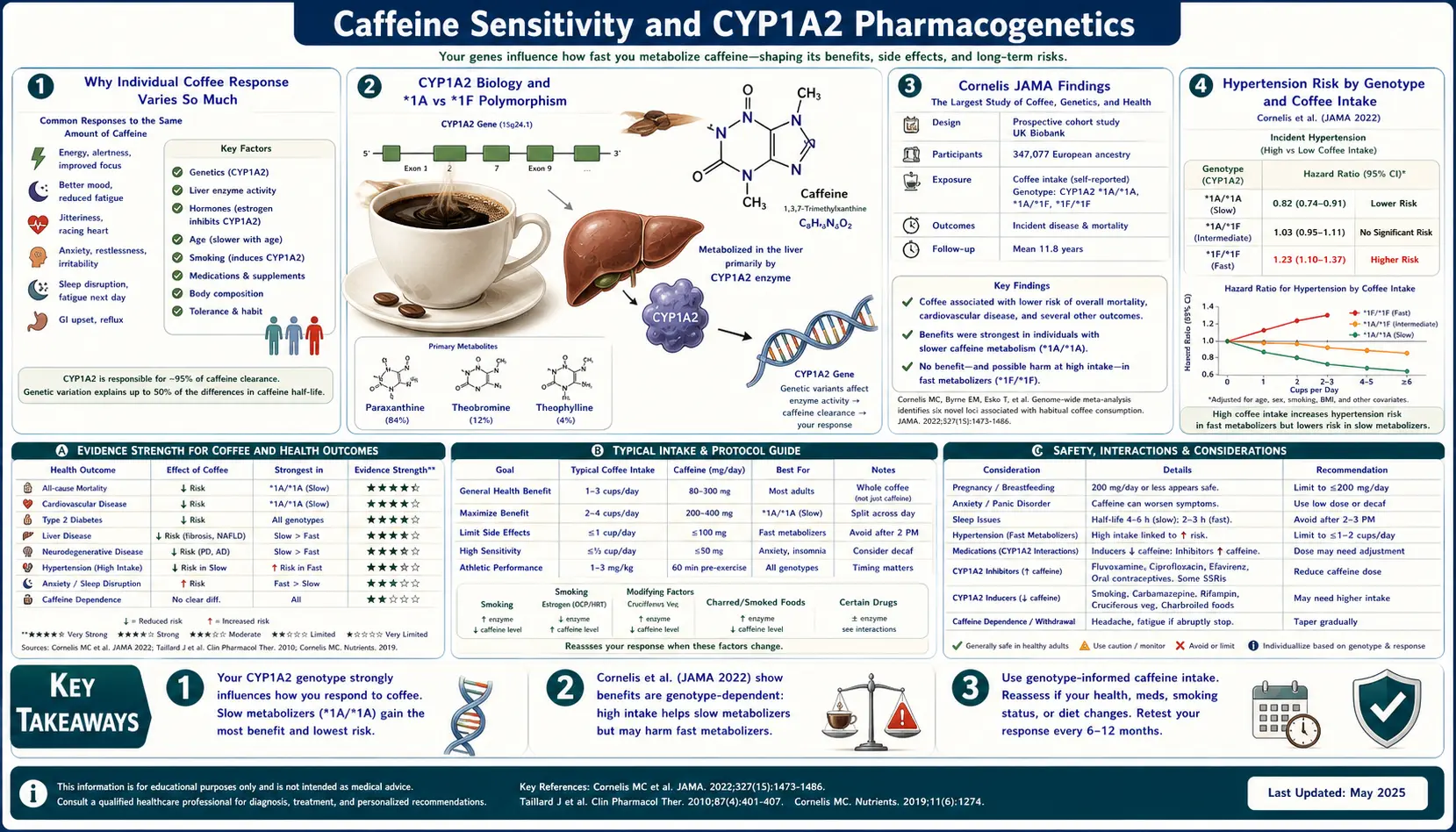
The CYP1A2 *1A versus *1F polymorphism (rs762551, a single-nucleotide A>C substitution in intron 1 of the CYP1A2 gene) divides people into rapid and slow caffeine metabolizers, and in several studies coffee’s link with heart attacks and high blood pressure differed by this gene. In a Costa Rican study of 2,014 heart-attack patients and 2,014 controls, only people with two *1A copies (*1A/*1A) counted as rapid metabolizers; anyone carrying a *1F copy counted as slow (54–55% of those studied). Slow metabolizers had higher odds of a non-fatal heart attack (myocardial infarction) at 2–3 cups a day (odds ratio 1.36) and at 4 or more cups (odds ratio 1.64) than at less than 1 cup; in rapid metabolizers overall, no intake level was linked to significantly higher or lower odds. Add ADORA2A gene variants (linked to caffeine-induced anxiety and to caffeine’s effect on sleep) and you have the pharmacogenetic framework that explains most individual variation in coffee tolerance.
Interactive Visualization Caffeine, Adenosine & Why Coffee Stops Working Caffeine doesn’t give you energy — it blocks the tiredness signal while adenosine keeps piling up behind the blockade. Move your coffee to 2 p.m. and watch your deep sleep vanish. Launch →
Table of Contents
- Why Individual Coffee Response Varies So Much
- CYP1A2 Biology and the *1A vs *1F Polymorphism
- The Cornelis JAMA Findings
- Hypertension Risk by Genotype
- ADORA2A and Caffeine-Induced Anxiety
- Clinical Clues to Slow Metabolism Without Testing
- Genetic Testing Options
- What the Studies Found for Slow Metabolizers
- CYP1A2 Drug Interactions
- Key Research Papers
- Connections
- Featured Videos
Why Individual Coffee Response Varies So Much
The single largest source of variation in caffeine pharmacokinetics is the CYP1A2 enzyme that performs ~95% of caffeine demethylation. The plasma half-life of caffeine in healthy non-smoking adults ranges from approximately 1.5 to 9.5 hours — a six-fold variation that has clinical consequences. A 100 mg caffeine dose (one cup of coffee) in a rapid metabolizer is largely cleared by bedtime if taken at noon; in a slow metabolizer, plasma concentrations are still pharmacologically active 12 hours later, disrupting sleep and producing sustained cardiovascular stress.
The variation is principally genetic (the CYP1A2 *1F polymorphism), with secondary contributions from:
- Smoking — polycyclic aromatic hydrocarbons in tobacco smoke induce CYP1A2 expression, doubling enzyme activity. Smokers metabolize caffeine ~2x faster than non-smokers, which is why smoking cessation can dramatically increase caffeine sensitivity within 2-4 weeks. Vaping does not produce the same induction.
- Hormonal status — oral contraceptives and pregnancy reduce CYP1A2 activity by ~50%. Pregnant women in the third trimester have caffeine half-lives of 12-15 hours.
- Cruciferous vegetables and grilled meats — broccoli, Brussels sprouts, cabbage, and heterocyclic-amine-containing charred meats modestly induce CYP1A2.
- Concurrent CYP1A2 substrates — ciprofloxacin, fluvoxamine, theophylline, and clozapine compete for the enzyme and can dramatically prolong caffeine half-life.
The genetic component is the most actionable because it is stable and testable. Two SNPs explain most of the variation: rs762551 (the *1A vs *1F allele in intron 1) and rs2069514 (the *1C allele common in East Asian populations).
CYP1A2 Biology and the *1A vs *1F Polymorphism
CYP1A2 is a hepatic cytochrome P450 enzyme that metabolizes caffeine, theophylline, melatonin, several antipsychotics (olanzapine, clozapine), and the heterocyclic amines produced when meat is cooked at high temperature. It accounts for ~13% of total hepatic P450 content.
The rs762551 polymorphism is a single-nucleotide change in intron 1 (position -163 from the start codon) that alters the binding of transcription factors and modulates the inducibility of the enzyme:
- *1A/*1A genotype (rs762551 A/A homozygous — the "rapid metabolizer" or "AA" genotype): Stronger induction of the enzyme in response to smoking, omeprazole, or cruciferous vegetables. In the Sachse et al. study of 236 adults (185 healthy Caucasian non-smokers and 51 smokers), 46% had this genotype. Among the smokers, A/A carriers broke caffeine down faster than the other genotypes; among the non-smokers, the caffeine breakdown ratio did not differ significantly between the three genotypes.
- *1A/*1F heterozygous (AC): 44% of the Sachse et al. sample. The heart-attack and blood-pressure studies below counted this genotype as a slow metabolizer.
- *1F/*1F homozygous (CC): Reduced induction. 10% of the Sachse et al. sample.
The *1F variant is not rare. Because the heart studies below counted every *1F carrier as a slow metabolizer, more than half of the people in them were “slow”: 54–55% in the Costa Rican heart-attack study and 59% in the HARVEST blood-pressure study. Population-average results for coffee can therefore hide large differences between individuals. The Sachse et al. (Br J Clin Pharmacol 1999) characterization of the polymorphism remains the foundational genotype-phenotype study.
The Cornelis JAMA Findings
The Cornelis et al. JAMA 2006 case-control study of 2,014 first non-fatal myocardial infarction (MI) cases and 2,014 matched controls in Costa Rica is the foundational pharmacogenetic study of coffee and cardiovascular disease. Cases and controls were genotyped for CYP1A2 *1A vs *1F and assigned to rapid or slow metabolizer categories. Myocardial infarction risk was then stratified by coffee intake within each genotype group:
Slow metabolizers (anyone carrying *1F: *1A/*1F or *1F/*1F; 55% of cases and 54% of controls):
- <1 cup per day: reference odds ratio (OR) 1.00
- 1 cup per day: odds ratio 0.99 (95% confidence interval 0.69-1.44)
- 2-3 cups per day: odds ratio 1.36 (95% confidence interval (CI) 1.01-1.83)
- 4+ cups per day: odds ratio 1.64 (95% confidence interval 1.14-2.34) — a statistically significant 64% increase in myocardial infarction odds
Rapid metabolizers (*1A/*1A only):
- <1 cup per day: reference odds ratio 1.00
- 1 cup per day: odds ratio 0.75 (95% confidence interval 0.51-1.12)
- 2-3 cups per day: odds ratio 0.78 (95% confidence interval 0.56-1.09) — lower, but not statistically significant
- 4+ cups per day: odds ratio 0.99 (95% confidence interval 0.66-1.48) — no difference
In people younger than the study’s median age of 59, slow metabolizers had significantly higher odds at 2-3 cups (1.67) and 4+ cups (2.33), while rapid metabolizers had significantly lower odds at 1 cup (0.48) and 2-3 cups (0.57), but not at 4+ cups (0.83).
The difference between the genotypes was statistically significant (P = .04 for the gene × coffee interaction). The authors concluded that coffee was linked to a higher risk of non-fatal heart attack only in people with slow caffeine metabolism, suggesting that caffeine plays a role. The proposed mechanism is that caffeine lingers longer in slow metabolizers, keeping the body’s stress response switched on, making blood platelets stickier and keeping blood vessels narrowed for longer.
A population-average result for coffee and the heart may therefore combine two groups that respond differently: in this study, the same intake went with higher heart-attack odds in slow metabolizers and not in rapid metabolizers.
Hypertension Risk by Genotype
The Palatini et al. HARVEST study (J Hypertens 2009) found a similar genotype pattern for high blood pressure. It followed 553 young White adults who had been screened for stage 1 hypertension (mildly raised blood pressure) for a median of 8.2 years; the outcome was hypertension diagnosed by a doctor and needing treatment. 59% carried the slow *1F allele. Compared with people who drank no coffee:
- Slow metabolizers (*1F carriers) drinking 1-3 cups per day (moderate drinkers) had hazard ratio (HR) 1.72 (95% confidence interval 1.21-2.44) for developing hypertension.
- Slow metabolizers drinking >3 cups per day (heavy drinkers) had hazard ratio 3.00 (95% confidence interval 1.53-5.90).
- Rapid metabolizers (*1A/*1A) who were heavy drinkers had a significantly lower risk (hazard ratio 0.36, 95% confidence interval 0.14-0.89); for moderate drinkers the hazard ratio was 0.80 (0.52-1.23), not statistically significant.
The Guessous et al. analysis (Hum Mol Genet 2012) combined four observational studies (16,719 European adults) and one quasi-experimental study (106 people). In non-smokers, compared with the rs762551 C/C genotype, the odds of hypertension were 0.78 (95% confidence interval 0.59-1.02) for C/A and 0.66 (0.50-0.86) for A/A; the link was not seen in smokers. In non-smokers, these variants went with higher reported caffeine intake, which in turn went with lower odds of hypertension and lower blood pressure (BP). In a genetic (Mendelian randomization) analysis, each cup of caffeinated drink was linked to a systolic blood pressure 9.57 mmHg lower. The authors concluded that CYP1A2 plays a causal role in blood pressure control through caffeine intake.
In the HARVEST study, coffee drinking went with a higher risk of later needing blood-pressure treatment in *1F carriers, and not in people with the *1A/*1A genotype. Its authors concluded that *1F carriers “should thus abstain from coffee, whereas individuals with *1A/*1A genotype can safely drink coffee.”
ADORA2A and Caffeine-Induced Anxiety
The Childs et al. and Alsene et al. studies found that polymorphisms in the gene encoding the adenosine A2A receptor (ADORA2A) modulate the psychotropic and anxiogenic effects of caffeine independently of CYP1A2 metabolic capacity. The principal variant is rs5751876, a synonymous C/T polymorphism in exon 5:
- People with two T copies (T/T) reported greater increases in anxiety after a 150 mg dose of caffeine than people with the other genotypes (Alsene et al. 2003, 94 people; Childs et al. 2008, 102 people). Childs et al. tested 0, 50, 150 and 450 mg and found the genetic link at 150 mg; the lowest dose did not raise anxiety, and the highest dose raised anxiety in most people. The link was not significant in that study’s European-American subgroup (62 people). A 2012 review (Thorn et al.) notes the T/T link was also reported in a mostly White European group and in American college students, while describing results across ADORA2A studies as mixed and the studies as relatively small.
- For sleep, the link runs the other way. Retey et al. (Clin Pharmacol Ther 2007) found that this ADORA2A genotype differs between people who rate themselves as caffeine-sensitive and those who do not, and that it determines how closely caffeine’s effects on brain waves during sleep (sleep electroencephalogram, EEG) resemble the pattern seen in insomnia. Their sleep-laboratory test gave 19 people two 200 mg doses of caffeine or placebo, at 11 and 23 hours of being awake. The 2012 Thorn et al. review records the C/C genotype as the one linked to caffeine sensitivity and to insomnia-like sleep after caffeine.
On this research, a person who finds that "coffee makes me anxious" may carry the ADORA2A T/T genotype, whereas a person who finds that "coffee keeps me up at night" may carry either the slow CYP1A2 *1F variant (caffeine lingers longer) or the ADORA2A C/C genotype (linked to caffeine-related sleep disruption).
Clinical Clues to Slow Metabolism Without Testing
For people who have not had a gene test, several everyday observations are described as pointing toward the slow-metabolizer pattern:
- Sleep latency after afternoon coffee. If a single 12-2 PM cup measurably delays sleep onset that night, the person may be a slow metabolizer or carry the ADORA2A C/C genotype.
- Palpitations or chest tightness within 30-60 minutes of coffee. The acute pressor and chronotropic effects are dose-related to plasma caffeine concentration; slow metabolizers reach higher peak concentrations from the same dose.
- Persistent jitteriness lasting >4 hours. Rapid metabolizers experience caffeine as a sharp peak that resolves; slow metabolizers experience a prolonged plateau.
- Caffeine-induced anxiety in family members. CYP1A2 and ADORA2A polymorphisms are inherited; a parent or sibling with prominent caffeine intolerance raises the probability of carrying the same alleles.
- Hypertension that improves with coffee elimination. A 4-week trial of coffee elimination with home blood pressure monitoring is the simplest n=1 test of the genotype-mediated blood pressure effect.
The absence of these clues is also informative: a person who drinks 4 cups daily, sleeps normally, and has no palpitations is less likely to be a slow metabolizer, though only a gene test shows the genotype.
Genetic Testing Options
- Consumer DNA tests that provide raw data. Some consumer ancestry tests genotype rs762551 (the CYP1A2 *1A/*1F SNP). The raw data file can be uploaded to free online interpretation tools or examined directly — the rs762551 row will show A/A, A/C, or C/C. In the heart-attack and blood-pressure studies above, A/A counted as rapid, and both A/C and C/C counted as slow. Many tests also report rs5751876 (ADORA2A).
- Clinical pharmacogenetic panels. Some laboratories offer CLIA-certified pharmacogenetic panels that explicitly report CYP1A2 metabolizer status. These are typically $150-400 and report several P450 enzymes relevant to drug metabolism.
- Clinical sequencing. Cardiology, psychiatry, and oncology practices increasingly order pharmacogenetic (PGx) panels as part of medication-management workflows. The Clinical Pharmacogenetics Implementation Consortium (CPIC), which publishes gene-drug prescribing guidelines, has no guideline for CYP1A2: none of the 29 guidelines in its list covers CYP1A2 or clozapine.
- Caffeine clearance testing (research only). Direct measurement of plasma caffeine and paraxanthine concentrations after a standardized 200 mg dose remains the gold standard for phenotypic characterization, but is not clinically available.
What the Studies Found for Slow Metabolizers
The studies above do not show that every amount of coffee is linked to harm in slow metabolizers. The chlorogenic-acid benefits for liver health and T2DM prevention are described as applying across genotypes; the genotype differences above concern caffeine and the heart and blood pressure. What the research found at each intake, and related facts:
- 1 cup a day compared with 2-3 cups. In the Cornelis study, slow metabolizers drinking 1 cup a day had about the same heart-attack odds as those drinking less than 1 cup (odds ratio 0.99); at 2-3 cups a day their odds were higher (odds ratio 1.36), and at 4 or more cups higher still (1.64). In the HARVEST study, *1F carriers drinking 1-3 cups a day had a higher risk of needing blood-pressure treatment (hazard ratio 1.72).
- Time of day. Slow metabolizers experience pharmacologically active caffeine concentrations 10-12 hours after a dose, so afternoon coffee can disrupt the structure of sleep even when falling asleep feels normal.
- Decaffeinated coffee. Decaf preserves ~70% of the type 2 diabetes benefit and most of the liver benefit, and contains little of the caffeine that the genotype findings above concern.
- Paper filtration. A paper filter removes diterpenes (cafestol/kahweol), which are not implicated in any genotype-specific benefit but do raise low-density lipoprotein (LDL).
- Home blood pressure. Slow metabolizers can experience meaningful blood pressure changes from modest coffee adjustments; home blood-pressure readings over the 4 weeks after a change can show this.
- Pregnancy. CYP1A2 induction is suppressed and CYP1A2 activity declines further in pregnancy. Many women find their tolerable coffee dose halves during the second trimester. The American College of Obstetricians and Gynecologists (Committee Opinion No. 462, 2010) states that moderate caffeine intake (less than 200 mg a day) does not appear to be a major contributing factor in miscarriage or preterm birth, and that the relationship of caffeine to growth restriction remains undetermined.
CYP1A2 Drug Interactions
CYP1A2 metabolizes many drugs in addition to caffeine, and inhibitors or competing substrates can dramatically alter coffee tolerance:
- Ciprofloxacin and other fluoroquinolones — powerful CYP1A2 inhibitors. Caffeine half-life can triple during a ciprofloxacin course, producing palpitations and insomnia at a normal coffee intake.
- Fluvoxamine — the most potent CYP1A2-inhibiting selective serotonin reuptake inhibitor (SSRI). Can produce caffeine intoxication symptoms at normal intake.
- Oral contraceptives — reduce CYP1A2 activity by ~50%, effectively converting a rapid metabolizer to an intermediate phenotype. People starting birth-control pills (OCPs) may notice new coffee intolerance.
- Smoking — doubles CYP1A2 activity. Smoking cessation triples plasma clozapine levels (a CYP1A2 substrate) within 1-2 weeks and similarly increases caffeine sensitivity.
- Theophylline and aminophylline — competing CYP1A2 substrates. Coffee can elevate theophylline into the toxic range in patients on chronic theophylline therapy.
- Clozapine, olanzapine — CYP1A2 substrates. Coffee can elevate plasma concentrations; smoking cessation in patients on clozapine is a known cause of clozapine toxicity for the same reason.
- Caffeine-containing over-the-counter (OTC) products — combination headache pills that contain caffeine, weight-loss supplements, pre-workout formulas. Caffeine from several sources adds up. The U.S. Food and Drug Administration cites 400 mg a day (about two to three 12-ounce cups of coffee) as an amount not generally associated with negative effects for most adults, notes wide variation in how sensitive people are to caffeine and how fast they clear it, and estimates that toxic effects such as seizures can occur with rapid intake of around 1,200 mg.
Key Research Papers
- Cornelis MC et al., coffee, CYP1A2 genotype, and risk of myocardial infarction (JAMA 2006;295:1135-1141) — PubMed PMID: 16522833
- Sachse C et al., functional significance of a C/A polymorphism in intron 1 of the CYP1A2 gene tested with caffeine (Br J Clin Pharmacol 1999;47:445-449) — Search PubMed
- Palatini P et al., CYP1A2 genotype modifies the association between coffee intake and the risk of hypertension (J Hypertens 2009;27:1594-1601) — PubMed PMID: 19451835
- Guessous I et al., caffeine intake and CYP1A2 variants associated with high caffeine intake protect non-smokers from hypertension (Hum Mol Genet 2012;21:3283-3292) — Search PubMed
- Cornelis MC et al., genome-wide meta-analysis identifies six novel loci associated with habitual coffee consumption (Mol Psychiatry 2015;20:647-656) — PubMed PMID: 25288136
- Childs E et al., association between ADORA2A and DRD2 polymorphisms and caffeine-induced anxiety (Neuropsychopharmacology 2008;33:2791-2800) — PubMed PMID: 18305461
- Alsene K et al., association between A2a receptor gene polymorphisms and caffeine-induced anxiety (Neuropsychopharmacology 2003;28:1694-1702) — Search PubMed
- Retey JV et al., genetic variation in adenosine A2A receptor (ADORA2A) contributes to individual sensitivity to caffeine effects on sleep (Clin Pharmacol Ther 2007;81:692-698) — PubMed PMID: 17329997
- Womack CJ et al., influence of CYP1A2 polymorphism on the ergogenic effects of caffeine (J Int Soc Sports Nutr 2012;9:7) — Search PubMed
- Yang A et al., genetics of caffeine consumption and responses to caffeine (Psychopharmacology 2010;211:245-257) — Search PubMed
- Begas E et al., in vivo evaluation of CYP1A2, CYP2A6, NAT-2 and xanthine oxidase activities in a Greek population sample by the RP-HPLC monitoring of caffeine metabolic ratios (Biomed Chromatogr 2007;21:190-200) — PubMed PMID: 17221922
- Thorn CF et al., PharmGKB summary: caffeine pathway (Pharmacogenet Genomics 2012;22:389-395) — PubMed PMID: 22293536
PubMed Topic Searches
Connections
- All Food
- Caffeine, Adenosine & Why Coffee Stops Working — interactive animation
- Coffee Benefits Hub
- Coffee for Cardiovascular Health
- Coffee for Liver Health
- Coffee for T2DM Prevention
- Coffee Main Hub
- Coffee and Mental Health (Original)
- Hypertension
- Anxiety Disorders
- Insomnia
- Pharmacogenomic Testing
- Caffeine (as Toxin at High Dose)
- All Remedies
- History
- Nutrients