Beans — Benefits Deep Dive
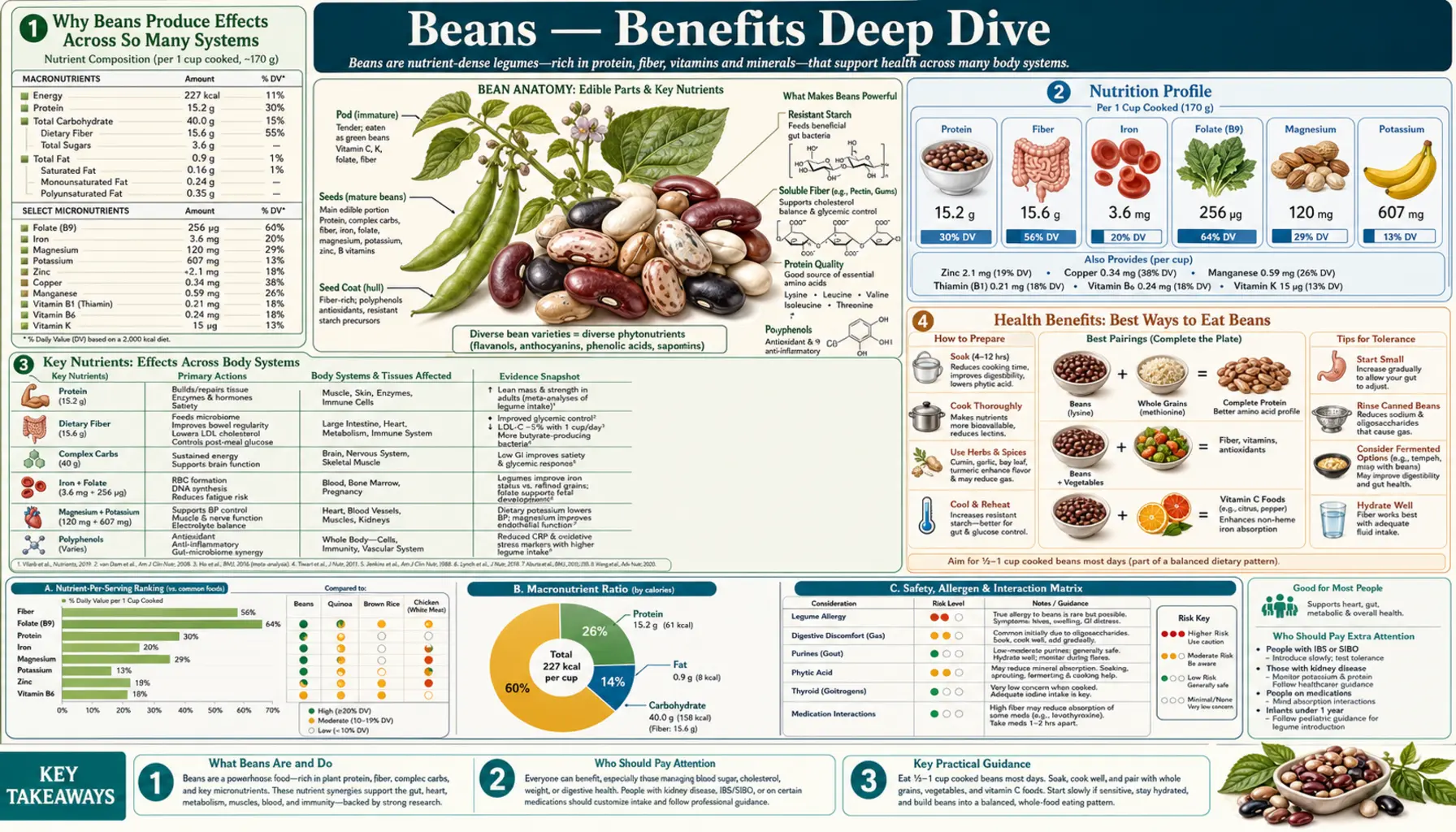
Beans — mostly varieties of Phaseolus vulgaris (black, kidney, pinto, navy, cannellini, great northern) plus close relatives such as adzuki beans — are among the most heavily studied foods in nutrition science, and the evidence is unusually consistent: regular bean eating lowers LDL cholesterol, steadies blood sugar, feeds a healthier gut, and tracks with longer life in every long-lived population studied. The four deep-dive pages below cover where that evidence is strongest. The first answers a question we are asked often, and which a wave of viral videos has made popular — whether beans "detox the kidneys." The honest answer reframes the claim: food does not "flush," "cleanse," or "detox" healthy kidneys (they filter your blood continuously on their own), but beans genuinely help protect kidney function over a lifetime — mostly by controlling the two conditions, high blood pressure and high blood sugar, that cause roughly three-quarters of all kidney disease. That same page carries the one caution the viral "kidney-bean" videos leave out: in advanced kidney disease, beans' high potassium and phosphorus may actually need to be limited.
Deep-Dive Articles
Kidney Health
What "beans for kidney detox" gets right and wrong. The real, evidence-based ways beans protect the kidneys — lowering blood pressure and blood sugar (the cause of ~75% of kidney disease), reducing dietary acid load versus animal protein, and feeding fiber-fermenting gut bacteria that produce fewer of the uremic toxins (indoxyl sulfate, p-cresyl sulfate) that burden failing kidneys. Plus the gout/purine surprise, and the critical safety caveat: in advanced CKD, beans' high potassium and phosphorus may need restriction.
Heart Health & Cholesterol
One of the best-documented "food as medicine" effects in the literature. The 2014 CMAJ meta-analysis of randomized trials showing about one serving of pulses a day meaningfully lowers LDL cholesterol, the bile-acid-sequestration mechanism behind it, the blood-pressure benefit of beans' potassium-to-sodium ratio, and the NHANES cohort linking four-plus servings a week to lower coronary heart disease risk.
Blood Sugar & Diabetes
Beans have one of the lowest glycemic indices of any starch-bearing food. The fiber-resistant-starch-protein combination that flattens the post-meal glucose rise, the "second-meal effect" that carries the benefit into your next meal, the Diabetologia meta-analysis showing pulses lower HbA1c, and the cohort evidence linking higher bean intake to lower type-2-diabetes risk.
Gut Health & Longevity
Why beans are a top prebiotic food. Resistant starch and fermentable fiber feed gut bacteria that produce butyrate — the short-chain fatty acid that fuels the colon lining — the satiety that makes beans a weight-management staple, and the Blue Zones finding that legumes are the single dietary factor most strongly associated with survival in the world's longest-lived populations.
Table of Contents
- Deep-Dive Articles
- Why Beans Produce Effects Across So Many Systems
- Research Papers: Kidney Health
- Research Papers: Heart Health & Cholesterol
- Research Papers: Blood Sugar & Diabetes
- Research Papers: Gut Health & Longevity
- Research Papers: Cross-Cutting (Pulses, Mortality, Safety)
- External Authoritative Resources
- Connections
- Featured Videos
Why Beans Produce Effects Across So Many Systems
Most single foods influence one or two clinical endpoints. Beans influence many, because a single one-cup serving packages the substrate inputs for several distinct physiologic pathways at once. Each maps to a different category of measurable benefit in the research literature.
- Soluble fiber — viscous, gel-forming fiber binds bile acids in the small intestine, forcing the liver to pull cholesterol out of the blood to make replacement bile. This is the direct mechanism behind the LDL reductions documented in legume trials. See Heart Health and Cholesterol.
- Slowly digested, low-glycemic starch — bean starch is packaged inside intact cell walls and is high in amylose, so it digests slowly and releases glucose gradually rather than spiking it. This drives the blood-sugar and diabetes benefits. See Blood Sugar and Diabetes.
- Resistant starch and fermentable fiber — the share of bean carbohydrate that escapes digestion travels to the colon, where bacteria ferment it into short-chain fatty acids (especially butyrate) that nourish the gut lining and calm inflammation. This is the gut-microbiome and prebiotic mechanism. See Gut Health and Longevity.
- Plant protein with a low acid load — roughly 15 grams of protein per cup, but with far less of the fixed-acid byproduct that animal protein generates. A lower dietary acid load means the kidney has less acid to excrete, which matters for long-term kidney health. See Kidney Health.
- Potassium, magnesium, and a low sodium content — beans are naturally high in potassium and magnesium and naturally low in sodium, a mineral ratio that supports healthy blood pressure. (This same high-potassium feature, however, is the reason advanced kidney-disease patients must be cautious — covered on the Kidney Health page.)
- Folate and other B vitamins, iron, and zinc — beans are a meaningful source of folate (important in pregnancy), non-heme iron, and zinc, supporting cell division, oxygen transport, and immune function.
- Polyphenols — plant antioxidant compounds concentrated in the colored seed coats of black, red, and adzuki beans, which contribute to the anti-inflammatory effects seen in observational and intervention studies.
The same package also contains antinutrients and one genuine toxin worth knowing about. Oligosaccharides (raffinose, stachyose) cause the familiar gas; phytic acid binds some minerals; and raw or undercooked red kidney beans contain phytohaemagglutinin, a lectin that causes acute illness unless destroyed by vigorous boiling. All are manageable with ordinary cooking and gradual introduction, and all are covered on the main Beans page and in the deep-dive articles.
Research Papers: Kidney Health
- Banerjee T, Crews DC, Wesson DE, et al. (2015). High Dietary Acid Load Predicts ESRD among Adults with CKD. Journal of the American Society of Nephrology. — PubMed
- Goraya N, Simoni J, Jo CH, Wesson DE (2013). A comparison of treating metabolic acidosis in CKD stage 4 hypertensive kidney disease with fruits and vegetables or sodium bicarbonate. Clinical Journal of the American Society of Nephrology. — PubMed
- Choi HK, Atkinson K, Karlson EW, Willett W, Curhan G (2004). Purine-rich foods, dairy and protein intake, and the risk of gout in men. New England Journal of Medicine. — PubMed
- Rossi M, Johnson DW, Morrison M, et al. (2016). Synbiotics Easing Renal Failure by Improving Gut Microbiology (SYNERGY): A Randomized Trial. Clinical Journal of the American Society of Nephrology. — PubMed
- Lau WL, Vaziri ND (2017). The Leaky Gut and Altered Microbiome in Chronic Kidney Disease. Journal of Renal Nutrition. — PubMed
- Plant protein intake and chronic kidney disease progression — PubMed: Plant protein and CKD
- Dietary fiber intake and kidney disease / inflammation and mortality in CKD — PubMed: Fiber and CKD
- Phosphorus bioavailability in plant versus animal and additive sources in kidney disease — PubMed: Plant phosphorus bioavailability in CKD
Research Papers: Heart Health & Cholesterol
- Ha V, Sievenpiper JL, de Souza RJ, et al. (2014). Effect of dietary pulse intake on established therapeutic lipid targets for cardiovascular risk reduction: a systematic review and meta-analysis of randomized controlled trials. CMAJ. — PubMed
- Bazzano LA, Thompson AM, Tees MT, Nguyen CH, Winham DM (2011). Non-soy legume consumption lowers cholesterol levels: a meta-analysis of randomized controlled trials. Nutrition, Metabolism & Cardiovascular Diseases. — PubMed
- Bazzano LA, He J, Ogden LG, et al. (2001). Legume consumption and risk of coronary heart disease in US men and women: NHANES I Epidemiologic Follow-up Study. Archives of Internal Medicine. — PubMed
- Anderson JW, Gustafson NJ, Spencer DB, Tietyen J, Bryant CA (1990). Hypocholesterolemic effects of oat-bran or bean intake for hypercholesterolemic men. American Journal of Clinical Nutrition. — PubMed
- Threapleton DE, Greenwood DC, Evans CE, et al. (2013). Dietary fibre intake and risk of cardiovascular disease: systematic review and meta-analysis. BMJ. — PubMed
- Afshin A, Micha R, Khatibzadeh S, Mozaffarian D (2014). Consumption of nuts and legumes and risk of incident ischemic heart disease, stroke, and diabetes: a systematic review and meta-analysis. American Journal of Clinical Nutrition. — PubMed
Research Papers: Blood Sugar & Diabetes
- Sievenpiper JL, Kendall CWC, Esfahani A, et al. (2009). Effect of non-oil-seed pulses on glycaemic control: a systematic review and meta-analysis of randomised controlled experimental trials in people with and without diabetes. Diabetologia. — PubMed
- Jenkins DJ, Kendall CW, Augustin LS, et al. (2012). Effect of legumes as part of a low glycemic index diet on glycemic control and cardiovascular risk factors in type 2 diabetes mellitus. Archives of Internal Medicine. — PubMed
- Villegas R, Gao YT, Yang G, et al. (2008). Legume and soy food intake and the incidence of type 2 diabetes in the Shanghai Women's Health Study. American Journal of Clinical Nutrition. — PubMed
- Mollard RC, Luhovyy BL, Panahi S, et al. (2012). Regular consumption of pulses for 8 weeks reduces metabolic syndrome risk factors in overweight and obese adults. Applied Physiology, Nutrition, and Metabolism. — PubMed
- Reynolds A, Mann J, Cummings J, Winter N, Mete E, Te Morenga L (2019). Carbohydrate quality and human health: a series of systematic reviews and meta-analyses. Lancet. — PubMed
Research Papers: Gut Health & Longevity
- Darmadi-Blackberry I, Wahlqvist ML, Kouris-Blazos A, et al. (2004). Legumes: the most important dietary predictor of survival in older people of different ethnicities. Asia Pacific Journal of Clinical Nutrition. — PubMed
- Slavin J (2013). Fiber and prebiotics: mechanisms and health benefits. Nutrients. — PubMed
- Buettner D, Skemp S (2016). Blue Zones: Lessons From the World's Longest Lived. American Journal of Lifestyle Medicine. — PubMed
- Resistant starch, colonic fermentation, and butyrate production — PubMed: Resistant starch and butyrate
- Legume and pulse consumption and all-cause mortality — PubMed: Legumes and mortality
- Beans, satiety, and body-weight regulation — PubMed: Beans and satiety
Research Papers: Cross-Cutting (Pulses, Mortality, Safety)
- Marventano S, Izquierdo Pulido M, Sánchez-González C, et al. (2017). Legume consumption and CVD risk: a systematic review and meta-analysis. Public Health Nutrition. — PubMed
- Mudryj AN, Yu N, Aukema HM (2014). Nutritional and health benefits of pulses. Applied Physiology, Nutrition, and Metabolism. — PubMed
- Polak R, Phillips EM, Campbell A (2015). Legumes: health benefits and culinary approaches to increase intake. Clinical Diabetes. — PubMed
- Bouchenak M, Lamri-Senhadji M (2013). Nutritional quality of legumes, and their role in cardiometabolic risk prevention: a review. Journal of Medicinal Food. — PubMed
- U.S. Food & Drug Administration. Bad Bug Book: Phytohaemagglutinin (Kidney Bean Lectin). — fda.gov
External Authoritative Resources
- USDA FoodData Central — the authoritative per-100 g nutrient profiles for black, kidney, pinto, navy, and other beans
- Harvard T.H. Chan School of Public Health — Nutrition Source: Legumes & Pulses
- National Kidney Foundation — Potassium and Your CKD Diet (essential reading before increasing beans if you have kidney disease)
- NIDDK (National Institutes of Health) — Kidney Disease
- PubMed — All research on Phaseolus vulgaris (beans) nutrition
Connections
- All Food
- Beans (Main Page)
- Beans for Kidney Health
- Beans for Heart Health & Cholesterol
- Beans for Blood Sugar & Diabetes
- Beans for Gut Health & Longevity
- Lentils
- Resistant Starches
- Potassium
- Magnesium
- Cholesterol Management
- Type 2 Diabetes
- Hypertension