Fake Olive Oil: Adulteration, Grade Fraud, and How to Spot It
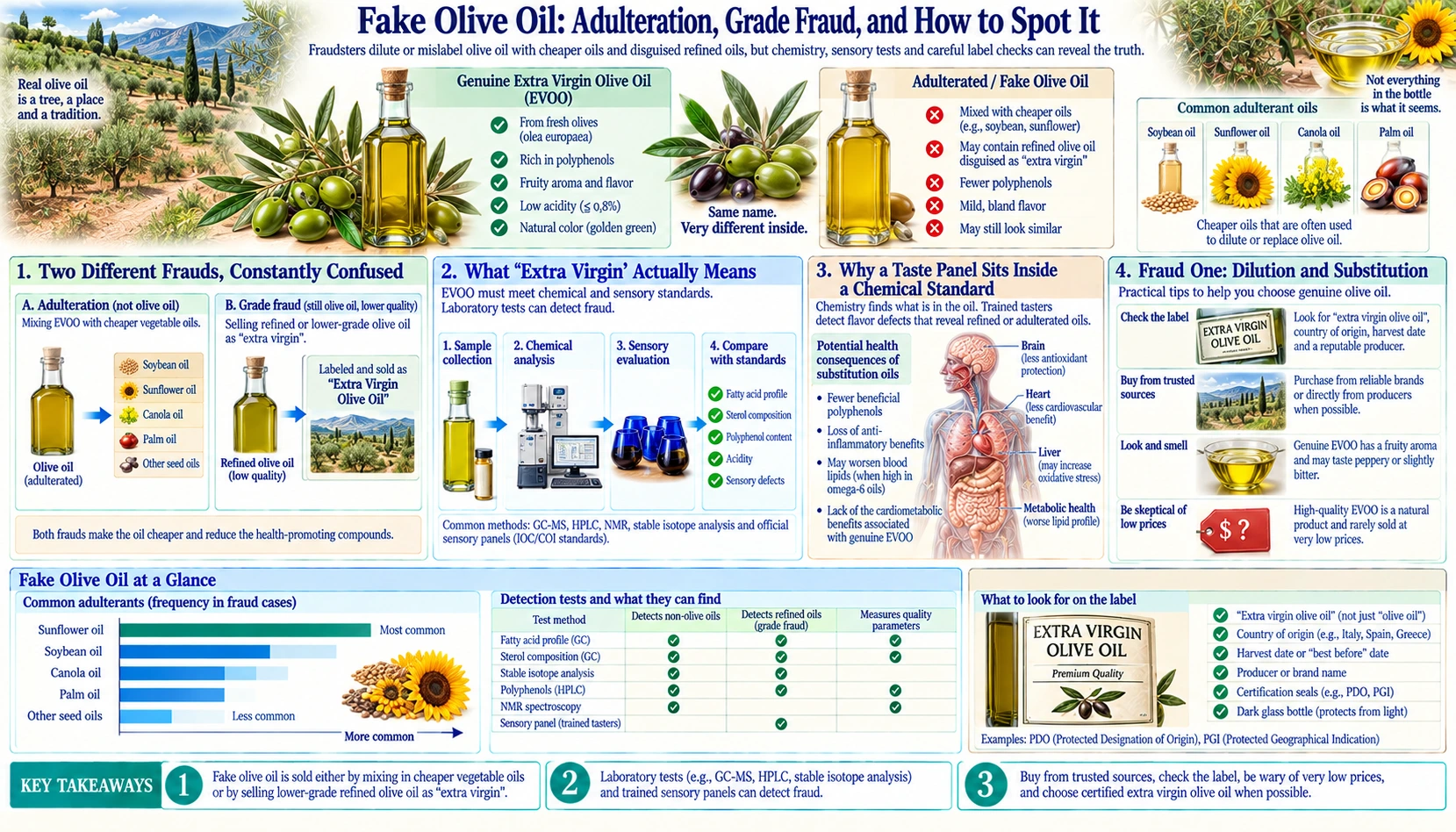
Olive oil is one of the most economically attractive foods in the world to cheat with. The gap between the cheapest edible fat and the most expensive grade of olive oil is wide, the product is a liquid that can be blended in any proportion, and the quality difference that justifies the price is largely invisible — it lives in aroma compounds and phenolic molecules that most shoppers have never been taught to notice. That combination has produced fraud for as long as olive oil has been traded, and it still produces it now.
What follows is not a list of bottles to avoid. Brand-level testing goes stale within a season, and a page that names names teaches nothing transferable. This page explains the mechanism: what “extra virgin” is as a legal grade, the two quite different frauds that get lumped together under the word “fake,” how laboratories actually tell them apart, what those laboratory methods miss, what the regulations in the United States, the European Union and California really say, and what you can do with your own nose and a bottle you already own.
Table of Contents
- Two Different Frauds, Constantly Confused
- What “Extra Virgin” Actually Means
- Why a Taste Panel Sits Inside a Chemical Standard
- Fraud One: Dilution and Substitution
- Fraud Two: Grade Fraud
- The Worst Case on Record: Spain, 1981
- Why Good Oil Turns Into Bad Oil
- What Oxidised Oil Does Inside the Body
- How Laboratories Actually Detect It
- Plasticisers: Contamination That Is Not Fraud
- The Regulatory Picture, Accurately
- What a Shopper Can Actually Do
- The Kitchen Test That Works, and the One That Does Not
- Why It Matters for Health, Honestly
- The Bottom Line
- Why This Page Names No Brands
- The Investigation That Prompted This Page
- Key Research Papers
- Connections
- Featured Videos
Two Different Frauds, Constantly Confused
Almost every conversation about fake olive oil collapses two separate problems into one, and the collapse is why so much of the advice you hear does not work.
The first is dilution or substitution. Something that is not olive oil — a refined seed oil, a nut oil, an olive-pomace oil extracted with solvents — is blended into the bottle or sold outright as olive oil. This is the version people picture when they hear “fake”: a foreign substance smuggled into a familiar product.
The second is grade fraud. Nothing foreign is added at all. The contents are genuinely olive oil, pressed from genuine olives. But the oil in the bottle no longer meets the requirements of the grade printed on the label — it has aged, oxidised, been made from damaged fruit, or been gently refined to remove faults — and it is sold as extra virgin anyway.
The second is far more common in regulated markets, and it is much harder to catch. Standard purity testing works by looking for molecules that olives do not make and other plants do. When the adulterant is also olive oil, every one of those tests comes back clean, because there is nothing foreign to find. As the analytical literature puts it plainly, the purity criteria and the quality criteria answer different questions, and passing one says nothing about the other (Tena 2015).
Keep the distinction in mind for the rest of this page. Nearly every claim you will read about olive oil fraud — including the alarming ones — makes much more sense once you ask which of the two frauds it is actually describing.
What “Extra Virgin” Actually Means
Extra virgin is not a marketing adjective like “premium” or “artisan.” It is the top rung of a defined grading ladder, and the rungs have numbers attached. The international reference is the International Olive Council trade standard, COI/T.15/NC No 3, which the European Union, the United States Department of Agriculture and the Codex Alimentarius standard all broadly track. To be extra virgin, an oil must satisfy all of the following at once.
It has to be extracted mechanically
Virgin olive oils are obtained from the fruit “solely by mechanical or other physical means under conditions, particularly thermal conditions, that do not lead to alterations in the oil.” No solvents, no chemical refining, no re-esterification, no blending with oil of any other kind. Pressing or centrifugation, and that is all. The EU further restricts the labels people associate with this: under Commission Delegated Regulation (EU) 2022/2104, “first cold pressing” may appear only on extra virgin or virgin oil obtained below 27 °C by traditional hydraulic pressing, and “cold extraction” only on oil obtained below 27 °C by percolation or centrifugation. Outside the EU those two phrases are not defined at all, which is worth remembering when you see them on a bottle sold elsewhere.
Free acidity at or below 0.8%
Free acidity measures how many fatty acids have broken loose from the glycerol backbone that normally holds them — expressed as grams of oleic acid per 100 grams of oil. Fat molecules do not fall apart on their own in a healthy fruit; they fall apart when enzymes get to work, which happens when olives are bruised, left in bins, attacked by fruit fly, or milled late. Free acidity is therefore a record of how the fruit was handled between the tree and the mill. Extra virgin allows no more than 0.80 g per 100 g. Virgin allows 2.0. Above 2.0 the oil is lampante — from the word for lamp fuel — and may not be sold to consumers without refining first.
One point that trips people up: free acidity has nothing whatsoever to do with the acid taste of vinegar or lemon. You cannot taste it, and a “low acidity” boast on a label is not a flavour promise.
Peroxide value at or below 20
Peroxide value counts the primary products of oxidation — the first molecular damage oxygen does to a fat. The extra virgin limit is 20 milliequivalents of active oxygen per kilogram. A fresh, well-made oil is usually far below that, often in single digits.
Ultraviolet absorbance: K232, K270 and ΔK
When a fat oxidises or is refined, its double bonds rearrange into conjugated patterns that absorb ultraviolet light at characteristic wavelengths. Extra virgin must have K270 below 0.22 and ΔK below 0.01; the K232 limit of 2.50 is applied on an optional, commercial-agreement basis in the IOC standard. K270 and ΔK in particular are the classic screen for refined oil hiding in a virgin bottle, because industrial refining leaves a signature in that part of the spectrum.
Fatty acid ethyl esters at or below 35 mg/kg
Ethyl esters form when olives ferment. Their presence at any real level means the fruit sat around before milling, and the limit was tightened over the years precisely because it turned out to be a useful marker for oils built from poor-quality raw material and then cleaned up.
Zero sensory defects, and measurable fruitiness
This is the requirement that surprises people, and it is not optional garnish. To be extra virgin an oil must have a median of defects equal to zero and a median of the fruity attribute greater than zero, assessed by a trained panel under the IOC method. The United States grade standard says the same thing in its own words: “U.S. Extra Virgin Olive Oil” is virgin olive oil which has excellent flavor and odor (median of defects equal to zero and median of fruitiness greater than zero) together with free fatty acids of not more than 0.8 grams per 100 grams.
Read that carefully. An oil can pass every chemical test on the list and still fail to be extra virgin, because a panel found a defect. And an oil can taste pleasant to you and still fail, because it exceeded a number. Both routes to failure are real, and both are used.
Why a Taste Panel Sits Inside a Chemical Standard
Putting human tasters inside a legal standard looks like a category error until you understand what they are measuring. The panel is not scoring deliciousness or awarding stars. It is looking for a short, closed list of named defects, each of which is the sensory signature of a specific thing that went wrong:
- Fusty / muddy sediment — olives piled up and fermented anaerobically before milling, or oil left sitting on its own sludge.
- Musty – humid – earthy — fungal and yeast growth on fruit stored damp.
- Winey – vinegary – acid – sour — aerobic fermentation producing acetic acid, ethyl acetate and ethanol.
- Rancid — the fat itself has oxidised, the end state of oxygen, light, heat and time.
- Frostbitten — olives frozen on the tree before harvest.
Each of those has a chemical basis, but no single instrument reading captures all of them, and the concentrations involved are frequently below what routine chemistry detects while remaining well above the human threshold. The nose is, for these particular molecules, still the most sensitive affordable detector available.
The method is more disciplined than “a group of people vote.” A panel of eight to twelve selected and trained assessors works individually in separate booths, from covered blue glasses that hide the oil's colour, warmed to a standard temperature. Each assessor marks the intensity of each attribute on a continuous scale. The panel leader takes the median, not the mean — medians are robust to a single outlying assessor — and the result is rejected outright if the panel's robust coefficient of variation is too high. If the median of defects is zero and the median of fruitiness is above zero, the oil is extra virgin on the sensory criterion; if a defect median rises above zero the oil drops to virgin, and above 3.5 it drops to lampante.
Panels are not infallible, and the literature is honest about it. Work using neural networks to predict panel outcomes from chemical parameters found the relationship real but incomplete — chemistry explains a great deal of what a panel decides, and not all of it (Cancilla 2014). That cuts both ways: it is an argument for keeping instrumental methods honest, and equally an argument for keeping the panel, because it is measuring something the instruments do not fully reach.
Fraud One: Dilution and Substitution
This is the crude version: put something cheaper in the bottle. Historically it has been done with refined seed oils, with olive-pomace oil — the solvent-extracted oil recovered from the spent paste after pressing — and, most awkwardly of all, with hazelnut oil.
Modern purity testing is genuinely good at most of this. Every plant lays down a characteristic fingerprint of fatty acids, sterols and minor compounds, and the official standards fix limits on all of them. A sunflower or corn oil blend shifts the fatty acid profile out of range immediately. Sterol composition, the ratio of β-sitosterol to campesterol, the wax content, the ΔECN42 triacylglycerol difference, and the 2-glyceryl monopalmitate figure between them close off most routes. Refined pomace oil carries a raised wax content that gives it away. As one of the standard reviews of the field summarises, the chemistry available for detecting foreign oils in olive oil is mature and, applied properly, reliable (Frankel 2010).
Hazelnut oil is the notorious exception. Its fatty acid profile is so close to olive oil's that a modest addition can sit entirely inside the legal limits for every routine parameter. Detecting it has required dedicated methods hunting for trace marker compounds specific to the nut, and it remains one of the harder problems in the field.
Two consequences follow, and both matter for how you read alarming headlines.
First, in markets where the purity criteria are actually enforced, gross substitution with a seed oil is a risky fraud: it is detectable by a routine test that costs very little. That is precisely why sophisticated fraud has migrated toward the second category, where there is nothing foreign to detect.
Second, a claim that a supermarket bottle is “mostly canola oil” is a strong claim that requires the corresponding evidence — a fatty acid and sterol profile from an accredited laboratory, not a taste impression. Where consumer investigations have actually run the full analysis, the failures they report are overwhelmingly failures of grade, not of purity. That is a less dramatic headline and a more useful one.
Fraud Two: Grade Fraud
Grade fraud is olive oil sold as a better olive oil than it is. It comes in two flavours.
Simple degradation
The oil was extra virgin when it was made and is not any more. Time, oxygen, light and warmth have pushed its peroxide value, its ultraviolet absorbance, or its sensory profile past the line. Nobody necessarily set out to defraud anybody: an oil bottled eighteen months ago, shipped through a hot port, and left standing under retail lighting can quietly stop qualifying for the words already printed on its label. The label does not update itself.
Soft deodorisation
This is the deliberate version, and it is the heart of the modern problem. Full industrial refining — degumming, neutralisation, bleaching, deodorising at high temperature — leaves obvious traces in the ultraviolet absorbance and strips the oil of colour and flavour entirely. But a mild vacuum steam treatment at a much lower temperature will strip out the volatile compounds responsible for fusty, musty and winey defects while leaving many of the conventional quality indices close to where they started. The result is an oil with no detectable defect for a panel to find, and chemistry that can slide under the extra virgin limits.
This is not a rumour; it has been studied deliberately. Researchers soft-deodorised virgin oils under controlled conditions and tracked exactly which quality and composition parameters moved and which did not, precisely so that markers capable of catching the practice could be identified (Aparicio-Ruiz 2017). A soft-deodorised oil is the perfect crime under the classical parameter set: it is 100% olive oil, it has no sensory defect, and its acidity and peroxide value look respectable. What gives it away, if anything does, are the markers described in the next section — several of which are not in the international standard at all.
The Worst Case on Record: Spain, 1981
Everything above is about money. Once, substitution killed, on a scale no other food fraud in modern Europe has matched — and the mechanism is close enough to the fraud described above that it belongs on this page rather than in somebody else's footnote.
In May 1981 doctors around Madrid began seeing a disease nobody could name: crushing muscle pain, a strikingly high eosinophil count in the blood, and infiltrates on the chest X-ray. It became known as toxic oil syndrome. The vehicle was found to be rapeseed oil that had been diverted from industrial use. That oil had been denatured with aniline — aniline is added precisely so that industrial oil cannot be passed off as food — and it was then refined to strip the denaturant's colour back out and sold in unlabelled five-litre containers by itinerant salesmen as cheap olive oil (Posada de la Paz 2001).
The figures, as the investigation actually recorded them. Over 20,000 people were affected. Approximately 300 died shortly after the onset of the illness, and a larger number developed chronic disease (Gelpí 2002). Over the following two decades, more than 1,200 deaths from all causes were recorded in the affected cohort (Posada de la Paz 2001). That last number is worth reading slowly: it is all-cause mortality in a large group followed for twenty years, not a count of people killed by the oil, and the twenty-year review reports no detected excess of late mortality. The lasting damage shows up instead as chronic illness among survivors — scleroderma-like changes and neurological changes prominent among them.
The cause has never been settled. The leading candidates are compounds formed from the aniline during processing — fatty acid anilides, and esters of 3-(N-phenylamino)-1,2-propanediol — and the chemistry of how the denaturing and deodorisation steps could generate them has been worked through in detail (Messeguer 2011) (Ruiz-Méndez 2011). The syndrome has never been reproduced in a laboratory animal, which is part of why the question stays open. Survivors are still being studied: case-control work published in 2025 looked for blood markers of neurodegeneration four decades after the exposure (Ruiz-Ortiz 2025).
Why this sits on an olive oil page. The step that turned unsaleable industrial oil into something that looked like food was refining — the same industrial process that, used openly, produces ordinary refined olive oil, and that, used quietly on defective oil, produces the soft-deodorisation grade fraud described above. The equipment is not the crime. The label is.
And why the date matters. “Olive oil fraud has a body count” is true, and it is regularly deployed to make a supermarket bottle feel dangerous. The 1981 product was unlabelled, sold off the back of a van, outside every control that existed even then. Much of the purity testing, traceability and conformity checking described on this page exists because of it. A barcoded bottle failing a sensory panel and an unlabelled drum of denatured industrial rapeseed oil are not two points on one scale.
Why Good Oil Turns Into Bad Oil
Every mechanism of grade fraud is downstream of the same physical reality: olive oil is a perishable fruit juice that happens to be a fat, and it begins losing quality from the moment the fruit leaves the tree.
Time from harvest to mill
An olive is a living fruit with active enzymes. Once picked, and especially once bruised, its lipases begin cleaving fatty acids free — the process free acidity measures — and if the fruit is heaped in bins it warms up and ferments, generating the compounds a panel will later score as fusty and winey. Hours matter here, not days. This is the single largest quality decision in the whole chain, and it is made before the mill is even switched on.
Milling itself
Crushing and malaxation — the slow kneading of the olive paste that lets oil droplets coalesce — trade off against each other. Warmer, longer malaxation frees more oil and makes the mill more money; it also drives off aroma compounds and reduces the phenolic content that gives the oil its bitterness, its pepperiness and much of its stability. Extraction conditions measurably change the finished oil's composition (Taticchi 2019). Yield and quality pull in opposite directions, and something has to give.
Oxygen, light and heat in storage
After bottling, three things degrade the oil, and they compound each other.
- Oxygen drives the classic autoxidation chain. Headspace in a part-used bottle is a continuous supply.
- Light is worse than most people expect. Chlorophyll and pheophytins, the pigments that make good oil green, act as photosensitisers: exposed to light they generate singlet oxygen, which attacks the fat by a faster route than ordinary oxidation. The pigments that signal freshness become the agents of destruction the moment the bottle is put in a bright place. This is the whole argument for dark glass and tins, and against clear glass or plastic on a lit shelf.
- Heat accelerates everything, which is why the cupboard beside the cooker is the worst storage location in most kitchens.
Storage conditions leave a readable trace: oils held under different conditions can be told apart analytically (Kalua 2006). And even under ideal conditions the clock still runs. Extra virgin oils followed for 22 months in complete darkness showed steady, measurable change in composition over that period (Esposto 2020). Dark storage slows the decline; it does not stop it.
Why the “best before” date does not help you
A best-before date is set by the bottler, usually as a fixed interval after bottling, and bottling can happen a long time after milling. Researchers have asked directly whether that date carries any real information about the freshness of the oil inside and concluded that it does not reliably do so (Aparicio-Ruiz 2014). A harvest date is a fact about the fruit. A best-before date is a projection about the future. Only one of them tells you how old the oil is.
What Oxidised Oil Does Inside the Body
The section above explains how good oil turns into bad oil. The obvious next question — and one this page previously left alone — is whether the resulting oil does anything to you beyond tasting flat.
The most direct evidence to date comes from a 2025 study from the University of Vienna, published in Redox Biology (Bao 2025). Mice were fed oxidised olive oil as the only fat in the diet. It disrupted lipid metabolism and produced inflammation along the gut: in the duodenum and upper jejunum, anti-inflammatory oxylipins fell and pro-inflammatory mediators rose; in the ileum and colon, the inflammation tracked with suppressed mitochondrial β-oxidation and a fall in short-chain-fatty-acid-producing gut bacteria. The authors also identified 9,10-epoxy-stearic acid, an inflammatory lipid mediator formed by oxidation of dietary oleic acid — the very fatty acid olive oil is prized for — which in turn upregulated soluble epoxide hydrolase.
Three limits, which are usually dropped when this study is quoted. It is a mouse study. The oil was oxidised deliberately, by heating to 180 °C for ten minutes — that is a frying model, not a bottle that went slowly stale in a cupboard. And the oxidised oil was the sole lipid source of the diet, which no one eats.
So it does not license “your old bottle is inflaming your gut”. What it does do is remove the last comfortable assumption behind grade fraud — that a tired oil is merely a weaker version of a good one, costing you some antioxidants and nothing else. Oxidised oleic acid is not inert. That is a better reason to care about freshness than any of the marketing is offering, and it is the mechanism underneath the practical advice already on this page: buy a size you will finish, keep it dark and cool, and treat the harvest date as the number that matters.
How Laboratories Actually Detect It
Each test below answers a narrow question well and other questions not at all. The gaps are as important as the coverage, and they explain why a bottle can carry a certificate of analysis and still be a poor oil.
Free fatty acids
Catches: damaged, fermented or badly stored fruit; late milling. Misses: anything that has been refined. Refining drives free acidity down to near zero, so a deodorised oil scores better on this test than an honest one. A very low acidity figure is not proof of quality, and on its own it is faintly suspicious.
Peroxide value
Catches: early-stage oxidation. Misses: late-stage oxidation, because peroxides are unstable intermediates that break down into aldehydes and ketones. A thoroughly rancid oil can have a falling peroxide value. It is also reset to near zero by refining.
Ultraviolet absorbance (K232, K270, ΔK)
Catches: conjugated oxidation products, and above all the signature of industrial refining — K270 and ΔK are the traditional way to find refined oil in a virgin bottle. Misses: mild soft deodorisation, which is designed around exactly these limits.
Fatty acid profile, sterols, waxes and ΔECN42
Catches: foreign oils. This is the purity block, and it is the reason crude adulteration with a seed oil or with pomace oil is a poor commercial bet in a market that tests. Misses: grade fraud completely. Olive oil blended with olive oil produces a flawless purity result, and hazelnut oil is close enough to olive to be a genuine problem.
Fatty acid ethyl esters
Catches: oils built from fermented fruit, including some that were later cleaned up. Misses: oil from sound fruit that simply aged in the bottle.
1,2-Diacylglycerols and pyropheophytins
These two are the most useful markers for grade fraud, and the most politically interesting, because neither is part of the IOC trade standard, the USDA grade standard or the EU marketing standard.
1,2-Diacylglycerols (DAGs). Fresh oil from healthy fruit is rich in the 1,2 isomer; with time, heat and hydrolysis it isomerises to the more stable 1,3 form. The proportion of 1,2-DAG among total DAGs therefore falls as an oil ages or is heated, giving a freshness and handling marker independent of the classical indices.
Pyropheophytins (PPP). Chlorophyll degrades to pheophytin and then, with heat and time, to pyropheophytin. The percentage of pyropheophytin among total pheophytins rises with thermal history — slowly during ordinary ageing, quickly during deodorisation. Rapid HPLC methods with fluorescence detection make it a routine measurement (Li 2015).
Two jurisdictions have written them into law. The Australian standard AS 5264-2011 requires extra virgin to have PPP no higher than 17% and 1,2-DAG at 35% or above. California's mandatory Grade and Labeling Standards adopt the identical two limits for its extra virgin grade. The international standard adopts neither — which means an oil can be fully compliant with the IOC and USDA definitions of extra virgin while failing the two tests most likely to reveal that it is old or has been deodorised. Misses: both markers have natural variability by cultivar, region and season, which is exactly the argument the trade has used against adopting them, and it is not a frivolous argument.
Non-targeted fingerprinting
The newest approaches abandon the idea of a checklist of named compounds and compare the oil's whole chemical fingerprint against a reference set. Infrared, near-infrared and Raman spectroscopy combined with chemometrics can classify oils by origin and flag adulteration without a specific target (Kakouri 2021), and non-targeted authentication frameworks have been demonstrated for extra virgin specifically (Aykas 2020). Mass spectrometry is moving the same way: gas chromatography with cold electron ionisation has been applied to both quality assessment and adulteration detection in a single run (Neumark 2026), direct analysis in real time coupled to QTOF mass spectrometry gives rapid authentication with minimal sample preparation (Papelis 2026), and low-cost metal-oxide gas sensor arrays — an electronic nose — have been trialled for authenticity screening (Poeta 2026).
Catches: in principle, novel frauds that no targeted test was designed for, which is their whole appeal. Misses: anything outside the reference database they were trained on. None of them is an official method, and a fingerprint classifier is only as trustworthy as the authentic samples behind it.
Plasticisers: Contamination That Is Not Fraud
This page is about what was swapped. There is a separate question — what leached in — and it deserves its own heading because it behaves completely differently from everything above.
Phthalates (phthalic acid esters) are plasticisers used to make plastics flexible. They are fat-loving, so of all the foods that can pick them up, an oil is close to the worst case: it will happily pull them out of tubing, gaskets, hoses, seals, storage vessels and bottles over time. Migration into edible oils is measurable and documented (Sungur 2015), the sources and migration routes have been reviewed in detail (Liu 2026), analytical methods exist for extra virgin olive oil specifically (Wu 2024), and packaging choice measurably changes what ends up in the oil (Charfi 2026).
The important structural point: this is not adulteration and not grade fraud. Nobody substituted anything. A genuinely single-estate, harvest-dated, chemically impeccable extra virgin oil can carry plasticiser residue, because the residue comes from the plant the oil passed through, not from the olives. Every instinct this page has trained — check the harvest date, check the grade, check the origin — is orthogonal to it. That is precisely why it earns a separate section rather than a line in the fraud list.
On the health end, be careful in both directions. Phthalate exposure is a genuine and active area of toxicology, and the human evidence on di-2-ethylhexyl phthalate and male reproductive function has been systematically reviewed (Høyer 2018). It is also not settled, the effect sizes in human studies are not the ones in high-dose animal work, and diet as a whole — not olive oil in particular — is the exposure route of interest.
How to read the consumer testing that circulates. Advocacy groups periodically publish phthalate results for named brands, in parts per billion, ranked worst to best. Those reports are worth knowing about and they are a different evidence tier from the papers above. Before a ranking means anything, ask: which specific phthalates were measured, at what limit of detection, in how many lots per brand, by a laboratory accredited to which standard, with the full method published? A single bottle of a single lot is a snapshot of that lot. And a bare “parts per billion of phthalates” total cannot be compared against a health reference value, because the reference values are set per compound, not for the category.
What actually reduces it. Glass or tin rather than plastic, for storage at home and as a signal about the producer's own handling; and, as always, a producer who will show you a batch certificate. If plasticisers are the thing that worries you, that certificate — not the word “premium” on the front — is the only thing on the shelf that speaks to it.
The Regulatory Picture, Accurately
You will frequently read that the United States has “never written a legal definition of olive oil.” That is half true, and the half that is false matters, because the real situation is both more specific and more fixable than the slogan implies.
What is true: there is no FDA standard of identity
The Food and Drug Administration has not issued a standard of identity for olive oil. Standards of identity are the recipes-in-regulation that fix what a food must contain to be sold under a given name. FDA sought comment on adopting one based on the international standard more than forty years ago and concluded there was not sufficient need. Two citizen petitions were later filed asking the agency to write one — one in November 2019 from a domestic producers' association together with a large processor, one in May 2020 from the main importers' trade association — and no standard has issued.
What is false: there is no federal definition
There is, and it is precise. The United States Standards for Grades of Olive Oil and Olive-Pomace Oil, issued by the USDA Agricultural Marketing Service, took effect on 25 October 2010 (published at 75 FR 22363 on 28 April 2010). They superseded an earlier issue that had been in effect since 22 March 1948. The United States has had a written federal grade definition for olive oil for more than three quarters of a century.
The 2010 standard defines “U.S. Extra Virgin Olive Oil” with a median of defects of zero, a median of fruitiness above zero, and free fatty acids no higher than 0.8 grams per 100 grams — substantially the international definition. It also defines U.S. Virgin, U.S. Lampante, U.S. Refined, and the plain “U.S. Olive Oil” grade, which the standard describes as a blend of refined olive oil and virgin olive oils with free fatty acids up to 1.0 grams per 100 grams. That last one is worth internalising: on a shelf, a bottle whose front says only “olive oil,” with no grade word in front of it, is describing a mostly refined product, and that is the standard behaving exactly as written rather than a trick.
The actual gap: voluntary adoption and thin verification
The standards open with the sentence that explains everything: “Voluntary U.S. grade standards are issued under the authority of the Agricultural Marketing Act of 1946.” Grading against them is an inspection service “offered to interested parties, upon application, on a fee-for-service basis.” So the definition exists, is public, and is technically sound. What is absent is any requirement that a bottle sold in the United States be submitted to it, and any routine programme of pulling bottles off shelves to check.
Nor is the market lawless. Labelling that is false or misleading is prohibited under the misbranding provisions of the Federal Food, Drug, and Cosmetic Act whether or not a standard of identity exists, and origin and grade claims on olive oil have repeatedly been the subject of consumer class actions in the United States. The honest summary is not “there is no law.” It is: the definition is written, its use is voluntary, and nobody is systematically checking.
The International Olive Council
The IOC is an intergovernmental organisation whose trade standard, COI/T.15/NC No 3, is the reference nearly every national standard tracks; the current revision is Rev. 20 of November 2024. The United States is not a member and attends as an observer. IOC compliance is therefore a commercial commitment in the US market rather than a legal obligation.
The European Union: mandatory, with conformity checks
The EU is the sharpest contrast. Commission Delegated Regulation (EU) 2022/2104 lays down marketing standards for olive oil, and Commission Implementing Regulation (EU) 2022/2105 lays down the rules for conformity checks and the methods of analysis. Together they replaced the long-standing Regulation (EEC) No 2568/91 and Implementing Regulation (EU) No 29/2012. The categories are legally defined, the analysis methods are prescribed, the labelling rules are mandatory, and Member States are required to run checks. This is why a claim like “first cold pressing” means something specific inside the EU and nothing in particular outside it.
California: the mandatory exception inside the United States
California adopted Grade and Labeling Standards for Olive Oil, Refined-Olive Oil and Olive-Pomace Oil, published by the state's Department of Food and Agriculture on 18 September 2014. They are mandatory for California handlers processing 5,000 gallons or more of California olives in a season, they require testing and grading, and — the notable part — their extra virgin specification includes the pyropheophytin and diacylglycerol limits that the federal and international standards omit. A separate provision of the California Health and Safety Code, adopted in 2011, references the USDA standards for olive oils traded in the state.
The result is that the strictest routine olive oil regime operating in the United States is a state programme covering the larger producers of one state's crop, sitting alongside a voluntary federal standard that applies to everything else.
What a Shopper Can Actually Do
You cannot run a sterol profile in a shop. You can do the following, and together they shift the odds a long way.
Look for a harvest or pressing date
This is the single most informative thing on any olive oil label, and most bottles do not carry it. A harvest date is a fact about when the fruit was picked; a best-before date is a bottler's projection. Prefer the most recent harvest available, and treat the absence of any harvest date as what it is — a producer choosing not to tell you how old the oil is.
Buy dark glass or tin
Clear glass and clear plastic on a lit shelf are actively hostile to the product inside, because of the photo-oxidation mechanism described above. Dark green or brown glass, or an opaque tin, is not packaging vanity.
Prefer a stated single origin
A multi-country blend is not automatically bad oil, but it is oil whose history you cannot trace: several harvests, several supply chains, several storage regimes averaged together. A single stated region, and better still a single estate, is a shorter chain with fewer places for time and heat to accumulate. Read the origin statement rather than the picture — a scene, a flag or a family story on the front is not an origin declaration, and the actual declaration is often in small type on the back.
Buy a size you will finish
A large container is only a bargain if you use it quickly. Once opened, every pour replaces oil with air. Buying a size you will get through in a couple of months, or decanting from a large tin into a small dark bottle and keeping the rest sealed, is worth more than most label claims.
Store it away from the cooker
Cool, dark, tightly closed, and not on the counter next to the hob or on a sunny windowsill. This costs nothing and is probably the highest-yield change most households can make.
Understand what the seals do and do not say
Organic certification describes how the olives were farmed. It says nothing about whether the oil is still extra virgin by the time it reaches you — an organically grown olive can yield a defective oil like any other. Trade-association quality seals are voluntary programmes that a company chooses to join; they are not government inspection, and their value depends entirely on the specific programme's testing regime. Neither category of seal is dishonest. They simply answer a different question from the one you are asking.
The Kitchen Test That Works, and the One That Does Not
The refrigerator test does not work
The idea that genuine extra virgin olive oil will solidify in the fridge while an adulterated one stays liquid is popular and wrong. Researchers at the UC Davis Olive Center tested it directly and published the result as “Refrigeration is not reliable in detecting olive oil adulteration” (Li, Wang and Flynn, 2013). What chilling actually probes is the proportion of saturated and monounsaturated fats and the cultivar, which vary among perfectly authentic oils; in their testing a sample deliberately cut with lower-grade oil congealed, and would therefore have passed. A test that clears an adulterated sample is worse than no test, because it produces confidence.
Smell and taste, which do work — within limits
Sensory assessment is the basis of the legal standard, so it is not surprising that an amateur version has some value. Pour a small amount into a glass, cover the top with your palm and cup it in your hand for half a minute — volatile compounds need warmth to lift. Then uncover it and smell.
A sound oil smells alive: cut grass, green tomato leaf, artichoke, green almond, sometimes apple or banana. A degraded oil smells of old crayons, putty, stale nuts or damp cardboard — or of nothing at all, which is its own answer.
Then take a small sip, draw air across it, and swallow. Two things to look for. Bitterness on the tongue, and a peppery catch at the back of the throat that can make you cough. Both are phenolic compounds — the pungency in particular is largely oleocanthal — and both are the compounds that refining removes and ageing degrades. Bitterness and pungency are positive attributes in the standard, not faults. An oil that is entirely smooth, round and mild is often simply an oil whose phenols have gone.
Be honest about the limits of this. An untrained palate reliably detects gross rancidity and reliably detects the absence of pungency. It is much less reliable on fustiness and mustiness, which is precisely why trained panels exist and why soft deodorisation works commercially. Use the kitchen test to reject bad oil with confidence; do not use it to certify good oil.
Why It Matters for Health, Honestly
The reason grade matters for health, rather than just for cooking, is that the health interest in olive oil attaches heavily to its phenolic compounds — hydroxytyrosol, tyrosol, oleuropein derivatives, oleocanthal — and those are exactly what degradation and refining remove. The monounsaturated fat survives refining; the phenols largely do not. Phenolic content also varies enormously between genuine extra virgin oils, by cultivar, harvest timing, milling and age. A bottle of real extra virgin can contain many times the phenols of another bottle of equally real extra virgin.
Now the evidence, stated at its true strength rather than its most quotable.
What is reasonably well supported
The EU has authorised one specific claim: that olive oil polyphenols contribute to the protection of blood lipids from oxidative stress, permitted only for oils containing at least 5 mg of hydroxytyrosol and its derivatives per 20 g of oil. The underlying human evidence includes a multi-centre randomised crossover trial in which oils of increasing phenolic content produced dose-dependent improvements in HDL cholesterol and in markers of lipid oxidative damage (Covas 2006). Note the endpoint carefully: this is a surrogate marker — oxidative damage to lipids — not a clinical event.
At the dietary-pattern level, the large Spanish primary-prevention trial reported fewer major cardiovascular events in people assigned to a Mediterranean diet supplemented with extra virgin olive oil or with nuts (Estruch 2018). A recent systematic review gathers the cardiovascular literature on extra virgin olive oil specifically (Ussia 2025).
Where it is weaker than the headlines
Three honest caveats, none of which is usually mentioned alongside the good news.
The flagship trial was retracted and republished. The 2013 report of that Spanish trial was withdrawn after irregularities in randomisation were identified at some study sites, and the 2018 paper cited above is the corrected and republished version. The re-analysis, which handled the affected participants differently, reached broadly the same conclusion — but the episode is a reason to hold the result with appropriate humility, and commentators had already asked how strong the evidence really was (Guasch-Ferré 2017).
It was a dietary pattern, not a bottle. The trial tested a whole Mediterranean diet with supplied olive oil against advice to reduce fat. It does not isolate olive oil, and it certainly does not isolate the phenolic fraction.
Recent regulatory assessments of broader claims have been negative. In 2025 the European Food Safety Authority evaluated two further proposed claims for olive oil phenolics. On lowering LDL cholesterol and systolic blood pressure, the panel found that a supporting trial was not corroborated by others, that no evidence addressed durability beyond a few weeks, and that no plausible mechanism had been established; the claim was not substantiated (EFSA 2025a). On maintaining normal HDL cholesterol, the panel again found a single supportive trial unreplicated in other groups and settings, with no long-term data and no established mechanism, and concluded the evidence was insufficient (EFSA 2025b). The authorised claim about protection of blood lipids from oxidative stress stands; these two attempts to extend it did not.
The honest bottom line on health
Genuine, phenol-rich extra virgin olive oil is a good fat with a solid observational record inside a Mediterranean dietary pattern and one authorised, mechanism-specific claim about lipid oxidation. It is not a medicine, and the strongest specific claims made for its polyphenols have repeatedly failed formal regulatory assessment. What can be said with confidence is narrower and still useful: whatever benefit the phenols carry, a refined, deodorised or long-degraded oil has lost most of them. That is the real health argument for caring about grade — not that the fake oil is poisonous, but that you paid for a compound that is no longer in the bottle. For the broader nutrition picture, see the olive oil page; for the individual phenol with the most human data behind it, see hydroxytyrosol.
The Bottom Line
- Extra virgin is a grade with numbers, not a marketing word. Mechanical extraction only, free acidity at or below 0.8%, peroxide value at or below 20, K270 at or below 0.22, and a trained panel finding zero defects and detectable fruitiness.
- Grade fraud is the common problem, not seed oil in the bottle. Purity testing catches foreign oils fairly well. It cannot catch olive oil sold as a better grade of olive oil, because there is nothing foreign there.
- The tests most likely to catch grade fraud are not in the main standards. Diacylglycerols and pyropheophytins are required in California and in Australia; the IOC, USDA and EU standards omit both.
- The US does have a federal definition — a voluntary one. The USDA grade standards took effect in 2010, replacing a version dating from 1948. What is missing is a mandatory standard of identity and any routine shelf testing, not the definition itself.
- The refrigerator test does not work. Smell and taste do, within limits: green and grassy aromas, bitterness, and a peppery catch in the throat are what you want.
- Harvest date, dark glass, single origin, small bottle, cool dark cupboard. Five habits that beat any seal on the front.
Why This Page Names No Brands
The commonest format in this subject is the ranked brand list: so many bottles to avoid, a handful to buy. This section of the site does not publish those, and the reasoning is worth stating rather than leaving as an unexplained gap.
A test result attaches to a lot, not to a logo. Olive oil is an agricultural product reblended every harvest. Suppliers change, mills change, owners change, and a brand that failed one year's sampling may pass the next on oil from an entirely different country. A list is therefore at its most accurate on the day it is published and decays from then on — while the page carrying it stays online, and gets shared, for years.
The bias the lists run on is itself worth knowing. Consumers reliably rate an Italian-sounding name as higher quality with no data attached to it. A charitable mission, a founder story, a grower-cooperative history and a premium price all do the same work. None of that is evidence about the oil. The useful takeaway is not which name to trust but that the name is not the evidence — which is exactly what a ranked list of names quietly denies, even when its individual entries are correct.
Recommendations have the same problem, and one more. A “these five are real” list is a purchase instruction whose basis the reader cannot check, usually resting on one round of sampling, and it is frequently monetised. This site has no commercial relationship with any producer and does not intend to acquire one by accident.
Where a company name does appear on this site, it is because a public regulatory record names it — a recall, a warning letter, a consent decree, a court judgment — and it is described only as that record describes it, with the primary source linked. That is a verifiable statement about a documented event. It is not a shopping list.
What replaces the list is the paperwork, which is the whole of the What a Shopper Can Actually Do section: a harvest date, a batch certificate of analysis, a third-party seal, dark glass or tin, a size you will finish. Those questions work on a bottle whose name you have never heard, next year, in a different country. A list does not.
The Investigation That Prompted This Page
This page was written after a 2026 consumer investigation that sent supermarket olive oils for laboratory analysis and reported that most of the sampled bottles failed to meet the extra virgin grade they were sold under. We have deliberately not repeated its brand-by-brand findings, for two reasons: we cannot independently verify a laboratory result we did not commission, and brand-level results go stale within a season while the mechanisms above do not. Watch it and judge it yourself — and read the sections above for what the peer-reviewed literature and the actual regulations say.
One framing in that video is worth correcting, because it is repeated widely: the claim that the United States has never written a legal definition of olive oil. As set out under the regulatory picture, the missing piece is an FDA standard of identity. A federal grade definition has existed since 1948 and was substantially rewritten in 2010. It is voluntary, and unenforced by routine testing, which is a different and more tractable problem than having no definition at all.

Tasted & Tested — A consumer investigation that sent supermarket olive oils to a laboratory and reported most failed the extra virgin grade.
A second video prompted the material added above — the 1981 Spanish outbreak, the oxidised-oil biology and the plasticiser section all came out of checking its claims. It is a ranked brand list, which is the format this page does not publish, but several of its underlying factual claims are real and checkable, and two of them pointed at genuine gaps here.

Grocery Exposed — a ranked list of olive oil brands, from which this page took the 1981 Spanish outbreak, the oxidised-oil study and the plasticiser question.
Both frames above are written into this page and stay put. The Featured Videos further down are curated separately and rotate.
Where this page corrects the video
The 1981 death toll is overstated. The video gives “nearly 700” deaths in 1981, rising to “1,800 deaths and over 25,000 people permanently injured” by 1997. The WHO-supported investigation recorded over 20,000 people affected and approximately 300 deaths shortly after onset, with more than 1,200 deaths from all causes in the affected cohort over the following twenty years and no detected excess of late mortality. Those are the figures used in the section above. The lower numbers are not a minimisation — the chronic illness among survivors is the larger part of the harm, and the video does not mention it at all.
The adulterant was not a lubricant. The video describes the oil as “adulterated with an industrial lubricant”. It was rapeseed oil denatured with aniline — a marker added specifically to stop industrial oil being sold as food. The fraud was refining the marker back out, which is what makes the episode relevant to a page about deodorisation.
“Failed international purity standards” conflates the two frauds. The UC Davis sampling failures were overwhelmingly failures of the sensory and grade standard, not of the chemical purity tests that detect foreign oils. That distinction is the subject of the first section of this page, and collapsing it is what turns a real quality problem into an imaginary seed-oil conspiracy.
The oxidised-oil study is real, and three of its limits are dropped. The journal, the year, the University of Vienna and even the compound are all reported correctly — unusually so. What is left out: it is a mouse study, the oil was oxidised by heating it to 180 °C rather than by going stale, and it was the animals' only dietary fat. See the section above.
Brand phthalate rankings are a different evidence tier from the papers they sit beside. Parts-per-billion figures for named brands, from a single round of advocacy-group testing, are presented with the same authority as peer-reviewed work. The underlying phenomenon is real and is covered in the plasticiser section; the ranking is not something this page can verify or reproduce.
Not an error, but not reproduced here: the video closes with five recommended brands. That is a purchase recommendation this site does not make, for the reasons set out in Why This Page Names No Brands.
Key Research Papers
Authenticity, adulteration and analytical methods
- Frankel EN. Chemistry of extra virgin olive oil: adulteration, oxidative stability, and antioxidants. Journal of Agricultural and Food Chemistry. 2010;58(10):5991–6006. — the reference review on how adulteration is done and how it is detected. — doi:10.1021/jf1007677
- Tena N, Wang SC, Aparicio-Ruiz R, et al. In-depth assessment of analytical methods for olive oil purity, safety, and quality characterization. Journal of Agricultural and Food Chemistry. 2015;63(18):4509–4526. — what each official method actually measures, and where the gaps are. — doi:10.1021/jf5062265
- Aparicio-Ruiz R, Romero I, García-González DL, et al. Soft-deodorization of virgin olive oil: study of the changes of quality and chemical composition. Food Chemistry. 2017;220:42–50. — the mechanism of modern grade fraud, studied under controlled conditions. — doi:10.1016/j.foodchem.2016.09.176
- Li X, Woodman M, Wang SC. High-performance liquid chromatography with fluorescence detection for the rapid analysis of pheophytins and pyropheophytins in virgin olive oil. Journal of Separation Science. 2015;38(16):2813–2818. — the pyropheophytin method behind the Californian and Australian limits. — doi:10.1002/jssc.201401240
- Cancilla JC, Wang SC, Díaz-Rodríguez P, et al. Linking chemical parameters to sensory panel results through neural networks to distinguish olive oil quality. Journal of Agricultural and Food Chemistry. 2014;62(44):10661–10665. — how far chemistry can predict what a trained panel decides. — doi:10.1021/jf503482h
- Kakouri E, Revelou PK, Kanakis C, et al. Authentication of the botanical and geographical origin and detection of adulteration of olive oil using gas chromatography, infrared and Raman spectroscopy techniques: a review. Foods. 2021;10(7):1565. — the spectroscopic and chromatographic toolkit, compared. — doi:10.3390/foods10071565
- Aykas DP, Karaman AD, Keser B, et al. Non-targeted authentication approach for extra virgin olive oil. Foods. 2020;9(2):221. — fingerprint-based screening rather than a checklist of named compounds. — doi:10.3390/foods9020221
- Neumark B, Elkabets O, Shabi Z, et al. Olive oil quality analysis and the detection of adulterations by GC-MS with cold EI. Journal of Mass Spectrometry. 2026;61(9):e70103. — quality and adulteration assessed in a single mass-spectrometry run. — doi:10.1002/jms.70103
- Papelis DA, Drakopoulou SK, Nastou ES, et al. Direct analysis in real time coupled to QTOF-MS for the rapid authentication and fraud detection of extra virgin olive oil. Food Chemistry. 2026;502:147618. — rapid authentication with minimal sample preparation. — doi:10.1016/j.foodchem.2025.147618
- Poeta E, Núñez-Carmona E, Sberveglieri V, et al. MOX sensors for authenticity assessment and adulteration detection in extra virgin olive oil (EVOO). Sensors. 2026;26(1):275. — a low-cost electronic-nose approach to screening. — doi:10.3390/s26010275
Freshness, storage and degradation
- Aparicio-Ruiz R, Aparicio R, García-González DL. Does “best before” date embody extra-virgin olive oil freshness? Journal of Agricultural and Food Chemistry. 2014;62(3):554–556. — the case for a harvest date over a best-before date. — doi:10.1021/jf405220d
- Esposto S, Selvaggini R, Taticchi A, et al. Quality evolution of extra-virgin olive oils according to their chemical composition during 22 months of storage under dark conditions. Food Chemistry. 2020;311:126044. — even perfect storage only slows the clock. — doi:10.1016/j.foodchem.2019.126044
- Kalua CM, Bedgood DR Jr, Bishop AG, et al. Discrimination of storage conditions and freshness in virgin olive oil. Journal of Agricultural and Food Chemistry. 2006;54(19):7144–7151. — storage history leaves a readable chemical trace. — PubMed PMID: 16968075
- Taticchi A, Selvaggini R, Esposto S, et al. Physicochemical characterization of virgin olive oil obtained using an ultrasound-assisted extraction at an industrial scale: influence of olive maturity index and malaxation time. Food Chemistry. 2019;289:7–15. — how milling conditions change the finished oil. — doi:10.1016/j.foodchem.2019.03.041
Health effects and their evidence tier
- Bao Y, Osowiecka M, Ott C, et al. Dietary oxidized lipids in redox biology: oxidized olive oil disrupts lipid metabolism and induces intestinal and hepatic inflammation in C57BL/6J mice. Redox Biology. 2025;81:103575. — identifies 9,10-epoxy-stearic acid from oxidised oleic acid; a mouse study using oil heated to 180 °C as the sole dietary fat, and the limits matter as much as the finding. — doi:10.1016/j.redox.2025.103575
- Covas MI, Nyyssönen K, Poulsen HE, et al. The effect of polyphenols in olive oil on heart disease risk factors: a randomized trial. Annals of Internal Medicine. 2006;145(5):333–341. — the dose-dependent phenolic effect on HDL and lipid oxidation markers. — PubMed PMID: 16954359
- Estruch R, Ros E, Salas-Salvadó J, et al. Primary prevention of cardiovascular disease with a Mediterranean diet supplemented with extra-virgin olive oil or nuts. New England Journal of Medicine. 2018;378(25):e34. — the corrected and republished version of the 2013 trial. — doi:10.1056/NEJMoa1800389
- Guasch-Ferré M, Salas-Salvadó J, Ros E, et al. The PREDIMED trial, Mediterranean diet and health outcomes: how strong is the evidence? Nutrition, Metabolism and Cardiovascular Diseases. 2017;27(7):624–632. — a candid appraisal of the trial's strength. — doi:10.1016/j.numecd.2017.05.004
- EFSA Panel on Nutrition, Novel Foods and Food Allergens (Turck D, Bohn T, Cámara M, et al.). Phenolic compounds naturally present in olive oil and lowering of blood LDL-cholesterol and systolic blood pressure, therefore reducing the risk of coronary heart disease. EFSA Journal. 2025;23(5):e9470. — claim not substantiated. — doi:10.2903/j.efsa.2025.9470
- EFSA Panel on Nutrition, Novel Foods and Food Allergens (Turck D, Bohn T, Cámara M, et al.). Olive oil polyphenols and the maintenance of normal HDL-cholesterol concentrations. EFSA Journal. 2025;23(5):e9372. — evidence judged insufficient. — doi:10.2903/j.efsa.2025.9372
- Ussia S, Ritorto G, Mollace R, et al. Exploring the benefits of extra virgin olive oil on cardiovascular health enhancement and disease prevention: a systematic review. Nutrients. 2025;17(11):1843. — recent synthesis of the cardiovascular literature. — doi:10.3390/nu17111843
- Frankel EN. Nutritional and biological properties of extra virgin olive oil. Journal of Agricultural and Food Chemistry. 2011;59(3):785–792. — what the phenolic fraction is and why grade determines how much of it you get. — doi:10.1021/jf103813t
Toxic oil syndrome (Spain, 1981)
- Posada de la Paz M, Philen RM, Borda AI. Toxic oil syndrome: the perspective after 20 years. Epidemiologic Reviews. 2001;23(2):231–247. — how an illicit industrial oil, refined to remove its aniline denaturant, reached 20,000 people; the source for the cohort size and the all-cause death count. — PubMed PMID: 12192735
- Gelpí E, de la Paz MP, Terracini B, et al. The Spanish toxic oil syndrome 20 years after its onset: a multidisciplinary review of scientific knowledge. Environmental Health Perspectives. 2002;110(5):457–464. — the WHO-supported review: approximately 300 early deaths, no detected excess of late mortality, and chronic disease as the lasting harm. — PubMed PMID: 12003748
- Messeguer A. Potential implication of aniline derivatives in the Toxic Oil Syndrome (TOS). Chemico-Biological Interactions. 2011;192(1–2):136–141. — the case for fatty acid anilides and PAP esters as the causal agents, which remain unconfirmed. — PubMed PMID: 20970410
- Ruiz-Méndez MV. Contribution of denaturing and deodorization processes of oils to toxic oil syndrome. Chemico-Biological Interactions. 2011;192(1–2):142–144. — how the refining step itself generated the suspect compounds; the link between this episode and deodorisation. — PubMed PMID: 21238434
- Ruiz-Ortiz M, Lapeña-Motilva J, Giménez de Bejar V, et al. Blood biomarkers of neurodegeneration over four decades after toxic oil syndrome: a case-control study. International Journal of Molecular Sciences. 2025;26(11). — survivors are still being followed; the findings are modest, which is itself worth reporting. — PubMed PMID: 40507935
Packaging, plasticisers and contamination
- Sungur S, Okur R, Turgut FH, et al. Migrated phthalate levels into edible oils. Food Additives & Contaminants: Part B, Surveillance. 2015;8(3):190–194. — direct measurement of migration into oils; an oil is close to the worst case because phthalates are fat-loving. — PubMed PMID: 25896944
- Liu S, Wu Y, Shi Z, et al. Phthalate acid esters in water and edible oils: a comprehensive review of contamination sources, migration mechanisms, and emerging removal technologies of food matrices. Food Research International. 2026;243(Pt 2):120402. — where the residue comes from and how it gets in; the review behind this page's processing-not-olives framing. — PubMed PMID: 42705760
- Wu X, Du Z, Ma R, et al. Qualitative and quantitative studies of phthalates in extra virgin olive oil (EVOO) by surface-enhanced Raman spectroscopy (SERS) combined with long short term memory (LSTM) neural network. Food Chemistry. 2024;433:137300. — method work specific to extra virgin olive oil rather than edible oils in general. — PubMed PMID: 37657163
- Charfi A, Moya López AJ, Sánchez Villasclaras S. Food safety in the production of olive oils. Presence of heavy metals and phthalic acid esters using different types of packaging. Journal of Food Science and Technology. 2026;63(4):766–777. — packaging choice measurably changes what ends up in the bottle. — PubMed PMID: 41889567
- Høyer BB, Lenters V, Giwercman A, et al. Impact of di-2-ethylhexyl phthalate metabolites on male reproductive function: a systematic review of human evidence. Current Environmental Health Reports. 2018;5(1):20–33. — the human evidence, which is active and unsettled rather than conclusive in either direction. — PubMed PMID: 29468520
Standards, regulations and other sources
- International Olive Council. Trade Standard Applying to Olive Oils and Olive Pomace Oils, COI/T.15/NC No 3/Rev. 20, November 2024. Full text (PDF) — the international grade definitions and limits quoted above.
- USDA Agricultural Marketing Service. United States Standards for Grades of Olive Oil and Olive-Pomace Oil, effective 25 October 2010. Standards page — the voluntary federal grade definitions.
- Commission Delegated Regulation (EU) 2022/2104 on marketing standards for olive oil. EUR-Lex — the mandatory EU categories and labelling rules.
- Commission Implementing Regulation (EU) 2022/2105 on conformity checks and methods of analysis for olive oil. EUR-Lex — how the EU actually checks.
- California Department of Food and Agriculture. Grade and Labeling Standards for Olive Oil, Refined-Olive Oil and Olive-Pomace Oil, 2014. Summary tables (PDF) — the mandatory Californian programme, including the PPP and DAG limits.
- Li X, Wang SC, Flynn D. Refrigeration Is Not Reliable in Detecting Olive Oil Adulteration. UC Davis Olive Center, 2013. Report (PDF) — why the fridge test fails.
- Tasted & Tested. We Sent 8 Popular Olive Oils to a Lab (video, 28 minutes, published 26 August 2026). Watch on YouTube — the consumer investigation that prompted this page; its laboratory results are the publisher's own and are not independently verified here.
Connections
- Fake Food — The section hub: adulteration, dilution, mislabelling and grade fraud
- Olive Oil — Nutrition, cooking and health benefits of the genuine article
- Extra Virgin Quality — What quality means once you have a good bottle
- Polyphenols and Oleocanthal — The compounds behind the peppery catch in the throat
- Cooking Temperature — What heat does to olive oil in your own pan
- Olive Oil and Heart Health — The cardiovascular evidence in full
- Hydroxytyrosol — The olive phenol behind the authorised EU health claim
- Mediterranean Diet — The dietary pattern the trial evidence comes from
- Processed Oils — What refining, bleaching and deodorising do to a fat
- Seed Oils — The oils most often used to cut a costlier one
- Food Additives — What is deliberately added to food, and why
- Ultra-Processed Foods — When the processing itself is the problem
- Saffron — The spice with the same economics and the same fraud problem
- Honey — Another of the most adulterated foods in world trade
- Food — The complete food library
- Fake Avocado Oil — The younger premium oil with the same two frauds and, until 2024, no standard at all