Olive Oil Cooking Temperature and Thermal Stability
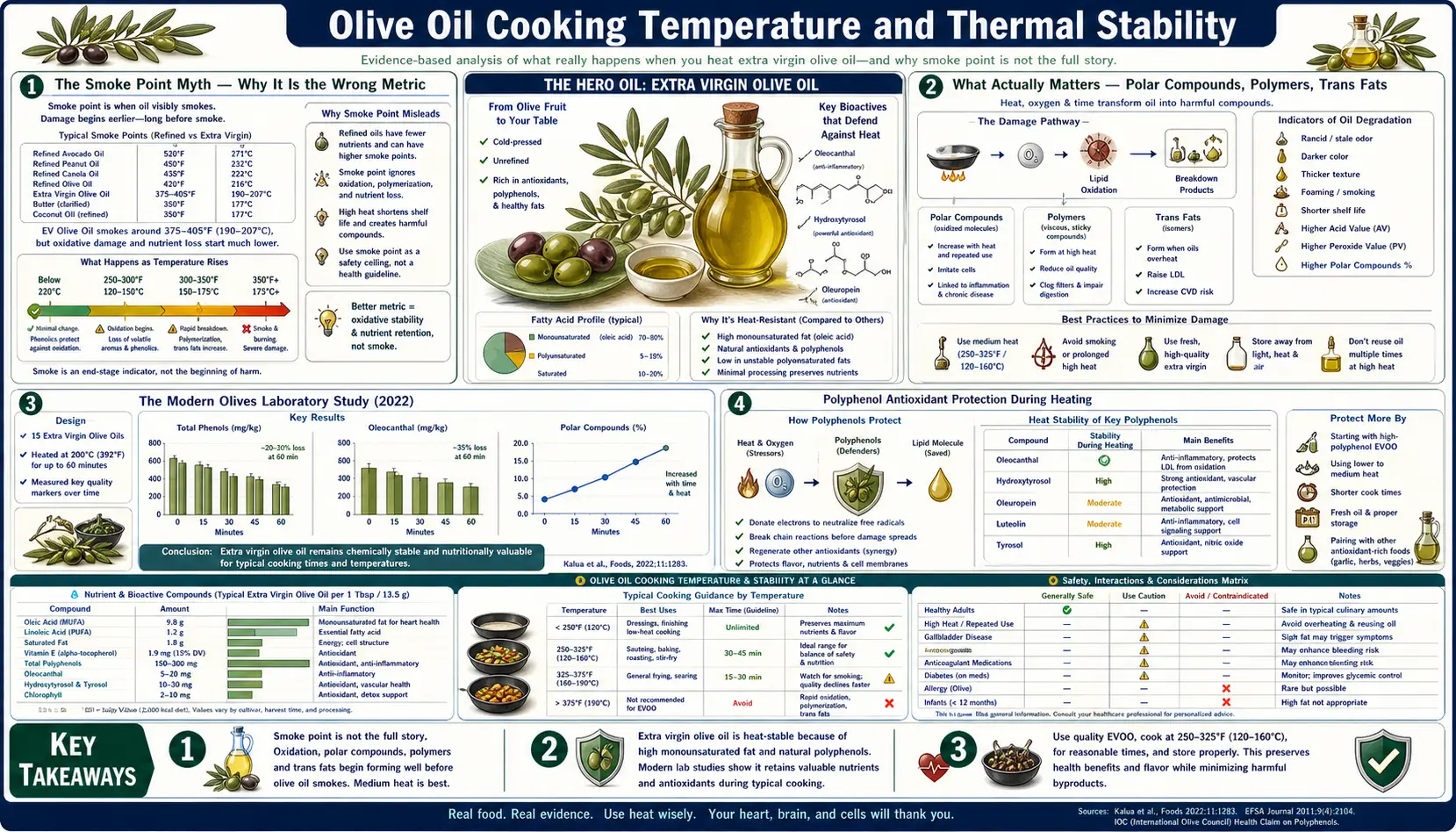
Extra-virgin olive oil has a lower smoke point than many refined seed oils, and smoke point is often treated as a guide to how well an oil tolerates cooking heat. A 2018 study of ten supermarket oils, by authors at a commercial olive-oil testing laboratory in Australia and published in a journal not indexed in PubMed, tested that idea and concluded that, under its conditions, smoke point did not predict how an oil performed when heated; extra-virgin olive oil produced the lowest level of polar compounds after heating, “closely followed by coconut oil.” Indexed domestic-frying studies report a similar pattern for olive oils against seed-oil comparisons, and also report that extra-virgin olive oil loses much of its natural antioxidant content during the first hours of frying. This page sets out what those studies measured, what they found, and where their findings stop.
Table of Contents
- What the Smoke Point Measures
- What Heating Does to an Oil
- The 2018 Ten-Oil Heating Study
- Polyphenols and Tocopherols During Heating
- Temperatures Used in the Studies
- Extra-Virgin Olive Oil and Seed Oils in Frying Studies
- Extra-Virgin and Other Olive Oil Grades Compared
- What the Studies Do and Do Not Show
- Repeated Frying
- Limitations and Concerns
- Key Research Papers
- Connections
- Featured Videos
What the Smoke Point Measures
The smoke point is the temperature at which an oil begins to smoke continuously, seen as a bluish smoke. The 2018 study describes this smoke as an indication of the chemical breakdown of the fat into glycerol and free fatty acids; the glycerol breaks down further to acrolein, one of the main components of the smoke. According to the same paper, the smoke point depends greatly on an oil's free fatty acid content and to a lesser degree on partial glycerides; the degree of unsaturation has little influence, while chain length matters, with oils rich in short-chain fatty acids such as lauric acid smoking at lower temperatures (De Alzaa and colleagues, 2018).
Measured by a standard method (AOCS Cc 9a-48), the ten oils in that study smoked at these temperatures before heating: grapeseed 268.00°C, canola 255.67°C, sunflower 254.67°C, rice bran 237.00°C, high-oleic peanut 226.33°C, the grade sold simply as “olive oil” 208.00°C, extra-virgin olive oil 206.67°C, avocado 196.67°C, coconut 191.00°C and virgin olive oil 175.33°C (De Alzaa and colleagues, 2018).
The smoke point is not fixed. The same study reports that every oil's smoke point fell after both heating trials; for extra-virgin olive oil it fell from 206.7°C to 184.7°C after 360 minutes at 180°C, and averaged 191.6°C at the end of the two treatments, while virgin olive oil and avocado oil showed large drops within the first 30 minutes of heating (De Alzaa and colleagues, 2018).
The question the study set out to answer was whether a higher smoke point goes with greater stability under heat. In its data the answer was no: the authors report a positive correlation between smoke point and the final level of polar compounds, meaning the oils with higher smoke points tended to form more polar compounds when heated (De Alzaa and colleagues, 2018).
What Heating Does to an Oil
A review of deep-fat frying chemistry describes three main reactions in a heated oil — hydrolysis, oxidation and polymerization — and lists the factors that lower an oil's oxidative stability: high frying temperature, the number of fryings, and the oil's content of free fatty acids, polyvalent metals and unsaturated fatty acids. The same review reports that antioxidants slow frying-oil oxidation but become less effective at high frying temperatures (Choe and Min, 2007).
- Hydrolysis — water from food splits the oil, raising its free fatty acid content. The 2018 study notes that its trials were run without food, and that the water and steam from cooked food aid hydrolysis (De Alzaa and colleagues, 2018).
- Oxidation — measured in the studies on this page as peroxide value, conjugated dienes and trienes (the UV coefficients K232 and K270), anisidine value and oxidative stability (Casal and colleagues, 2010; De Alzaa and colleagues, 2018; Santos and colleagues, 2019). Secondary oxidation products include aldehydes.
- Polar compounds and polymers — the 2018 paper describes non-volatile polar compounds and triglyceride dimers and polymers as the major decomposition products of frying oil, and notes, citing earlier work, that some of these compounds (certain aldehydes, alkyl benzenes and other aromatic hydrocarbons) have been associated with various cancers and with neurodegenerative diseases (De Alzaa and colleagues, 2018).
- Trans fats — cis double bonds can isomerize to the trans form under heat; the 2018 study measured trans fats before and after both trials (De Alzaa and colleagues, 2018).
Total polar compounds are the usual yardstick for when a frying oil is spent. Casal and colleagues fried until total polar compounds reached 25 percent, which they describe as the maximum legal value (Casal and colleagues, 2010); the 2018 paper states that many jurisdictions treat a limit of no more than 24 to 27 percent as safe (De Alzaa and colleagues, 2018).
The 2018 Ten-Oil Heating Study
De Alzaa, Guillaume and Ravetti published the study in 2018 in Acta Scientific Nutritional Health, a journal not indexed in PubMed. The authors work at a commercial olive-oil testing laboratory in Australia, and the analyses were run in an ISO 17025-accredited laboratory. Their design:
- Ten oils bought in Australian supermarkets: extra-virgin olive oil, virgin olive oil, the grade sold as “olive oil”, canola, rice bran, grapeseed, coconut, high-oleic peanut, sunflower and avocado oil.
- Trial 1: a 250 mL sample of each oil was heated gradually in a pan fryer from 25°C to 240°C over about 20 minutes, with samples taken as the oil passed 150, 180, 210 and 240°C.
- Trial 2: a 3-litre sample of each oil was held at 180°C in a deep fryer for 6 hours, with samples at 30, 60, 180 and 360 minutes.
- Measurements: smoke point, oxidative stability (Rancimat induction time at 110°C), free fatty acids, total polar compounds, fatty-acid profile, trans fats, and the UV coefficients K232 and K270. Polymers and peroxide values were not reported separately.
- The oils were heated alone, without food.
Results reported in the paper:
- Polar compounds after 6 hours at 180°C: highest in sunflower (21.75 percent), grapeseed (20.24 percent), canola (17.32 percent) and rice bran oil (15.66 percent); lowest in coconut oil (9.68 percent) and extra-virgin olive oil (10.5 percent). On this measure coconut oil finished slightly below extra-virgin olive oil.
- Polar compounds in the 240°C ramp: canola oil rose rapidly from 150°C to 240°C and reached 27.5 percent, which the authors describe as above the limits permitted for human consumption, followed by grapeseed (19.3 percent) and rice bran (13.0 percent).
- Averaged across both trials, the paper's ranking table puts extra-virgin olive oil first (8.47 percent final polar compounds) and coconut oil second (9.30 percent); canola (22.43 percent) and grapeseed (19.79 percent) were highest.
- Oxidative stability of the unheated oils: coconut 50.27 hours, high-oleic peanut 35.37, extra-virgin olive oil 32.70 and virgin olive oil 30.00 hours, against 6.10 for sunflower and 6.56 for grapeseed. Extra-virgin olive oil ranked third, behind coconut and high-oleic peanut oil. During heating, the authors describe extra-virgin olive oil as showing “remarkable stability” at high temperatures and coconut oil as highly stable, with peanut, “olive oil”, sunflower and avocado oil lowest after 6 hours.
- Trans fats: refined oils started with more trans fat than unrefined ones, which the authors relate to bleaching and heating during refining; grapeseed started highest, and extra-virgin and virgin olive oil lowest. Grapeseed and canola oils showed the largest increases after heating.
- Free fatty acids rose slowly during heating; most oils showed a significant rise after 360 minutes at 180°C.
- Fatty-acid profile: polyunsaturated fat made up 7.21 percent of the extra-virgin olive oil, against 68.73 percent of grapeseed, 50.82 percent of sunflower, 33.69 percent of rice bran and 25.80 percent of canola oil, and 1.89 percent of coconut oil. Polyunsaturated fat content correlated positively with polar compound formation, and oxidative stability correlated negatively with it.
The authors concluded that oxidative stability, secondary oxidation products and total polyunsaturated fat were reasonable predictors of how an oil performs when heated, and that extra-virgin olive oil was the most stable oil when heated, “followed closely by coconut oil and other virgin oils such as avocado and high oleic acid seed oils.” They also noted that because no food was cooked, oxidation may have had a greater effect relative to other deterioration reactions than it would in real cooking (De Alzaa and colleagues, 2018).
The same laboratory group later published a peer-reviewed study with food: four cycles of deep-frying at 180°C for 4 minutes, cooking potato chips, chicken nuggets and broccoli in extra-virgin olive oil, canola or grapeseed oil. All the foods had more antioxidants and monounsaturated fat after cooking in extra-virgin olive oil, the highest polar compounds in food were found with canola and grapeseed oils, and canola and grapeseed oils increased trans fats in the food (De Alzaa and colleagues, 2021).
Indexed frying studies from other groups report a similar direction. In domestic frying sampled every 3 hours and continued until total polar compounds reached 25 percent, all the olive oils tested lasted longer (24 to 27 hours) than a commercial vegetable-oil blend (15 hours); the extra-virgin oil showed less oxidation and hydrolysis and more minor antioxidant compounds, the commercial “olive oil” category behaved similarly, and the blend, despite containing significantly more vitamin E, was highly susceptible to oxidation (Casal and colleagues, 2010). In a potato deep-frying study at 175°C, peanut and canola oils reached the 25 percent limit after 18 to 20 hours while extra-virgin olive oil lasted more than 28 hours (Santos and colleagues, 2019). Allouche and colleagues heated two extra-virgin olive oils at 180°C for 36 hours: tocopherols and polyphenols were the most affected components and degraded fastest, while oleic acid, sterols, squalene and triterpenic compounds stayed fairly constant, and the authors concluded that the oils kept most of their minor compounds (Allouche and colleagues, 2007).
Polyphenols and Tocopherols During Heating
The 2018 paper explains extra-virgin olive oil's stability by its fatty-acid composition and by its polyphenols, which react rapidly with lipid radicals and are consumed in doing so; it notes that the activation energy of lipid oxidation is higher when antioxidants are present (De Alzaa and colleagues, 2018).
Experiments support a protective role for the polyphenols. Pellegrini and colleagues added increasing amounts of polyphenols extracted from extra-virgin olive oil (25 to 326 ppm) to refined olive oil containing a fixed 300 ppm of alpha-tocopherol, heated the oils at 160 to 190°C for 30 to 120 minutes, and reported that the polyphenols were effective stabilizers of alpha-tocopherol during heating (Pellegrini and colleagues, 2001).
The antioxidants are used up as they work:
- Over eight successive domestic frying sessions of potatoes, retention of total phenolics in virgin olive oil fell from 70–80 percent after the first frying to 20–30 percent after the eighth, and alpha- and beta-plus-gamma-tocopherol retention fell from 85–90 percent to 15–40 percent; hydroxytyrosol was among the fastest-eliminated phenolics, and deep-frying gave better recoveries than pan-frying (Andrikopoulos and colleagues, 2002, International Journal of Food Sciences and Nutrition).
- In the 175°C potato deep-frying study, all the major antioxidants were lost during the first 8 to 12 hours of frying, and the authors note that extra-virgin olive oil “loses its pool of natural bioactive compounds in the first hours of frying” (Santos and colleagues, 2019).
- In 36 hours at 180°C, tocopherols and polyphenols degraded fastest of all the components measured, at rates that differed between the two cultivars (Allouche and colleagues, 2007).
Temperatures Used in the Studies
The studies on this page used these heating conditions:
- 160–190°C for 30 to 120 minutes, described by the authors as domestic heating conditions (Pellegrini and colleagues, 2001).
- 175°C, potato deep-frying 8 hours a day for up to 28 hours (Santos and colleagues, 2019).
- 180°C, which the 2018 paper calls the highest recommended temperature for deep frying: 6 hours of oil-only heating (De Alzaa and colleagues, 2018), 5 to 15 hours of thermoxidation (Velasco and colleagues, 2004), 36 hours of heating (Allouche and colleagues, 2007), and four 4-minute deep-frying cycles with food (De Alzaa and colleagues, 2021).
- A 20-minute ramp to 240°C, oil alone, sampled at 150, 180, 210 and 240°C (De Alzaa and colleagues, 2018).
- Domestic frying until 25 percent polar compounds, 24 to 27 hours for the olive oils (Casal and colleagues, 2010).
The papers fetched for this page do not report measured oil temperatures for everyday home sautéing, searing, roasting or wok cooking, so no temperature figures are given here for those methods.
Extra-Virgin Olive Oil and Seed Oils in Frying Studies
The studies point to two features of the oil:
- Polyunsaturated fat content — in the 2018 study, oils richer in polyunsaturated fat formed more polar compounds, and the authors relate the lower oxidation stability of canola, grapeseed, sunflower and rice bran oils to their higher linoleic and linolenic acid content and lower levels of natural antioxidants (De Alzaa and colleagues, 2018). In laboratory-simulated shallow frying, a De Montfort University group found the highest aldehyde concentrations in the polyunsaturated-rich soybean and corn oils, while the monounsaturated-rich avocado and olive oils were much more resistant (Wann and colleagues, 2021).
- Antioxidant content — an Australian analysis of three olive oil grades and ten vegetable oils found the most polyphenols in extra-virgin olive oil (48 µg per gram); none were detected in sunflower, walnut, peanut or almond oils, and the other oils contained 2 to 10 µg per gram (Colquhoun and colleagues, 1996). Casal and colleagues found that a vegetable-oil blend was highly susceptible to oxidation during frying despite containing significantly more vitamin E than the olive oils (Casal and colleagues, 2010).
Not every measure favours olive oil. Velasco and colleagues heated olive oil and conventional sunflower oil at 180°C for 5, 10 and 15 hours and found that, for similar levels of degradation, olive oil contained more monoepoxy fatty acids (oxidized fatty acids formed at high temperature) than sunflower oil: 4.29 to 14.24 mg per gram of oil in olive oil against 5.10 to 9.44 mg per gram in sunflower oil. Used frying oils from Spanish restaurants and fried-food outlets contained 3.37 to 14.42 mg per gram (Velasco and colleagues, 2004).
Extra-Virgin and Other Olive Oil Grades Compared
Refining strips most of the phenolic fraction from olive oil. In a study of lampante olive oils sampled through each refining step, hydroxytyrosol and tyrosol were completely removed in the early steps, while tocopherols fell significantly (by 7 to 16 percent) in only four of nine samples (Lucci and colleagues, 2020). Colquhoun and colleagues likewise concluded that phenolic content is reduced by chemical extraction and refining (Colquhoun and colleagues, 1996).
The heating results for the grades differ by study:
- In the 2018 oil-only study, the grade sold as “olive oil” had a smoke point of 208.00°C against 206.67°C for extra-virgin, an oxidative stability of 15.98 hours against 32.70, and an average final polar compound level of 11.65 percent against 8.47 percent (De Alzaa and colleagues, 2018).
- In domestic frying with food, the commercial “olive oil” category behaved similarly to a protected-designation extra-virgin oil, and the authors concluded that olive oil was clearly resistant to frying conditions whichever commercial category was used (Casal and colleagues, 2010).
What the Studies Do and Do Not Show
- Smoke point did not predict heat stability. In the 2018 study the higher-smoke-point seed oils formed more polar compounds, and the authors found oxidative stability, UV coefficients and polyunsaturated fat content to be better predictors (De Alzaa and colleagues, 2018).
- Olive oils outlasted the seed-oil comparisons in domestic frying studies. Olive oils took 24 to 27 hours to reach 25 percent polar compounds against 15 hours for a vegetable-oil blend (Casal and colleagues, 2010), and extra-virgin olive oil more than 28 hours against 18 to 20 hours for peanut and canola oils (Santos and colleagues, 2019).
- Coconut oil was close to, and on some measures ahead of, extra-virgin olive oil. It had the highest oxidative stability and the lowest polar compounds after 6 hours at 180°C, while extra-virgin olive oil ranked first on the average of both trials (De Alzaa and colleagues, 2018).
- The protective antioxidants are consumed. Phenolics and tocopherols fall with each frying session and are largely gone within the first 8 to 12 hours of frying (Andrikopoulos and colleagues, 2002; Santos and colleagues, 2019).
- The 2018 study heated oil without food, and its authors note that this may have changed the balance between oxidation and other reactions (De Alzaa and colleagues, 2018).
- The 2018 and 2021 studies come from a laboratory group working in the olive-oil sector; the 2018 paper appeared in a journal not indexed in PubMed. The indexed studies by other groups (Casal 2010, Santos 2019) used different oils and conditions, so their figures are not directly comparable.
Repeated Frying
The 2018 paper describes the physical changes that build up as an oil is heated and fried: rising viscosity, darkening colour, increasing foaming, and a falling smoke point, which may go unnoticed until the oil has been used for a long time (De Alzaa and colleagues, 2018). A review of frying chemistry lists the number of fryings among the factors that lower an oil's oxidative stability, and notes that the reactions depend in part on replenishment with fresh oil (Choe and Min, 2007).
- Across eight successive sessions of domestic potato frying, phenolics and tocopherols in virgin olive oil declined steadily; the authors note that three to four frying sessions are the most usual in a household kitchen, by which point the other phenolic species had fallen by 40 to 50 percent in deep-frying and 20 to 30 percent in pan-frying (Andrikopoulos and colleagues, 2002, International Journal of Food Sciences and Nutrition).
- Frying hours to the 25 percent limit: 24 to 27 hours for the olive oils and 15 hours for a vegetable-oil blend (Casal and colleagues, 2010); more than 28 hours for extra-virgin olive oil and 18 to 20 hours for peanut and canola oils (Santos and colleagues, 2019).
- Repeated deep-frying in sunflower oil raised aldehyde levels in the potato chips cooked in it, and these increased with repeated frying episodes; restaurant-fried chips contained 10 to 25 ppm of each aldehyde class monitored (Moumtaz and colleagues, 2019 — the abstract discloses that the senior author's work was funded by, and he consulted for, the maker of the algae-derived oil tested).
Limitations and Concerns
- Heating lowers the polyphenol content — the bioactive compounds that are part of extra-virgin olive oil's nutritional interest are consumed during frying, mostly in the first hours (Santos and colleagues, 2019; Andrikopoulos and colleagues, 2002). The amount reaching the diet from heated oil is therefore lower than from unheated oil.
- Coconut oil's stability comes from saturated fat — in the 2018 study it contained 1.89 percent polyunsaturated fat and 7.87 percent oleic acid, and it ranked first for oxidative stability (De Alzaa and colleagues, 2018). Coconut oil's health effects are covered on the Coconut Oil page.
- Polyunsaturated-rich seed oils formed the most degradation products in the studies on this page: the highest polar compounds after 6 hours at 180°C (sunflower, grapeseed, canola, rice bran), canola above the permitted limit in the 240°C ramp (De Alzaa and colleagues, 2018), and the highest aldehyde levels in soybean and corn oils (Wann and colleagues, 2021). Seed oils are covered on the Industrial Seed Oils page.
- Olive oil is not free of oxidation products — it formed more monoepoxy fatty acids than sunflower oil at similar degradation levels (Velasco and colleagues, 2004).
- Smoke contains acrolein — the 2018 paper identifies acrolein, formed from the breakdown of glycerol, as one of the main components of the bluish smoke from overheated oil (De Alzaa and colleagues, 2018).
Key Research Papers
- De Alzaa F, Guillaume C, Ravetti L (2018). Evaluation of chemical and physical changes in different commercial oils during heating. Acta Scientific Nutritional Health 2(6):2-11. — Full text (journal PDF) (Not indexed in PubMed; no DOI; authors at a commercial olive-oil testing laboratory.)
- Casal S, Malheiro R, Sendas A, Oliveira BP, Pereira JA (2010). Olive oil stability under deep-frying conditions. Food and Chemical Toxicology 48(10):2972-2979. — PubMed PMID: 20678538
- Allouche Y, Jimenez A, Gaforio JJ, Uceda M, Beltran G (2007). How heating affects extra virgin olive oil quality indexes and chemical composition. Journal of Agricultural and Food Chemistry 55(23):9646-9654. — PubMed PMID: 17935291
- Pellegrini N, Visioli F, Buratti S, Brighenti F (2001). Direct analysis of total antioxidant activity of olive oil and studies on the influence of heating. Journal of Agricultural and Food Chemistry 49(5):2532-2538. — PubMed PMID: 11368632
- Grootveld M, Rodado VR, Silwood CJL (2014). Detection, monitoring, and deleterious health effects of lipid oxidation products generated in culinary oils during thermal stressing episodes. AOCS Inform. PubMed: Grootveld culinary oil oxidation (Trade-magazine article; not found in PubMed or Crossref in the 2026-10-14 check, so the link is a topic search. The group's indexed frying work is cited below: Wann 2021.)
- Choe E, Min DB (2007). Chemistry of deep-fat frying oils. Journal of Food Science 72(5):R77-R86. — PubMed PMID: 17995742
- Aladedunye FA, Przybylski R (2009). Degradation and nutritional quality changes of oil during frying. Journal of the American Oil Chemists' Society 86(2):149-156. — doi:10.1007/s11746-008-1328-5
- Andrikopoulos NK, Kalogeropoulos N, Falirea A, Barbagianni MN (2002). Performance of virgin olive oil and vegetable shortening during domestic deep-frying and pan-frying of potatoes. International Journal of Food Science & Technology 37(2):177-190. — doi:10.1046/j.1365-2621.2002.00555.x
- Quiles JL, Ramirez-Tortosa MC, Gomez JA, Huertas JR, Mataix J (2002). Role of vitamin E and phenolic compounds in the antioxidant capacity, measured by ESR, of virgin olive, olive and sunflower oils after frying. Food Chemistry 76(4):461-468. — doi:10.1016/S0308-8146(01)00307-7
- Velasco J, Marmesat S, Bordeaux O, Marquez-Ruiz G, Dobarganes C (2004). Formation and evolution of monoepoxy fatty acids in thermoxidized olive and sunflower oils and quantitation in used frying oils from restaurants and fried-food outlets. Journal of Agricultural and Food Chemistry 52(14):4438-4443. — PubMed PMID: 15237949
- Chiou A, Salta FN, Kalogeropoulos N, Mylona A, Ntalla I, Andrikopoulos NK (2007). Retention and distribution of polyphenols after pan-frying of French fries in oils enriched with olive leaf extract. Journal of Food Science 72(8):S574-S584. — PubMed PMID: 17995623
- Santos CSP, Cunha SC, Casal S (2017). Deep or air frying? A comparative study with different vegetable oils. European Journal of Lipid Science and Technology 119(6):1600375. — doi:10.1002/ejlt.201600375
- Santos CSP, García LM, Cruz R, Cunha SC, Fernandes JO, Casal S (2019). Impact of potatoes deep-frying on common monounsaturated-rich vegetable oils: a comparative study. Journal of Food Science and Technology 56(1):290-301. — PubMed PMID: 30728571
- de Alzaa F, Guillaume C, Ravetti L (2021). Evaluation of chemical and nutritional changes in chips, chicken nuggets, and broccoli after deep-frying with extra virgin olive oil, canola, and grapeseed oils. Journal of Food Quality 2021:1-14. — doi:10.1155/2021/7319013
- Andrikopoulos NK, Dedoussis GV, Falirea A, Kalogeropoulos N, Hatzinikola HS (2002). Deterioration of natural antioxidant species of vegetable edible oils during the domestic deep-frying and pan-frying of potatoes. International Journal of Food Sciences and Nutrition 53(4):351-363. — PubMed PMID: 12090031
- Wann AI, Percival BC, Woodason K, Gibson M, Vincent S, Grootveld M (2021). Comparative 1H NMR-based chemometric evaluations of the time-dependent generation of aldehydic lipid oxidation products in culinary oils exposed to laboratory-simulated shallow frying episodes: differential patterns observed for omega-3 fatty acid-containing soybean oils. Foods 10(10):2481. — PubMed PMID: 34681530
- Moumtaz S, Percival BC, Parmar D, Grootveld KL, Jansson P, Grootveld M (2019). Toxic aldehyde generation in and food uptake from culinary oils during frying practices: peroxidative resistance of a monounsaturate-rich algae oil. Scientific Reports 9(1):4125. — PubMed PMID: 30858398 (The abstract discloses industry funding and consulting by the senior author.)
- Colquhoun DM, Hicks BJ, Reed AW (1996). Phenolic content of olive oil is reduced in extraction and refining. Asia Pacific Journal of Clinical Nutrition 5(2):105-107. — PubMed PMID: 24394520
- Lucci P, Bertoz V, Pacetti D, Moret S, Conte L (2020). Effect of the refining process on total hydroxytyrosol, tyrosol, and tocopherol contents of olive oil. Foods 9(3):292. — PubMed PMID: 32150867