Olive Oil for Heart Health
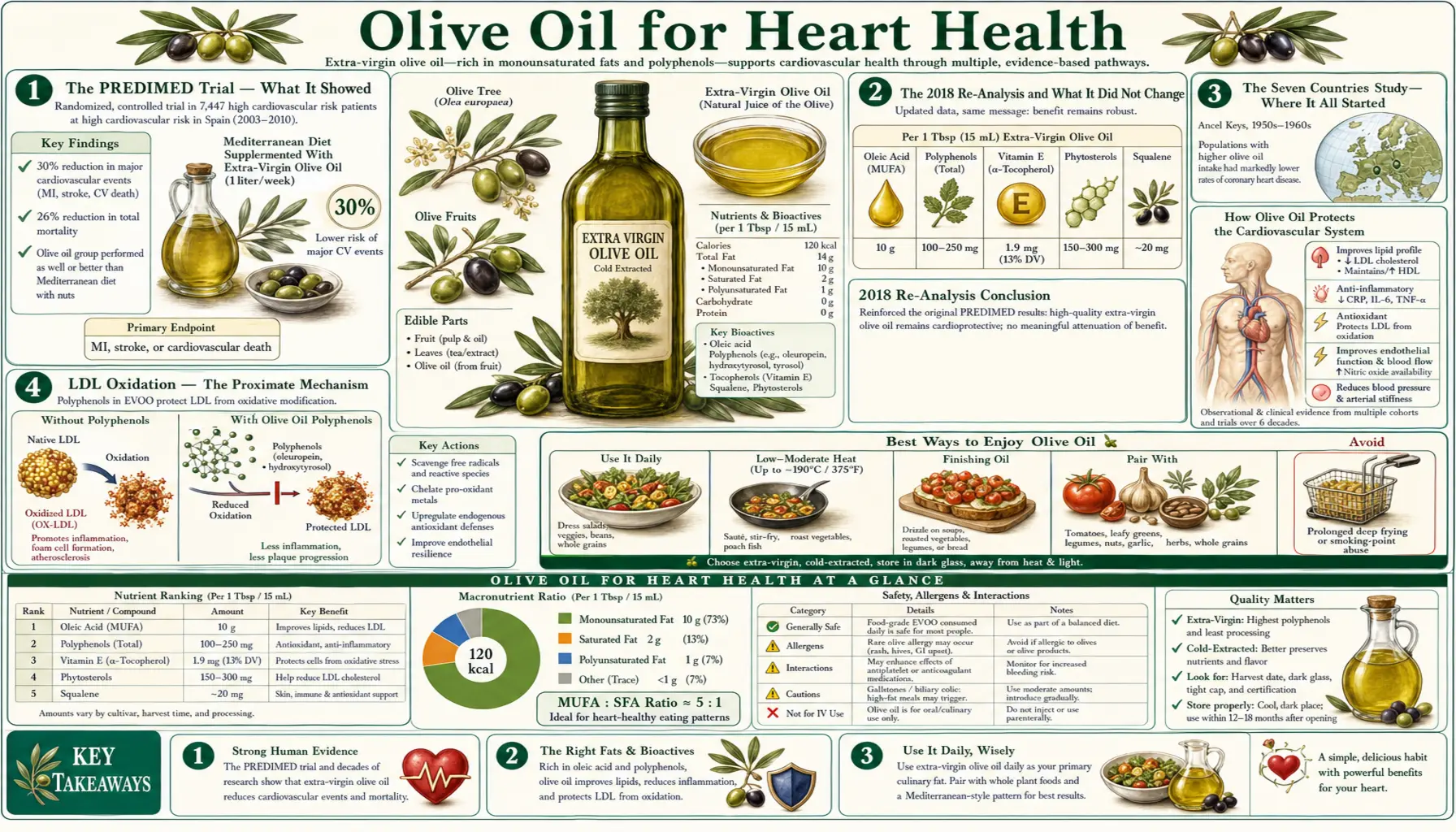
The PREDIMED trial (Prevención con Dieta Mediterránea, Estruch et al., NEJM; the 2013 report was retracted and republished with corrected analyses in 2018) is one of the largest randomized trials of a dietary pattern for cardiovascular prevention. 7,447 Spanish adults at high cardiovascular risk but with no prior cardiovascular disease were assigned to one of three diets: a Mediterranean diet supplemented with extra-virgin olive oil; a Mediterranean diet supplemented with mixed nuts; or a control diet, described by the trialists as advice to reduce dietary fat. After a median 4.8 years of follow-up, the primary endpoint — combined myocardial infarction, stroke, and cardiovascular death — was lower in both Mediterranean groups than in the control group: in the corrected 2018 analysis, a hazard ratio of 0.69 (95% CI 0.53-0.91) for the olive oil arm and 0.72 (95% CI 0.54-0.95) for the nuts arm. The trial was stopped on the basis of a prespecified interim analysis. The intervention tested was the whole Mediterranean pattern with olive oil provided, not olive oil added to an otherwise unchanged diet.
Table of Contents
- The PREDIMED Trial — What It Showed
- The 2018 Re-Analysis and What It Did Not Change
- The Seven Countries Study — Where It All Started
- LDL Oxidation — The Proximate Mechanism
- Endothelial Function and Flow-Mediated Dilation
- Blood Pressure Effects
- HDL Function and Cholesterol Efflux
- Amounts Used in Trials, Cohorts and Health Claims
- What the PREDIMED Intervention Involved
- Cautions
- Key Research Papers
- Connections
- Featured Videos
The PREDIMED Trial — What It Showed
PREDIMED was a multicenter randomized trial run at 11 study sites in Spain, with participants recruited between 2003 and 2009 (Toledo and colleagues, 2015, describe it as a single-blind, controlled field trial). Participants were men aged 55 to 80 and women aged 60 to 80 who had no cardiovascular disease at enrollment but were at high cardiovascular risk because of type 2 diabetes or several major risk factors (Guasch-Ferré and colleagues, 2014).
The 7,447 enrollees were assigned to one of three diets:
- Mediterranean diet + extra-virgin olive oil — Mediterranean diet education plus free extra-virgin olive oil (1 liter per week in the trial's 2006 pilot report). The trial's 14-point Mediterranean-diet adherence screener awards a point for using olive oil as the main cooking fat and a point for using four or more tablespoons a day.
- Mediterranean diet + nuts — the same education plus free mixed nuts (30 g per day in the pilot report).
- Control diet — described by the trialists as “advice to reduce dietary fat”. Participants in all three groups received quarterly educational sessions; the control group received small nonfood gifts instead of food. The 2006 pilot report notes as a limitation that the nutritional education about the low-fat diet was less intense than the education about the Mediterranean diets.
The primary endpoint was a composite of myocardial infarction, stroke, or death from cardiovascular causes. After a median follow-up of 4.8 years the trial was stopped on the basis of a prespecified interim analysis. The figures below are from the corrected 2018 report (the 2013 report was retracted):
- Primary endpoint events: 288 in total — 96 in the extra-virgin olive oil group (3.8%), 83 in the nuts group (3.4%), 109 in the control group (4.4%)
- Hazard ratio for the composite primary endpoint vs. control, intention-to-treat, adjusted for baseline characteristics and propensity scores: 0.69 for extra-virgin olive oil (95% CI 0.53-0.91) and 0.72 for nuts (95% CI 0.54-0.95)
- Results were similar after omitting the 1,588 participants whose study-group assignments were known or suspected to have departed from the protocol
The authors' conclusion was that major cardiovascular events were less frequent among people assigned to a Mediterranean diet supplemented with extra-virgin olive oil or nuts than among those assigned to a reduced-fat diet. The trial tested whole dietary patterns, with olive oil or nuts provided, against that control diet; it did not test olive oil in isolation, and it did not compare diet with medicines.
The 2018 Re-Analysis and What It Did Not Change
The original 2013 NEJM report was retracted in 2018 (retraction notice PMID 29897867) after the investigators identified protocol deviations: household members enrolled without randomization, some participants at 1 of the 11 sites assigned to a study group without randomization, and apparently inconsistent use of randomization tables at another site. The trial was republished in 2018 with revised effect estimates from analyses that do not rely exclusively on the assumption that every participant was randomly assigned.
In the revised analysis the direction and approximate size of the effect were unchanged:
- Extra-virgin olive oil hazard ratio: 0.69 (95% CI 0.53-0.91)
- Nuts hazard ratio: 0.72 (95% CI 0.54-0.95)
- Results similar after omitting the 1,588 participants whose assignments were known or suspected to have departed from the protocol
Several studies derived from PREDIMED were also reanalyzed; journals published corrections for them in 2018 (for example the 2006 pilot report and two 2015 secondary analyses in JAMA Internal Medicine, under the notice “Protocol Deviations and Reanalyses in Derivative Studies of the PREDIMED Trial”).
Guasch-Ferré and colleagues (2014) also analyzed olive oil intake within PREDIMED as an observational exposure across all three groups (7,216 participants). Those in the highest third of baseline extra-virgin olive oil intake had a hazard ratio of 0.61 (95% CI 0.44-0.85) for cardiovascular disease compared with the lowest third, and each 10 g/day increase in extra-virgin olive oil was associated with a 10% lower cardiovascular disease risk. The associations were significant in the two Mediterranean-diet groups but not in the control group, and intake of common olive oil (a blend that is mostly refined oil) was not significantly associated with cardiovascular events or mortality. Being observational, this analysis shows association, not cause.
The 2020 Guasch-Ferré analysis in JACC followed 61,181 women in the Nurses' Health Study and 31,797 men in the Health Professionals Follow-up Study for 24 years. Compared with non-consumers, those eating more than half a tablespoon (more than 7 g) of olive oil a day had a 14% lower risk of cardiovascular disease (HR 0.86) and an 18% lower risk of coronary heart disease (HR 0.82); no significant association was seen for stroke. Replacing 5 g/day of margarine, butter, mayonnaise, or dairy fat with olive oil was associated with a 5-7% lower risk of total cardiovascular disease and coronary heart disease. No significant association was found when olive oil was compared with other plant oils combined.
The Seven Countries Study — Where It All Started
The idea that olive oil is linked with lower coronary risk traces back to the Seven Countries Study, designed by Ancel Keys and colleagues at the end of the 1950s, which followed 16 cohorts of middle-aged men in Finland, Greece, Italy, Japan, the Netherlands, the United States and Yugoslavia. Food records collected in the 1960s showed large differences in diet between cohorts; in Greece the intake of olive oil and fruit was high, while in Finland the intake of milk, potatoes, edible fats and sugar products was very high (Kromhout and colleagues, 1989).
In the 15-year mortality analysis (Keys and colleagues, 1986; 11,579 men), death rates rose with the cohort's average share of energy from saturated fat and fell with its share from monounsaturated fat, which was almost entirely oleic acid; all-cause and coronary death rates were low in the cohorts with olive oil as the main fat. The authors stated explicitly that causal relationships were not claimed.
Because it compared whole populations, the Seven Countries Study could not establish causation. It generated the hypothesis that later randomized trials such as PREDIMED tested, in the form of a whole Mediterranean dietary pattern.
LDL Oxidation — The Proximate Mechanism
One long-studied model of atherosclerosis centers on the oxidative modification of LDL particles. In that model, oxidized LDL is taken up by scavenger receptors (such as CD36 and SR-A) on macrophages in the artery wall in an unregulated way, so that the cells fill with lipid droplets and become foam cells, an early feature of plaque.
Olive oil polyphenols (hydroxytyrosol and related compounds) are studied as antioxidants for this reason. The EUROLIVE trial (Covas and colleagues, 2006) randomized 200 healthy men at 6 research centers in 5 European countries to a crossover sequence of three olive oils, 25 mL a day for 3 weeks each, separated by 2-week washouts. The oils were otherwise similar but had low (2.7 mg/kg), medium (164 mg/kg) or high (366 mg/kg) phenolic content. HDL cholesterol rose and the total-to-HDL cholesterol ratio fell linearly with phenolic content, and oxidative stress markers, including oxidized LDL, decreased linearly as phenolic content increased (mean change in oxidized LDL −3.21 U/L with the high-phenolic oil). The authors list as limitations self-reported diet and short intervention periods.
In a PREDIMED substudy (Hernáez and colleagues, 2017; 210 participants, 1 year), the Mediterranean diet with virgin olive oil increased LDL resistance against oxidation (+6.46%) and reduced the degree of LDL oxidative modification relative to the control diet; the nuts diet showed no significant effect on these LDL traits versus control.
This antioxidant evidence underlies the European Union health claim: “Olive oil polyphenols contribute to the protection of blood lipids from oxidative stress.” Following a 2011 EFSA scientific opinion, Regulation (EU) No 432/2012 permits the claim only for olive oil containing at least 5 mg of hydroxytyrosol and its derivatives (e.g. oleuropein complex and tyrosol) per 20 g of olive oil, with the information that the beneficial effect is obtained with a daily intake of 20 g of olive oil.
Refining strips most of the polyphenols from olive oil while leaving its oleic acid. EUROLIVE showed polyphenol-dependent differences in blood lipid and oxidation markers among oils of similar fat composition, and the PREDIMED observational analysis found an association for extra-virgin but not for common olive oil; no randomized trial has compared refined with extra-virgin olive oil on heart attacks or strokes.
Endothelial Function and Flow-Mediated Dilation
The endothelium — the single-cell layer lining the blood vessels — releases nitric oxide (NO) in response to blood flow, which relaxes the vessel. Loss of this response (endothelial dysfunction) is regarded as an early step in atherosclerosis.
Endothelial function is commonly measured by flow-mediated dilation (FMD): the brachial artery is measured by ultrasound before and after a blood-pressure cuff briefly stops and then releases blood flow, and the widening of the artery is recorded.
The results with olive oil depend on the setting. In a small single-meal study (Vogel and colleagues, 2000; 10 healthy people), a 900-kcal meal containing 50 g of fat as olive oil reduced FMD by 31% three hours later, while olive oil meals that also contained antioxidant vitamins or vegetables and vinegar, and meals made with canola oil or salmon, did not significantly reduce it. Over longer periods, a 2015 meta-analysis of randomized trials (Schwingshackl and colleagues) found that olive oil interventions increased FMD by 0.76 percentage points more than control interventions (8 trials) and lowered C-reactive protein and interleukin-6; the authors urged a conservative interpretation because the trials differed widely in design and control diets. In a crossover trial in 20 older adults (Marin and colleagues, 2011), 4 weeks of a Mediterranean diet rich in monounsaturated fat was followed by fewer circulating endothelial microparticles and more endothelial progenitor cells than a saturated-fat diet or a low-fat, high-carbohydrate diet.
Proposed mechanisms include protection of nitric oxide from oxidative breakdown by polyphenols and anti-inflammatory effects; these are hypotheses drawn largely from laboratory work.
Blood Pressure Effects
The blood-pressure evidence is mixed. In the 2006 PREDIMED pilot report (772 participants, 3 months), systolic blood pressure fell by 5.9 mmHg more with the Mediterranean diet plus olive oil, and by 7.1 mmHg more with the Mediterranean diet plus nuts, than with the low-fat control diet; this short study measured risk factors rather than clinical events, and the low-fat group received less intense education.
Meta-analyses that isolate olive oil are less clear. A 2024 meta-analysis of 17 randomized trials of olive oil (14 trials) or flaxseed oil (3 trials) in healthy adults and adults at risk of hypertension (McNabb and colleagues) found no significant effect on systolic or diastolic blood pressure. A 2025 meta-analysis comparing the two PREDIMED-style diets (Pourrajab and colleagues, 21 trials) found no difference in diastolic blood pressure or blood lipids between the olive oil and nut versions, with slightly higher systolic pressure in the olive oil groups than in the nut groups.
See our Hypertension page for the wider evidence on diet and blood pressure.
HDL Function and Cholesterol Efflux
Research on HDL has shifted from the amount of HDL cholesterol in the blood toward what HDL particles do — in particular their ability to accept cholesterol from cells in the artery wall for return to the liver (reverse cholesterol transport, measured in the laboratory as cholesterol efflux capacity), and their antioxidant and vessel-relaxing properties.
Hernáez and colleagues (2017, Circulation) measured these functions in a random subsample of 296 PREDIMED participants after 1 year. Both Mediterranean diets increased cholesterol efflux capacity relative to baseline. The virgin olive oil diet also lowered cholesteryl ester transfer protein activity relative to baseline and increased HDL's ability to esterify cholesterol, paraoxonase-1 arylesterase activity and HDL vasodilatory capacity relative to the control diet. The authors concluded that the traditional Mediterranean diet, especially when enriched with virgin olive oil, improved HDL atheroprotective functions.
Amounts Used in Trials, Cohorts and Health Claims
No trial has established a dose-response curve or a threshold intake of olive oil for cardiovascular events. The amounts that appear in the research and in regulatory claims are:
- PREDIMED: free extra-virgin olive oil (1 liter per week in the pilot report), with four or more tablespoons a day scored as adherent on the trial's screener. The trial compared this whole Mediterranean pattern with a control diet of advice to reduce dietary fat.
- PREDIMED observational analysis (Guasch-Ferré and colleagues, 2014): each additional 10 g/day of extra-virgin olive oil was associated with a 10% lower cardiovascular disease risk.
- US cohorts (Guasch-Ferré and colleagues, 2020): more than half a tablespoon (more than 7 g) a day was associated with lower cardiovascular and coronary risk than none; the associations were seen when olive oil replaced margarine, butter, mayonnaise or dairy fat, not when it was compared with other plant oils combined.
- EU health claim (Regulation (EU) No 432/2012): olive oil with at least 5 mg of hydroxytyrosol and its derivatives per 20 g, with the stated benefit tied to a daily intake of 20 g of olive oil; the claim concerns protection of blood lipids from oxidative stress, not heart disease.
- US FDA qualified health claim (November 2018): for edible oils containing at least 70% oleic acid, the FDA allows the statement that “supportive but not conclusive scientific evidence suggests that daily consumption of about 1½ tablespoons (20 grams) of oils containing high levels of oleic acid”, when replacing fats and oils higher in saturated fat and without increasing total daily calories, may reduce the risk of coronary heart disease.
The common thread in the cohort data and in the FDA claim is substitution: the associations concern olive oil used in place of other fats rather than added on top of an unchanged diet.
What the PREDIMED Intervention Involved
The intervention that produced the PREDIMED result was more than a bottle of oil:
- Extra-virgin olive oil specifically. The trial provided extra-virgin oil, the grade that keeps its polyphenols; the PREDIMED observational analysis found no significant association for common olive oil. The Extra Virgin Quality page covers how grades differ.
- A whole dietary pattern. Participants received Mediterranean-diet education in quarterly sessions; the oil was one component of that pattern, and the nut arm, with the same education but nuts instead of extra oil, had a similar result (HR 0.72).
- Olive oil as the main fat. The trial's adherence screener scored olive oil as the main cooking fat; the US cohort associations were for olive oil replacing other fats.
- Raw and cooked use. How heating affects the oil's polyphenols is covered on the Cooking Temperature page.
- Years, not weeks. The clinical result came from a median of 4.8 years of follow-up; the short trials of blood markers (3 weeks in EUROLIVE, 3 months in the pilot) measured risk factors, not events.
Cautions
- Calories — olive oil is pure fat, which supplies about 9 kcal per gram. The cohort and FDA-claim findings concern olive oil replacing other fats, and the FDA claim is conditioned on not increasing total daily calories.
- The trial population and the comparison — PREDIMED enrolled older Spanish adults at high cardiovascular risk without prior cardiovascular disease, and compared dietary patterns with a control diet; it did not test diet as a replacement for medicines. Decisions about cardiovascular medicines belong with a clinician.
- Platelets — olive oil polyphenols and platelet function are discussed on the Polyphenols and Oleocanthal page. There is little published data on high olive oil intake in people taking anticoagulants or with bleeding disorders, which is a question for their clinician.
- Grade matters — refined, “light” or “pure” olive oil has lost most of its polyphenols. The evidence for a difference in cardiovascular outcomes comes from observational data (extra-virgin vs common olive oil in PREDIMED) and from marker trials such as EUROLIVE, not from a head-to-head outcome trial.
- Size of the effect — the PREDIMED reduction (hazard ratio 0.69 for the olive oil arm in the corrected 2018 analysis) lowered but did not remove cardiovascular events: 3.8% of the olive oil group still had a primary-endpoint event over the follow-up, against 4.4% of the control group.
Key Research Papers
- Estruch R, Ros E, Salas-Salvado J, Covas MI, Corella D, Aros F, et al. (2018). Primary Prevention of Cardiovascular Disease with a Mediterranean Diet Supplemented with Extra-Virgin Olive Oil or Nuts. NEJM 378(25):e34. — PubMed PMID: 29897866
- Estruch R et al. (2013). Primary prevention of cardiovascular disease with a Mediterranean diet. NEJM 368(14):1279-1290. — PubMed PMID: 23432189 (Original publication; corrected and republished in 2018 as PubMed PMID: 29897866, above.) — Retracted (retraction notice: PubMed PMID: 29897867)
- Guasch-Ferre M, Liu G, Li Y, Sampson L, Manson JE, Salas-Salvado J, et al. (2020). Olive Oil Consumption and Cardiovascular Risk in U.S. Adults. JACC 75(15):1729-1739. — PubMed PMID: 32147453
- Covas MI, Nyyssonen K, Poulsen HE, et al. (2006). The effect of polyphenols in olive oil on heart disease risk factors. Annals of Internal Medicine 145(5):333-341. (EUROLIVE trial). — PubMed PMID: 16954359
- Hernaez A, Castaner O, Goday A, Ros E, Pinto X, Estruch R, et al. (2017). The Mediterranean Diet decreases LDL atherogenicity in high cardiovascular risk individuals: a randomized controlled trial. Molecular Nutrition & Food Research 61(9):1601015. — PubMed PMID: 28371298
- Hernaez A, Castaner O, Elosua R, Pinto X, Estruch R, Salas-Salvado J, et al. (2017). Mediterranean Diet Improves High-Density Lipoprotein Function in High-Cardiovascular-Risk Individuals: A Randomized Controlled Trial. Circulation 135(7):633-643. — PubMed PMID: 28193797
- Vogel RA, Corretti MC, Plotnick GD (2000). The postprandial effect of components of the Mediterranean diet on endothelial function. JACC 36(5):1455-1460. — PubMed PMID: 11079642
- Schwingshackl L, Hoffmann G (2014). Monounsaturated fatty acids, olive oil and health status: a systematic review and meta-analysis of cohort studies. Lipids in Health and Disease 13:154. — PubMed PMID: 25274026
- Marin C, Ramirez R, Delgado-Lista J, et al. (2011). Mediterranean diet reduces endothelial damage and improves the regenerative capacity of endothelium. American Journal of Clinical Nutrition 93(2):267-274. — PubMed PMID: 21123460
- Estruch R, Martinez-Gonzalez MA, Corella D, et al. (2006). Effects of a Mediterranean-style diet on cardiovascular risk factors: a randomized trial. Annals of Internal Medicine 145(1):1-11. (PREDIMED pilot). — PubMed PMID: 16818923 (Erratum 2018 after the PREDIMED protocol-deviation reanalysis: PubMed PMID: 30128531)
- Lopez-Miranda J, Perez-Jimenez F, Ros E, De Caterina R, Badimon L, Covas MI, et al. (2010). Olive oil and health: summary of the II international conference on olive oil and health consensus report, Jaen and Cordoba (Spain) 2008. Nutrition, Metabolism & Cardiovascular Diseases 20(4):284-294. — PubMed PMID: 20303720
- Toledo E, Salas-Salvado J, Donat-Vargas C, Buil-Cosiales P, Estruch R, Ros E, et al. (2015). Mediterranean Diet and Invasive Breast Cancer Risk Among Women at High Cardiovascular Risk in the PREDIMED Trial: A Randomized Clinical Trial. JAMA Internal Medicine 175(11):1752-1760. — PubMed PMID: 26365989 (Corrected 2018, “Protocol Deviations and Reanalyses in Derivative Studies of the PREDIMED Trial”: PubMed PMID: 30398520)
- Guasch-Ferre M, Hu FB, Martinez-Gonzalez MA, Fito M, Bullo M, Estruch R, et al. (2014). Olive oil intake and risk of cardiovascular disease and mortality in the PREDIMED Study. BMC Medicine 12:78. — PubMed PMID: 24886626
- Schwingshackl L, Christoph M, Hoffmann G (2015). Effects of Olive Oil on Markers of Inflammation and Endothelial Function — A Systematic Review and Meta-Analysis. Nutrients 7(9):7651-7675. — PubMed PMID: 26378571
- McNabb TB, Young I, Newman RG, Skinner RC, Benedito VA, Tou JC (2024). Supplementation of Olive Oil and Flaxseed Oil on Blood Pressure and Inflammation in Healthy and At-Risk Adults: A Systematic Literature Review and Meta-Analysis. Current Hypertension Reviews 20(3):141-155. — PubMed PMID: 39558500
- Pourrajab B, Mirdar Harijani A, Asghari P, Shidfar F (2025). Effect of the Mediterranean diet supplemented with olive oil versus the Mediterranean diet supplemented with mixed nuts on blood pressure and serum lipid indexes among adults: a systematic review and meta-analysis of randomized controlled trials. Nutrition, Metabolism & Cardiovascular Diseases 35(11):104166. — PubMed PMID: 40651889
- Keys A, Menotti A, Karvonen MJ, Aravanis C, et al. (1986). The diet and 15-year death rate in the seven countries study. American Journal of Epidemiology 124(6):903-915. — PubMed PMID: 3776973
- Kromhout D, Keys A, Aravanis C, Buzina R, et al. (1989). Food consumption patterns in the 1960s in seven countries. American Journal of Clinical Nutrition 49(5):889-894. — PubMed PMID: 2718924
- EFSA Panel on Dietetic Products, Nutrition and Allergies (2011). Scientific Opinion on the substantiation of health claims related to polyphenols in olive and protection of LDL particles from oxidative damage (ID 1333, 1638, 1639, 1696, 2865) and other claims, pursuant to Article 13(1) of Regulation (EC) No 1924/2006. EFSA Journal 9(4):2033. Claim authorized in Commission Regulation (EU) No 432/2012. — doi:10.2903/j.efsa.2011.2033
- U.S. Food and Drug Administration (19 November 2018). FDA Completes Review of Qualified Health Claim Petition for Oleic Acid and the Risk of Coronary Heart Disease. — fda.gov constituent update