Extra Virgin Olive Oil Quality and Adulteration
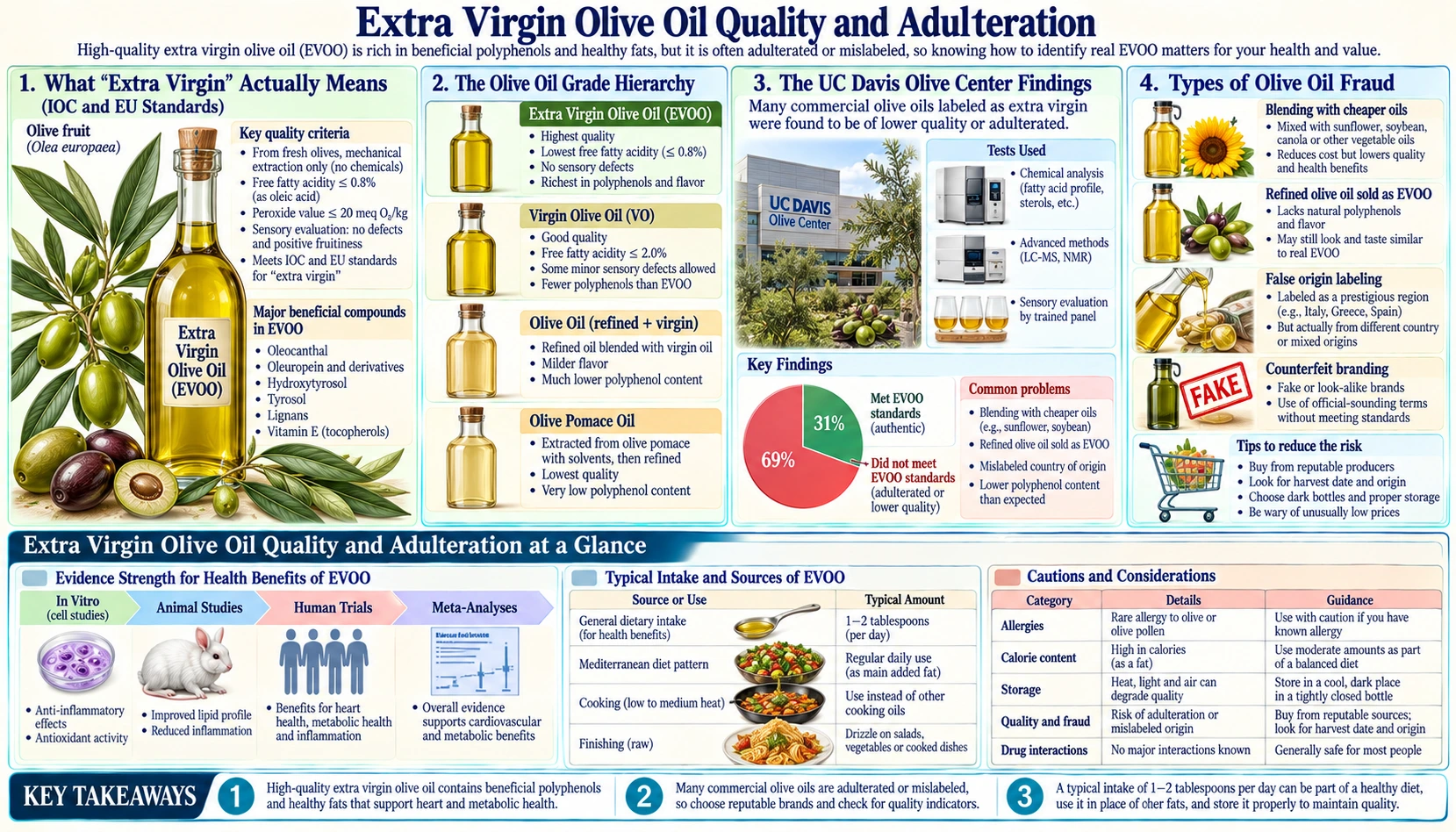
The UC Davis Olive Center published two reports, in July 2010 and April 2011, on olive oil labelled "extra virgin" that its researchers bought from California retailers in 2010. In the second report, 66 of 90 samples (73%) from the five top-selling imported brands in the United States failed the International Olive Council's (IOC) sensory standard for extra virgin olive oil, as judged by two IOC-accredited tasting panels; by brand, the failure rate ranged from 56% to 94%. The journalist Tom Mueller described olive-oil fraud investigations in Italy and the United States in a 2007 New Yorker article, "Slippery Business," and later in a 2011 book, Extra Virginity. This page covers what the extra-virgin grade means under EU and IOC rules, how oils are tested, the kinds of fraud described in the research literature, and what the regulated label terms mean.
Table of Contents
- What "Extra Virgin" Actually Means (IOC and EU Standards)
- The Olive Oil Grade Hierarchy
- The UC Davis Olive Center Findings
- Types of Olive Oil Fraud
- Chemical Tests for Quality and Authenticity
- Sensory Evaluation — The IOC Tasting Panel
- Reading the Label — What the Rules Say
- Results by Category of Oil
- Storage and Degradation After Purchase
- Cautions
- Key Research Papers
- Connections
- Featured Videos
What "Extra Virgin" Actually Means (IOC and EU Standards)
"Extra virgin olive oil" is a defined grade, not a marketing slogan. The International Olive Council (IOC) sets it in its trade standard (COI/T.15/NC No 3), and in the European Union it is set by Commission Delegated Regulation (EU) 2022/2104, which repealed the older Regulations 2568/91 and 29/2012; the methods of analysis are in Commission Implementing Regulation (EU) 2022/2105. An extra-virgin oil has to meet three kinds of criteria:
- Production method — the IOC defines virgin olive oils as oils obtained from the fruit of the olive tree "solely by mechanical or other physical means under conditions, particularly thermal conditions, that do not lead to alterations in the oil," with no treatment other than washing, decantation, centrifugation and filtration. On EU labels the extra-virgin category is described as "superior category olive oil obtained directly from olives and solely by mechanical means." The 27°C figure often linked with "cold" oil belongs to two optional EU label terms (see Reading the Label): "cold extraction" may appear only on extra-virgin or virgin oils obtained below 27°C by percolation or centrifugation of the olive paste.
- Chemical criteria — the EU limits for extra virgin olive oil (Annex I of Regulation 2022/2104):
- Free acidity: not more than 0.80%, expressed as oleic acid
- Peroxide value: not more than 20.0 milliequivalents O2/kg
- K232 (UV absorbance at 232 nm): not more than 2.50
- K268 or K270 (UV absorbance at 268 or 270 nm): not more than 0.22
- Delta-K: not more than 0.01
- Fatty acid ethyl esters: not more than 35 mg/kg
- Purity limits on fatty-acid composition, trans isomers, stigmastadienes (not more than 0.05 mg/kg), sterol composition, waxes and other markers
- Organoleptic (sensory) criteria — a tasting panel working under the IOC method (COI/T.20/Doc. No 15), which requires between 8 and 12 trained tasters for each test:
- Median of the defect perceived with the greatest intensity: 0.0
- Fruity median: greater than 0.0
An oil that misses the extra-virgin limits falls into a lower category (see the grade hierarchy below). In the United States, the U.S. Department of Agriculture's grade standards for olive oil, effective October 25, 2010, are voluntary grade standards issued under the Agricultural Marketing Act of 1946; "U.S. Extra Virgin Olive Oil" requires a median of defects equal to zero, a median of fruitiness greater than zero and free fatty acid of not more than 0.8 grams per 100 grams. The UC Davis reports note that the United States is not a member of the IOC, and the 2011 report, citing the IOC, states that the IOC's quality-control program assessed an average of 116 extra-virgin samples a year purchased in the whole of the United States and Canada in 2008–2009. A 2017 paper by U.S. Food and Drug Administration scientists states that the FDA is mandated to protect the U.S. public against intentional adulteration of foods and has jurisdiction over deceptive label declarations (Mossoba and colleagues, 2017).
The Olive Oil Grade Hierarchy
The legal grades, as the EU regulation and the IOC trade standard define them:
- Extra Virgin Olive Oil (EVOO) — the top grade defined above: free acidity up to 0.80%, a defect median of 0 and a fruity median above 0.
- Virgin Olive Oil — also obtained solely by mechanical means, with free acidity up to 2.0%, a defect median up to 3.5 and a fruity median above 0 (EU). The IOC standard also has an "ordinary virgin olive oil" grade, with free acidity up to 3.3 grams per 100 grams, which may be sold direct to the consumer only where the country of retail sale permits it.
- Lampante (Lamp Oil) — in the EU, free acidity above 2.0% and/or a defect median above 3.5; in the IOC standard, lampante virgin olive oil has free acidity above 3.3 grams per 100 grams and/or other characteristics fixed for that category, and "is intended for refining or for technical use."
- Refined Olive Oil — in the IOC definition, "olive oil obtained from virgin olive oils by refining methods which do not lead to alterations in the initial glyceridic structure," with free acidity up to 0.30 grams per 100 grams. The EU table sets no defect or fruity median for it. In lampante oils sampled at each stage of refining (degumming, chemical and physical neutralization, bleaching and deodorization), total hydroxytyrosol and tyrosol were completely removed in the early steps, while tocopherols fell significantly, by 7 to 16 percent, in only four of nine samples (Lucci and colleagues, 2020).
- Olive Oil (refined plus virgin) — the blend sold under the name "olive oil," with free acidity up to 1.00 gram per 100 grams and, in the EU table, no defect or fruity median. On EU labels it must be described as "oil comprising exclusively olive oils that have undergone refining and oils obtained directly from olives," and no place of origin may be displayed on it.
- Olive Pomace Oil — in the IOC definition, oil "obtained by treating olive pomace with solvents or other physical treatments"; the crude oil is refined, and the edible product is a blend of refined olive pomace oil and virgin olive oils. The IOC standard states that olive pomace oil cannot be sold with the designation or definition "olive oil," and that its blend may in no case be called "olive oil."
Refining leaves the glyceridic (fat) structure of the oil in place, by the IOC definition, but in the Lucci study it removed hydroxytyrosol and tyrosol entirely. Which grades the major clinical trials used is described on the Olive Oil overview page.
The UC Davis Olive Center Findings
The UC Davis Olive Center published two reports on olive oil labelled extra virgin that its team bought from supermarkets in three regions of California (Sacramento County, the San Francisco Bay Area and Los Angeles County). In both, the UC Davis Olive Oil Chemistry Laboratory worked with the Australian Oils Research Laboratory, and the oils were judged against IOC and USDA standards plus two tests adopted in Germany and by the Australian Olive Association: 1,2-diacylglycerols (DAGs) and pyropheophytins (PPP). The tests were run "blind," without knowledge of brand name or origin. Both reports carry a note that their results, based on samples bought in 2010, "should not be used to characterize the quality or authenticity of olive oil currently available in California or elsewhere," and both thank two California olive-oil producers and the California Olive Oil Council for financial support of the research.
July 2010 report. Bottles of 14 imported and five California brands were bought in March 2010 and analysed in both laboratories, with sensory analysis by one IOC-recognized panel in Australia:
- 69% of the imported samples and 10% of the California samples failed the IOC/USDA sensory standard for extra virgin; the panel found defects such as rancid, fusty and musty and classed these samples at the lower grade of "virgin." Nine of the ten California samples were judged authentic extra virgin olive oil.
- Of the imported samples that failed the sensory standard, 31% also failed the IOC/USDA UV-absorbance limits (K232 and K268), 83% failed the DAGs standard and 52% failed the PPP standard.
- All samples were within the IOC/USDA limits for peroxide value, delta-K, stigmastadienes and fatty-acid profile. The authors concluded that if any of the samples were adulterated, the adulterant was most likely refined olive oil rather than refined nut, seed or vegetable oils, because, unless the adulteration levels were very small, oils adulterated with those would not have met the fatty-acid and sterol standards.
April 2011 report. The second report tested more samples of fewer brands: 134 samples of eight brands bought between September 9 and October 21, 2010 — the five top-selling brands in the United States (all imported), the top-selling brand from California, the top-selling brand from Australia and the top-selling premium Italian brand. Two IOC-accredited sensory panels, the UC Davis Olive Oil Taste Panel and the Australian Olive Oil Sensory Panel, assessed the samples:
- 66 of 90 samples (73%) from the five top-selling imported brands failed the IOC sensory standard with both panels; by brand, the rate ranged from 56% to 94%. The report states that the July 2010 study had found the same 73% failure rate for these five brands (11 of 15 samples).
- None of the California or Australian samples failed both panels; 11% of the premium Italian brand's samples did.
- The failed samples showed defects greater than zero, particularly rancidity, which the report attributes to oxidation, and fustiness, which it attributes to olives left to undergo an advanced state of fermentation before processing.
- All samples passed the IOC limits for free fatty acids, fatty-acid profile and peroxide value; several samples failed the UV tests. Of the samples from the five top-selling imported brands, 70% failed the DAGs test and 50% failed the PPP test.
Both reports list the same possible reasons for failure: oxidation from exposure to elevated temperatures, light and/or aging; adulteration with cheaper refined olive oil; and poor-quality oil made from damaged and overripe olives, processing flaws and/or improper oil storage. They do not assign a reason to each sample. Both found that the IOC chemistry tests often passed oils that had failed the sensory standard, and proposed adding the DAGs and PPP tests to the IOC and USDA standards.
A later screening study by FDA scientists applied Fourier-transform near-infrared (FT-NIR) spectroscopy to 88 products labelled extra virgin bought in College Park, Maryland: 55 (62.5%) did not meet one or more of the method's criteria for authentic extra-virgin oil, with the method flagging possible mixing with oils high in linoleic acid, oils high in oleic acid, palm olein or refined olive oil. Had the products been judged only on whether their fatty-acid composition fell within IOC ranges, fewer than 10% would have been identified as non-extra-virgin. The authors reported that their results were consistent with earlier data from two IOC-accredited sensory panels (Mossoba and colleagues, 2017).
Types of Olive Oil Fraud
A 2021 review of fraud in the olive-oil sector, supplemented by an international online survey of people working in it, found that the most common infringements (fraud or non-compliance) are the marketing of virgin olive oil as extra virgin, and blends of other vegetable oils (sunflower, corn, palm, rapeseed and others) with olive oil being marketed as olive oil (Casadei and colleagues, 2021). A 2020 review notes that fats and oils, including olive oils, ranked third, after meat and meat products and fish and fish products, in the 2016 EU Food Fraud report on non-compliances per product category (Conte and colleagues, 2020). The forms described in these sources include:
- Lower grades sold as extra virgin — marketing virgin oil as extra virgin is the most common infringement in the 2021 review, and a questionnaire sent to the EU Food Fraud Network's national contact points found that the most frequent fraudulent practice is mixing with lower-quality olive oils (Casadei and colleagues, 2021). The 2010 UC Davis report notes that adulterating extra virgin olive oil with cheaper refined olive oil makes chemical detection of adulteration more difficult, and that the German and Australian DAGs and PPP tests it used were adopted to help detect the adulteration of extra virgin olive oils with refined olive oils.
- Other vegetable oils mixed in — Mueller's 2007 New Yorker article describes an early-1990s investigation by Italian finance police and an EU anti-fraud team into tanker cargoes of Turkish hazelnut oil and Argentinian sunflower-seed oil documented as Greek olive oil, and a February 2006 seizure by U.S. federal marshals of about 61,000 litres of what was supposedly extra-virgin olive oil from a New Jersey warehouse, some of which, the article reports, consisted almost entirely of soybean oil. In the FDA screening study described above, the 55 failing products were flagged for possible mixing with oils high in linoleic acid (25.5%), oils high in oleic acid (10.9%), palm olein (5.4%), refined olive oil (25.5%) or a combination (32.7%) (Mossoba and colleagues, 2017).
- An adulterated oil sold to the public: the 1981 toxic oil syndrome — in Spain in 1981, an illicit oil that had been diverted from industrial use and refined to remove its aniline denaturant was sold in unlabelled 5-litre containers by itinerant salesmen. Over 20,000 people were ultimately affected, and over 1,200 deaths from all causes have been recorded in the affected cohort (Posada de la Paz and colleagues, 2001). The oil was imported rapeseed oil denatured with aniline and illegally refined in Spain (Diggle, 2001). The 2001 review states that the exact causative agent remained unknown.
- Olive pomace oil — pomace oil is obtained from the olive residue with solvents or other physical treatments, and the IOC standard does not allow it to be sold as "olive oil." Wax content separates the grades: the IOC and EU limit for extra-virgin and virgin olive oil is 150 mg/kg (C42 + C44 + C46), while the IOC standard sets olive pomace oils above 350 mg/kg (C40 + C42 + C44 + C46).
- False origin — the 2021 questionnaire found that oils of EU, non-EU and mixed EU and non-EU origin are the cases that need more control activity in relation to false designations of origin (Casadei and colleagues, 2021). Mueller's 2007 article reported that Spain had for the previous ten years produced more oil than Italy, but that much of it was shipped to Italy for packaging and sold, legally, as Italian oil. EU labelling rules now tie the place of origin to where the olives were harvested and where the mill is (see Reading the Label).
- Old oil — phenolic content falls in storage: two Calabrian extra-virgin oils lost 15 and 32 percent of their measured phenolic compounds over 12 months (Frisina and colleagues, 2023). In the EU, the harvesting year may appear only on extra-virgin and virgin oils, and only if 100% of the contents come from that harvest.
- Soft-deodorized oil — the addition of deodorized oil, and mixing with oil obtained by a second centrifugation of the olive paste (remolido), appeared to be emerging issues of high priority to industry in the 2021 survey (Casadei and colleagues, 2021). A 2008 study found that fatty acid alkyl esters, formed by esterification of free fatty acids with low-molecular-weight alcohols and promoted by poor-quality fruit and inappropriate extraction practices, remain after mild refining, so that blends of extra virgin oil with mildly refined low-quality oil can be detected by their alkyl-ester concentrations (Pérez-Camino and colleagues, 2008). In a 2017 laboratory study, soft deodorization at 100°C for 60 minutes removed the volatile compounds responsible for sensory defects with losses of total phenols of 14 to 32 percent, and the authors reported values of pyropheophytins and fatty acid ethyl esters at which soft-deodorized oil could be added at up to 50% to extra-virgin oil without current standard methods detecting it (Aparicio-Ruiz and colleagues, 2017).
Chemical Tests for Quality and Authenticity
The chemistry of olive-oil authentication is reviewed by Aparicio and colleagues (2013), Bajoub and colleagues (2018) and Conte and colleagues (2020). The main tests:
- Free acidity (free fatty acids, FFA) — free fatty acids are formed by hydrolysis of the triacylglycerols during extraction, processing and storage, and an elevated level indicates hydrolysed, oxidized and/or poor-quality oil (UC Davis, 2010). EU limit for extra virgin: 0.80%. In the 2010 UC Davis samples, California oils ranged from 0.16 to 0.38 and imported oils from 0.26 to 0.84. The EU regulation states that reference to acidity in isolation wrongly suggests a scale of absolute quality, and allows a maximum acidity on the label only alongside the maximum peroxide value, wax content and UV absorption.
- Peroxide value (PV) — peroxides are primary oxidation products formed when oils are exposed to oxygen; an elevated level indicates oxidized and/or poor-quality oil (UC Davis, 2010). EU limit for extra virgin: 20.0 meq O2/kg.
- K232, K268/K270 and delta-K (UV absorbance) — conjugated double bonds form from the oil's natural unsaturation upon oxidation, and elevated UV absorbance indicates oxidized and/or poor-quality oil (UC Davis, 2010); the 2011 report describes K232 as measuring conjugated dienes and K268 conjugated trienes. EU limits for extra virgin: K232 2.50, K268/K270 0.22, delta-K 0.01.
- Pyropheophytin a (PPP) — chlorophyll pigments break down to pheophytins and then pyropheophytins on thermal degradation of the oil; an elevated level indicates oil that is oxidized and/or adulterated with refined oil. The Australian Olive Association limit used by UC Davis was not more than 15% of total pheophytins. PPP is not among the EU or IOC grade limits listed above.
- 1,2-Diacylglycerols (DAGs) — fresh extra-virgin oil has a high proportion of 1,2-diacylglycerols among total 1,2- and 1,3-diacylglycerols, while oil from poor-quality fruit and refined oil have more 1,3-diacylglycerols. The Australian Olive Association limit used by UC Davis was at least 40% 1,2-diacylglycerols. In the 2011 report, the DAGs test confirmed failed sensory results most often (65%), followed by PPP (49%).
- Stigmastadienes — produced by thermal dehydration of beta-sitosterol, a natural sterol in virgin olive oil; an elevated level indicates adulteration with refined oil (UC Davis, 2010). The EU limit for extra-virgin and virgin olive oil is 0.05 mg/kg, so a trace is permitted; the IOC standard sets less than 0.05 mg/kg for those grades and less than 0.50 mg/kg for lampante virgin oil. All the 2010 UC Davis samples were within the IOC/USDA limit then in force.
- Fatty acid ethyl esters (FAEE) — considered markers for virgin olive oils obtained from poor-quality olives, and indirect markers of soft deodorization (Palagano and colleagues, 2020). EU limit for extra virgin: 35 mg/kg.
- Waxes — IOC and EU limit for extra-virgin and virgin olive oil: 150 mg/kg (C42 + C44 + C46); pomace oils are higher (see Types of Fraud).
- Fatty-acid and sterol profiles — distinguishable markers between olive oils and some seed and nut oils (UC Davis, 2010). EU purity limits include oleic acid at 55.00–85.00% of total fatty acids, linolenic acid at not more than 1.00%, campesterol at not more than 4.0% and apparent beta-sitosterol at not less than 93.0% of total sterols. In the FDA screening study, fatty-acid ranges alone would have identified fewer than 10% of the products as non-extra-virgin, against 62.5% by the spectroscopic method (Mossoba and colleagues, 2017).
- Newer methods — spectroscopic, isotopic, chromatographic and trace-element techniques are reviewed as alternatives and complements to the official methods by Aparicio and colleagues (2013), and chemometric approaches combined with fast spectroscopic techniques by Gómez-Caravaca and colleagues (2016).
- Total polyphenols — no extra-virgin standard has been set. The 2010 UC Davis report notes that polyphenol content decreases with prolonged storage but, because it is influenced by varietal, horticultural and processing variables, it "does not necessarily indicate oil authenticity or quality." The EU health claim for olive oil polyphenols has its own condition (see Reading the Label).
Sensory Evaluation — The IOC Tasting Panel
The IOC method for the organoleptic assessment of virgin olive oil (COI/T.20/Doc. No 15, revision 11, 2024) sets out how a panel grades an oil. Between 8 and 12 tasters are required for each test; a panel leader selects, trains and monitors them. Each tasting glass holds 14–16 ml of oil, and samples of edible oils are examined at 28 ± 2°C. The standard tasting glass is made of dark-coloured glass "to prevent the taster from perceiving the colour of the oil," so that colour cannot bias the assessment (COI/T.20/Doc. No 5).
The method describes the technique. The taster tilts and rotates the covered glass to wet its inside, uncovers it and smells the sample with slow, deep breaths for no more than 30 seconds; then takes a small sip of about 3 ml, spreads it through the whole mouth, and takes short, successive breaths through the mouth so that the aromatic compounds are also perceived through the back of the nose. The method states that the pungency of the oil should be taken into consideration and that, for this purpose, it is advisable to ingest the oil. It recommends at most four samples per session.
The IOC defines three positive attributes:
- Fruity — the set of olfactory sensations characteristic of the oil, which depends on the variety and comes from sound, fresh olives, ripe or unripe, perceived directly and/or through the back of the nose.
- Bitter — the characteristic primary taste of oil obtained from green olives or olives turning colour, perceived in the circumvallate papillae on the "V" region of the tongue.
- Pungent — a biting tactile sensation characteristic of oils produced at the start of the crop year, primarily from olives that are still unripe, which can be perceived throughout the mouth and particularly in the throat.
The defects listed in the method include fusty/muddy sediment, musty-humid-earthy, winey-vinegary, frostbitten olives (wet wood), rancid (the flavour of oils that have undergone an intense process of oxidation), heated or burnt, and metallic. Each taster marks the intensity of each attribute on a profile sheet, and the panel leader calculates the medians. Pungency is graded in the same way, by the panel's median score: on request, the panel leader may certify "robust" for a median above 6.0, "medium" for a median above 3.0 and up to 6.0, and "delicate" for 3.0 or less; under the EU standard, the panel leader must report a bitter or pungent median above 5.0. The method contains no count of coughs.
Pungency has been traced to phenolic compounds. In a 2003 sensory study of phenolic fractions isolated from virgin olive oils, almost all were bitter and astringent, and the fraction containing deacetoxy-ligstroside aglycon produced a strong burning sensation at the back of the throat; the authors identified it as the polyphenol responsible for the majority of the burning pungency of pungent extra-virgin oils (Andrewes and colleagues, 2003). A 2005 report described oleocanthal, found in newly pressed extra-virgin olive oil, as a compound whose pungency induces a strong stinging sensation in the throat (Beauchamp and colleagues, 2005).
Reading the Label — What the Rules Say
Under Commission Delegated Regulation (EU) 2022/2104, these label terms are required, defined or restricted:
- Category description — mandatory: extra virgin olive oil carries the words "superior category olive oil obtained directly from olives and solely by mechanical means"; the refined-and-virgin blend carries "oil comprising exclusively olive oils that have undergone refining and oils obtained directly from olives."
- Place of origin — mandatory on extra-virgin and virgin olive oil, and not allowed on the refined-and-virgin blend or on olive-pomace oil. It must correspond to the area in which the olives were harvested and the mill is situated; if the olives were harvested in a different country from the mill, the label must read "(extra) virgin olive oil obtained in (country) from olives harvested in (country)." Blends of oils from more than one country are labelled, for example, "blend of olive oils of European Union origin," "blend of olive oils not of European Union origin," or "blend of olive oils of European Union origin and not of European Union origin."
- Harvesting year — optional, only on extra-virgin and virgin olive oil, and only if 100% of the contents come from that harvest; member states may make it compulsory for their own domestic production intended for their national markets.
- "First cold pressing" — may appear only on extra-virgin or virgin oils obtained at a temperature below 27°C from a first mechanical pressing of the olive paste by a traditional extraction system using hydraulic presses.
- "Cold extraction" — may appear only on extra-virgin or virgin oils obtained at a temperature below 27°C by percolation or centrifugation of the olive paste. In both terms, the 27°C limit is the temperature at which the oil is obtained from the paste.
- Taste and smell terms — only on extra-virgin and virgin oils, only the terms defined in EU law, and only if based on a panel assessment under the official method.
- Acidity — a maximum acidity may be stated only if it is accompanied, in marking of the same size and in the same visual field, by the maximum values for peroxide, wax content and ultraviolet absorption expected by the same date.
- Storage — the container or label must state that the oil must be stored away from light and heat.
- Packaging — consumer packaging holds at most five litres and has an opening system that can no longer be sealed after it is first opened.
- EU health claim for olive oil polyphenols — Commission Regulation (EU) No 432/2012 authorizes the claim "Olive oil polyphenols contribute to the protection of blood lipids from oxidative stress" only for olive oil that contains at least 5 mg of hydroxytyrosol and its derivatives (e.g. oleuropein complex and tyrosol) per 20 g of olive oil, and requires that the consumer be told the beneficial effect is obtained with a daily intake of 20 g of olive oil. In 2025, EFSA assessed two further olive-polyphenol claims: it concluded that a cause-and-effect relationship had not been established between phenolic compounds naturally present in olive oil and the reduction of blood LDL cholesterol or systolic blood pressure, and that the evidence was insufficient to establish one for the maintenance of normal HDL cholesterol (EFSA NDA Panel, 2025).
In the United States, the USDA grade standards described above are voluntary. On containers, a 2014 UC Davis Olive Center literature review found that dark glass protects the oil from light better than clear glass and that both protect it better than plastic materials (Wang and colleagues, 2014).
Results by Category of Oil
The studies above report their results by category of oil:
- Top-selling imported brands in U.S. supermarkets — in the 2011 UC Davis report, 73% of their samples failed the IOC sensory standard with both panels (56% to 94% by brand); in the 2010 report, 69% of all imported samples failed the sensory standard.
- California-produced oil — nine of ten California samples were judged authentic extra virgin in 2010; in 2011, none of the 18 samples of the top-selling California brand failed both sensory panels, all passed the DAGs test and 89% passed the PPP test.
- Australian-produced oil — in 2011, none of the eight samples of the top-selling Australian brand failed both sensory panels; all passed the DAGs test and all failed the PPP test.
- A premium Italian brand — in 2011, 11% of its 18 samples failed both sensory panels, and about one-third failed the DAGs and PPP tests.
- Retail products in one U.S. city — 62.5% of 88 products labelled extra virgin bought in College Park, Maryland, did not meet one or more FT-NIR criteria for authentic extra-virgin oil (Mossoba and colleagues, 2017).
Average purchase prices in the 2011 report were $0.47 an ounce for the top-selling imported brands, $0.46 for the California brand, $0.42 for the Australian brand and $0.89 for the premium Italian brand. Each result describes samples bought at one time and place; the UC Davis authors state that their results should not be used to characterize oil available later.
No individual producer is named here, and none is recommended. A result for one year's lots is not a guarantee about later lots.
Storage and Degradation After Purchase
What the sources report about storage:
- Light and heat — EU law requires olive-oil labels to state that the oil must be stored away from light and heat. In a laboratory study of virgin olive oils kept at 23, 35 and 65°C and under light of 400, 1,000 and 7,000 lux, mesh cell-FTIR spectra showed the formation of hydroperoxides and then of alcohols and aldehydes (Tena and colleagues, 2017).
- Oxygen and moisture — the 2014 UC Davis packaging review lists oxygen, moisture, trace metals, free fatty acids and a high peroxide value as shortening shelf life, and phenolics, which are antioxidants, as helping to prolong it. It describes storage in the dark at 16–18°C, in packaging that keeps out light and air, as ideal for shelf stability.
- Container — in the same review, dark glass gave better protection from light than clear glass, both gave better protection than plastic materials, plastics are porous and let in air and humidity, and migration of small molecules from plastic can diminish oil quality and food safety. Reused tinplate cans can corrode and release compounds that accelerate oxidation, shortening shelf life.
- Time — two Calabrian extra-virgin oils lost 15 and 32 percent of their measured phenolic compounds over 12 months of storage (Frisina and colleagues, 2023). The UC Davis review states that a high-quality olive oil under ideal storage conditions can be kept for months, even years, without becoming rancid, but that oxidation ultimately leads to rancid flavours and aromas.
Waxes and long-chain fatty acids can make extra virgin olive oil solidify in the cold, in amounts that vary from oil to oil. In a 2013 UC Davis test at 4.7°C, samples containing at least 50% virgin olive oil showed minor congealing at the bottom of the bottle after 120 hours and more after 180 hours but never fully solidified, while samples that were mostly refined oils stayed liquid; the authors concluded that the "fridge test" is unreliable for judging whether an oil is truly made from olives and gives no information on its quality (Li and colleagues, 2013).
Cautions
- Chemistry alone often passes defective oil — in the 2010 UC Davis report, the IOC/USDA chemistry standards confirmed negative sensory results in 31% of cases, against 86% for the DAGs and PPP standards; in 2011, the free fatty acid, fatty-acid profile and peroxide value tests confirmed none of the failed sensory results.
- Some blends can pass standard methods — in a 2017 laboratory study, soft-deodorized virgin oil could be added at up to 50% to extra-virgin oil without current standard methods detecting it (Aparicio-Ruiz and colleagues, 2017); fatty-acid ranges alone would have identified fewer than 10% of the retail products in the FDA screening study as non-extra-virgin (Mossoba and colleagues, 2017).
- Colour — official tasting uses dark-coloured glasses so that the taster cannot see the oil's colour, eliminating prejudice and bias (IOC, COI/T.20/Doc. No 5).
- Price — in the 2011 UC Davis report, the top-selling imported brands, whose samples failed most often, cost on average about the same per ounce as the California and Australian brands, none of whose samples failed both panels.
- The cold test — refrigeration did not reliably separate olive oil from refined oils in the 2013 UC Davis test (see Storage).
- The age of the evidence — the UC Davis samples were bought in 2010, and the authors state that the results should not be used to characterize olive oil available later. Both reports thank two California olive-oil producers and the California Olive Oil Council for financial support.
Key Research Papers
- Frankel EN, Mailer RJ, Wang SC, Shoemaker CF, Guinard JX, Flynn JD, Sturzenberger ND (2011). Evaluation of extra-virgin olive oil sold in California. UC Davis Olive Center Report, April 2011. — UC Davis Olive Center report (PDF)
- Frankel EN, Mailer RJ, Shoemaker CF, Wang SC, Flynn JD (2010). Tests indicate that imported "extra virgin" olive oil often fails international and USDA standards. UC Davis Olive Center Report, July 2010. — UC Davis Olive Center report (PDF)
- Mueller T (2007). Slippery business: the trade in adulterated olive oil. The New Yorker, August 13, 2007 issue (and book: Mueller T (2011). Extra Virginity: The Sublime and Scandalous World of Olive Oil. W. W. Norton). — The New Yorker article
- International Olive Council (2024). COI/T.15/NC No 3/Rev. 20 — Trade standard applying to olive oils and olive pomace oils. — IOC trade standard (PDF)
- Bajoub A, Bendini A, Fernandez-Gutierrez A, Carrasco-Pancorbo A (2018). Olive oil authentication: a comparative analysis of regulatory frameworks with especial emphasis on quality and authenticity indices, and recent analytical techniques developed for their assessment. A review. Critical Reviews in Food Science and Nutrition 58(5):832-857. — PubMed PMID: 27657556
- Gomez-Caravaca AM, Maggio RM, Cerretani L (2016). Chemometric applications to assess quality and critical parameters of virgin and extra-virgin olive oil. A review. Analytica Chimica Acta 913:1-21. — PubMed PMID: 26944986
- Aparicio R, Morales MT, Aparicio-Ruiz R, Tena N, Garcia-Gonzalez DL (2013). Authenticity of olive oil: Mapping and comparing official methods and promising alternatives. Food Research International 54(2):2025-2038. — doi:10.1016/j.foodres.2013.07.039
- Conte L, Bendini A, Valli E, Lucci P, Moret S, Maquet A, et al. (2020). Olive oil quality and authenticity: A review of current EU legislation, standards, relevant methods of analyses, their drawbacks and recommendations for the future. Trends in Food Science & Technology 105:483-493. — doi:10.1016/j.tifs.2019.02.025
- Casadei E, Valli E, Panni F, Donarski J, Farrus Gubern J, Lucci P, et al. (2021). Emerging trends in olive oil fraud and possible countermeasures. Food Control 124:107902. — doi:10.1016/j.foodcont.2021.107902
- Tena N, Aparicio R, Garcia-Gonzalez DL (2017). Virgin olive oil stability study by mesh cell-FTIR spectroscopy. Talanta 167:453-461. — PubMed PMID: 28340745
- Aragon-Vargas LF, Wang FZ (1992). Effects of seasoning and storage on the stability of olive oil. PubMed: EVOO storage stability (Note: no record of this paper was found in PubMed or Crossref when this page was checked in October 2026; no statement on this page rests on it.)
- Caponio F, Bilancia MT, Pasqualone A, Sikorska E, Gomes T (2005). Influence of the exposure to light on extra virgin olive oil quality during storage. European Food Research and Technology 221(1-2):92-98. — doi:10.1007/s00217-004-1126-8
- Commission Delegated Regulation (EU) 2022/2104 of 29 July 2022, marketing standards for olive oil (grade definitions, Annex I quality and purity limits, labelling, place of origin, “first cold pressing,” “cold extraction” and harvesting-year rules). — EUR-Lex 32022R2104
- Commission Implementing Regulation (EU) 2022/2105 of 29 July 2022, conformity checks of marketing standards for olive oil and methods of analysis. — EUR-Lex 32022R2105
- Commission Regulation (EU) No 432/2012 of 16 May 2012, list of permitted health claims (olive oil polyphenols: at least 5 mg of hydroxytyrosol and its derivatives per 20 g of olive oil). — EUR-Lex 32012R0432
- EFSA Panel on Nutrition, Novel Foods and Food Allergens (NDA) (2025). Phenolic compounds naturally present in olive oil and lowering of blood LDL-cholesterol and systolic blood pressure, therefore reducing the risk of coronary heart disease: Evaluation of a health claim pursuant to Article 14 of Regulation (EC) No 1924/2006. EFSA Journal 23(5):e9470. — PubMed PMID: 40416788 (Cause-and-effect relationship not established.)
- EFSA Panel on Nutrition, Novel Foods and Food Allergens (NDA) (2025). Olive oil polyphenols and the maintenance of normal HDL-cholesterol concentrations: Evaluation of a health claim pursuant to Article 13(5) of Regulation (EC) No 1924/2006. EFSA Journal 23(5):e9372. — PubMed PMID: 40321163 (Evidence insufficient.)
- International Olive Council (2024). COI/T.20/Doc. No 15/Rev. 11 — Method for the organoleptic assessment of virgin olive oil. — IOC method (PDF)
- International Olive Council (2020). COI/T.20/Doc. No 5/Rev. 2 — Sensory analysis of olive oil. Standard: glass for oil tasting. — IOC standard (PDF)
- U.S. Department of Agriculture, Agricultural Marketing Service (2010). United States Standards for Grades of Olive Oil and Olive-Pomace Oil, effective October 25, 2010. — USDA AMS standard (PDF)
- Mossoba MM, Azizian H, Fardin-Kia AR, Karunathilaka SR, Kramer JKG (2017). First application of newly developed FT-NIR spectroscopic methodology to predict authenticity of extra virgin olive oil retail products in the USA. Lipids 52(5):443-455. — PubMed PMID: 28401382
- Lucci P, Bertoz V, Pacetti D, Moret S, Conte L (2020). Effect of the refining process on total hydroxytyrosol, tyrosol, and tocopherol contents of olive oil. Foods 9(3):292. — PubMed PMID: 32150867
- Frisina M, Bonacci S, Oliverio M, Nardi M, Vatrano TP, Procopio A (2023). Storage effects on bioactive phenols in Calabrian monovarietal extra virgin olive oils based on the EFSA health claim. Foods 12(20):3799. — PubMed PMID: 37893692
- Andrewes P, Busch JL, de Joode T, Groenewegen A, Alexandre H (2003). Sensory properties of virgin olive oil polyphenols: identification of deacetoxy-ligstroside aglycon as a key contributor to pungency. Journal of Agricultural and Food Chemistry 51(5):1415-1420. — PubMed PMID: 12590491
- Beauchamp GK, Keast RS, Morel D, Lin J, Pika J, Han Q, et al. (2005). Phytochemistry: ibuprofen-like activity in extra-virgin olive oil. Nature 437(7055):45-46. — PubMed PMID: 16136122
- Posada de la Paz M, Philen RM, Borda AI (2001). Toxic oil syndrome: the perspective after 20 years. Epidemiologic Reviews 23(2):231-247. — PubMed PMID: 12192735
- Diggle GE (2001). The toxic oil syndrome: 20 years on. International Journal of Clinical Practice 55(6):371-375. — PubMed PMID: 11501225
- Perez-Camino MC, Cert A, Romero-Segura A, Cert-Trujillo R, Moreda W (2008). Alkyl esters of fatty acids a useful tool to detect soft deodorized olive oils. Journal of Agricultural and Food Chemistry 56(15):6740-6744. — PubMed PMID: 18642925
- Aparicio-Ruiz R, Romero I, Garcia-Gonzalez DL, Oliver-Pozo C, Aparicio R (2017). Soft-deodorization of virgin olive oil: study of the changes of quality and chemical composition. Food Chemistry 220:42-50. — PubMed PMID: 27855920
- Palagano R, Valli E, Tura M, Cevoli C, Perez-Camino MDC, Moreda W, et al. (2020). Fatty acid ethyl esters in virgin olive oils: in-house validation of a revised method. Foods 9(7):924. — PubMed PMID: 32674289
- Wang SC, Li X, Rodrigues R, Flynn D (2014). Packaging influences on olive oil quality: a review of the literature. UC Davis Olive Center Report, August 2014. — UC Davis Olive Center report (PDF)
- Li X, Wang SC, Flynn D (2013). Refrigeration is not reliable in detecting olive oil adulteration. UC Davis Olive Center Report, March 2013. — UC Davis Olive Center report (PDF)
PubMed Topic Searches
Connections
- Fake Olive Oil — Grade fraud, the laboratory tests that catch it, and what a shopper can do
- All Food
- Olive Oil Overview
- Olive Oil Benefits Hub
- Polyphenols and Oleocanthal
- Heart Health
- Cooking Temperature
- Mediterranean Diet
- Olive Leaf
- Industrial Seed Oils
- Vitamin E (Tocopherols)
- Avocado Oil
- Coconut Oil
- Atherosclerosis
- Lipid Panel
- History
- Nutrients