Raynaud's Disease: History and Discovery
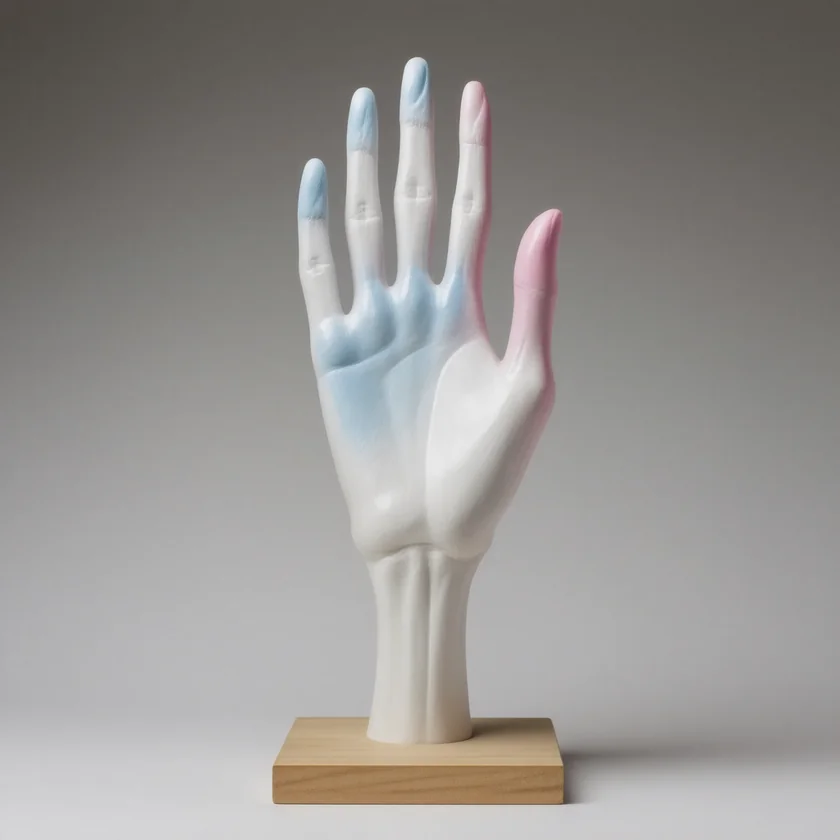
In 1862, a young Parisian physician named Maurice Raynaud described, in his doctoral thesis, a striking pattern he had observed in twenty-five patients: fingers and toes that turned ghostly white, then blue, then flushed red when exposed to cold or emotional stress. He called it “local asphyxia.” More than sixty years later, the British cardiologist Sir Thomas Lewis would dissect the underlying blood-vessel mechanism and draw the still-essential line between Raynaud's disease (the harmless, stand-alone form) and Raynaud's phenomenon (a warning sign of another disease). This page traces that story — from a single dissertation to modern calcium-channel-blocker therapy — and is careful to separate verified fact from the hypotheses these pioneers proposed.
Table of Contents
- Maurice Raynaud and the 1862 Thesis
- Inside the Dissertation: The Twenty-Five Cases
- “Local Asphyxia” and Raynaud's Own Hypothesis
- Reaching the English-Speaking World
- Thomas Lewis and the “Local Fault”
- Disease versus Phenomenon: Primary and Secondary
- The Twentieth-Century Mechanism and Modern Treatment
- From Eponym to “Raynaud's Phenomenon”
- Legacy and What Remains Uncertain
- Key Research Papers
- Connections
- Featured Videos
Maurice Raynaud and the 1862 Thesis
The condition takes its name from Auguste Gabriel Maurice Raynaud (1834–1881), a French physician trained in Paris during one of the most fertile periods in the history of clinical medicine. In 1862, as the dissertation required for his Doctor of Medicine degree, Raynaud submitted a monograph with the long descriptive title De l'asphyxie locale et de la gangrène symétrique des extrémités — in English, On Local Asphyxia and Symmetrical Gangrene of the Extremities. The thesis was published in Paris early that year. With it, Raynaud became one of the rare physicians to win lasting eponymous fame through a doctoral dissertation rather than a later career discovery.
What Raynaud described is the syndrome still recognized today: recurring, sharply demarcated episodes in which the fingers (and sometimes the toes, ears, nose, or lips) change color in response to cold temperatures or emotional stress. In the classic attack the affected digits first turn white (pallor, as the small arteries clamp shut and blood drains away), then blue (cyanosis, as the trapped, deoxygenated blood lingers), and finally red (rubor, the flush of returning blood as the vessels reopen). This white-blue-red sequence — not always complete in every person — remains the textbook signature of the condition.
It is worth being precise about Raynaud's place in the story. He was not the very first human being to notice cold-induced color changes in the fingers — such observations are scattered through earlier medical writing — but he was the first to gather a series of cases, describe the syndrome systematically, propose a unifying explanation, and give it a coherent clinical identity. That act of synthesis is why his name, and not an earlier one, became attached to the disorder.
Inside the Dissertation: The Twenty-Five Cases
Raynaud's 1862 thesis was built on a case series of twenty-five patients, the great majority of them — reported as twenty of the twenty-five — women. This female predominance, recorded in the very first description, has held up remarkably well: primary Raynaud's is still diagnosed far more often in women than in men, and it characteristically begins in the teens and twenties. Raynaud's clinical eye, in other words, captured an epidemiological pattern that would be confirmed again and again over the following century and a half.
His patients spanned a wide spectrum of severity. At the mild end were people who suffered nothing worse than uncomfortable, color-changing fingers in cold weather — the picture we would now call benign, primary Raynaud's. At the severe end were patients in whom the recurring loss of blood flow had progressed to symmetrical gangrene: actual tissue death at the tips of matching digits on both sides of the body. That symmetry struck Raynaud as a crucial clue. Ordinary gangrene from a blocked or injured artery is usually one-sided and random; gangrene appearing in mirror-image fashion on both hands pointed, he reasoned, to a systemic disturbance of the nervous control of the circulation rather than a local blockage.
By assembling these cases along a single continuum — from a passing chill in the fingers to frank gangrene — Raynaud made the argument that they were expressions of one underlying process operating at different intensities. That framing was his central intellectual contribution, and it is the reason a scattering of unconnected observations became, after 1862, a named disease.
“Local Asphyxia” and Raynaud's Own Hypothesis
The phrase Raynaud chose — local asphyxia — was both vivid and literal. Asphyxia normally means suffocation of the whole body for lack of oxygen; Raynaud applied it to a single finger, picturing a digit that was being locally starved of oxygenated blood while the rest of the body breathed freely. The blue, dusky color of the affected fingers — the same color seen in a person deprived of air — made the metaphor feel exact.
To explain why the vessels were clamping down, Raynaud advanced a hypothesis that must be flagged clearly as such: he proposed that the attacks were driven by an over-reactivity of the sympathetic nervous system — the part of the nervous system that, among many other jobs, tightens small arteries. In his view, an exaggerated nervous signal squeezed the digital arteries shut, producing the pallor, the cyanosis, and, in the worst cases, the gangrene. This was a reasonable and influential idea for its time, and it shaped thinking for decades. But it was an interpretation, not a proven mechanism, and — as the next sections describe — the picture turned out to be more complicated than a purely nervous-system fault.
Raynaud's instinct that the disorder was functional and vascular — a problem of how blood vessels behave rather than a structural blockage — was sound and durable. It was the specific claim about the sympathetic nerves as the sole cause that later investigators would test, challenge, and substantially revise.
Reaching the English-Speaking World
For a generation Raynaud's monograph circulated chiefly in French. Its entry into the broader Anglophone medical mainstream came in 1888, when the English physician Thomas Barlow (1845–1945) translated Raynaud's work — together with Raynaud's later writings on the subject — for the New Sydenham Society in London, an organization devoted to making important Continental medical texts available in English. The translated volume carried Raynaud's case descriptions and his theory to a wide new readership of British and American clinicians.
This translation matters historically because it set the stage for the next chapter. Once Raynaud's syndrome was widely known and discussed in English, it became a target for the rigorous, experimentally minded British physiology of the early twentieth century — and in particular for one of its most exacting practitioners, Thomas Lewis. Without the 1888 translation broadcasting the problem, the careful re-examination that followed might have come much later.
Thomas Lewis and the “Local Fault”
The single most important figure after Raynaud himself is Sir Thomas Lewis (1881–1945), the pioneering British cardiologist and clinical scientist. Working in the late 1920s and into the 1930s, Lewis subjected Raynaud's syndrome to the kind of controlled bedside experimentation he had brought to the study of the heartbeat and the skin's blood vessels. His findings, published around 1929–1930, reframed the disorder.
Lewis directly challenged Raynaud's hypothesis that the attacks were caused simply by an overactive sympathetic nervous system. Through experiments — including blocking the nerves to an affected hand and observing that attacks could still be provoked — he argued that the trouble lay closer to the vessels themselves. He proposed what he called a “local fault”: an abnormal, exaggerated sensitivity of the small digital arteries to cold, such that the vessels in the fingers over-constricted in response to a chill even when the nervous signals reaching them were normal. In Lewis's account the fingertip arteries were, in effect, hyper-reactive at the local level — the cold was acting on the vessel wall, not only through the nerves.
This shifted the center of gravity of the whole problem. Raynaud had located the disease primarily in the nerves; Lewis relocated much of it to the blood vessels of the digits. The modern understanding incorporates both insights — cold and stress, sympathetic nervous signaling, and a heightened local responsiveness of the digital arteries all contribute — but it was Lewis who established that a local vascular hyper-reactivity, not nervous overactivity alone, sat at the heart of the attacks.
Disease versus Phenomenon: Primary and Secondary
Lewis's careful observations did something else of lasting clinical value: they sharpened the distinction between two situations that look identical at the bedside but mean very different things. This is the difference between Raynaud's disease and Raynaud's phenomenon, and it is the most important practical idea on this page.
Raynaud's disease — now usually called primary Raynaud's — is the stand-alone, idiopathic form: the color changes occur on their own, with no underlying illness driving them. It is common, tends to begin young, runs in families, affects women far more often than men, and is generally benign; the fingers are a nuisance in the cold but the tissue is not destroyed. Raynaud's phenomenon in the strict sense — secondary Raynaud's — is the same color changes appearing as a symptom of another disease, most importantly the autoimmune connective-tissue diseases such as scleroderma (systemic sclerosis) and lupus. The secondary form tends to begin later in life, can be more severe, and carries a real risk of tissue damage. Here the cold fingers are a clue that something larger is going on.
The work of separating these two was advanced not only by Lewis but also by the American physicians Edgar Allen and George Brown, who in 1932 published an influential set of diagnostic criteria intended to distinguish primary Raynaud's disease from the secondary phenomenon. Their criteria — emphasizing features such as symmetry, the absence of an obvious underlying cause, and the lack of tissue destruction in the primary form — gave clinicians a practical checklist and framed the primary-versus-secondary question for much of the twentieth century. Modern criteria have since been refined, but the Allen–Brown framework is the historical root of how the distinction is made.
The Twentieth-Century Mechanism and Modern Treatment
Through the twentieth century the underlying mechanism came into clearer focus, building on Lewis's local-vessel insight. The attacks are now understood as episodes of vasospasm — an abrupt, exaggerated narrowing of the small arteries and arterioles supplying the fingers and toes — triggered by cold or stress. Several threads contribute: heightened activity of the body's vasoconstrictor signaling (including alpha-adrenergic receptors on the vessels, an echo of Raynaud's nervous-system idea), an imbalance between substances that constrict and substances that dilate blood vessels, and, in the secondary forms, actual damage or disease of the vessel wall and lining from the underlying autoimmune condition. The result is the same in every case: a temporary shutdown of blood flow that produces the white, then blue, then red sequence.
Effective drug treatment is a distinctly late-twentieth-century achievement. The breakthrough came with the calcium channel blockers — medicines that relax and widen blood vessels by blocking the calcium influx that makes the artery wall contract. Controlled trials in the 1980s established that the calcium channel blocker nifedipine reduced the frequency and severity of Raynaud's attacks, and this class of drugs — the dihydropyridine calcium channel blockers, with nifedipine and amlodipine the usual choices — remains the recognized first-line medication today, used when keeping warm and avoiding triggers are not enough. Later additions for more severe, usually secondary, disease have included other vasodilators, but the calcium channel blockers remain the cornerstone.
The arc is striking: Raynaud could describe the disease vividly and even reason correctly that it was a functional vascular disorder, but he and his nineteenth-century contemporaries had nothing to offer that reliably reopened the vessels. The mechanistic understanding of vasospasm and the drugs to counteract it both belong to the twentieth century — a reminder of how long the gap can be between naming a disease and being able to treat it.
From Eponym to “Raynaud's Phenomenon”
The naming of the condition has itself drifted over time, and the current convention is worth stating plainly. For most of its history the disorder was called Raynaud's disease, honoring its first describer. As the crucial split between the benign stand-alone form and the symptom-of-something-else form became central to good care, the umbrella term “Raynaud's phenomenon” came into favor, because it neutrally covers both the primary and the secondary situations without prejudging which one a given patient has.
In current usage, then, Raynaud's phenomenon is generally the preferred umbrella term, with primary Raynaud's phenomenon (the old “Raynaud's disease”) and secondary Raynaud's phenomenon (associated with scleroderma, lupus, and other conditions) naming the two branches beneath it. The older labels “Raynaud's disease” for the primary form and “Raynaud's syndrome” persist in everyday speech and in many patient resources, and they are not wrong — but the cleanest modern framing treats “phenomenon” as the parent term. This page keeps the familiar title “Raynaud's Disease” for continuity with how most people search for it, while making the primary-versus-secondary distinction explicit throughout.
Legacy and What Remains Uncertain
Maurice Raynaud died in 1881, at forty-seven, his name already permanently attached to the disorder he had characterized as a young graduate. His legacy is not that he got every detail right — his sympathetic-overactivity hypothesis was, as Lewis showed, only part of the picture — but that he saw the disease whole: he recognized that mild cold fingers and severe symmetrical gangrene were two ends of a single process, described it in careful clinical detail, and gave medicine a category it could study. That is the durable achievement.
The honest summary of the history is layered. The first description and the eponym belong to Raynaud (1862). The reframing of the cause toward a local vascular fault, and the sharpening of the all-important primary-versus-secondary distinction, belong to Thomas Lewis (around 1929–1930), with the early diagnostic criteria owed to Allen and Brown (1932). The mechanism (vasospasm) and the treatment (calcium channel blockers, from the 1980s) are twentieth-century work. And the disorder's true causes are still not fully settled — why the digital vessels of some people, especially young women, over-react so dramatically to cold remains an active research question, and the relationship between the benign primary form and the dangerous secondary forms is still being clarified. Where this page states a mechanism it reflects the prevailing scientific understanding; where the historical figures proposed an idea, it has been labeled as their hypothesis rather than settled fact.
Key Research Papers
The references below combine peer-reviewed historical and clinical reviews of Raynaud's phenomenon with curated PubMed topic-search links into the historical and mechanistic literature. Raynaud's original 1862 thesis (De l'asphyxie locale et de la gangrène symétrique des extrémités) and Thomas Barlow's 1888 New Sydenham Society translation are named in the article as historical primary sources rather than as modern citations. Each link opens in a new tab.
- Fava A, Boin F. Historical Perspective of Raynaud's Phenomenon. In: Raynaud's Phenomenon: A Guide to Pathogenesis and Treatment. Springer; 2015. — doi:10.1007/978-1-4939-1526-2_1
- Maricq HR, et al. (overview of the disease–phenomenon distinction and classification). Rheumatic Disease Clinics of North America. — PubMed: Raynaud primary vs secondary classification
- Smith CR, et al. (StatPearls) Raynaud Disease. StatPearls [Internet]. NCBI Bookshelf. — NCBI Bookshelf: Raynaud Disease
- Smith PJW, et al. Effect of the calcium channel blocker nifedipine on Raynaud's phenomenon: a controlled double-blind trial. Annals of Internal Medicine. 1980s. — PubMed PMID: 6376801
- Rirash F, et al. Calcium channel blockers for primary and secondary Raynaud's phenomenon. Cochrane Database of Systematic Reviews. 2017. — PubMed PMID: 29237099
- Maurice Raynaud (1834–1881) — biography and the 1862 doctoral thesis (historical accounts). — PubMed: Maurice Raynaud 1862 local asphyxia history
- Thomas Lewis and the “local fault” of digital arteries in Raynaud's disease (historical and physiological accounts). — PubMed: Thomas Lewis Raynaud local fault
- Pathophysiology of vasospasm in Raynaud's phenomenon. — PubMed: Raynaud vasospasm pathophysiology
- Secondary Raynaud's phenomenon in systemic sclerosis (scleroderma). — PubMed: Raynaud and systemic sclerosis
- Raynaud's phenomenon in systemic lupus erythematosus. — PubMed: Raynaud and lupus
- Allen EV, Brown GE — 1932 diagnostic criteria for Raynaud's disease (historical references). — PubMed: Allen and Brown Raynaud criteria
- Nifedipine and dihydropyridine calcium channel blockers as first-line therapy for Raynaud's phenomenon. — PubMed: nifedipine first-line Raynaud treatment
- Epidemiology of Raynaud's phenomenon — female predominance and young age of onset. — PubMed: Raynaud epidemiology and prevalence
External Authoritative Resources
- StatPearls (NCBI Bookshelf) — Raynaud Disease
- NIAMS (NIH) — Raynaud's Phenomenon
- PubMed — All research on the history of Raynaud's phenomenon. — Search PubMed
Connections
- Rheumatology
- Raynaud's Disease
- Lupus
- Sjogren's Syndrome
- Arthritis
- Ehlers-Danlos Syndrome
- Fibromyalgia
- All Conditions