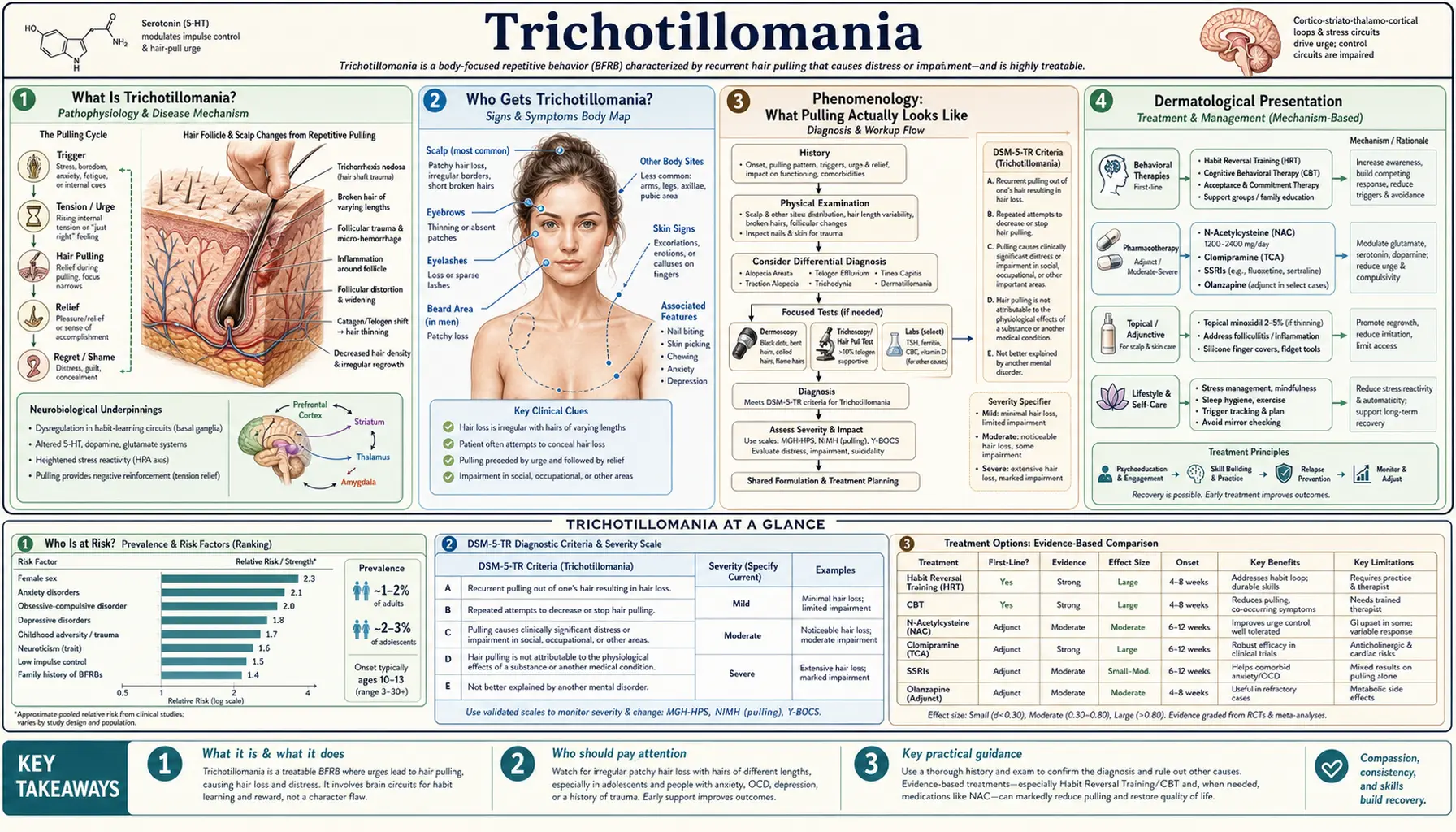
Trichotillomania
Trichotillomania — also called Hair-Pulling Disorder — is a mental health condition in which a person repeatedly pulls out their own hair, causing noticeable hair loss and significant distress. It belongs to the DSM-5 category of Obsessive-Compulsive and Related Disorders, a family of conditions that share the feature of repetitive, difficult-to-control behaviors. Trichotillomania affects millions of people of all ages, yet most go undiagnosed for years because of shame, concealment, and the mistaken belief that it is simply a bad habit. It is not. It is a real, treatable psychiatric condition — and effective help exists.
Table of Contents
- What Is Trichotillomania?
- Who Gets Trichotillomania?
- Phenomenology: What Pulling Actually Looks Like
- Dermatological Presentation
- Rapunzel Syndrome: When Hair Eating Becomes Dangerous
- Co-occurring Conditions
- Treatment — Behavioral Approaches (First-Line)
- Treatment — Medications
- Living with Trichotillomania
- Key Research Papers
- Connections
- Featured Videos
What Is Trichotillomania?
Trichotillomania (trik-oh-till-oh-MAY-nee-uh) is a condition defined by recurrent, compulsive urges to pull out hair — from the scalp, eyebrows, eyelashes, beard, pubic area, or elsewhere on the body. The pulling results in noticeable hair loss and causes real distress or interferes with daily life. The scalp is the most commonly targeted site, where pulling creates patchy, irregularly shaped bald areas that are often partially hidden with hats, wigs, or creative hairstyling.
The DSM-5 (the standard diagnostic manual used in the United States) classifies trichotillomania under Obsessive-Compulsive and Related Disorders, alongside OCD, Body Dysmorphic Disorder, Hoarding Disorder, and Excoriation (skin-picking) Disorder. What these conditions share is repetitive behavior that is difficult to stop — even when the person wants to — driven by internal tension or urges rather than external demands.
To meet the formal diagnosis, four criteria must be present: (1) recurrent hair pulling that causes hair loss; (2) repeated attempts to decrease or stop pulling; (3) the pulling causes clinically significant distress or impairs social, occupational, or other functioning; (4) the pulling is not explained by another medical condition or substance use, and is not better explained by another psychiatric disorder.
One important and underrecognized complication is trichophagia — the act of eating or mouthing the pulled hair. This occurs in an estimated 20–30% of people with trichotillomania. While seemingly minor, trichophagia can lead to a dangerous condition called Rapunzel Syndrome (see below), in which swallowed hair accumulates in the stomach and forms a large matted mass called a trichobezoar. This is a surgical emergency. For this reason, clinicians should always ask about trichophagia directly — patients rarely volunteer this information on their own.
Who Gets Trichotillomania?
Trichotillomania is more common than most people realize. Lifetime prevalence estimates range from 0.5% to 2% of the general population, meaning somewhere between 1 in 50 and 1 in 200 people will experience it at some point in their lives. In the United States alone, that translates to millions of individuals.
One of the most striking features of trichotillomania is its strong female predominance. In clinical samples — people who actually seek treatment — the ratio of women to men is roughly 10 to 1. Researchers believe this reflects a true sex difference in who develops the condition, not simply a difference in who asks for help. Hormonal factors, differences in stress response systems, and socialization around emotional regulation are all proposed contributors, though the biology is not fully understood.
Onset tends to cluster in two distinct windows. The first is childhood, typically ages 5–8. Hair pulling that begins in young children is often mild, may affect only one area (commonly the scalp or eyelashes), and frequently resolves on its own without formal treatment as the child matures. The second, more clinically significant window is adolescence and young adulthood — often around puberty. This later-onset form tends to be more persistent, more widespread across body sites, and much harder to treat. Without intervention, it can last for decades.
Many adults with trichotillomania have lived with the condition since their teens without ever receiving a diagnosis. They may have assumed it was a nervous habit or a personal weakness, not knowing that it has a name, a biological basis, and effective treatments. The average delay between symptom onset and first treatment is estimated at more than a decade — a sobering reminder of how underrecognized this condition remains.
Phenomenology: What Pulling Actually Looks Like
Understanding how pulling happens — not just that it happens — is essential both for accurate diagnosis and for choosing the right treatment approach. Researchers have identified two primary pulling styles, and most people with trichotillomania engage in both at different times.
Automatic pulling is estimated to account for 40–75% of pulling episodes in most individuals. This type of pulling happens below the level of full conscious awareness — the person is absorbed in another activity (reading, watching television, working at a computer, talking on the phone) and pulls without deliberately deciding to do so. They may not even notice until significant hair has been removed. It is sometimes called "habit" pulling and closely resembles other body-focused repetitive behaviors like nail biting. Because it occurs outside of awareness, people often dramatically underestimate how often they pull.
Focused pulling, by contrast, is deliberate and tension-driven. The person feels a mounting internal urge — a sense of anxiety, discomfort, or restlessness — and pulls hair intentionally to relieve that tension. Focused pulling is often ritualistic: the person may search specifically for a particular type of hair (coarse, gray, thick, or hair with a specific texture at the root), and the pulling may be accompanied by specific motions such as running the pulled root across the lips, stroking it with the fingers, or biting the root bulb. This sensory engagement — tactile and sometimes oral — is part of what makes the behavior self-reinforcing in the moment.
In both types, the experience follows a characteristic urge-relief cycle: a building tension or discomfort → the act of pulling → a brief moment of relief, release, or even pleasure → guilt, shame, or regret shortly after. Critically, the pulling often does not feel ego-dystonic (disturbing or unwanted) in the moment the way OCD compulsions do. In the moment of pulling, it can feel satisfying — even pleasurable. This is one reason willpower alone rarely works as a treatment strategy. The behavior is neurobiologically reinforced.
Some individuals also engage in mixed pulling — shifting between automatic and focused styles depending on their emotional state, environment, or time of day. Stress and boredom are the most common triggers for both types, though the behavioral pathways differ.
Dermatological Presentation
Trichotillomania most commonly presents as irregular, patchy alopecia (hair loss) on the scalp, most often affecting the vertex (top) and crown. What sets trichotillomania apart from other causes of patchy hair loss — most importantly alopecia areata — are several distinctive clinical features.
The edges of trichotillomania-related bald patches are typically irregular and geometric, reflecting the mechanical pattern of pulling. In contrast, alopecia areata produces smooth, round or oval patches with well-defined borders and a characteristic finding called "exclamation-point hairs" (short hairs that taper toward the base near the scalp). In trichotillomania, hairs of many different lengths are present within the patches because they are broken or pulled at different stages of growth — not lost from the root uniformly as in areata.
Dermoscopy (a magnified skin examination tool) reveals characteristic patterns in trichotillomania: broken hairs at varying lengths, coiled or "flame" hairs, black dots where follicles have been broken flush with the scalp, and preserved vellus (fine, unpigmented) hairs. This last feature is important — the thin vellus hairs are hard to grasp and tend to survive even in actively pulled areas.
When the clinical picture is ambiguous, a skin biopsy can resolve the diagnosis. In trichotillomania, pathology shows empty hair follicles (the telogen germinal unit), trichomalacia (a distorted, incompletely keratinized hair shaft caused by repeated trauma), and pigment casts within follicular canals — all without the inflammatory infiltrate that characterizes alopecia areata (which shows a "swarm of bees" pattern of peribulbar lymphocytes).
Beyond the scalp, eyebrows and eyelashes are frequently involved. Complete or near-complete loss of eyebrows or eyelashes — in the absence of inflammatory skin disease — should raise clinical suspicion for trichotillomania, particularly when other causes have been excluded. Dermatologists are often the first clinicians to encounter these patients, making dermatology-psychiatry collaboration important for timely diagnosis.
Rapunzel Syndrome: When Hair Eating Becomes Dangerous
In the original fairy tale, Rapunzel's hair was her lifeline — she used it to help others climb to safety. In medicine, Rapunzel Syndrome carries a darker meaning: it describes a life-threatening complication of swallowing pulled hair, named for the tale's famous image of cascading locks.
Trichophagia — swallowing or mouthing pulled hair — occurs in an estimated 20–30% of people with trichotillomania. The behavior is often secretive and deeply shameful; patients frequently do not disclose it without being specifically asked. Clinicians should include a direct, non-judgmental question about trichophagia in any evaluation of hair pulling: "Do you ever put the hair in your mouth, chew it, or swallow it?"
Human hair is composed of keratin, a protein that cannot be broken down by human digestive enzymes. Swallowed hair does not pass through the gastrointestinal system normally. Instead, it accumulates in the stomach, becoming entangled with food debris and mucus. Over months to years, this mass compresses and matures into a trichobezoar — a hard, dark, matted mass of hair that takes the shape of the stomach.
Rapunzel Syndrome is the specific subtype in which the trichobezoar extends beyond the stomach through the pylorus and into the small intestine, forming a "tail" — resembling the silhouette of Rapunzel's braid. The tail can extend as far as the cecum (the first part of the large intestine).
Symptoms include chronic abdominal pain, nausea, early satiety (feeling full after eating only a small amount), weight loss, a palpable abdominal mass, and ultimately bowel obstruction. If untreated, the bezoar can cause pressure necrosis of the stomach or intestinal wall, leading to perforation, peritonitis, and death. This is a surgical emergency that requires operative removal of the bezoar.
Because trichophagia is underreported and the progression from hair swallowing to symptomatic bezoar can take years, the diagnosis is often delayed. Any patient with unexplained upper abdominal symptoms, early satiety, or a palpable mass — particularly a young woman with known or suspected trichotillomania — should be evaluated with abdominal imaging. Upper endoscopy can visualize the bezoar directly; CT scanning defines its extent.
Co-occurring Conditions
Trichotillomania rarely travels alone. The majority of people with this condition have at least one co-occurring psychiatric condition, and many have several. Recognizing these co-occurring disorders is essential because they influence treatment choice, treatment response, and overall prognosis.
OCD (Obsessive-Compulsive Disorder) co-occurs in approximately 30% of people with trichotillomania. The two share a diagnostic category (OCD and Related Disorders) and some overlapping neurobiology, but they differ in important ways: OCD compulsions are driven primarily by obsessional anxiety about consequences, and the behavior is experienced as unwanted. Trichotillomania pulling, by contrast, is often partially pleasurable in the moment — more driven by sensory satisfaction or urge relief than by fear.
Major depressive disorder and generalized anxiety disorder are each highly prevalent, affecting roughly half of clinical samples with trichotillomania. These conditions may be primary (predating and driving the pulling) or secondary (developing in response to the shame, social withdrawal, and functional impairment that trichotillomania produces). Both directions of causation can exist simultaneously.
Excoriation Disorder (compulsive skin picking) and trichotillomania belong to a cluster known as Body-Focused Repetitive Behaviors (BFRBs). The two conditions share similar phenomenology (urge-relief cycles, automatic and focused subtypes, shame and concealment), similar demographics (female predominance), similar treatment approaches (HRT is first-line for both), and significant co-occurrence — they frequently appear together in the same individual. Nail biting (onychophagia) and cheek biting also belong to this cluster.
The emotional weight of living with visible, socially noticeable hair loss — and the relentless effort to conceal it — generates shame, social avoidance, and reduced quality of life that are themselves major sources of suffering. Many individuals with trichotillomania avoid swimming, hairstylists, intimate relationships, job interviews, or any situation that might expose their hair loss. This secondary impairment compounds the direct effects of the condition and should be explicitly addressed in treatment.
Treatment — Behavioral Approaches (First-Line)
Behavioral therapy is the most effective treatment for trichotillomania — more effective than medication alone for most people, and particularly important because it teaches skills that address the root mechanism of the pulling rather than simply suppressing it pharmacologically. The goal of behavioral treatment is to break the urge-pull-relief cycle by increasing awareness and substituting a competing, non-harmful behavior.
Habit Reversal Training (HRT) is the gold-standard behavioral approach, with the strongest evidence base for trichotillomania. HRT has three core components:
- Awareness Training: Many people pull automatically, without noticing. The first step is teaching people to recognize — in real time — when they are about to pull or are already pulling. This involves self-monitoring (keeping a log of when and where pulling occurs), identifying warning signs (specific postures, locations, emotional states), and building a clear picture of individual triggers. Common triggers include sitting at a desk, lying in bed, watching television, talking on the phone, or feeling bored, anxious, or stressed.
- Competing Response Training: Once the urge to pull is identified, the patient practices a competing physical behavior that makes pulling impossible. The most widely taught competing response is making a fist with the dominant hand and holding it for one minute — or until the urge passes. The competing response must be physically incompatible with pulling, inconspicuous in public, and easy to remember. Other examples include pressing palms flat on a table, gripping a pen, or placing hands in pockets.
- Social Support Component: A trusted person (partner, parent, friend) is taught to gently prompt the patient when they observe pulling behavior — without criticism or nagging — and to provide encouragement for successful use of the competing response.
HRT produces approximately a 50% reduction in pulling in clinical trials, making it the single most evidence-supported intervention. It requires practice and perseverance — the skill does not become automatic immediately — but it can be learned in as few as 8–12 sessions with a trained therapist.
Cognitive-Behavioral Therapy (CBT) adapted for trichotillomania adds components that address the thoughts, beliefs, and emotional patterns that sustain pulling. This may include work on shame and self-compassion, addressing perfectionism or emotional avoidance, and restructuring unhelpful thoughts (e.g., "I will never be able to stop" or "I am disgusting"). For many patients, a combination of HRT and CBT elements is more comprehensive than either alone.
Stimulus control strategies are practical environmental modifications that reduce access to pulling opportunities. Examples include wearing gloves or bandanas at home, keeping hair cut shorter (less to grab), wearing hair in a bun or braid (reducing access to loose strands), sitting on hands while watching television, or rearranging furniture so that the "automatic pulling chair" is no longer in its habitual position. These are most useful as supplements to HRT rather than standalone approaches.
Smartphone apps designed for BFRB awareness — such as habit-tracking apps or those specifically built for trichotillomania — can support awareness training between sessions, providing urge logs, competing response reminders, and streak tracking. They should be viewed as helpful adjuncts to professional treatment, not replacements.
Treatment — Medications
No medication has received FDA approval specifically for trichotillomania as of 2024. This is an important fact to communicate to patients — not to discourage medication use, but to set realistic expectations and explain that the evidence base is more limited than for OCD or depression. That said, several medications have demonstrated meaningful benefit in randomized controlled trials and are widely used in clinical practice.
N-Acetylcysteine (NAC) is the most evidence-supported pharmacological treatment for trichotillomania. NAC is a glutamate-modulating supplement that restores balance in the brain's glutamate system — the same system implicated in compulsive and repetitive behaviors more broadly. A landmark double-blind, placebo-controlled trial by Grant and colleagues (2009) demonstrated significant reduction in pulling severity with NAC at doses of 1,200–2,400 mg per day. NAC is generally well-tolerated; the main side effects are gastrointestinal (nausea, stomach upset), which can be minimized by taking it with food. It is available over-the-counter as a supplement. Response typically develops over 9–12 weeks of consistent use.
Clomipramine (brand name Anafranil) is a tricyclic antidepressant with strong serotonin-reuptake inhibition that has specific evidence in trichotillomania from controlled trials, most notably the landmark Swedo et al. study. Other serotonin reuptake inhibitors (SSRIs) such as fluoxetine have shown less consistent benefit for trichotillomania specifically, despite their effectiveness in OCD — a reminder that these two conditions, while related, have distinct pharmacological profiles. Clomipramine is generally second-line due to its side effect burden (dry mouth, constipation, sedation, cardiac effects at higher doses).
Olanzapine, a second-generation antipsychotic, has been used as an augmentation strategy for patients who have partial response to first-line treatments. It is not a first-choice agent given its metabolic side effects (weight gain, glucose dysregulation), but it may benefit patients whose pulling is accompanied by significant agitation or impulsivity.
Combination treatment — medication alongside HRT or CBT — generally produces better outcomes than either approach alone. The behavioral therapy provides active coping skills; the medication may reduce the intensity of urges to a level where those skills become more usable. For patients with significant anxiety or depression alongside trichotillomania, treating the comorbid condition often reduces pulling severity as well, since emotional dysregulation is a key trigger.
When discussing medications with patients, it is worth emphasizing that these are tools to make behavioral work more tractable — not cures in themselves. The goal is not to suppress pulling indefinitely with a pill, but to reduce urge intensity enough that the patient can build lasting behavioral skills.
Living with Trichotillomania
One of the most healing things a person with trichotillomania can hear is this: you are not alone, this is not a character flaw, and it is treatable. Millions of people live with body-focused repetitive behaviors, and the shame and secrecy that often surround trichotillomania — frequently maintained for years or decades — can be more burdensome than the pulling itself.
Normalizing the experience does not mean minimizing it. It means accurately naming it as a medical condition with biological underpinnings, a recognized diagnostic category, and evidence-based treatments — the same framework we apply to depression, anxiety, or diabetes. Hair pulling is not a bad habit that willpower can fix. It is a condition that responds to the right treatment, just as those other conditions do.
Practical concealment tools — wigs, hairpieces, head scarves, microblading for drawn-on eyebrows, semi-permanent eyelash extensions — are legitimate, valid coping strategies that deserve full clinical validation, not subtle discouragement. For many patients, these tools allow participation in school, work, and social life that would otherwise be avoided. Clinicians should ask about them, support them, and help patients access them. Self-acceptance and practical adaptation are not mutually exclusive goals.
Disclosure — deciding when and how to tell partners, family members, employers, or healthcare providers about trichotillomania — is a deeply personal process. Therapy can help patients think through what level of disclosure feels safe, how to explain the condition in plain language, and how to respond to questions or misunderstanding. Some patients find that disclosure to a partner or trusted friend is a significant relief; others prefer to keep it private. Both choices are valid.
The TLC Foundation for Body-Focused Repetitive Behaviors (bfrb.org) is the premier patient organization for people with trichotillomania, excoriation disorder, and related conditions. Their website provides therapist directories (filtering for BFRB-trained clinicians), peer support communities, educational materials, and resources for families and schools. The TLC Foundation also funds research and hosts an annual conference. Connecting patients with this organization is one of the highest-value referrals a clinician can make.
For children and adolescents, the school environment introduces unique challenges. Peers may notice pulling or bald patches; teachers may misinterpret repetitive behavior as inattention. A brief, factual school accommodation letter from a treating clinician — requesting a discreet signal system with the teacher, permission to wear a hat, or reduced scrutiny around certain behaviors — can make school markedly more manageable. Educating at least one trusted teacher or school counselor also helps create a supportive environment rather than an inadvertently shaming one.
Key Research Papers
The following peer-reviewed publications represent foundational and landmark research in the understanding and treatment of trichotillomania. Citations link directly to PubMed records.
- Christenson GA, Pyle RL, Mitchell JE. (1991). Estimated lifetime prevalence of trichotillomania in college students. J Clin Psychiatry. Search PubMed — Early prevalence study establishing that trichotillomania is far more common than clinical samples suggested; lifetime prevalence 1–2% in college populations.
- Woods DW, Flessner CA, Franklin ME, et al. (2006). The Trichotillomania Impact Project (TIP): exploring phenomenology, functional impairment, and treatment utilization. J Clin Psychiatry. Search PubMed — DOI: 10.4088/JCP.v67n1207 — Large survey of 1,697 adults with trichotillomania documenting phenomenology, functional impairment, and the significant gap between prevalence and treatment uptake.
- Grant JE, Odlaug BL. (2008). Clinical characteristics of trichotillomania with trichophagia. Compr Psychiatry. Search PubMed — DOI: 10.1016/j.comppsych.2008.05.002 — Characterized the 18–20% of trichotillomania patients who engage in trichophagia; identified this subgroup as having greater symptom severity and functional impairment.
- Azrin NH, Nunn RG, Frantz SE. (1980). Treatment of hairpulling (trichotillomania): a comparative study of habit reversal and negative practice training. J Behav Ther Exp Psychiatry. Search PubMed — DOI: 10.1016/0005-7916(80)90046-8 — Seminal study establishing Habit Reversal Training (HRT) as an effective treatment for trichotillomania; the HRT protocol described here became the foundation for all subsequent behavioral approaches.
- Grant JE, Odlaug BL, Kim SW. (2009). N-acetylcysteine, a glutamate modulator, in the treatment of trichotillomania: a double-blind, placebo-controlled study. Arch Gen Psychiatry. PMID: 19581567 — DOI: 10.1001/archgenpsychiatry.2009.60 — Landmark RCT demonstrating that NAC (1,200–2,400 mg/day) significantly reduced pulling severity compared to placebo; introduced glutamate modulation as a therapeutic target.
- Swedo SE, Lenane MC, Leonard HL. (1993). Long-term treatment of trichotillomania (hair pulling). N Engl J Med. Search PubMed — DOI: 10.1056/NEJM199308053290618 — Classic long-term follow-up study showing that clomipramine (a tricyclic with strong serotonergic effects) outperformed desipramine in trichotillomania; established serotonin system involvement.
- Flessner CA, Conelea CA, Woods DW, Franklin ME, Keuthen NJ, Cashin SE. (2008). Styles of pulling in trichotillomania: exploring differences in symptom severity, phenomenology, and functional impact. Behav Res Ther. Search PubMed — DOI: 10.1016/j.brat.2007.07.009 — Validated the distinction between automatic and focused pulling styles and demonstrated that these styles have different clinical implications for severity and treatment targeting.
- Lochner C, Seedat S, Niehaus DJ, Stein DJ. (2006). Topiramate in the treatment of trichotillomania: an open-label pilot study. Int Clin Psychopharmacol. Search PubMed — DOI: 10.1097/01.yic.0000199453.34596.8f — Open-label pilot demonstrating potential benefit of topiramate (an anticonvulsant with glutamatergic and GABAergic activity) in trichotillomania; supports the glutamate modulation hypothesis.
- Tay YK, Levy ML, Metry DW. (2004). Trichotillomania in childhood: case series and review. Pediatrics. Search PubMed — DOI: 10.1542/peds.113.5.e494 — Pediatric case series with review; highlights the benign, often self-limited nature of childhood-onset trichotillomania and the importance of distinguishing it from other causes of childhood alopecia.
- Odlaug BL, Grant JE. (2008). Trichotillomania and pathologic skin picking: clinical comparison with an examination of comorbidity. Ann Clin Psychiatry. Search PubMed — Systematic comparison of trichotillomania and excoriation disorder highlighting their shared phenomenological features, demographic patterns, and high co-occurrence rate within the BFRB cluster.
- Diefenbach GJ, Tolin DF, Hannan S, Crocetto J, Worhunsky P. (2005). Trichotillomania: impact on psychosocial functioning and quality of life. Behav Res Ther. Search PubMed — DOI: 10.1016/j.brat.2004.07.003 — Quantified the quality-of-life burden of trichotillomania including social isolation, work impairment, and emotional distress; demonstrated impairment comparable to other serious psychiatric disorders.
- van Minnen A, Hoogduin KA, Keijsers GP, Hellenbrand I, Hendriks GJ. (2003). Treatment of trichotillomania with behavioral therapy or fluoxetine: a randomized, waiting-list controlled study. Arch Gen Psychiatry. Search PubMed — DOI: 10.1001/archpsyc.60.5.517 — Head-to-head RCT comparing behavioral therapy versus fluoxetine; behavioral therapy was significantly superior, reinforcing HRT as the first-line treatment of choice over medication.
Additional research: PubMed: trichotillomania treatment PubMed: hair pulling disorder HRT
Connections
- Psychiatry
- Obsessive-Compulsive Disorder
- Body Dysmorphic Disorder
- Hoarding Disorder
- Anxiety Disorders
- Depression
- Addiction
- NAC for Mental Health: OCD & Trichotillomania — the Grant 2009 trial and the glutamate-homeostasis mechanism behind it.