Anxiety: History and Discovery
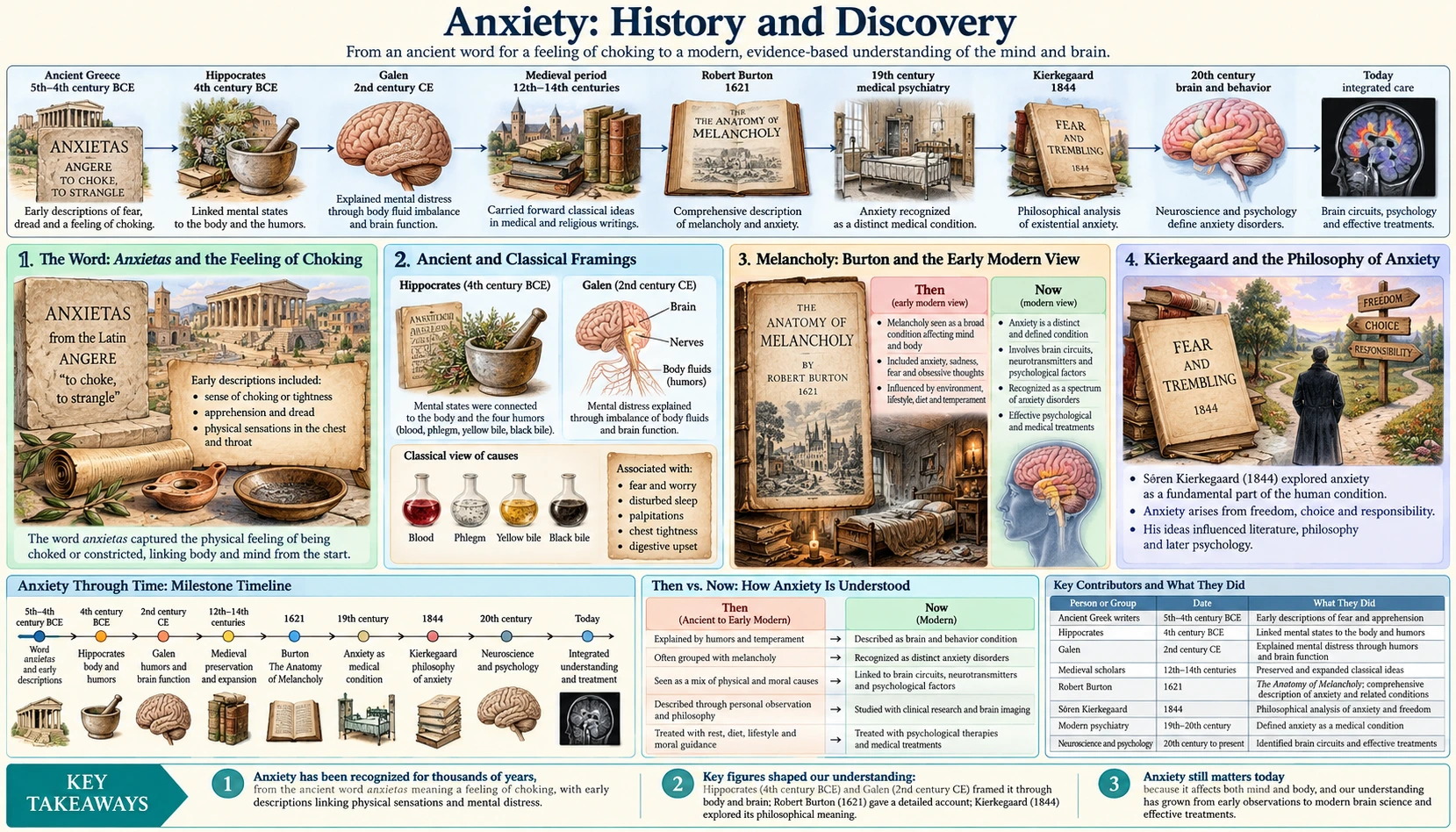
Anxiety is not a modern invention. The clenched chest, the racing heart, the dread of a danger that has no name — people have felt these sensations, and tried to describe them, for as long as there have been words for feeling. What changed over the centuries was not the experience but the explanation: a Stoic philosopher counselling against needless worry, a seventeenth-century scholar cataloguing “fear and sorrow without a just cause,” a Danish philosopher naming the “dizziness of freedom,” a Viennese neurologist carving out a distinct “anxiety neurosis,” and finally a modern psychiatry that split that single idea into named, treatable disorders and met them with talking therapies and medicines. This page traces that long, compassionate journey — from an ancient feeling in the throat to a twenty-first-century understanding — and is careful to mark where solid history ends and unproven theory begins. Anxiety is common, it is human, and it is treatable; understanding where our ideas about it came from is part of taking the fear out of the fear.
Table of Contents
- The Word: Anxietas and the Feeling of Choking
- Ancient and Classical Framings
- Melancholy: Burton and the Early Modern View
- Kierkegaard and the Philosophy of Anxiety
- Freud and the Birth of “Anxiety Neurosis” (1895)
- The Drug Era: Miltown, Librium, and diazepam
- DSM-III (1980) and the Modern Anxiety Disorders
- Talking Cures: Exposure and Cognitive Therapy
- The “Chemical Imbalance” Story, Told Honestly
- Key Research Papers
- Connections
- Featured Videos
The Word: Anxietas and the Feeling of Choking
The history of anxiety is written into the word itself. English anxiety descends from the Latin anxietas (anguish, solicitude, uneasiness of mind), which in turn comes from anxius (“uneasy, troubled in mind”). The deeper root is the Latin verb angere (also anguere), meaning literally “to choke, squeeze, throttle” and figuratively “to torment or cause distress.” Trace it back further and you reach the reconstructed Proto-Indo-European root *angh-, meaning “tight, painfully constricted, painful” the same root that gives us anguish, anger, and the German Angst, as well as the Latin angina (a choking, constricting chest pain).
This is a remarkable piece of buried wisdom. Long before anyone could measure a heart rate or describe the autonomic nervous system, the people who built these words located anxiety exactly where sufferers still feel it most: as a tightening — in the throat, in the chest, in the breath. The same image recurs across unrelated languages; the Serbo-Croatian word for anxiety, tjeskoba, literally means “tightness, narrowness.” The metaphor of being squeezed or choked by an unseen pressure is one humanity arrived at again and again, independently, simply by paying attention to the body.
The English word “anxiety” entered the language in the 1520s, meaning apprehension over some danger or misfortune and a restless dread of an uncertain evil; from the 1660s it was sometimes treated as a recognizable pathological condition, and its specifically psychiatric use is generally dated to the early twentieth century. The journey of the word — from a verb meaning “to choke” to a clinical diagnosis — mirrors the journey of the idea, from raw bodily sensation to medical category, that the rest of this page describes.
Ancient and Classical Framings
The ancient world did not have a single word that maps cleanly onto our “anxiety disorder,” but it knew the experience intimately and wrote about it constantly. Greek and Roman thinkers, especially the Stoic philosophers — Seneca, Epictetus, and later Marcus Aurelius — devoted a great deal of attention to worry, fear of the future, and distress over things outside one’s control. Seneca’s letters return repeatedly to the observation that we suffer more in imagination than in reality, and that much of human torment comes from dread of events that may never arrive. Read today, these passages can sound startlingly like a modern self-help reflection on catastrophic thinking — which is one reason cognitive therapists sometimes cite the Stoics as distant intellectual ancestors. It is important to be precise, though: the Stoics offered a philosophy of how to live, not a medical diagnosis, and we should not retroactively label them as describing a clinical disorder.
In the medical tradition that ran from Hippocrates through the Roman physician Galen, anxious states were often folded into the vast, shifting category of melancholia. In humoral medicine, an excess of “black bile” was thought to produce a temperament marked by fear and sadness; persistent, groundless fear was understood as one of melancholia’s defining features. The picture was not uniform, though: as a modern history of the subject points out, some Greek and Latin physicians and philosophers did distinguish anxiety from other kinds of negative feeling and identified it as a medical disorder. What did not last was a separate diagnosis. The humoral framework dominated Western medicine for the better part of two thousand years, and between classical antiquity and the late nineteenth century anxiety was not classified as an illness of its own — it stayed entangled with what we would now call depression, much as “fear and sadness” were paired together as the twin signatures of the melancholic state.
The takeaway from the classical era is twofold. First, the feeling of anxiety is genuinely ancient and universal; it is not a by-product of modern life, smartphones, or the news cycle, even if those can certainly inflame it. Second, the way it was explained — as a philosophical problem of judgment, or as an imbalance of bodily humors — was entirely different from how we explain it now. Keeping those two things separate, the timeless experience and the time-bound theory, is the central discipline of reading this history honestly.
Melancholy: Burton and the Early Modern View
The single most famous early-modern treatment of the anxious mind is Robert Burton’s The Anatomy of Melancholy, first published in 1621. Burton, an Oxford scholar and clergyman, produced an enormous, sprawling, endlessly digressive book — he revised and expanded it across the rest of his life — that attempted to catalogue everything then known about melancholy: its causes, its symptoms, and its cures. Crucially for the history of anxiety, Burton defined melancholy in terms that center on causeless fear. He worked from the common definition of it as “a kind of dotage without a fever, having for his ordinary companions, fear and sadness, without any apparent occasion,” and explained that the words “without a cause” were added to set it apart “from all other ordinary passions of fear and sorrow.” That phrase — fear without an obvious cause — is very close to how a clinician today might describe pathological anxiety as distinct from ordinary, justified fear.
Burton wrote within the humoral tradition, so his explanations and remedies belong firmly to the seventeenth century rather than to modern medicine. But two things make his work a landmark in this story. The first is descriptive: by insisting that the hallmark of the disorder was the excessive and unreasonable quality of the fear and sorrow — emotions out of all proportion to any real threat — Burton was isolating exactly the feature that still separates an anxiety disorder from healthy worry. The second is humane: Burton wrote with unusual compassion and even humor about mental suffering, treating it as a real and serious affliction deserving of careful study, at a time when such suffering was often dismissed or moralized.
The early-modern period also kept alive the entanglement of anxiety and depression under the melancholy umbrella, a knot that would not be formally untied until the twentieth century. When you read Burton, you are watching a thoughtful observer circle around the concept of an anxiety disorder — naming its core feature, describing its torments — centuries before the vocabulary existed to give it a separate, modern name. He named the symptom with precision; the category would have to wait.
Kierkegaard and the Philosophy of Anxiety
In 1844 the Danish philosopher Søren Kierkegaard published Begrebet Angest, known in English as The Concept of Anxiety (sometimes translated The Concept of Dread), under the pseudonym Vigilius Haufniensis. It is essential to be clear about what this book is and is not: it is a work of philosophy and theology, not a medical text. Kierkegaard was not describing a clinical disorder, prescribing a treatment, or studying patients. He was exploring anxiety as a fundamental feature of being human.
Kierkegaard’s central and enduring image is that anxiety is the “dizziness of freedom.” Where ordinary fear has a definite object — you are afraid of a specific thing — Kierkegaard’s angest is objectless: it is the vertigo a person feels when they look into the open space of their own possibilities and realize they are free to choose. For Kierkegaard this is not a malfunction to be cured but an inescapable condition of a self-aware creature confronting its own future. This distinction — between fear that has an object and a more diffuse, objectless dread — would later echo, in a very different key, through clinical descriptions that separate specific phobias from generalized, free-floating anxiety.
Kierkegaard’s influence runs less through psychiatry than through twentieth-century existential philosophy and, later, existential and humanistic psychotherapy, where anxiety is treated not only as a symptom to be relieved but sometimes as a meaningful signal about freedom, responsibility, and mortality. Including him here is a reminder that the history of anxiety is not only a medical history. For much of the Western tradition, anxiety has been a subject for philosophers and theologians as much as for physicians — and the experience itself has always been larger than any single diagnosis can contain.
Freud and the Birth of “Anxiety Neurosis” (1895)
The decisive move from anxiety-as-philosophy and anxiety-as-melancholy toward anxiety-as-a-distinct-clinical-entity belongs to Sigmund Freud. In an 1895 paper bearing the unwieldy but precise title “On the Grounds for Detaching a Particular Syndrome from Neurasthenia under the Description ‘Anxiety Neurosis’” (written in 1894 and published in January 1895), Freud argued that a cluster of symptoms then lumped under the catch-all label neurasthenia — a fashionable nineteenth-century diagnosis of “nervous exhaustion” popularized by the American physician George Beard — actually constituted a separate condition deserving its own name. He called it Angstneurose, anxiety neurosis.
What Freud grouped under anxiety neurosis is recognizable today: chronic apprehension and “anxious expectation,” general irritability, acute anxiety attacks (with the pounding heart, breathlessness, and sweating we would now associate with panic), and secondary avoidance of feared situations. By detaching this syndrome from the vague neurasthenic background and describing its features as a coherent whole, Freud took a genuinely important step: he treated pathological anxiety as a defined object of clinical attention. Anxiety went on to occupy a central place in psychoanalytic theory, and Freud’s own thinking about it evolved over decades — most notably in his later reconceptualization, in the 1920s, of anxiety as a signal the mind produces in the face of perceived danger.
Honesty requires two caveats. First, Freud’s specific causal theory — that anxiety neurosis arose from dammed-up or mishandled sexual energy — is not accepted by modern medicine and should be read as a historical artifact of his system, not as established fact. Second, the lasting contribution here is the act of classification, of naming anxiety as a distinct clinical problem, rather than the particular psychoanalytic machinery Freud built around it. That distinction — keeping the durable insight separate from the discarded mechanism — is exactly the kind of care this history is meant to model.
The Drug Era: Miltown, Librium, and diazepam
For the first half of the twentieth century, medicine had little to offer anxious patients beyond sedatives such as the barbiturates — effective but dangerous, with a narrow margin between a calming dose and a lethal one, and a high potential for addiction. The modern pharmacological era of anxiety treatment opened in 1955 with meprobamate, marketed as Miltown (and as Equanil). Meprobamate was developed at the drug company Carter Products by the pharmacologist Frank Berger and his colleagues, among them the chemist Bernard Ludwig, and was named after Milltown, a small town near New Brunswick, New Jersey. Promoted as a “tranquilizer” that eased tension without heavy sedation, Miltown became extremely popular in the 1950s and opened the market for the “tranquilizing” drugs that followed.
The far larger revolution arrived with the benzodiazepines. Working at Hoffmann-La Roche, the chemist Leo Sternbach had synthesized a series of compounds in the 1950s; one set-aside crystalline substance, retested after the project was shelved, proved to be a potent and comparatively safe tranquilizer. That compound, chlordiazepoxide, was brought to market as Librium in 1960 — the first benzodiazepine. Sternbach and Roche followed it with the more potent diazepam, marketed as Valium in 1963. The benzodiazepines reduced anxiety more reliably than the older tranquilizers and, critically, were far safer in overdose than barbiturates, which made them an enormous commercial and clinical success; diazepam was the most-prescribed drug in the United States through much of the 1970s.
This history carries an essential, sobering lesson that belongs on any honest account. The very features that made the benzodiazepines a triumph — fast, effective relief — were shadowed by a problem that took years to be fully appreciated: with regular use they can produce tolerance, physical dependence, and a genuinely difficult withdrawal syndrome. What looked at first like a clean replacement for the dangerous barbiturates turned out to carry real risks of its own. Modern prescribing therefore treats benzodiazepines with caution — valuable for short-term or situational use, but generally not a first-line, long-term solution for chronic anxiety. The arc from the first tranquilizers to the benzodiazepines is a reminder that “a pill that takes the anxiety away” is rarely the whole story, and that effectiveness and safety are not the same thing.
DSM-III (1980) and the Modern Anxiety Disorders
The diagnosis that we recognize today — not “anxiety” in general, but specific, named anxiety disorders — was born in 1980 with the third edition of the American Psychiatric Association’s Diagnostic and Statistical Manual of Mental Disorders, the DSM-III. This edition was a watershed for all of psychiatry. It deliberately moved away from the psychoanalytic, theory-laden language of the previous editions and toward an approach based on observable, checklist-style criteria, intended to let different clinicians arrive at the same diagnosis for the same patient.
For anxiety specifically, the most consequential change was that DSM-III abolished the old unified category of “anxiety neurosis” — Freud’s broad concept — and split it into several distinct diagnoses. The diffuse, chronic worry became generalized anxiety disorder (GAD), while the discrete, terrifying episodes of acute anxiety became panic disorder. Alongside these, the manual recognized the phobic disorders (including what would later be refined into specific phobia and social phobia/social anxiety disorder) and obsessive-compulsive disorder. One concrete reason for separating panic from generalized anxiety was that the two appeared to respond differently to medication — panic attacks responded to the antidepressant imipramine, whereas generalized anxiety responded to benzodiazepines — suggesting they were not simply two intensities of one thing.
This reclassification is why an anxious person today is not told they have “anxiety neurosis” but is instead assessed for a particular pattern — panic disorder, GAD, social anxiety disorder, a specific phobia, and so on — each with its own criteria and its own evidence-based treatments. Later editions continued to refine the map: obsessive-compulsive disorder and post-traumatic stress disorder, once housed among the anxiety disorders, were given their own separate chapters in DSM-5 (2013) to reflect their distinct features. The lesson of the DSM era is that “anxiety” is not one thing but a family of related conditions — and that naming them precisely is what makes it possible to study and treat them well.
Talking Cures: Exposure and Cognitive Therapy
The drug story is only half of modern anxiety treatment. Running alongside it, and arguably more important for long-term recovery, is the development of structured psychological therapies whose effectiveness for anxiety is now strongly supported by evidence. The first major strand grew out of behaviorism. In 1958 the South African–born psychiatrist Joseph Wolpe published Psychotherapy by Reciprocal Inhibition, introducing systematic desensitization — an early form of exposure therapy. Its premise is simple and powerful: a person cannot be deeply relaxed and intensely anxious at the same moment. By teaching patients to relax while they gradually, step by step, confront the situations they fear, Wolpe found that the fear response itself could be progressively worn down. Exposure-based methods remain a cornerstone of anxiety and phobia treatment to this day.
The second strand is cognitive. The American psychiatrist Aaron T. Beck, who had developed cognitive therapy for depression in the 1960s, extended the same model to anxiety; his 1976 book Cognitive Therapy and the Emotional Disorders applied the approach across a range of conditions. Beck’s insight was that anxiety is fueled and sustained by characteristic patterns of thought — above all, unrealistically heightened expectations of harm, whether of physical danger or of humiliation and rejection. By helping people identify, test, and revise these automatic catastrophic predictions, cognitive therapy aims to change the appraisals that drive the fear. (It is here that the distant echo of the Stoics is most audible: the idea that our suffering is shaped by our judgments about events, not only by the events themselves.)
Over the following decades the behavioral and cognitive traditions merged into cognitive behavioral therapy (CBT), which combines exposure with cognitive restructuring and is today one of the best-supported, most widely recommended treatments for the anxiety disorders. How it compares with medication depends on how the comparison is made. A 2013 meta-analysis of 67 trials that tested psychotherapy and antidepressant medicines head to head, in depressive and anxiety disorders, found no overall difference between them, with psychotherapy doing better for obsessive-compulsive disorder; a larger 2015 meta-analysis that measured before-and-after improvement in panic disorder, generalized anxiety disorder and social phobia found bigger average gains with medication. Where cognitive behavioral therapy stands apart is what happens after treatment ends: its benefits tend to last and lower the risk of symptoms returning, an enduring effect that, according to a 2006 review, has not been observed for the medications, which appear mainly to relieve symptoms while they are taken. The history here is encouraging and worth stating plainly for any anxious reader: anxiety is one of the most treatable conditions in all of mental health, and the tools that work were built, tested, and refined within living memory.
The “Chemical Imbalance” Story, Told Honestly
No honest history of anxiety can end without addressing the phrase most people have heard: that anxiety and depression are caused by a “chemical imbalance” in the brain, usually framed as too little serotonin. This idea spread widely from the late twentieth century onward, helped along by the marketing of the selective serotonin reuptake inhibitors (SSRIs), and for many people it was a compassionate, de-stigmatizing message — a way of saying that mental suffering is real and biological, not a personal failing or weakness of will. That reassurance had genuine value.
But it is important to be clear that the simple chemical-imbalance model is best understood as a hypothesis and a metaphor, not an established fact. The serotonin theory was always more provisional than the public messaging implied. A widely discussed 2022 umbrella review led by Joanna Moncrieff, surveying decades of research, concluded that there is no consistent evidence that depression is caused by lowered serotonin — and for anxiety the direct evidence is even thinner. (That review has itself been contested by other researchers, which is exactly how science is supposed to work; the point is not that one camp has the final word, but that the “low serotonin” story was never settled science.) That selective serotonin reuptake inhibitors can help some people with anxiety does not prove that a serotonin deficiency caused the anxiety, any more than a headache improving with aspirin proves the headache was caused by a lack of aspirin.
The current scientific understanding is more complex, more honest, and ultimately more hopeful. Anxiety disorders are best understood as arising from many interacting factors — genetics and temperament, early-life experience, chronic stress, physical health, and life circumstances — rather than from a single broken chemical. They also show up in the brain’s threat circuits: imaging studies find the amygdala more reactive to feared cues in social anxiety, specific phobias and post-traumatic stress disorder, although whether that is a cause of the disorder or a consequence of it is still an open question. None of this makes anxiety any less real, and none of it makes it any less treatable. The throughline of this entire history is consistent and worth holding onto: anxiety is an ancient, universal human experience; our explanations for it have changed many times and will change again; and across all of those changing theories, the practical reality has only improved — today there are effective, evidence-based therapies and medications, and most people who seek help get meaningfully better.
Key Research Papers
The sources below combine peer-reviewed histories of anxiety and its treatment with primary papers by the people who shaped it and modern reviews of the evidence. Two historical primary texts named in the article — Kierkegaard’s The Concept of Anxiety (1844) and Freud’s 1895 paper on anxiety neurosis — are cited in their standard English editions as historical works rather than as modern clinical evidence. Each link opens in a new tab.
- Crocq MA. A history of anxiety: from Hippocrates to DSM. Dialogues in Clinical Neuroscience. 2015;17(3):319-325. — PubMed PMID: 26487812
- Crocq MA. The history of generalized anxiety disorder as a diagnostic category. Dialogues in Clinical Neuroscience. 2017;19(2):107-116. — doi:10.31887/DCNS.2017.19.2/macrocq ( PubMed PMID: 28867935)
- Bandelow B, Michaelis S. Epidemiology of anxiety disorders in the 21st century. Dialogues in Clinical Neuroscience. 2015;17(3):327-335. — doi:10.31887/DCNS.2015.17.3/bbandelow ( PubMed PMID: 26487813)
- Moncrieff J, Cooper RE, Stockmann T, Amendola S, Hengartner MP, Horowitz MA. The serotonin theory of depression: a systematic umbrella review of the evidence. Molecular Psychiatry. 2023;28(8):3243-3256. — doi:10.1038/s41380-022-01661-0 ( PubMed PMID: 35854107)
- Freud S. On the grounds for detaching a particular syndrome from neurasthenia under the description “anxiety neurosis” (1895). In: The Standard Edition of the Complete Psychological Works of Sigmund Freud, Volume III (1893–1899): Early Psycho-Analytic Publications. Translated under the general editorship of James Strachey. London: Hogarth Press; 1962:85-115. (First published in German in Neurologisches Centralblatt, 1895;14:50-66.)
- López-Muñoz F, Alamo C, García-García P. The discovery of chlordiazepoxide and the clinical introduction of benzodiazepines: half a century of anxiolytic drugs. Journal of Anxiety Disorders. 2011;25(4):554-562. — PubMed PMID: 21315551 (the discovery of chlordiazepoxide, introduced as Librium in 1960, and the benzodiazepines that followed)
- Balon R. The dawn of anxiolytics: Frank M. Berger, 1913-2008. American Journal of Psychiatry. 2008;165(12):1531. — Search PubMed (a short history of Berger and meprobamate, the drug that opened the era of anxiolytics)
- Navarrete F, Marín-Mayor M, Martínez-Hostyn L, Rubio G, Manzanares J. Benzodiazepine Dependence: Clinical and Molecular Aspects, Preventive Strategies and Therapeutic Approaches. International Journal of Molecular Sciences. 2026;27(3):1430. — PubMed PMID: 41683852
- Frances A, Miele GM, Widiger TA, Pincus HA, Manning D, Davis WW. The classification of panic disorders: from Freud to DSM-IV. Journal of Psychiatric Research. 1993;27 Suppl 1:3-10. — PubMed PMID: 8145181 (traces the classification from Freud’s anxiety neurosis through DSM-I and DSM-II to DSM-III, which dropped the neurosis concept)
- Wolpe J. Reciprocal inhibition as the main basis of psychotherapeutic effects. AMA Archives of Neurology and Psychiatry. 1954;72(2):205-226. — PubMed PMID: 13180056 (the reciprocal-inhibition principle behind systematic desensitization, four years before the 1958 book named in the article)
- Beck AT, Laude R, Bohnert M. Ideational components of anxiety neurosis. Archives of General Psychiatry. 1974;31(3):319-325. — PubMed PMID: 4153376 (in 32 patients, anxiety came with thoughts and images of danger and unrealistically heightened expectations of harm)
- Cuijpers P, Sijbrandij M, Koole SL, Andersson G, Beekman AT, Reynolds CF 3rd. The efficacy of psychotherapy and pharmacotherapy in treating depressive and anxiety disorders: a meta-analysis of direct comparisons. World Psychiatry. 2013;12(2):137-148. — PubMed PMID: 23737423
- Bandelow B, Reitt M, Röver C, Michaelis S, Görlich Y, Wedekind D. Efficacy of treatments for anxiety disorders: a meta-analysis. International Clinical Psychopharmacology. 2015;30(4):183-192. — PubMed PMID: 25932596
- Hollon SD, Stewart MO, Strunk D. Enduring effects for cognitive behavior therapy in the treatment of depression and anxiety. Annual Review of Psychology. 2006;57:285-315. — PubMed PMID: 16318597
- Shin LM, Liberzon I. The neurocircuitry of fear, stress, and anxiety disorders. Neuropsychopharmacology. 2010;35(1):169-191. — PubMed PMID: 19625997 (brain imaging finds heightened amygdala activation to disorder-relevant cues in post-traumatic stress disorder, social phobia and specific phobia)
- Kierkegaard S. Kierkegaard’s Writings, VIII: The Concept of Anxiety: A Simple Psychologically Orienting Deliberation on the Dogmatic Issue of Hereditary Sin. Edited and translated by Reidar Thomte in collaboration with Albert B. Anderson. Princeton, NJ: Princeton University Press; 1980. — doi:10.1515/9781400846979 (first published in Danish as Begrebet Angest, 1844)
External Authoritative Resources
Connections
- Psychiatry
- Anxiety
- All Conditions
- Depression
- Obsessive-Compulsive Disorder (OCD)
- Post-Traumatic Stress Disorder (PTSD)
- Insomnia
- Bipolar Disorder