Toxocara Symptoms
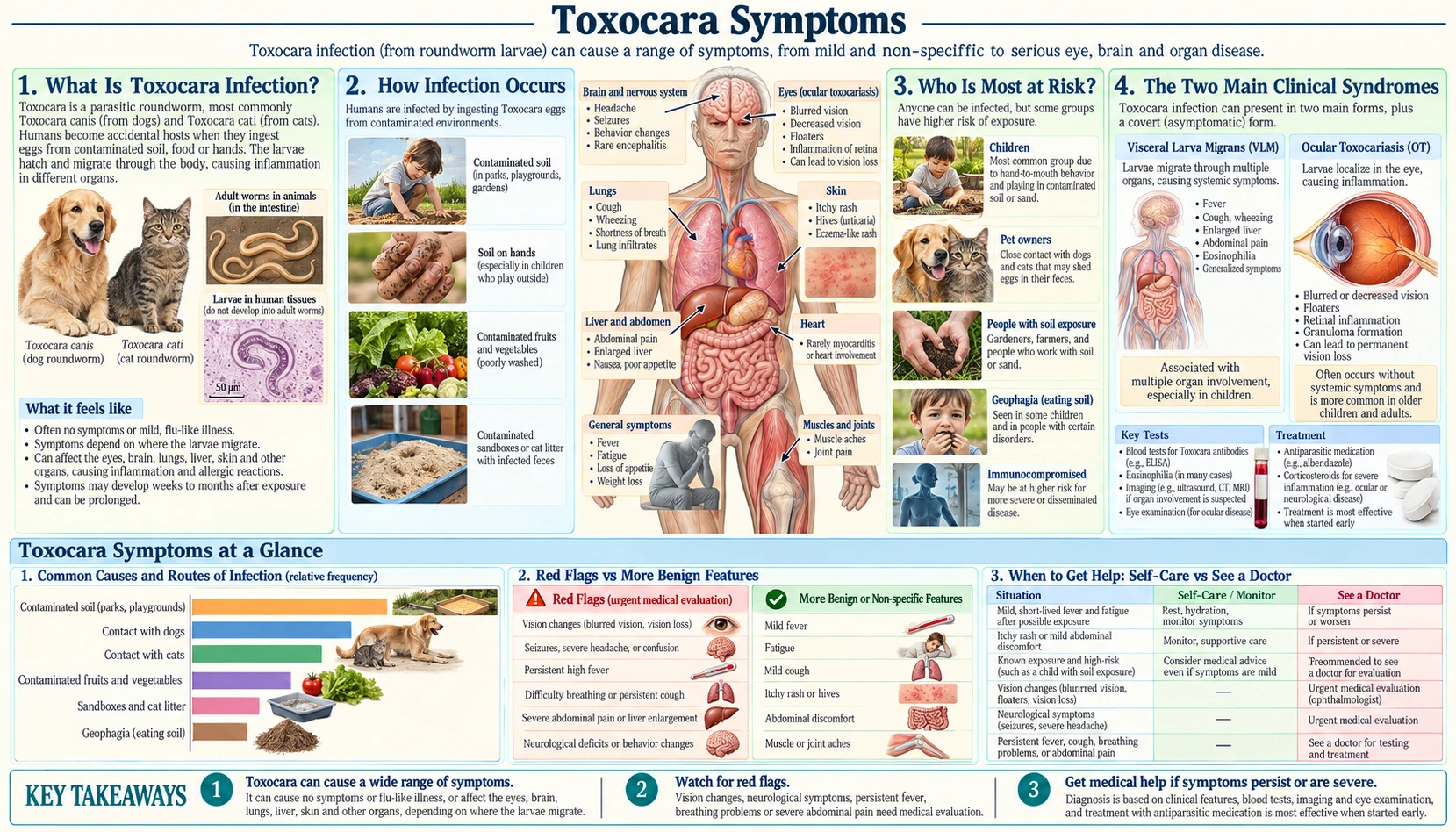
Toxocara canis (dog roundworm) and Toxocara cati (cat roundworm) are nematodes whose larvae hatch from ingested eggs and migrate through human tissues — an accidental dead-end host. Approximately 14% of the US population is seropositive, yet most infections are silent. When symptoms occur, they fall into distinct clinical syndromes depending on where larvae migrate: visceral organs (visceral larva migrans), the eye (ocular larva migrans), the nervous system (neurotoxocariasis), or diffuse low-grade infection (covert toxocariasis).
Table of Contents
1. What Is Toxocara Infection?
Toxocara canis is the most common roundworm of dogs; T. cati infects cats. Both species normally parasitize their definitive host's intestines, producing eggs shed in feces. Humans are accidental paratenic hosts — we ingest embryonated eggs from contaminated soil, but larvae hatch and migrate through human tissues without ever maturing into adult worms.
Larvae (second-stage L2) penetrate the gut wall, enter the portal bloodstream, and spread hematogenously to liver, lungs, brain, eyes, muscles, and other organs. They can remain viable in human tissue for months to years, causing damage both through physical migration and by triggering intense eosinophilic granulomatous reactions. An estimated 14% of the US population carries serological evidence of past exposure — roughly 46 million Americans — making this the most prevalent helminth infection in the country by serology.
The vast majority of seropositive individuals have no symptoms. Clinical disease occurs when larval burden is sufficient to overwhelm local defenses or when a single larva lodges in a critical site such as the eye or brain. The clinical presentation depends entirely on the organs invaded and the intensity of the immune response.
2. How Infection Occurs
The primary route is ingestion of embryonated eggs from contaminated soil, sandboxes, or surfaces. Freshly shed feces are not immediately infectious — eggs require 2–4 weeks in warm moist soil to become embryonated and infective. Once embryonated, eggs are extraordinarily hardy, surviving in soil for years.
Key exposure pathways include:
- Sandboxes and playgrounds — cats use uncovered sandboxes as litter boxes; eggs accumulate at high density
- Urban parks and gardens — areas used by dogs accumulate eggs; surveys find eggs in a large proportion of urban park soil samples
- Pica in children — deliberate or accidental soil ingestion delivers heavy egg loads
- Raw or undercooked animal liver/meat — eating raw chicken, cattle, or rabbit liver containing encysted larvae (paratenic host transmission)
- Unwashed raw vegetables — grown in contaminated soil
Importantly, fresh dog feces are safe — eggs do not become infectious until they embryonate in the environment over 2–4 weeks. Prompt removal of pet waste prevents environmental build-up.
3. Who Is Most at Risk?
Risk is shaped by behavioral and environmental exposures:
- Children ages 1–7 — hand-to-mouth behavior during outdoor play; children with pica are at highest risk of heavy infection producing VLM
- Dog and cat owners — especially those with puppies and kittens who shed the heaviest egg burdens; nearly all puppies are born infected via transplacental transmission
- Low-income urban communities — higher environmental contamination, older housing with soil access, fewer veterinary resources for routine deworming
- Southeastern United States residents — seroprevalence highest in this region; African American children in poverty have the highest documented rates
- Gardeners and farmers — prolonged soil contact in areas frequented by cats or dogs
- People who eat raw animal liver — associated with VLM outbreaks in Japan from raw chicken liver consumption
Older children and young adults are more likely to present with OLM than VLM, possibly because lower-level exposure (single larva) is more typical at older ages and because acquired immunity may limit systemic spread.
4. The Two Main Clinical Syndromes
Toxocariasis produces two well-defined clinical syndromes based on the pattern of larval migration:
Visceral Larva Migrans (VLM) — predominantly in young children after heavy egg ingestion. Multiple larvae migrate through abdominal organs, causing hepatomegaly, pulmonary infiltrates, persistent eosinophilia (often 30–80% of WBC differential), fever, elevated IgE, and hypergammaglobulinemia. Severity ranges from mild (most cases) to life-threatening with myocarditis or encephalitis. See the Visceral Larva Migrans page for detailed coverage.
Ocular Larva Migrans (OLM) — caused by a single larva entering the eye, usually in older children or young adults. Presents as unilateral visual disturbance, strabismus, or leukocoria (white pupil). Eosinophilia is characteristically absent in isolated OLM, making diagnosis difficult. Risk of permanent unilateral blindness is real; OLM must be distinguished from retinoblastoma. See the Ocular Larva Migrans page for detailed coverage.
These syndromes are generally mutually exclusive — patients who develop VLM from heavy infection develop systemic immunity that appears to prevent simultaneous OLM.
5. Covert Toxocariasis
Covert toxocariasis describes mild, low-burden Toxocara infection producing nonspecific symptoms without meeting criteria for VLM or OLM. Documented associations include:
- Mild eosinophilia (500–2,000/µL) with or without symptoms
- Chronic abdominal pain and hepatomegaly without fever
- Recurrent urticaria (hives) and atopic symptoms
- Chronic cough and mild reactive airways disease
- Headache and behavioral changes in children
Epidemiological data link Toxocara seropositivity with childhood asthma, epilepsy, and cognitive delays, though establishing causality is challenging given high background seroprevalence. Covert toxocariasis is clinically important as an underrecognized cause of chronic eosinophilia and nonspecific inflammatory symptoms, particularly in children with animal and soil exposure.
6. Neurotoxocariasis
Neurotoxocariasis occurs when larvae migrate into the central nervous system. It is rare — estimated at fewer than 100 documented cases globally in the literature — but produces potentially severe neurological disease:
- Eosinophilic meningitis — headache, meningismus, CSF pleocytosis with eosinophil predominance
- Encephalitis — seizures, altered consciousness, focal deficits
- Myelitis — spinal cord involvement causing weakness or bladder dysfunction
- Behavioral and cognitive changes — recognized in epidemiological studies of seropositive children
Diagnosis requires brain MRI (white matter lesions, migratory tracts), CSF analysis (eosinophilia, elevated protein, positive Toxocara antibodies in CSF), and exclusion of other causes. Treatment requires extended albendazole (21 days) combined with corticosteroids. Prognosis is generally good with appropriate treatment, but permanent neurological deficits can result from severe or delayed-diagnosis cases.
7. Cardiac Involvement
Cardiac toxocariasis (myocarditis from migrating larvae) is rare but serious. Larvae can invade the myocardium, triggering eosinophilic myocarditis with:
- Arrhythmias
- Cardiomegaly
- Congestive heart failure in severe cases
- Chest pain and dyspnea
Cardiac MRI with late gadolinium enhancement can reveal myocardial involvement. Elevated troponin and ECG changes may be present. Endomyocardial biopsy demonstrating eosinophilic infiltration with necrosis can confirm the diagnosis, though it is rarely performed. Treatment with albendazole plus corticosteroids is recommended. Cardiac involvement correlates with severe, heavy-burden VLM and is a marker of potentially life-threatening disease.
8. Prognosis and Outcome
The great majority of Toxocara infections — even those producing clinical VLM — resolve spontaneously over months as larvae die and granulomatous inflammation subsides. Prognosis depends on the organs involved and treatment timeliness:
- Uncomplicated VLM — self-limited; full recovery expected with or without treatment, though albendazole accelerates resolution
- Pulmonary VLM — transient infiltrates resolve; rarely causes permanent airway changes
- OLM — prognosis depends heavily on larva location; foveal or optic nerve involvement carries risk of permanent vision loss even with optimal treatment
- Neurotoxocariasis — most recover with treatment; risk of permanent neurological deficit in severe or delayed cases
- Cardiac toxocariasis — generally recovers with treatment; severe myocarditis can lead to permanent cardiac damage
Early recognition and treatment improve outcomes across all symptomatic syndromes. Because OLM can present with no systemic symptoms and no eosinophilia, a high index of suspicion in children with unexplained unilateral visual symptoms or strabismus is critical.
Key Research Papers
Landmark studies and systematic reviews on Toxocara clinical syndromes and epidemiology.
- Rubinsky-Elefant G, et al. Human toxocariasis: diagnosis, worldwide seroprevalences and clinical expression of the systemic and ocular forms. — PubMed PMID: 20149289
- Despommier D. Toxocariasis: clinical aspects, epidemiology, medical ecology, and molecular aspects. — PubMed PMID: 12692098
- Won KY, et al. National seroprevalence and risk factors for zoonotic Toxocara spp. infection. — PubMed PMID: 27457773
- Fillaux J, Magnaval JF. Laboratory diagnosis of human toxocariasis. — Search PubMed
- Beaver PC, Snyder CH, Carrera GM, Dent JH, Lafferty JW. Chronic eosinophilia due to visceral larva migrans. — PubMed PMID: 14911260
- Magnaval JF, et al. Highlights of human toxocariasis. — Search PubMed
- Pawlowski Z. Toxocariasis in humans: clinical expression and treatment dilemma. — PubMed PMID: 11818044
- Woodhall D, et al. Neglected parasitic infections in the United States: toxocariasis. — Search PubMed
- Iddawela DR, et al. Seroprevalence of toxocariasis and risk factors for infection in Sri Lanka. — PubMed PMID: 12971508
- Finsterer J, Auer H. Neurotoxocarosis. — Search PubMed