Alpha-Gal Syndrome: Natural History & Path to Tolerance
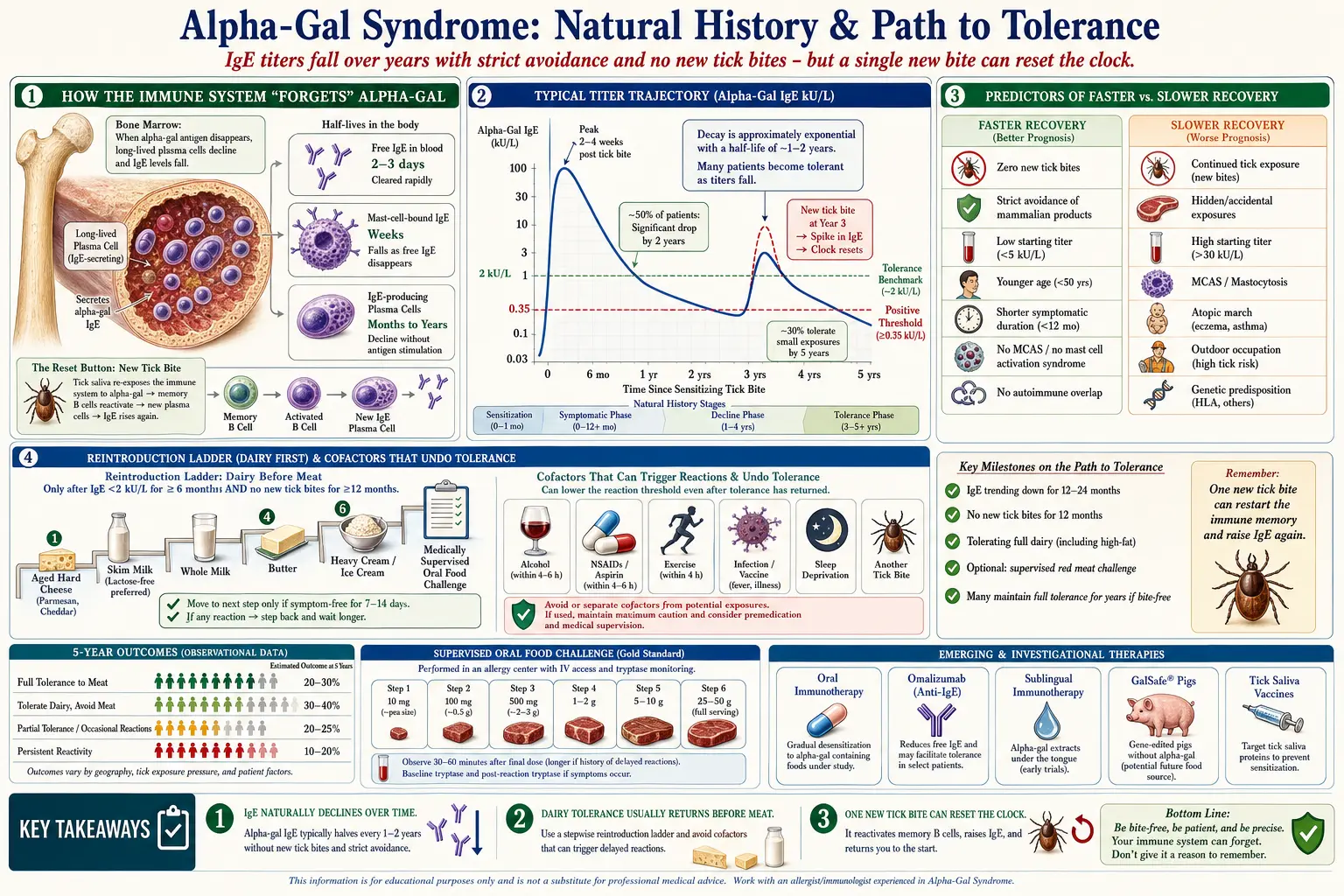
Table of Contents
- What the Follow-Up Studies Found
- How the Immune System "Forgets"
- What Repeated Blood Tests Show
- What Is Linked to a Falling Titer
- What Is Linked to a Steady or Rising Titer
- Dairy: Reactions Vary
- What Is Known About Regaining Tolerance
- Eating Meat Again: What Has Been Reported
- Cofactors Linked to Stronger Reactions
- Emerging Treatments — The Research Frontier
- Why Avoidance Remains the Primary Management
- Reports of Partial Tolerance and Desensitization
- Living With AGS Long-Term
- Psychological Adjustment
- Children with AGS
- What Is Still Unknown
- Key Research Papers
- Connections
- Featured Videos
1. What the Follow-Up Studies Found
The main finding on the natural history of Alpha-Gal Syndrome (AGS) comes from the University of Virginia group that first described delayed reactions to mammalian meat: blood levels of IgE to alpha-gal often drop in patients who avoid recurrent tick bites, but the rate of decline is variable (Platts-Mills 2020). Their 2025 review states that the management of AGS symptoms is based on avoiding food derived from mammals, but that the only thing that can allow IgE to decrease is avoidance of tick bites (Platts-Mills 2025).
The one published study that tracked the titer systematically is a retrospective review of 67 people with AGS at the University of Virginia (Kim 2020):
- In 42 of 47 encounters (89%) in which people reported no tick bites between two blood tests, alpha-gal IgE fell.
- In encounters in which tick bites were reported, it fell in 23 of 60 (38%); the authors summarize that many people with repeat tick bites (62%) had further rises.
- Among those who reported no tick bites, alpha-gal IgE fell by a median of 27.3% per year, with a wide spread between individuals.
- The study was not designed to measure tolerance — whether symptoms became milder or meat could be eaten again.
No published study was found that reports what share of patients regain tolerance after a given number of years.
2. How the Immune System "Forgets"
IgE to alpha-gal is made after tick bites: in the United States the lone star tick (Amblyomma americanum) is the primary cause, and different ticks are responsible in other countries (Platts-Mills 2020). The 2025 review describes the IgE-producing B cells as appearing to derive from B cells that already make IgM or IgG to alpha-gal — a "natural" antibody response everyone has — with repeated tick bites driving a strong Th2 signal (IL-4 and IL-13) in tick-specific T cells (Platts-Mills 2025).
When the bites stop, that stimulus is gone and the level falls gradually rather than all at once; the cellular details of why the decline takes months to years in AGS have not been worked out in published studies. In the other direction, prospective follow-up of 3 people whose blood had been stored before they were bitten showed alpha-gal IgE rising 20-fold or greater after tick bites (Commins 2011).
3. What Repeated Blood Tests Show
In the 2020 University of Virginia review of paired blood samples (Kim 2020):
- The time between paired samples ranged from 2 to 413 weeks, and samples were not collected at set intervals.
- The median alpha-gal IgE at the first test was 13 IU/mL.
- Total IgE also fell (median 15.5% per year) in people who reported no tick bites.
- In the 23 encounters where tick bites were reported but alpha-gal IgE still fell, the rate of decrease (23.8% per year) was similar to that in people who reported no bites. The authors note that not all ticks are thought to cause alpha-gal sensitization: the dog tick and the blacklegged tick are also common in central Virginia.
- The 2020 clinical review adds that alpha-gal IgE levels can drop rapidly in some cases (Platts-Mills 2020).
The authors of the 2020 study state that alpha-gal IgE levels should be reassessed at regular intervals; no specific testing interval is given. Testing is covered in Testing and Diagnosis.
4. What Is Linked to a Falling Titer
The published evidence on what predicts a falling titer is limited to one factor:
- No new tick bites. This is the factor the Virginia data tie to a falling titer (Kim 2020), and the 2025 review calls avoiding tick bites the only thing that can allow IgE to decrease (Platts-Mills 2025).
- Diet. The 2020 review states the authors were unaware of any data on whether eating red meat influences alpha-gal IgE levels in people with the syndrome (Platts-Mills 2020). Avoiding mammalian foods is the management of symptoms; hidden sources are covered in the Mammalian Foods List.
- Starting titer, age, symptom duration, coexisting conditions. No published study was found that tested these as predictors of a faster decline or earlier tolerance. In the Virginia cohort the starting level trended higher in people who reported no bites (median 26 IU/mL) than in those who did (10 IU/mL), a difference that was not statistically significant (Kim 2020).
5. What Is Linked to a Steady or Rising Titer
- Continued tick bites. The 2020 review states that further tick bites can maintain or increase the titer (Platts-Mills 2020); in the Virginia data alpha-gal IgE fell in only 38% of encounters with reported bites (Kim 2020).
- Outdoor exposure in tick regions. People who live or work outdoors where the lone star tick is common have more opportunity for bites; the 2020 review notes that avoiding tick bites in rural or suburban areas is difficult, and that clothing and repellent sprays can be effective (Platts-Mills 2020).
- Atopy. The same review reports that alpha-gal IgE levels and the clinical picture are similar in people with and without other allergies (Platts-Mills 2020); no study was found showing that atopy, mast cell disorders or autoimmunity slow the decline.
Tick-bite measures are covered in Tick Bite Prevention.
6. Dairy: Reactions Vary
The University of Virginia group does not include dairy in primary avoidance, because most of their patients do not react to milk or cheese — even though patients' IgE has been known since 2009 to recognize alpha-gal in cow's milk extract (Platts-Mills 2020). The review estimates that in about 80% of cases avoiding red meat and organs is sufficient, that a minority (about 5–20%) also need to avoid dairy and gelatin, and that a small minority (about 1% or less) need to be aware of the many products derived from mammals (Platts-Mills 2020). Dairy figures from other studies are covered in the Mammalian Foods List.
No published study was found that describes an order in which particular dairy foods become tolerated again, or a timetable for it.
7. What Is Known About Regaining Tolerance
- No agreed threshold. The 2020 review states that it is not clear what degree of decrease is required to regain tolerance (Platts-Mills 2020). Its diagnostic guide uses a different cut-off: alpha-gal IgE of 2 IU/mL or more, or more than 2% of total IgE, makes the diagnosis very likely.
- Negative titers. The same group reports following many patients whose titers became negative (below 0.1 IU/mL) and who reintroduced meat on their own (Platts-Mills 2020).
- Inconsistent reactions. Some people with the syndrome eat red meat on some occasions with few or no symptoms and have severe reactions on others; the review links this to differences in the meat and to cofactors (Platts-Mills 2020). Severity is not predicted by the titer.
- Challenges. The review describes oral food challenges as occasionally necessary to resolve diagnostic confusion; no published standard challenge protocol for confirming tolerance in AGS was found.
8. Eating Meat Again: What Has Been Reported
The published reports are case series and single cases, not trials:
- Patients in the Virginia clinic whose alpha-gal IgE became negative reintroduced meat on their own (Platts-Mills 2020).
- In an Istanbul series, 12 of 20 adults with confirmed red-meat allergy underwent red-meat oral immunotherapy; all who underwent it became tolerant, and over 5 years of follow-up alpha-gal IgE gradually fell in the nine who kept eating red meat without reactions while it stayed unchanged in the 8 untreated controls (Ünal 2023). In 2 patients, tick bites were followed by reactions and a rise in alpha-gal IgE.
- A 2026 case report describes partial tolerance to most red meats after a stepwise "bacon ladder", with continued reactions to fried pork skin (Aman 2026).
The 2020 review links the risk of reactions on any given occasion to the meat itself and to cofactors rather than to the amount alone (Platts-Mills 2020). Decisions about reintroducing mammalian foods belong with a clinician.
9. Cofactors Linked to Stronger Reactions
Reviews list these as factors that can change whether a reaction occurs and how strong it is:
- Exercise (Platts-Mills 2020; Patel 2020).
- Alcohol (Platts-Mills 2020; Patel 2020).
- Non-steroidal anti-inflammatory drugs (NSAIDs, such as aspirin and ibuprofen) (Platts-Mills 2020).
- The amount of alpha-gal and fat in the food (Patel 2020); internal organs are reported to be equally or more able to induce reactions than muscle meat (Platts-Mills 2020).
- A new tick bite, which can raise the titer again (Platts-Mills 2020; Kim 2020).
A 2014 German research letter reported that alpha-gal sensitization is a prerequisite for pork-kidney allergy and for cofactor-related mammalian-meat anaphylaxis (Fischer 2014). No published data were found on infection, vaccination, sleep loss or stress as cofactors in AGS.
10. Emerging Treatments — The Research Frontier
No treatment has been approved specifically for AGS. Approaches under study or reported:
Oral Immunotherapy (OIT)
Gradually increasing doses of red meat. The largest published series is the Istanbul study described above (Ünal 2023); a single-patient Turkish report describes a modified version of that protocol (Tepetam 2023). These are small, uncontrolled series, and OIT is not a standard treatment for AGS.
Omalizumab
An anti-IgE monoclonal antibody. On February 16, 2024 the FDA approved it for IgE-mediated food allergy in certain adults and children 1 year or older to reduce allergic reactions after accidental exposure, with continued avoidance of the foods. The trial behind that approval studied peanut and other common food allergens, not alpha-gal: 67% of omalizumab-treated children and adolescents tolerated 600 mg or more of peanut protein after 16 weeks, versus 7% on placebo (Wood 2024). In AGS the published evidence is case reports, such as its use before hip replacement surgery in a 65-year-old woman (Kohli-Pamnani 2026). No cost or coverage data are reported here.
Ligelizumab
Another anti-IgE antibody. A phase 3 peanut-allergy study was stopped early because target efficacy would not be met; at 12 weeks 44.7% on the 240 mg dose tolerated 600 mg or more of peanut protein versus 4.3% on placebo (Bégin 2026). No study in AGS was found.
Dupilumab
An anti-IL-4/IL-13 antibody. No published study of dupilumab in AGS was found.
Alpha-Gal-Depleted Meat
Pigs genetically altered to lack the GGTA1 enzyme that builds alpha-gal have been developed, including for xenotransplantation research. No published clinical study of people with AGS eating meat from such animals was found.
Avian-Derived Medical Products
Birds do not make alpha-gal (the gene is absent outside mammals), but no published study was found comparing bird-derived medical products with mammalian ones in people with AGS. Medicines and medical products are covered in Cross-Reactive Medications.
Tolerance Vaccines
No published human study of a vaccine to induce tolerance to alpha-gal was found. The 2020 NIAID workshop report lists research priorities for the mechanisms, diagnosis, management and prevention of the syndrome (Platts-Mills 2020 workshop).
11. Why Avoidance Remains the Primary Management
The published reviews describe two kinds of avoidance with different purposes:
- Avoiding mammalian meat (and dairy in some cases) is described as the primary treatment — it prevents reactions (Platts-Mills 2020).
- Avoiding tick bites is what the Virginia data link to a falling titer (Kim 2020; Platts-Mills 2025).
- The 2020 review notes that whether eating red meat changes alpha-gal IgE levels has not been studied (Platts-Mills 2020).
- The same review states that the severity of reactions is not predicted by the delay or by the titer (Platts-Mills 2020).
12. Reports of Partial Tolerance and Desensitization
Stepwise reintroduction has been published only as small series and case reports (Ünal 2023; Tepetam 2023; Aman 2026), all carried out by allergy specialists. In the Istanbul series, tick bites were followed by reactions and a rising titer in 2 patients, while 1 patient with low follow-up alpha-gal IgE ate red meat without reactions after frequent tick bites (Ünal 2023). The 2026 case report describes tolerance as partial, with reactions still occurring to fried pork skin (Aman 2026).
13. Living With AGS Long-Term
- Timescale. Changes in titer are measured over months to years, and the rate varies between people (Kim 2020; Platts-Mills 2020). No published figure was found for how long it typically takes to regain tolerance.
- Community. Patient-run groups share recipes, product lists and travel information; their contents are not peer-reviewed.
- Re-testing. The 2020 study authors state that alpha-gal IgE levels should be reassessed at regular intervals (Kim 2020).
- Emergency planning. Epinephrine auto-injectors and emergency plans are covered in the Anaphylaxis Emergency Plan.
- Other conditions. Mast cell disorders and gut conditions are covered on the MCAS and SIBO pages; no study was found measuring how often they occur together with AGS.
14. Psychological Adjustment
Social meals, travel and family traditions often involve mammalian foods, and a long-term change of diet affects them. No peer-reviewed study of quality of life or food-related anxiety specifically in AGS was found in PubMed.
- Diet and nutrition. Dietitians and clinicians familiar with chronic illness are among the professionals who help with meal planning and nutritional adequacy on any long-term elimination diet.
- Community support. Online patient groups and local meetups in tick regions exist; their advice is not peer-reviewed.
15. Children with AGS
A University of Virginia study identified 45 children aged 4 to 17 with delayed reactions to mammalian meat and IgE to alpha-gal; most had a history of tick bites within the past year that itched and persisted (Kennedy 2013). The 2020 review states that the published data suggest the condition in children has features similar to adult cases (Platts-Mills 2020).
- No published long-term follow-up was found on whether children lose their alpha-gal IgE or regain tolerance faster than adults.
- School meal and emergency arrangements in the United States can be set out in a Section 504 plan.
16. What Is Still Unknown
IgE to alpha-gal was identified as the cause of cetuximab reactions in 2008 (Chung 2008), and delayed reactions to red meat were described in 2009 (Commins 2009). That means:
- Follow-up data are short. The one systematic study of the titer over time is retrospective, with samples at irregular intervals (Kim 2020).
- Tolerance has not been measured systematically. No published study reports how many patients regain tolerance, or how fast.
- No reliable individual predictor of the decline or of reaction severity has been established (Platts-Mills 2020).
- Research is active, and the NIAID workshop report sets out research priorities (Platts-Mills 2020 workshop).
Key Research Papers
- Platts-Mills TAE, Li RC, Keshavarz B, Smith AR, Wilson JM. Diagnosis and management of patients with the α-Gal syndrome. J Allergy Clin Immunol Pract. 2020;8(1):15-23.e1. — doi:10.1016/j.jaip.2019.09.017
- Commins SP, James HR, Kelly LA, et al. The relevance of tick bites to the production of IgE antibodies to the mammalian oligosaccharide galactose-α-1,3-galactose. J Allergy Clin Immunol. 2011;127(5):1286-93.e6. — doi:10.1016/j.jaci.2011.02.019
- Kim MS, Straesser MD, Keshavarz B, Workman L, McGowan EC, Platts-Mills TAE, Wilson JM. IgE to galactose-α-1,3-galactose wanes over time in patients who avoid tick bites. J Allergy Clin Immunol Pract. 2020;8(1):364-367.e2. PubMed PMID: 31520841
- Platts-Mills TAE, Gangwar RS, Workman L, Wilson JM. The immunology of alpha-gal syndrome: history, tick bites, IgE, and delayed anaphylaxis to mammalian meat. Immunol Rev. 2025;332(1):e70035. PubMed PMID: 40515672
- Platts-Mills TAE, Commins SP, Biedermann T, et al. On the cause and consequences of IgE to galactose-α-1,3-galactose: a report from the National Institute of Allergy and Infectious Diseases Workshop on Understanding IgE-Mediated Mammalian Meat Allergy. J Allergy Clin Immunol. 2020;145(4):1061-1071. PubMed PMID: 32057766
- Commins SP, Satinover SM, Hosen J, et al. Delayed anaphylaxis, angioedema, or urticaria after consumption of red meat in patients with IgE antibodies specific for galactose-alpha-1,3-galactose. J Allergy Clin Immunol. 2009;123(2):426-33. PubMed PMID: 19070355
- Chung CH, Mirakhur B, Chan E, et al. Cetuximab-induced anaphylaxis and IgE specific for galactose-alpha-1,3-galactose. N Engl J Med. 2008;358(11):1109-17. PubMed PMID: 18337601
- Kennedy JL, Stallings AP, Platts-Mills TA, et al. Galactose-α-1,3-galactose and delayed anaphylaxis, angioedema, and urticaria in children. Pediatrics. 2013;131(5):e1545-52. PubMed PMID: 23569097
- Ünal D, Eyice-Karabacak D, Kutlu A, et al. Oral immunotherapy in alpha-gal red meat allergy: could specific IgE be a potential biomarker in monitoring management? Allergy. 2023;78(12):3241-3251. PubMed PMID: 37545316
- Tepetam FM, Yegin Katran Z, Bayraktar Barın R, Çakmak Uğurlu B. Delayed anaphylaxis due to alpha-gal allergy: a modified desensitization protocol with red meat in an adult patient. Tuberk Toraks. 2023;71(3):318-324. PubMed PMID: 37740636
- Aman M, Janowiecki M, Carlson JC. Partial tolerance achieved in persistent alpha-gal syndrome: a case report. J Allergy Clin Immunol Glob. 2026;5(6):100769. PubMed PMID: 42662562
- Fischer J, Hebsaker J, Caponetto P, Platts-Mills TA, Biedermann T. Galactose-alpha-1,3-galactose sensitization is a prerequisite for pork-kidney allergy and cofactor-related mammalian meat anaphylaxis. J Allergy Clin Immunol. 2014;134(3):755-759.e1. PubMed PMID: 25171869
- Patel C, Iweala OI. "Doc, will I ever eat steak again?": diagnosis and management of alpha-gal syndrome. Curr Opin Pediatr. 2020;32(6):816-824. PubMed PMID: 33009122
- Wood RA, Togias A, Sicherer SH, et al. Omalizumab for the treatment of multiple food allergies. N Engl J Med. 2024;390(10):889-899. PubMed PMID: 38407394
- Kohli-Pamnani A, Rodenas M, Duah BA, Ansah-Twum J, Blessing M, Mansour E. Alpha-gal syndrome managed with omalizumab for perioperative optimization of total hip arthroplasty: a case report. JBJS Case Connect. 2026;16(1). PubMed PMID: 41785334
- Bégin P, Ebisawa M, Muraro A, et al. Efficacy and safety of ligelizumab in individuals with confirmed peanut allergy. Allergy. 2026 (online ahead of print). PubMed PMID: 41555809
PubMed Topic Searches
Additional searchable literature on PubMed:
Connections
- Pain & Allergy
- Mast Cell Activation Syndrome
- Tick Bite Prevention
- Mammalian Foods List
- Anaphylaxis Emergency Plan
- Testing and Diagnosis
- SIBO
- Alpha-Gal Syndrome Overview
- Allergies
- POTS
- Tick-Origin Science
- Restaurant and Travel Survival
- Cross-Reactive Medications
- Lyme Disease
- Alpha-Gal and Cardiovascular Risk
- Elimination Diet
- Salmon
- Tick Borne Co Infections
- Hereditary Alpha Tryptasemia