Alpha-Gal Syndrome Testing & Diagnosis Guide
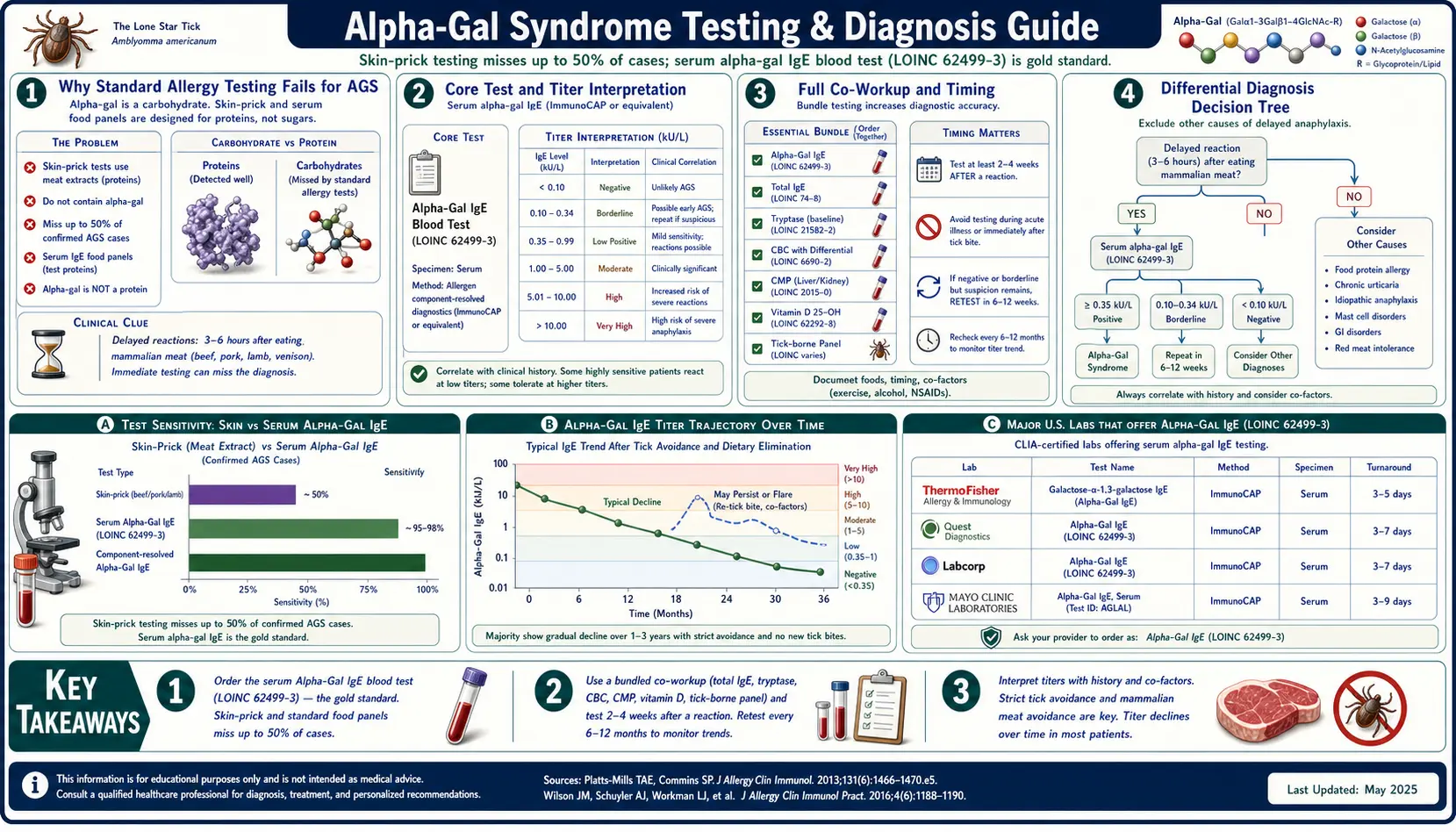
Table of Contents
- Why Skin-Prick Testing Is Unreliable for AGS
- The Core Test: Alpha-Gal-Specific IgE
- Where the Blood Test Is Run
- Timing of the Blood Test
- Total IgE + Component Testing
- Tryptase and Mast Cell Disorders
- Skin Testing (Limited Usefulness)
- Oral Food Challenge and Basophil Testing
- Differential Diagnosis — What Else Could It Be
- Other Tests Reported Alongside Alpha-Gal IgE
- When Clinicians Are Unfamiliar With AGS
- Tracking Titer Over Time
- Pediatric Considerations
- Diagnosis Codes
- Consumer-Ordered Tests
- Key Research Papers
- Connections
- Featured Videos
1. Why Skin-Prick Testing Is Unreliable for AGS
Alpha-gal syndrome (AGS) reactions typically begin hours after a meal rather than minutes, which is one reason the condition is easy to miss. The original University of Virginia series described anaphylaxis or hives 3 to 6 hours after eating beef, pork or lamb (Commins 2009), and a 2020 review from the same group gives a delay of 2 to 6 hours (Platts-Mills 2020).
The standard skin-prick test with commercial meat extracts performs poorly in this condition. In the 2009 series, skin-prick tests to mammalian meat produced wheals usually smaller than 4 mm, while intradermal tests and prick tests with fresh food gave larger and more consistent responses (Commins 2009). The 2020 review states that early studies made it clear that prick tests with beef or pork extracts were unreliable, and that most allergists rely on a blood test for IgE to alpha-gal (Platts-Mills 2020). A German diagnostic review likewise reports that prick testing with commercial whole-meat extracts often does not give reliable results, while alpha-gal-specific IgE is generally detectable in affected patients (Weins 2019). No published study was found that gives a single percentage of AGS patients who test negative on skin-prick.
Alpha-gal (galactose-alpha-1,3-galactose) is a sugar, not a protein. The 2020 review describes a “glycolipid hypothesis” for the delay: alpha-gal carried on fat-associated molecules may reach the tissues only after fat is digested and packaged into chylomicrons, which enter the circulation after about two hours; the review cites a laboratory gut-barrier study in which alpha-gal-carrying glycolipids from beef, but not glycoproteins, crossed the barrier and were packaged into chylomicrons (Platts-Mills 2020).
2. The Core Test: Alpha-Gal-Specific IgE
The blood test measures IgE antibody specific for alpha-gal. CDC states that AGS is diagnosed through a detailed patient history, a physical examination and a blood test, and that a positive alpha-gal IgE test does not by itself mean a person has AGS; results are read together with symptoms, whether reactions are delayed, and tick-bite or outdoor exposure.
Test name and code
The test is listed as “alpha-gal IgE” or “galactose-alpha-1,3-galactose IgE.” The LOINC table maintained through the U.S. National Library of Medicine lists the quantitative serum test as LOINC 73837-7 (Galactose-alpha-1,3-galactose (Alpha-Gal) IgE Ab [Units/volume] in Serum).
Cutoffs used in published studies
There is no single agreed diagnostic cutoff. The 2020 review states that there are no strict criteria for what level equates with the diagnosis (Platts-Mills 2020). Cutoffs reported in the literature:
- 0.1 kU/L — the CDC analysis of U.S. laboratory results counted a result of 0.1 kU/L or higher as positive (Thompson 2023); a German allergy-clinic study used 0.10 kUA/L or higher (Fischer 2020).
- 0.35 IU/mL — the threshold used in a 2019 University of Virginia study of 261 children and adults reporting red-meat allergy, in which 245 had alpha-gal IgE at or above it (Wilson 2019).
- 0.54 kUA/L — the optimal cutoff in a receiver-operating-characteristic analysis among 1,369 German allergy patients (Fischer 2020).
- 2 IU/mL — the 2020 review states that alpha-gal IgE of 2 IU/mL or more, or more than 2% of total IgE, makes the diagnosis very likely (Platts-Mills 2020). In a South African study using oral food challenges, 2.00 kU/L gave the best correct classification (Mabelane 2018).
- 5.5 kU/L — in the same South African study, the level above which there was a 95% probability of meat allergy (Mabelane 2018).
What the level does and does not tell
- Sensitization is common without symptoms. The 2020 review reports that random cohorts in Tennessee, Virginia and North Carolina found 15% or more of the population with IgE to alpha-gal (Platts-Mills 2020). In the German allergy clinic, 19.9% of patients were positive (Fischer 2020).
- Severity is not predicted by the number. In the 2019 Virginia study, alpha-gal IgE levels were similar in people with and without anaphylaxis (Wilson 2019); the German study found alpha-gal IgE a sensitive marker but of limited predictive value for the characteristics or severity of the allergy (Fischer 2020).
- Response to diet. The 2020 review describes the final element of diagnosis as how a person responds clinically to a diet avoiding red meat (Platts-Mills 2020).
3. Where the Blood Test Is Run
According to the 2023 CDC report, until August 2021 a single commercial laboratory was the primary U.S. provider of alpha-gal IgE testing and handled nearly all testing before 2022; few academic institutions and specialty allergy clinics offered it before then, and several commercial laboratories began offering the test in August 2021 (Thompson 2023). It is now offered by several national reference laboratories and some academic medical-center laboratories.
Published studies measured alpha-gal IgE with a commercial fluorescence immunoassay platform (ImmunoCAP) (Kennedy 2013; Fischer 2020). Units and reference wording can differ between laboratory reports, and the cutoffs above come from different studies.
4. Timing of the Blood Test
Alpha-gal IgE is not static. It can rise after tick bites: in 3 people whose blood had been stored before they were bitten, alpha-gal IgE rose 20-fold or more after tick bites (Commins 2011). It tends to fall when tick bites stop (Kim 2020).
- No published study was found that sets an optimal interval between a reaction and the blood draw.
- The 2020 University of Virginia study authors state that alpha-gal IgE levels should be reassessed at regular intervals, without giving a specific interval (Kim 2020).
- Changes in the level over months to years are covered in Tracking Titer Over Time below.
5. Total IgE + Component Testing
Total IgE
The 2020 review reports that the group often measures total IgE because some patients are non-atopic and have low total IgE, and that most of their patients have alpha-gal IgE that is at least 1% of total IgE. It describes a patient with a convincing history whose total IgE was 6.0 IU/mL and alpha-gal IgE 0.8 IU/mL — below 1.0 IU/mL, but more than 10% of the total (Platts-Mills 2020). In the South African challenge study, an alpha-gal-to-total-IgE ratio of 0.75% gave the best correct classification and a ratio of 2.12% marked a 95% probability of meat allergy (Mabelane 2018).
Component testing for other mammalian-meat allergies
Component tests separate AGS from protein-based allergies to mammalian products. In the 2019 Virginia study of 261 people reporting red-meat allergy, component testing supported AGS in 95%, pork-cat syndrome in 1.9% and primary beef allergy in 1.1% (Wilson 2019). The 2020 review describes pork-cat syndrome as showing IgE to cat, to cat serum albumin (Fel d 2) and to pork serum albumin (Sus s 1), and reports a patient first thought to have mammalian-meat allergy whose reactions were explained by IgE to cow’s milk and bovine serum albumin (Bos d 6) and who responded to a dairy-free diet (Platts-Mills 2020).
6. Tryptase and Mast Cell Disorders
Serum tryptase is a marker of mast cell activity. In a prospective NIH study of 70 people referred with a diagnosis of idiopathic anaphylaxis, 6 (9%) had IgE to alpha-gal; after a diet free of red meat none had further anaphylaxis. Two of the six had indolent systemic mastocytosis, and they had more severe reactions, lower alpha-gal IgE and higher serum tryptase (Carter 2018).
- Tryptase in severe reactions. The 2020 review lists cases with tryptase of 36.5 ng/mL and 95.5 ng/mL measured during severe alpha-gal anaphylaxis (Platts-Mills 2020).
- Hereditary alpha-tryptasemia (HαT). Extra copies of the TPSAB1 gene, which encodes alpha-tryptase, segregate with inherited increases in basal serum tryptase; elevated basal tryptase is present in 4–6% of the general population (Lyons 2016). No published study was found that measures how often HαT occurs in people with AGS.
- See the Hereditary Alpha-Tryptasemia page for genetic testing.
7. Skin Testing (Limited Usefulness)
Skin testing is not the main diagnostic test for AGS. CDC states that allergy skin testing may also be used to help diagnose it.
Commercial meat extract prick
In the 2009 series, prick tests with commercial mammalian-meat extracts usually produced wheals smaller than 4 mm (Commins 2009), and the 2020 review calls them unreliable (Platts-Mills 2020). A small or negative result does not rule out AGS.
Fresh food prick-to-prick
Prick tests with fresh food gave larger and more consistent wheals than commercial extracts in the 2009 series (Commins 2009).
Intradermal testing
Intradermal tests also gave larger and more consistent responses (Commins 2009). The 2020 review describes intradermal tests to beef, pork and milk, with chicken, turkey and fish as negative controls, but notes that few clinics carry out intradermal tests for food antigens (Platts-Mills 2020).
8. Oral Food Challenge and Basophil Testing
An oral food challenge means eating a measured amount of mammalian meat under medical supervision. The 2020 review describes challenges as occasionally necessary to resolve diagnostic confusion (Platts-Mills 2020). A German diagnostic review describes an in-patient challenge, for example with cooked pork or porcine kidney together with suspected cofactors, as the way to judge whether a sensitization is clinically relevant (Weins 2019). The South African study used challenges with beef sausage (Mabelane 2018).
Basophil activation test (BAT). In a German-Luxembourg study of 21 patients with AGS, 12 alpha-gal-sensitized people without symptoms and 18 controls, several basophil activation measures were significantly higher in patients with AGS than in sensitized people without symptoms, and all were negative in controls; the authors propose BAT as an additional test before time-consuming and potentially risky oral challenges (Mehlich 2019). The German diagnostic review describes cell-based tests such as BAT as used only in an experimental setting (Weins 2019).
9. Differential Diagnosis — What Else Could It Be
Several conditions can resemble AGS or overlap with it:
- Idiopathic anaphylaxis: in the NIH study, 9% of people referred with this diagnosis turned out to have IgE to alpha-gal (Carter 2018).
- Primary meat-protein allergy and pork-cat syndrome: IgE to meat proteins such as serum albumins (Bos d 6, Sus s 1) rather than to the alpha-gal sugar (Wilson 2019; Platts-Mills 2020).
- Cow’s-milk protein allergy: the 2020 review describes a patient whose reactions were explained by IgE to milk and Bos d 6 rather than alpha-gal (Platts-Mills 2020).
- Chronic hives: the 2020 review states that distinguishing AGS from chronic hives can be challenging, and that the two may overlap in some cases (Platts-Mills 2020).
- Gastrointestinal disease: the same review describes patients with episodes of abdominal pain without skin involvement, which can be severe (Platts-Mills 2020).
- FPIES (food protein-induced enterocolitis syndrome): a delayed, non-IgE gastrointestinal reaction to food.
- Mast cell activation syndrome (MCAS) and mastocytosis: see Mediators & Symptom Map; indolent systemic mastocytosis was found together with alpha-gal sensitization in the NIH study (Carter 2018).
- Hereditary alpha-tryptasemia (HαT): an inherited cause of raised basal tryptase (Lyons 2016).
- Histamine intolerance and exercise-induced anaphylaxis: other diagnoses considered in delayed or cofactor-linked reactions.
10. Other Tests Reported Alongside Alpha-Gal IgE
No published guideline was found that sets a standard panel of tests to run alongside alpha-gal IgE. Tests described in the studies and agency pages cited here:
- Total IgE — measured often by the University of Virginia group, to read alpha-gal IgE as a share of the total (Platts-Mills 2020).
- Component tests — such as IgE to pork and cat serum albumin and to bovine serum albumin, used to identify pork-cat syndrome and primary meat or milk allergy (Wilson 2019; Platts-Mills 2020).
- Serum tryptase — reported in the NIH idiopathic-anaphylaxis study and in severe AGS cases (Carter 2018; Platts-Mills 2020).
- Tick-borne infection testing — CDC states that Lyme disease bacteria are spread by infected blacklegged ticks, and CDC lists blacklegged ticks as a less common cause of AGS than the lone star tick. For Lyme disease CDC describes a two-step blood test in which both steps are required: an enzyme immunoassay first, then either a western blot or a second enzyme immunoassay.
11. When Clinicians Are Unfamiliar With AGS
A 2023 CDC survey of 1,500 U.S. health care providers found that 42% had never heard of AGS, and that among those who had, fewer than one third knew how to diagnose it; two thirds said guidelines for diagnosis and management would be useful (Carpenter 2023). The authors write that limited awareness likely contributes to underdiagnosis.
- CDC publishes information for patients and clinicians on its alpha-gal syndrome pages (cdc.gov/alpha-gal-syndrome/).
- The 2020 University of Virginia review in The Journal of Allergy and Clinical Immunology: In Practice covers diagnosis and management (Platts-Mills 2020).
- Allergy and immunology specialists perform the skin tests, component tests and supervised challenges described above. Decisions about testing and diagnosis belong with a clinician.
12. Tracking Titer Over Time
The published data on how alpha-gal IgE changes come mainly from a retrospective University of Virginia review of 67 people with AGS (Kim 2020):
- In 42 of 47 encounters (89%) in which people reported no tick bites between two blood tests, alpha-gal IgE fell.
- Among those who reported no tick bites, the median fall was 27.3% per year, with a wide spread between individuals.
- The time between paired samples ranged from 2 to 413 weeks, and samples were not collected at set intervals.
- The study did not measure tolerance.
Further tick bites can maintain or increase the level (Platts-Mills 2020), and alpha-gal IgE rose 20-fold or more in 3 people followed after tick bites (Commins 2011). The 2020 review states that it is not clear what degree of decrease is needed to regain tolerance, and reports following many patients whose levels became negative (below 0.1 IU/mL) and who reintroduced meat on their own (Platts-Mills 2020). See Natural History and Tolerance.
13. Pediatric Considerations
A University of Virginia study identified 45 children aged 4 to 17 with delayed reactions to mammalian meat and IgE to alpha-gal; most had a history of tick bites within the past year that itched and persisted. The authors concluded that diagnosis is best confirmed by specific testing and that it should be considered for children living where the lone star tick is common (Kennedy 2013). In the 2019 Virginia study, alpha-gal IgE levels and reaction severity were similar in children (n = 35) and adults (n = 226) (Wilson 2019). The 2023 CDC laboratory analysis found suspected cases predominantly in counties within the southern, midwestern and mid-Atlantic U.S. Census regions (Thompson 2023).
14. Diagnosis Codes
Entries in the ICD-10-CM code set (as listed in the National Library of Medicine’s ICD-10-CM table) that relate to AGS:
- ICD-10-CM Z91.014 — Allergy to mammalian meats.
- ICD-10-CM T78.09XA — Anaphylactic reaction due to other food products, initial encounter. The anaphylaxis codes by food in that table do not include one specific to mammalian meat.
Code selection is made by the treating clinician and coder.
15. Consumer-Ordered Tests
Consumer-ordered allergy panels are sold online, and whether a given panel includes alpha-gal IgE varies. No published study evaluating consumer-ordered alpha-gal tests was found in PubMed. CDC describes diagnosis as combining the blood test with a detailed history and physical examination, and a positive test alone does not establish AGS.
Key Research Papers
- Platts-Mills TAE, Li RC, Keshavarz B, Smith AR, Wilson JM. Diagnosis and management of patients with the α-Gal syndrome. J Allergy Clin Immunol Pract. 2020;8(1):15-23.e1. — doi:10.1016/j.jaip.2019.09.017
- Commins SP, Satinover SM, Hosen J, et al. Delayed anaphylaxis, angioedema, or urticaria after consumption of red meat in patients with IgE antibodies specific for galactose-alpha-1,3-galactose. J Allergy Clin Immunol. 2009;123(2):426-33. — doi:10.1016/j.jaci.2008.10.052
- Pattanaik D, Lieberman P, Lieberman J, et al. The changing face of anaphylaxis in adults and adolescents. Ann Allergy Asthma Immunol. 2018;121(5):594-597. — doi:10.1016/j.anai.2018.07.017
- Fischer J, Biedermann T. Delayed immediate-type hypersensitivity to red meat and innards: current insights into a novel disease entity. J Dtsch Dermatol Ges. 2016;14(1):38-44. — doi:10.1111/ddg.12821
- Kim MS, Straesser MD, Keshavarz B, Workman L, McGowan EC, Platts-Mills TAE, Wilson JM. IgE to galactose-α-1,3-galactose wanes over time in patients who avoid tick bites. J Allergy Clin Immunol Pract. 2020;8(1):364-367.e2. PubMed PMID: 31520841
- Commins SP, James HR, Kelly LA, et al. The relevance of tick bites to the production of IgE antibodies to the mammalian oligosaccharide galactose-α-1,3-galactose. J Allergy Clin Immunol. 2011;127(5):1286-93.e6. — doi:10.1016/j.jaci.2011.02.019
- Wilson JM, Schuyler AJ, Workman L, et al. Investigation into the α-Gal syndrome: characteristics of 261 children and adults reporting red meat allergy. J Allergy Clin Immunol Pract. 2019;7(7):2348-2358.e4. PubMed PMID: 30940532
- Fischer J, Huynh HN, Hebsaker J, Forchhammer S, Yazdi AS. Prevalence and impact of type I sensitization to alpha-gal in patients consulting an allergy unit. Int Arch Allergy Immunol. 2020;181(2):119-127. PubMed PMID: 31805569
- Mabelane T, Basera W, Botha M, Thomas HF, Ramjith J, Levin ME. Predictive values of alpha-gal IgE levels and alpha-gal IgE: total IgE ratio and oral food challenge-proven meat allergy in a population with a high prevalence of reported red meat allergy. Pediatr Allergy Immunol. 2018;29(8):841-849. PubMed PMID: 30144162
- Mehlich J, Fischer J, Hilger C, et al. The basophil activation test differentiates between patients with alpha-gal syndrome and asymptomatic alpha-gal sensitization. J Allergy Clin Immunol. 2019;143(1):182-189. PubMed PMID: 30125663
- Weins AB, Eberlein B, Biedermann T. Diagnostics of alpha-gal syndrome: current standards, pitfalls and perspectives [in German]. Hautarzt. 2019;70(1):36-43. PubMed PMID: 30617520
- Carter MC, Ruiz-Esteves KN, Workman L, Lieberman P, Platts-Mills TAE, Metcalfe DD. Identification of alpha-gal sensitivity in patients with a diagnosis of idiopathic anaphylaxis. Allergy. 2018;73(5):1131-1134. PubMed PMID: 29161766
- Lyons JJ, Yu X, Hughes JD, et al. Elevated basal serum tryptase identifies a multisystem disorder associated with increased TPSAB1 copy number. Nat Genet. 2016;48(12):1564-1569. PubMed PMID: 27749843
- Kennedy JL, Stallings AP, Platts-Mills TA, et al. Galactose-α-1,3-galactose and delayed anaphylaxis, angioedema, and urticaria in children. Pediatrics. 2013;131(5):e1545-52. PubMed PMID: 23569097
- Thompson JM, Carpenter A, Kersh GJ, Wachs T, Commins SP, Salzer JS. Geographic distribution of suspected alpha-gal syndrome cases — United States, January 2017–December 2022. MMWR Morb Mortal Wkly Rep. 2023;72(30):815-820. PubMed PMID: 37498787
- Carpenter A, Drexler NA, McCormick DW, Thompson JM, Kersh G, Commins SP, Salzer JS. Health care provider knowledge regarding alpha-gal syndrome — United States, March–May 2022. MMWR Morb Mortal Wkly Rep. 2023;72(30):809-814. PubMed PMID: 37498792
PubMed Topic Searches
PubMed searches for deeper reading:
Connections
- Pain & Allergy
- Natural History and Tolerance
- Mast Cell Activation Syndrome
- Alpha-Gal Syndrome Overview
- Allergies
- Hereditary Alpha-Tryptasemia
- Tick Bite Prevention
- Mammalian Foods List
- Tick-Origin Science
- Restaurant and Travel Survival
- Cross-Reactive Medications
- Anaphylaxis Emergency Plan
- Lyme Disease
- Food Intolerance
- MCAS Mediators and Symptom Map
- Complete Blood Count
- Alpha-Gal and Cardiovascular Risk