Complete Mammalian Foods List for Alpha-Gal Syndrome
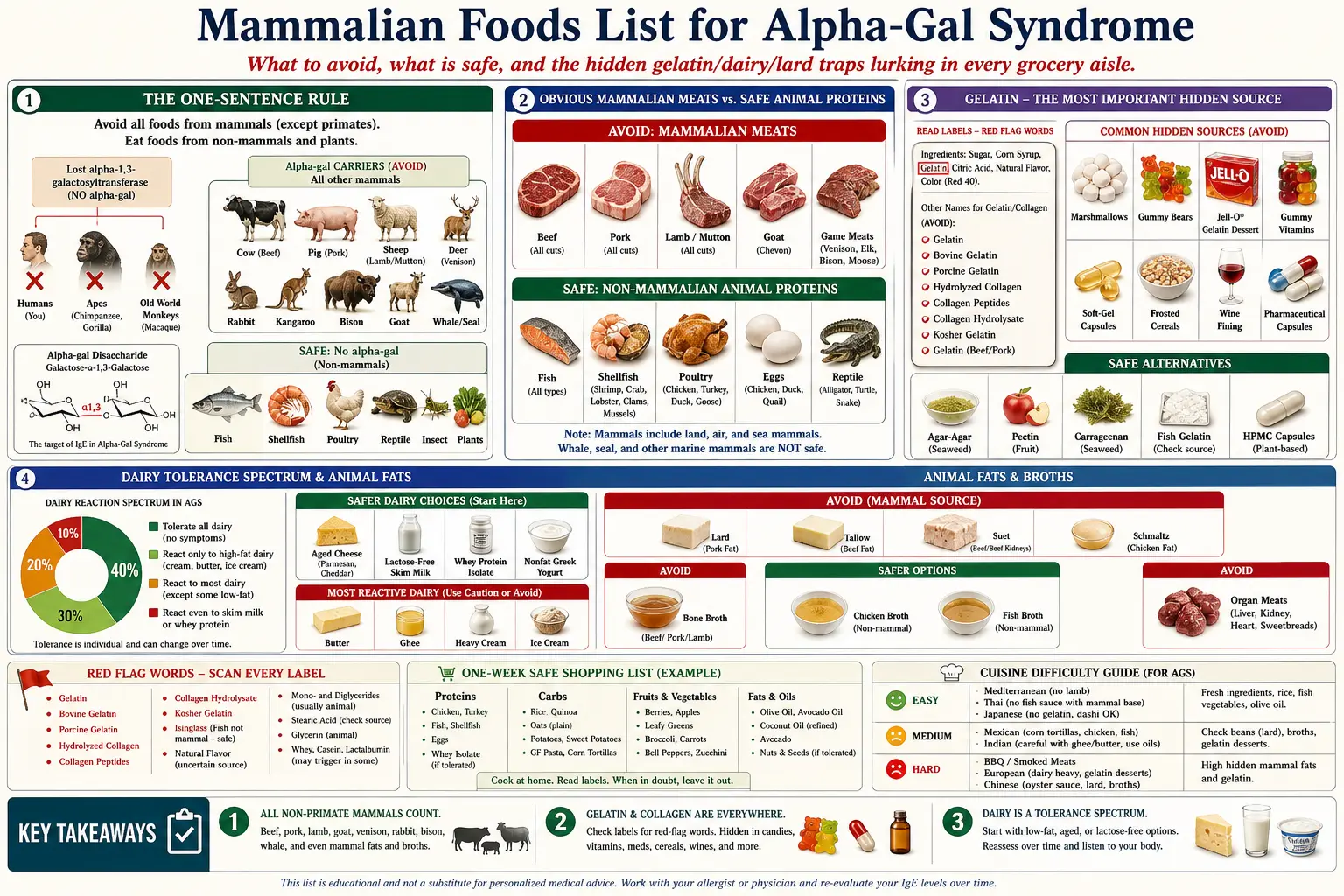
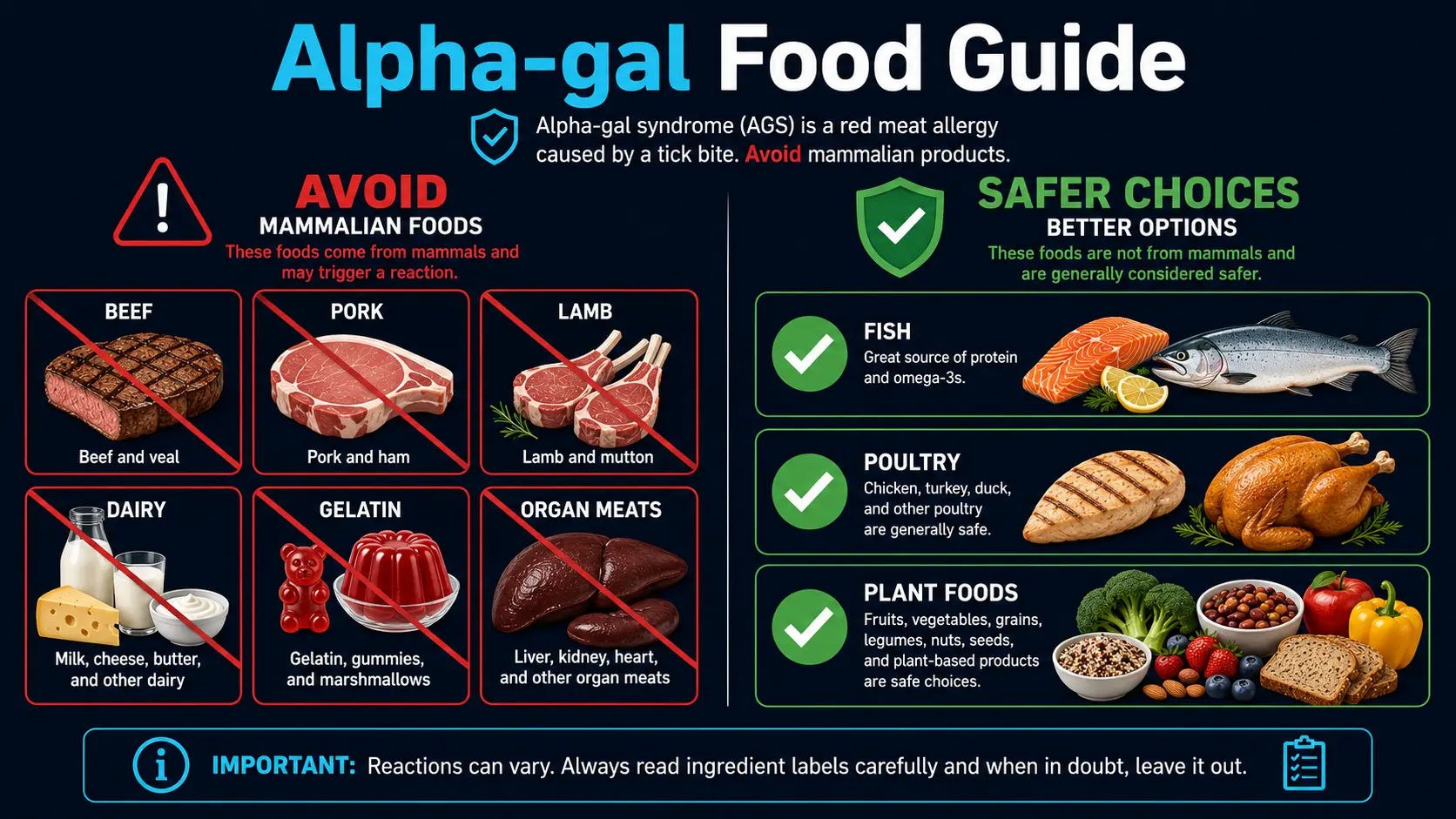
Alpha-Gal Syndrome (AGS) is an allergy to a sugar made by most mammals, and the published food and product lists for it come from a handful of sources: the U.S. Centers for Disease Control and Prevention (CDC), clinical reviews from allergy research groups, and published case series and patient surveys. CDC states that most healthcare providers recommend patients with AGS stop eating meat from mammals, and that some patients also need to eliminate other sources such as dairy and certain medications. This page gathers what those sources report about mammalian foods, hidden mammalian ingredients and mammal-derived medical products, with each finding attributed.
Table of Contents
- The Underlying Rule: Which Animals Make Alpha-Gal
- Mammalian Meats
- Animal Foods CDC Lists Without Alpha-Gal
- Gelatin — A Hidden Source
- Dairy — Reactions Vary
- Lard, Tallow, Suet, Schmaltz
- Broth, Stock, Bouillon and Gravy
- Organ Meats
- Processed Foods With Mammalian Ingredients
- Medicines, Vaccines and Medical Products
- Carrageenan — What Is and Is Not Known
- Magnesium Stearate and Other Excipients
- Sausage Casings
- Insects and Novel Foods
- Foods CDC Lists as Not Containing Alpha-Gal
- Label Terms That Point to Mammalian Sources
- Where This Information Comes From
- Key Research Papers
- Connections
- Featured Videos
1. The Underlying Rule: Which Animals Make Alpha-Gal
Alpha-Gal Syndrome is an IgE-mediated allergy to galactose-alpha-1,3-galactose (alpha-gal). The enzyme that makes it, alpha-1,3-galactosyltransferase, is active in marsupials, non-primate placental mammals, lemurs and New World monkeys, and the gene is absent in other vertebrates. It was inactivated in the ancestors of Old World monkeys and apes, so humans, apes and Old World monkeys do not make alpha-gal (Galili 2015). CDC describes alpha-gal as a molecule naturally produced in the bodies of most mammals but not in people, and also found in the saliva of some ticks.
In the United States, CDC states that AGS is primarily associated with the bite of the lone star tick (Amblyomma americanum), and less commonly with blacklegged and western blacklegged ticks; other tick species have been linked to AGS in other countries. CDC reports that most U.S. cases occur in South, East and Central states, where most lone star ticks are found. A 2011 University of Virginia study found that IgE to alpha-gal rose 20-fold or more in 3 people followed after tick bites, and that alpha-gal IgE correlated with tick-bite histories and with IgE to lone star tick proteins (Commins 2011).
CDC reports that more than 110,000 suspected cases were identified in the United States between 2010 and 2022, that AGS is not nationally notifiable, and that as many as 450,000 people may be affected. The 2023 MMWR laboratory analysis found that 90,018 people received a positive alpha-gal IgE test from January 2017 through December 2022 (Thompson 2023). A companion 2023 MMWR survey of 1,500 U.S. health care providers found that 42% had never heard of AGS (Carpenter 2023).
The source lists below follow from that biology:
- Can contain alpha-gal: meat and organs from mammals, and products made from mammals — CDC lists gelatin, mammal fats (lard, tallow, suet), meat broths, and milk and milk products, plus some medicines, vaccines and medical products.
- CDC lists as not containing alpha-gal: poultry, fish and seafood, eggs, and fruits and vegetables.
2. Mammalian Meats
CDC lists beef, pork, lamb, venison, rabbit "or other meat from mammals" as foods that may contain alpha-gal, and states that a person with AGS is more likely to react to mammalian meat than to other alpha-gal-containing products such as dairy. The term "red meat" is loose: pork is a mammalian meat regardless of the colour of the cooked flesh. The original University of Virginia case series described reactions 3 to 6 hours after eating beef, pork or lamb (Commins 2009). Common examples of each group:
Beef and Cattle
- Steak (ribeye, sirloin, filet mignon, flank, skirt, hanger, T-bone, porterhouse)
- Ground beef, hamburgers, meatballs, meatloaf
- Brisket, short ribs, chuck roast, pot roast
- Veal (young cattle)
- Beef jerky, beef stock, beef bouillon
- Beef liver, heart, tongue, tripe, sweetbreads, oxtail
Pork
- Bacon, pancetta, guanciale, salt pork
- Ham, prosciutto, serrano, jamón, capicola
- Pork chops, pork loin, pork belly, pork shoulder, ribs
- Sausage (breakfast sausage, Italian sausage, chorizo, bratwurst, kielbasa, andouille)
- Hot dogs made with pork or beef
- Pork rinds, cracklings, chicharrones
- Salami, pepperoni, mortadella, bologna
Lamb, Mutton, Goat
- Lamb chops, leg of lamb, rack of lamb, lamb shank
- Ground lamb, gyro meat, shawarma, kofta, kebabs (often mixed lamb/beef)
- Mutton (adult sheep)
- Goat curry, cabrito, birria (sometimes goat, sometimes beef)
Game and Other Mammals
- Venison (deer), elk, moose, caribou, reindeer, antelope
- Bison, buffalo, yak
- Rabbit, hare, squirrel, beaver, muskrat, raccoon, opossum
- Horse, donkey
- Kangaroo (a marsupial — marsupials make alpha-gal), camel, water buffalo
- Whale, seal, walrus
3. Animal Foods CDC Lists Without Alpha-Gal
CDC's list of foods that do not contain alpha-gal names poultry (such as chicken, turkey, duck or quail), fish and seafood (such as shrimp), and eggs. In the 2009 University of Virginia series, patients' IgE bound beef, pork, lamb and cow's milk but not turkey, chicken or fish (Commins 2009), consistent with the gene being absent outside mammals. Prepared dishes made from these foods can still carry mammalian ingredients such as butter, cream, lard or beef stock.
Fish
- Salmon, tuna, cod, halibut, mackerel, sardines, anchovies, herring
- Tilapia, catfish, trout, bass, snapper, grouper, mahi-mahi, swordfish
- Flounder, sole, pollock, haddock, pike, perch
Shellfish and Other Seafood
- Shrimp, prawns, lobster, crab, crayfish
- Clams, mussels, oysters, scallops
- Squid (calamari), octopus, cuttlefish
Poultry
- Chicken, turkey, duck, goose
- Cornish hen, pheasant, quail, guinea fowl, partridge, grouse
- Ostrich, emu (ratite birds — reddish meat but still avian)
Eggs
- Chicken eggs, duck eggs, quail eggs, goose eggs
- Egg whites, egg yolks, egg-white protein powder
Reptiles
- Alligator, crocodile, snake, turtle — reptiles are vertebrates outside the mammals, where the alpha-gal gene is absent (Galili 2015); CDC's list does not mention them
4. Gelatin — A Hidden Source
Gelatin is made from the collagen of animal hides, bones and connective tissue, and CDC lists "gelatin made from beef or pork" among the animal products some people with AGS are sensitive to. In an Australian study of 1,335 adults skin-tested with gelatin, 30 of 40 patients with red-meat allergy tested positive to gelatin and 12 were clinically allergic to it; alpha-gal was measured in bovine gelatin colloids at about 0.44 to 0.52 μg per gram of gelatin (Mullins 2012). In a 2026 survey of 3,437 adults with clinician-diagnosed AGS, 61.3% reported reactions to gelatin (Merritt Meinholz 2026).
Where gelatin commonly appears
- Marshmallows and marshmallow candies
- Gummy candies and fruit snacks made with gelatin
- Gummy vitamins and gummy supplements
- Gelatin desserts and some pudding cups
- Some yogurts, ice creams and gelatos (as a thickener or stabilizer)
- Hard-shell capsules and soft-gel supplements made with bovine or porcine gelatin
- Some frosted cereals and glazed desserts
- Wine, beer and juice clarified with gelatin as a fining agent
Gelatin and collagen terms on labels
- gelatin
- hydrolyzed collagen
- collagen peptides
- collagen hydrolysate
- bovine gelatin (cow)
- porcine gelatin (pig)
- kosher gelatin (the term describes religious certification, not the source animal; it can be bovine or fish)
Non-mammalian gelling agents
- Fish gelatin — made from fish skin; fish are outside the mammals, and labels name it as fish gelatin
- Agar (agar-agar) — seaweed-derived
- Pectin — from citrus peel and apple pomace
- Carrageenan — from red seaweed (see section 11 for what is and is not known)
- Plant-cellulose capsules (hydroxypropyl methylcellulose, HPMC) — a non-gelatin capsule material
5. Dairy — Reactions Vary
CDC states that food products containing milk and milk products may contain alpha-gal, but that many patients with AGS can tolerate milk products; cow's milk is the only alpha-gal-containing ingredient classified as a major food allergen under U.S. labeling law, so it must be named on food labels. A 2020 clinical review from the University of Virginia group describes the primary treatment as avoiding mammalian meat "and also dairy in some cases" (Platts-Mills 2020).
How many patients react to dairy depends on who is counted. A 2024 laboratory study cites recent studies reporting that 10–20% of AGS patients also react to dairy proteins; it found that three milk-fat-globule proteins (butyrophilin, lactadherin and xanthine oxidase) carry alpha-gal, supporting the possibility that milk, "especially in its whole form," can cause reactions (Aiuto 2024). In the 2026 self-selected patient survey recruited through social media and support organizations, 66.9% reported reactions to dairy (Merritt Meinholz 2026). In a CDC-led chart review of 100 patients at the University of North Carolina, those reporting dairy reactions were less likely to have isolated skin symptoms (3% vs. 24%) than dairy-tolerant patients (Binder 2023).
The published sources do not set out a dairy reintroduction schedule, and CDC describes later tolerance of alpha-gal-containing products as an individualized medical decision made with a healthcare provider. Dairy foods that contain cow's milk or milk fat include:
- Milk of every fat level, and whey and casein ingredients
- Butter and ghee (concentrated milk fat)
- Heavy cream, whipping cream, half-and-half
- Cheeses, from fresh soft cheeses to aged hard cheeses
- Cream cheese, mascarpone, crème fraîche
- Yogurt, ice cream and gelato
6. Lard, Tallow, Suet, Schmaltz
CDC lists "products made or cooked with mammal fat, like lard, tallow, or suet" among the animal products some people with AGS are sensitive to. Restaurant frying fats are not always stated on menus, so the same dish can differ between kitchens. The fats by source animal:
- Lard = rendered pork fat. Found in traditional pastries, piecrusts, biscuits, tamales, refried beans, pan de muerto, empanadas and many Latin American dishes. Mammalian.
- Tallow = rendered beef fat. Used for frying in some restaurants, food carts and chip shops. Mammalian.
- Suet = hard beef or mutton fat from around the kidneys. Used in traditional British Christmas pudding, mincemeat, dumplings and suet crust. Mammalian.
- Bacon grease = rendered pork fat, often saved for frying in Southern U.S. cooking. Mammalian.
- Schmaltz = rendered chicken fat. Poultry, which CDC lists as not containing alpha-gal.
- Duck fat, goose fat — poultry fats, likewise outside CDC's alpha-gal list.
7. Broth, Stock, Bouillon and Gravy
CDC lists "meat broth, bouillon, stock, and gravy" among the animal products some people with AGS are sensitive to. Bone broth is simmered collagen, fat and tissue from whichever animal is used, so its alpha-gal status follows the animal:
- Beef bone broth, pork bone broth, oxtail broth, veal stock, beef bouillon: mammalian.
- Chicken bone broth, turkey bone broth: poultry, outside CDC's alpha-gal list.
- Fish bone broth, dashi (fish + kelp): fish-based, outside CDC's alpha-gal list.
No published data were found on how much alpha-gal skimmed or clarified beef broth carries. Chicken and fish stocks are the poultry and seafood alternatives in CDC's terms.
8. Organ Meats
CDC lists "mammal organ meat, such as liver, kidneys, intestines, or sweetbreads" and Rocky Mountain or prairie oysters (testicles) among foods that may contain alpha-gal. A German clinical review reports that reactions to innards come on more rapidly than reactions to red meat (Fischer 2016), and a Luxembourg–German study describes pork kidney as the most potent known trigger; it identified two alpha-gal-carrying kidney proteins whose IgE epitopes resisted heat denaturation (Hilger 2016).
- Organs and offal from any mammal: liver, kidney, heart, spleen, brain, sweetbreads (thymus/pancreas), tripe, lungs, tongue, trotters, marrow
- Dishes built on them: pâté, liverwurst, braunschweiger, haggis, blood sausage, black pudding, head cheese, menudo, pho with tripe
9. Processed Foods With Mammalian Ingredients
CDC notes that its product list is not complete and that people with AGS might not react to every product containing alpha-gal, or may react differently to the same product at different times. Common places mammalian ingredients appear in processed foods:
Soups and sauces
- Soups made with beef stock (French onion soup is traditionally beef-based; "vegetable" soups can use beef or chicken stock)
- Gravy (pan drippings, beef bouillon)
- Demi-glace, veal stock, reduction sauces
- Worcestershire sauce (traditionally anchovy-based; some versions list beef extract)
- Pasta sauces with cream, butter or pancetta (vodka sauce, alfredo, carbonara, bolognese)
Candies and sweets
- Gummy candies, marshmallows, taffy and nougat made with gelatin
- Milk chocolate (dairy)
- Caramel (butter + cream)
- Fruit snacks made with gelatin
Vitamins and supplements
- Hard-shell capsules and soft-gels made with bovine or porcine gelatin
- Gummy vitamins made with gelatin
- Chondroitin (often from bovine cartilage)
- Collagen powders (bovine, porcine or marine)
- Glucosamine (commonly shellfish-derived; source varies)
- Vitamin D3, which is commonly made from lanolin (sheep wool grease); no published AGS reaction data were found
Baked goods
- Lard in piecrusts, empanadas and some samosas
- Tallow in some traditional pastries
- Gelatin glaze on cheesecakes and fruit tarts
- Butter in commercial baking, puff pastry and croissants (dairy)
Beverages
- Wines and juices fined with gelatin (fining agents are not always listed on labels)
- Cream liqueurs (dairy)
- Protein shakes made with whey (dairy)
- Bone-broth protein powders (source animal varies)
Beans, dressings and condiments
- Refried beans and some canned beans made with lard or pork flavoring
- Ranch and other cream-based dressings (dairy)
- Caesar dressing (anchovy plus parmesan — a dairy ingredient)
- Bacon-bit toppings
- French fries cooked in beef tallow or seasoned with beef flavoring
10. Medicines, Vaccines and Medical Products
CDC states that some medications and vaccines may contain alpha-gal-containing additives, stabilizers or coatings, that not all patients with AGS react to them, and that decisions about specific vaccines and medications are individual risk-benefit decisions made with healthcare providers. CDC names animal-derived medical products — heart valves from pigs or cows, monoclonal antibodies, heparin and certain antivenoms — as products that may contain alpha-gal. The 2020 clinical review notes that heart valves, gelatin-based plasma expanders and pancreatic enzymes are relevant to select patient groups, and that a minority of patients may benefit from avoiding a wide range of mammalian-derived products such as gelatin (Platts-Mills 2020). Published findings:
- Cetuximab (a cancer drug): the alpha-gal story began here. In a 2008 study, 25 of 76 patients treated with this chimeric mouse–human monoclonal antibody had hypersensitivity reactions; IgE against the drug was present before treatment in 17 of them but in only 1 of 51 who did not react, and the IgE was specific for alpha-gal on the drug's heavy chain. Pre-treatment IgE was found in 20.8% of Tennessee controls, 6.1% in northern California and 0.6% in Boston (Chung 2008).
- Heparin (porcine): at one academic center, 17 of 8,819 cardiac surgery patients had a positive alpha-gal test, and 4 of those 17 had a severe allergic reaction during high-dose heparin for bypass; reactors had higher alpha-gal titers (Hawkins 2021). A hospital-system review found heparin products tolerated in 56 of 57 visits by patients with documented alpha-gal allergy (Nwamara 2022).
- Vaccines: a case report described anaphylaxis after a live zoster vaccine in a patient with alpha-gal allergy; testing found alpha-gal in the MMR and zoster vaccines, which share higher gelatin content and bovine calf serum (Stone 2017). CDC points to its Pink Book excipient tables and the Institute for Vaccine Safety for vaccine ingredient lists.
- Gelatin-based plasma expanders: 2 of 2 patients with gelatin-colloid anaphylaxis tested positive to gelatin in the Australian series (Mullins 2012).
- Porcine or bovine heart valves: described in a 2014 report of 3 patients with alpha-gal IgE (Mozzicato 2014).
- Pancreatic enzyme replacement (porcine): named in the 2020 review as relevant to select patients (Platts-Mills 2020).
- Capsules: CDC's symptoms page gives gelatin-coated medications as an example of non-food exposure; HPMC (plant-cellulose) capsules are a non-gelatin alternative made for some products.
In the 2026 patient survey, 41.3% reported reactions to prescription medications, 36.4% to over-the-counter medications and 42.0% to personal care products (Merritt Meinholz 2026). In a Tennessee anaphylaxis series, alpha-gal was the most common identified cause among cases with a definitive cause, at 28 of 85 (Pattanaik 2018). Decisions about medicines belong with a clinician.
11. Carrageenan — What Is and Is Not Known
Carrageenan is extracted from red seaweed (Chondrus crispus and relatives), not from mammals, and is used as a thickener and stabilizer in dairy alternatives, deli meats, ice cream, yogurt and infant formula. It is not on CDC's list of products that may contain alpha-gal.
The question raised in the literature is structural. Carrageenan is a chain of galactose units joined by beta-1,4 and alpha-1,3 galactose–galactose bonds (Borsani 2021). A 2015 letter in the Journal of Allergy and Clinical Immunology raised the possibility that carrageenan relates to the alpha-gal epitope (Tobacman 2015), and a 2024 laboratory study found that enzymatically produced carrageenan fragments bound natural human anti-alpha-gal antibodies and a monoclonal anti-alpha-gal antibody (Sokolova 2024). No clinical study was found showing that dietary carrageenan triggers reactions in people with AGS. Separately, a 2021 review describes carrageenan's use as an inflammatory agent in animal and cell experiments and states that no definitive human safety data are available (Borsani 2021).
12. Magnesium Stearate and Other Excipients
Magnesium stearate is a common flow agent in tablets, capsules and powdered supplements. It is a magnesium salt of stearic acid, and stearic acid can come from either vegetable fat or animal fat; labels often do not state which. CDC lists magnesium stearate among medication and vaccine ingredients that may contain alpha-gal, together with gelatin, glycerin and bovine extract, and adds that not all patients with AGS react to these ingredients.
- No published study measuring alpha-gal in magnesium stearate, or reaction rates to it, was found.
- Some supplement labels state a vegetable source for magnesium stearate or glycerin.
- Manufacturers can be asked about the source of an excipient; CDC frames medication choices as decisions made with a healthcare provider.
13. Sausage Casings
The filling of a sausage may be poultry while the casing comes from a mammal. CDC lists mammalian intestines among organ meats that may contain alpha-gal.
- Natural casings = animal intestine (commonly hog, sheep or beef). Mammalian regardless of the filling; some poultry sausages are made in pork or lamb casings.
- Collagen casings = reconstituted collagen, commonly bovine. Mammalian when bovine.
- Cellulose casings = plant-based, usually peeled off before sale (as on some hot dogs).
- "Skinless" sausages = formed without a casing; the filling itself determines the alpha-gal status.
The label phrase "natural casing" does not name the animal.
14. Insects and Novel Foods
CDC's lists do not address insects, cultivated meat or plant-based meat substitutes, and no clinical studies of these foods in AGS were found.
- Insects (crickets, mealworms, grasshoppers) — not mammals; no published AGS reaction data were found.
- Cultivated ("lab-grown") meat — grown from cells of the source animal, such as cattle or pigs; no published measurements of its alpha-gal content were found.
- Plant-based "meat" products — built on plant proteins, which contain no mammalian tissue; binders and flavorings vary by product.
- Mycoprotein — fungal protein; some products use egg white as a binder.
- Seitan — wheat gluten (relevant to celiac disease, not to AGS).
15. Foods CDC Lists as Not Containing Alpha-Gal
CDC's list of foods that do not contain alpha-gal is short: poultry, fish and seafood, eggs, and fruits and vegetables. Plant foods — grains, legumes, nuts, seeds, fruits and vegetables — come from no animal at all. Examples within those groups:
Proteins
- Chicken, turkey, duck
- Wild-caught salmon and other fish
- Canned tuna, sardines, salmon
- Shrimp and other shellfish
- Eggs
- Ground turkey (preformed patties and sausages can include casings or other ingredients)
- Fermented soy foods such as natto, miso and tempeh
Fats and pantry items
- Extra-virgin olive oil, avocado oil, coconut oil
- Agar or pectin as gelling agents
- Chicken stock, fish stock, dashi
- Salt, black pepper, fresh herbs, garlic, ginger
- Canned tomatoes, tomato paste
- Coconut milk (a non-dairy cream)
Grains, legumes and vegetables
- Brown rice and other whole-grain rices
- Quinoa, oats, barley, farro
- Potatoes, sweet potatoes, yams
- Dried and canned beans (refried beans can contain lard)
- Lentils, chickpeas
- Fresh vegetables and fruit
Snacks
- Fruit
- Dried seaweed, nori sheets
- Corn tortillas
- Popcorn popped in plant oil
- Nuts and seeds
- Hummus, guacamole
- Dark chocolate (some contains milk ingredients, which are named on the label)
16. Label Terms That Point to Mammalian Sources
CDC's managing-symptoms page lists reading food labels as part of identifying products that contain alpha-gal. Ingredient-panel terms that indicate, or can indicate, a mammalian source:
- gelatin, collagen, hydrolyzed collagen, collagen peptides, collagen hydrolysate
- lard, tallow, suet, bacon fat, bacon grease, drippings
- beef, pork, ham, bacon, lamb, mutton, goat, venison, bison, buffalo, kangaroo
- pepperoni, salami, prosciutto, pancetta, guanciale, sausage, chorizo, bratwurst
- bone broth, stock, bouillon (unless the animal is named as chicken, turkey or fish)
- natural casings
- beef flavor, pork flavor, "natural flavor" (the last does not name its source)
- glycerin, stearic acid, magnesium stearate (animal or vegetable source; CDC lists glycerin and magnesium stearate as medication ingredients that may contain alpha-gal)
- lanolin (from sheep wool)
- milk, whey, casein, butter, cream, milk fat, butterfat (dairy; cow's milk must be declared under U.S. allergen labeling law)
17. Where This Information Comes From
- CDC — the Fast Facts: Products That May Contain Alpha-gal page, plus the About Alpha-gal Syndrome and Managing Symptoms pages (all reviewed January 2026). CDC notes its product list is not a list of every product that may contain alpha-gal.
- MMWR 2023 — the geographic analysis of suspected cases (Thompson 2023) and the health care provider knowledge survey (Carpenter 2023).
- Clinical reviews — the 2020 diagnosis and management review from the University of Virginia group (Platts-Mills 2020) and a German review of delayed reactions to red meat and innards (Fischer 2016).
- Case series and laboratory studies — listed in Key Research Papers below.
- Product-scanning apps, wine and spirits databases, and patient-run groups also exist; their contents are not peer-reviewed and change over time.
Key Research Papers
- Platts-Mills TAE, Li RC, Keshavarz B, Smith AR, Wilson JM. Diagnosis and management of patients with the α-Gal syndrome. J Allergy Clin Immunol Pract. 2020;8(1):15-23.e1. — clinical review of diagnosis and management. — doi:10.1016/j.jaip.2019.09.017
- Commins SP, James HR, Kelly LA, et al. The relevance of tick bites to the production of IgE antibodies to the mammalian oligosaccharide galactose-α-1,3-galactose. J Allergy Clin Immunol. 2011;127(5):1286-93.e6. — the tick–alpha-gal IgE connection from the University of Virginia group. — doi:10.1016/j.jaci.2011.02.019
- Pattanaik D, Lieberman P, Lieberman J, et al. The changing face of anaphylaxis in adults and adolescents. Ann Allergy Asthma Immunol. 2018;121(5):594-597. — alpha-gal was the most common definitive cause of anaphylaxis in this series. — doi:10.1016/j.anai.2018.07.017
- Fischer J, Biedermann T. Delayed immediate-type hypersensitivity to red meat and innards: current insights into a novel disease entity. J Dtsch Dermatol Ges. 2016;14(1):38-44. — reports that reactions to innards come on more rapidly than to red meat. — doi:10.1111/ddg.12821
- Commins SP, Satinover SM, Hosen J, et al. Delayed anaphylaxis, angioedema, or urticaria after consumption of red meat in patients with IgE antibodies specific for galactose-alpha-1,3-galactose. J Allergy Clin Immunol. 2009;123(2):426-33. PubMed PMID: 19070355
- Chung CH, Mirakhur B, Chan E, et al. Cetuximab-induced anaphylaxis and IgE specific for galactose-alpha-1,3-galactose. N Engl J Med. 2008;358(11):1109-17. PubMed PMID: 18337601
- Thompson JM, Carpenter A, Kersh GJ, et al. Geographic distribution of suspected alpha-gal syndrome cases — United States, January 2017–December 2022. MMWR Morb Mortal Wkly Rep. 2023;72(30):815-820. PubMed PMID: 37498787
- Carpenter A, Drexler NA, McCormick DW, et al. Health care provider knowledge regarding alpha-gal syndrome — United States, March–May 2022. MMWR Morb Mortal Wkly Rep. 2023;72(30):809-814. PubMed PMID: 37498792
- Galili U. Significance of the evolutionary α1,3-galactosyltransferase (GGTA1) gene inactivation in preventing extinction of apes and old world monkeys. J Mol Evol. 2015;80(1):1-9. PubMed PMID: 25315716
- Mullins RJ, James H, Platts-Mills TA, et al. Relationship between red meat allergy and sensitization to gelatin and galactose-α-1,3-galactose. J Allergy Clin Immunol. 2012;129(5):1334-1342.e1. PubMed PMID: 22480538
- Hilger C, Fischer J, Swiontek K, et al. Two galactose-α-1,3-galactose carrying peptidases from pork kidney mediate anaphylactogenic responses in delayed meat allergy. Allergy. 2016;71(5):711-9. PubMed PMID: 26728983
- Binder AM, Cherry-Brown D, Biggerstaff BJ, et al. Clinical and laboratory features of patients diagnosed with alpha-gal syndrome—2010–2019. Allergy. 2023;78(2):477-487. PubMed PMID: 36178236
- Aiuto B, Cirrincione S, Giuffrida MG, et al. Milk fat globule proteins are relevant bovine milk allergens in patients with α-Gal syndrome. Mol Nutr Food Res. 2024;68(10):e2300796. PubMed PMID: 38704747
- Merritt Meinholz T, Cleary K, Iweala OI, et al. Alpha-Gal syndrome is more than meats the IgE: a patient survey of symptoms, diagnosis, and burdens. Healthcare (Basel). 2026;14(16):2522. PubMed PMID: 42651291
- Stone CA Jr, Hemler JA, Commins SP, et al. Anaphylaxis after zoster vaccine: implicating alpha-gal allergy as a possible mechanism. J Allergy Clin Immunol. 2017;139(5):1710-1713.e2. PubMed PMID: 27986511
- Mozzicato SM, Tripathi A, Posthumus JB, et al. Porcine or bovine valve replacement in 3 patients with IgE antibodies to the mammalian oligosaccharide galactose-alpha-1,3-galactose. J Allergy Clin Immunol Pract. 2014;2(5):637-638. PubMed PMID: 25213067
- Hawkins RB, Wilson JM, Mehaffey JH, et al. Safety of intravenous heparin for cardiac surgery in patients with alpha-gal syndrome. Ann Thorac Surg. 2021;111(6):1991-1997. PubMed PMID: 33031779
- Nwamara U, Kaplan MC, Mason N, et al. A retrospective evaluation of heparin product reactions in patients with alpha-gal allergies. Ticks Tick Borne Dis. 2022;13(1):101869. PubMed PMID: 34798527
- Tobacman JK. The common food additive carrageenan and the alpha-gal epitope. J Allergy Clin Immunol. 2015;136(6):1708-1709. (letter) PubMed PMID: 26518095
- Borsani B, De Santis R, Perico V, et al. The role of carrageenan in inflammatory bowel diseases and allergic reactions: where do we stand? Nutrients. 2021;13(10):3402. PubMed PMID: 34684400
- Sokolova E, Jouanneau D, Chevenier A, et al. Enzymatically-derived oligo-carrageenans interact with α-Gal antibodies and Galectin-3. Carbohydr Polym. 2024;324:121563. PubMed PMID: 37985065
PubMed Topic Searches
Focused PubMed searches for deeper reading on hidden sources, dairy tolerance, gelatin exposure, and the mammalian-food question:
Connections
- Pain & Allergy
- Natural History and Tolerance
- Alpha-Gal Syndrome Overview
- Salmon
- Allergies
- Tick Bite Prevention
- Tick-Origin Science
- Restaurant and Travel Survival
- Cross-Reactive Medications
- Anaphylaxis Emergency Plan
- Testing and Diagnosis
- Mast Cell Activation Syndrome
- Lyme Disease
- Food Intolerance
- Cod
- Elimination Diet
- Beef
- Pork
- Bone Broth
- Chicken — poultry is alpha-gal-free, so it is a safe replacement for beef and pork.