Septic Arthritis
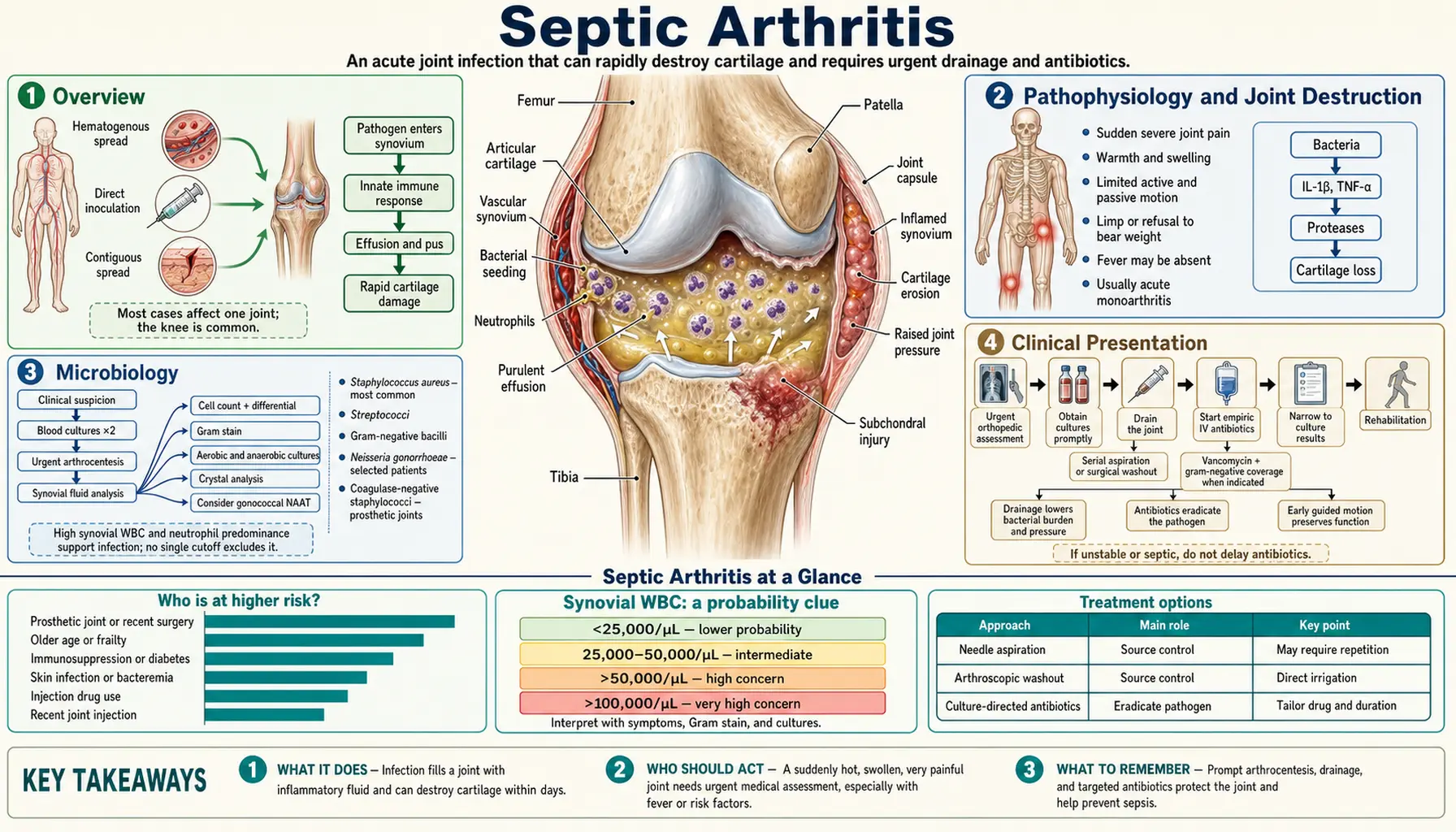
Table of Contents
- Overview
- Pathophysiology and Joint Destruction
- Microbiology
- Clinical Presentation
- Diagnosis and Joint Aspiration
- Differential Diagnosis
- Antibiotic Treatment
- Joint Drainage
- Outcomes and Complications
- Key Research Papers
- PubMed Research Searches
- Connections
- Featured Videos
1. Overview
Septic arthritis is a bacterial infection of the joint space — a true orthopedic emergency. Bacteria within a joint elicit a powerful inflammatory response that rapidly destroys articular cartilage through a combination of direct bacterial proteases, neutrophil-released enzymes, and elevated intra-articular pressure that cuts off synovial blood supply. Permanent cartilage loss can begin within 24–48 hours of infection onset, and irreversible joint damage can be established within 7–10 days. Speed of diagnosis and drainage is the single most important determinant of joint outcome.
Septic arthritis occurs at an estimated rate of 2–10 per 100,000 population per year in developed countries, with higher rates in patients over 65, in those with underlying joint disease (rheumatoid arthritis, osteoarthritis, crystal arthropathy), and in patients with conditions predisposing to bacteremia (intravenous drug use, diabetes, immunosuppression, intravenous catheters). Prosthetic joint infection, a related but distinct entity affecting implanted joint replacements, occurs in approximately 1–2% of knee and hip arthroplasties and is addressed by its own management framework.
The clinical principle that guides initial management is simple and must be the default assumption: any acute monoarthritis should be considered septic arthritis until proven otherwise. The consequences of missing septic arthritis — irreversible joint destruction, septicemia, death — are far worse than the consequences of over-treating gout or another non-infectious arthritis empirically while awaiting culture confirmation.
2. Pathophysiology and Joint Destruction
The synovial membrane is highly vascularized and lacks a basement membrane, making it uniquely accessible to bloodborne bacteria. Once bacteria enter the joint space, the following cascade unfolds:
- Bacterial adhesion and multiplication. S. aureus, the dominant pathogen, expresses multiple adhesins (fibronectin-binding protein A and B, collagen-binding adhesin, bone sialoprotein) that allow it to attach to synovial membrane and articular cartilage. Within hours, bacterial counts can reach 108–109 CFU/mL in infected synovial fluid.
- Neutrophil influx and enzymatic damage. Bacterial products activate complement and toll-like receptors, triggering a massive neutrophil recruitment into the joint space. Neutrophils release proteases (elastase, collagenase, cathepsins) and reactive oxygen species during phagocytosis. The enzymes digest the proteoglycan matrix of articular cartilage, which is not self-renewing — proteoglycan loss is irreversible within days of onset.
- Elevated intra-articular pressure. Purulent exudate accumulates under pressure in the closed joint compartment, compressing synovial vasculature and cutting off synovial fluid production. Cartilage depends on synovial fluid diffusion for nutrition; ischemia accelerates chondrocyte death. In the hip, elevated pressure can also compress the femoral head's blood supply, causing avascular necrosis — a catastrophic complication especially in children.
- Cytokine-mediated bone erosion. Interleukin-1 and TNF-α released by activated macrophages stimulate osteoclast-mediated bone erosion at the joint margins, producing juxta-articular osteopenia and marginal erosions visible on radiographs as early as 2–3 weeks into untreated infection.
- Biofilm and chronicity. If inadequately treated, bacteria on synovial surfaces and within articular cartilage fissures can transition to biofilm communities, making antibiotic eradication increasingly difficult and risking conversion to a chronic destructive arthritis.
3. Microbiology
The microbiology of septic arthritis is age- and risk-factor-dependent:
S. aureus — the dominant pathogen
Staphylococcus aureus is the most common cause of non-gonococcal septic arthritis across all age groups, responsible for approximately 40–50% of cases in adults. MRSA causes 20–30% of S. aureus septic arthritis in high-risk populations (healthcare workers, IVDU, patients from long-term care facilities). S. aureus septic arthritis tends to be severe, with high rates of joint destruction and mortality.
Streptococcal species
Streptococcus pyogenes (Group A Strep), Streptococcus agalactiae (Group B, important in neonates and diabetics), and Streptococcus pneumoniae collectively account for 15–25% of non-gonococcal cases. Group B streptococcal septic arthritis in adults often occurs in patients with diabetes, cirrhosis, or malignancy.
Neisseria gonorrhoeae — in sexually active young adults
Disseminated gonococcal infection (DGI) is the most common cause of septic arthritis in sexually active adults under 40 in the United States. The clinical presentation of DGI has two phases:
- Bacteremic phase: Migratory polyarthralgia (moving from joint to joint), tenosynovitis (particularly of dorsal hand/wrist and Achilles tendon), and characteristic dermatitis (scattered painless necrotic pustules on the trunk and extremities, often fewer than 20 lesions). Blood cultures may be positive.
- Septic joint phase: Purulent monoarthritis develops, most commonly in the wrist, knee, or ankle. Cultures of urogenital, rectal, and pharyngeal sites are more sensitive than synovial fluid culture in DGI (synovial culture positive in only ~25% of cases due to fastidious growth requirements).
DGI responds rapidly to appropriate antibiotics (ceftriaxone 1g IV daily), and joint outcome is generally favorable. Sexual partners must be evaluated and treated. Rising rates of cephalosporin-resistant gonorrhea are an emerging concern worldwide.
Gram-negative bacilli
Gram-negative septic arthritis occurs in neonates, elderly patients with urinary sources, IVDU (with axial joint involvement — sternoclavicular, sacroiliac), and immunocompromised patients. E. coli and Klebsiella are most common. Pseudomonas aeruginosa is specifically associated with IVDU and puncture wounds through footwear.
Kingella kingae in young children
Kingella kingae is a fastidious gram-negative coccobacillus that is the second most common cause of septic arthritis and osteomyelitis in children aged 6 months to 4 years. It colonizes the upper respiratory tract and enters the bloodstream via mucosal disruption during viral infections. Culture sensitivity is greatly improved by inoculating synovial fluid directly into blood culture bottles. Kingella infections tend to be less destructive than S. aureus and respond well to beta-lactam antibiotics.
Unusual pathogens in immunocompromised patients
Patients with HIV, solid-organ transplant, or on biologic DMARDs (TNF inhibitors, JAK inhibitors) are susceptible to unusual organisms: Mycobacterium tuberculosis, atypical mycobacteria (M. marinum from aquatic exposure), Cryptococcus neoformans, Candida species, and Sporothrix schenckii. Synovial biopsy with special stains and cultures for acid-fast bacilli and fungi is required when standard cultures are negative and the host is immunocompromised.
4. Clinical Presentation
The classic presentation of non-gonococcal septic arthritis is acute onset monoarthritis with fever, pain, swelling, warmth, and severely limited range of motion in a single joint. Key features by joint:
Knee (most common, approximately 50% of cases)
Visible effusion, warmth, and exquisite pain with any attempted movement. The patient holds the knee in slight flexion (the position of maximum joint space). The inability to fully extend the knee against gravity is a helpful sign. The knee's large volume means effusions can become massive before causing the pressure complications seen in the hip.
Hip (second most common in adults; most serious in children)
The hip is a deeply situated joint, making physical examination challenging. The patient typically holds the hip in the position of comfort: flexion, abduction, and external rotation (a position that maximizes joint volume). Active and passive range of motion is severely limited and painful in all planes. The hip Patrick test (FABER — flexion, abduction, external rotation) reproduces pain. In children, hip septic arthritis is a surgical emergency due to the risk of avascular necrosis from pressure on the femoral head's blood supply; urgent ultrasound + joint aspiration is mandatory.
Shoulder, ankle, wrist
Each has characteristic effusion signs (subacromial fullness, ankle synovitis above the malleoli, dorsal wrist swelling). The shoulder is the most common site of septic arthritis in IVDU and in patients with rheumatoid arthritis. All sites present with the universal features of acute bacterial arthritis: warmth, swelling, extreme pain with movement, and erythema.
Atypical presentations
Elderly patients, patients on corticosteroids, and immunocompromised patients may present with minimal fever or only subtle joint findings. Patients on biologic DMARDs (which suppress cytokine production) may have blunted inflammatory signs even with established joint infection. A high index of suspicion and low threshold for joint aspiration are essential in these patients.
5. Diagnosis and Joint Aspiration
Joint aspiration is mandatory whenever septic arthritis is suspected. It must not be delayed for imaging or laboratory results. Synovial fluid should be sent for:
- Cell count with differential (most important test)
- Gram stain
- Culture (aerobic and anaerobic; consider fungal and mycobacterial cultures in appropriate hosts)
- Crystal analysis under polarized light microscopy (to assess for gout/pseudogout)
- Glucose and protein (less specific than cell count; not routinely required if WBC available)
Synovial fluid WBC count interpretation
The synovial white blood cell count is the most important diagnostic parameter:
- >100,000 cells/μL with >90% neutrophils: near-diagnostic for septic arthritis; treat empirically as infected pending cultures. Sensitivity ~28%, specificity ~99%.
- 50,000–100,000 cells/μL: Strongly suggestive of septic arthritis; treat empirically. Sensitivity ~62%, specificity ~92%.
- 20,000–50,000 cells/μL: Suspicious; requires integration with clinical context. Crystal arthropathy and inflammatory arthritis (RA, reactive arthritis) can reach these levels. Do not withhold treatment if clinical suspicion is high.
- <20,000 cells/μL: Makes septic arthritis less likely but does not exclude it, especially in immunocompromised patients or partially treated infection.
Critically, crystal arthropathy and septic arthritis can coexist. Finding monosodium urate or calcium pyrophosphate crystals on polarized microscopy does not rule out concurrent bacterial infection. If Gram stain or culture suggests infection in a crystal-containing fluid, treat for both.
Gram stain and culture
Gram stain is positive in approximately 50% of non-gonococcal septic arthritis cases (higher for gram-positive cocci, lower for gram-negative rods). Culture is positive in 70–80% of non-gonococcal cases when obtained before antibiotics. Inoculating synovial fluid into blood culture bottles significantly improves yield for fastidious organisms including Kingella kingae and N. gonorrhoeae.
Blood cultures
Blood cultures should be drawn before antibiotics in all patients. They are positive in approximately 30–50% of hematogenous septic arthritis cases and may be the only positive culture in gonococcal bacteremic phase disease.
Imaging
Plain radiographs are obtained to assess for osteomyelitis, fracture, or pre-existing joint disease, but are normal early in septic arthritis. Ultrasound is the quickest modality for confirming joint effusion and guiding aspiration, especially in deep joints like the hip. MRI with gadolinium can detect early synovitis, periarticular soft tissue involvement, and concurrent osteomyelitis — important when the clinical picture is complex or when adjacent bone infection is suspected.
6. Differential Diagnosis
The differential for acute monoarthritis is critically important because several conditions mimic septic arthritis:
- Crystal arthropathy: Gout (monosodium urate) and pseudogout (calcium pyrophosphate) are the most common mimics. Both can cause fever, elevated WBC, and markedly elevated synovial fluid cell counts. Definitive distinction requires crystal analysis. Key point: crystals do not exclude infection — they can coexist.
- Reactive arthritis (formerly Reiter syndrome): Sterile oligoarthritis triggered by a preceding infection (urogenital Chlamydia, enteric Salmonella, Shigella, Campylobacter). Typically occurs 1–4 weeks after the triggering infection. Synovial WBC typically 10,000–50,000 cells/μL; cultures negative.
- Hemarthrosis: Bloody joint fluid from trauma, anticoagulation, or hemophilia. WBC usually low with predominantly red cells; no organisms. Coagulation studies and trauma history guide the diagnosis.
- Lyme arthritis: In endemic areas, Borrelia burgdorferi causes a monoarthritis typically involving the knee. Synovial WBC can exceed 50,000 cells/μL. Diagnosis by serology (ELISA + Western blot). Important because it requires oral doxycycline, not surgical drainage.
- Inflammatory arthritis: Rheumatoid arthritis, psoriatic arthritis, and spondyloarthropathy can all present with acute flares mimicking infection. Characteristic extra-articular features, prior disease history, negative cultures, and appropriate serology guide the workup. Risk: patients with RA on immunosuppressive therapy can develop septic arthritis that partially mimics a disease flare.
7. Antibiotic Treatment
Antibiotics must be started promptly after joint aspiration and blood cultures are obtained — ideally within the same clinical encounter. Do not delay antibiotics to wait for culture results when the clinical picture strongly suggests infection.
Empiric regimens
- Non-gonococcal, MSSA risk (Gram stain shows gram-positive cocci or no organism identified, low MRSA risk): Nafcillin or oxacillin 2g IV q4h. Superior to vancomycin for confirmed MSSA based on outcomes data (lower mortality, faster bacteremia clearance).
- Non-gonococcal, MRSA risk (IVDU, healthcare-associated, prior MRSA colonization, severe illness): Vancomycin IV dosed by AUC/MIC monitoring (target AUC 400–600 mg·h/L). Alternative: daptomycin 6mg/kg/day IV.
- Gram-negative coverage required (neonates, elderly with urinary source, IVDU, immunocompromised): Ceftriaxone 2g IV daily (most gram-negatives including many enteric organisms) or cefepime 2g IV q8h if Pseudomonas risk. Ciprofloxacin has excellent oral bioavailability and bone/joint penetration for step-down therapy.
- Gonococcal arthritis: Ceftriaxone 1g IV once daily. After clinical improvement (≥24–48 hours), step down to oral cefixime 400mg twice daily or azithromycin if susceptible. Total duration typically 7–14 days. Treat concurrently for Chlamydia trachomatis with azithromycin 1g single dose (co-infection rate ~20–40%).
- Children (<3 months): Antistaphylococcal beta-lactam + gram-negative coverage (e.g. nafcillin + gentamicin or cefotaxime).
Duration of therapy
Standard duration for non-gonococcal septic arthritis is 2–4 weeks, though practice varies. The IDSA recommends 2 weeks minimum for uncomplicated gram-positive septic arthritis and 4 weeks for S. aureus (especially MRSA) or gram-negative infection. Vertebral and hip involvement may warrant longer courses. IV-to-oral step-down after 5–7 days of clinical improvement is supported by the OVIVA trial data when an appropriate oral agent with good bioavailability is available.
8. Joint Drainage
Antibiotics alone are insufficient — drainage of the infected joint is a fundamental component of treatment. Purulent joint fluid must be evacuated to reduce intra-articular pressure, remove proteolytic enzymes, and reduce the bacterial load.
Needle aspiration
Repeated closed needle aspiration, performed daily or every other day until effusion resolves and inflammatory markers trend down, is appropriate for most accessible joints (knee, wrist, ankle). It is less practical for deep joints (hip, shoulder) and when loculation prevents complete drainage.
Arthroscopic drainage and lavage
Arthroscopic irrigation and debridement is the preferred surgical option for most joints when:
- Needle aspiration fails (fluid re-accumulates rapidly, effusion remains thick/loculated).
- The joint is deep and poorly accessible (hip, shoulder).
- There is concurrent osteomyelitis or significant synovial debris requiring mechanical debridement.
- Clinical response is inadequate after 48–72 hours of antibiotics and aspiration.
Arthroscopy allows direct visualization of cartilage damage, thorough lavage of all joint recesses, and synovial biopsy if diagnosis is uncertain. In experienced hands it achieves superior joint clearance compared to needle aspiration alone.
Open surgical drainage
Open arthrotomy (surgical opening of the joint) is specifically indicated for the hip joint in children (to urgently decompress pressure threatening femoral head perfusion), for joints where arthroscopy is not available or technically difficult (sternoclavicular, sacroiliac), and when arthroscopic approaches have failed or there is extensive bone involvement requiring open debridement.
Post-drainage mobilization
Early mobilization and physical therapy after initial drainage is critical for preserving joint function. Immobilization promotes cartilage adhesion and joint stiffness. Range-of-motion exercises should begin as soon as pain permits, typically within 24–48 hours of initial drainage in a well-controlled infection.
9. Outcomes and Complications
The prognosis of septic arthritis depends on the causative organism, the joint involved, time to diagnosis and drainage, and the patient's baseline health:
- Cartilage destruction and chronic arthritis: Approximately 25–50% of patients with septic arthritis develop some degree of permanent joint damage. Risk factors include delay to drainage (>5 days), S. aureus infection, older age, pre-existing joint disease (especially RA), and hip or shoulder involvement.
- Avascular necrosis of the femoral head: The most feared complication of hip septic arthritis in children. Elevated intra-articular pressure cuts off blood supply to the femoral head, causing ischemic necrosis. Urgent surgical decompression (<24 hours of symptom onset when possible) is essential to prevent this outcome.
- Mortality: Septic arthritis still carries a mortality rate of 7–15% in adults, predominantly due to septicemia and multi-organ failure in elderly and immunocompromised patients. S. aureus bacteremia carries particularly high mortality risk (endocarditis, metastatic infection).
- Extension to bone (osteomyelitis): Adjacent bone can become secondarily infected, particularly in infants and at the hip where the metaphysis is intra-articular. This significantly complicates treatment and worsens prognosis.
- Gonococcal arthritis prognosis: Generally excellent with prompt treatment. Permanent joint damage is uncommon compared to non-gonococcal septic arthritis, reflecting the less destructive nature of N. gonorrhoeae in the joint space.
10. Key Research Papers
- Search PubMed — Epidemiology of septic arthritis: incidence, risk factors, and changing demographics; 2.3/100,000/yr in US with rising rates in elderly.
- Search PubMed — Pathophysiology of acute septic arthritis: cartilage destruction mechanisms, cytokine cascade, and rationale for urgent drainage.
- Search PubMed — Systematic review: does this patient have septic arthritis? Likelihood ratios for synovial WBC, fever, and risk factors.
- Search PubMed — Arthroscopic vs. open lavage for septic arthritis: outcomes comparison; arthroscopy associated with improved joint function.
- Search PubMed — Septic arthritis review: clinical features, diagnosis, management, and outcomes; Lancet classic reference.
- Search PubMed — Long-term outcomes of septic arthritis: 33% had persistent functional limitation at 1 year; delay to drainage strongest predictor of poor outcome.
- Search PubMed — Kingella kingae septic arthritis in children: clinical features, culture yield with blood culture bottles, favorable prognosis.
- Search PubMed — Septic arthritis in patients with rheumatoid arthritis on biologic therapy: delayed diagnosis and high mortality in this blunted-inflammatory population.
- Search PubMed — Disseminated gonococcal infection: clinical presentations, rising cephalosporin resistance, treatment recommendations.
- Search PubMed — Oral antibiotics non-inferior to IV for bone and joint infections including septic arthritis at 1 year; supports early oral step-down.
- Search PubMed — Kocher criteria for differentiating septic arthritis from transient synovitis of the hip in children; fever, non-weight-bearing, elevated ESR, elevated WBC predictors.
- Search PubMed — Prognosis of septic arthritis: systematic review; mortality 7–15%, joint damage in 25–50%; organism and delay to drainage are dominant outcome drivers.
11. PubMed Research Searches
The links below run live searches on PubMed, the U.S. National Library of Medicine's database of biomedical literature.
- Septic arthritis treatment outcomes
- Septic arthritis synovial fluid diagnosis
- S. aureus MRSA septic arthritis
- Gonococcal arthritis DGI
- Hip septic arthritis children avascular necrosis
- Septic arthritis arthroscopic drainage
- Septic arthritis vs gout differential diagnosis
- Kingella kingae pediatric joint infection
- Septic arthritis rheumatoid arthritis biologics
- Septic arthritis cartilage destruction pathogenesis
- Reactive arthritis post-infectious monoarthritis
- Prosthetic joint infection septic arthritis
Connections
- Orthopedics
- Osteomyelitis — septic arthritis and osteomyelitis frequently coexist; infection can spread from joint to adjacent bone or from hematogenous seeding of both simultaneously.
- Gout — the most common mimic of septic arthritis; both cause acute monoarthritis with elevated synovial WBC; can coexist; differentiation by crystal analysis is critical.
- Rheumatoid Arthritis — RA patients on DMARDs and biologics have increased susceptibility to septic arthritis with blunted inflammatory signs; a flare may mask underlying infection.
- Osteoarthritis — pre-existing OA and joint arthroplasty create surfaces susceptible to hematogenous bacterial seeding.
- Spinal Stenosis — distinguishing degenerative spinal disease from infectious spondylodiscitis is a critical clinical challenge in back-pain evaluation.
- Diabetes — diabetes impairs neutrophil function and vascular supply, increasing susceptibility to both septic arthritis and osteomyelitis.
- All Conditions — complete disease index.
- Arthritis — the umbrella overview of joint inflammation, including the non-infectious forms that must be distinguished from a septic joint.