Parkinson's Disease: History and Discovery
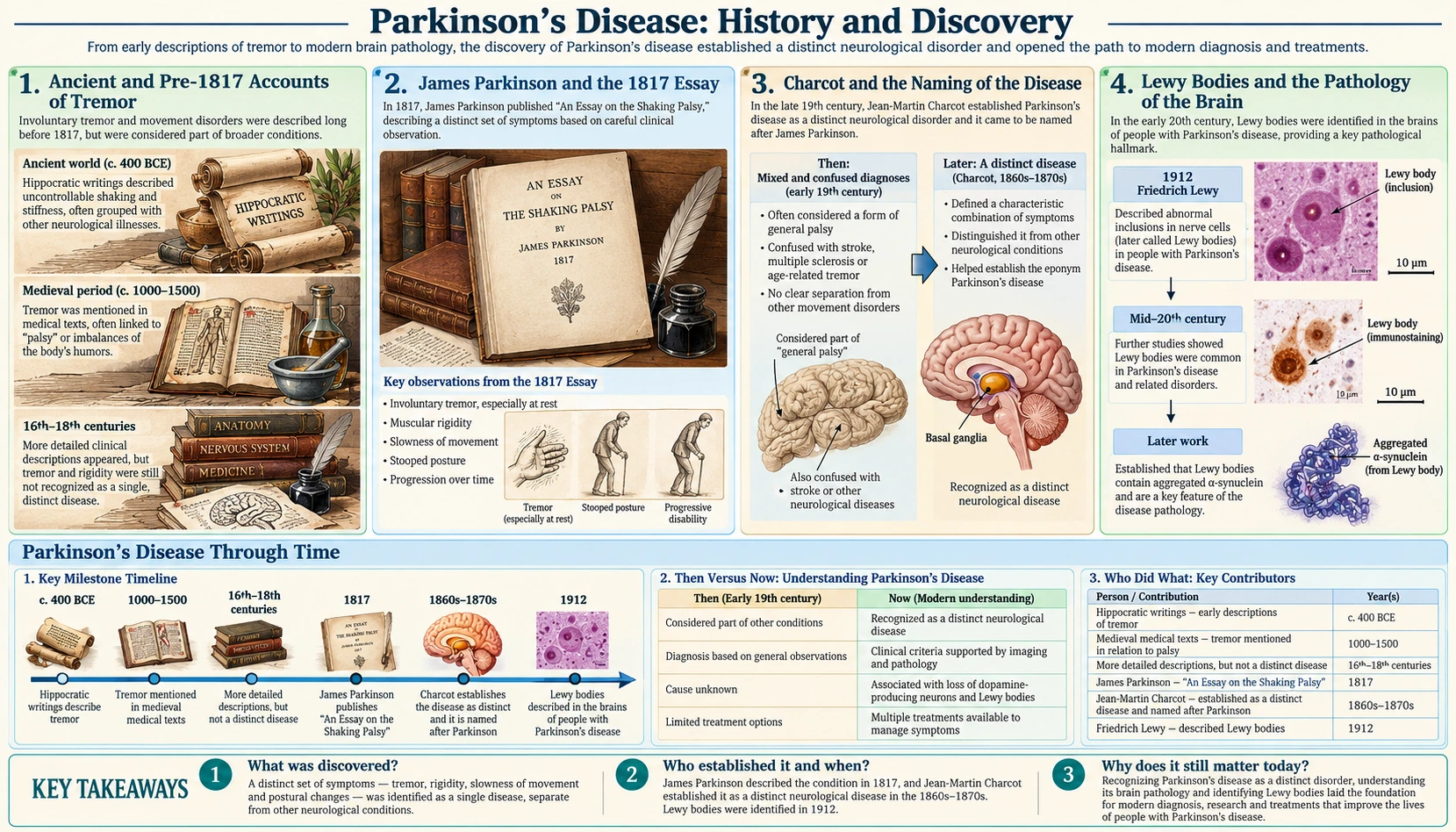
Parkinson's disease carries the name of a London apothecary-surgeon, James Parkinson, who in 1817 published An Essay on the Shaking Palsy — the first systematic clinical description of the disorder he called paralysis agitans. Tremor and shaking had been noticed by physicians since antiquity, but it was Parkinson who first drew the scattered signs into a single recognizable disease. Half a century later the great French neurologist Jean-Martin Charcot refined that picture, separated rigidity and slowness of movement from tremor, and proposed that the condition be named after Parkinson. The twentieth century then uncovered its biology in stages — the Lewy bodies seen down a microscope in 1912, the dying cells of the substantia nigra, the missing brain chemical dopamine (1960), and finally the transforming drug levodopa — turning a mysterious palsy into one of the best-understood neurodegenerative diseases. This page traces that two-hundred-year arc, naming who described what, and when, and flagging where the record is uncertain.
Table of Contents
- Ancient and Pre-1817 Accounts of Tremor
- James Parkinson and the 1817 Essay
- Charcot and the Naming of the Disease
- Lewy Bodies and the Pathology of the Brain
- Discovering the Cause: Substantia Nigra and Dopamine
- From Levodopa to Modern Therapy
- Genetics and the Alpha-Synuclein Era
- Modern Understanding
- Key Research Papers
- Connections
- Featured Videos
Ancient and Pre-1817 Accounts of Tremor
Shaking and tremor are among the most visible of all human afflictions, so it is no surprise that physicians described them long before Parkinson. The honest historical position, however, is that no ancient writer described Parkinson's disease as we now define it. They recorded tremor — a symptom shared by many conditions — and only in retrospect can some of their accounts be read as possible parkinsonism. Several traditions are frequently cited. In the Ayurvedic medical literature of ancient India, a syndrome called Kampavata (from Sanskrit kampa, “tremor”) was described, and scholars have noted that texts attributed to Charaka and later to Madhava grouped tremor with rigidity, slowness, and gait disturbance. The Greek physician Galen, in the second century CE, is often quoted as having distinguished a “shaking palsy.” Both attributions are genuinely discussed in the history-of-medicine literature, but the precise dating and wording are debated, and they should be read as antecedents, not as a diagnosis of modern Parkinson's disease.
The difficulty for all these early sources is that classical and medieval medicine did not yet separate resting tremor (the slow, “pill-rolling” shake of Parkinson's, present when the hand is still) from the many other tremors of fever, fear, old age, alcohol, and other diseases. Without that distinction, “palsy” and “trembling” remained loose, catch-all terms. Renaissance and early-modern physicians — among them Sylvius de la Boë, François Boissier de Sauvages, and others who wrote about tremor and a condition some called scelotyrbe festinans (a hurrying, festinating gait) — edged closer, recording the shuffling, accelerating walk that Parkinson would later make central. Even so, these were fragments.
What James Parkinson did in 1817 was not to notice tremor for the first time — that had been done for millennia — but to gather the resting tremor, the stooped posture, the festinating gait, and the progressive course into one coherent clinical entity and argue that they belonged together. That act of synthesis, not the mere observation of shaking, is why the modern history of the disease begins with him.
James Parkinson and the 1817 Essay
James Parkinson (1755–1824) was an English apothecary and surgeon in Hoxton, then a district on the edge of London, and a man of remarkably broad interests — a political reformer, a campaigner for public health, and an accomplished geologist and palaeontologist whose work on fossils was respected in its own right. In 1817 he published a slim monograph of about sixty-six pages, An Essay on the Shaking Palsy, printed in London by Sherwood, Neely, and Jones. In it he defined the condition he named paralysis agitans — literally “shaking palsy” as “involuntary tremulous motion, with lessened muscular power, in parts not in action and even when supported; with a propensity to bend the trunk forward, and to pass from a walking to a running pace.”
The Essay was based on only six cases, and famously Parkinson did not formally examine all of them: some he studied in his own practice, while others he observed in the streets of London, watching their gait and posture as they passed. Limited as this was, his clinical eye was extraordinary. He captured the resting tremor, the progressive weakening of movement, the forward-stooped posture, the festinating gait, the disturbed sleep, and the slow, relentless advance of the illness over years. With characteristic honesty he noted what he could not establish — he was careful to state that the senses and the intellect appeared spared in his cases, an observation later refined as the cognitive features of advanced disease became understood.
Parkinson also speculated, cautiously, about the cause, suggesting the lesion might lie in the upper spinal cord or medulla — a guess that was wrong in detail but right in spirit, in that he sought a definite anatomical seat for the disease. Crucially, he closed the Essay with a call for others to take up the investigation, anticipating that “anatomical examination” would one day reveal the true nature of the disorder. For a generation, however, the Essay attracted little attention. Its rescue from obscurity, and the elevation of Parkinson's name to permanent association with the disease, came not from London but from Paris.
Charcot and the Naming of the Disease
The figure who transformed paralysis agitans into Parkinson's disease was Jean-Martin Charcot (1825–1893), the founder of modern clinical neurology, working at the Hôpital de la Salpêtrière in Paris. From the 1860s through the 1880s Charcot and his colleagues studied the disorder in far greater depth than Parkinson had been able to, drawing on the large patient population of the Salpêtrière. As early as 1861–1862, Charcot and his collaborator Alfred Vulpian published observations under the title De la paralysie agitante, and Charcot went on to deliver his celebrated clinical lessons on the disease across roughly two decades of teaching at the hospital.
Charcot's contributions were several and substantial. He recognized that rigidity and slowness of movement (what would later be called bradykinesia) were core features in their own right, distinct from tremor — correcting Parkinson's emphasis and noting that some patients had little or no tremor at all. He carefully separated Parkinson's disease from other tremor-producing disorders, most importantly distinguishing it from multiple sclerosis, whose tremor (an action or intention tremor) Charcot showed was different in character. He described the characteristic facial immobility, the small handwriting, and other now-familiar signs, and he even devised therapeutic experiments, including a vibrating chair built after he observed that patients felt better following train and carriage journeys.
It was Charcot who, recognizing that “shaking palsy” was a misleading name — the disease is not strictly a palsy, and not all patients shake — proposed that the condition be called maladie de Parkinson, “Parkinson's disease,” in honour of the English physician who had first delineated it. This act of naming, by the most authoritative neurologist of the age, both immortalized James Parkinson and gave the disease the identity it carries today. The describer (Parkinson) and the man who fixed the eponym (Charcot) are thus two different people, separated by half a century and the English Channel — a distinction worth keeping clear.
Lewy Bodies and the Pathology of the Brain
If the nineteenth century established what Parkinson's disease looked like at the bedside, the twentieth century set out to find what was happening inside the brain. The first major microscopic clue came from the German-born neurologist Friedrich (later Frederic) Lewy (1885–1950). Working in Berlin and Munich, Lewy carried out his key studies in 1910–1911 and published them in 1912 in Lewandowsky's Handbuch der Neurologie. Examining the brains of patients who had died with paralysis agitans, he described abnormal, rounded protein inclusion bodies inside nerve cells in several brainstem regions. These structures — eosinophilic (pink-staining) globular deposits within the neuron's cytoplasm — are now known as Lewy bodies, and they remain a defining pathological hallmark of the disease.
Notably, Lewy himself did not name the bodies after himself, nor did he initially focus on the brain region that would later prove central. The eponym “corps de Lewy” (Lewy bodies) was bestowed by others — the Russian-born neuropathologist Konstantin Tretiakoff, in his pivotal 1919 Paris thesis, applied Lewy's name to the inclusions he found in the substantia nigra (the Spanish neuropathologist Gonzalo Lafora is also associated with promoting the term). This is a useful reminder of how medical eponyms work: the person who first sees something and the person whose name ends up attached to it are frequently not the same.
It would take many further decades to learn what Lewy bodies are actually made of. Only in the late 1990s, following the genetic discoveries described below, was their principal protein constituent identified as aggregated alpha-synuclein. That finding tied the pathology Lewy had seen in 1912 to the disease's molecular biology, and recast Parkinson's as one of a family of “synucleinopathies” that also includes dementia with Lewy bodies. Lewy's lone microscopic observation, made before the First World War, thus turned out to point directly at the molecular heart of the disease.
Discovering the Cause: Substantia Nigra and Dopamine
The trail to the cause of Parkinson's disease ran through a single, ink-dark spot in the midbrain. The substantia nigra (Latin, “black substance,” so called because its cells contain dark pigment) was first linked to the disorder through a remarkable chain of French clinical work. In 1893, Paul Blocq and Georges Marinesco, studying a Salpêtrière patient who had developed one-sided parkinsonian tremor, found at autopsy a tumour confined to the substantia nigra on the opposite side of the brain. Building on this, in 1895 Charcot's pupil Édouard Brissaud proposed the hypothesis — and it was explicitly a hypothesis — that damage to the substantia nigra was the seat of Parkinson's disease.
Brissaud's idea was confirmed in 1919 by Konstantin Tretiakoff, whose Paris doctoral thesis examined the substantia nigra in dozens of brains and demonstrated a consistent, marked loss of its pigmented nerve cells in patients who had suffered from the disease. Tretiakoff received little recognition in his lifetime, yet his observation — degeneration of the pigmented neurons of the substantia nigra — remains the cardinal pathological criterion for diagnosing Parkinson's disease to this day. The structural cause was, in essence, settled: specific cells in a specific place were dying.
The chemical cause emerged in the mid-twentieth century. In 1957 the Swedish pharmacologist Arvid Carlsson showed that dopamine is a neurotransmitter in its own right (not merely a precursor of noradrenaline) and that it is concentrated in the basal ganglia, the brain's motor-control hub; in animals, the dopamine-depleting drug reserpine abolished movement, and giving the dopamine precursor L-dopa restored it. Carlsson's work earned him a share of the Nobel Prize in Physiology or Medicine in 2000. Then, in 1960, Herbert Ehringer and Oleh Hornykiewicz in Vienna measured dopamine directly in post-mortem human brains and found it severely depleted in the striatum of people who had died with Parkinson's disease. The pieces now locked together: the dying nigral cells of Tretiakoff's thesis were the brain's main dopamine producers, and their loss starved the striatum of the dopamine needed for smooth movement. After a century and a half, Parkinson's disease finally had a mechanism.
From Levodopa to Modern Therapy
The discovery of dopamine deficiency pointed immediately to a treatment: if the brain lacked dopamine, perhaps it could be replenished. Dopamine itself cannot cross the protective blood–brain barrier, but its precursor levodopa (L-dopa) can — and once inside the brain it is converted into dopamine. Early trials of levodopa around 1961, including pioneering work by Hornykiewicz with the neurologist Walther Birkmayer in Vienna and others, showed dramatic but brief and inconsistent benefit, and through most of the 1960s the results were disputed and the drug's future uncertain.
The decisive breakthrough came from George Cotzias and colleagues, who in a landmark paper in The New England Journal of Medicine in 1967 reported sustained, striking improvement in Parkinson's patients given high oral doses of levodopa, started low and increased very gradually over weeks. Cotzias's key insight was one of dose and patience: by pushing the dose far higher than earlier investigators had dared, and titrating slowly, he overcame the nausea and inconsistency that had defeated others and unlocked the drug's full effect. Patients who had been rigid and nearly immobile could walk again. Levodopa was approved by the U.S. Food and Drug Administration in 1970 and remains, more than half a century later, the single most effective treatment for the disease.
Subsequent refinements addressed levodopa's limitations. Combining it with a peripheral decarboxylase inhibitor (carbidopa, marketed as Sinemet, or benserazide) prevented its premature conversion outside the brain, sharply reducing nausea and allowing lower doses. Researchers also confronted the drug's hard truth: after years of use, many patients develop motor fluctuations (the “wearing-off” of each dose) and involuntary writhing movements called dyskinesias. Later additions to the toolkit — dopamine-agonist drugs, MAO-B and COMT inhibitors, the surgical technique of deep brain stimulation (electrodes placed in the basal ganglia, refined from the 1980s onward), and continuous drug-delivery systems — were developed to smooth these fluctuations and extend good function. None of these cures the disease, but together they have profoundly changed what it means to live with Parkinson's.
Genetics and the Alpha-Synuclein Era
For most of its history Parkinson's disease was regarded as essentially non-hereditary — a sporadic condition of later life. That assumption was overturned in 1997, when Mihael Polymeropoulos and colleagues, studying a large Italian family and several Greek families with inherited parkinsonism, identified a mutation in the gene SNCA, which encodes the protein alpha-synuclein (reported in Science). It was the first gene definitively linked to Parkinson's disease, and it proved to be a turning point far beyond the relatively rare families it explained.
Within the same year, alpha-synuclein was shown to be the principal protein found inside Lewy bodies — the very inclusions Friedrich Lewy had described in 1912. In a single stroke, this connected the disease's oldest pathological clue, its bedside picture, and its newest genetic finding into one coherent story: misfolded, aggregated alpha-synuclein accumulating in vulnerable neurons. Parkinson's disease was reframed as a synucleinopathy, and the protein became a central target of research into how the disease starts and spreads.
The genetic floodgates then opened. Mutations in further genes — among them LRRK2 (the most common known genetic cause), PARKIN (PRKN), PINK1, DJ-1, and the lysosomal gene GBA — were identified over the following years, each illuminating a different biological pathway: mitochondrial function, the cell's protein- and waste-clearance systems, and inflammation. It is now understood that only a minority of cases are caused by single-gene mutations; most Parkinson's arises from a complex interplay of many small genetic risk factors with environmental exposures (certain pesticides and toxins among them) and ageing. The genetic era did not yield a simple answer, but it handed researchers the molecular handles — alpha-synuclein chief among them — on which today's experimental disease-modifying therapies are built.
Modern Understanding
Two centuries after Parkinson's Essay, the disease is understood as a progressive neurodegenerative disorder defined by two linked features: the loss of dopamine-producing neurons in the substantia nigra, and the accumulation of alpha-synuclein-rich Lewy bodies in surviving nerve cells. But the modern picture is considerably broader than the classic motor triad of tremor, rigidity, and slowness. Pathological studies, notably the staging scheme proposed by Heiko Braak in the early 2000s, suggested that the disease process may begin outside the substantia nigra altogether — possibly in the lower brainstem and even the nerves of the gut and the olfactory system — years before movement symptoms appear, and then spread upward through the brain.
This helps explain why Parkinson's is now recognized to involve a wide range of non-motor symptoms: loss of smell, constipation, and REM-sleep behaviour disorder can precede the tremor by years, while depression, anxiety, cognitive change, and disturbances of blood pressure and the autonomic nervous system are common as the disease advances. The recognition that motor signs may be a relatively late event has reshaped research toward early detection — the search for biomarkers (including alpha-synuclein seed-amplification assays now able to detect the misfolded protein in spinal fluid and other tissues) that might identify the disease before irreversible damage is done.
Therapeutically, the field stands on the foundation laid across this history. Levodopa, born of the 1960 dopamine discovery, remains the cornerstone; deep brain stimulation offers durable relief for selected patients; and an intense international effort now aims at disease-modifying treatments — therapies that would slow or halt the underlying neurodegeneration rather than merely replace dopamine. Many of these target alpha-synuclein, the molecule that ties Friedrich Lewy's 1912 microscope slide to the genetics of 1997. The throughline of the whole story is unbroken: James Parkinson asked what the disease was and where it lived; Charcot sharpened the question and named it; Lewy, Tretiakoff, Brissaud, Carlsson, Ehringer, and Hornykiewicz located it in the brain and its chemistry; Cotzias learned to treat it; and the genetic age is now working to stop it. Each generation answered part of the question Parkinson posed in 1817, and the work continues.
Key Research Papers
The references below combine the landmark primary papers of Parkinson's-disease history with peer-reviewed historical reviews and curated PubMed topic-search links. James Parkinson's An Essay on the Shaking Palsy (1817), Charcot's nineteenth-century lessons, and Lewy's 1912 chapter in Lewandowsky's Handbuch der Neurologie are named in the article as historical primary sources. Each link opens at its publisher or at PubMed (National Library of Medicine) in a new tab.
- Parkinson J. An Essay on the Shaking Palsy (1817; reprinted with commentary). The Journal of Neuropsychiatry and Clinical Neurosciences. 2002;14(2):223-236. — doi:10.1176/jnp.14.2.223
- Goetz CG. The History of Parkinson's Disease: Early Clinical Descriptions and Neurological Therapies. Cold Spring Harbor Perspectives in Medicine. 2011;1(1):a008862. — doi:10.1101/cshperspect.a008862
- Kempster PA, Hurwitz B, Lees AJ. A new look at James Parkinson's Essay on the Shaking Palsy. Neurology. 2007;69(5):482-485. — doi:10.1212/01.wnl.0000266639.50620.d1
- Goetz CG. Charcot on Parkinson's disease. Movement Disorders. 1986;1(1):27-32. — doi:10.1002/mds.870010104
- Holdorff B. Centenary of Lewy bodies (1912-2012). Journal of Neural Transmission. 2014;121(4):389-394. — doi:10.1007/s00702-013-0984-2
- Parent M, Parent A. Substantia Nigra and Parkinson's Disease: A Brief History of Their Long and Intimate Relationship. Canadian Journal of Neurological Sciences. 2010;37(3):313-319. — doi:10.1017/S0317167100010209
- Hornykiewicz O. A brief history of levodopa. Journal of Neurology. 2010;257(Suppl 2):S249-S252. — doi:10.1007/s00415-010-5741-y
- Cotzias GC, Van Woert MH, Schiffer LM. Aromatic amino acids and modification of parkinsonism. New England Journal of Medicine. 1967;276(7):374-379. — doi:10.1056/NEJM196702162760703
- Fahn S. The medical treatment of Parkinson disease from James Parkinson to George Cotzias. Movement Disorders. 2015;30(1):4-18. — doi:10.1002/mds.26102
- Polymeropoulos MH, Lavedan C, Leroy E, et al. Mutation in the alpha-synuclein gene identified in families with Parkinson's disease. Science. 1997;276(5321):2045-2047. — doi:10.1126/science.276.5321.2045
- Spillantini MG, Schmidt ML, Lee VM, Trojanowski JQ, Jakes R, Goedert M. Alpha-synuclein in Lewy bodies. Nature. 1997;388(6645):839-840. — doi:10.1038/42166
- Lees AJ, Hardy J, Revesz T. Parkinson's disease. The Lancet. 2009;373(9680):2055-2066. — doi:10.1016/S0140-6736(09)60492-X
- Arvid Carlsson, dopamine, and the Nobel Prize 2000 — PubMed: Arvid Carlsson dopamine history
- Prehistory and ancient descriptions of parkinsonism (Ayurveda, Galen, early accounts) — PubMed: history of parkinsonism, ancient descriptions
External Authoritative Resources
Connections
- Neurology
- Parkinson's Disease (main article)
- All Conditions
- Alzheimer's Disease
- Multiple Sclerosis
- Huntington's Disease