POTS Diet: Small Frequent Meals & Postprandial Crashes
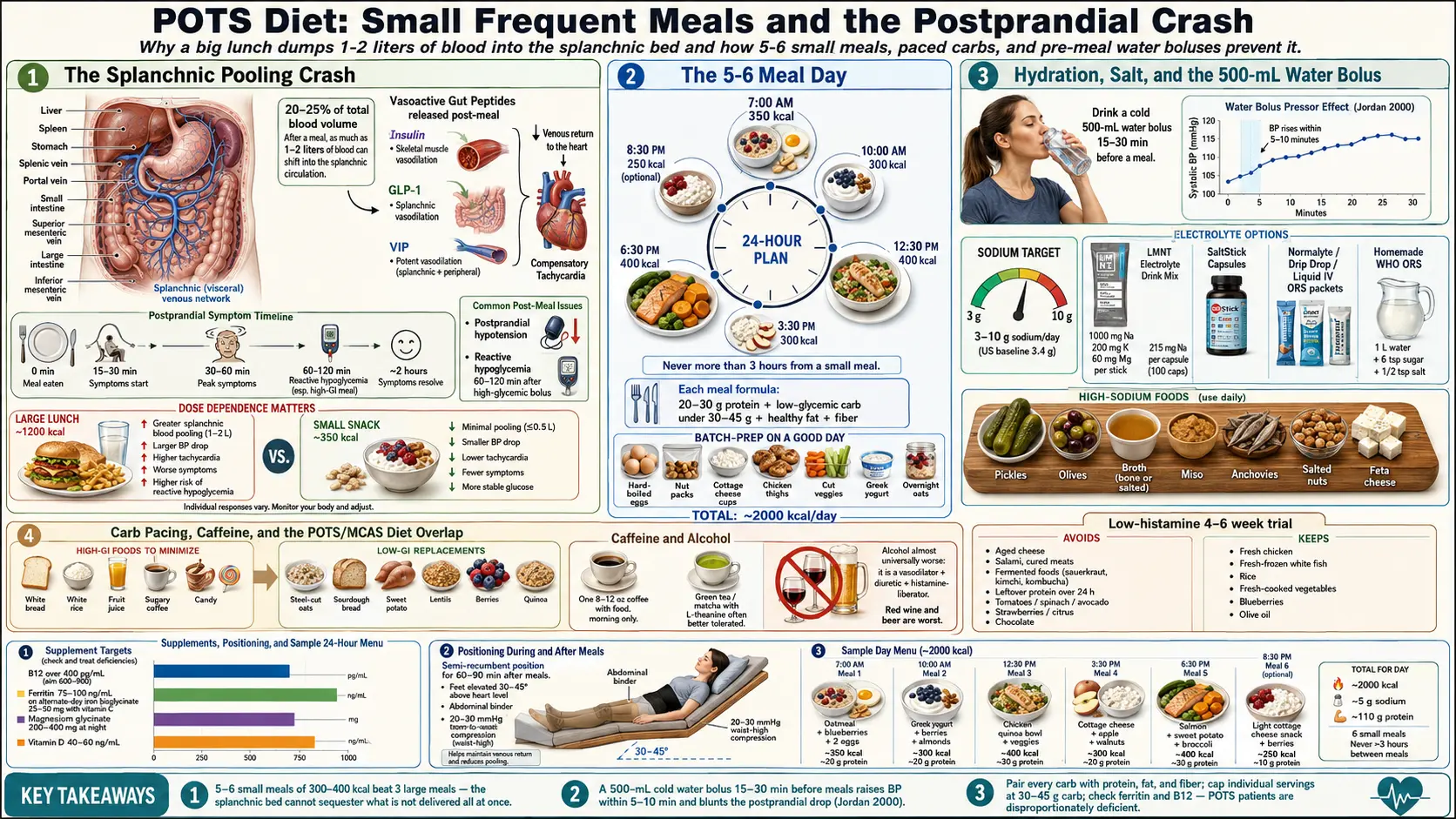
Many people with postural orthostatic tachycardia syndrome (POTS) report that symptoms get worse after eating. A 2018 systematic review from the Vanderbilt Autonomic Dysfunction Center reports that its patients usually describe worsening pre-syncopal symptoms (lightheadedness, the feeling of being about to faint) and tachycardia after meals, particularly meals rich in carbohydrates, and that meals both trigger gastrointestinal symptoms and worsen orthostatic intolerance in POTS (Mehr 2018). The explanation most often given is splanchnic pooling: after a meal, blood flow to the gut rises, and in POTS the circulation may not compensate well for the extra blood held in the abdomen.
This article reports what studies and consensus documents say about meal size, carbohydrate, protein, water, salt, caffeine, alcohol, histamine and gluten in POTS, and where the evidence is thin. The 2015 Heart Rhythm Society (HRS) expert consensus statement and the 2019 National Institutes of Health (NIH) expert consensus meeting give salt and fluid figures; no controlled trial of a complete POTS meal plan was found.
Table of Contents
- Why Meals Can Worsen POTS: Splanchnic Pooling
- Small Frequent Meals: What the Research Reports
- Carbohydrate-Rich Meals and Glucose in POTS
- Protein and Whole-Food Meal Composition
- Water Drinking Around Meals
- Salt and Sodium Figures in the Guidelines
- Caffeine and Alcohol: What the Studies Show
- Mast Cell Activation, Histamine and Gluten
- Nutrient Levels, Gastroparesis Overlap, and Positioning
- Symptom Diaries and Commonly Reported Trigger Foods
- Key Research Papers
- PubMed Topic Searches
- Connections
- Featured Videos
Why Meals Can Worsen POTS: Splanchnic Pooling
The splanchnic circulation is the blood supply of the stomach, intestines, liver, spleen and pancreas. The 2018 review describes it as a larger blood reservoir than the limbs and therefore particularly important during changes of posture and after meals (Mehr 2018).
A Mayo Clinic study measured blood flow in the superior mesenteric artery, the main artery to the intestines, in 11 patients with POTS and 10 controls, lying down and during head-up tilt, before and after a liquid meal. At rest, the POTS group had higher mesenteric blood flow and lower mesenteric vascular resistance than the controls, which the authors read as excessive splanchnic capacity (pooling) at rest in POTS. The test meal raised heart rate, cardiac output and mesenteric blood flow in both groups (Tani 2000).
Several contributors to meal-related falls in blood pressure are listed in a review of postprandial hypotension, a condition mainly of older adults and people with autonomic failure: inadequate sympathetic compensation for meal-induced splanchnic pooling, impaired baroreflex function, an inadequate rise in cardiac output, impaired peripheral vasoconstriction, insulin-induced vasodilation, and the release of vasodilating gastrointestinal peptides. The review defines postprandial hypotension as a fall in systolic blood pressure of 20 mm Hg or more and states that its mechanism is not fully understood (Jansen 1995). In the 2022 POTS glucose study described below, the change was a rise in upright heart rate while blood pressure did not change (Breier 2022).
Small Frequent Meals: What the Research Reports
Smaller, more frequent meals are the dietary change most often described for POTS, but the evidence comes from clinical experience and from a related condition rather than from a POTS trial:
- Clinical experience in POTS. The 2018 Vanderbilt review reports that eating small meals throughout the day and limiting carbohydrate content curbs pre-syncopal symptoms in its patients (Mehr 2018). A 2022 Vanderbilt paper notes that POTS patients eat, on average, three meals and three snacks a day and so spend most of the day in a post-meal state, and lists eating small meals throughout the day among the dietary approaches clinicians prescribe (Breier 2022).
- A meal-size trial in autonomic failure. In 7 people with primary autonomic failure, three large meals were compared with six small meals giving the same total daily calories. Blood pressure was lower after the large meals lying, sitting and standing, fell lower between meals, and 5 of the 7 had more postural dizziness after large meals. The authors conclude that in primary autonomic failure smaller, more frequent meals reduce postprandial hypotension and post-meal postural symptoms (Puvi-Rajasingham 1996). Primary autonomic failure is a different condition from POTS, so the result may not transfer.
No study was found that tested a specific number of meals, a calorie figure per meal or a fixed meal timetable in POTS. The 2018 review also notes that gastrointestinal symptoms can cause significant weight loss and malnutrition in some people with POTS (Mehr 2018).
Carbohydrate-Rich Meals and Glucose in POTS
The most direct test of carbohydrate in POTS is a 2022 Vanderbilt case-control study. Twelve women with POTS who reported that eating made their symptoms worse, and 13 age-matched women without POTS, drank 75 g of glucose. Over the following 120 minutes:
- Upright heart rate rose by 21.2% in the POTS group against 6.0% in controls, and upright stroke volume (the blood pumped per beat) fell by 10.3% against a 3.3% rise in controls. Total peripheral resistance, blood pressure and cardiac output did not change.
- Nutrient absorption, measured with acetaminophen, was similar in both groups.
- The POTS group had higher levels of C-peptide (a marker of insulin secretion), glucose-dependent insulinotropic polypeptide (GIP), peptide YY and pancreatic polypeptide after the glucose. Only GIP, which the authors describe as a splanchnic vasodilator, tracked the worsening upright tachycardia and fall in stroke volume over time (Breier 2022).
The study used a glucose drink, not a mixed meal, and did not compare foods, glycemic index or carbohydrate amounts. No POTS study was found that tested a grams-of-carbohydrate threshold per meal, and no study was found that measured reactive hypoglycemia (a delayed fall in blood sugar after a carbohydrate load) as a cause of post-meal symptoms in POTS. A 2026 Swedish study found that fasting insulin and C-peptide correlated with blood pressure in people with POTS but not in controls, that fasting insulin was not significantly higher in POTS after adjustment for body mass index, and that HbA1c was comparable between groups; the authors call for further study of insulin in POTS (Tufvesson 2026).
Protein and Whole-Food Meal Composition
No study was found that tested protein amount per meal, or protein in place of carbohydrate, as a treatment for post-meal symptoms in POTS. In the 2022 glucose study, pancreatic polypeptide — a hormone the authors note is released mostly after high-protein meals — also rose more in POTS after glucose, but it was not linked to the change in heart rate (Breier 2022).
Whole-food protein sources include eggs, fish such as salmon and sardines, poultry, meat, full-fat yogurt and cheese, beans and lentils, and fermented soy foods such as tempeh, natto and miso. For people who also have mast cell activation syndrome, low-histamine diets as commonly described place aged, smoked, cured and fermented foods, and leftovers, among the higher-histamine foods; the POTS/MCAS/EDS triad article covers that overlap.
Water Drinking Around Meals
The guidance documents pair fluid with salt: up to 2–3 L of water a day in the 2015 HRS statement (Sheldon 2015), at least 2–3 L in the NIH consensus (Vernino 2021), and 2–2.5 L a day in a 2009 Mayo Clinic review, which describes at least one glass or cup of fluid with each meal and at least two at other times of the day (Low 2009).
Drinking water quickly has a measurable short-term effect:
- Blood pressure. In 47 patients with severe autonomic failure, drinking tap water raised seated systolic blood pressure by a maximum of 33 mm Hg (multiple system atrophy) and 37 mm Hg (pure autonomic failure) after 30 to 35 minutes. In 11 older controls systolic pressure rose by 11 mm Hg; it did not rise in 8 young controls. The authors attribute the response to a rise in sympathetic activity (Jordan 2000).
- Heart rate in orthostatic tachycardia. In 9 patients with orthostatic tachycardia (described as idiopathic orthostatic intolerance), 480 mL of tap water drunk in under 5 minutes lowered standing heart rate from 123 to 108 beats/min on average (Shannon 2002).
- After a meal, in autonomic failure. In 7 patients with autonomic failure, blood pressure fell by 43/20 mm Hg after a meal without water and by 22/12 mm Hg when they drank water (Shannon 2002). This was tested in autonomic failure, not in POTS.
The 2009 Mayo review describes a "water bolus" of two 8-ounce glasses drunk one after the other and reports a pressor response sustained for 1–2 hours (Low 2009). No study was found that tested restricting fluid during meals in POTS.
Salt and Sodium Figures in the Guidelines
Water on its own is not retained for long; the guidance pairs it with sodium, which holds water in the circulation. The published figures are stated in different units:
- 2015 HRS consensus: up to 2–3 L of water and 10–12 g of salt (sodium chloride) a day "may be considered" (Class IIb) for patients known or strongly suspected to have low blood volume, if tolerated (Sheldon 2015). That is about 3.9–4.7 g of sodium (Garland 2021).
- 2019 NIH expert consensus meeting (published 2021): sodium increased to 3–10 g of sodium a day from table salt, salt tablets or electrolyte solutions, with at least 2–3 L of water; the document adds that further research is needed to establish the true benefit of salt loading and the optimal sodium intake (Vernino 2021).
- 2009 Mayo Clinic review: 150–250 mEq of sodium (10–20 g of salt) a day for patients with low blood volume (Low 2009).
A 2021 randomized crossover trial in 14 women with POTS found that 6 days of a high-sodium diet (300 mmol a day) increased plasma volume and reduced the rise in heart rate on standing compared with a low-sodium diet, without normalizing it (Garland 2021). The research raises concerns about high salt intake for people with high blood pressure, kidney disease or heart failure. Food sources of sodium (broths, pickles, olives, miso, anchovies, feta and others), oral rehydration solutions, the World Health Organization rehydration formula, salt tablets and the full set of guideline figures are covered on the salt and hydration protocol article. Electrolyte products differ several-fold in sodium per serving, and some contain glucose.
Caffeine and Alcohol: What the Studies Show
Caffeine. No controlled trial of caffeine in POTS was found. The 1995 review of postprandial hypotension notes that caffeine is often recommended for meal-related blood-pressure falls but that the available data do not support its use (Jansen 1995). In the water-drinking study, water raised plasma norepinephrine as much as caffeine and nicotine, which the authors call classic sympathetic stimuli (Jordan 2000). Individual responses to coffee and tea in POTS are reported anecdotally to vary widely; no study measuring that variation was found.
Alcohol. The 2015 HRS statement lists alcohol, with exercise, heat and dehydration, among the factors that commonly worsen POTS symptoms (Sheldon 2015). In a double-blind, placebo-controlled study of 14 healthy young volunteers, alcohol blocked the normal rise in forearm vascular resistance during simulated standing (lower-body negative pressure) and doubled the fall in systolic blood pressure at the strongest level of suction (−14 vs −7 mm Hg); the authors conclude that short-term alcohol intake causes hypotension during orthostatic stress by impairing vasoconstriction (Narkiewicz 2000). That study was in healthy people, not POTS.
Mast Cell Activation, Histamine and Gluten
How common mast cell activation syndrome (MCAS) is in POTS is disputed. A 2026 meta-analysis of 19 studies found that about one-third of POTS patients reported MCAS (36.3%, with a wide 95% confidence interval of 17.8–60.0%) and noted substantial heterogeneity between studies (Kulin 2026). A 2026 report from an allergy group is titled "Lack of evidence for increased mast cell activation syndrome prevalence in postural orthostatic tachycardia syndrome and/or hypermobile Ehlers-Danlos syndrome" (Valdez 2026).
A 2005 Vanderbilt study described POTS patients with mast cell activation, diagnosed by episodes of flushing and raised urine methylhistamine. Their triggers included long periods of standing, exercise, the premenstrual phase, meals and sexual intercourse, and they had a hyperadrenergic response to standing (Shibao 2005).
No trial of a low-histamine diet in POTS was found. Low-histamine diets as commonly described limit aged cheeses, cured and smoked meats, fermented foods and drinks, leftovers, and some fruits and vegetables. The POTS-MCAS-EDS triad article covers the mast cell picture in more detail.
Gluten. Two small studies are the main evidence:
- In 100 patients with POTS in Sheffield, 4% had serology- and biopsy-proven coeliac disease, against 1% of 1,200 local controls (odds ratio 4.1), and 42% reported gluten sensitivity against 19% of matched controls. The authors started the study after noticing that patients were putting themselves on gluten-free diets, and call for a prospective study (Penny 2016).
- In 20 women with POTS and without coeliac disease who had followed a gluten-free diet, autonomic symptom scores (COMPASS-31), completed retrospectively for before and after the diet, fell from a mean of 57.8 before the diet to 38.2 after it. There was no control group, and the authors state that large prospective studies are needed (Zha 2023).
The 2018 systematic review states that there are no well-controlled studies of a gluten-free diet in POTS patients with coeliac disease or non-coeliac gluten sensitivity (Mehr 2018). No controlled trial of a low-FODMAP diet in POTS was found.
Nutrient Levels, Gastroparesis Overlap, and Positioning
Nutrient levels. Small studies, mostly in adolescents, report lower nutrient levels in POTS or related orthostatic intolerance. None tested supplements, and none set target blood levels for POTS:
- Iron. In 24 adolescents with POTS, low iron storage (ferritin of 25 μg/L or less) was found in 50%, against 14% of the normal US pediatric population, and mild anemia was also more common (Jarjour 2013). In 188 adolescents with fatigue or orthostatic intolerance, 47% had low iron stores and 22% were iron deficient, but the heart-rate rise on standing did not correlate with ferritin (Antiel 2011).
- Vitamin D. In the same group of adolescents, 22% had a 25-hydroxyvitamin D of 20 ng/mL or less, and low vitamin D was associated with orthostatic intolerance (Antiel 2011).
- Vitamin B12. In 125 children with vasovagal syncope, those whose test showed a POTS pattern had lower vitamin B12 levels than those without it (Öner 2014).
- Magnesium. No trial of magnesium in POTS was found.
Gastroparesis overlap. A 2026 meta-analysis of 19 studies (8,268 patients) found that 57.9% of people with POTS had at least one gastrointestinal symptom; nausea was the most common (70.1%), followed by bloating, abdominal pain and postprandial fullness (Kulin 2026). The 2018 review names delayed gastric emptying as the most common gastrointestinal abnormality reported in POTS. It describes the dietary measures used in gastroparesis as more liquid-based or blended meals, because liquids empty more normally, and smaller single meals with 6–8 small feedings a day (Mehr 2018). The 2022 American College of Gastroenterology (ACG) guideline recommends a small-particle diet in gastroparesis and reports that small-particle, low-fat diets were better tolerated in the studies it reviewed. For refractory symptoms it suggests metoclopramide over no treatment, and it covers short-term erythromycin and 5-HT4 agonists such as prucalopride (Camilleri 2022). These guidelines are for gastroparesis in general, not POTS specifically.
Positioning and compression. No study was found that tested a body position after meals in POTS. The 2009 Mayo review describes an abdominal binder as reducing splanchnic-mesenteric venous capacity (Low 2009). In a 2021 randomized crossover trial in 30 adults with POTS, heart rate during tilt fell and symptoms improved step by step from no compression to lower-leg, abdominal/thigh and full abdominal/leg compression (Bourne 2021); that trial was not done after meals. Garments and the published exercise program are covered in the compression and exercise program article.
Symptom Diaries and Commonly Reported Trigger Foods
Food-and-symptom diaries, sometimes with heart-rate readings after meals, are widely used by patients and clinics to identify personal patterns. No study validating a particular diary format in POTS was found.
The meal-related triggers described in the studies on this page are:
- Meals rich in carbohydrates (clinical experience reported in Mehr 2018; a 75 g glucose drink in Breier 2022).
- Large meals (tested in primary autonomic failure: Puvi-Rajasingham 1996).
- Alcohol (listed in the HRS statement: Sheldon 2015; studied in healthy volunteers: Narkiewicz 2000).
- Meals as one of several triggers in POTS with mast cell activation (Shibao 2005).
- Gluten, self-reported by some patients (Penny 2016), with only uncontrolled diet data (Zha 2023).
No published sample menu or daily meal plan for POTS has been tested in a trial. The recurring themes in the sources are smaller meals, attention to large carbohydrate loads, generous fluid and salt where they are tolerated and not contraindicated, and compression to limit pooling, alongside management of gastrointestinal and mast cell conditions that overlap with POTS. Decisions about diet, salt and supplements in POTS belong with a clinician.
Key Research Papers
- Low PA, Sandroni P, Joyner M, Shen W-K. Postural tachycardia syndrome (POTS). J Cardiovasc Electrophysiol. 2009;20(3):352–358. — doi:10.1111/j.1540-8167.2008.01407.x
- Raj SR. Postural tachycardia syndrome (POTS). Circulation. 2013;127(23):2336–2342. — doi:10.1161/CIRCULATIONAHA.112.144501
- Jordan J, Shannon JR, Black BK, et al. The pressor response to water drinking in humans: a sympathetic reflex? Circulation. 2000;101(5):504–509. — doi:10.1161/01.CIR.101.5.504
- Jansen RWMM, Lipsitz LA. Postprandial hypotension: epidemiology, pathophysiology, and clinical management. Ann Intern Med. 1995;122(4):286–295. — doi:10.7326/0003-4819-122-4-199502150-00009
- Fu Q, Levine BD. Exercise and non-pharmacological treatment of POTS. Auton Neurosci. 2018;215:20–27. — doi:10.1016/j.autneu.2018.07.001
- Sheldon RS, Grubb BP, Olshansky B, et al. 2015 Heart Rhythm Society Expert Consensus Statement on the Diagnosis and Treatment of Postural Tachycardia Syndrome, Inappropriate Sinus Tachycardia, and Vasovagal Syncope. Heart Rhythm. 2015;12(6):e41–e63. — doi:10.1016/j.hrthm.2015.03.029
- Tani H, Singer W, McPhee BR, et al. Splanchnic-mesenteric capacitance bed in the postural tachycardia syndrome (POTS). Auton Neurosci. 2000;86(1–2):107–113. — PubMed PMID: 11269915
- Mehr SE, Barbul A, Shibao CA. Gastrointestinal symptoms in postural tachycardia syndrome: a systematic review. Clin Auton Res. 2018;28(4):411–421. — PubMed PMID: 29549458
- Breier NC, Paranjape SY, Scudder S, et al. Worsening postural tachycardia syndrome is associated with increased glucose-dependent insulinotropic polypeptide secretion. Hypertension. 2022;79(5):e89–e99. — PubMed PMID: 35232225
- Puvi-Rajasingham S, Mathias CJ. Effect of meal size on post-prandial blood pressure and on postural hypotension in primary autonomic failure. Clin Auton Res. 1996;6(2):111–114. — PubMed PMID: 8726096
- Tufvesson H, Roth B, Johansson M, et al. Gut hormones in POTS and their relation to hemodynamic parameters and gastrointestinal symptoms. Sci Rep. 2026;16(1):15514. — PubMed PMID: 42156945
- Shannon JR, Diedrich A, Biaggioni I, et al. Water drinking as a treatment for orthostatic syndromes. Am J Med. 2002;112(5):355–360. — PubMed PMID: 11904109
- Vernino S, Bourne KM, Stiles LE, et al. Postural orthostatic tachycardia syndrome (POTS): state of the science and clinical care from a 2019 National Institutes of Health Expert Consensus Meeting – Part 1. Auton Neurosci. 2021;235:102828. — PubMed PMID: 34144933
- Garland EM, Gamboa A, Nwazue VC, et al. Effect of high dietary sodium intake in patients with postural tachycardia syndrome. J Am Coll Cardiol. 2021;77(17):2174–2184. — PubMed PMID: 33926653
- Narkiewicz K, Cooley RL, Somers VK. Alcohol potentiates orthostatic hypotension: implications for alcohol-related syncope. Circulation. 2000;101(4):398–402. — PubMed PMID: 10653831
- Kulin D, Shah A, Fairlie T, et al. Gastrointestinal symptoms and systemic comorbidities in patients with POTS: a systematic review and meta-analysis. Neurogastroenterol Motil. 2026;38(4):e70305. — PubMed PMID: 41952073
- Valdez JA, Gansert E, Bhuiyan FJ, et al. Lack of evidence for increased mast cell activation syndrome prevalence in postural orthostatic tachycardia syndrome and/or hypermobile Ehlers-Danlos syndrome. J Allergy Clin Immunol Pract. 2026 (online ahead of print). — PubMed PMID: 42595300
- Shibao C, Arzubiaga C, Roberts LJ 2nd, et al. Hyperadrenergic postural tachycardia syndrome in mast cell activation disorders. Hypertension. 2005;45(3):385–390. — PubMed PMID: 15710782
- Penny HA, Aziz I, Ferrar M, et al. Is there a relationship between gluten sensitivity and postural tachycardia syndrome? Eur J Gastroenterol Hepatol. 2016;28(12):1383–1387. — PubMed PMID: 27606948
- Zha K, Brook J, McLaughlin A, et al. Gluten-free diet in postural orthostatic tachycardia syndrome (POTS). Chronic Illn. 2023;19(2):409–417. — PubMed PMID: 35098721
- Jarjour IT, Jarjour LK. Low iron storage and mild anemia in postural tachycardia syndrome in adolescents. Clin Auton Res. 2013;23(4):175–179. — PubMed PMID: 23720007
- Antiel RM, Caudill JS, Burkhardt BE, et al. Iron insufficiency and hypovitaminosis D in adolescents with chronic fatigue and orthostatic intolerance. South Med J. 2011;104(8):609–611. — PubMed PMID: 21886073
- Öner T, Guven B, Tavli V, et al. Postural orthostatic tachycardia syndrome (POTS) and vitamin B12 deficiency in adolescents. Pediatrics. 2014;133(1):e138–e142. — PubMed PMID: 24366986
- Camilleri M, Kuo B, Nguyen L, et al. ACG clinical guideline: gastroparesis. Am J Gastroenterol. 2022;117(8):1197–1220. — PubMed PMID: 35926490
- Bourne KM, Sheldon RS, Hall J, et al. Compression garment reduces orthostatic tachycardia and symptoms in patients with postural orthostatic tachycardia syndrome. J Am Coll Cardiol. 2021;77(3):285–296. — PubMed PMID: 33478652
PubMed Topic Searches
For further reading, the following PubMed topic searches return current peer-reviewed work on POTS, postprandial physiology, and dietary management:
- POTS and diet
- Postprandial hypotension
- Splanchnic pooling and orthostatic intolerance
- Water bolus pressor response
- POTS, salt loading, and plasma volume
- POTS and mast cell activation (MCAS)
- POTS and gastroparesis overlap
- POTS, iron deficiency, and ferritin
- POTS, compression garments, and abdominal binders
- Reactive hypoglycemia and autonomic dysfunction
Connections
- Neurology
- POTS Overview
- Compression and Exercise Program
- Salt and Hydration Protocol
- POTS-MCAS-EDS Triad
- Medications Guide
- POTS Subtypes
- Vagus Nerve and Autonomic Retraining
- Low-Dose Naltrexone for POTS
- Tilt Table and NASA Lean Test
- Mast Cell Activation Syndrome (MCAS)
- Ehlers-Danlos Syndrome
- Magnesium
- Salmon
- Sardines
- Potassium
- Olive Oil