Compression Garments and the CHOP/Dallas Exercise Program for POTS
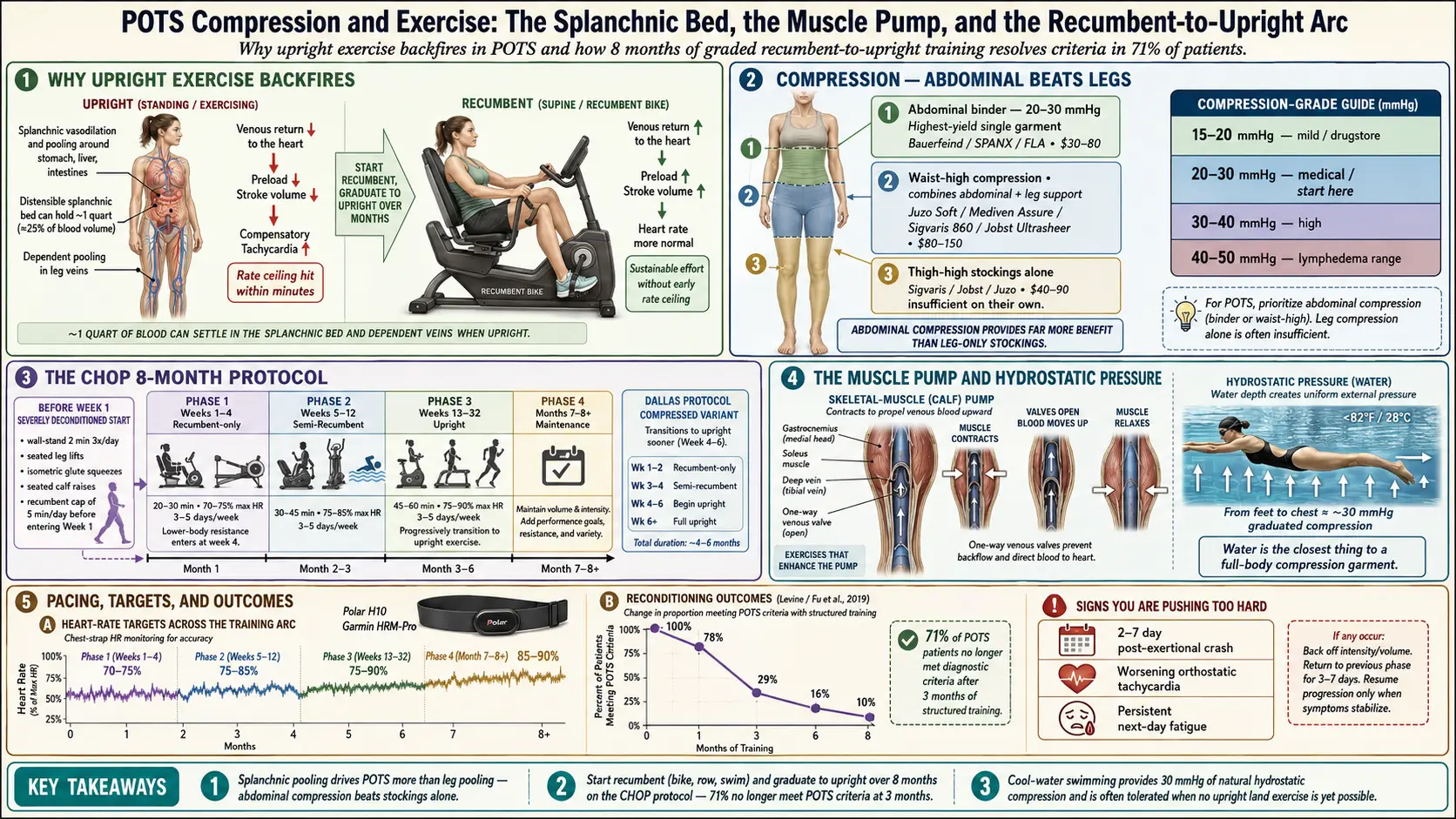
Table of Contents
- Why Upright Exercise Is Hard in POTS
- How Compression Works
- Compression Levels in the Studies
- Garment Types Studied
- What Patients Report About Wearing Garments
- The Published 3-Month Training Program
- CHOP, Dallas and Levine: What the Names Refer To
- When Patients Start Severely Deconditioned
- Resistance Training in the Published Program
- Swimming and Water Exercise
- Heart-Rate Zones in the Published Program
- Overexertion and Post-Exertional Symptoms
- How Exercise Fits With Other Treatments
- What the Studies Report Over Time
- Key Research Papers
- Connections
- Featured Videos
1. Why Upright Exercise Is Hard in POTS
Exercise intolerance is part of the POTS picture. The 2015 Heart Rhythm Society (HRS) expert consensus statement lists it among the symptoms that occur with standing, notes that patients with POTS often have poor exercise tolerance and deconditioning, and lists exercise, heat, dehydration and alcohol among the things that commonly make symptoms worse (Sheldon 2015). The 2022 CMAJ review by Raj, Fedorowski and Sheldon reports that more than 90% of patients with POTS have chronic fatigue and at least half meet criteria for myalgic encephalomyelitis/chronic fatigue syndrome (ME/CFS) (Raj 2022).
The Dallas group of Qi Fu and Benjamin Levine measured why. In 27 patients, upright heart rate was higher and stroke volume and cardiac output were lower than in 16 healthy controls; left ventricular mass (1.26 vs 1.45 g/kg) and blood volume (60 vs 71 mL/kg) were smaller, and autonomic function tests were intact. The authors attributed the tachycardia on standing to “a small heart coupled with reduced blood volume” (Fu 2010). In a later exercise-testing study, peak oxygen uptake was lower in POTS than in sedentary controls (26.1 vs 36.3 mL/kg/min) because of a lower peak stroke volume; when heart rate was expressed against relative workload, it did not differ from that of healthy people (Shibata 2012; Fu 2015).
Because the upright posture itself brings on symptoms, the published training programs begin with exercise done lying down or semi-reclined. The HRS statement describes initial exercise restricted to non-upright forms — rowing machines, recumbent cycles and swimming — “to minimize orthostatic stress on the heart” (Sheldon 2015), and Fu and Levine describe recumbent or semi-recumbent training at the start as “critical” (Fu 2018).
2. How Compression Works
On standing, gravity shifts about 700 to 900 mL of blood from the central circulation to the lower body, and excessive venous pooling is considered one major cause of orthostatic intolerance. Studies have reported increased venous pooling in the legs of patients with POTS during upright posture, and excessive pooling in the splanchnic (abdominal-organ) circulation at rest and when upright (reviewed in Fu 2018). Compression garments press on these veins and reduce the pooling; the HRS statement lists “reducing venous pooling with compression garments” among the non-drug treatments to try first (Sheldon 2015).
Which part of the body is compressed matters. In a 1997 study of 14 patients with neurogenic orthostatic hypotension (a different condition from POTS) using a modified anti-gravity suit, compressing all compartments was the most effective, the abdomen was the only single compartment whose compression significantly reduced the blood-pressure fall, and leg compression alone was less effective (Denq 1997). Fu and Levine attribute this to the large capacity of the abdomen relative to the legs and describe abdomen-high rather than knee- or thigh-high garments for POTS (Fu 2018).
A 2021 randomized crossover trial from Calgary, whose authors note that waist-high compression had not previously been evaluated in adults with POTS, tested it directly. Thirty participants each had four 10-minute head-up tilt tests in random order: no compression, lower-leg compression, abdominal/thigh compression, and full abdominal/leg compression. Heart rate fell and symptoms improved in a dose-dependent manner across the four conditions; stroke volume and systolic blood pressure were better maintained with full and abdominal compression than with leg-only or none. The authors concluded that the effect was driven by improved stroke volume and that abdominal compression alone “might also provide a clinical benefit if full lower body compression is not well tolerated” (Bourne 2021). The 2022 CMAJ review lists waist-high compression garments in its suggested initial approach (Raj 2022).
3. Compression Levels in the Studies
Compression garments are graded by the pressure they apply, in millimetres of mercury (mmHg). None of the POTS trials cited on this page establishes a best pressure grade for POTS, and the trial abstracts report the garment’s coverage (lower leg, abdomen and thigh, waist-high, abdomen only) rather than a grade. In the 2021 crossover trial, mean heart rate during tilt was 109 beats/min with no compression, 103 with lower-leg compression, 97 with abdominal/thigh compression and 92 with full abdominal/leg compression (Bourne 2021), as drawn below.
The only pressure comparison found for abdominal compression comes from a different condition. In patients with neurogenic orthostatic hypotension, 40 mmHg of abdominal compression raised blood pressure more than 20 mmHg (mean 18/8 vs 9/4 mmHg), and an elastic abdominal binder raised standing blood pressure by 15/6 mmHg on average, with wide individual variation (Smit 2004). Results in orthostatic hypotension may not transfer to POTS.
4. Garment Types Studied
Waist-High Garments and Tights
Full abdominal/leg compression gave the lowest heart rate in the 2021 tilt trial (Bourne 2021). A 2025 community-based trial then tested commercially available compression tights in 26 participants in a community setting. With heart-rate medicines held, standing heart rate was 105 beats/min with the tights on versus 119 with them off in the morning; with medicines taken as usual it was 84 versus 89. In both protocols, standing heart rate and symptoms rose again when the garment was removed after several hours of wear (Bourne 2025).
Abdominal-Only Garments and Binders
A 2026 trial from the same group tested commercially available abdominal-only garments in a one-day study with heart-rate medicines held. In the morning, standing heart rate was 103 beats/min with the garment versus 118 without, the rise in heart rate from lying to standing was 27 versus 41, and symptom scores were 29 versus 35 on a 0–90 scale (medians). The authors describe abdominal garments as a possible alternative to full waist-high garments (Bourne 2026). Fu and Levine describe either lower-body garments extending at least to the xiphoid (the bottom of the breastbone) or an abdominal binder (Fu 2018).
Leg-Only Stockings
Lower-leg compression produced the smallest heart-rate change of the three garment conditions in the 2021 trial (Bourne 2021), and leg compression alone was the least effective option in the 1997 orthostatic hypotension study (Denq 1997).
Ease of Wear
Fu and Levine note that one-piece commercial gradient garments are difficult to put on and take off, even with assistance, which leads to low use. They describe a custom-fit three-piece abdomen-high garment (two leg stockings and biker-style shorts, with zippers) developed by NASA and report that their own pilot studies found it reduced heart rate by about 10 beats/min during a 5-minute stand test; they state that these preliminary observations need confirming in more patients (Fu 2018).
5. What Patients Report About Wearing Garments
A Calgary study surveyed 27 patients with POTS and interviewed 20 of them about compression garments. Experiences varied: some participants reported significant benefit and others minimal or none. Six themes influenced whether a garment was worn — its expected benefit for symptoms, the activities planned for the day, environmental conditions, the garment’s own attributes, psychological and cognitive aspects, and cost. The authors describe patients as making “a daily cost-benefit analysis” about wearing one (Bourne 2024).
Garments are sold in many styles and pressure grades, and insurance coverage and prescription requirements differ between insurers and countries. Decisions about medical-grade garments belong with a clinician.
6. The Published 3-Month Training Program
The structured program tested in the Dallas trials was first developed as a countermeasure for spaceflight and head-down bed rest, and was then studied in POTS in a research setting and in a community registry (Fu 2018). The HRS statement gives “a regular, structured, and progressive exercise program” a Class IIa recommendation (“can be effective”), describing it as graduated and supervised, with aerobic reconditioning and some resistance training for the thighs (Sheldon 2015).
Fu and Levine’s 2018 review describes the program for the first 3 months:
- Month 1: rowing, swimming or a recumbent bike only. Patients train 3 to 4 times a week for 25 to 30 minutes.
- Month 2: the month-1 forms plus an upright bike.
- Month 3: the earlier forms plus elliptical and treadmill walking. Upright exercise — upright cycling, treadmill walking or jogging — is added by the end of the second month or the start of the third.
- By the end of month 3: 5 to 6 sessions a week of 45 to 60 minutes.
- Each endurance session has a 5-minute warm-up and a 5-minute cool-down; harder sessions are added first once every two weeks and then once a week, and are always followed by recovery sessions (Fu 2018).
The individual trials reported their own versions. In the 2010 and 2011 trials, patients initially trained 2 to 4 times a week for 30 to 45 minutes on a recumbent bike, rowing machine or in a pool (Fu 2010; Fu 2011). The community registry used mild- to moderate-intensity endurance training progressing from semi-recumbent to upright, 3 to 5 times a week for 30 to 45 minutes, plus strength training, together with increased salt and water intake (George 2016).
7. CHOP, Dallas and Levine: What the Names Refer To
The program published by Benjamin Levine’s group in Dallas (the Institute for Exercise and Environmental Medicine and UT Southwestern) is the one tested in the trials on this page, and it is often called the Dallas or Levine protocol. Adapted versions are circulated by individual clinics, including one associated with the Children’s Hospital of Philadelphia (CHOP). No separately published trial of a CHOP schedule, or of a faster or slower variant of the Dallas schedule, was found in PubMed; the schedule described in the previous section is the one the Dallas group published.
Fu and Levine describe the program as a set of guidelines that is modified for some patients (Fu 2018), and the next sections report the modifications they describe.
8. When Patients Start Severely Deconditioned
The Dallas group reports that even the most symptomatic patients in its 2011 trial completed the training, and attributes this partly to avoiding upright exercise in the early stage (Fu 2011). Modifications described in the 2018 review include:
- Splitting a session that cannot be completed without a break — for example, two 15-minute sessions with 10 minutes of rest in between instead of 30 minutes at once.
- Repeating a whole week before moving forward if not all of that week’s sessions were completed; after a missed period, backing up in the schedule, possibly returning to the horizontal forms (recumbent bike, swimming, rowing), and considering starting over after a break of more than two weeks.
- Spreading workouts through the week rather than bunching them, with no more than 2 days off in a row.
- For patients who also have hypermobile Ehlers-Danlos syndrome: beginning with non-weight-bearing swimming or rowing at the easiest training zone, elbow and knee braces, slow increases, and physical therapy alongside supervised training (Fu 2018).
Completion is a real limit. Training was completed by 76% of patients in the research setting and by 41% in the community registry, and the reasons given for stopping included other medical problems, cost or lack of access to equipment, and finding the training too difficult (Fu 2018; George 2016). In a 6-month unsupervised home program in Boston, 48 of 77 invited patients took part and 43 completed it (Gibbons 2021).
9. Resistance Training in the Published Program
The program adds resistance training for the lower body and core, because leg muscles act as pumps that push venous blood back toward the heart when they contract (Fu 2018). As described in the 2018 review:
- Weight training begins once a week for 15 to 20 minutes and builds to twice a week for 30 to 40 minutes.
- All sessions use seated equipment; free weights are left out until the patient is stronger and fitter.
- The starting set is 2 sets of 10 repetitions of seated leg press, leg curl, leg extension, calf raise, chest press and seated row, with the weight increased once more than 10 repetitions are possible on the second set.
- Core work on the floor (such as abdominal crunches, back extensions or side planks) is added, 2 sets of 10 to 20 repetitions.
- At least a day of rest separates resistance workouts; muscle soreness is described as common early on, especially two days after a workout (Fu 2018).
10. Swimming and Water Exercise
Swimming is one of the three non-upright forms of exercise the HRS statement names for the start of training, alongside rowing machines and recumbent cycles (Sheldon 2015), and it is one of the month-1 forms in the Dallas program (Fu 2018). The horizontal body position is the reason given in both documents. The surrounding water also presses on the submerged body, but no study measuring that effect in POTS was found for this page.
Heat is relevant to any setting: the HRS statement lists heat among the factors that commonly worsen POTS symptoms (Sheldon 2015), and the 2022 CMAJ review notes that heat and cold intolerance are commonly reported (Raj 2022).
11. Heart-Rate Zones in the Published Program
The Dallas program sets three training zones from the predicted maximal heart rate (220 minus age, ±5 beats/min) and the resting heart rate (Fu 2018):
- Base pace: about 75% of predicted maximal heart rate, a perceived exertion of 13–15 on a 6–20 scale (“somewhat hard” to “hard”). Most sessions, especially early on, are at this level.
- Maximal steady state: perceived exertion 16–18 (“very hard”), added once the patient is fitter.
- Recovery: perceived exertion 6–12, below the lowest base-pace heart rate.
Patients in the program are encouraged to monitor heart rate during every session with a chest-strap monitor. Fu and Levine note that beta-blockers, other medicines and underlying autonomic disorders can change the heart-rate response, so that patients who stay on beta-blockers gauge workouts by perceived exertion instead; in the registry, most clinicians chose to wean patients off their previous medicines before or during training (Fu 2018).
12. Overexertion and Post-Exertional Symptoms
The training trials do not publish a validated list of warning signs or a set rule for scaling back. What the sources describe:
- Exercise is one of the factors that commonly worsens POTS symptoms (Sheldon 2015).
- At least half of patients with POTS meet criteria for ME/CFS (Raj 2022), a condition in which symptoms worsen after exertion; pacing for that condition is covered on the Pacing and Energy Envelope page.
- Fu and Levine write that many patients have increased fatigue or a worsening of other POTS symptoms when they start the program, and that in their experience these symptoms abate as patients work through it. Within the program, a week whose sessions were not all completed is repeated, sessions can be split, and muscle soreness in the first weeks is described as common (Fu 2018).
13. How Exercise Fits With Other Treatments
The HRS statement describes non-drug treatments as the first step for all patients: withdrawing medicines that can worsen POTS (such as norepinephrine reuptake inhibitors), increasing blood volume with more salt and fluid, reducing venous pooling with compression garments, and limiting deconditioning (Sheldon 2015). In the community registry, the exercise program was delivered together with increased salt and water intake (George 2016). Fu and Levine also describe sleeping with the head of the bed raised, compression garments, and physical countermeasures such as leg crossing, muscle tensing and squatting (Fu 2018).
- Salt and fluids: the 2015 HRS figures are up to 2–3 L of water and 10–12 g of salt (sodium chloride) a day, as a Class IIb recommendation (Sheldon 2015). The guideline figures are compared on the Salt & Hydration Protocol page.
- Medicines: in the 2011 trial, propranolol and exercise training both lowered standing heart rate, but quality-of-life scores improved after training and not after propranolol (Fu 2011). The medicines used in POTS are covered on the Medications Guide page.
14. What the Studies Report Over Time
- 3 months, research setting (Dallas, 2010): 25 patients began and 19 completed. Training increased left ventricular mass by about 12% and blood volume by about 7%, lowered upright heart rate by 9 beats/min, and improved quality of life in all completers; 10 of the 19 no longer met POTS criteria (Fu 2010).
- 3 months, exercise physiology (Dallas, 2012): peak oxygen uptake rose by 11%, heart rate was lower at any given oxygen uptake, and heart-rate recovery after exercise was faster (Shibata 2012).
- 3 months, community registry (2016): 251 patients enrolled through their own physicians and 103 completed. Of the completers, 71% no longer qualified for POTS; the rise in heart rate on a 10-minute stand fell from 46 to 23 beats/min, and in the 31 followed for 6–12 months the effect persisted (George 2016). Across the Dallas research studies, the pooled figure was 53% (Fu 2018).
- 3 months, randomized trial in military recruits (Vienna, 2005): after a jogging program, 6 of 16 trained recruits still had orthostatic intolerance, compared with 10 of 11 controls (Winker 2005). This trial studied orthostatic intolerance found by screening, not POTS patients referred to clinics.
- 6 months, unsupervised home program (Boston, 2021): 11 of 48 participants (23%) still met heart-rate criteria for POTS, compared with 27 of 29 (93%) of the invited patients who did not take part; supine and standing heart rates and the frequency of fainting fell, and quality-of-life scores rose (Gibbons 2021). The comparison group was not randomized.
The registry authors state that it remains to be determined whether exercise can be an effective long-term treatment for POTS (George 2016), and Fu and Levine write that randomized trials are still needed for the other non-drug treatments (Fu 2018).
Key Research Papers
- Fu Q, Vangundy TB, Shibata S, et al. Exercise training versus propranolol in the treatment of the postural orthostatic tachycardia syndrome. Hypertension. 2011;58(2):167–175. — doi:10.1161/HYPERTENSIONAHA.111.172262
- Raj SR. Postural tachycardia syndrome (POTS). Circulation. 2013;127(23):2336–2342. — doi:10.1161/CIRCULATIONAHA.112.144501
- Sheldon RS, Grubb BP 2nd, Olshansky B, et al. 2015 Heart Rhythm Society expert consensus statement on the diagnosis and treatment of postural tachycardia syndrome, inappropriate sinus tachycardia, and vasovagal syncope. Heart Rhythm. 2015;12(6):e41–e63. — doi:10.1016/j.hrthm.2015.03.029
- Fu Q, Levine BD. Exercise in the postural orthostatic tachycardia syndrome. Auton Neurosci. 2015;188:86–89. — doi:10.1016/j.autneu.2014.11.008
- Fu Q, Vangundy TB, Galbreath MM, et al. Cardiac origins of the postural orthostatic tachycardia syndrome. J Am Coll Cardiol. 2010;55(25):2858–2868. — PubMed PMID: 20579544
- Shibata S, Fu Q, Bivens TB, et al. Short-term exercise training improves the cardiovascular response to exercise in the postural orthostatic tachycardia syndrome. J Physiol. 2012;590(15):3495–3505. — PubMed PMID: 22641777
- George SA, Bivens TB, Howden EJ, et al. The international POTS registry: evaluating the efficacy of an exercise training intervention in a community setting. Heart Rhythm. 2016;13(4):943–950. — PubMed PMID: 26690066
- Fu Q, Levine BD. Exercise and non-pharmacological treatment of POTS. Auton Neurosci. 2018;215:20–27. — PubMed PMID: 30001836
- Winker R, Barth A, Bidmon D, et al. Endurance exercise training in orthostatic intolerance: a randomized, controlled trial. Hypertension. 2005;45(3):391–398. — PubMed PMID: 15699447
- Gibbons CH, Silva G, Freeman R. Cardiovascular exercise as a treatment of postural orthostatic tachycardia syndrome: a pragmatic treatment trial. Heart Rhythm. 2021;18(8):1361–1368. — PubMed PMID: 33482385
- Bourne KM, Sheldon RS, Hall J, et al. Compression garment reduces orthostatic tachycardia and symptoms in patients with postural orthostatic tachycardia syndrome. J Am Coll Cardiol. 2021;77(3):285–296. — PubMed PMID: 33478652
- Bourne KM, Karalasingham K, Siddiqui T, et al. A community-based trial of commercially available compression tights in patients with postural orthostatic tachycardia syndrome. JACC Clin Electrophysiol. 2025;11(1):179–190. — PubMed PMID: 39614865
- Bourne KM, Karalasingham K, Siddiqui T, et al. Abdominal-only compression garments reduce orthostatic tachycardia and improve symptoms in patients with postural orthostatic tachycardia syndrome. Can J Cardiol. 2026;42(6):1320–1328. — PubMed PMID: 41338488
- Bourne KM, Sheldon RS, Exner DV, et al. One size does not fit all: an exploration of compression garment use in patients with postural orthostatic tachycardia syndrome. CJC Open. 2024;6(11):1324–1333. — PubMed PMID: 39582711
- Denq JC, Opfer-Gehrking TL, Giuliani M, et al. Efficacy of compression of different capacitance beds in the amelioration of orthostatic hypotension. Clin Auton Res. 1997;7(6):321–326. — PubMed PMID: 9430805
- Smit AA, Wieling W, Fujimura J, et al. Use of lower abdominal compression to combat orthostatic hypotension in patients with autonomic dysfunction. Clin Auton Res. 2004;14(3):167–175. — PubMed PMID: 15241645
- Raj SR, Fedorowski A, Sheldon RS. Diagnosis and management of postural orthostatic tachycardia syndrome. CMAJ. 2022;194(10):E378–E385. — PubMed PMID: 35288409
PubMed Topic Searches
Curated PubMed topic searches — each link opens a live query so you always see the most recent literature.
- PubMed: POTS exercise training
- PubMed: CHOP protocol for POTS
- PubMed: Recumbent exercise in orthostatic intolerance
- PubMed: Compression garments for POTS
- PubMed: Abdominal compression for orthostatic intolerance
- PubMed: POTS deconditioning reversal
- PubMed: Levine POTS exercise studies
- PubMed: Swimming and orthostatic intolerance
Connections
- Neurology
- POTS Overview
- Medications Guide
- Salt & Hydration Protocol
- POTS Subtypes
- Tilt-Table & NASA Lean Test
- Vagus Nerve & Autonomic Retraining
- POTS-MCAS-EDS Triad
- Low-Dose Naltrexone for POTS
- MCAS
- Fibromyalgia
- Chronic Fatigue Syndrome
- Ehlers-Danlos Syndrome
- POTS Diet
- Magnesium
- Exercise Pacing and Graded Movement
- Pacing and Energy Envelope
- Physical Therapy and Joint Protection