Myasthenia Gravis: History and Discovery
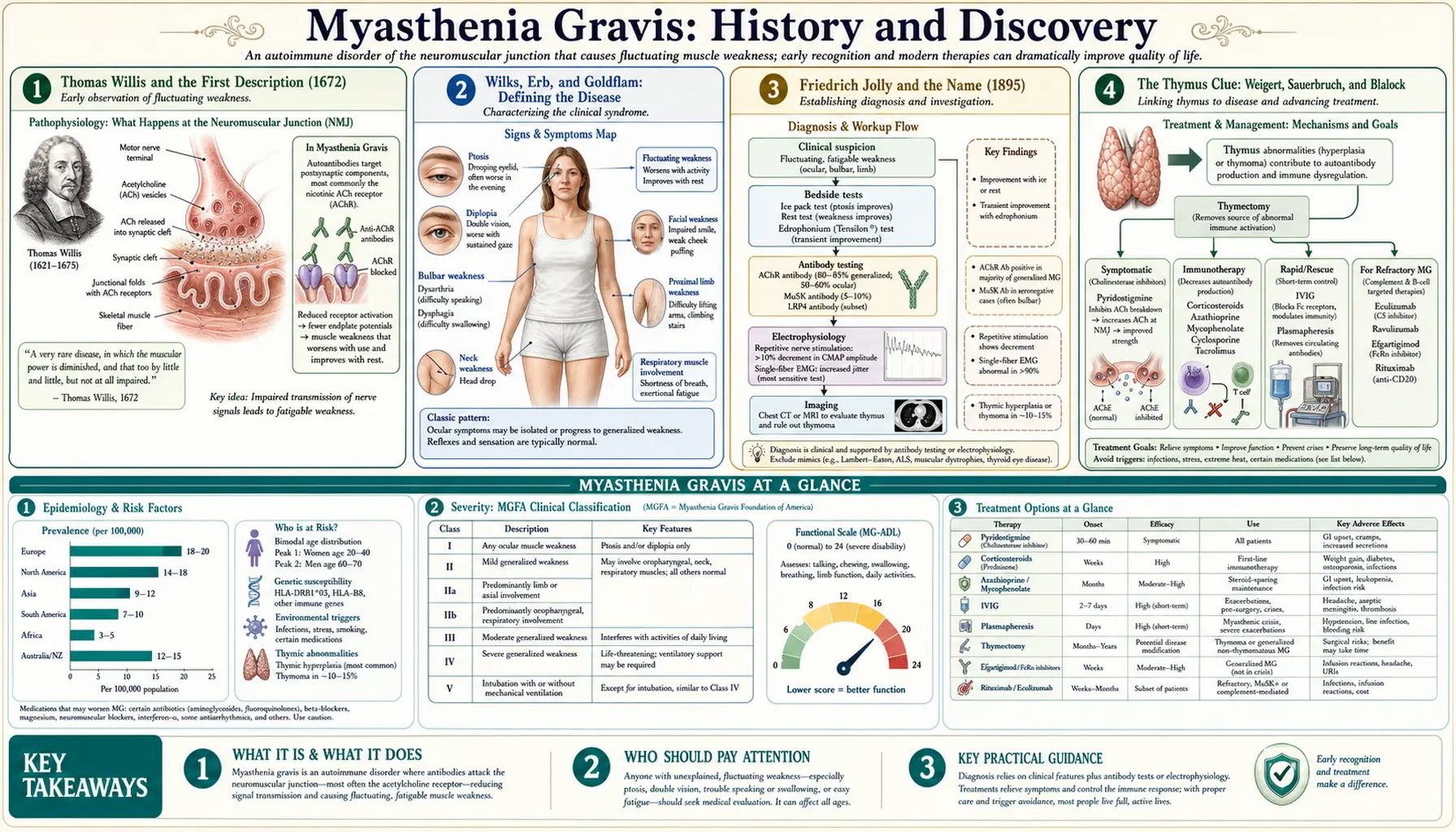
The story of myasthenia gravis is a 350-year detective story that runs from a single sentence written by an Oxford physician in 1672 to the precise, molecule-by-molecule picture we have today. Along the way it passed through the great German and Polish clinicians who first described it as a disease, the physician who finally gave it its Latin name in 1895, a quiet Scottish doctor whose ten-minute bedside experiment in 1934 transformed it from a death sentence into a treatable condition, and the immunologists of the 1970s who proved at last that the body's own antibodies were the cause. This page traces that history carefully, distinguishing who first described the illness, who named it, and who discovered why it happens — three different milestones that are often blurred together.
Table of Contents
- Thomas Willis and the First Description (1672)
- Wilks, Erb, and Goldflam: Defining the Disease
- Friedrich Jolly and the Name (1895)
- The Thymus Clue: Weigert, Sauerbruch, and Blalock
- Mary Walker and the Physostigmine Miracle (1934)
- The Edrophonium (Tensilon) Test
- Proving the Autoimmune Cause (1960–1976)
- From Antibody to Modern Targeted Therapy
- Key Research Papers
- Connections
- Featured Videos
Thomas Willis and the First Description (1672)
What is generally regarded as the first clinical description of myasthenia gravis appears in the work of Thomas Willis, the celebrated Oxford physician and a founder of modern neurology (the "circle of Willis" at the base of the brain bears his name). In his 1672 Latin treatise De Anima Brutorum, Willis described a pattern of muscle weakness that grew worse with use and recovered with rest — the defining signature of the disease. He wrote of patients who could speak freely in the morning but, after a time, became so exhausted that they could barely utter a word; in the most-quoted passage he describes a woman who would temporarily lose the power of speech and become "mute as a fish."
It is worth being precise about what this milestone means. Willis recognized and recorded the phenomenon of fatigable weakness in the limbs and especially in the tongue and speech; he did not name the disease, identify its cause, or separate it cleanly from other conditions. His account was written in Latin, buried within a larger work, and went almost entirely unnoticed by the medical world — it was not rediscovered and credited as the first description of myasthenia gravis until the early twentieth century, around 1903. For more than two hundred years, in effect, the disease had been described but forgotten.
This long silence is the first important lesson of the history: a disease is not truly "known" to medicine until it is described in a way that other physicians can find, repeat, and build upon. Willis saw the illness clearly, but because his observation was isolated and unrepeated, myasthenia gravis would have to be effectively rediscovered, from scratch, by the clinicians of the late nineteenth century.
Wilks, Erb, and Goldflam: Defining the Disease
The modern medical understanding of myasthenia gravis was built in the last quarter of the nineteenth century. An early modern observation is usually credited to the London physician Samuel Wilks, who in 1877 reported a fatal case of bulbar weakness (affecting speech and swallowing) and, importantly, noted that the patient's spinal cord and brainstem looked normal at autopsy — an early hint that the problem did not lie in the nerves or the brain in the ordinary way. But the first full, systematic clinical descriptions came from two clinicians working independently in different countries.
In Germany, Wilhelm Erb of Heidelberg — one of the founding figures of clinical neurology — described cases in 1879, drawing attention to the characteristic involvement of the muscles of the eyes, face, and throat. In Poland, Samuel Goldflam of Warsaw published in 1893 a detailed analysis of three patients, together with a thorough review of the cases reported before him, that is often regarded as the definitive early clinical account: he laid out the fluctuating weakness, the variable course, and the pattern of muscles affected with a completeness no one had achieved before. In recognition of their parallel contributions, the disease was for a time known as the Erb–Goldflam symptom complex (or Erb–Goldflam syndrome), and that eponym is still occasionally encountered today.
What Erb and Goldflam accomplished was the crucial step that Willis's isolated note could not: they established myasthenia gravis as a recognizable, reproducible clinical entity — a disease that physicians across Europe could now identify in their own patients by its tell-tale pattern of fatigable, fluctuating weakness. The disease had finally entered the permanent medical record. What it still lacked was a name.
Friedrich Jolly and the Name (1895)
In 1895 the Berlin neurologist Friedrich Jolly gave the disease the name it carries to this day. Presenting cases before a Berlin medical society, he proposed the term myasthenia gravis pseudoparalytica. The components of that name are themselves a compact clinical description: myasthenia is from the Greek for "muscle weakness," gravis is Latin for "grave" or "serious," and pseudoparalytica — "false paralysis" captured a key observation, that despite the profound weakness there was no permanent structural damage to be found in the muscles or nerves at autopsy. The weakness was real but the paralysis was, in this structural sense, only apparent. Over time the cumbersome final word was dropped in everyday use, leaving the familiar myasthenia gravis.
Jolly's contribution was not merely to coin a label. He also helped demonstrate the disease's most distinctive physiological feature using the laboratory tools of his day: applying repeated electrical stimulation to a muscle, he showed that its contractions grew progressively weaker with continued activity — an objective demonstration of the fatigability that patients described. This electrically-provoked exhaustion (sometimes called the "myasthenic reaction") was an important early sign that the fault lay in the muscle's response to repeated nerve signals, and it anticipated, in spirit, the repetitive-nerve-stimulation tests still used to diagnose myasthenia gravis in the modern clinic.
With Jolly's name, the first chapter of the history was effectively complete. By the close of the nineteenth century the disease had been described (Willis, then Wilks, Erb, and Goldflam), characterized as a distinct entity, and named. But its cause remained a total mystery. The next great clues would come not from the muscles or nerves directly, but from two unexpected directions: a small gland in the chest, and a poison used on arrows.
The Thymus Clue: Weigert, Sauerbruch, and Blalock
One of the strangest and most important clues in the history of myasthenia gravis is its connection to the thymus, a small gland behind the breastbone that is central to the immune system. In 1901 the pathologist Carl Weigert reported the association between myasthenia gravis and a tumour of the thymus (a thymoma), the first time the gland was linked to the disease. Over the following decades, pathologists repeatedly found that the thymus glands of myasthenic patients were abnormal — either tumorous or, more often, enlarged and inflamed — though at the time no one could explain why a chest gland should have anything to do with weak muscles.
The surgical chapter began in 1911, when the German surgeon Ferdinand Sauerbruch performed what is generally cited as the first thymectomy (removal of the thymus) in a patient with myasthenia gravis — in this instance for an enlarged but non-cancerous gland — and the patient's symptoms improved. The decisive demonstration, however, came from the United States in 1939, when the surgeon Alfred Blalock, then at Vanderbilt University, removed a cystic thymic tumour from a young woman with myasthenia gravis and observed a dramatic remission of her disease. Blalock went on to show that thymectomy could help myasthenic patients even when there was no tumour, and it was this work that established surgical removal of the thymus as a genuine treatment for the disease. (Blalock is also famous, a few years later, for the "blue baby" heart operation.)
The thymus connection was a profound clue precisely because, decades later, it pointed straight at the answer. The thymus is the organ where the immune system's T-cells learn to tell "self" from "non-self." That a gland so central to immune tolerance should be diseased in myasthenia gravis was, in hindsight, a flashing signpost toward an autoimmune cause — but that interpretation lay a full half-century in the future. Thymectomy remains an important treatment for many patients with myasthenia gravis today, and its benefit in non-thymomatous disease was finally confirmed by a large randomized trial published in 2016, more than a century after Sauerbruch's first operation.
Mary Walker and the Physostigmine Miracle (1934)
The single most consequential bedside discovery in the history of myasthenia gravis was made in 1934 by a modest Scottish physician, Mary Broadfoot Walker (1888–1974), working at St Alfege's Hospital in Greenwich, London. Walker made a connection that more eminent specialists had missed. She observed that the fluctuating, fatigable weakness of myasthenia gravis closely resembled the paralysis caused by curare, the South American arrow poison that blocks the transmission of signals from nerve to muscle. The known antidote to curare poisoning at the time was physostigmine (also called eserine), a drug that inhibits the enzyme which breaks down the chemical messenger acetylcholine. Reasoning by analogy, Walker asked a simple, brilliant question: if myasthenia behaves like curare poisoning, might the curare antidote help?
She injected physostigmine into a myasthenic patient and watched the weakness lift, temporarily but unmistakably, within minutes. She reported the result in a short letter to The Lancet, published on 2 June 1934. The effect was so striking when demonstrated at the bedside — a patient barely able to lift their eyelids or arms suddenly able to move again — that it became known as "the miracle at St Alfege's." Walker soon extended her work to the related, longer-acting drug neostigmine (Prostigmin), which became the practical mainstay of treatment. For a disease that had until then offered nothing but slow decline, this was the first effective therapy, and it remains, in the form of the modern drug pyridostigmine (Mestinon), a first-line treatment to this day.
Walker's discovery was a turning point in two senses. Practically, it gave patients their lives back. But scientifically it was just as important, because of why it worked. In her own cautious words, she noted that it might be significant that physostigmine inhibits the esterase that destroys acetylcholine — in plain terms, the drug helped because it raised the level of acetylcholine, the chemical that carries the nerve's "contract" signal across the gap to the muscle. The success of an anticholinesterase drug was a powerful clue that the fundamental fault in myasthenia gravis lay at the neuromuscular junction — the tiny synapse where nerve meets muscle — and specifically in the signalling done by acetylcholine. Walker had not yet identified the cause, but she had pointed the searchlight directly at the right place. It is a striking historical injustice that her achievement, made far from the prestigious centres and reported in a single modest letter, was for many years under-credited.
The Edrophonium (Tensilon) Test
Mary Walker's insight that an anticholinesterase drug rapidly and reversibly improves myasthenic weakness was soon turned into a bedside diagnostic test. In 1952 Kermit Osserman and Kalman Kaplan, working in New York, described the use of edrophonium chloride — marketed as Tensilon — as a rapid diagnostic test for myasthenia gravis, reporting their results in the Journal of the American Medical Association. Edrophonium is a very short-acting acetylcholinesterase inhibitor: injected into a vein, it briefly floods the neuromuscular junction with extra acetylcholine, and its effect lasts only about ten minutes.
The logic of the test was elegant and visual. A physician would identify an obviously weak muscle — most often a drooping eyelid — inject a small dose of edrophonium, and watch. In a patient with myasthenia gravis, the weak muscle would briefly but clearly strengthen as the eyelid lifted, before the drug wore off and the weakness returned. For decades the Tensilon test was one of the iconic bedside demonstrations in all of clinical neurology, a near-instant confirmation of the diagnosis that students were taught to recognize.
It is important for readers to know that the edrophonium test is now largely historical. Because it could produce both false-positive and false-negative results, and because it carried a small risk of serious side effects (slowing of the heart, in particular), it has been replaced in modern practice by safer and more specific tools — chiefly blood tests for the responsible antibodies (described in the next section) and electrical nerve-conduction studies. Edrophonium has been discontinued in the United States and many other countries. The test belongs to the history of the disease, not its present-day work-up; it is described here for that reason.
Proving the Autoimmune Cause (1960–1976)
By the mid-twentieth century, physicians knew where the problem was (the neuromuscular junction) and how to treat the symptoms (anticholinesterase drugs), but the underlying cause was still unknown. The breakthrough idea came in 1960, when the Scottish neurologist John A. Simpson proposed — in a now-classic paper, and independently of similar thinking by the American researcher Joseph Nastuk — that myasthenia gravis is an autoimmune disease: that the body produces an antibody directed against its own neuromuscular junction. Simpson reasoned by careful clinical analogy, pointing to a constellation of telling clues: the diseased thymus, the frequent association of myasthenia with other known autoimmune disorders, and above all the observation that babies born to myasthenic mothers could be born temporarily weak themselves — exactly what you would expect if some factor in the mother's blood (an antibody, which can cross the placenta) were causing the disease. It is essential to be clear that in 1960 this was a hypothesis, a brilliant inference rather than a proven fact; the proof would take more than a decade and a piece of laboratory luck.
That luck came from an unrelated corner of biology. To prove Simpson right, researchers needed to find and study the actual acetylcholine receptor — the molecular "lock" on the muscle that acetylcholine fits into — but it was present in tissue in vanishingly small amounts. The key tool turned out to be α-bungarotoxin, a component of the venom of a banded krait snake, which binds to the acetylcholine receptor with exquisite specificity and could be used both to label the receptor and, from the electric organs of eels and rays (which are extraordinarily rich in it), to purify it. Two decisive lines of evidence followed in 1973. First, James Patrick and Jon Lindstrom, purifying acetylcholine receptor from an electric eel and injecting it into rabbits to raise antibodies against it, were startled to find that the rabbits developed muscular weakness indistinguishable from myasthenia gravis — they had accidentally created the disease in an animal, an experimental model now called experimental autoimmune myasthenia gravis (EAMG). They reported it in Science that year. Second, also in 1973, Douglas Fambrough and colleagues used radioactively-labelled α-bungarotoxin to count the acetylcholine receptors at the neuromuscular junctions of actual myasthenic patients and found them dramatically reduced in number — direct evidence that the receptors were being destroyed or blocked.
The final, clinching step was to show the predicted antibody in patients themselves. In 1976, Jon Lindstrom and colleagues (Seybold, Lennon, Whittingham, and Duane) published in the journal Neurology a study demonstrating that antibodies to the acetylcholine receptor were present in the blood of about 87 percent of patients with myasthenia gravis, and essentially never in people without the disease. This was the proof: Simpson's 1960 hypothesis was correct. Myasthenia gravis is caused by autoantibodies that attack and deplete the acetylcholine receptors at the neuromuscular junction, so that the nerve's signal can no longer reliably reach the muscle — and as the receptors are progressively lost with continued use, the muscle fatigues, exactly as Thomas Willis had observed three centuries earlier. The 1976 test also gave clinicians a precise, specific blood test for the disease, the acetylcholine receptor (AChR) antibody assay that remains the single most useful diagnostic test for myasthenia gravis today.
From Antibody to Modern Targeted Therapy
Identifying the cause opened the modern era. Because myasthenia gravis was now understood as a specific, antibody-mediated autoimmune attack on a single, known target, treatment could move beyond merely propping up acetylcholine levels and begin to address the immune assault itself. Through the 1970s and 1980s, broad immune-suppressing strategies came into use: corticosteroids such as prednisone to dampen the immune response, steroid-sparing drugs such as azathioprine, and — for severe flares and crises — plasma exchange (filtering the harmful antibodies out of the blood) and intravenous immunoglobulin (IVIg). Combined with thymectomy and the anticholinesterase drugs descended directly from Mary Walker's discovery, these therapies turned myasthenia gravis from a frequently fatal illness into a chronic condition that most patients can live with for a normal lifespan.
Research after 1976 also refined the picture in important ways. It became clear that not every patient has detectable AChR antibodies; in 2001 a group led by Angela Vincent and colleagues identified a second autoantibody target, muscle-specific kinase (MuSK), responsible for a subset of cases that are "seronegative" for the AChR antibody, and further targets (such as LRP4) have since been described. Understanding these distinct antibody subtypes matters because they behave differently and respond differently to treatment — a level of precision that would have been unimaginable to the nineteenth-century clinicians who first defined the disease.
Most recently, the deep knowledge of the disease's mechanism has produced a new generation of targeted biologic therapies designed to interrupt the autoimmune process at specific points: drugs that block the complement system the antibodies recruit to damage the junction, and drugs (FcRn inhibitors) that accelerate the body's clearance of the harmful antibodies themselves. These therapies, several approved only in recent years, are the direct intellectual descendants of the 1973–1976 discovery that an antibody against the acetylcholine receptor is the root cause. The arc is remarkable to contemplate: from a single forgotten Latin sentence in 1672, through a name in 1895 and a miraculous bedside experiment in 1934, to medicines in the present day engineered to silence the exact antibody responsible. Few diseases trace so clean a line from first description to molecular cure.
Key Research Papers
The references below combine key peer-reviewed historical reviews and landmark primary papers in the history of myasthenia gravis with curated PubMed topic-search links for further reading. Where a stable identifier is available it is given; otherwise a PubMed search link opens the relevant literature. Thomas Willis's 1672 De Anima Brutorum is cited in the text as a historical primary source rather than as a modern citation. Each external link opens in a new tab.
- Keesey JC. Contemporary opinions about Mary Walker: a shy pioneer of therapeutic neurology. Neurology. 1998;51(5):1433-1439. — doi:10.1212/WNL.51.5.1433
- Hughes T. The early history of myasthenia gravis. Neuromuscular Disorders. 2005;15(12):878-886. — doi:10.1016/j.nmd.2005.08.007
- Patrick J, Lindstrom J. Autoimmune response to acetylcholine receptor. Science. 1973;180(4088):871-872. — doi:10.1126/science.180.4088.871
- Lindstrom JM, Seybold ME, Lennon VA, Whittingham S, Duane DD. Antibody to acetylcholine receptor in myasthenia gravis: prevalence, clinical correlates, and diagnostic value. Neurology. 1976;26(11):1054-1059. — doi:10.1212/WNL.26.11.1054
- Fambrough DM, Drachman DB, Satyamurti S. Neuromuscular junction in myasthenia gravis: decreased acetylcholine receptors. Science. 1973;182(4109):293-295. — doi:10.1126/science.182.4109.293
- Conti-Fine BM, Milani M, Kaminski HJ. Myasthenia gravis: past, present, and future. Journal of Clinical Investigation. 2006;116(11):2843-2854. — doi:10.1172/JCI29894
- Hoch W, McConville J, Helms S, Newsom-Davis J, Melms A, Vincent A. Auto-antibodies to the receptor tyrosine kinase MuSK in patients with myasthenia gravis without acetylcholine receptor antibodies. Nature Medicine. 2001;7(3):365-368. — doi:10.1038/85520
- Wolfe GI, Kaminski HJ, Aban IB, et al. Randomized trial of thymectomy in myasthenia gravis (MGTX). New England Journal of Medicine. 2016;375(6):511-522. — doi:10.1056/NEJMoa1602489
- Walker MB (1934) and the treatment of myasthenia gravis with physostigmine — James Lind Library historical record. — PubMed: Mary Walker physostigmine myasthenia gravis
- Jolly and the naming of myasthenia gravis pseudoparalytica — PubMed: Jolly myasthenia gravis pseudoparalytica
- Goldflam and Erb — the Erb–Goldflam syndrome and early clinical descriptions — PubMed: Erb–Goldflam syndrome history
- Simpson's autoimmune hypothesis of myasthenia gravis (1960) and its validation — PubMed: Simpson myasthenia gravis autoimmune hypothesis
- Thymectomy for myasthenia gravis — Sauerbruch, Blalock, and the history of surgical treatment — PubMed PMID: 40189865
- Edrophonium (Tensilon) test in myasthenia gravis — history and diagnostic value — PubMed PMID: 41664151
External Authoritative Resources
- NINDS (NIH) — Myasthenia Gravis information page
- MedlinePlus (NLM) — Myasthenia Gravis
- PubMed — All research on the history of myasthenia gravis. — Search PubMed
Connections
- Neurology
- Myasthenia Gravis (overview)
- All Conditions
- Multiple Sclerosis (MS)
- Amyotrophic Lateral Sclerosis (ALS)
- Peripheral Neuropathy