Corticobasal Syndrome (CBS)
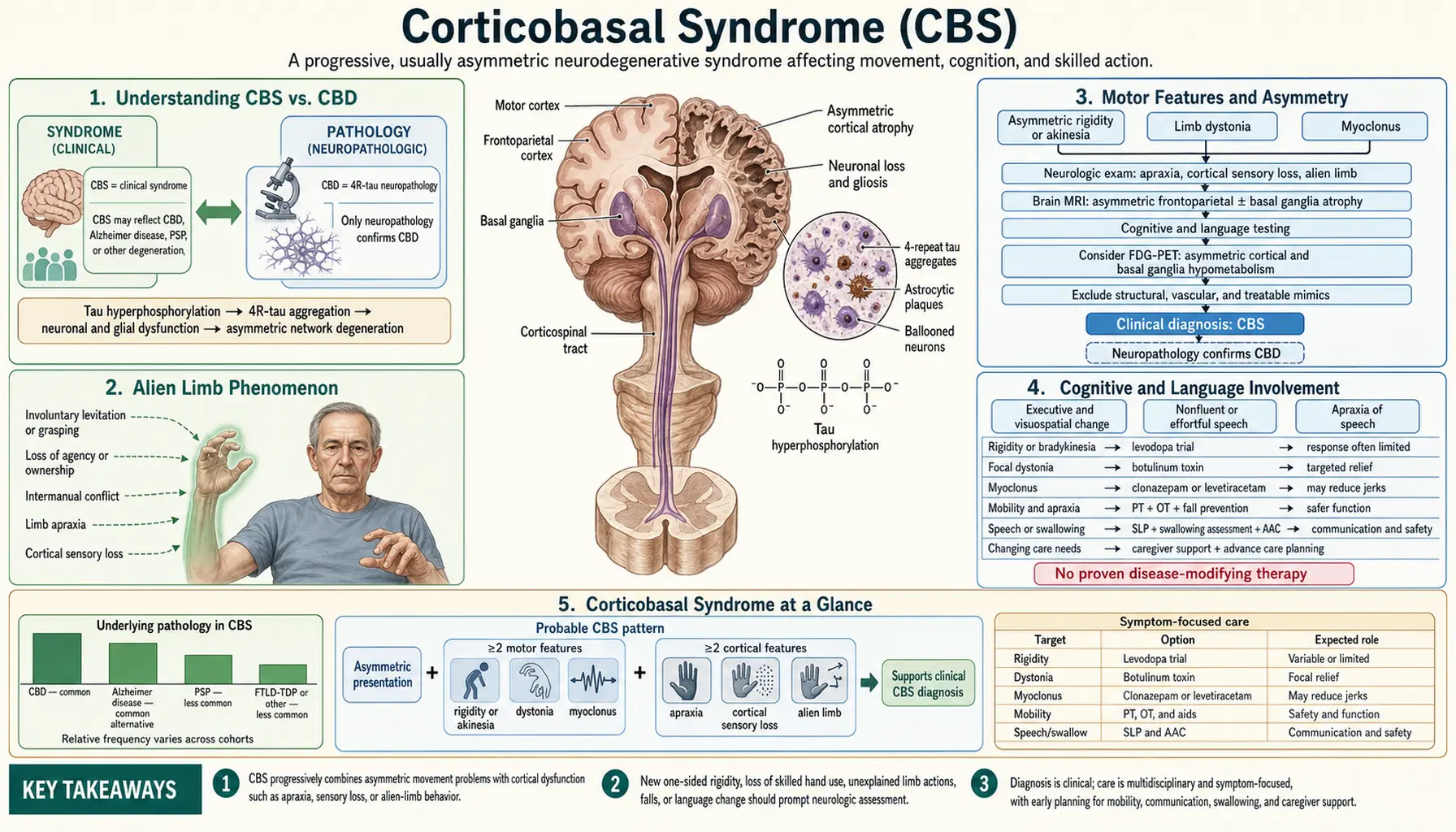
Corticobasal syndrome (CBS) is a rare, progressive neurodegenerative disorder characterized by profoundly asymmetric motor and cognitive impairment. Its signature features — alien limb phenomenon, apraxia, cortical sensory loss, and asymmetric rigidity — arise from degeneration of the cerebral cortex and basal ganglia on one side more than the other. Crucially, CBS is a clinical syndrome: the identical presentation can be caused by several distinct underlying pathologies, most commonly corticobasal degeneration (CBD) tau, but also PSP-tau, frontotemporal lobar degeneration with TDP-43 inclusions (FTLD-TDP), Alzheimer's disease pathology, or rarely prion disease. This clinicopathological dissociation makes CBS both diagnostically challenging and a window into how different protein aggregates converge on the same clinical picture.
- Understanding CBS vs. CBD
- Alien Limb Phenomenon
- Motor Features and Asymmetry
- Cognitive and Language Involvement
- Eye Movement and Other Signs
- Underlying Pathology and Tau Biology
- Imaging and Diagnosis
- Epidemiology and Prognosis
- Treatment and Supportive Care
- Key Research Papers
- Featured Videos
- Connections
Understanding CBS vs. CBD
For many years clinicians used the term corticobasal degeneration (CBD) to describe both the clinical syndrome and the autopsy-confirmed 4R-tau pathology. Advances in neuropathology forced a crucial renaming. Post-mortem studies show that fewer than half of patients with the classic CBS clinical picture actually have CBD-tau at autopsy. The rest harbor PSP-tau, FTLD-TDP-43 type A, Alzheimer's disease, or other rare proteinopathies.
Current terminology therefore separates:
- CBS (corticobasal syndrome) — the clinical diagnosis made during life, based on a defined set of motor, sensory, and cognitive features.
- CBD (corticobasal degeneration) — the specific 4R-tau pathology confirmed at autopsy or, increasingly, inferred by research-grade tau PET imaging.
This distinction matters enormously for clinical trials and emerging tau-directed therapies: a trial enrolling "CBS" patients is actually enrolling a mixed-pathology group, diluting any signal from a therapy targeting one specific protein. The Armstrong 2013 diagnostic criteria and subsequent MDS refinements have attempted to define probabilistic tiers — possible, probable, and definite — that enrich for underlying CBD pathology.
From the patient perspective, CBS typically begins in the late 50s to mid-60s, usually on one side of the body, and progresses relentlessly over 6–8 years. There is no proven disease-modifying treatment, but symptom management can meaningfully preserve function and quality of life.
Alien Limb Phenomenon
The alien limb phenomenon is the most evocative and diagnostically striking feature of CBS, reported in approximately 50–60% of patients at some point in the disease course. The affected limb — nearly always an arm, sometimes a leg — behaves as if it has a will of its own. Patients describe the experience in vivid, often distressing terms: the arm rises involuntarily from the lap, reaches across to grasp objects the patient did not intend to pick up, or interferes with the voluntary movements of the opposite hand (intermanual conflict).
Three distinct subtypes of alien limb have been described:
- Frontal type: The limb engages in groping, grasping, and utilization behavior — picking up and using objects in the environment without conscious intention. This reflects disinhibition of the supplementary motor area and loss of voluntary motor suppression.
- Callosal type: The affected hand acts in opposition to the patient's intention — for instance, undoing a button as fast as the other hand fastens it (intermanual conflict). This results from corpus callosum degeneration disrupting interhemispheric coordination.
- Posterior (sensory) type: The limb floats upward spontaneously (levitation), especially with eyes closed or during distraction, due to severe cortical proprioceptive loss. The patient does not know where the limb is in space and cannot actively suppress its drift.
Neuroimaging correlates of alien limb include atrophy of the supplementary motor area, anterior cingulate, and callosal body. The phenomenon is highly specific for cortical rather than subcortical disease — it does not occur in pure Parkinson's disease, MSA, or PSP. Its presence in a patient with asymmetric parkinsonism strongly tips the diagnosis toward CBS.
Motor Features and Asymmetry
The defining motor hallmark of CBS is profound asymmetry. Whereas PSP and MSA predominantly cause axial (midline, symmetric) degeneration, CBS destroys the cortex and basal ganglia far more on one side. Patients typically present with one-sided clumsiness — they notice that one hand has become slow, stiff, and inaccurate — often years before any bilateral involvement emerges. This unilateral onset creates what some describe as "hemi-Parkinson plus cortical signs."
Key motor features include:
- Asymmetric rigidity: Limb rigidity, usually cogwheel quality, markedly worse on the initially affected side. Unlike PD, where rigidity responds to levodopa, rigidity in CBS is largely levodopa-resistant.
- Akinesia and bradykinesia: Slowness and poverty of movement, again asymmetric. Finger tapping and hand movements are reduced in amplitude and speed on the affected side.
- Dystonia: Fixed or action-triggered posturing, commonly an inverted, clenched hand or plantar flexion of the foot. The "clenched fist" in CBS is a direct result of cortical degeneration causing loss of inhibitory control over distal motor units. Dystonia can be painful.
- Myoclonus: Cortical myoclonus — brief, high-amplitude, action- or reflex-triggered jerks of the affected limb — occurs in up to 30–50% of patients. It is elicited by tapping the fingers or touching the hand and can be confirmed on EEG (preceding cortical discharge). This distinguishes it from the subcortical myoclonus of other disorders.
- Postural instability and falls: Less prominent early on than in PSP (which causes backward falls in the first year), but emerges as the disease progresses bilaterally.
- Limb apraxia: See below — a cardinal cortical feature.
The combination of limb rigidity, dystonia, and myoclonus on one side alongside cortical signs on the same side creates a distinctive clinical picture that should prompt CBS consideration in any patient with asymmetric parkinsonism.
Cognitive and Language Involvement
CBS is not a "pure motor" disorder. Cortical degeneration — particularly of the parietal and frontal lobes contralateral to the more affected limb — produces distinctive cognitive and language impairments that are often the first features patients notice before the motor syndrome is fully developed.
Limb apraxia is a cardinal sign. Apraxia is the loss of ability to perform learned skilled movements despite intact strength, sensation, and coordination. In CBS, both limb-kinetic apraxia (clumsy, inaccurate distal movements) and ideomotor apraxia (inability to pantomime tool use — "show me how you would use a hammer") are present. The patient who cannot wave goodbye, use an imaginary scissors, or mimic brushing teeth despite understanding the request and having no arm weakness has ideomotor apraxia. This is a cortical sign that separates CBS from pure basal ganglia disorders.
Cortical sensory loss is highly characteristic: astereognosis (inability to identify objects by touch — a key in the palm cannot be recognized with eyes closed) and agraphesthesia (inability to identify numbers or letters written on the palm). Light touch and pinprick are often preserved — this is not a peripheral sensory loss but a failure of cortical processing. Cortical sensory loss on one hand in a patient with that same hand's motor impairment is a strong CBS pointer.
Language syndromes depend on which pathology underlies CBS. The CBS-CBD tau variant more commonly causes frontal executive dysfunction and non-fluent/agrammatic primary progressive aphasia (PNFA). The CBS-AD (Alzheimer's pathology) variant more frequently causes posterior cortical atrophy syndrome — visuospatial dysfunction, alexia, dyscalculia — or logopenic progressive aphasia. The presence of language impairment does NOT exclude CBS; it points toward the underlying cause.
Behavioral change — apathy, disinhibition, perseveration — occurs as degeneration spreads to the prefrontal cortex. This can resemble the behavioral variant of FTD (bvFTD), particularly when FTLD-TDP underlies the CBS presentation. Memory, by contrast, is usually relatively spared early compared to Alzheimer's disease.
Eye Movement and Other Signs
Eye movement abnormalities in CBS are qualitatively different from those in PSP. While PSP produces a characteristic vertical supranuclear gaze palsy — inability to look up or down — CBS produces cortical oculomotor deficits:
- Saccadic pursuit: Smooth pursuit eye movements (tracking a moving target) become broken and jerky (cogwheel or saccadic pursuit) due to parietal cortex degeneration. Normal smooth pursuit requires intact parieto-occipital cortex.
- Apraxia of eyelid opening: Difficulty initiating voluntary eyelid opening, despite intact orbicularis function (unlike blepharospasm). Patients must concentrate hard or use a finger to raise the lid — this reflects failure of levator premotor cortex activation.
- Asymmetric reflexive saccades: Saccades to targets may be hypometric or slowed to one side. A full vertical gaze palsy argues more for underlying PSP pathology than CBD.
Other notable signs include:
- Dysarthria: Hypophonic, effortful speech, sometimes with apraxia of speech (distorted articulation without consistent phonemic errors, a feature of cortical motor speech area degeneration).
- Dysphagia: Appears later than in PSP, but can cause aspiration risk as the disease progresses.
- Hyperreflexia and Babinski signs: Corticospinal tract involvement produces upper motor neuron signs on the affected side, distinguishing CBS from purely extrapyramidal disorders.
- Stimulus-sensitive myoclonus: A tap on the affected hand triggers a jerk visible to the examiner, a direct bedside marker of cortical hyperexcitability.
Underlying Pathology and Tau Biology
When the underlying cause is CBD (corticobasal degeneration pathology), the molecular signature is abnormal accumulation of 4-repeat (4R) tau — the same tau isoform that accumulates in PSP. In healthy neurons, tau exists in six isoforms defined by whether exon 10 is included (4R) or excluded (3R) during mRNA splicing; a 1:1 ratio is normally maintained. In CBD, 4R-tau predominates due to altered splicing, leading to hyperphosphorylated tau filaments that aggregate into distinctive structures:
- Astrocytic plaques: The pathological hallmark of CBD — fan-shaped tau deposits in the distal processes of astrocytes, forming stellate clusters. These are distinct from the tufted astrocytes seen in PSP.
- Neuronal threads: Tau-positive threads in the white matter neuropil, disrupting axonal conduction.
- Ballooned (achromatic) neurons: Swollen, pale neurons that have lost their Nissl substance, indicative of severe cytoskeletal disruption. Found most prominently in frontoparietal cortex.
- Coiled bodies: Tau inclusions in oligodendrocytes (compare with MSA, where inclusions are α-synuclein in oligodendrocytes — MSA's glial cytoplasmic inclusions, GCIs).
The anatomical distribution of CBD pathology mirrors the asymmetric clinical syndrome: maximal degeneration in the frontoparietal cortex, substantia nigra, and subthalamic nucleus, all substantially worse on the side contralateral to the more-affected limb. This spread likely begins unilaterally and propagates via corticobasal and thalamocortical circuits before eventually affecting both sides.
Tau PET imaging using the radiotracer flortaucipir (18F-AV-1451) now allows visualization of tau burden in living patients. CBD shows a characteristic asymmetric frontoparietal cortical and striatal tau PET signal that correlates with clinical severity. While not yet diagnostic-grade, tau PET is transforming both clinical trials and the understanding of the relationship between CBS symptom onset and tau spread.
Imaging and Diagnosis
No single imaging finding definitively diagnoses CBS or its underlying pathology in life, but a characteristic pattern on structural MRI is highly supportive:
- Asymmetric perirolandic atrophy: Loss of cortical volume in the frontoparietal (sensorimotor and supplementary motor) cortex, markedly worse on the side contralateral to the more-affected limb. This is the most recognizable structural MRI finding in CBS-CBD and is best seen on coronal T1 sequences.
- Asymmetric parietal and frontal atrophy: Superior parietal lobule atrophy contralateral to the affected side — the region subserving complex sensorimotor integration and spatial awareness — correlates with apraxia and cortical sensory loss severity.
- Asymmetric putaminal signal: In some cases, T2/FLAIR signal change or volume loss in the posterior putamen is seen on the side contralateral to the more-affected limb, reflecting striatonigral degeneration.
FDG-PET (fluorodeoxyglucose — metabolic imaging) demonstrates asymmetric hypometabolism in the frontoparietal cortex and contralateral basal ganglia, providing additional diagnostic support and sometimes detecting metabolic changes before atrophy is visible on MRI. FDG-PET asymmetry correlating with limb-symptom asymmetry is one of the best supportive imaging biomarkers for CBS.
The Armstrong criteria (2013) remain the most widely used clinical diagnostic framework. They define four CBS variants based on the combination of motor, praxis, sensory, and language features, and establish probability tiers:
- Probable CBS-CBD: insidious onset, asymmetric presentation, ≥2 of limb rigidity/akinesia, limb dystonia, limb myoclonus, plus ≥2 of orobuccal or limb apraxia, cortical sensory deficit, alien limb.
- Possible CBS: may be symmetric, allows broader features including vertical gaze palsy or frontal behavioral syndrome.
- Definite CBS: pathological confirmation at autopsy.
Distinguishing CBS from PSP clinically can be challenging; an asymmetric patient with prominent alien limb and apraxia favors CBS, while symmetric axial disease with early backward falls and vertical gaze palsy favors PSP. Both are 4R-tauopathies and sometimes overlap pathologically.
Epidemiology and Prognosis
CBS is the rarest of the three major atypical parkinsonian syndromes. Prevalence estimates range from 1.0 to 2.5 per 100,000 population. Age of onset is typically between 60 and 70 years, with most series reporting a mean onset around 63–67 years. Unlike Parkinson's disease (which shows a slight male predominance) and PSP (approximately equal sex ratio), some studies have suggested a slightly higher prevalence in women for CBS, though the data are inconsistent across centers and likely affected by ascertainment bias.
Survival from symptom onset to death is typically 6–8 years, making CBS intermediate between PSP (6–7 years) and MSA (6–9 years) in terms of pace. However, underlying pathology influences prognosis: CBS with underlying AD pathology tends to run a slightly longer course than CBD-tau. The cause of death is most commonly aspiration pneumonia (from dysphagia and reduced cough reflex), pulmonary embolism (immobility), or sepsis from urinary tract infections.
Functional decline follows a characteristic arc: the first 1–2 years are dominated by unilateral motor clumsiness and the alien limb phenomenon, often misdiagnosed as focal dystonia, stroke, or early PD. Years 2–4 see progressive bilateral motor and cognitive involvement. By years 4–6, most patients are wheelchair-dependent, severely dysarthric, and require full-time care. Dysphagia and aspiration risk become the dominant management concern in the final 1–2 years.
There are currently no validated prognostic biomarkers that predict rate of progression in individual patients. Cerebrospinal fluid (CSF) neurofilament light chain (NfL) is elevated in CBS (as in all atypical parkinsonisms) and correlates with disease severity, but is not specific for CBS or the underlying pathology.
Treatment and Supportive Care
There is no approved disease-modifying therapy for CBS or its underlying pathologies. Multiple clinical trials have enrolled CBS/CBD populations in recent years, driven by advances in tau biology and tau-targeting strategies, but none has demonstrated clinical benefit to date.
Symptomatic pharmacological treatment:
- Levodopa trial: A levodopa/carbidopa trial (up to 1,000 mg levodopa/day for at least 3 months) is standard practice. Response is typically poor — fewer than 25% of CBS patients have a meaningful motor response, compared to the nearly universal response in PD. A partial response does not exclude CBS but favors a PD-spectrum pathology. The trial should not be abandoned without reaching an adequate dose.
- Botulinum toxin injections: The most consistently useful pharmacological intervention in CBS. Injected into the forearm flexors, hand intrinsics, or lower leg, botulinum toxin reduces dystonia severity, relieves pain from the clenched fist, and can improve hand function and hygiene. Also used for blepharospasm and drooling (submandibular gland injection). Typically repeated every 3–4 months.
- Clonazepam: Effective for cortical myoclonus, reducing jerk frequency and amplitude. Starting dose 0.25–0.5 mg at bedtime, titrated as tolerated. Sedation and fall risk are the main concerns.
- Levetiracetam or valproate: Second-line options for myoclonus when clonazepam is not tolerated or insufficient.
- SSRIs: For behavioral symptoms — apathy, irritability, depression, pseudobulbar affect.
Rehabilitation and allied health:
- Physiotherapy: Fall prevention exercises, gait training with an assistive device, management of postural instability. Particularly important given the fall risk from the asymmetric motor syndrome.
- Occupational therapy: Adaptive equipment for the unaffected hand; strategies to compensate for apraxia; home safety assessments.
- Speech-language pathology: Dysphagia assessment and modified-texture diet, augmentative and alternative communication (AAC) devices as dysarthria progresses, apraxia of speech therapy.
- Neuropsychology: Cognitive assessment, strategies for apraxia compensation, support for caregiver education.
Research pipeline: Anti-tau strategies under investigation include antisense oligonucleotides (ASOs) targeting tau mRNA, small-molecule tau aggregation inhibitors, and active and passive immunotherapy. The TACT-D trial (leucomethylthioninium) and multiple tau antibody trials have enrolled CBS/PSP patients. The CBD Solutions consortium and the CurePSP Foundation maintain registries and trial pipelines that interested clinicians and patients can access.
Key Research Papers
- Armstrong MJ, Litvan I, Lang AE, et al. Criteria for the diagnosis of corticobasal degeneration. Neurology. 2013;80(5):496–503. PMID: 23359374 — Landmark criteria paper establishing probabilistic diagnostic tiers for CBS and its pathological subtypes; the standard reference for clinical trial enrollment.
- Boeve BF, Lang AE, Litvan I. Corticobasal degeneration and its relationship to progressive supranuclear palsy and frontotemporal dementia. Ann Neurol. 2003;54(Suppl 5):S15–S19 — Search PubMed — Comprehensive review defining the clinical overlap between CBS, PSP, and FTLD, establishing the 4R-tau spectrum concept.
- Dickson DW, Bergeron C, Chin SS, et al. Office of rare diseases neuropathologic criteria for corticobasal degeneration. J Neuropathol Exp Neurol. 2002;61(11):935–946. PMID: 12430710 — Defines the neuropathological criteria for CBD, including astrocytic plaques, ballooned neurons, and tau thread distribution.
- Murray R, Neumann M, Forman MS, et al. Cognitive and motor assessment in autopsy-proven corticobasal degeneration. Neurology. 2007;68(16):1274–1283 — Search PubMed — Autopsy-confirmed series showing the diversity of clinical presentations underlying CBD pathology and the low specificity of CBS for CBD.
- Kouri N, Murray ME, Hassan A, et al. Neuropathological features of corticobasal degeneration presenting as corticobasal syndrome or Richardson syndrome. Brain. 2011;134(11):3264–3275 — Search PubMed — Demonstrates that CBD pathology frequently presents as Richardson syndrome (PSP phenotype) and that CBS is often not CBD at autopsy.
- Lee SE, Rabinovici GD, Mayo MC, et al. Clinicopathological correlations in corticobasal degeneration. Ann Neurol. 2011;70(2):327–340 — Search PubMed — Largest single-center autopsy-verified CBS series; shows that ~40% of CBS patients have non-CBD underlying pathology, including AD and PSP.
- Greve DN, Dickerson BC, Fischl B, et al. Longitudinal morphometry of corticobasal syndrome. Cortex. 2020;130:234–247 — Search PubMed — Characterizes the asymmetric perirolandic and parietal atrophy pattern on longitudinal MRI, including rate of change as a potential biomarker.
- Pardini M, Huey ED, Caplan A, Grafman J. Nurse utilization syndrome: clinical presentations and neural correlates. J Neurol Neurosurg Psychiatry. 2009;80(12):1283–1289 — Search PubMed — Reviews alien limb subtypes, correlating frontal vs. callosal vs. posterior presentations with specific neuroanatomical lesion sites relevant to CBS.
- Whitwell JL, Jack CR Jr, Boeve BF, et al. Imaging correlates of pathology in corticobasal syndrome. Neurology. 2010;75(21):1879–1887 — Search PubMed — Demonstrates that MRI atrophy patterns distinguish CBS-CBD from CBS-AD and CBS-PSP, with implications for in-vivo pathology prediction.
- Josephs KA, Whitwell JL, Dickson DW, et al. Voxel-based morphometry in autopsy proven PSP and CBD. Neurobiol Aging. 2008;29(2):280–289 — Search PubMed — VBM analysis of autopsy-confirmed CBD vs. PSP reveals distinct spatial distribution of atrophy, useful for distinguishing the two 4R-tauopathies on imaging.
- Höglinger GU, Respondek G, Stamelou M, et al. Clinical diagnosis of progressive supranuclear palsy: the Movement Disorder Society criteria. Mov Disord. 2017;32(6):853–864. PMID: 28467028 — MDS criteria for PSP also address the CBS-PSP overlap variants, providing the framework for separating CBS-PSP from CBS-CBD clinically.
- Tetzloff KA, Graff-Radford J, Martin PR, et al. Regional distribution, asymmetry, and clinical correlates of tau uptake on [18F]AV-1451 PET in atypical Alzheimer's disease and non-Alzheimer's disease tauopathies. J Alzheimers Dis. 2018;62(4):1713–1724 — Search PubMed — Demonstrates asymmetric frontoparietal tau PET signal in CBS-CBD vs. symmetric posterior-dominant signal in CBS-AD, advancing in-vivo pathological discrimination.
PubMed topic searches:
Corticobasal syndrome diagnosis CBD tau pathology Alien limb phenomenon CBS apraxia treatment