Alport Syndrome
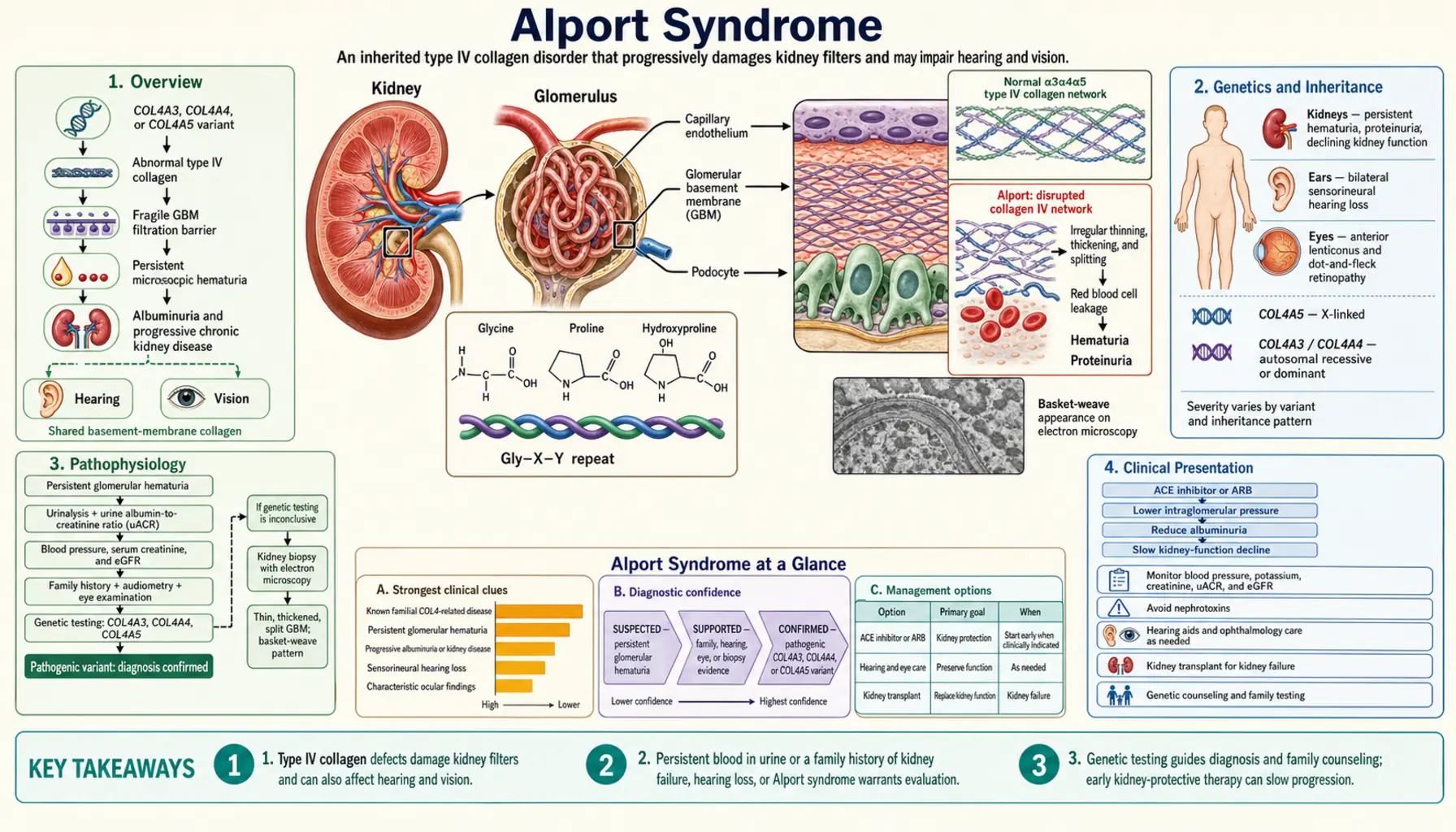
Alport syndrome is a hereditary nephritis caused by mutations in COL4A3, COL4A4, or COL4A5 genes encoding type IV collagen α-chains, components of the glomerular basement membrane (GBM). The disease produces a characteristic triad of progressive glomerulonephritis leading to end-stage renal disease, sensorineural hearing loss, and ocular abnormalities including anterior lenticonus. It accounts for approximately 2–3% of pediatric ESRD cases worldwide.
Table of Contents
- Overview
- Genetics and Inheritance
- Pathophysiology
- Clinical Presentation
- Diagnosis
- Histopathology
- Treatment
- Prognosis and ESRD Risk
- Transplantation and Anti-GBM Disease
- Genetic Counseling
- Research Papers (PubMed searches)
- References
- Featured Videos
1. Overview
Alport syndrome is a progressive hereditary nephritis first described by Cecil Alport in 1927 as a familial nephritis with associated hearing loss. It is caused by mutations in genes encoding type IV collagen α3, α4, or α5 chains (COL4A3, COL4A4, COL4A5), which are critical structural components of the glomerular basement membrane (GBM), cochlear basement membrane, and lens capsule. Three inheritance patterns exist: X-linked (XLAS, ~85% of cases, COL4A5 mutations), autosomal recessive (ARAS, ~15%, COL4A3 or COL4A4 mutations), and autosomal dominant (ADAS, ~5%, heterozygous COL4A3/A4, milder). XLAS affects males more severely than females. Alport syndrome accounts for approximately 0.6% of adults on renal replacement therapy but 2–3% of pediatric ESRD. Early ACE inhibitor therapy has been shown to delay ESRD onset by 5–13 years.
2. Genetics and Inheritance
Type IV collagen is the major structural collagen of basement membranes. The GBM contains predominantly the α3α4α5(IV) heterotrimer encoded by COL4A3 (chromosome 2q36), COL4A4 (chromosome 2q36), and COL4A5 (chromosome Xq22). In early fetal GBM, α1α2(IV) predominates; during nephrogenesis, the switch to α3α4α5(IV) occurs (the “isoform switch”). Loss-of-function mutations prevent this switch or disrupt heterotrimer assembly, resulting in persistence of fetal-type α1α2(IV) GBM that is prone to mechanical degradation.
X-linked Alport syndrome (XLAS): ~85% of Alport families. COL4A5 mutation on X chromosome. Hemizygous males: ESRD by median age 25 years (truncating mutations) or 30–40 years (missense mutations). Heterozygous females: 15% reach ESRD by age 60; 90% have persistent microscopic hematuria. Female carriers have variable expression due to X-inactivation.
Autosomal recessive ARAS: ~15% of Alport cases. Biallelic mutations in COL4A3 or COL4A4. Males and females equally affected. ESRD by 20s–30s, similar severity to X-linked males.
Autosomal dominant ADAS: Heterozygous COL4A3/A4 mutations. Milder phenotype; ESRD in 50s–70s if it occurs. Overlaps with thin basement membrane nephropathy (TBMN); ADAS may represent ~1% of the general population (previously called “benign familial hematuria”).
De novo mutations account for ~10–15% of XLAS cases (no family history).
3. Pathophysiology
Loss of the α3α4α5(IV) heterotrimer in the GBM disrupts the normal network of type IV collagen crosslinks, reducing GBM tensile strength. The resulting structurally fragile GBM allows passage of erythrocytes (hematuria) and plasma proteins (proteinuria). Podocyte foot process effacement develops as the diseased GBM fails to support podocyte attachment.
Mechanistically, the absence of the α3/α4/α5 network also exposes the persistent fetal α1α2(IV) chains to injury, and activates mesangial cells and tubular cells via mechanical and cytokine-mediated pathways. TGF-β1 drives progressive interstitial fibrosis. The same α3α4α5(IV) network is critical in the cochlear basilar membrane (explaining sensorineural hearing loss) and the lens capsule (explaining anterior lenticonus and macular lesions).
4. Clinical Presentation
The classic triad of Alport syndrome consists of:
1. Progressive glomerulonephritis: Persistent microscopic hematuria from infancy (universal in affected males and female carriers). Episodic macroscopic hematuria, particularly with upper respiratory infections or exercise, in childhood. Proteinuria begins in the second decade in X-linked males. CKD progresses to ESRD in untreated males by median age 25 (truncating) or 30–40 years (missense mutations).
2. Sensorineural hearing loss (SNHL): Bilateral, high-frequency SNHL (2,000–8,000 Hz range). Present in 90% of XLAS males by ESRD. Typically begins in teens. Hearing loss is not congenital — audiogram may be normal in young children. Also present in ~60% of ARAS patients. Often the second symptom to develop after hematuria.
3. Ocular abnormalities: Anterior lenticonus (protrusion of the lens nucleus anteriorly through the lens capsule) — pathognomonic but found in only 20–30% of XLAS males; confirmed by slit-lamp examination showing oil-droplet reflex. Macular flecks (perimacular yellowish-white dot pattern); posterior polymorphous corneal dystrophy. Vision is usually not severely impaired.
Additional features: recurrent corneal erosions; aortic aneurysm (rare, XLAS); diffuse leiomyomatosis (rare, contiguous COL4A5/COL4A6 deletion).
5. Diagnosis
Clinical diagnosis is suspected in: persistent microscopic hematuria in a child or young adult with family history of nephritis, ESRD, or hearing loss. Confirmed by:
Genetic testing: Next-generation sequencing (NGS) panel for COL4A3/A4/A5 is first-line. Pathogenic variants identified in 90–95% of clinically diagnosed Alport patients. Interpretation: truncating (nonsense/frameshift/splice) mutations are more severe in XLAS males; missense variants must be assessed for pathogenicity (ClinVar, Alport Online database). Annual review of variant classification is advised for patients with variants of uncertain significance (VUS).
Skin biopsy (for XLAS): Immunofluorescence staining for α5(IV) collagen. In XLAS males: absent or reduced α5(IV) in epidermal basement membrane and GBM. In XLAS females: mosaic staining (alternating positive/negative segments due to X-inactivation). Skin biopsy is less invasive than renal biopsy and ~80% sensitive for XLAS diagnosis.
Kidney biopsy: Light microscopy: initially normal or focal mesangial proliferation; later FSGS, tubular atrophy, interstitial fibrosis. Immunofluorescence: absent α3/α4/α5(IV) in GBM (in ARAS and XLAS males); mosaic in XLAS females. Electron microscopy (EM): pathognomonic — GBM shows diffuse irregular thickening, splitting, and lamellation (“basket-weave” or “moth-eaten” pattern) in advanced disease; diffuse thinning in early childhood disease. EM findings evolve with age from thin GBM to lamellated GBM.
Additional workup: Audiogram in all diagnosed patients (annual monitoring thereafter). Ophthalmology slit-lamp examination for lenticonus (annual after diagnosis). Laboratory: urinalysis with microscopy (dysmorphic RBCs, RBC casts), spot urine PCR to quantify proteinuria, eGFR trend, complement levels (normal — distinguishes from immune complex GN).
6. Histopathology
The ultrastructural changes on electron microscopy are central to Alport diagnosis and staging:
Early disease (children): Diffuse thinning of the GBM (normal adult GBM thickness ~300–400 nm; thin = <200 nm). May overlap with thin basement membrane nephropathy. Light microscopy and immunofluorescence may be normal.
Established disease: Irregular GBM thickness — areas of thinning interspersed with thickening. Splitting and lamellation of the lamina densa: the dense central layer breaks up into multiple irregular strands enclosing rounded electron-lucent areas (“basket-weave” pattern). This ultrastructural appearance is pathognomonic for Alport syndrome.
Advanced disease: Widespread GBM thickening and lamellation, foot process effacement, mesangial hypercellularity, segmental sclerosis, interstitial fibrosis, and tubular atrophy.
Immunofluorescence with α-chain specific antibodies: In ARAS and XLAS males — complete absence of α3/α4/α5(IV) in GBM and Bowman’s capsule; absent α5(IV) in distal tubular basement membrane and skin. In XLAS females — segmental/mosaic expression. Enables genotype prediction from biopsy in ~80% of cases.
7. Treatment
RAAS Blockade (cornerstone of treatment)
ACE inhibitors (e.g., ramipril, benazepril) or ARBs are first-line treatment to reduce proteinuria and delay CKD progression. The Alport Syndrome Research Collaborative (Gross et al., 2012) showed ACEi therapy delayed ESRD by a median of 13 years when started before proteinuria onset (hematuria-only stage). Guidelines recommend initiating ACEi in all males with XLAS and a known pathogenic variant, even before proteinuria develops (preventive treatment). Target: proteinuria <300 mg/day; blood pressure <125/75 mmHg.
Sparsentan
FDA-approved dual endothelin/angiotensin receptor antagonist (also approved for IgAN and FSGS). The Phase 3 DUPLEX trial evaluated sparsentan in FSGS/Alport; results support use in proteinuric hereditary nephritis. Reduces proteinuria more than ARB alone.
Emerging Therapies
Bardoxolone methyl (NRF2 activator): Phase 2 CARDINAL trial showed eGFR improvement in CKD including Alport patients.
Atrasentan (endothelin-A antagonist): Phase 3 ALIGN trial ongoing; selective endothelin-A blockade reduces proteinuria.
Lademirsen (anti-miR-21): microRNA-21 drives fibrosis downstream of TGF-β1 in Alport mouse models; Phase 1/2 trial in Alport patients evaluated safety and preliminary efficacy.
Gene therapy: In vivo and ex vivo strategies for COL4A3/A5 restoration remain in preclinical development.
Anti-TGF-β therapy: Pirfenidone and losartan (with TGF-β pathway effects) have been investigated in murine Alport models.
Symptomatic Management
Hearing aids for SNHL; ophthalmology monitoring and lens management for lenticonus; strict blood pressure control; dietary sodium restriction; avoidance of nephrotoxins (NSAIDs, aminoglycosides, contrast agents).
8. Prognosis and ESRD Risk
Untreated XLAS males: Truncating COL4A5 mutations (nonsense, frameshift, large deletions) → ESRD by median age 25. Missense mutations → median ESRD age 35–40. Deletions involving COL4A5 + COL4A6 → leiomyomatosis (rare). Hearing loss present in >90% by ESRD.
With early ACEi: ESRD delayed 5–13 years depending on mutation severity and time of treatment initiation.
XLAS females: 12% reach ESRD by age 45; 30% by age 60. Risk factors for progression in females include significant proteinuria and more severe variant class.
ARAS: ESRD by 20s–30s in both sexes if untreated; clinical severity similar to X-linked males.
ADAS: Variable. A subset reaches ESRD in 50s–70s; a significant proportion maintain normal kidney function into old age. Overlaps clinically with thin basement membrane nephropathy.
Genetic modifier effects: Variants in UMOD, MUC1, APOL1, and other genes may modulate the rate of CKD progression independently of the primary COL4A mutation.
9. Transplantation and Anti-GBM Disease
Kidney transplantation is the treatment of choice for Alport ESRD, with outcomes comparable to other hereditary nephritides. However, a rare but serious complication is post-transplant anti-GBM nephritis (Alport anti-GBM disease):
Mechanism: Alport patients who lacked α3/α4/α5(IV) chains throughout their lives are immunologically naive to these antigens. The transplanted kidney introduces normal GBM antigens as neo-antigens. The immune system may recognize α3(IV) NC1 or α5(IV) NC1 as foreign and mount an anti-GBM antibody response, causing crescentic GN in the graft.
Incidence: Approximately 3–5% of Alport males post-transplant (higher in those with complete absence of α3/α4/α5 chains, i.e., ARAS or XLAS with truncating mutations). Onset typically within 1 year of transplant.
Management: High-dose immunosuppression (cyclophosphamide + steroids), plasmapheresis (as for Goodpasture syndrome). Graft loss is common despite treatment. Screening: anti-GBM antibody titers post-transplant, especially in ARAS patients.
Living-related donor evaluation: Female XLAS carriers can donate; careful evaluation of GFR trend, proteinuria, and genetic variant severity is required. ARAS heterozygote relatives have increased lifetime CKD risk — carrier status alone does not preclude donation but warrants careful assessment and long-term follow-up.
10. Genetic Counseling
All patients and families with Alport syndrome should receive formal genetic counseling. Key inheritance points:
X-linked (XLAS): Sons of affected females have a 50% chance of inheriting the COL4A5 mutation. Daughters of affected females have a 50% chance of being carriers (will have hematuria; variable CKD risk). Sons of affected males cannot inherit the X-linked variant from their father. Daughters of affected males are all obligate carriers.
Autosomal recessive (ARAS): Parents are obligate heterozygotes (TBMN carriers); siblings have a 25% chance of ARAS. Prenatal testing and preimplantation genetic diagnosis (PGD) are available options for affected families.
Autosomal dominant (ADAS): 50% transmission probability per pregnancy.
De novo mutations (~10–15%): Molecular testing can confirm de novo status. Genetic testing of first-degree relatives is recommended even without symptoms, as early identification enables early ACEi therapy.
Variant reclassification: As ClinVar and disease-specific databases expand, variant classifications change over time. Annual review of genetic reports is advised for patients with variants of uncertain significance (VUS).
11. Research Papers (PubMed searches)
- Alport syndrome COL4A5 mutation
- Alport syndrome ACE inhibitor treatment delay ESRD
- Alport syndrome glomerular basement membrane electron microscopy
- Alport syndrome hearing loss genetics
- Alport syndrome post-transplant anti-GBM nephritis
- thin basement membrane nephropathy COL4A3
12. References
- Savige J, et al. Expert guidelines for the management of Alport syndrome and thin basement membrane nephropathy. J Am Soc Nephrol. 2013;24(3):364–375. PMID: 23349312. https://doi.org/10.1681/ASN.2012020148
- Gross O, et al. Early angiotensin-converting enzyme inhibition in Alport syndrome delays renal failure and improves life expectancy. Kidney Int. 2012;81(5):494–501. PMID: 22189050. https://doi.org/10.1038/ki.2011.407
- Kashtan CE, et al. Alport syndrome: a unified classification of genetic disorders of collagen IV α345: a position paper of the Alport Syndrome Classification Working Group. Kidney Int. 2018;93(5):1045–1051. PMID: 29503057. https://doi.org/10.1016/j.kint.2017.12.018
- Yamamura T, et al. New COL4A3 and COL4A4 Mutations Expand the Known Phenotype of Alport Syndrome. J Am Soc Nephrol. 2017;28(10):3046–3056. PMID: 28522649. https://doi.org/10.1681/ASN.2016111244
- Heidet L, et al. A human-mouse chimera of the alpha3alpha4alpha5(IV) collagen protomer rescues the renal phenotype in Col4a3-/- Alport mice. Am J Pathol. 2000;156(6):1849–1857. PMID: 10854209. https://doi.org/10.1016/S0002-9440(10)65056-X
- Byrne MC, et al. Renal transplant outcomes in patients with Alport syndrome. Transplantation. 2019;103(5):926–932. PMID: 30394992. https://doi.org/10.1097/TP.0000000000002484
- Temme J, et al. Incidence of renal failure and nephroprotection by RAAS inhibition in heterozygous carriers of X-chromosomal and autosomal recessive Alport mutations. Kidney Int. 2012;81(8):779–783. PMID: 22237749. https://doi.org/10.1038/ki.2011.452
- van der Loop FT, et al. Autosomal dominant Alport syndrome caused by a COL4A3 splice site mutation. Kidney Int. 2000;58(5):1870–1875. PMID: 11044206. https://doi.org/10.1046/j.1523-1755.2000.00356.x
- Kamiyoshi N, et al. Genetic, clinical, and pathologic backgrounds of patients with autosomal dominant Alport syndrome. Clin J Am Soc Nephrol. 2016;11(8):1422–1430. PMID: 27340281. https://doi.org/10.2215/CJN.00050116
- Jais JP, et al. X-linked Alport syndrome: natural history and genotype-phenotype correlations in girls and women belonging to 195 families: a “European Community Alport Syndrome Concerted Action” study. J Am Soc Nephrol. 2003;14(10):2603–2610. PMID: 14514737. https://doi.org/10.1097/01.asn.0000090034.71205.74
- Bekheirnia MR, et al. Genotype-phenotype correlation in X-linked Alport syndrome. J Am Soc Nephrol. 2010;21(5):876–883. PMID: 20360308. https://doi.org/10.1681/ASN.2009070738
- Kashtan CE. Alport syndrome: achieving early diagnosis and treatment. Am J Kidney Dis. 2021;77(2):272–279. PMID: 32763101. https://doi.org/10.1053/j.ajkd.2020.07.016
Connections
- Nephrology & Hepatology
- Glomerulonephritis
- IgA Nephropathy
- Nephrotic Syndrome
- Chronic Kidney Disease
- Focal Segmental Glomerulosclerosis
- Rapidly Progressive GN
- Lupus Nephritis
- Kidney Function Tests
- Urinalysis
- Creatinine