Acetaminophen Overdose
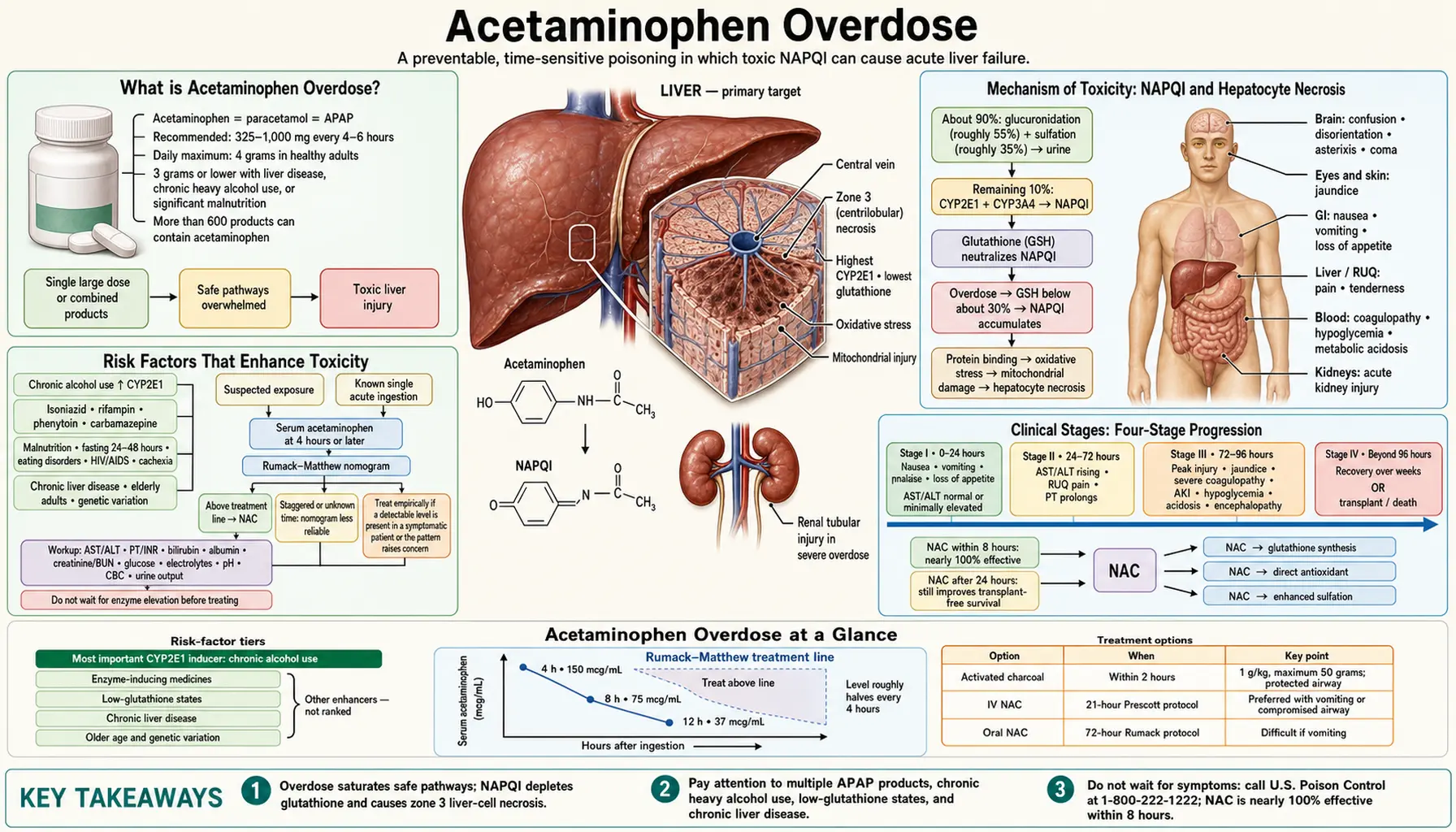
Acetaminophen overdose is the leading cause of acute liver failure in the United States and United Kingdom, yet it is almost entirely preventable and — when caught in time — highly treatable. Understanding how a medicine found in hundreds of everyday products can silently destroy the liver within days is the first step toward preventing this tragedy.
Interactive Visualization What Alcohol Actually Does Inside Your Liver Ethanol becomes acetaldehyde becomes acetate — and the NADH that piles up shuts down fat burning, stalls your blood sugar and drives uric acid up. Nothing speeds it up. Launch →Table of Contents
- What is Acetaminophen Overdose?
- Mechanism of Toxicity: NAPQI and Hepatocyte Necrosis
- Risk Factors That Enhance Toxicity
- Clinical Stages: Four-Stage Progression
- Diagnosis: Serum Levels and the Rumack-Matthew Nomogram
- Treatment: N-Acetylcysteine and Activated Charcoal
- Acute Liver Failure and Liver Transplantation
- Prevention and Public Health
- Research Papers
- Connections
- Featured Videos
What is Acetaminophen Overdose?
Acetaminophen — also called paracetamol in the United Kingdom, Australia, and much of the world, and abbreviated as APAP from its chemical name N-acetyl-p-aminophenol — is one of the most widely used medicines on earth. At recommended doses it is safe and effective for pain and fever. But it carries a narrow therapeutic index: the gap between a dose that works and a dose that harms the liver is surprisingly small, particularly when the liver is already under stress.
Acetaminophen overdose accounts for more cases of acute liver failure in the United States than any other cause, including alcohol. In the United Kingdom, paracetamol poisoning is similarly the top cause of drug-induced liver failure. Each year, more than 100,000 calls are made to U.S. Poison Control Centers regarding acetaminophen exposures, and more than 450 deaths result — making this one of the most lethal yet preventable drug toxicities in modern medicine.
The standard therapeutic dose is 325–1,000 mg every 4–6 hours, with a daily maximum of 4 grams in healthy adults. In people with liver disease, chronic heavy alcohol use, or significant malnutrition, the safe daily ceiling drops to 3 grams or lower. Exceeding these limits — whether by a single massive intentional overdose or by unwittingly combining multiple products that each contain acetaminophen — overwhelms the liver's ability to process the drug safely.
Acetaminophen is found in more than 600 over-the-counter and prescription products: pain relievers (Tylenol, Excedrin), cold-and-flu remedies (NyQuil, DayQuil, TheraFlu), sleep aids, and combination opioid prescriptions such as Vicodin (hydrocodone/APAP) and Percocet (oxycodone/APAP). This ubiquity means unintentional overdose — sometimes called therapeutic misadventure — is as common as intentional self-harm. A patient who takes Tylenol for a headache, NyQuil for a cold, and a Percocet for back pain may easily exceed 4 grams per day without realizing it.
Mechanism of Toxicity: NAPQI and Hepatocyte Necrosis
To understand why acetaminophen is dangerous in overdose, you need to understand how the liver normally handles it — and what goes wrong when the system is overwhelmed.
Under normal circumstances, about 90% of acetaminophen is metabolized through two safe pathways: glucuronidation (roughly 55%) and sulfation (roughly 35%). Both reactions attach a harmless molecule to the drug, creating a water-soluble compound that the kidneys can excrete in urine. This is the liver doing exactly what it is designed to do.
The remaining 10% passes through a different pathway, driven by liver enzymes called CYP2E1 and CYP3A4. This pathway produces NAPQI (N-acetyl-p-benzoquinone imine), a highly reactive and toxic electrophile. At normal therapeutic doses, NAPQI is immediately neutralized by glutathione (GSH), a natural antioxidant molecule that the liver makes continuously. The NAPQI-glutathione combination is then excreted harmlessly as a mercapturate compound.
In overdose, however, the glucuronidation and sulfation pathways become saturated — they simply cannot process all the drug fast enough. More and more acetaminophen is shunted into the CYP pathway, generating NAPQI faster than the liver can make glutathione. Once glutathione stores are depleted (typically when they fall below about 30% of normal), NAPQI begins accumulating inside liver cells.
Unbound NAPQI is extremely destructive. It covalently binds to proteins inside hepatocytes (liver cells), disrupting their function. It causes oxidative stress and directly damages the mitochondria — the energy-producing organelles that cells depend on for survival. When mitochondria fail, the hepatocyte undergoes necrosis: not a controlled, clean cell death, but a chaotic rupture that spills toxic contents into surrounding tissue and triggers inflammation.
The damage follows a characteristic anatomical pattern. It strikes hardest in zone 3 (centrilobular) hepatocytes — the cells surrounding the central veins of each liver lobule. These cells have the highest concentration of CYP2E1 enzymes and the lowest reserves of glutathione. This centrilobular pattern is so distinctive that a pathologist can often identify acetaminophen toxicity on biopsy, even without knowing the patient's history.
In very severe overdoses, the kidneys are also at risk. The kidneys contain their own CYP enzymes and can generate NAPQI locally, causing direct renal tubular injury and acute kidney injury (AKI). Less commonly, pancreatitis and rare myocardial injury have been described.
Risk Factors That Enhance Toxicity
Not everyone who takes the same acetaminophen overdose experiences the same degree of liver damage. Several factors shift the balance between safe metabolism and toxic NAPQI accumulation, making some people far more vulnerable than others.
CYP2E1 inducers increase the fraction of acetaminophen converted to NAPQI. The most important is chronic alcohol use: regular heavy drinking upregulates CYP2E1 activity, so a habitual drinker produces more NAPQI per milligram of acetaminophen than a non-drinker. Certain medications do the same, including isoniazid (the tuberculosis antibiotic), rifampin, and anticonvulsants like phenytoin and carbamazepine. Patients on these drugs should use acetaminophen cautiously and at the lowest effective dose.
Reduced glutathione stores limit the liver's ability to neutralize the NAPQI that is produced. Glutathione synthesis depends on adequate protein and micronutrient intake. States that deplete GSH include malnutrition, prolonged fasting (as brief as 24–48 hours), eating disorders such as anorexia nervosa, HIV/AIDS, and cancer-associated cachexia. A malnourished person taking what looks like a "safe" dose of acetaminophen may be walking a much finer line than they realize.
Pre-existing chronic liver disease is a double risk: it reduces both the liver's glucuronidation capacity and its ability to synthesize glutathione. Patients with cirrhosis, NAFLD, or hepatitis must use lower acetaminophen doses.
Age plays a nuanced role. Neonates and young infants have relatively low CYP2E1 activity, which may offer some protection — infants tend to metabolize acetaminophen more through sulfation. Elderly adults, however, have reduced glutathione stores and slower hepatic metabolism overall, increasing their risk at any given dose.
One counterintuitive finding worth noting: acute alcohol ingestion at the time of overdose may actually be somewhat protective, because ethanol competes with acetaminophen for CYP2E1 binding, temporarily slowing NAPQI production. This is the opposite of chronic alcohol use. Clinicians must be careful not to reassure a binge drinker who just took a large acetaminophen dose — protection is partial and time-limited, and the full toxic picture emerges as alcohol is cleared.
Finally, genetic variation in CYP2E1, CYP3A4, and UGT1A (the glucuronidation enzyme) creates inherited differences in how individuals process acetaminophen. Population-level data show measurable variation in susceptibility across ethnic groups, though this does not change clinical management for any individual patient.
Clinical Stages: Four-Stage Progression
Acetaminophen toxicity unfolds in a predictable four-stage sequence over several days. Understanding this timeline is critical because the window for life-saving treatment is wide open in Stage I — and nearly closed by Stage III.
Stage I: 0–24 Hours — The Deceptive Phase
In the first 24 hours, patients experience nausea, vomiting, malaise, and loss of appetite. These symptoms are non-specific — they could accompany almost any illness. More dangerously, liver enzymes (AST, ALT) are normal or only minimally elevated at this stage. Hepatocyte death has begun, but it is not yet reflected in blood tests. Many patients feel "not that sick" and assume everything is fine. This false sense of reassurance is lethal when it leads to delayed medical care. Stage I is the critical window: N-acetylcysteine given now is close to 100% effective at preventing serious liver damage.
Stage II: 24–72 Hours — Rising Enzymes
Between 24 and 72 hours, the picture changes. AST and ALT begin rising — often dramatically, sometimes reaching 10,000 IU/L or higher. Right upper quadrant pain and tenderness appear as hepatocytes die in large numbers. Prothrombin time (PT) begins to prolong as the liver's ability to make clotting factors is impaired. Paradoxically, nausea often improves in Stage II, further lulling patients into believing recovery is underway when in fact the worst is still ahead.
Stage III: 72–96 Hours — Peak Hepatotoxicity
Stage III represents the peak of liver injury, typically 72–96 hours after ingestion. Jaundice develops as the damaged liver fails to process bilirubin. Coagulopathy becomes severe, with markedly prolonged INR — the liver can no longer produce the clotting factors that prevent uncontrolled bleeding. Acute kidney injury develops from direct NAPQI-mediated nephrotoxicity and from the hemodynamic consequences of liver failure. Hypoglycemia occurs because the failing liver can no longer maintain blood glucose through gluconeogenesis. Metabolic acidosis reflects global mitochondrial dysfunction. Finally, hepatic encephalopathy emerges — confusion, disorientation, asterixis (a flapping hand tremor), and ultimately coma as ammonia and other toxins accumulate in the bloodstream. Death from multiorgan failure can occur in Stage III in untreated or late-presenting patients.
Stage IV: Beyond 96 Hours — Recovery or Transplant
Stage IV is the fork in the road. For patients who survive Stage III without progressing to irreversible acute liver failure, the liver's remarkable regenerative capacity takes over. Hepatocytes regrow from spared periportal cells, enzyme levels fall, coagulopathy resolves, and most patients achieve complete recovery of liver function over weeks. The liver does not scar as it would in chronic injury; centrilobular necrosis heals cleanly. For patients who do progress to fulminant hepatic failure, Stage IV means either liver transplantation or death.
Diagnosis: Serum Levels and the Rumack-Matthew Nomogram
The cornerstone of acetaminophen overdose diagnosis is a simple blood test: the serum acetaminophen level. The result is only meaningful when interpreted against the time elapsed since ingestion.
Levels drawn before 4 hours post-ingestion are unreliable because drug absorption is still ongoing — the peak concentration may not yet have been reached. The standard practice is to draw the level at 4 hours or later after a single acute ingestion and plot it on the Rumack-Matthew nomogram.
The Rumack-Matthew nomogram, first published in 1975, is a graph that plots serum acetaminophen concentration (vertical axis) against time since ingestion (horizontal axis). It contains a treatment line (originally called the "probable toxicity" line) that slopes downward from left to right, reflecting the fact that the drug is being cleared over time. If a patient's level falls above the treatment line, N-acetylcysteine therapy is indicated regardless of symptoms. A level below the line means significant hepatotoxicity is unlikely.
As a practical reference: at 4 hours post-ingestion, the treatment threshold is approximately 150 mcg/mL. By 8 hours it is about 75 mcg/mL; by 12 hours, 37 mcg/mL. The level roughly halves every 4 hours in a healthy liver. Some centers use a more conservative lower treatment line ("possible toxicity") to capture patients at intermediate risk.
The nomogram is most reliable for a single acute ingestion at a known time. For staggered ingestions — where the patient has taken multiple doses over hours or days — the nomogram is less reliable because the timing reference point is ambiguous. In these cases, clinicians treat empirically if any detectable level is present in a symptomatic patient or if the pattern of use raises concern.
A full diagnostic workup includes:
- Liver function tests: AST and ALT (AST typically rises faster and higher than ALT in acetaminophen toxicity, which is the reverse of many other liver diseases), PT/INR, bilirubin, albumin
- Metabolic panel: creatinine and BUN (for AKI), serum glucose (hypoglycemia), electrolytes, venous or arterial pH (acidosis signals poor prognosis)
- Complete blood count
- Urine output monitoring
Liver biopsy is not routinely performed — the clinical picture combined with enzyme levels is usually sufficient. When biopsy specimens are available (from transplant explants, for example), they show the characteristic centrilobular necrosis with preserved portal tracts, a pattern that distinguishes acetaminophen toxicity from most other causes of liver injury.
A critical clinical lesson: do not wait for enzyme elevation before treating. By the time AST and ALT are dramatically elevated, irreversible hepatocyte death has already occurred. The nomogram guides treatment decisions in the pre-symptomatic window when treatment is most effective.
Treatment: N-Acetylcysteine and Activated Charcoal
Acetaminophen overdose has a specific, highly effective antidote: N-acetylcysteine (NAC). The key to success is giving it early. But even late administration helps — a fact that is not widely enough appreciated.
Activated Charcoal
When a patient presents to the emergency department within 2 hours of ingestion and has a protected airway and intact mental status, activated charcoal (1 gram per kilogram body weight, maximum 50 grams) can be given orally. Activated charcoal acts like a sponge in the gastrointestinal tract, adsorbing unabsorbed acetaminophen before it enters the bloodstream and reducing the total dose the liver must process. Beyond 2 hours, most of the drug has already been absorbed and charcoal provides little benefit. Gastric lavage (stomach pumping) is rarely indicated and is not recommended beyond 1 hour of ingestion because the aspiration risk outweighs the benefit.
N-Acetylcysteine: How It Works
NAC works through three mechanisms. First and most importantly, it is a precursor to cysteine, which the liver uses to synthesize glutathione — the very molecule that is depleted in overdose and that normally detoxifies NAPQI. Replenishing cysteine lets the liver ramp up glutathione production and resume safe detoxification. Second, NAC itself acts as a direct antioxidant, scavenging reactive oxygen species. Third, it enhances sulfation, shunting more acetaminophen into the non-toxic sulfate pathway. In established liver failure, NAC also improves oxygen delivery to tissues and has direct anti-inflammatory effects that appear to reduce multiorgan dysfunction.
Timing of NAC and Its Impact on Outcome
The relationship between timing and benefit is stark:
- Within 8 hours of ingestion: NAC is nearly 100% effective at preventing significant hepatotoxicity. A patient treated within 8 hours is very unlikely to develop any clinically meaningful liver injury.
- 8–24 hours post-ingestion: NAC reduces the severity of liver injury even if it cannot fully prevent it. Most patients treated in this window will still recover without liver failure.
- After 24 hours (established ALF): NAC still improves transplant-free survival and reduces complications such as cerebral edema and renal failure. It should be continued throughout the ICU course. A landmark 1990 Lancet paper by Harrison and colleagues showed that even late NAC administration significantly improved outcomes in fulminant hepatic failure.
IV vs. Oral NAC
Intravenous NAC is preferred when a patient is vomiting (which is common) or when the airway is compromised. The standard 21-hour Prescott IV protocol delivers:
- 150 mg/kg over 1 hour (loading dose)
- 50 mg/kg over 4 hours (second phase)
- 100 mg/kg over 16 hours (maintenance phase)
Anaphylactoid reactions — flushing, itching, nausea, bronchospasm — occur in approximately 5% of patients receiving IV NAC, typically during the high-concentration loading dose. These are not true allergic reactions but rate-dependent histamine release. Slowing the infusion rate almost always resolves them. Randomized controlled trial evidence (Bateman et al., Lancet 2014) showed that a modified slower loading dose significantly reduces these adverse effects without compromising efficacy.
Oral NAC follows the 72-hour Rumack protocol: a loading dose of 140 mg/kg, then 70 mg/kg every 4 hours for 17 additional doses. Oral NAC has an unpleasant sulfurous odor and taste and is difficult for vomiting patients to tolerate. Antiemetics can be used to facilitate oral dosing.
Treatment duration is not fixed to a protocol clock. NAC should be continued until serum acetaminophen is undetectable and liver function tests are clearly improving and INR is below 2. Premature discontinuation in a patient with ongoing enzyme rise risks undertreating a severe ingestion.
Acute Liver Failure and Liver Transplantation
Despite optimal treatment, a subset of patients with massive acetaminophen ingestion or late presentation will progress to acute liver failure (ALF), also called fulminant hepatic failure. ALF is defined by three features: INR greater than 1.5, hepatic encephalopathy, and no pre-existing chronic liver disease — all arising within 26 weeks of the precipitating event.
Acetaminophen-induced ALF carries a mortality of 20–40% without transplantation, but unlike many other causes of ALF (such as Wilson's disease or viral hepatitis), it has a higher rate of spontaneous recovery — provided the patient survives long enough for hepatocyte regeneration to occur. This makes the challenge in ALF not just keeping the patient alive but accurately identifying who will recover and who will not.
ICU Management
Patients with acetaminophen-induced ALF require intensive care. Key elements of management include:
- Continued IV NAC infusion throughout the ICU course, including in established ALF
- Intracranial pressure (ICP) monitoring in grade III–IV encephalopathy — cerebral edema is the leading direct cause of death in ALF and is managed with mannitol, hypertonic saline, and head elevation
- Renal replacement therapy (continuous venovenous hemofiltration) for acute kidney injury, which occurs in up to 50% of ALF cases
- Glucose infusions to prevent and treat hypoglycemia from impaired gluconeogenesis
- Fresh frozen plasma and vitamin K for coagulopathy (though bleeding prophylaxis is controversial — coagulopathy also serves as a prognostic marker and correcting it obscures the clinical picture)
- Lactulose and rifaximin to reduce gut-derived ammonia in hepatic encephalopathy
- Vasopressors for hemodynamic instability (norepinephrine first-line)
- Prophylactic antibiotics in some centers, as ALF patients are highly susceptible to bacterial and fungal infections
King's College Criteria: Who Needs Listing for Transplant?
The King's College Criteria, derived from a landmark 1989 study by O'Grady and colleagues, remain the most widely used tool for identifying acetaminophen-induced ALF patients unlikely to survive without transplantation. A patient meets criteria if they have:
- Arterial pH less than 7.3 after adequate volume resuscitation — this single criterion alone is sufficient to list for transplant; OR
- All three of the following simultaneously: PT greater than 100 seconds (INR greater than 6.5), serum creatinine greater than 3.4 mg/dL, and grade III or IV hepatic encephalopathy
Patients meeting these criteria have an approximately 90% mortality without transplantation. Those who receive a liver transplant have roughly 80% one-year survival. The criteria are not perfect — they miss some patients who will die and list some who would have recovered — but no better validated tool has replaced them in clinical practice, though newer biomarkers such as phosphate, lactate, and MELD-Na score are being evaluated as supplements.
Acetaminophen-induced ALF has a somewhat better prognosis than many other causes of ALF, partly because the underlying injury is acute rather than chronic. The liver retains its regenerative scaffold, and if multiorgan failure can be supported long enough, spontaneous recovery is possible even in patients with very high enzyme levels. This is why continuous NAC, aggressive ICU support, and timely transplant evaluation are so important: time is on the patient's side if the kidneys, brain, and circulation can be protected.
Prevention and Public Health
Acetaminophen is genuinely a safe medicine when used correctly. The public health challenge is that its dangers are underappreciated, its presence in hundreds of combination products is invisible to many consumers, and the damage it causes in overdose is both severe and time-sensitive. Several policy levers have proved effective at reducing harm.
Prescription-only restrictions for high-strength formulations have made the clearest difference. In the United Kingdom, since 1998, paracetamol 500 mg packs sold over the counter have been limited to 16 tablets in pharmacies and 32 tablets in other retail outlets. Purchase of larger quantities requires a prescription. This policy was specifically designed to reduce the lethality of impulsive overdose attempts by limiting the amount of drug easily available. Studies have consistently shown meaningful reductions in paracetamol-related deaths and liver transplants in the UK since implementation — one of the most successful pharmaceutical harm-reduction interventions of the past three decades.
Mandatory labeling changes in the United States now require prominent warnings about liver damage on all acetaminophen-containing products and explicit instructions not to exceed the daily dose. Since 2011, warnings also specifically address the risk of taking multiple products containing acetaminophen simultaneously.
Reducing APAP content in combination opioids addressed a major source of unintentional overdose. Products like Vicodin and Percocet historically contained up to 750 mg of acetaminophen per tablet. In 2014, the FDA required manufacturers to reduce the acetaminophen component in prescription combination products to no more than 325 mg per tablet. A patient taking Percocet for pain who supplemented with Tylenol for a headache could easily exceed toxic thresholds under the old formulation — the reduced dose provides more margin for error.
Pack-size limits in Australia restrict non-prescription acetaminophen to 100 tablets per sale — a policy associated with reduced paracetamol-related hospital admissions. Similar evidence supports blister-pack (unit-dose) packaging, which slows down ingestion compared to loose tablets and may reduce lethality in impulsive self-harm attempts.
For individual consumers, the most important preventive action is to check every medicine label for acetaminophen (listed as "acetaminophen," "APAP," or "paracetamol") before taking it, and to keep a mental tally of total daily intake across all sources. Anyone who has exceeded the safe dose, or suspects they might have, should call Poison Control: 1-800-222-1222 (United States), which operates 24 hours a day, 7 days a week, at no cost. The most important message: do not wait for symptoms. The absence of symptoms in the first 24 hours does not mean the liver is unharmed.
Research Papers
The following studies established the clinical framework for understanding and treating acetaminophen overdose. All citations include PubMed identifiers for verification.
- Rumack BH, Matthew H. "Acetaminophen poisoning and toxicity." Pediatrics. 1975;55(6):871–876. PMID: 1134886 — The foundational paper introducing the Rumack-Matthew nomogram; established the relationship between serum acetaminophen levels, time of ingestion, and risk of hepatotoxicity that guides treatment decisions worldwide.
- Harrison PM, Keays R, Bray GP, Alexander GJ, Williams R. "Improved outcome of paracetamol-induced fulminant hepatic failure by late administration of acetylcysteine." Lancet. 1990;335(8705):1572–1573. — Search PubMed — Demonstrated that N-acetylcysteine improves transplant-free survival even when given after 24 hours in established fulminant hepatic failure.
- Prescott LF, Illingworth RN, Critchley JA, Stewart MJ, Adam RD, Proudfoot AT. "Intravenous N-acetylcysteine: the treatment of choice for paracetamol poisoning." Br Med J. 1979;2(6198):1097–1100. — Search PubMed — The paper establishing the 21-hour IV NAC protocol (Prescott protocol) still used in clinical practice today.
- O'Grady JG, Alexander GJ, Hayllar KM, Williams R. "Early indicators of prognosis in fulminant hepatic failure." Gastroenterology. 1989;97(2):439–445. — Search PubMed — The original King's College Criteria paper; defined the prognostic thresholds for liver transplant listing in ALF from acetaminophen and non-acetaminophen causes.
- Lee WM. "Acute liver failure." N Engl J Med. 1993;329(25):1862–1872. PMID: 8305063 — Comprehensive review of acute liver failure pathophysiology, etiology, and management by the founder of the US ALF Study Group.
- Dart RC, Bailey E. "Does therapeutic use of acetaminophen cause acute liver failure?" Pharmacotherapy. 2007;27(9):1219–1230. — Search PubMed — Examined the evidence for liver injury at therapeutic doses; clarified the role of staggered overdose vs. true therapeutic-dose toxicity.
- Smilkstein MJ, Knapp GL, Kulig KW, Rumack BH. "Efficacy of oral N-acetylcysteine in the treatment of acetaminophen overdose." N Engl J Med. 1988;319(24):1557–1562. PMID: 3059186 — Large multicenter study demonstrating that oral NAC efficacy declines with time from ingestion, providing the data behind the 8-hour treatment window.
- Heard KJ. "Acetylcysteine for acetaminophen poisoning." N Engl J Med. 2008;359(3):285–292. — Search PubMed — Contemporary review of NAC mechanisms, routes of administration, dosing protocols, and adverse effects; widely used clinical reference.
- Larson AM, Polson J, Fontana RJ, et al. "Acetaminophen-induced acute liver failure: results of a United States multicenter, prospective study." Hepatology. 2005;42(6):1364–1372. PMID: 16317692 — US ALF Study Group data showing acetaminophen as the leading cause of ALF in the United States, responsible for ~46% of cases; characterized unintentional vs. intentional overdose patterns.
- Rowden AK, Norvell J, Eldridge DL, Kirk MA. "Updates on acetaminophen toxicity." Med Clin North Am. 2005;89(6):1145–1159. — Search PubMed — Clinical update covering risk factor stratification, nomogram interpretation for staggered ingestions, and treatment decisions for high-risk populations.
- Bateman DN, Dear JW, Thanacoody HK, et al. "Reduction of adverse effects from intravenous acetylcysteine treatment for paracetamol poisoning: a randomised controlled trial." Lancet. 2014;383(9918):697–704. — Search PubMed — Randomized trial demonstrating that a modified loading dose protocol significantly reduces anaphylactoid reactions to IV NAC without compromising clinical efficacy.
- Craig DG, Lee A, Hayes PC, Simpson KJ. "Review article: the current management of acute liver failure." Aliment Pharmacol Ther. 2010;31(3):345–358. — Search PubMed — Comprehensive management review covering ICU supportive care, transplant criteria, and emerging prognostic biomarkers for acetaminophen and non-acetaminophen ALF.
Additional PubMed searches for further reading:
- Acetaminophen hepatotoxicity mechanism NAPQI
- N-acetylcysteine acetaminophen overdose treatment
- Acute liver failure transplantation outcomes
- Paracetamol pack size restriction mortality UK
Connections
- Nephrology & Hepatology
- What Alcohol Does Inside Your Liver — interactive animation
- Acute Kidney Injury — NAPQI-mediated renal tubular injury occurs in severe overdose; AKI complicates up to 50% of ALF cases
- Hepatic Encephalopathy — Stage III acetaminophen overdose culminates in encephalopathy; cerebral edema is the leading cause of death in ALF
- Liver Disease — Pre-existing liver disease dramatically lowers the safe acetaminophen dose threshold
- Cirrhosis — Cirrhosis reduces glutathione synthesis and glucuronidation capacity, increasing toxicity risk at lower doses
- NAFLD — Nonalcoholic fatty liver disease impairs hepatic metabolism and may increase vulnerability to drug-induced liver injury
- Wilson's Disease — Another important cause of acute liver failure, particularly in young patients; differential diagnosis in unexplained ALF
- Addiction and Overdose — Intentional acetaminophen overdose in the context of self-harm requires concurrent mental health evaluation and support
- Household Chemical Toxicity — Acetaminophen sits among common household substances capable of causing serious internal organ injury