Coronary Artery Calcium (CAC), Statins, and the Density Paradox: How Calcium Reshapes Cholesterol Decisions
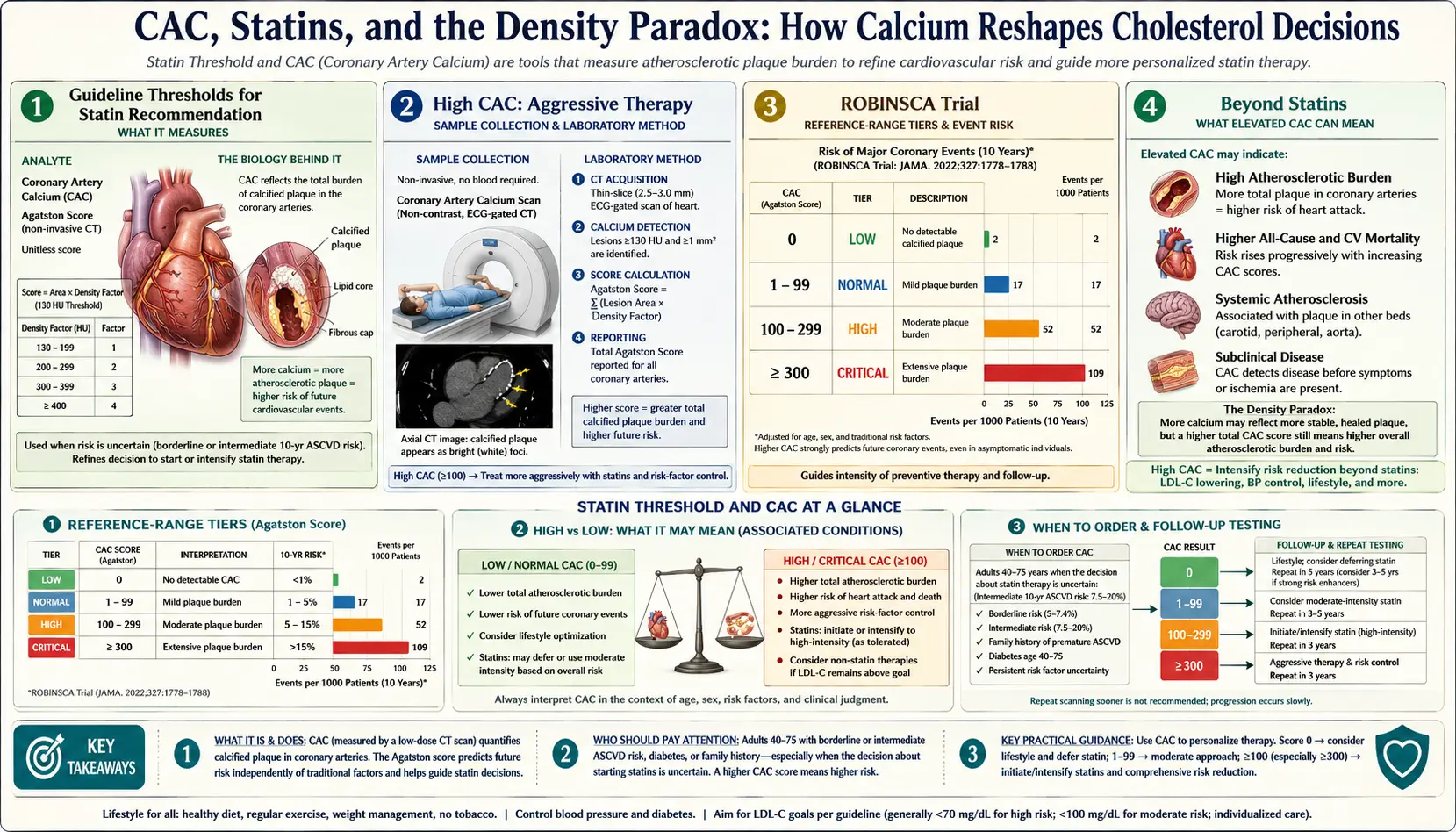
The single most consequential clinical use of the coronary calcium score is in reshaping the statin decision. Coronary artery calcium (CAC) turns the abstract "10-year ASCVD risk percentage" into a concrete picture of accumulated plaque, and that visibility changes the conversation: it can confirm the need for therapy, defer it for years, or escalate it past guideline-default intensity. This page covers the guideline thresholds, the trial evidence behind them, and the most counterintuitive finding in the field: statins make your calcium score go up, even as they reduce your risk of dying from a heart attack.
Table of Contents
- Guideline Thresholds for Statin Recommendation
- Deferring Statins with Coronary Artery Calcium = 0
- The Coronary Artery Calcium ≥100 Threshold
- High Coronary Artery Calcium: Aggressive Therapy
- SCOT-HEART Trial
- ROBINSCA Trial
- The Density Paradox
- Progression on Statins
- Beyond Statins
- Key Research Papers
- Connections
- Featured Videos
Guideline Thresholds for Statin Recommendation
The 2018 ACC/AHA cholesterol guideline (and subsequent updates) explicitly incorporate coronary artery calcium into the statin decision pathway for primary prevention. The relevant cutoffs:
- Coronary artery calcium = 0 — Reasonable to defer statin therapy in adults at intermediate ASCVD risk (5–19.9%) without diabetes, smoking, or family history of premature coronary artery disease (CAD)
- Coronary artery calcium 1–99 — Statin reasonable, especially in those at higher percentiles for age
- Coronary artery calcium ≥100 OR ≥75th percentile — Statin recommended regardless of low-density lipoprotein cholesterol (LDL-C) level
- Coronary artery calcium ≥300 — High-intensity statin; consider aspirin if not contraindicated; aggressive risk-factor management
Different societies have slightly different thresholds. The European ESC guideline emphasizes percentile rather than absolute number. The American College of Cardiology favors the absolute ≥100 cutoff for simplicity.
Deferring Statins with Coronary Artery Calcium = 0
The deferral pathway is one of the strongest reasons to obtain a coronary artery calcium. Patients with intermediate ASCVD risk but a calcium score of zero have 10-year event rates so low that the absolute benefit of statin therapy becomes very small — the number-needed-to-treat over a decade is in the 200–400 range, comparable to many other interventions whose risk/benefit balance favors deferral.
Practical interpretation: a 60-year-old with low-density lipoprotein cholesterol 145, no diabetes, no smoking, no family history, and a coronary artery calcium of 0 has <1% 10-year event risk. Standard pooled-cohort risk calculation might suggest 8–10% risk and trigger a statin recommendation. The coronary artery calcium = 0 result reasonably defers that recommendation with a re-evaluation timeline of 5–10 years. See the coronary artery calcium = 0 page.
The Coronary Artery Calcium ≥100 Threshold
A coronary artery calcium score of 100 or above triggers statin recommendation in most current guidelines, regardless of low-density lipoprotein cholesterol level or pooled-cohort risk score. The reasoning:
- 10-year event rates approach or exceed 7.5% at coronary artery calcium ≥100, meeting threshold for statin benefit
- The presence of mature plaque means the lipoprotein-driven atherogenic process has advanced; further low-density lipoprotein (LDL) exposure compounds the existing burden
- Statin therapy reduces 10-year myocardial infarction (MI) and CV death by 25–35% in this population
- The number-needed-to-treat over a decade falls to ~30–50, a clearly favorable risk/benefit balance
This threshold has shifted clinical practice meaningfully — many patients who would not have qualified for statins under older low-density lipoprotein cholesterol-only criteria now qualify based on calcium burden, and many patients who would have been pressured into therapy on borderline calculator results are now reasonably watched.
High Coronary Artery Calcium: Aggressive Therapy
For coronary artery calcium ≥300, especially ≥1000 or top-percentile-for-age:
- High-intensity statin (atorvastatin 40–80 mg or rosuvastatin 20–40 mg) — aim for low-density lipoprotein cholesterol <70 mg/dL or 50% reduction
- Consider ezetimibe if low-density lipoprotein cholesterol target not met on statin alone
- Consider PCSK9 inhibitors in genetic dyslipidemia or persistent very-high low-density lipoprotein despite statin + ezetimibe
- Aspirin 81 mg daily often appropriate (after weighing bleeding risk), especially in high-risk patterns
- Tight blood pressure control — goal <130/80
- Diabetes screening and management — sodium-glucose cotransporter-2 (SGLT2) inhibitors and glucagon-like peptide-1 (GLP-1) agonists if diabetic
- Stress test or CCTA if symptoms emerge or as a one-time anatomy/ischemia evaluation
- Cardiology consultation at very high scores
SCOT-HEART Trial
The SCOT-HEART trial (Lancet, 2018) randomized 4,146 Scottish patients with stable chest pain to standard care vs CCTA-guided care. Five-year results:
- CCTA-guided arm: 41% relative reduction in death from coronary heart disease (CHD) or non-fatal myocardial infarction (hazard ratio (HR) 0.59, 95% confidence interval (CI) 0.41–0.84)
- The benefit was driven by more accurate diagnosis and earlier statin initiation in the CCTA arm
- The trial demonstrated that imaging-guided care, beyond just coronary artery calcium, can reduce hard endpoints
SCOT-HEART used CCTA, not pure coronary artery calcium, but the principle — that visualization of plaque changes management in a way that improves outcomes — underlies the use of coronary artery calcium in primary prevention as well.
ROBINSCA Trial
ROBINSCA (Risk Or Benefit IN Screening for CArdiovascular disease) was a large Dutch trial randomizing asymptomatic adults at moderate baseline risk to no screening, ASCVD-risk-score-based management, or coronary artery calcium-based management. Findings:
- Coronary artery calcium-based screening identified more high-risk patients earlier than ASCVD-risk-only management
- Patients with elevated coronary artery calcium who started statins earlier had better long-term cardiovascular outcomes
- The trial supported population-level coronary artery calcium screening for asymptomatic adults at intermediate baseline risk
ROBINSCA, alongside SCOT-HEART, has been influential in moving coronary artery calcium from "interesting research test" into mainstream primary prevention practice.
The Density Paradox
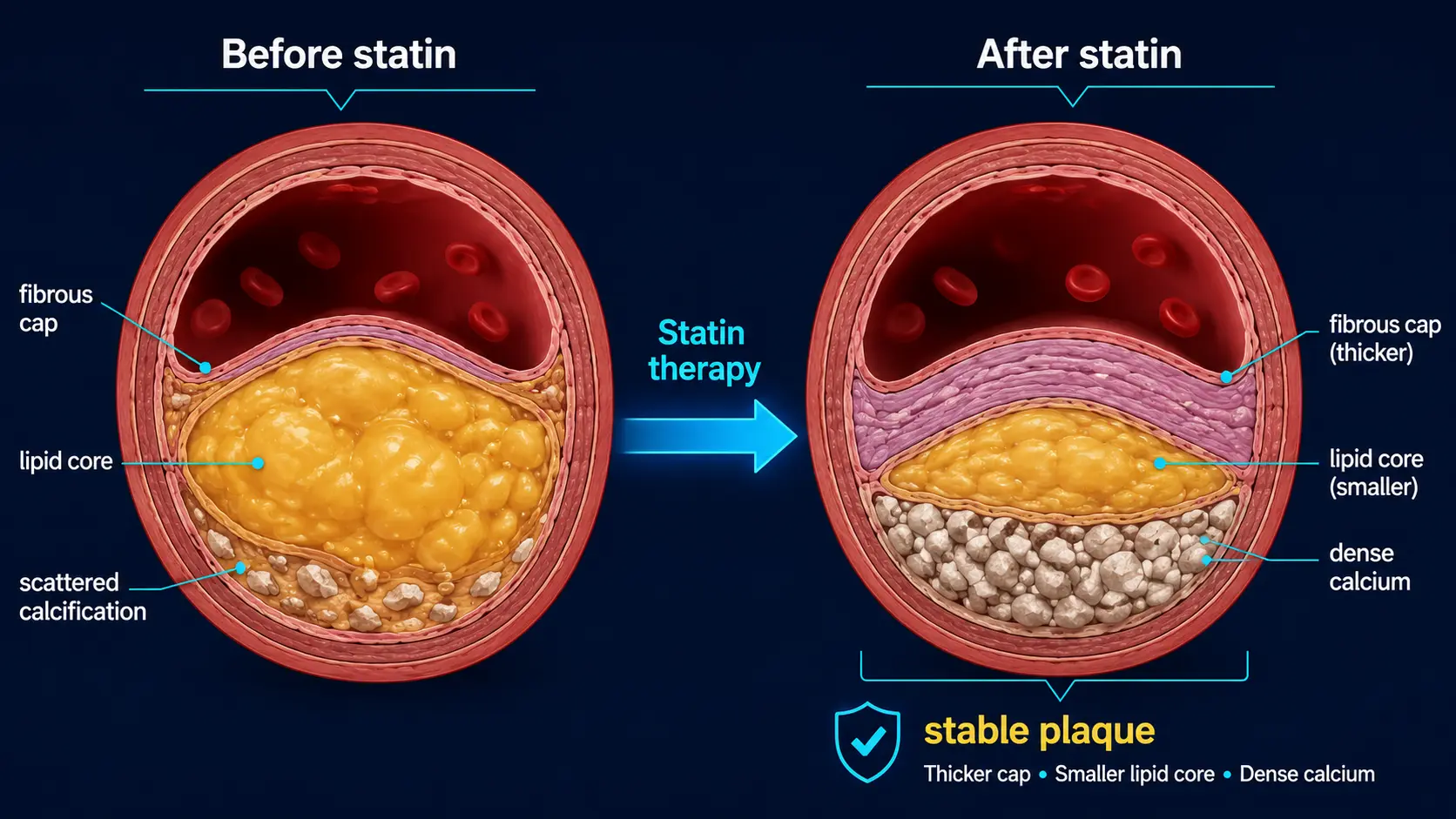
Here is the most counterintuitive finding in coronary artery calcium research: statins make coronary artery calcium scores go up.
Multiple randomized trials and registries have shown that patients on statins have higher calcium scores at follow-up than statin-naïve controls, despite having lower rates of cardiovascular events. The Agatston score rises (or progresses faster) on statin therapy by an average of 10–20% per year, more than the natural progression rate.
The mechanism is plaque stabilization:
- Statins reduce lipid accumulation in plaques and reduce inflammatory drive
- Stable plaques are more calcified than unstable plaques
- The body deposits calcium into existing lipid-rich plaque cores as part of the fibro-calcific stabilization process
- The Agatston score, which weights heavily toward dense calcium, captures this stabilization as an apparent "progression"
- Fewer plaque ruptures occur because the stabilized, denser plaque is less vulnerable
This is why a coronary artery calcium score that has risen on statin therapy is not a signal that the medication is failing — it is, in many cases, a signal that the medication is working. Calcium volume scoring (rather than Agatston) tracks burden more directly and is sometimes preferred for follow-up. Either way, treatment decisions should be based on event risk and clinical context, not on a rising follow-up Agatston score in a statin-treated patient.
Progression on Statins
Practical interpretation of follow-up scans on statin therapy:
- Modest annual rise in Agatston score (10–20% per year) is expected; not a failure of therapy
- Stable or slowly-rising volume score is more reassuring than rising Agatston score because it isn't density-weighted
- Rapid increase (>30–40% per year) warrants reassessment of low-density lipoprotein/ApoB targets, medication adherence, lifestyle factors
- New high-risk vessel patterns (Left Main, proximal LAD) at follow-up may warrant additional imaging or stress testing
- Symptom development always overrides imaging trends — new chest pain, dyspnea, or exertional intolerance warrants prompt evaluation
The main reason to obtain a follow-up coronary artery calcium on statin therapy is for patient motivation and adherence, not for treatment titration. A patient seeing their score rise from 200 to 300 over five years on a statin can be counter-intuitively reassured that this represents stabilization — if the message is delivered correctly. A patient who never gets a follow-up scan misses the opportunity for that conversation.
Beyond Statins
For patients with high coronary artery calcium who tolerate or fail statin therapy:
- Ezetimibe — reduces intestinal cholesterol absorption; modest low-density lipoprotein reduction; good safety profile
- PCSK9 inhibitors (alirocumab, evolocumab) — potent low-density lipoprotein reduction (~50% on top of statin); injectable
- Bempedoic acid — pre-statin pathway inhibitor; useful in statin-intolerant patients
- Inclisiran — siRNA against PCSK9; twice-yearly injection
- Lp(a)-targeted therapies — in trials; pelacarsen and others may be available in coming years
- Aspirin 81 mg — consider if no bleeding contraindication, especially at very high coronary artery calcium scores
- Lifestyle: see Reversal & Lifestyle
Key Research Papers
Connections
- All Lab Tests
- Coronary Calcium Score
- Reversal Plaque Stabilization and Lifestyle
- Coronary Artery Calcium Zero and the Power of Negative Result
- Agatston Score Calculation and Interpretation
- ApoB
- Soft Plaque and Coronary Artery Calcium Limitations
- MESA Risk Calculator and Age Percentiles
- Coronary Artery Calcium vs Other Cardiac Tests
- Lipoprotein(a)
- Lipid Panel
- Coronary Artery Calcium in Women and Younger Adults
- Insurance Cost and Access
- Cardiovascular Disease
- Coronary Artery Disease
- Diabetes
- Calcium