Thalassemia: History and Discovery
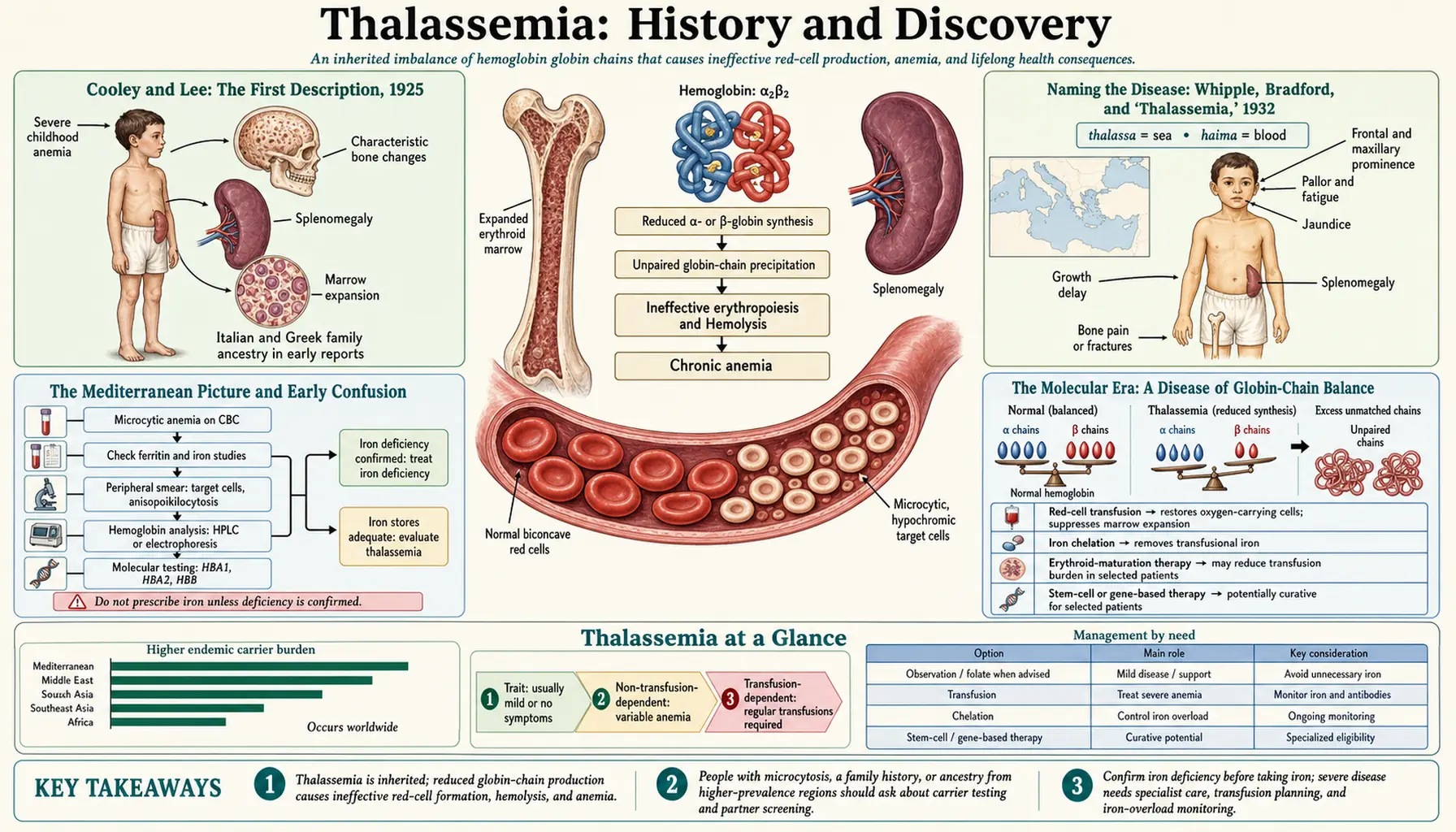
Thalassemia's story moves through three discoveries that are easy to confuse. The first clinical description of the severe childhood form came in 1925, when the Detroit pediatricians Thomas Benton Cooley and Pearl Lee reported children of Mediterranean extraction with anemia, an enlarged spleen and peculiar changes in the bones (Verma 2011; Hassan 2023) — the disorder still called Cooley's anemia. The name "thalassemia," from the Greek thalassa (sea) and haima (blood), is credited to George Hoyt Whipple and W. L. Bradford, and appears in the title of their 1936 paper (Hassan 2023; Zhan 2023). The molecular cause — unbalanced production of the alpha and beta globin chains of hemoglobin — was first shown directly in 1965 (Rees 2022), and disorders of hemoglobin were among the first molecular diseases to be identified (Higgs 2012). This page traces that arc, keeps description, naming and mechanism apart, and marks hypothesis as hypothesis.
Table of Contents
- Cooley and Lee: The First Description, 1925
- Naming the Disease: Whipple, Bradford, and "Thalassemia"
- The Mediterranean Picture and Early Confusion
- The Molecular Era: A Disease of Globin-Chain Balance
- Sorting Out Alpha and Beta Thalassemia
- The Malaria Hypothesis and Geographic Distribution
- Transfusion, Iron Chelation, and the Modern Era
- Gene Therapy and the Present Frontier
- Legacy: A Model Molecular Disease
- Key Research Papers
- Connections
- Featured Videos
Cooley and Lee: The First Description, 1925
The modern medical history of thalassemia begins in Detroit. At a 1925 meeting of the American Pediatric Society, the pediatricians Thomas Benton Cooley and Pearl Lee reported children of Mediterranean extraction with anemia, an enlarged spleen (splenomegaly) and peculiar changes in the bones (Verma 2011; Hassan 2023). A 2022 account of the report describes four children with a greatly enlarged liver and spleen, anemia, jaundice and marked bone abnormalities, including enlargement of the bones of the skull and face (Rees 2022). The report, "A series of cases of splenomegaly in children with anemia and peculiar bone changes," appeared in the Transactions of the American Pediatric Society in 1925, and a fuller account by Cooley, Witwer and Lee followed in the American Journal of Diseases of Children in 1927 (Hassan 2023).
The same 2022 account notes that at first the condition seemed more likely to be a disease of bone than of blood, as more clinical descriptions emerged from the Mediterranean and Asia (Rees 2022). The bone changes are now understood as the result of an expanded bone marrow: a 2010 review lists skeletal changes resulting from expansion of the marrow among the findings in untreated or poorly transfused thalassemia major (Galanello 2010). Cooley's own term for the condition was erythroblastic anemia — the title of his 1932 paper in the American Journal of Diseases of Children (Cooley 1932) — and the term survives in the subtitle of Whipple and Bradford's 1936 paper, "erythroblastic anemia of Cooley" (Whipple and Bradford 1936).
The most severe form of beta-thalassemia, beta-thalassemia major, is still known as Cooley's anemia (Ali 2021). What 1925 represents is the first clear clinical description of the syndrome — not the coining of the word "thalassemia," which came later, and not an understanding of its cause, which came later still.
Naming the Disease: Whipple, Bradford, and "Thalassemia"
The word thalassemia is credited to George Hoyt Whipple and W. L. Bradford (Hassan 2023; Zhan 2023). Whipple, of the University of Rochester, shared the 1934 Nobel Prize in Physiology or Medicine with George Minot and William Murphy "for their discoveries concerning liver therapy in cases of anaemia" (Nobel Prize facts page). A 1932 paper by Whipple on the disorder in the American Journal of Diseases of Children was titled "Racial or familial anemia of children associated with fundamental disturbances of bone and pigment metabolism (Cooley-von Jaksch)" (Whipple 1932). The word thalassemia appears in the title of Whipple and Bradford's 1936 paper in the Journal of Pediatrics, "Mediterranean disease — thalassemia (erythroblastic anemia of Cooley)" (Whipple and Bradford 1936), and recent reviews date the coinage to that paper (Hassan 2023; Zhan 2023).
The name was built from the disease's geography: the Greek thalassa (Θάλασσα), "sea," and haima (αἷμα), "blood," because the patients described were of Mediterranean origin (Hassan 2023; Zhan 2023).
A point of historical nuance: the coinage is sometimes dated to 1932. The sources checked for this page — the published titles of the 1932 and 1936 papers and the reviews cited above — place the word in the 1936 paper, and none of them confirms an earlier use. What they agree on is the authors (Whipple and Bradford), the etymology (thalassa + haima) and the reasoning (the Mediterranean origin of the patients).
The Mediterranean Picture and Early Confusion
For its first decades, thalassemia was known as a clinical entity under several names — Cooley's anemia, erythroblastic anemia and Mediterranean anemia — as the title of a 1938 Indian report, "Cooley's anaemia (erythroblastic or Mediterranean anaemia)," shows; that report is described as the first recorded case of thalassemia east of Suez (Verma 2011). Physicians could recognize the syndrome at the bedside long before anyone could say what was wrong inside the red cell — the clinical entity was named and catalogued first, and the mechanism was filled in afterward.
In parallel with advances in genetics, red-cell biology and hemoglobin analysis, it became apparent that thalassemia is inherited in an autosomal recessive manner, with mild red-cell abnormalities typically present in both parents (Rees 2022). That framed thalassemia as a spectrum: thalassemia minor (the carrier state) is clinically asymptomatic, though some carriers have moderate anemia, while thalassemia major usually presents within the first two years of life with severe anemia requiring regular red-cell transfusions (Galanello 2010).
Still, through the first half of the twentieth century the fundamental question remained open: why did these children fail to make enough normal hemoglobin? The answer required the protein chemistry of the hemoglobin molecule itself.
The Molecular Era: A Disease of Globin-Chain Balance
The decisive shift came in the 1950s and 1960s. Adult hemoglobin is a four-part molecule built from two alpha-like and two beta-like globin chains (α2β2) (Harteveld 2010). In 1956, Vernon Ingram reported a specific chemical difference between the globins of normal and sickle-cell hemoglobin (Ingram 1956), and protein studies showed that some hemoglobin disorders, most notably sickle cell disease, are caused by structural abnormalities of the globin chains, whereas in others — the thalassemia syndromes — no globin abnormality could be detected (Rees 2022). In 1959 Ingram and Stretton published "Genetic basis of the thalassaemia diseases" in Nature (Ingram and Stretton 1959). Disorders of hemoglobin synthesis (thalassemia) and structure (such as sickle cell disease) were among the first molecular diseases to be identified (Higgs 2012).
Thalassemia was suspected to be a quantitative defect — a problem of the amount of globin made rather than its shape — but there was no direct evidence until 1965, when David Weatherall, John Clegg and Naughton measured globin-chain synthesis by incubating reticulocytes with radiolabeled leucine (Weatherall 1965; Rees 2022). They showed that beta and alpha globin synthesis were matched in normal reticulocytes, with quantitative deficits of beta and alpha globin in the respective types of thalassemia. A 2022 account describes how this led to an understanding of ineffective erythropoiesis, and of the fact that the cell damage comes from an excess of the unaffected globin chain rather than a deficiency of the protein from the mutated gene (Rees 2022).
This was a profound reframing. The bone changes, the enlarged spleen and the lifelong need for transfusion could now be traced back to a single quantitative failure: too little of one globin chain, an excess of the other, and red-cell precursors damaged as a result.
Sorting Out Alpha and Beta Thalassemia
Once thalassemia was understood as a globin-chain-balance disorder, it split into two families defined by which chain is deficient. Beta-thalassemia — the form Cooley first described — is caused by point mutations or, more rarely, deletions in the beta globin gene on chromosome 11, leading to reduced (β+) or absent (β0) synthesis of the beta chains (Galanello 2010); its severe form is beta-thalassemia major, Cooley's anemia. Alpha-thalassemia comes from a deficit in the production of alpha globin chains; its forms include a moderate to severe form, hemoglobin H disease, and the lethal Hb Bart's hydrops fetalis, in which no alpha globin is made (Harteveld 2010).
A key piece of evidence came from abnormal hemoglobins that form when one chain is in short supply and the leftover chains pair with themselves. When alpha chains are underproduced, the excess beta-like chains form four-gamma-chain tetramers (γ4), called hemoglobin Bart's, in fetal life, and four-beta-chain tetramers (β4), called hemoglobin H, in adult life (Harteveld 2010). In 1959 Hunt and Lehmann characterized hemoglobin Bart's as a fetal hemoglobin without alpha chains (Hunt and Lehmann 1959), giving investigators a direct chemical fingerprint of alpha-chain deficiency.
The alpha/beta distinction governs how the disease presents, how severe it is, how it is inherited and how it is diagnosed. The normal complement of four functional alpha-globin genes may be reduced by one, two, three or all four copies, which explains the increasing severity of alpha-thalassemia, and the condition is inherited as an autosomal recessive disorder (Harteveld 2010). Weatherall and Clegg's monograph The Thalassaemia Syndromes, which synthesized the field, reached a fourth edition in 2001 (Weatherall 2009).
The Malaria Hypothesis and Geographic Distribution
One puzzle followed thalassemia from the start: if the severe form is so often fatal in childhood, why is the underlying gene so common in certain populations? The leading explanation is the malaria hypothesis, first proposed by the British geneticist J. B. S. Haldane in 1949 (Haldane 1949; Kariuki and Williams 2020). Haldane speculated that thalassemia was common in the Mediterranean region because it conferred a survival advantage against malaria (Kariuki and Williams 2020). As usually stated, the hypothesis holds that diseases such as thalassemia persist as polymorphisms because carriers gain resistance to malaria — a heterozygote advantage traded off against the harm of the disease — and the first generally recognized evidence of genetic resistance to malaria in humans came in 1954, for sickle-cell carriers (Hedrick 2012).
Haldane's 1949 proposal was a hypothesis, and a 2009 review by Weatherall notes that it took many years to confirm. The review reports extensive evidence that the mild forms of alpha-thalassemia reach their high frequencies through protection against Plasmodium falciparum malaria, and at least some suggestive evidence that the same applies to the beta-thalassemias (Weatherall 2009). Alpha-thalassemia is especially frequent in Mediterranean countries, South-East Asia, Africa, the Middle East and the Indian subcontinent (Harteveld 2010).
Geography named the disease — the "sea" in thalassemia — and, under the malaria hypothesis, geography also helps explain where the gene is common.
Transfusion, Iron Chelation, and the Modern Era
For most of the twentieth century, the mainstay of care for severe beta-thalassemia was regular blood transfusion. The 2021 Thalassaemia International Federation (TIF) guidelines describe an effective transfusion regimen as one that gives good growth and development, good energy levels and sufficient suppression of blood formation inside and outside the marrow (Farmakis 2022). But transfusion created a problem of its own: iron overload is inevitable with regular transfusion, because the human body lacks a mechanism to excrete excess iron, and the accumulated iron causes heart failure, cirrhosis, liver cancer, growth retardation and endocrine disorders (Farmakis 2022). A 2010 review states that cardiac disease remains the main cause of death in patients with iron overload (Galanello 2010).
The answer was iron chelation: drugs that bind excess iron so it can be excreted. Desferrioxamine B (deferoxamine) was discovered in the late 1950s as a metabolite of the soil bacterium Streptomyces pilosus, and its strong affinity for iron identified its potential for patients with transfusion-dependent hemoglobin disorders (Codd 2018). Drugs@U.S. Food and Drug Administration (FDA) lists its US approval on April 1, 1968 (Drugs@FDA, NDA 016267). Given as a single daily intramuscular injection, deferoxamine could not achieve a net negative iron balance; a 1977 study found that constant infusion under the skin over 24 hours was 90% as effective as intravenous infusion and produced net urinary iron losses often above 1 g a month (Propper 1977). The current US label describes slow subcutaneous infusion by portable pump over 8 to 12 hours, normally 5 to 7 times a week (US label, deferoxamine). In a 2026 study of 622 children aged 5 to 12 at six centers in Punjab, Pakistan, deferoxamine use was among the negative predictors of adherence and quality of life (Muneeb 2026).
Two drugs taken by mouth followed. Drugs@U.S. Food and Drug Administration lists the US approval of deferasirox on November 2, 2005 (Drugs@FDA, NDA 021882) and of deferiprone on October 14, 2011 (Drugs@FDA, NDA 021825); deferiprone was first designed and synthesized in 1981, and a history written by its developer describes its use combined with deferoxamine (Kontoghiorghes 2020). The 2021 TIF guidelines state that chelation improves survival and reduces the risk of heart failure, and that patient-reported outcomes show a beneficial impact of oral chelation relative to parenteral (injected) chelation (Farmakis 2022). A 2010 review reports that the outlook in beta-thalassemia improved substantially over the preceding 20 years with advances in transfusion, iron chelation and bone marrow transplantation (Galanello 2010).
For selected patients, allogeneic hematopoietic stem-cell (bone-marrow) transplantation from a donor offered something transfusion and chelation could not: a cure, by replacing the patient's blood-forming cells. Thomas and colleagues reported marrow transplantation for thalassaemia in 1982 (Thomas 1982), described as the first successful human allogeneic transplant for thalassemia major, building on earlier studies in dogs (Graves and Storb 2021). A 2010 review calls bone marrow transplantation the only definitive cure then available (Galanello 2010). In a European registry of 1,493 patients with thalassemia major transplanted between 2000 and 2010, transplants from a human leukocyte antigen-identical sibling gave the best results, with 2-year overall survival of 91% and thalassemia-free survival of 83% (Baronciani 2016).
Alongside treatment came prevention. In Cyprus, a programme for the prevention of beta-homozygous thalassemia operated from 1973, combining public education, population screening, genetic counseling and antenatal diagnosis; in 1979, 18 affected children were known to have been born, compared with 77 expected, though the authors noted that not all cases might yet have come to notice (Angastiniotis 1981). In Sardinia, a programme that screened couples at marriage, conception or early pregnancy and offered counseling and prenatal diagnosis was followed by a 90% decline in thalassemia major births (Cao 1989).
Gene Therapy and the Present Frontier
The most recent chapter brings the story from describing a disease in 1925 to altering its genetic root nearly a century later. Because thalassemia is caused by a defect in producing a specific globin chain, it has long been a target for gene therapy — modifying a patient's own blood-forming stem cells and returning them to the patient.
Two approaches reached approval in the 2020s. Betibeglogene autotemcel consists of the patient's own CD34+ blood stem cells transduced with a lentiviral vector carrying a modified beta-globin gene (βA-T87Q) (U.S. Food and Drug Administration label, betibeglogene autotemcel). The U.S. Food and Drug Administration approved it on August 17, 2022 for adult and pediatric patients with beta-thalassemia who require regular red-cell transfusions (U.S. Food and Drug Administration approval letter, August 17, 2022), describing it as the first cell-based gene therapy for this group (U.S. Food and Drug Administration news release, August 17, 2022, archived copy); in the trials summarized in its label, 32 of 36 evaluable patients (89%) achieved transfusion independence (U.S. Food and Drug Administration label). Exagamglogene autotemcel uses CRISPR/Cas9 editing at the erythroid-specific enhancer of the BCL11A gene, which reduces BCL11A expression and so increases production of fetal hemoglobin (U.S. Food and Drug Administration label, exagamglogene autotemcel). It was first approved on December 8, 2023 for sickle cell disease in patients 12 and older (U.S. Food and Drug Administration approval letter, December 8, 2023), when the U.S. Food and Drug Administration described it as the first U.S. Food and Drug Administration-approved therapy to use CRISPR/Cas9 (U.S. Food and Drug Administration news release, December 8, 2023), and for transfusion-dependent beta-thalassemia in patients aged 12 and older on January 16, 2024 (U.S. Food and Drug Administration approval letter, January 16, 2024). On July 1, 2026 the U.S. Food and Drug Administration approved an expansion of the indication to patients aged 2 to under 12 years (U.S. Food and Drug Administration approval letter, July 1, 2026); the current label covers patients aged 2 and older and notes that the therapy has not been studied in children under 5 (U.S. Food and Drug Administration label).
Both labels require full myeloablative conditioning before the modified cells are infused. Busulfan was the conditioning drug used in the betibeglogene trials, and the exagamglogene label specifies busulfan or another myeloablative regimen (U.S. Food and Drug Administration label, betibeglogene autotemcel; U.S. Food and Drug Administration label, exagamglogene autotemcel). These therapies represent the current frontier rather than the end of the road, and research into other options continues. For day-to-day information on the condition, see the main Thalassemia page.
Legacy: A Model Molecular Disease
Few inherited disorders have taught medicine as much as thalassemia. Disorders of hemoglobin synthesis and structure were among the first molecular diseases to be identified (Higgs 2012), and the globin-chain-synthesis method developed for thalassemia was central to discoveries about how the globin genes are switched on and translated, which served as paradigms for molecular biology in general (Rees 2022).
The history also shows how medical knowledge is built. The milestones are separate achievements by different people in different eras: Cooley and Lee described the disease in 1925; Whipple and Bradford named it, the word appearing in their 1936 paper; a generation of molecular hematologists — Ingram, Lehmann, Weatherall, Clegg and others — explained why it happens; and Haldane hypothesized in 1949 why the gene endured. Keeping description, naming, mechanism and evolutionary hypothesis distinct is how the history actually unfolded, and it avoids collapsing a century of work into a single "discovery."
From a fatal childhood anemia of unknown cause to a molecular disease now addressed with gene addition and gene editing, thalassemia's history links clinical observation, protein chemistry, population genetics and modern biotechnology.
Key Research Papers
Historical primary sources, reviews and trials cited on this page, each checked against its PubMed or Crossref record. Cooley and Lee's 1925 Transactions report has no PubMed or Crossref record and is listed as cited in Rees 2022. U.S. Food and Drug Administration approval letters, labels and Drugs@U.S. Food and Drug Administration records are linked where they are cited in the text. Each external link opens in a new tab.
- Cooley TB, Lee P. A series of cases of splenomegaly in children with anemia and peculiar bone changes. Transactions of the American Pediatric Society. 1925;37:29–30. (Historical primary source — first clinical description of the severe childhood anemia later called Cooley's anemia; no PubMed or Crossref record; volume and pages as cited in Rees 2022.)
- Whipple GH, Bradford WL. Mediterranean disease — thalassemia (erythroblastic anemia of Cooley). Journal of Pediatrics. 1936;9(3):279–311. (Historical primary source — the paper whose title contains the term "thalassemia"; this entry earlier carried the journal, year and pages of Whipple's 1932 paper, listed separately below.) — doi:10.1016/S0022-3476(36)80021-3
- Cooley TB, Witwer ER, Lee P. Anemia in children with splenomegaly and peculiar changes in the bones. American Journal of Diseases of Children. 1927;34:347–363. (Historical primary source — expanded clinical account.) — doi:10.1001/archpedi.1927.04130210022002
- Weatherall DJ. Thalassaemia: the long road from bedside to genome. Nature Reviews Genetics. 2004;5(8):625–631. — doi:10.1038/nrg1406
- Higgs DR, Engel JD, Stamatoyannopoulos G. Thalassaemia. The Lancet. 2012;379(9813):373–383. — doi:10.1016/S0140-6736(11)60283-3
- Ingram VM, Stretton AO. Genetic basis of the thalassaemia diseases. Nature. 1959;184:1903–1909. — PubMed PMID: 13852871
- Weatherall DJ, Clegg JB, Naughton MA. Globin synthesis in thalassaemia: an in vitro study. Nature. 1965;208(5015):1061–1065. — PubMed PMID: 5870556
- Hunt JA, Lehmann H. Haemoglobin "Bart's": a foetal haemoglobin without alpha chains. Nature. 1959;184:872–873. — PubMed PMID: 14405427
- Haldane JBS. The rate of mutation of human genes. Hereditas. 1949;35(S1):267–273. — doi:10.1111/j.1601-5223.1949.tb03339.x
- Muneeb A, Inam S, Ali I, et al. Medication adherence, clinical outcomes, and health-related quality of life among pediatric patients with β-thalassemia major receiving iron chelation therapy: a multicenter study from Punjab, Pakistan. Patient Preference and Adherence. 2026;20:615467. — PubMed PMID: 42668965
- Whipple GH. Racial or familial anemia of children associated with fundamental disturbances of bone and pigment metabolism (Cooley-von Jaksch). American Journal of Diseases of Children. 1932;44(2):336. (Crossref lists Whipple as author.) — doi:10.1001/archpedi.1932.01950090074009
- Cooley TB. Erythroblastic anemia. American Journal of Diseases of Children. 1932;43(3):705. — doi:10.1001/archpedi.1932.01950030175018
- Rees DC. The beginnings of molecular medicine. Haematologica. 2022;107(9):2009–2010. — PubMed PMID: 36047317
- Verma IC, Saxena R, Kohli S. Past, present & future scenario of thalassaemic care & control in India. Indian Journal of Medical Research. 2011;134:507–521. — PubMed PMID: 22089615
- Hassan S, Bahar R, Johan MF, et al. Next-generation sequencing (NGS) and third-generation sequencing (TGS) for the diagnosis of thalassemia. Diagnostics (Basel). 2023;13:373. — PubMed PMID: 36766477
- Zhan L, Gui C, Wei W, et al. Third generation sequencing transforms the way of the screening and diagnosis of thalassemia: a mini-review. Frontiers in Pediatrics. 2023;11:1199609. (A 2025 correction changes only the funding statement.) — PubMed PMID: 37484768
- Ali S, Mumtaz S, Shakir HA, et al. Current status of beta-thalassemia and its treatment strategies. Molecular Genetics & Genomic Medicine. 2021;9:e1788. — PubMed PMID: 34738740
- Galanello R, Origa R. Beta-thalassemia. Orphanet Journal of Rare Diseases. 2010;5:11. — PubMed PMID: 20492708
- Harteveld CL, Higgs DR. Alpha-thalassaemia. Orphanet Journal of Rare Diseases. 2010;5:13. — PubMed PMID: 20507641
- Ingram VM. A specific chemical difference between the globins of normal human and sickle-cell anaemia haemoglobin. Nature. 1956;178(4537):792–794. — PubMed PMID: 13369537
- Kariuki SN, Williams TN. Human genetics and malaria resistance. Human Genetics. 2020;139:801–811. — PubMed PMID: 32130487
- Hedrick PW. Resistance to malaria in humans: the impact of strong, recent selection. Malaria Journal. 2012;11:349. — PubMed PMID: 23088866
- Weatherall DJ. Recent insights into the population genetics and dynamics of the inherited disorders of hemoglobin. Mediterranean Journal of Hematology and Infectious Diseases. 2009;1(1). — PubMed PMID: 21416000
- Codd R, Richardson-Sanchez T, Telfer TJ, Gotsbacher MP. Advances in the chemical biology of desferrioxamine B. ACS Chemical Biology. 2018;13(1):11–25. — PubMed PMID: 29182270
- Propper RD, Cooper B, Rufo RR, et al. Continuous subcutaneous administration of deferoxamine in patients with iron overload. New England Journal of Medicine. 1977;297(8):418–423. — PubMed PMID: 882111
- Kontoghiorghes GJ, Kleanthous M, Kontoghiorghe CN. The history of deferiprone (L1) and the paradigm of the complete treatment of iron overload in thalassaemia. Mediterranean Journal of Hematology and Infectious Diseases. 2020;12(1):e2020011. — PubMed PMID: 31934321
- Farmakis D, Porter J, Taher A, et al. 2021 Thalassaemia International Federation guidelines for the management of transfusion-dependent thalassemia. HemaSphere. 2022;6:e732. — PubMed PMID: 35928543
- Thomas ED, Buckner CD, Sanders JE, et al. Marrow transplantation for thalassaemia. The Lancet. 1982;2(8292):227–229. — PubMed PMID: 6124668
- Graves SS, Storb R. Evolution of haematopoietic cell transplantation for canine blood disorders and a platform for solid organ transplantation. Veterinary Medicine and Science. 2021;7:2156–2171. — PubMed PMID: 34390541
- Baronciani D, Angelucci E, Potschger U, et al. Hemopoietic stem cell transplantation in thalassemia: a report from the European Society for Blood and Bone Marrow Transplantation Hemoglobinopathy Registry, 2000–2010. Bone Marrow Transplantation. 2016;51(4):536–541. — PubMed PMID: 26752139
- Angastiniotis MA, Hadjiminas MG. Prevention of thalassaemia in Cyprus. The Lancet. 1981;1(8216):369–371. — PubMed PMID: 6109998
- Cao A, Rosatelli C, Galanello R, et al. The prevention of thalassemia in Sardinia. Clinical Genetics. 1989;36(5):277–285. — PubMed PMID: 2598483
PubMed Topic Searches
- Thomas Benton Cooley, Pearl Lee, and the history of Cooley's anemia / thalassemia — PubMed: history of Cooley's anemia and thalassemia
- Origin and naming of "thalassemia" (Whipple and Bradford, Mediterranean disease) — PubMed: thalassemia naming and Mediterranean disease
- Gene therapy for transfusion-dependent beta-thalassemia — betibeglogene autotemcel and CRISPR exagamglogene autotemcel — PubMed: gene therapy for beta-thalassemia
- The inherited disorders of hemoglobin as the first "molecular diseases" PubMed: hemoglobinopathies as molecular diseases
External Authoritative Resources
Connections
- Hematology
- Thalassemia (main page)
- All Conditions
- Sickle Cell Disease
- Anemia
- Hemochromatosis (Iron Overload)
- Hemophilia
- Polycythemia Vera