Polycythemia Vera: History and Discovery
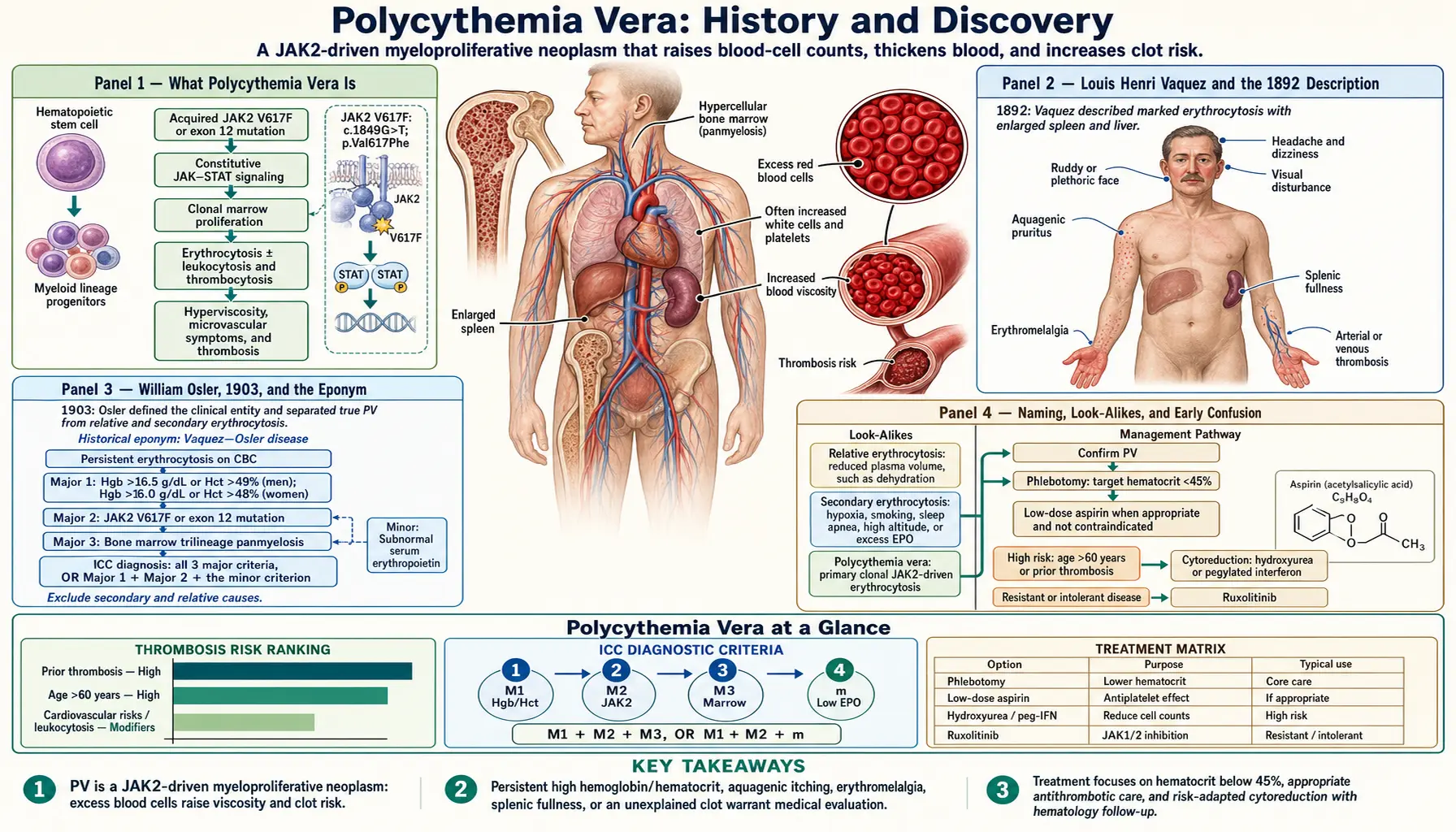
Polycythemia vera (PV) is a chronic blood cancer in which the bone marrow makes far too many red blood cells, thickening the blood and raising the risk of clots. Its modern story spans more than a century: the French physician Louis Henri Vaquez described the disease in Paris in 1892, and Sir William Osler gave a celebrated detailed account and case series in 1903 — which is why the condition is still sometimes called Vaquez–Osler disease. In 1951 William Dameshek united PV with several related marrow disorders under the concept of the “myeloproliferative” diseases, and in 2005 four research teams independently discovered the JAK2 V617F mutation that drives most cases, transforming diagnosis. Uniquely among modern illnesses, the ancient practice of bloodletting — here called phlebotomy — remains a genuinely correct, frontline treatment.
Table of Contents
- What Polycythemia Vera Is
- Louis Henri Vaquez and the 1892 Description
- William Osler, 1903, and the Eponym
- Naming, Look-Alikes, and Early Confusion
- Dameshek and the Myeloproliferative Concept (1951)
- The JAK2 V617F Discovery of 2005
- Phlebotomy: When Bloodletting Is Right
- From Hydroxyurea to JAK Inhibitors
- Legacy and Open Questions
- Research Papers and References
- Connections
- Featured Videos
What Polycythemia Vera Is
Polycythemia vera belongs to a family of blood cancers called the myeloproliferative neoplasms (MPNs). In a healthy person, the bone marrow carefully matches red-cell production to the body's need for oxygen, taking its cue from the hormone erythropoietin. In PV the marrow stops listening to that signal and churns out red blood cells on its own, autonomously and relentlessly. The blood becomes overcrowded and viscous; the hematocrit (the fraction of blood made up of red cells) climbs well above normal. Many patients also overproduce white cells and platelets, because the disease arises in an early blood stem cell that can feed all three lineages.
The Latin name is descriptive: polycythemia means “many cells in the blood,” and vera means “true,” distinguishing this primary marrow disease from the far commoner secondary forms in which the red-cell count rises for an understandable reason — living at high altitude, chronic lung disease, smoking, or dehydration. The thickened blood flows sluggishly and clots too easily, so the gravest dangers are strokes, heart attacks, and clots in the veins; classic symptoms include headache, dizziness, a ruddy or purplish complexion, ringing in the ears, and a peculiar itching that flares after a warm bath or shower (aquagenic pruritus).
Understanding the disease in these terms — an autonomous, clonal overproduction of red cells in a person who has no good reason to be making them — is exactly the insight that took medicine more than a century to assemble, from Vaquez's first careful clinical eye in 1892 to the molecular cause pinned down in 2005. The rest of this page follows that arc.
Louis Henri Vaquez and the 1892 Description
The first clear medical description of polycythemia vera is credited to Louis Henri Vaquez (1860–1936), a French physician working in Paris. In 1892 he reported the case of a patient with persistent, striking overproduction of red blood cells and a deeply congested, plethoric appearance, and he made the crucial argument that this was a disease in its own right — not merely a consequence of heart or lung trouble. In his account he characterized it as a special, lasting form of polycythemia that was associated neither with the cyanosis of high altitude nor with congenital heart disease, separating it cleanly from the secondary causes physicians already knew.
That distinction is the heart of Vaquez's contribution and the reason his name endures. Plenty of conditions can raise the red-cell count as a sensible response to low oxygen; what Vaquez recognized was a patient whose marrow was overproducing for no such reason. The French eponym maladie de Vaquez (Vaquez's disease) commemorates this insight and is still used in French-language medicine. Vaquez himself went on to a distinguished career chiefly in cardiology — he is remembered as a founder of French clinical cardiology and helped establish an important journal on diseases of the heart and blood vessels — but it is this single 1892 observation that secured his place in the history of hematology.
It is worth being precise about what 1892 does and does not mark. Vaquez gave the first well-recognized clinical description of the entity now called polycythemia vera; he did not, and could not, know its cause. The tools to measure blood cells were primitive, the concept of a bone-marrow stem cell did not yet exist, and the genetic mutation behind the disease would not be found for another 113 years. What Vaquez supplied was the foundational clinical recognition on which everything else was later built.
William Osler, 1903, and the Eponym
If Vaquez first recognized the disease, it was Sir William Osler (1849–1919) — the Canadian physician often called a father of modern internal medicine — who brought it to wide attention in the English-speaking world. In 1903 Osler published a detailed clinical account, gathering and analyzing a small series of cases of what he described as chronic cyanosis with polycythemia and an enlarged spleen. His careful, systematic description sharpened the clinical picture and helped establish PV as a distinct, recognizable diagnosis rather than a curiosity.
Because both men contributed to defining the disease — Vaquez with the original recognition, Osler with the influential synthesis and case series — the condition came to carry both their names. It is variously called Vaquez–Osler disease or Osler–Vaquez disease, and in older texts simply Osler's disease (a label that is ambiguous, since several conditions bear Osler's name). The modern preferred term in clinical practice is the plain descriptive one, polycythemia vera, but the eponym persists in the literature and in medical eponym dictionaries as a marker of this dual origin.
Accuracy matters here: Osler did not discover the disease, and 1903 is not its “founding” date — Vaquez's 1892 report holds that priority. What 1903 represents is the moment PV entered mainstream internal medicine through one of its most authoritative voices, which is why so many later accounts begin the story with Osler even though the clinical credit properly starts eleven years earlier with Vaquez.
Naming, Look-Alikes, and Early Confusion
For the first half of the twentieth century, polycythemia vera sat in a tangle of overlapping names and uncertain boundaries. It was variously labeled erythremia (literally “red blood,” emphasizing the red-cell excess), splenomegalic polycythemia (stressing the enlarged spleen), and primary or true polycythemia. Each name foregrounded a different feature, and the lack of a single agreed term reflected a deeper problem: physicians could describe the disease far better than they could explain or distinguish it.
The central difficulty was telling PV apart from the many causes of a high red-cell count that are not cancers at all. A person living at altitude, a heavy smoker, someone with chronic lung or heart disease, a dehydrated patient, or a rare individual with a kidney tumor secreting erythropoietin can all show a raised hematocrit. Distinguishing these secondary polycythemias from the primary, autonomous marrow disease that Vaquez described required tools that simply did not exist in 1903 — reliable red-cell-mass measurement, erythropoietin assays, and eventually genetic testing all came much later.
This long era of descriptive but mechanistically blind classification is important context for appreciating the two great conceptual leaps that followed. Dameshek's 1951 reframing and the 2005 molecular discovery did not just add detail; they replaced a museum of overlapping clinical labels with, first, a unifying biological idea and then a single defining mutation. The messy nomenclature of the early decades is precisely the confusion those breakthroughs resolved.
Dameshek and the Myeloproliferative Concept (1951)
The next great advance was conceptual rather than technological. In 1951, the influential American hematologist William Dameshek (1900–1969), founding editor of the journal Blood, published a short, now-famous editorial titled Some Speculations on the Myeloproliferative Syndromes. In it he proposed that a group of marrow diseases that had been studied separately — including polycythemia vera, chronic (granulocytic) myeloid leukemia, essential thrombocythemia, and idiopathic myelofibrosis (myeloid metaplasia) — were in fact closely related members of a single family, sharing an underlying tendency of the bone marrow to overproliferate.
This was a genuine paradigm shift. Instead of viewing PV as an isolated oddity, Dameshek placed it within a coherent group united by a common theme: excessive, self-driven proliferation of the marrow's blood-forming cells. He speculated — remarkably, decades before the molecular era — that these conditions might share a common cause or stimulus, perhaps a single undiscovered factor driving the marrow. The umbrella term that grew from his editorial, the myeloproliferative disorders (today usually called myeloproliferative neoplasms, MPNs, reflecting their recognized status as cancers), remains the organizing framework of this corner of hematology.
Dameshek's speculation was, strictly, a hypothesis — an inspired grouping based on clinical and pathological resemblance, not on a known mechanism. Its vindication came more than half a century later: the discovery in 2005 that a single mutation in the JAK2 gene underlies most cases of polycythemia vera and a large share of essential thrombocythemia and primary myelofibrosis supplied exactly the kind of shared molecular driver Dameshek had imagined. Commentators have since described the JAK2 discovery as the fulfillment of Dameshek's prophecy, a reminder of how a well-framed hypothesis can outrun the evidence available to confirm it by two generations.
The JAK2 V617F Discovery of 2005
The defining molecular breakthrough came in 2005, when an acquired mutation in the JAK2 gene — a single change converting the amino acid valine to phenylalanine at position 617, written JAK2 V617F — was identified in the great majority of patients with polycythemia vera. JAK2 (Janus kinase 2) is an enzyme that relays growth signals from blood-cell hormone receptors into the cell. The V617F mutation jams this switch in the “on” position, so the marrow behaves as though it is constantly being told to make blood even when no such signal is present — a clean molecular explanation for the autonomous red-cell overproduction Vaquez had described 113 years earlier.
Strikingly, the discovery was made by several research teams working independently and reported within weeks of one another in early 2005. They included the group led by William Vainchenker in France (with Chloé James as first author, in Nature); the Cambridge group of Tony Green (Baxter and colleagues, in The Lancet); the team of Radek Skoda in Switzerland (Kralovics and colleagues, in the New England Journal of Medicine); and the U.S. group led by D. Gary Gilliland (Ross Levine and colleagues, in Cancer Cell). That four laboratories converged on the same mutation almost simultaneously is a notable case of independent, parallel scientific discovery, and the credit is shared among them.
Two points of accuracy are worth stressing. First, JAK2 is a gene and V617F a specific mutation within it — not the name of the disease and not the same thing as the broader myeloproliferative category. Second, the mutation is acquired (somatic), arising in blood cells during life rather than being inherited from a parent. The V617F mutation is present in roughly 95% or more of polycythemia vera patients; most of the small remainder carry related mutations elsewhere in JAK2 (in exon 12), so that JAK2 abnormalities account for nearly all cases.
The clinical impact was immediate and lasting. A simple blood test for JAK2 V617F became a cornerstone of diagnosis, turning what had been a diagnosis of exclusion — ruling out every secondary cause one by one — into a positive, confirmable finding. The mutation was written into the World Health Organization's diagnostic criteria, and it opened the door to drugs designed to block the overactive JAK2 pathway.
Phlebotomy: When Bloodletting Is Right
Polycythemia vera carries one of the most satisfying ironies in medicine. For more than two thousand years, physicians bled their patients for almost every imaginable ailment — fevers, headaches, infections, madness — on a mistaken theory of balancing the body's “humors.” That indiscriminate bloodletting did enormous harm and is the classic emblem of pre-scientific medicine. Yet in polycythemia vera, removing blood is exactly the right thing to do, and it remains a frontline treatment to this day. PV is one of the very few diseases in which bloodletting is genuinely, mechanistically correct.
The reason is straightforward. The danger in PV comes from blood that is too thick with red cells, which flows sluggishly and clots too readily, causing strokes and heart attacks. Removing a unit of blood — a procedure now called therapeutic phlebotomy, performed much like an ordinary blood donation — directly lowers the hematocrit and thins the blood, and repeating it as needed keeps the red-cell fraction in a safe range. Modern practice aims to hold the hematocrit below a target (commonly under 45%), a goal supported by clinical trial evidence showing fewer cardiovascular deaths and major clots when this threshold is met. Phlebotomy is typically paired with low-dose aspirin to further reduce clotting risk.
This makes PV a uniquely instructive chapter in medical history. The same intervention that symbolized centuries of error becomes, in this one specific disease with its specific mechanism, sound and evidence-based therapy — not because the old humoral theory was right, but because here the problem really is an excess of blood. It is a vivid lesson that a treatment is neither good nor bad in the abstract; it is right or wrong only against a correct understanding of the underlying cause.
From Hydroxyurea to JAK Inhibitors
Phlebotomy controls the red-cell count, but for many patients more is needed — especially those at higher risk of clots, those whose disease also drives up platelets and white cells, or those who cannot tolerate frequent bleeding. Through the later twentieth century the mainstay of such cytoreductive (cell-lowering) therapy became hydroxyurea (hydroxycarbamide), an oral drug that gently suppresses the overactive marrow. Interferon-alfa, including modern long-acting forms, has also long been used, valued in part because it can reduce the burden of mutated cells and is favored in younger patients and in pregnancy. Older approaches such as radioactive phosphorus or alkylating agents controlled the disease but raised the later risk of transformation to leukemia and have largely been set aside.
The 2005 discovery of JAK2 V617F made possible a more targeted approach: drugs that block the JAK signaling pathway itself. The first JAK inhibitor approved for polycythemia vera was ruxolitinib, cleared by the U.S. Food and Drug Administration in 2014 for patients with PV who have an inadequate response to, or cannot tolerate, hydroxyurea. Its approval rested on the phase III RESPONSE trial, in which ruxolitinib improved control of the hematocrit without phlebotomy and shrank enlarged spleens more effectively than the best available alternative therapy.
A note of honesty about what these drugs do and do not achieve: ruxolitinib and its successors blunt the disease, control blood counts, and relieve symptoms such as itching and an enlarged spleen, but they do not cure polycythemia vera and do not eliminate the mutant clone in most patients. PV remains, for now, a chronic disease to be managed over a lifetime — the great majority of patients live for many years with good control — with the small long-term risks of progression to myelofibrosis or, less often, to acute leukemia. The line from Vaquez's 1892 clinic to a 2014 designer drug is real and remarkable, but it has not yet reached a cure.
Legacy and Open Questions
The history of polycythemia vera is, in miniature, the history of how a disease comes to be understood. It begins with a sharp clinical eye — Vaquez in 1892 noticing that some patients overproduce red cells for no good reason, and Osler in 1903 making that observation rigorous and widely known. It advances through a daring act of conceptual unification — Dameshek in 1951 seeing PV not in isolation but as one of a family of myeloproliferative diseases. And it culminates, for now, in a molecular cause — the JAK2 V617F mutation found by four teams in 2005 — that converts a diagnosis of exclusion into a definite test and points toward targeted drugs.
Several threads from that history remain live. Researchers still ask why the same JAK2 mutation can produce such different diseases — polycythemia vera in one person, essential thrombocythemia or primary myelofibrosis in another — pointing to the roles of additional mutations, the order in which they appear, the number of mutant cells, and inherited background. Whether new agents can do what current ones cannot — truly clear the mutant clone and offer a cure rather than control — is an active question, as is how best to prevent the feared long-term transitions to myelofibrosis and leukemia.
What will not change is the shape of the story's foundation: a French physician's 1892 description, an eponym shared with Osler, a hematologist's 1951 act of imagination, a four-laboratory molecular triumph in 2005, and the enduring, beautifully appropriate use of an ancient remedy — bloodletting — for the one disease where it has always, unknowingly, been right.
Research Papers and References
The references below combine the landmark primary papers in the history of polycythemia vera — including the four near-simultaneous 2005 reports of the JAK2 V617F mutation — with curated PubMed topic-search links into the historical and clinical literature. Where a confident DOI or PMID is available it is given and opens in a new tab; the remaining entries open PubMed (National Library of Medicine) topic searches. Vaquez's 1892 report and Osler's 1903 account are named in the article as historical primary sources.
- James C, Ugo V, Le Couédic JP, et al. A unique clonal JAK2 mutation leading to constitutive signalling causes polycythaemia vera. Nature. 2005;434(7037):1144–1148. — doi:10.1038/nature03546
- Baxter EJ, Scott LM, Campbell PJ, et al. Acquired mutation of the tyrosine kinase JAK2 in human myeloproliferative disorders. The Lancet. 2005;365(9464):1054–1061. — doi:10.1016/S0140-6736(05)71142-9
- Kralovics R, Passamonti F, Buser AS, et al. A gain-of-function mutation of JAK2 in myeloproliferative disorders. New England Journal of Medicine. 2005;352(17):1779–1790. — doi:10.1056/NEJMoa051113
- Levine RL, Wadleigh M, Cools J, et al. Activating mutation in the tyrosine kinase JAK2 in polycythemia vera, essential thrombocythemia, and myeloid metaplasia with myelofibrosis. Cancer Cell. 2005;7(4):387–397. — doi:10.1016/j.ccr.2005.03.023
- Scott LM, Tong W, Levine RL, et al. JAK2 exon 12 mutations in polycythemia vera and idiopathic erythrocytosis. New England Journal of Medicine. 2007;356(5):459–468. — doi:10.1056/NEJMoa065202
- Vannucchi AM, Kiladjian JJ, Griesshammer M, et al. Ruxolitinib versus standard therapy for the treatment of polycythemia vera (RESPONSE). New England Journal of Medicine. 2015;372(5):426–435. — doi:10.1056/NEJMoa1409002
- Marchioli R, Finazzi G, Specchia G, et al. Cardiovascular events and intensity of treatment in polycythemia vera (CYTO-PV). New England Journal of Medicine. 2013;368(1):22–33. — doi:10.1056/NEJMoa1208500
- Dameshek W. Some speculations on the myeloproliferative syndromes (1951 editorial). Blood. — PubMed: Dameshek myeloproliferative syndromes
- Louis Henri Vaquez and the history of polycythemia vera (medical eponym / historical reviews) — PubMed: Vaquez polycythemia vera history
- Polycythemia vera: historical oversights, diagnostic details, and therapeutic views — PubMed: polycythemia vera historical perspective
- JAK2 V617F discovery — ten-year perspective and the fulfilment of Dameshek's concept — PubMed: JAK2 V617F discovery perspective
- Therapeutic phlebotomy and hematocrit targets in polycythemia vera — PubMed: phlebotomy hematocrit target polycythemia vera
- Ruxolitinib and JAK inhibitors in polycythemia vera — efficacy and long-term experience — PubMed: ruxolitinib polycythemia vera
- World Health Organization diagnostic criteria for polycythemia vera and the myeloproliferative neoplasms — PubMed: WHO criteria myeloproliferative neoplasms
External Authoritative Resources
- National Cancer Institute — Chronic Myeloproliferative Neoplasms Treatment (PDQ)
- MedlinePlus Genetics — Polycythemia Vera
- PubMed — All research on polycythemia vera
Connections
- Hematology
- Polycythemia Vera (Hub)
- All Conditions
- Leukemia
- Anemia
- Deep Vein Thrombosis
- Thrombocytopenia
- Hemochromatosis