Diabetes: History and Discovery
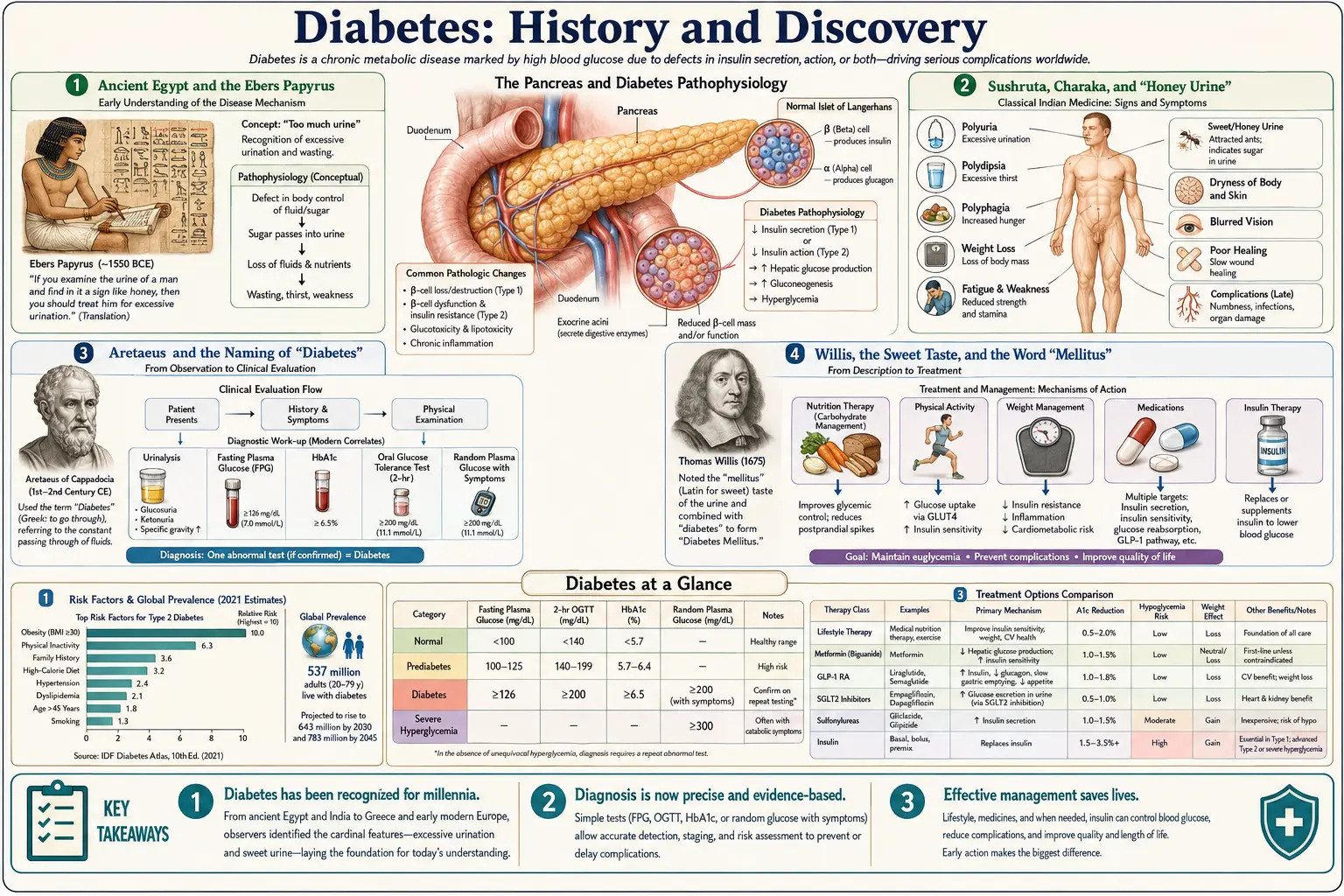
Diabetes has no single discoverer. Its story is a relay run across more than three thousand years and three continents — from an Egyptian scribe noting urine that "runs too much," to Indian physicians who watched ants swarm a patient's sweet urine, to a Greek doctor who gave the disease its name, to a Toronto laboratory that, in the winter of 1921–1922, finally turned a death sentence into a treatable condition. This page traces that arc honestly, keeping three different kinds of discovery distinct: describing the disease, naming it, finding its cause, and finding its treatment. Where a popular claim is contested by the historical record, it is flagged as such rather than repeated.
Interactive Visualization Blood Sugar & Insulin — eat a meal and watch glucose move Watch insulin escort glucose into cells and the liver bank glycogen, then switch on insulin resistance and see the curve change. Launch →Table of Contents
- Ancient Egypt and the Ebers Papyrus
- Sushruta, Charaka, and "Honey Urine"
- Aretaeus and the Naming of "Diabetes"
- Willis, the Sweet Taste, and the Word "Mellitus"
- Dobson, Rollo, and the Proof of Sugar
- The Pancreas: Langerhans, Minkowski, and von Mering
- The Discovery of Insulin: Toronto, 1921–1922
- Aftermath, Honors, and the Modern Era
- Research Papers and References
- Connections
- Featured Videos
Ancient Egypt and the Ebers Papyrus
The oldest written hint of diabetes comes from ancient Egypt. The Ebers Papyrus, a medical scroll generally dated to about 1550 BCE (and named for the Egyptologist Georg Ebers, who acquired it in 1872), records a remedy "to eliminate urine which is too plentiful." Egyptologists and historians of medicine read this brief line as the first surviving description of the cardinal symptom of diabetes — polyuria, the passing of large, frequent volumes of urine. It is essential to be precise here: the Ebers Papyrus describes a symptom, not the disease as we now define it. The scribe had no concept of blood sugar, the pancreas, or insulin. What he recorded was a recognizable, troubling pattern — excessive urination — and a suggested treatment, which is exactly the kind of careful clinical observation from which all later understanding would slowly grow.
That this single sentence has survived for over three and a half millennia is itself remarkable, and it anchors the convention that the recorded history of diabetes begins around 1550 BCE. But it is the beginning of description only. Naming, cause, and cure each lay many centuries ahead, and the next decisive observations would come not from the Nile but from the physicians of ancient India.
Sushruta, Charaka, and "Honey Urine"
In the classical Ayurvedic tradition of India, physicians made an observation that would not be matched in the West for more than two thousand years: they noticed that the urine of certain wasting patients was sweet. The two great compilers of this tradition, Sushruta (associated with the Sushruta Samhita) and Charaka (the Charaka Samhita), described a condition they placed within the broader category of prameha (disorders of excessive, abnormal urine) and named the sweet-urine form madhumeha — literally "honey urine." The dating of these texts is genuinely uncertain and debated by scholars, with the core observations commonly placed somewhere in the centuries around the mid-first-millennium BCE and the surviving recensions edited later; this page treats them as ancient rather than fixing a single year.
The most famous detail of the Indian record is a beautifully practical diagnostic test: the patients' urine was so sweet that it attracted ants and flies. Where the Egyptians had measured the disease by quantity, the Indian physicians had detected its defining chemical quality — sweetness — centuries earlier than anyone else on record. Historical sources also credit this tradition with distinguishing what we would now broadly map onto two patterns of the disease: one afflicting thin, young people (resembling what we now call type 1) and another tied to indolence, overeating, and heavier body habitus (resembling type 2). This is an extraordinary clinical achievement, though readers should understand it as an ancient categorization by outward pattern, not the modern immunological and metabolic definitions of type 1 and type 2, which depend on knowledge of insulin and autoimmunity that did not exist until the twentieth century.
Aretaeus and the Naming of "Diabetes"
The word diabetes comes from Greek medicine. It is most famously associated with Aretaeus of Cappadocia, a Greek physician usually placed in the second century CE (his exact dates are uncertain). Aretaeus left an unforgettable clinical portrait of the disease as "a melting down of the flesh and limbs into urine" — a vivid, accurate picture of severe, untreated diabetes wasting the body away. The term diabetes derives from a Greek root meaning "to pass through" or "siphon", capturing the sense that fluid ran straight through the patient, as if the body could not hold water and it simply poured out as urine.
A careful note on attribution: Aretaeus is the physician most responsible for fixing the name diabetes in the medical vocabulary through his powerful description, and he is rightly remembered for it. Some historians point out that the Greek term may have been in use slightly earlier (for example associated with Demetrius of Apamea or Apollonius of Memphis), so the most defensible statement is that the word was established in Greek medicine and given its enduring clinical meaning by Aretaeus, rather than literally invented by him alone. Either way, by the second century CE the disease had a name — one we still use — even though its cause remained a complete mystery and would stay that way for roughly seventeen more centuries.
Willis, the Sweet Taste, and the Word "Mellitus"
For over a thousand years after Aretaeus, Western medicine added little to the understanding of diabetes. The next major Western step came from the English physician Thomas Willis (1621–1675), one of the founding figures of neurology and a member of the early Royal Society. In his work Pharmaceutice Rationalis (Oxford, 1674), Willis described the urine of diabetic patients as wonderfully sweet, "as if imbued with honey or sugar" — reviving for European medicine, by direct taste, the sweetness that Indian physicians had recorded long before. (Tasting a patient's urine was a standard, if unappealing, diagnostic method of the era.) This is Willis's solid, well-attested contribution: he reconnected the European tradition to the sweetness of the disease.
Here an honest history must add a caution, because a very common claim deserves scrutiny. It is frequently stated that Willis "added the word mellitus" (Latin for honeyed) to give us diabetes mellitus. Several careful historical sources note that the word mellitus does not actually appear in Willis's own chapter on diabetes — he described the sweetness but did not attach that specific Latin epithet. The formal pairing of diabetes mellitus (honeyed diabetes) versus diabetes insipidus (tasteless diabetes) is generally credited to the Scottish physician William Cullen in the later eighteenth century (commonly cited around 1769–1776). The fairest summary is therefore: Willis (1674) revived and described the disease's sweetness; the Latin term mellitus was attached to the name somewhat later, with Cullen usually credited for formalizing the mellitus/insipidus distinction. The popular shorthand crediting Willis with the word itself is treated here as contested, not settled.
Dobson, Rollo, and the Proof of Sugar
Sweetness was an observation; sugar was a proof. That proof arrived with the English physician Matthew Dobson (working in Liverpool), who in 1776 reported experiments showing that the sweetness of diabetic urine was due to actual sugar — and, crucially, that sugar was present in the blood as well, not only the urine. By evaporating diabetic urine and recovering a sweet, sugar-like residue, Dobson demonstrated that diabetes was not merely a disease of the kidneys passing through bad fluid, but a systemic disorder of the whole body's handling of sugar. This reframing — from a local plumbing problem to a metabolic one — was a genuine conceptual breakthrough and pointed all future investigators toward the right question.
Building directly on Dobson's finding, the Scottish military surgeon John Rollo published An Account of Two Cases of the Diabetes Mellitus in 1797. Rollo reasoned that if the problem was too much sugar, the diet should contain as little sugar- and starch-forming food as possible; he prescribed a heavily meat-based, low-carbohydrate regimen for his diabetic patients. This is widely regarded as the first rational dietary treatment of diabetes grounded in an understanding of the disease's chemistry. It did not cure the disease, and it was crude by modern standards, but it marked the start of treatment based on cause rather than on guesswork — and Rollo's use of "diabetes mellitus" in his title helped cement that now-standard name.
The Pancreas: Langerhans, Minkowski, and von Mering
The nineteenth century moved the search from the urine to a specific organ. In 1869, a German medical student named Paul Langerhans (1847–1888), in his doctoral thesis on the microscopic anatomy of the pancreas, described small distinct clusters of cells scattered through the gland — "little heaps of cells" different from the surrounding tissue. Langerhans himself did not know what these cell-islands did; he simply described them accurately. Only decades later were they named the islets of Langerhans in his honor, once their role in producing the blood-sugar-controlling hormone became clear. His work is a pure example of careful description preceding, and ultimately enabling, the discovery of function.
The decisive link between the pancreas and diabetes came in 1889 in Strasbourg, when Oskar Minkowski and Joseph von Mering surgically removed the entire pancreas (a total pancreatectomy) from a dog. The dog promptly developed severe diabetes — passing large volumes of sugar-laden urine, reportedly noticed because flies gathered around it, echoing the ancient ant test. This single experiment proved that the pancreas was essential to preventing diabetes and that some product of the gland controlled blood sugar. The race was now on to find and isolate that mysterious internal secretion. Over the next thirty years several researchers came tantalizingly close — among them the American pathologist Eugene Opie, who tied diabetes specifically to damaged islets of Langerhans, and the Romanian physiologist Nicolae Paulescu, who in 1921 produced a pancreatic extract ("pancreine") that lowered blood sugar in animals. The hypothesized hormone even had a name before it was purified: the British physiologist Edward Sharpey-Schäfer proposed in the mid-1910s (commonly cited 1916) that the islets secreted a single sugar-regulating substance, which he called "insuline" (from Latin insula, island). At this stage insulin was still a hypothesis with a name, not yet a usable medicine.
The Discovery of Insulin: Toronto, 1921–1922
The breakthrough that changed everything happened at the University of Toronto in 1921–1922. A young Canadian orthopedic surgeon, Frederick Banting, had an idea for isolating the elusive pancreatic secretion and persuaded the physiology professor J.J.R. Macleod to lend him laboratory space, dogs, and an assistant for the summer of 1921. That assistant was a medical student, Charles Best. Working through the summer, Banting and Best produced pancreatic extracts that, when injected into diabetic dogs whose own pancreas had been removed, lowered their blood sugar and kept them alive. Late in 1921 Macleod brought in the skilled biochemist James Collip, whose purification work was essential in turning the crude, impure extract into something pure enough to give safely to a human being.
The clinical turning point came in January 1922. A 14-year-old boy named Leonard Thompson, dying of type 1 diabetes at Toronto General Hospital, received the first injection of the extract on 11 January 1922; this first, less-purified dose lowered his blood sugar only modestly and caused an allergic reaction. After Collip further refined the preparation, Leonard was injected again on 23 January 1922 — and this time it worked dramatically: his blood sugar fell toward normal, the sugar cleared from his urine, and the boy recovered. For the first time in the whole long history recounted on this page, a person with type 1 diabetes — previously a uniformly fatal disease — could be kept alive. Macleod announced the discovery of "insulin" to the medical world in May 1922, and the University of Toronto, with the pharmaceutical company Eli Lilly, moved with remarkable speed to manufacture insulin at scale so it could reach patients.
Aftermath, Honors, and the Modern Era
In 1923, the Nobel Prize in Physiology or Medicine was awarded to Frederick Banting and J.J.R. Macleod "for the discovery of insulin." The decision was immediately controversial because of who was left out: Banting, furious that his hands-on partner Charles Best had been omitted, shared his half of the prize money with Best; Macleod in turn shared his half with the biochemist James Collip. Today all four — Banting, Best, Macleod, and Collip — are generally credited together as the discoverers of clinically usable insulin. (The Romanian physiologist Nicolae Paulescu, who had published his own blood-sugar-lowering pancreatic extract in 1921, is also recognized by many historians as an independent contributor who narrowly preceded the Toronto team's clinical success.) In a now-celebrated act, Banting, Best, and Collip sold the insulin patent to the University of Toronto for a token one dollar each, intending that the lifesaving hormone should be made widely available rather than monopolized for profit.
Insulin transformed type 1 diabetes from an inevitably fatal wasting disease into a manageable chronic condition, and the century since has built steadily on that foundation: the discovery of insulin's protein structure by Frederick Sanger (work in the 1950s), the development of long-acting and rapid-acting insulin formulations, home blood-glucose monitoring and later continuous glucose monitors, the A1c test for long-term control, and entire new drug classes for type 2 diabetes such as metformin (rooted in the medieval herb goat's rue), the SGLT2 inhibitors, and the GLP-1 receptor agonists. Each of these is part of the same unbroken story that began with a line about excessive urine on an Egyptian papyrus. For the modern clinical picture — how diabetes is classified, diagnosed, monitored, and treated today — see the main Diabetes article and its deep-dive sub-articles on insulin dosing, continuous glucose monitoring, complications, and remission. The history makes one thing vivid: behind every modern glucose meter and insulin pen lie three thousand years of patient observation and one Toronto winter that finally turned description into rescue.
Research Papers and References
The list below combines peer-reviewed historical reviews of diabetes with curated PubMed topic-search links into the primary and secondary literature. Ancient primary sources (the Ebers Papyrus, the Sushruta Samhita and Charaka Samhita, the writings of Aretaeus, and Thomas Willis's Pharmaceutice Rationalis) are named in the article as historical sources rather than as modern citations. Each external link opens in a new tab.
- Karamanou M, Protogerou A, Tsoucalas G, Androutsos G, Poulakou-Rebelakou E. Milestones in the history of diabetes mellitus: The main contributors. World Journal of Diabetes. 2016;7(1):1-7. — doi:10.4239/wjd.v7.i1.1
- Laios K, Karamanou M, Saridaki Z, Androutsos G. Aretaeus of Cappadocia and the first description of diabetes. Hormones (Athens). 2012;11(1):109-113. — PubMed: PMID 22450352
- Lakhtakia R. The history of diabetes mellitus. Sultan Qaboos University Medical Journal. 2013;13(3):368-370. — doi:10.12816/0003257
- Vecchio I, Tornali C, Bragazzi NL, Martini M. The Discovery of Insulin: An Important Milestone in the History of Medicine. Frontiers in Endocrinology. 2018;9:613. — doi:10.3389/fendo.2018.00613
- Sapra A, Bhandari P. Diabetes (StatPearls; history and overview). National Library of Medicine. — NCBI Bookshelf: Diabetes (StatPearls)
- Diabetes mellitus in ancient and Ayurvedic medicine (madhumeha; Sushruta and Charaka) — PubMed: madhumeha and the history of diabetes
- Ebers Papyrus and the earliest descriptions of polyuria and diabetes — PubMed: Ebers Papyrus and the history of diabetes
- Thomas Willis, Pharmaceutice Rationalis, and the sweet taste of diabetic urine — PubMed: Thomas Willis and diabetes mellitus
- Matthew Dobson and the demonstration of sugar in diabetic blood and urine — PubMed: Matthew Dobson and the discovery of glycosuria
- John Rollo and the first dietary treatment of diabetes mellitus — PubMed: John Rollo and dietary treatment of diabetes
- Paul Langerhans and the discovery of the pancreatic islets — PubMed: Langerhans and the islets of the pancreas
- Minkowski and von Mering: pancreatectomy and the pancreatic origin of diabetes (1889) — PubMed: Minkowski, von Mering, and the pancreas
- Banting, Best, Macleod, and Collip: the Toronto discovery of insulin (1921–1922) — PubMed: the Toronto discovery of insulin
- Nicolae Paulescu and the pancreatic extract "pancreine" (priority debate) — PubMed: Paulescu and the insulin priority debate
External Authoritative Resources
- NobelPrize.org — The 1923 Nobel Prize in Physiology or Medicine (Banting & Macleod)
- NIDDK (NIH) — Diabetes Overview
- PubMed — All research on the history of diabetes mellitus
Connections
- Endocrinology
- Blood Sugar & Insulin — interactive animation
- Diabetes (Main Article)
- Insulin Resistance
- Metabolic Syndrome
- Obesity
- PCOS
- All Conditions