Eczema: History and Discovery
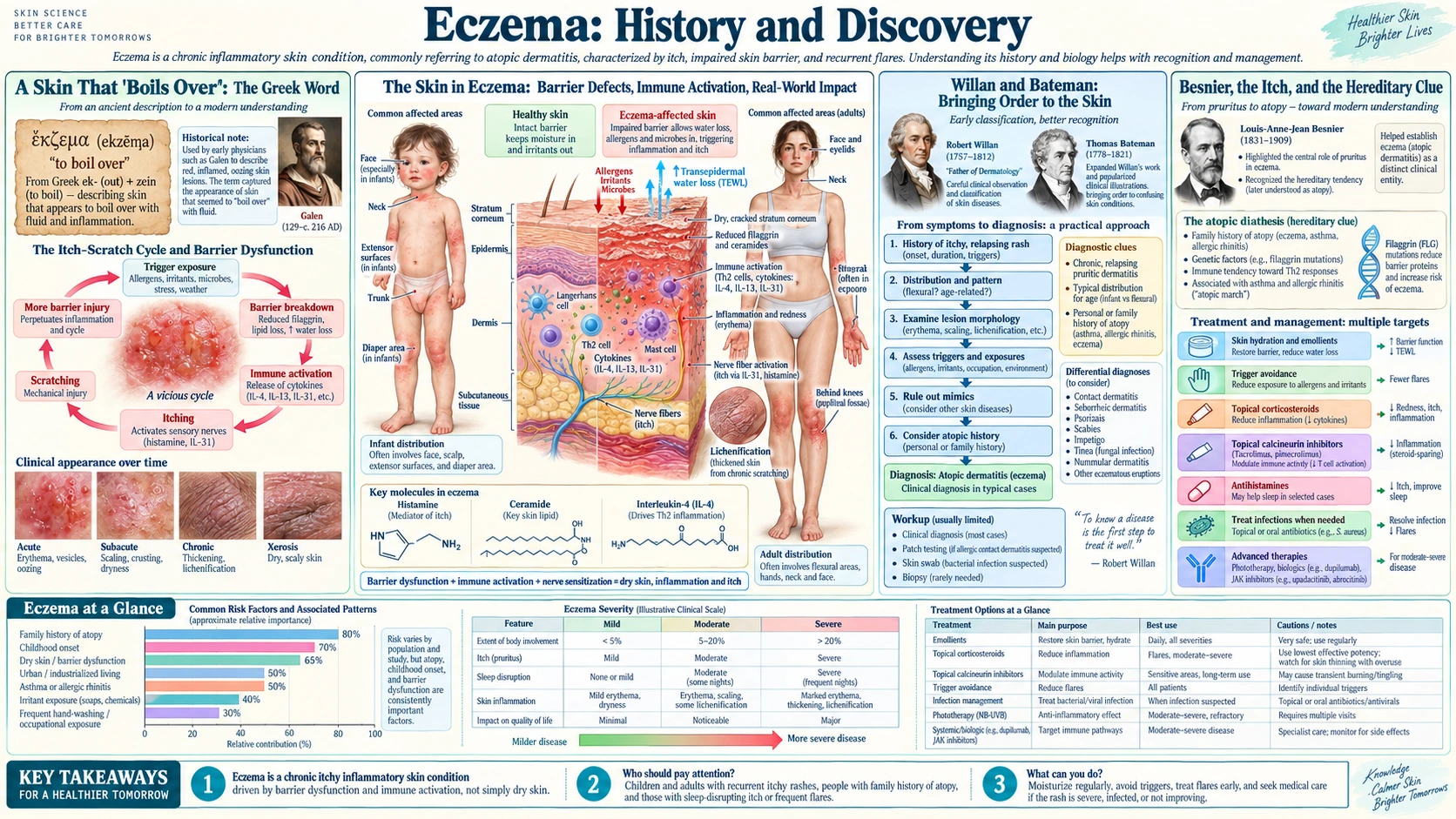
The word eczema is ancient, but the modern understanding of the disease is remarkably new. The name comes from the Greek ekzein — "to boil over" or "to break out" a vivid description of the tiny, bubbling, weeping blisters that erupt on inflamed skin, and it reaches back to the physician Aetius of Amida in the sixth century CE. Yet for most of recorded history "eczema" was a loose label for almost any red, itchy, oozing rash. Only in the early 1800s did Robert Willan and Thomas Bateman in London begin to classify skin diseases systematically; only in 1923 did Coca and Cooke coin the word atopy for the inherited tendency to asthma, hay fever, and eczema together; and only in 1933 did Wise and Sulzberger give us the name we still use, atopic dermatitis. The deepest answers — that a broken skin barrier and an over-reactive immune system drive the disease — arrived only in the last two decades. One fact has been clear throughout, and remains worth stating plainly: eczema is not contagious.
Table of Contents
- A Skin That "Boils Over": The Greek Word
- Ancient and Medieval Confusion
- Willan and Bateman: Bringing Order to the Skin
- Besnier, the Itch, and the Hereditary Clue
- Atopy: Coca and Cooke, 1923
- Naming Atopic Dermatitis: Wise and Sulzberger, 1933
- The Broken Barrier: Filaggrin and 2006
- The Immune Story and Modern Treatment
- Key Research Papers
- Connections
- Featured Videos
A Skin That "Boils Over": The Greek Word
The history of eczema begins with a word picture. The Greek verb ekzein is built from ek ("out") and zein ("to boil"), and the noun ekzema means, roughly, "something thrown out by heat" an eruption that bubbles and breaks through the surface. Anyone who has watched a patch of acute eczema flare will recognize the image: a rash of minute, fluid-filled vesicles that swell, burst, and weep, as though the skin itself were simmering. The ancient name and the visible disease match almost perfectly, which is part of why the term has survived for fifteen centuries.
The earliest surviving use of the term is generally credited to Aetius of Amida, a Greek-speaking Byzantine physician of the sixth century CE (some sources place the specific reference around 543 CE), in his great medical compilation. In that early usage "eczema" did not mean the particular disease we now diagnose; it was applied broadly to fiery, blistering eruptions of the skin. The precision came much later. For now the important point is that the word is ancient, descriptive, and Greek — while the concept of eczema as a specific, definable disease is a product of the modern era.
This gap between an old name and a new understanding runs through the entire story. It is the reason a careful history must distinguish the symptom (a weeping, itchy rash, recognized since antiquity) from the diagnosis (atopic dermatitis, defined only in the twentieth century). Keeping the two apart prevents a common error: assuming that because the ancients had a word for "eczema," they understood the disease we mean by it. They did not, and neither did anyone else until comparatively recently.
Ancient and Medieval Confusion
For most of recorded history, diseases of the skin were poorly differentiated from one another. To the eye, a great many conditions present in similar ways — redness, scaling, itching, oozing, crusting — and without microscopes, an understanding of the immune system, or any concept of allergy, physicians had little means of telling one chronic rash from another. Eczema, psoriasis, scabies, fungal infections, contact rashes, and a dozen other entities were frequently lumped together under shifting, overlapping names. A term like "eczema," "tetter," "dartre," or "salt rheum" might be attached to whatever scaly, itchy eruption a given writer happened to be describing.
This is not a sign that ancient and medieval physicians were careless. It reflects a genuine limit of observation. The visible surface of an inflamed rash simply does not, by itself, reveal whether the cause is an inherited tendency to allergy, a contact with an irritant, an autoimmune process, a mite, or a fungus. Classical authorities such as Galen, and the later Greek, Roman, Byzantine, and Arabic medical writers who built on them, recorded careful descriptions of skin eruptions and proposed treatments — ointments, baths, dietary changes, bloodletting in keeping with humoral theory — but they had no framework that could reliably separate eczema as we know it from its many look-alikes.
As a result, there is no clean ancient "discovery" of eczema to point to. There is instead a long pre-history of accurate symptom description tangled together with imprecise classification — centuries during which the weeping, itching rash was seen and treated countless times but never isolated as a distinct disease with a distinct cause. Untangling that knot was the achievement of the nineteenth century.
Willan and Bateman: Bringing Order to the Skin
The decisive turn toward a modern understanding came in London around the start of the nineteenth century with two physicians: Robert Willan (1757–1812), often called a founder of dermatology as a medical specialty, and his pupil and successor Thomas Bateman (1778–1821). Their great innovation was a method: instead of classifying skin diseases by supposed internal cause or by the body part affected, they grouped them according to the appearance of the primary lesion — whether the basic unit of the eruption was a papule, a scale, a pustule, a vesicle, and so on. By focusing on what could actually be seen and described, they replaced a chaos of folk names with an orderly, observation-based system.
Willan presented his classification of skin diseases to the Medical Society of London in 1790 (for which he received the society's Fothergill Gold Medal) and developed it in his landmark work On Cutaneous Diseases, of which the first part appeared in 1808. He died in 1812 with the work unfinished, and Bateman carried it forward, most influentially in A Practical Synopsis of Cutaneous Diseases According to the Arrangement of Dr. Willan, first published in 1813, which became a hugely important textbook and carried the Willanian system across Europe and America. Within this scheme, eczema was given a defined place — characterized, in Willan and Bateman's usage, as an eruption of minute vesicles — rather than remaining a vague catch-all term.
It is important to be precise about what Willan and Bateman did and did not do. They did not discover the cause of eczema, which remained unknown, and their category of "eczema" did not map exactly onto today's atopic dermatitis; nineteenth-century classifications continued to evolve and to differ from one author to the next. What they accomplished was foundational in a different way: they made dermatology a discipline of careful, reproducible observation and gave eczema a stable, defined identity within an organized system of skin disease. Every later refinement — including the recognition of an inherited, allergic form — was built on that base.
Besnier, the Itch, and the Hereditary Clue
Through the later nineteenth century, dermatologists increasingly suspected that a particular kind of chronic, intensely itchy eczema ran in families and traveled in company with other conditions. The clearest early statement of this came from the French dermatologist Ernest Besnier, who in 1892 described the disease he called prurigo diathésique — roughly, "constitutional itch-rash." Besnier's insight was less about the appearance of the lesions, which he found rather non-specific, than about the pattern surrounding them.
Three features of Besnier's description proved prophetic. First, he placed itch at the very center of the disease, recognizing that the relentless urge to scratch — and the damage scratching does — is the defining torment of this kind of eczema. Second, he noted a hereditary predisposition, the sense that affected people were "constitutionally" prone to the condition. Third, and most strikingly, he observed that the skin disease kept company with internal allergic conditions — asthma, hay fever, and related complaints — in the same patients and families. He also pushed back against the assumption that such rashes were confined to the poor.
Besnier could not explain why these things went together; the underlying concept of allergy did not yet exist, and would not be named until 1906 (by Clemens von Pirquet). But by tying the itchy skin, the family tendency, and the asthma-and-hay-fever connection into a single clinical picture, he laid out almost exactly the puzzle that the twentieth century would solve. A few decades later, in 1927, the dermatologist Louis Brocq proposed the alternative label constitutional eczema to capture the same hereditary quality — another step on the road to the modern name.
Atopy: Coca and Cooke, 1923
The conceptual breakthrough that finally united eczema with asthma and hay fever came not from a dermatologist but from two American allergists. In 1923, Arthur F. Coca (1875–1959) and Robert A. Cooke (1880–1960) coined the word atopy to name a peculiar, inherited tendency of certain people to develop hypersensitivity reactions — classically hay fever (allergic rhinitis) and asthma — on ordinary exposure to substances that were harmless to most people. They drew the term from the Greek atopos, meaning "out of place" or "strange," capturing the sense that these reactions were odd, unexpected, and did not fit existing categories of immunity.
The power of the idea lay in grouping. Coca and Cooke recognized that hay fever and asthma were not isolated complaints but expressions of a single underlying constitutional trait that tended to run in families — an inherited readiness to react allergically. This reframed a scatter of separate diseases as members of one family. It is the direct conceptual ancestor of what allergists now call the atopic march: the tendency for atopic individuals to develop eczema in infancy, then food allergies, then asthma and hay fever as they grow — different doors into the same underlying disposition.
Crucially, the eczema piece was not yet formally inside the "atopy" tent in 1923; Coca and Cooke's original focus was respiratory. But by giving a name and a unifying logic to the inherited allergic tendency Besnier had glimpsed, they created the conceptual container into which the right kind of eczema could finally be placed. That placement was the work of the next decade, and it gave the disease the name it still carries.
Naming Atopic Dermatitis: Wise and Sulzberger, 1933
In 1933, the American dermatologists Fred Wise (1881–1950) and Marion B. Sulzberger (1895–1983) introduced the term atopic dermatitis, explicitly bringing the chronic, itchy, hereditary eczema described by Besnier under the umbrella of Coca and Cooke's concept of atopy. The name itself encodes the whole modern theory in two words: atopic ties the skin disease to the inherited allergic tendency it shares with asthma and hay fever, and dermatitis identifies it as an inflammation of the skin. For the first time, the disease had a name that pointed at its nature rather than merely at its appearance.
This was the moment the threads came together. Willan and Bateman had given eczema a defined place in an orderly classification; Besnier had identified the itchy, hereditary, asthma-linked variety as something distinct; Coca and Cooke had named the inherited allergic constitution behind it. Wise and Sulzberger joined the dermatology to the allergy — recognizing this particular eczema as the skin's expression of atopy — and gave it the label that physicians use to this day. Sulzberger went on to become one of the most influential dermatologists of the twentieth century, and the term he helped establish has anchored the field ever since.
The naming was not the end of the refinement. In 1980, Jon Hanifin and Georg Rajka published a widely adopted set of diagnostic criteria — combinations of major features (such as itch, a typical pattern and distribution of the rash, chronic relapsing course, and personal or family history of atopy) and many minor ones — that gave clinicians and researchers a consistent, shared definition of atopic dermatitis. With a name and agreed criteria in place, the stage was set for the deeper question the twentieth century had not yet answered: what actually goes wrong in the skin?
The Broken Barrier: Filaggrin and 2006
For decades, two broad explanations of atopic dermatitis competed. One held that the disease was fundamentally a problem of the immune system — an allergic over-reaction — with the damaged skin as a consequence. The other, the "outside-in" view, held that the disease began with a faulty skin barrier that let irritants and allergens in and let moisture out, with the immune reaction following. A landmark genetic discovery in 2006 gave the barrier theory its strongest support and reshaped how the whole disease is understood.
That year, a team led by the geneticist W. H. Irwin McLean, working with dermatologists including Alan Irvine and Colin Palmer, reported that common loss-of-function mutations in the filaggrin gene (FLG) are a major inherited risk factor for atopic dermatitis. Filaggrin is a protein that helps knit together the tough outer layer of the skin and contributes to its natural moisturizing factor — in effect, part of the mortar in the skin's "brick wall." People who inherit a faulty FLG gene make too little working filaggrin; their skin barrier is leakier and drier, more easily penetrated by allergens and irritants and more prone to inflammation. The same gene defect had just been shown to cause ichthyosis vulgaris, a common dry, scaly skin condition, linking the two diseases at the molecular level.
The significance is hard to overstate. Filaggrin mutations are carried by a substantial fraction of people of European ancestry and are far more common in those with atopic dermatitis than in those without. The finding showed that, for many patients, a structurally broken barrier comes first — helping explain why eczema so often starts in infancy, why dry skin is so central, why moisturizers help, and how a leaky barrier could open the door to the food allergies and asthma of the atopic march. It did not make eczema a single-gene disease — most people with the mutation never develop it, and many patients with eczema have no FLG mutation — but it firmly established skin-barrier dysfunction as a core driver, working alongside the immune system rather than instead of it.
The Immune Story and Modern Treatment
The barrier is only half of the modern picture; the other half is the immune system. In atopic skin, the immune response is skewed toward a pattern dominated by what are called type 2 (Th2) immune signals — in particular messenger molecules such as interleukin-4 and interleukin-13. These signals drive the redness, the inflammation, and much of the maddening itch, and they further weaken the skin barrier, creating a vicious cycle: a leaky barrier lets allergens in, the immune system over-reacts, the reaction damages the barrier further, and the cycle repeats. Atopic dermatitis is now best understood as the product of both a barrier defect and immune dysregulation, with the balance between the two differing from patient to patient.
This dual understanding has transformed treatment in recent years. Decades of management rested on moisturizers (to support the barrier) and topical corticosteroids and, later, topical calcineurin inhibitors (to calm inflammation), and these remain mainstays for most people. But the identification of the specific type 2 signals opened the way to targeted biologic and small-molecule therapies. The monoclonal antibody dupilumab, which blocks interleukin-4 and interleukin-13 signaling and was approved beginning in 2017, was the first of a new generation of treatments aimed precisely at the immune pathway research had implicated; oral Janus kinase (JAK) inhibitors and other targeted agents have since followed. These are direct descendants of the scientific story this page has traced — the payoff of finally understanding the disease's mechanism.
It is worth closing where the history began: with what eczema is not. Because the rash can look raw and weeping, eczema has long been wrongly feared as catching. It is not. Eczema is not contagious — it cannot be passed from person to person by touch. It is a chronic, relapsing condition rooted in an inherited barrier and immune tendency, and while it cannot yet be cured, it can increasingly be controlled. The arc from Aetius's sixth-century word for a skin that "boils over" to a twenty-first-century antibody that switches off the immune signals behind the itch is one of the clearer examples in medicine of an ancient symptom slowly resolving into an understood, treatable disease.
Key Research Papers
The references below combine key peer-reviewed papers on the history and biology of eczema and atopic dermatitis with curated PubMed topic-search links. Historical primary texts — the writings of Aetius of Amida, Willan's On Cutaneous Diseases (1808), Bateman's Practical Synopsis (1813), and the original papers of Besnier (1892), Coca and Cooke (1923), and Wise and Sulzberger (1933) — are named in the article as historical sources. Each link opens in a new tab; dates and names of discovery have been cross-checked against multiple reputable sources.
- Kantor R, Thyssen JP, Paller AS, Silverberg JI. Atopic dermatitis, atopic eczema, or eczema? A systematic review, meta-analysis, and recommendation for uniform use of ‘atopic dermatitis’. Allergy. 2016;71(10):1480-1485. — PubMed PMID: 27392131
- Wallach D, Taïeb A. Atopic dermatitis/atopic eczema. Chemical Immunology and Allergy. 2014;100:81-96. — Search PubMed (history of the disease and its names)
- Thomsen SF. Atopic dermatitis: natural history, diagnosis, and treatment. ISRN Allergy. 2014;2014:354250. — doi:10.1155/2014/354250
- Palmer CNA, Irvine AD, Terron-Kwiatkowski A, et al. Common loss-of-function variants of the epidermal barrier protein filaggrin are a major predisposing factor for atopic dermatitis. Nature Genetics. 2006;38(4):441-446. — doi:10.1038/ng1767 · PubMed PMID: 16550169
- Weidinger S, Novak N. Atopic dermatitis. The Lancet. 2016;387(10023):1109-1122. — doi:10.1016/S0140-6736(15)00149-X · Search PubMed
- Bieber T. Atopic dermatitis. New England Journal of Medicine. 2008;358(14):1483-1494. — doi:10.1056/NEJMra074081
- Hanifin JM, Rajka G. Diagnostic features of atopic dermatitis. Acta Dermato-Venereologica (Supplement). 1980;92:44-47. — doi:10.2340/00015555924447
- Irvine AD, McLean WHI, Leung DYM. Filaggrin mutations associated with skin and allergic diseases. New England Journal of Medicine. 2011;365(14):1315-1327. — doi:10.1056/NEJMra1011040
- Eczema — etymology and first use (Greek ekzein; Aetius of Amida, 6th century CE) — Online Etymology Dictionary: eczema
- History of atopic dermatitis — Willan, Bateman, Besnier, Coca & Cooke, Wise & Sulzberger PubMed PMID: 42778510
- Robert Willan and the classification of cutaneous diseases PubMed: Robert Willan history of dermatology
- Origin of the term “atopy” (Coca and Cooke, 1923) and the atopic march PubMed: atopy history and the atopic march
- Filaggrin, the skin barrier, and atopic dermatitis PubMed PMID: 42858818
- Type 2 immunity (IL-4, IL-13) and targeted therapy in atopic dermatitis PubMed: type 2 immunity and dupilumab in atopic dermatitis