Basal Cell Carcinoma
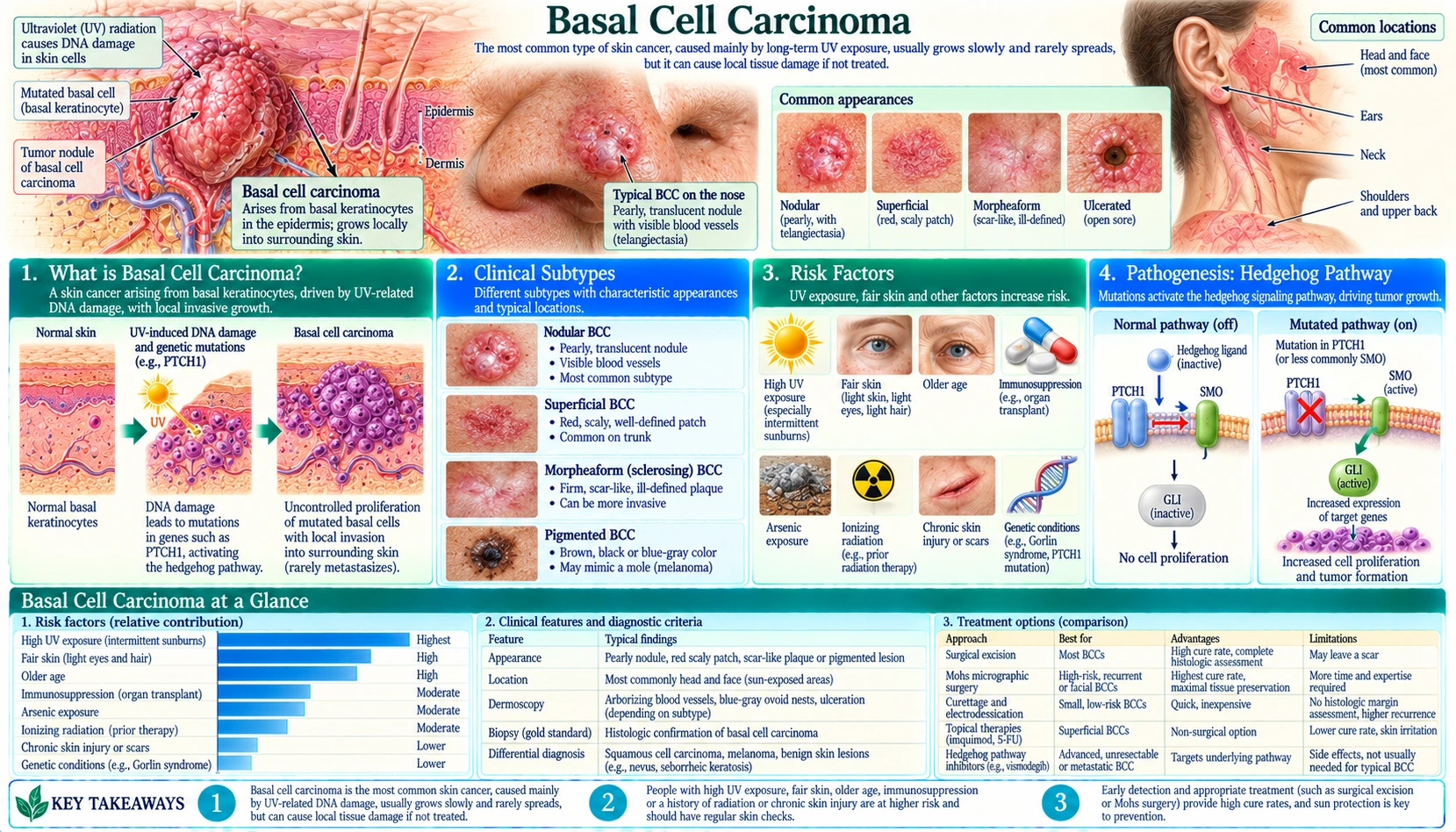
Table of Contents
What Basal Cell Carcinoma Is
Basal cell carcinoma (BCC) is the most common cancer in humans, accounting for approximately 3.5 million new cases per year in the United States alone and roughly 80% of all non-melanoma skin cancers. It arises from basal cells — the deepest layer of the epidermis — and almost always develops on sun-exposed skin, with the head and neck accounting for about 85% of cases.
Despite its extraordinary prevalence, BCC is rarely life-threatening. It grows slowly, destroys local tissue if left untreated, but metastasizes in fewer than 0.1% of cases. The danger lies not in spread but in local invasion: neglected BCCs on the face can erode into bone, cartilage, nerves, and the orbit. The defining principle of BCC management is therefore: cure it completely the first time, because recurrent BCC is substantially harder to treat.
Fair-skinned individuals (Fitzpatrick phototypes I and II) who burn easily and rarely tan carry the highest lifetime risk, with cumulative ultraviolet exposure being the primary driver. Lifetime risk for fair-skinned Americans is estimated at 30%.
Clinical Subtypes
Nodular BCC (Most Common)
Nodular BCC accounts for roughly 60–80% of all BCCs. It presents as a pearly or translucent papule or nodule with a rolled (raised) border and visible telangiectasias (dilated blood vessels) on the surface. Over time it may develop a central ulcer — the classic "rodent ulcer" appearance. It occurs most often on the head and neck. The rolled border and pearly sheen distinguish it from squamous cell carcinoma.
Superficial BCC
Superficial BCC appears as a flat, erythematous (red), scaly patch — often mistaken for eczema or psoriasis. It favors the trunk and shoulders and grows slowly along the surface rather than into deeper tissue. It responds well to topical treatments (imiquimod, 5-fluorouracil) and photodynamic therapy for low-risk lesions, though surgical excision remains the most reliable option.
Morpheaform (Sclerosing) BCC
Morpheaform BCC is the most aggressive subtype. It appears as a flat, scar-like, indurated plaque with ill-defined borders — it often looks more like a scar than a cancer. Because its edges are indistinct both clinically and histologically, standard excision margins are frequently inadequate. A 2015 consensus of the American Society for Dermatologic Surgery names Mohs surgery the treatment of choice for high-risk BCCs. Perineural invasion and subclinical extension make this subtype prone to recurrence.
Basosquamous (Metatypical) BCC
A rare subtype that shares features of both BCC and squamous cell carcinoma. It carries a higher metastatic potential (though still rare) and is one of the aggressive subtypes listed below as an indication for Mohs surgery.
Risk Factors
- Fitzpatrick skin type I–II: Blue or green eyes, fair skin, light hair, tendency to burn rather than tan. Melanin is the primary natural protection against ultraviolet-induced DNA damage.
- Cumulative ultraviolet exposure: Unlike melanoma (where intense intermittent burns dominate), BCC risk tracks cumulative lifetime sun exposure — the reason it is so common on the faces of older adults who worked outdoors.
- Tanning bed use: A 2012 meta-analysis of 12 studies (9,328 cases) found that people who had ever used indoor tanning had about 29% higher BCC risk (relative risk 1.29), and 40% higher when tanning started before age 25 (International Agency for Research on Cancer (IARC) classification: Group 1 carcinogen).
- Prior skin cancer: A 2000 meta-analysis of 17 studies found that after a first BCC, the risk of another BCC within 3 years is 44%, at least 10 times the rate of a first BCC in the general population.
- Immunosuppression: Organ transplant recipients have a 10-fold increased risk; long-term immunosuppressive medications (cyclosporine, azathioprine) impair tumor immune surveillance.
- Ionizing radiation: Prior radiation therapy to the skin, even decades earlier, predisposes to BCC at the irradiated site.
- Arsenic exposure: Chronic arsenic ingestion (historically from contaminated well water or industrial exposure) causes Bowen disease and BCC, particularly on non-sun-exposed sites.
- Gorlin syndrome (Nevoid BCC syndrome): An autosomal dominant PTCH1 mutation causing hundreds to thousands of BCCs beginning in early adulthood, jaw cysts, skeletal anomalies, and increased medulloblastoma risk.
Pathogenesis: Hedgehog Pathway
The molecular driver of virtually all BCCs is aberrant activation of the Sonic Hedgehog (SHH) signaling pathway. Under normal conditions:
- PTCH1 (Patched-1) protein inhibits Smoothened (SMO), keeping the pathway off.
- SHH ligand binds PTCH1, releasing SMO inhibition.
- Active SMO drives transcription of GLI family genes, promoting cell proliferation.
In BCC, ultraviolet-induced mutations in PTCH1 (loss-of-function, present in ~90% of BCCs) or activating mutations in SMO (~10%) constitutively activate the pathway regardless of SHH ligand. Cells proliferate without the normal restraining signal.
This pathway is the basis for targeted therapy: vismodegib and sonidegib are both SMO inhibitors — they block the constitutively active SMO and suppress BCC growth. They are approved for locally advanced or metastatic BCC where surgery is not feasible.
Additionally, ultraviolet causes characteristic C→T transitions at dipyrimidine sites (the "ultraviolet signature") in TP53 in approximately 50% of BCCs, further disabling tumor suppression.
Diagnosis and Dermoscopy
The clinical diagnosis of BCC is made by visual inspection and confirmed by skin biopsy (shave, punch, or excisional). Dermoscopy — using a hand-held dermatoscope to examine subsurface skin structures — significantly improves diagnostic accuracy and can often identify BCC before it is clinically obvious.
Dermoscopic Features of BCC
- Arborizing vessels: Large, bright-red, branching telangiectasias with a tree-branch pattern — the single most specific dermoscopic feature of nodular BCC. Absent in melanoma and squamous cell carcinoma (SCC).
- Leaf-like areas: Brown-gray discrete leaf-like or petal-like projections at the periphery — hallmark of pigmented BCC.
- Blue-gray ovoid nests: Large, well-defined blue-gray structures — characteristic of pigmented BCC.
- Spoke-wheel areas: Radial projections with a well-defined center — seen in superficial BCC.
- Ulceration: Central erosion with a red-white "structureless" area in nodular BCC.
- Shiny white structures: Chrysalis-like or white streaks under polarized light — associated with fibrotic subtypes including morpheaform.
Confocal reflectance microscopy and optical coherence tomography (OCT) are emerging non-invasive imaging tools for pre-operative margin assessment, though biopsy remains the gold standard for histologic subtype classification.
Treatment Options
The 2023 European guideline update on BCC states that the first-line treatment is complete surgery; that micrographically controlled (Mohs-type) surgery "shall be offered" for high-risk and recurrent BCC and for BCC on critical sites of the body; that photodynamic therapy is an effective treatment for superficial and low-risk nodular BCC; that the Hedgehog inhibitors vismodegib or sonidegib should be offered for locally advanced and metastatic BCC; and that cemiplimab is a second-line treatment when the disease progresses on, or cannot be treated with, those inhibitors.
Electrodesiccation and Curettage (ED&C)
ED&C involves scraping the tumor away with a curette followed by electrocautery to destroy the base, typically repeated three times in the same sitting. It is appropriate for low-risk BCCs on the trunk and extremities — primary, well-defined, nodular or superficial subtypes, diameter <2 cm, not on the face. Cure rates exceed 95% for carefully selected low-risk lesions. The wound heals by secondary intention, leaving a hypopigmented scar. It is not appropriate for morpheaform BCC, recurrent disease, or high-risk anatomical locations.
Standard Surgical Excision
Excision with histologically confirmed clear margins is appropriate for most BCCs. Recommended margins by subtype:
- Low-risk BCC (<2 cm, well-defined, primary, low-risk site): 4 mm margins achieve clearance in 95% of cases.
- High-risk BCC (>2 cm, poorly defined, aggressive subtype, recurrent): wider margins and/or Mohs surgery preferred.
Peripheral and deep margin assessment on frozen or permanent sections confirms complete excision.
Topical Therapies
Imiquimod 5% cream (immune response modifier) and 5-fluorouracil cream are U.S. Food and Drug Administration-approved for superficial BCC on the trunk and extremities. They are non-surgical alternatives for patients who are poor surgical candidates or who refuse surgery. Clearance rates are lower (75–85%) than surgical approaches and they are not appropriate for nodular or infiltrative subtypes.
Photodynamic Therapy (PDT)
Topical 5-aminolevulinic acid (5-ALA) is applied to the tumor and activated by specific-wavelength light, generating reactive oxygen species that destroy tumor cells. Suitable for superficial BCC; comparable efficacy to surgery for superficial lesions with better cosmetic outcomes. Not appropriate for nodular or deep subtypes.
Radiation Therapy
Radiation is an effective option for patients who cannot undergo surgery (elderly, anticoagulated, complex comorbidities) or where surgery would cause unacceptable functional or cosmetic morbidity (e.g., near the eye). Cure rates are similar to surgery for primary BCC but recurrence rates are higher for previously treated tumors. The 2023 European guideline describes radiotherapy as a valid alternative for people who are not candidates for or decline surgery, especially elderly patients; it is used less in young patients because of long-term field changes and the risk of radiation-induced carcinomas decades later.
Mohs Micrographic Surgery
Mohs micrographic surgery is the gold-standard treatment for high-risk BCCs. Developed by Frederic Mohs in the 1930s, the technique involves sequential excision of thin tissue layers with immediate complete margin assessment (100% of the peripheral and deep margins examined on frozen sections), excising more tissue only where cancer remains. This continues until margins are entirely clear.
Indications for Mohs Surgery
- High-risk anatomical locations: Face (especially central face, nose, ears, eyelids, lips), hands, feet, genitalia — areas where tissue conservation is critical for function and cosmesis.
- Large tumors (>2 cm)
- Aggressive histologic subtypes: Morpheaform, infiltrative, basosquamous
- Recurrent BCC after previous treatment
- Perineural or perivascular invasion
- Immunosuppressed patients
- Gorlin syndrome
Mohs surgery achieves 5-year cure rates of 99% for primary BCC and 94–95% for recurrent BCC — superior to any other treatment modality. (Two 1989 reviews by Rowe and colleagues give 5-year recurrence after Mohs surgery of 1.0% for primary and 5.6% for recurrent BCC.) It also removes the minimum amount of normal tissue, which is critical around the eyes and nose.
Advanced and Metastatic BCC
The overwhelming majority of BCCs are cured with local treatment. However, a small subset — those that are very large, deeply invasive, or that occur in immunosuppressed patients — can become locally advanced (invading bone, cartilage, nerves, orbit) or, extremely rarely (<0.1%), metastasize to regional lymph nodes, lungs, or bone.
Hedgehog Inhibitors
For locally advanced or metastatic BCC not amenable to surgery or radiation, the Hedgehog pathway inhibitors are the standard of care:
- Vismodegib: First-in-class SMO inhibitor; U.S. Food and Drug Administration-approved 2012. In the ERIVANCE trial, the response rate was 30% in 33 people with metastatic BCC and 43% in 63 people with locally advanced BCC. Median duration of response ~7.6 months. In the larger STEVIE study of 499 people treated in a setting close to routine practice, 66.7% of those with locally advanced BCC and 37.9% of those with metastatic BCC responded; the most common side effects were muscle spasms (64%), hair loss (alopecia, 62%), taste distortion (dysgeusia, 54%) and weight loss (33%). Treatment was stopped in 80% of STEVIE patients, about a third (36%) because of side effects.
- Sonidegib: Second SMO inhibitor; U.S. Food and Drug Administration-approved 2015. Similar efficacy and side-effect profile to vismodegib.
Resistance to vismodegib develops via additional SMO mutations or other pathway bypass mechanisms. Combination approaches (adding PD-1 inhibitors, PI3K pathway blockers) are under investigation.
Immunotherapy
Cemiplimab (anti-PD-1) received U.S. Food and Drug Administration (FDA) approval in 2021 for locally advanced or metastatic BCC that progresses on or is intolerant to Hedgehog inhibitors, achieving response rates of approximately 31%. In the trial behind it, 84 people with locally advanced BCC after Hedgehog-inhibitor therapy received cemiplimab: 31% responded (6% completely), serious (grade 3–4) side effects occurred in 48%, and there were no treatment-related deaths.
Prognosis and Recurrence
BCC is almost never fatal. Metastasis occurs in <0.1% of cases, and even locally advanced BCC is now manageable with targeted therapy. The primary concern is local recurrence, which can be destructive on the face.
- Primary skin cancers treated with excision or ED&C: recurrence under 5% (4.2% after excision, 1.6% after ED&C) over a median of 6.6 years in a Veterans Affairs cohort of basal and squamous cell cancers; an older pooled review of primary BCC gave 5-year recurrence of 10.1% after excision and 7.7% after ED&C
- High-risk primary BCC treated with standard excision: 5-year recurrence rate 8–17%
- Mohs surgery for primary BCC: 5-year recurrence rate about 1%
- Recurrent BCC treated with standard excision: 5-year recurrence rate ~17%
- Recurrent BCC treated with Mohs: 5-year recurrence rate ~5%
After treatment, surveillance for recurrence and new primary BCCs is essential. Patients with one BCC have a 44% risk of a second BCC within 3 years, at least 10 times the general-population rate (Marcil and Stern 2000). Recurrences also come late: Rowe's 1989 review found that only about two-thirds of recurrences appear in the first 3 years and 18% appear between years 5 and 10, and concluded that lifetime follow-up is necessary after treatment of primary BCC. The 2023 European guideline recommends long-term follow-up for people with high-risk BCC, multiple BCCs and Gorlin syndrome.
Prevention and Surveillance
- Daily sunscreen: In the Nambour randomized trial (1,621 adults in Queensland, Australia, followed for 4.5 years), daily SPF 15-plus sunscreen lowered squamous-cell carcinoma tumour counts by about 39% (rate ratio 0.61) but did not change basal cell carcinoma rates (rate ratio 1.03).
- Protective clothing and wide-brimmed hats: More reliable than sunscreen alone for field workers and outdoor athletes.
- Indoor tanning: linked to about 29% higher BCC risk in a 2012 meta-analysis (see Risk Factors).
- Midday sun: ultraviolet exposure is strongest between about 10 am and 4 pm.
- Nicotinamide (vitamin B3): In a randomized trial of 386 people who had had at least two nonmelanoma skin cancers in the previous 5 years (Chen et al., 2015, NEJM), oral nicotinamide 500 mg twice daily for 12 months lowered new nonmelanoma skin cancers by 23%; the 20% lower count of new BCCs on their own was not statistically significant, and no benefit was seen after the tablets were stopped. A 2023 trial in 158 organ-transplant recipients (stopped early because too few people joined) found no reduction: 207 new keratinocyte cancers with nicotinamide and 210 with placebo (rate ratio 1.0). A 2025 study of US veterans' health records (12,287 nicotinamide users matched with 21,479 non-users) found 14% lower skin cancer risk overall and 54% lower when nicotinamide was started after a first skin cancer, with lower risk seen for BCC too; it was an observational study, not a trial.
- Full-body skin checks: the 2023 European guideline recommends long-term follow-up for people with high-risk BCC, multiple BCCs or Gorlin syndrome; higher-risk groups include people with a prior BCC, fair skin, outdoor work or an organ transplant.
- Transplant recipients: Their risk is much higher (see Risk Factors), and they are often examined every 6 months; field cancerization (widespread ultraviolet-damaged skin at risk for multiple tumors) is treated with field-directed therapies (topical 5-fluorouracil, photodynamic therapy, acitretin).
Key Research Papers
Key peer-reviewed studies on BCC biology, diagnosis, and treatment. Each PMID link opens the study on PubMed.
- Sekulic A, et al. Efficacy and safety of vismodegib in advanced basal-cell carcinoma (ERIVANCE). N Engl J Med. 2012;366(23):2171-2179. — PubMed PMID: 22670903
- Chen AC, et al. A phase 3 randomized trial of nicotinamide for skin-cancer chemoprevention. N Engl J Med. 2015;373(17):1618-1626. — PubMed PMID: 26488693
- Kauvar AN, Cronin T Jr, Roenigk R, Hruza G, Bennett R; American Society for Dermatologic Surgery. Consensus for nonmelanoma skin cancer treatment: basal cell carcinoma, including a cost analysis of treatment methods. Dermatol Surg. 2015;41(5):550-571. — PubMed PMID: 25868035
- Rowe DE, Carroll RJ, Day CL Jr. Long-term recurrence rates in previously untreated (primary) basal cell carcinoma: implications for patient follow-up. J Dermatol Surg Oncol. 1989;15(3):315-328. — PubMed PMID: 2646336
- Green A, et al. Daily sunscreen application and betacarotene supplementation in prevention of basal-cell and squamous-cell carcinomas of the skin (Nambour Skin Cancer Prevention Trial). Lancet. 1999;354(9180):723-729. — PubMed PMID: 10475183
- Gailani MR, et al. The role of the human homologue of Drosophila patched in sporadic basal cell carcinomas. Nat Genet. 1996;14(1):78-81. — PubMed PMID: 8782823
- Wehner MR, Shive ML, Chren MM, Han J, Qureshi AA, Linos E. Indoor tanning and non-melanoma skin cancer: systematic review and meta-analysis. BMJ. 2012;345:e5909. — PubMed PMID: 23033409
- Altamura D, et al. Dermatoscopy of basal cell carcinoma: morphologic variability of global and local features and accuracy of diagnosis. J Am Acad Dermatol. 2010;62(1):67-75. — PubMed PMID: 19828209
- Peris K, Fargnoli MC, Kaufmann R, et al.. European consensus-based interdisciplinary guideline for diagnosis and treatment of basal cell carcinoma-update 2023. Eur J Cancer. 2023;192:113254. — PubMed PMID: 37604067
- Mohan SV, Chang AL. Advanced basal cell carcinoma: epidemiology and therapeutic innovations. Curr Dermatol Rep. 2014;3(1):40-45. — PubMed PMID: 24587976
- Chren MM, Torres JS, Stuart SE, Bertenthal D, Labrador RJ, Boscardin WJ. Recurrence after treatment of nonmelanoma skin cancer: a prospective cohort study. Arch Dermatol. 2011;147(5):540-546. — PubMed PMID: 21576572
- Basset-Seguin N, et al. Vismodegib in patients with advanced basal cell carcinoma (STEVIE): a pre-planned interim analysis of an international, open-label trial. Lancet Oncol. 2015;16(6):729-736. — PubMed PMID: 25981813
- Rowe DE, Carroll RJ, Day CL Jr. Mohs surgery is the treatment of choice for recurrent (previously treated) basal cell carcinoma. J Dermatol Surg Oncol. 1989;15(4):424-431. — PubMed PMID: 2925988
- Marcil I, Stern RS. Risk of developing a subsequent nonmelanoma skin cancer in patients with a history of nonmelanoma skin cancer: a critical review of the literature and meta-analysis. Arch Dermatol. 2000;136(12):1524-1530. — PubMed PMID: 11115165
- Stratigos AJ, Sekulic A, Peris K, et al.. Cemiplimab in locally advanced basal cell carcinoma after hedgehog inhibitor therapy: an open-label, multi-centre, single-arm, phase 2 trial. Lancet Oncol. 2021;22(6):848-857. — PubMed PMID: 34000246
- Allen NC, Martin AJ, Snaidr VA, et al.. Nicotinamide for Skin-Cancer Chemoprevention in Transplant Recipients. N Engl J Med. 2023;388(9):804-812. — PubMed PMID: 36856616
- Breglio KF, Knox KM, Hwang J, Weiss R, Maas K, Zhang S, Yao L, Madden C, Xu Y, Hartman RI, Wheless L. Nicotinamide for Skin Cancer Chemoprevention. JAMA Dermatol. 2025;161(11):1140-1147. — PubMed PMID: 40960808
Curated PubMed topic searches:
Connections
- Dermatology
- Sunburn, Tanning & What Ultraviolet Does to Your Skin — interactive animation
- Skin Cancer
- Melanoma
- Psoriasis
- Rosacea
- Acne
- Vitiligo
- Eczema
- Seborrheic Dermatitis
- Oncology
- Vitamin D3
- Sun Exposure
- Lupus