Neisseria meningitidis: Bacterial Meningitis and Meningococcal Disease
Symptoms & Diagnosis
A medical emergency that can kill within 24 hours — the warning signs to recognize.
Read the deep dive →Bacterial Meningitis
Headache, stiff neck, fever, and photophobia — the classic meningitis triad.
Read the deep dive →Meningococcemia & Purpura
The spreading purpuric rash that signals meningococcal sepsis — a visible emergency.
Read the deep dive →Diagnosis & Lumbar Puncture
CSF findings, when to do a lumbar puncture, and when to treat first and test after.
Read the deep dive →Treatment & Prevention
Immediate IV ceftriaxone + dexamethasone — and the vaccines that prevent this disease.
Read the deep dive →Antibiotic Treatment
Why every minute counts — ceftriaxone IV, dexamethasone adjunct, and ICU care.
Read the deep dive →Meningococcal Vaccines
MCV4, MenACWY, MenB — who gets which vaccine and when.
Read the deep dive →Chemoprophylaxis
Rifampicin or ciprofloxacin for close contacts — protecting those exposed.
Read the deep dive →Neisseria meningitidis (also called the meningococcus) is one of the most feared bacteria in medicine: a pathogen that can kill a previously healthy young person in under 24 hours. It lives harmlessly in the back of the throat of roughly 10–25% of the population at any given time. In a small number of people — typically triggered by a preceding respiratory virus, a disrupted immune response, or close crowded contact with a new strain — the bacterium breaches the mucosal barrier and invades the bloodstream, from which it can reach the membranes around the brain, the adrenal glands, and virtually every organ in the body. The characteristic petechial or purpuric rash (a spreading network of blood-red spots that do not fade when pressed) is a sign that the bacteria are releasing toxins that are destroying blood vessels, and it is a dermatological emergency. Vaccines against the most common serogroups have dramatically reduced meningococcal disease in countries that use them, making this one of the clearest vaccine success stories in modern medicine.
Table of Contents
What N. meningitidis Is
Neisseria meningitidis is a Gram-negative, aerobic diplococcus — meaning the individual kidney-bean-shaped bacteria pair up in a characteristic pattern visible under the microscope. It belongs to the same genus as Neisseria gonorrhoeae (the cause of gonorrhea) but causes a completely different clinical syndrome. The meningococcus is an obligate human pathogen: humans are its only known reservoir. It is carried in the nasopharynx (the back of the nose and throat) of healthy people without causing any symptoms in the vast majority of carriers.
The transition from harmless colonizer to lethal invader depends on a combination of bacterial virulence factors and host immune vulnerability. The bacterium is surrounded by a polysaccharide capsule that allows it to resist being swallowed and destroyed by immune cells — this is the key virulence factor that separates disease-causing strains from commensals. The capsule is also the basis for the serogroup classification system and the target of meningococcal vaccines.
Spread from person to person occurs by respiratory droplets and close oral contact — living together, kissing, sharing drinks or utensils, coughing or sneezing in a confined space. It is not spread by casual contact (touching a doorknob or sitting near a carrier in a classroom does not transmit it). The highest-risk settings are households, college dormitories, military barracks, nightclubs, and the Hajj pilgrimage, where many people live in close quarters.
Serogroups and Global Distribution
Twelve serogroups of N. meningitidis are recognized, based on the chemical structure of the capsular polysaccharide. Six serogroups cause the vast majority of human disease:
- Serogroup B: The dominant cause in Europe, the United States, Canada, and Australia for much of the past two decades. Historically the hardest to vaccinate against because its capsular polysaccharide chemically resembles a protein on human brain cells, causing immune tolerance and making polysaccharide vaccines ineffective. Protein-based vaccines (Bexsero, Trumenba) overcame this and are now licensed.
- Serogroup C: A historically major cause in Europe and North America. Mass vaccination campaigns with MenC conjugate vaccines in the late 1990s and 2000s virtually eliminated serogroup C disease in countries that adopted them — one of the most dramatic population-level vaccine successes in history.
- Serogroup A: The primary cause of epidemic meningococcal disease in sub-Saharan Africa's "Meningitis Belt" — a swath of countries from Senegal to Ethiopia where devastating annual epidemics killed tens of thousands before the introduction of the MenAfriVac conjugate vaccine in 2010. That vaccine has reduced serogroup A meningitis by over 99% in vaccinated populations.
- Serogroup W: Associated with the Hajj pilgrimage and has caused international outbreaks. Has become increasingly important in sub-Saharan Africa and the UK.
- Serogroup Y: Accounts for a significant proportion of cases in North America and is covered by quadrivalent vaccines.
- Serogroup X: Emerging in Africa and not covered by most current vaccines; a significant concern for the next generation of vaccine development.
Meningitis vs. Meningococcemia
When N. meningitidis breaches the nasopharyngeal barrier and enters the bloodstream, it can cause two distinct (though often overlapping) clinical syndromes:
- Meningococcal meningitis: The bacteria travel through the bloodstream and penetrate the blood-brain barrier, reaching the cerebrospinal fluid (CSF) that bathes the brain and spinal cord. They multiply rapidly in this fluid, which is poorly defended by the immune system. The body's inflammatory response to the invading bacteria — while necessary — is itself a major cause of brain damage. Raised intracranial pressure, cerebral edema, and brain herniation are the immediate threats to life. Survivors may be left with hearing loss, brain damage, or cognitive impairment.
- Meningococcemia (septicemia/meningococcal sepsis): A form where the bacteria multiply primarily in the bloodstream without necessarily causing prominent meningitis. This is often the more rapidly lethal form. The bacteria release endotoxin (a component of their outer membrane called lipopolysaccharide), which triggers a massive inflammatory cascade. This can cause disseminated intravascular coagulation (DIC) — a runaway clotting process that simultaneously blocks small blood vessels throughout the body and exhausts clotting factors, causing bleeding. The result is tissue death (necrosis) throughout the body, including in the skin (producing the petechial/purpuric rash), the adrenal glands (causing adrenal failure), and the extremities (sometimes necessitating limb amputation).
Many patients have both syndromes simultaneously. The combination of meningococcemia and meningitis carries the highest mortality. The case fatality rate for meningococcal disease overall is approximately 10–15% even with treatment. For pure meningococcemia without meningitis, mortality can exceed 20%. Survivors face a significant burden of permanent sequelae.
The Petechial Rash — Why It Is an Emergency
The classic warning sign of meningococcal septicemia is a rash that behaves differently from the rashes of viral illnesses: it does not fade or turn white (blanch) when you press a glass firmly against the skin. This non-blanching rash reflects actual bleeding into the skin from damaged blood vessels, not dilated capillaries that compress away.
The rash typically begins as petechiae — tiny, pinpoint flat red or purple spots the size of a pinhead, often first noticed on the trunk, ankles, or wrists. Within hours these can coalesce into larger purpuric areas — irregular patches of purple or deep red, sometimes with a bruised appearance. In the most severe cases, the skin and underlying tissue undergo purpura fulminans — frank skin necrosis, blistering, and gangrene. Skin over the fingers, toes, nose, and ears is particularly vulnerable; this is why survivors of meningococcemia sometimes require amputations of affected extremities.
The glass test: Roll a clean glass firmly over the rash. If the rash does not fade or blanch, it is non-blanching. A non-blanching rash in a febrile child or adult should be treated as meningococcal septicemia until proven otherwise and requires emergency medical services immediately.
The rash can be difficult to see in people with darker skin. Check under natural light, and look at the inner surfaces of the lips, conjunctivae (inside of the eyelids), and the palms and soles, where the rash may be more visible. Time from rash appearance to death can be measured in hours — there is no role for watchful waiting once a non-blanching rash with fever is identified.
Symptoms and Timeline
The incubation period from exposure to onset is typically 1 to 10 days, most commonly 2 to 4 days. The illness can progress from apparently mild to life-threatening with breathtaking speed — a student who seemed to have a bad cold in the morning can be dead by that evening.
Early symptoms (often the first 4–12 hours, easily mistaken for flu):
- Sudden onset of high fever and severe chills.
- Severe headache — often described as the worst headache of the person's life.
- Muscle and joint pains.
- Nausea and vomiting.
- Cold hands and feet despite a high fever — a counter-intuitive but important early sign of circulatory compromise.
- Unusual pallor or a pale/mottled/gray skin color.
Meningitis-specific symptoms (may develop alongside or slightly after the above):
- Neck stiffness (nuchal rigidity) — the patient cannot bend the chin to the chest due to meningeal inflammation. This is a classic sign, though it may be absent in young infants and in very rapidly progressive disease.
- Photophobia (pain from normal light) and phonophobia (pain from normal sounds).
- Altered consciousness — confusion, drowsiness, or difficult to rouse.
- Seizures.
- In young infants: the classic triad of fever, vomiting, and neck stiffness may be absent. Instead look for a bulging fontanelle (the soft spot on the baby's head), unusual high-pitched crying, and extreme irritability or limpness.
Late-stage signs (indicating septicemia and multi-organ failure):
- The petechial or purpuric rash described above.
- Rapid breathing and low blood pressure (septic shock).
- Limb pain, pallor, and coldness disproportionate to the fever.
Diagnosis and Treatment
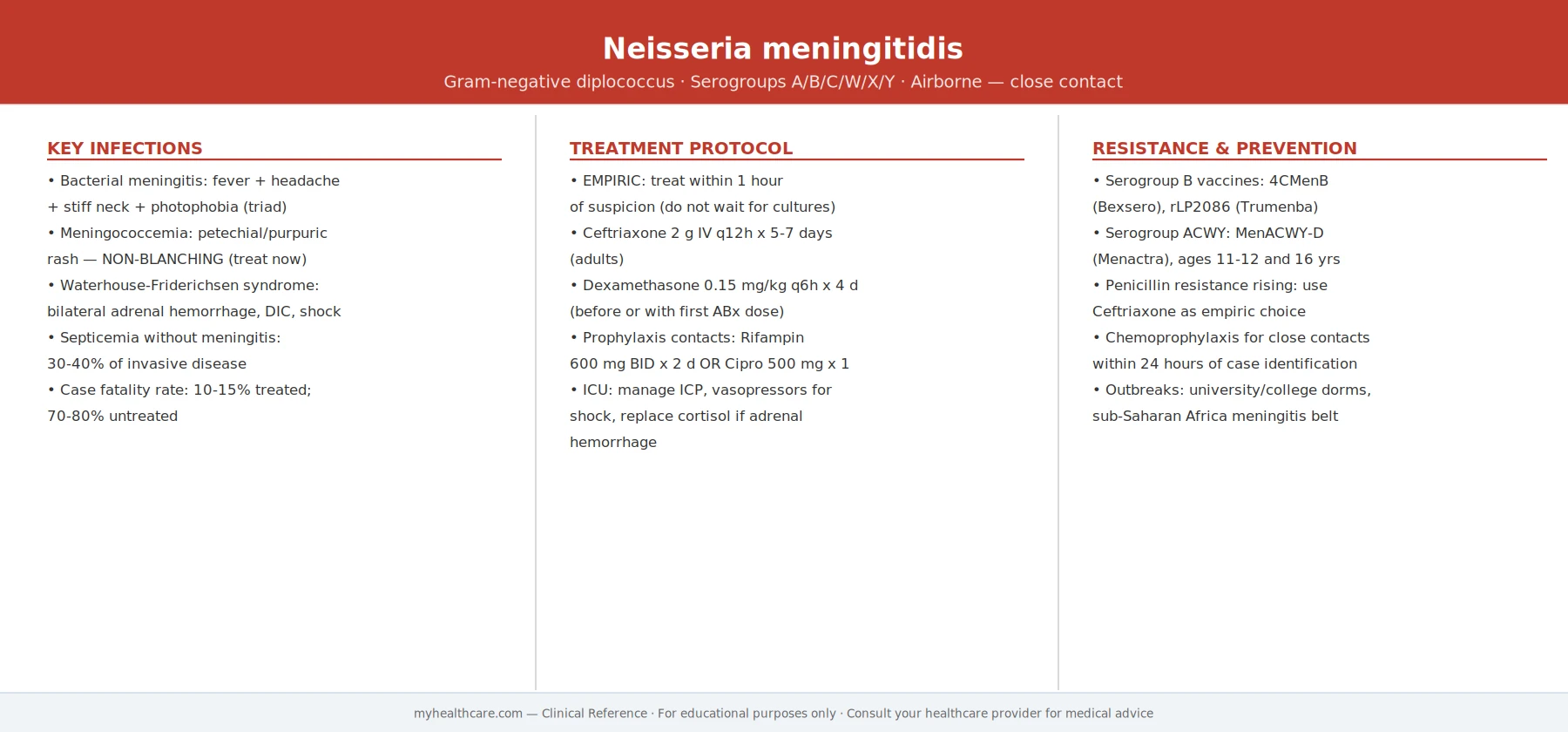
Diagnosis is both clinical and microbiological. The clinical recognition of the non-blanching rash and meningeal signs in a febrile patient is sufficient to begin empirical treatment before lab results are available — waiting for confirmation before starting antibiotics is not appropriate and costs lives.
Microbiological confirmation:
- Blood cultures: The single most important diagnostic test. Positive in 40–60% of meningococcal disease cases. Must be drawn before antibiotics are started, but should not delay antibiotic administration by more than a few minutes.
- Lumbar puncture (spinal tap): Analysis of CSF is diagnostic for meningitis. N. meningitidis appears as Gram-negative diplococci on Gram stain. CSF typically shows very high white cell count, high protein, and low glucose. LP should not be performed if there are signs of raised intracranial pressure (papilloedema, focal neurological signs, GCS < 13) — CT scan first in those cases.
- PCR: Highly sensitive meningococcal PCR on blood and CSF can identify the organism and serogroup even after antibiotics have been started (unlike culture). Rapidly becoming the gold standard for confirmation.
- Throat swab: Can isolate the organism from carriers or index cases, useful in outbreak investigation.
Treatment is one of the most time-critical in medicine:
- Antibiotics — immediate. Penicillin G or ceftriaxone (a third-generation cephalosporin) are the drugs of choice. Ceftriaxone has the advantage of also covering Listeria and other organisms that can cause meningitis when the exact pathogen is not yet known, making it the preferred empirical choice. Chloramphenicol is used in settings where beta-lactam antibiotics are unavailable. N. meningitidis remains highly susceptible to penicillin in most parts of the world, with resistance uncommon compared to many other bacteria.
- Dexamethasone (a corticosteroid) given before or with the first antibiotic dose reduces the inflammatory response in bacterial meningitis and has been shown to reduce the risk of hearing loss and neurological complications, particularly in pneumococcal meningitis. Evidence is somewhat less strong for meningococcal meningitis specifically, but it is standard practice to give it.
- Intensive care support: Management of septic shock with IV fluids (carefully — too much can worsen cerebral edema), vasopressors, management of DIC, respiratory support, and close neurological monitoring.
- Chemoprophylaxis for close contacts: Household members, kissing contacts, and healthcare workers who performed mouth-to-mouth resuscitation without protection receive rifampicin, ciprofloxacin, or ceftriaxone to clear nasopharyngeal carriage and prevent secondary cases.
Vaccines and Prevention
Vaccines are the most powerful tool against meningococcal disease, and the history of their deployment is one of striking success:
- Quadrivalent conjugate vaccines (MenACWY): Vaccines covering serogroups A, C, W, and Y (brands include Menveo, Menactra, MenQuadfi). These conjugate the polysaccharide to a carrier protein, producing long-lasting immunity and herd protection. Recommended routinely for adolescents at 11–12 years (with a booster at 16) in the United States, and for travelers to high-risk areas.
- Serogroup B vaccines (MenB): Bexsero (GSK) and Trumenba (Pfizer) were licensed in the US from 2014–2015 after decades of difficulty because serogroup B's polysaccharide is poorly immunogenic. These protein-based vaccines use outer membrane vesicles and recombinant surface proteins. In the US, MenB vaccines are recommended for people 10 years and older at increased risk and shared clinical decision-making for adolescents aged 16–23.
- MenAfriVac (MenA conjugate): A low-cost conjugate vaccine against serogroup A developed specifically for sub-Saharan Africa through a public-private partnership. Mass vaccination campaigns launched from 2010 onwards reduced serogroup A meningitis by more than 99% in the Meningitis Belt — one of the greatest public health achievements of the 21st century.
- Travel vaccination: All travelers to sub-Saharan Africa's Meningitis Belt during the dry season, and pilgrims to the Hajj, require proof of meningococcal vaccination. Saudi Arabia mandates MenACWY vaccination for all Hajj pilgrims.
Even with vaccination, N. meningitidis will not be eliminated — the vaccines do not cover all serogroups, immunity wanes, and new strains emerge. Public awareness of the warning signs and the speed with which the disease progresses remains critical. Early recognition and rapid antibiotic treatment save lives even when vaccination status is incomplete.
Key Research Papers
- Stephens DS, Greenwood B, Brandtzaeg P. Epidemic meningitis, meningococcaemia, and Neisseria meningitidis. Lancet. 2007;369(9580):2196–2210. — Comprehensive clinical and epidemiological overview of the full spectrum of meningococcal disease, pathogenesis, and public health impact. — Search PubMed
- Maiden MCJ, Bygraves JA, Feil E, et al. Multilocus sequence typing: a portable approach to the identification of clones within populations of pathogenic microorganisms. Proc Natl Acad Sci USA. 1998;95(6):3140–3145. — Introduced MLST, the molecular typing system that revolutionized understanding of the global population structure and spread of N. meningitidis hypervirulent lineages. — Search PubMed
- Pizza M, Scarlato V, Masignani V, et al. Identification of vaccine candidates against serogroup B meningococcus by whole-genome sequencing. Science. 2000;287(5459):1816–1820. — The landmark reverse vaccinology paper that identified the outer membrane protein antigens used in Bexsero, solving the decades-long puzzle of how to vaccinate against serogroup B. — PubMed PMID: 10710308
- LaForce FM, Ravenscroft N, Djingarey M, Viviani S. Epidemic meningitis due to group A Neisseria meningitidis in the African meningitis belt: a persistent problem with an imminent solution. Vaccine. 2009;27(Suppl 2):B13–B19. — Documents the massive disease burden in sub-Saharan Africa and describes the development strategy for MenAfriVac. — PubMed PMID: 19477559
- Rosenstein NE, Perkins BA, Stephens DS, Popovic T, Hughes JM. Meningococcal disease. N Engl J Med. 2001;344(18):1378–1388. — Classic New England Journal review covering pathogenesis, clinical management, chemoprophylaxis, and vaccination strategies; a foundational clinical reference. — Search PubMed