Bacteroides fragilis
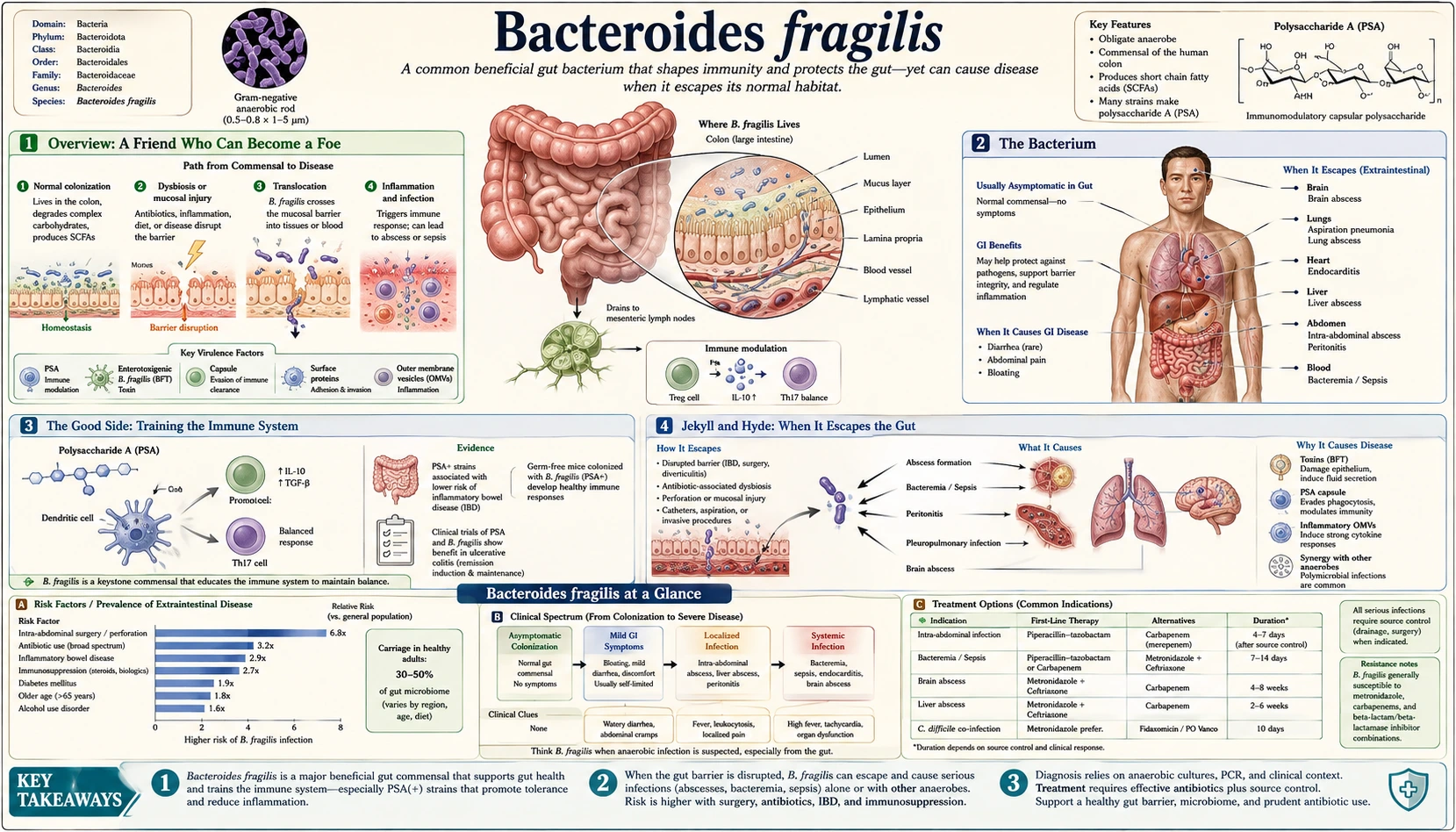
Bacteroides fragilis is one of the most abundant bacteria living in the healthy human colon — a normal, helpful resident of the gut microbiome that most of us carry for our entire lives without ever knowing it is there. It is an anaerobe, meaning it thrives only where there is no oxygen, which is precisely the environment the deep, airless folds of the large intestine provide. Inside the gut it earns its keep: it helps break down complex carbohydrates and, remarkably, produces a molecule that helps train and balance the immune system. Yet this same organism has a darker reputation in hospitals, because when the wall of the intestine is breached — by a burst appendix, diverticulitis, surgery, or an abdominal injury — B. fragilis is the anaerobe most often found causing serious abscesses, peritonitis, and bloodstream infections. This page tells the full, honest story of a bacterium that is at once one of our most important microbial partners and, in the wrong place, a formidable foe. We cover what it is, its genuine benefits, how and why it turns dangerous, who is most at risk, and how doctors diagnose and treat the infections it causes.
Table of Contents
- Overview: A Friend Who Can Become a Foe
- The Bacterium
- The Good Side: Training the Immune System
- Jekyll and Hyde: When It Escapes the Gut
- Enterotoxigenic Strains and the Colon-Cancer Question
- Who Is Most at Risk
- Diagnosis
- Treatment
- Prevention
- The Honest Bottom Line
- Key Research Papers
- Connections
- Featured Videos
Overview: A Friend Who Can Become a Foe
Bacteroides fragilis lives a double life, and understanding both halves is the key to understanding it. In the colon, where it belongs, it is a good citizen: a member of the Bacteroides fragilis group of anaerobes that together make up a large share of the bacteria in the large intestine. It ferments dietary fiber into short-chain fatty acids that nourish the cells lining the gut, competes with more harmful microbes for space and food, and — as researchers discovered relatively recently — actively helps calibrate the immune system. For the healthy person, its presence is not just harmless but genuinely useful.
The problem begins only when it leaves home. B. fragilis is by a wide margin the most common anaerobe isolated from serious human infections, even though it is far from the most common Bacteroides species in stool. That paradox — comparatively rare in the gut, yet the leading anaerobe in abscesses and blood cultures — is a clue to what makes it dangerous: it carries features, above all a protective outer capsule, that let it survive and cause disease outside the intestine. When the intestinal barrier is broken and gut contents spill into places that are supposed to be sterile, B. fragilis is the organism most likely to turn that spill into a walled-off pocket of pus.
The Bacterium
Bacteroides fragilis is a Gram-negative, rod-shaped bacterium and an obligate (strict) anaerobe. "Obligate anaerobe" means it cannot grow in the presence of oxygen — oxygen is actually toxic to it. This single fact shapes almost everything about how it lives and how it is diagnosed. It flourishes in the deep colon precisely because that environment is essentially oxygen-free, and it must be handled with special anaerobic techniques in the laboratory or it simply dies before it can be identified.
Its most important structural feature is a thick polysaccharide capsule — a sugar coat surrounding the cell. In the friendly setting of the gut this capsule is part of normal biology, but outside the gut it becomes a genuine virulence factor. The capsule helps the bacterium resist being engulfed and destroyed by immune cells, and, as we will see, it directly promotes the formation of abscesses. B. fragilis also produces enzymes, including a beta-lactamase that breaks down penicillin-type antibiotics, and it can generate other tissue-damaging enzymes and toxins depending on the strain.
It is worth being clear about naming. The "Bacteroides fragilis group" is a cluster of closely related anaerobes (including species such as B. thetaiotaomicron and B. vulgatus) that are common gut residents. B. fragilis itself is a minority member of that group in the healthy colon, yet it punches far above its weight in causing disease — a reminder that abundance and danger are not the same thing.
The Good Side: Training the Immune System
One of the most surprising findings in modern microbiome science is that B. fragilis is not merely tolerated by the body — it actively helps the immune system develop and stay balanced. The molecule responsible is part of its capsule, a sugar called polysaccharide A (PSA). Unlike most bacterial sugars, PSA carries both positive and negative charges (it is "zwitterionic"), and that unusual chemistry lets it be recognized and presented by the immune system in a way ordinary polysaccharides are not.
In a series of influential laboratory and animal studies, researchers led by Sarkis Mazmanian and Dennis Kasper showed that PSA can:
- Guide the maturation of the immune system. Germ-free mice (raised with no bacteria at all) have underdeveloped, lopsided immune systems; giving them B. fragilis or purified PSA helps restore a normal balance between the immune system's main arms.
- Encourage regulatory T cells. PSA prompts the body to produce regulatory T cells and the calming signaling molecule interleukin-10 (IL-10), which together dampen excessive inflammation.
- Protect against inflammatory disease in animal models. In mouse models of colitis, PSA reduced intestinal inflammation — earning it the description of a "symbiosis factor."
This is a genuine beneficial-microbiome story, and it reframes B. fragilis from a mere germ into a partner that helps teach the immune system the difference between real threats and harmless residents. It is important to be honest about the evidence, though: most of this work has been done in mice and in cell cultures, not in large human trials. PSA is not a treatment you can buy, and the findings are best understood as a window into how gut bacteria and human immunity co-evolved — not as a finished clinical therapy.
Jekyll and Hyde: When It Escapes the Gut
The same organism that helps train the immune system in the colon becomes a serious pathogen the moment it reaches tissue where it does not belong. The trigger is almost always a breach of the intestinal wall that lets gut contents leak into the normally sterile abdominal cavity or bloodstream. Common causes of such a breach include a perforated (burst) appendix, diverticulitis, a ruptured bowel, penetrating trauma, and abdominal or pelvic surgery.
Once it escapes, B. fragilis is the classic cause of several serious infections:
- Intra-abdominal abscesses. This is its signature disease. A localized pocket of pus walls itself off inside the abdomen. Remarkably, the bacterium's capsule is a direct driver of abscess formation — experiments showed that the purified capsular polysaccharide alone can induce abscesses, which is why the very feature that makes PSA immunologically interesting also makes the organism so good at building these pockets of infection.
- Pelvic abscesses and gynecologic infections. In the pelvis it contributes to tubo-ovarian abscesses and post-surgical or post-childbirth infections.
- Peritonitis. Widespread inflammation and infection of the lining of the abdominal cavity when gut spillage is not contained.
- Bloodstream infection (anaerobic bacteremia). B. fragilis is the most common anaerobe recovered from blood cultures. Anaerobic bacteremia is uncommon but carries a meaningful risk of death, especially in frail or immunocompromised patients.
- Wound and soft-tissue infections. Surgical-site infections and deep tissue infections, particularly after bowel surgery.
Crucially, these are usually polymicrobial (mixed) infections. When the gut spills, it releases many organisms at once — typically B. fragilis alongside aerobic bacteria such as Escherichia coli. The two kinds of bacteria can even help each other: oxygen-using organisms consume the local oxygen and create the airless conditions that let the anaerobe thrive. This is why effective treatment must cover both the anaerobes and the aerobes, not just one.
Enterotoxigenic Strains and the Colon-Cancer Question
Most B. fragilis in the human gut is harmless, but a subset of strains carry a gene for a toxin and are called enterotoxigenic Bacteroides fragilis (ETBF). These strains produce a metalloprotease toxin known as B. fragilis toxin (BFT), or fragilysin, which can damage the junctions between the cells lining the intestine and provoke inflammation.
ETBF has been linked to some cases of inflammatory diarrhea, particularly in children, and it has become a focus of cancer research. Laboratory and animal studies — much of it from Cynthia Sears and colleagues — have shown that ETBF can trigger a specific inflammatory immune response (involving a type of immune cell called Th17) that, in susceptible mice, promotes the growth of colon tumors. Human studies have also found ETBF and BFT more often in the colon tissue of people with colorectal cancer than in healthy controls.
Here honesty matters. This is an active and genuinely interesting area of research, but an association and a plausible mechanism are not the same as proof that ETBF causes colon cancer in people. Colorectal cancer has many well-established drivers, and the role of ETBF is best described as a promising line of investigation into how the microbiome might influence cancer risk — not an established cause and not something that currently changes screening or treatment. If you carry B. fragilis (and almost everyone does), that is not a reason for alarm.
Who Is Most at Risk
Because B. fragilis infection nearly always follows a breach of the gut, the people most at risk are those whose intestinal barrier is compromised. This includes:
- People with a perforated bowel from any cause, or who have recently undergone abdominal or pelvic surgery.
- People with diverticulitis — inflamed or ruptured pouches in the colon wall.
- People with appendicitis, especially when the appendix perforates.
- People with pelvic infections, tubo-ovarian abscesses, or complications of childbirth and gynecologic surgery.
- People with penetrating abdominal trauma (for example, a stab or gunshot wound involving the bowel).
- People who are immunocompromised — by cancer chemotherapy, immune-suppressing medication, diabetes, or advanced age — in whom a contained infection is more likely to spread to the blood.
Because it lives inside us rather than being caught from food or another person, B. fragilis infection is not something the general public typically needs to guard against in daily life. It is overwhelmingly a complication of an underlying abdominal or surgical problem.
Diagnosis
Diagnosing an anaerobic infection like B. fragilis takes deliberate effort, because the organism is easy to miss if a sample is exposed to air. The main tools are:
- Anaerobic culture. The defining requirement: pus or fluid must be collected and transported to the lab in an oxygen-free container and grown in an anaerobic chamber. If a specimen is left exposed to air, B. fragilis can die before it is ever detected — a common reason anaerobic infections are underdiagnosed. Fluid drained directly from an abscess is a far better sample than a superficial swab.
- Blood cultures. When bloodstream infection is suspected, blood is cultured in both aerobic and anaerobic bottles; B. fragilis is the anaerobe most often recovered this way.
- Imaging. A CT scan (or ultrasound) of the abdomen and pelvis is central to care — not to identify the bacterium, but to locate the abscess so it can be drained. Finding and draining the pocket of infection is often more important than the culture itself.
- Rapid identification. Modern labs use tools such as MALDI-TOF mass spectrometry to identify a colony quickly once it grows, and susceptibility testing to check which antibiotics will work — important given rising resistance.
Treatment
Treatment of B. fragilis infection rests on two pillars, and the first is often more important than the second.
1. Source control. An abscess is a walled-off pocket that antibiotics penetrate poorly. The single most important step in treating most B. fragilis infections is draining the abscess — through a needle placed under CT guidance or through surgery — and repairing the underlying breach in the bowel. Antibiotics alone frequently fail if the source is not controlled.
2. Antibiotics active against anaerobes. Not every antibiotic works against B. fragilis, and this is where the beta-lactamase enzyme matters: because the organism destroys ordinary penicillins, plain penicillin and many cephalosporins are unreliable. Agents that do work include:
- Metronidazole — a long-standing, highly reliable anti-anaerobic drug and a cornerstone of therapy.
- Carbapenems (such as meropenem or ertapenem) — broad-spectrum drugs that cover both the anaerobes and the aerobic bacteria in mixed infections.
- Beta-lactam / beta-lactamase-inhibitor combinations (such as piperacillin–tazobactam or amoxicillin–clavulanate) — here the added inhibitor blocks the bacterium's beta-lactamase so the beta-lactam can work.
An honest note on resistance is warranted. The B. fragilis group has become one of the most antibiotic-resistant of all anaerobes. Resistance to clindamycin (once a mainstay) is now so common that it is no longer a dependable choice, and worrying — though still uncommon — resistance has been reported even to carbapenems and to metronidazole. Because susceptibility varies, laboratory testing and expert guidance help ensure the chosen antibiotic will actually work. This is a genuine and growing concern, not a hypothetical one.
Prevention
Preventing B. fragilis infection is very different from preventing a foodborne illness. There is nothing to catch and no vaccine; prevention is almost entirely about keeping the gut barrier intact and managing the underlying problem that would otherwise let the bacterium escape. In practice this means:
- Prompt treatment of appendicitis and diverticulitis before the bowel perforates and spills its contents.
- Appropriate surgical prophylaxis — giving antibiotics that cover anaerobes around the time of bowel or pelvic surgery, a well-established practice for reducing post-operative infection.
- Careful surgical technique and wound care to limit contamination and to catch any leak early.
- Prompt evaluation of abdominal trauma, since bowel injury is a direct route for gut bacteria to reach sterile spaces.
For the healthy person going about daily life, no special measures are needed — and, given the organism's benefits inside the gut, none are desirable. There is no reason to try to eliminate B. fragilis from a healthy colon.
The Honest Bottom Line
Bacteroides fragilis is a vivid example of a truth that runs through the whole microbiome: the same organism can be a friend or a foe depending entirely on where it is. In the colon it is a helpful, even beneficial resident — digesting fiber, holding back other microbes, and teaching the immune system to stay balanced. Escape that home, though, and it becomes the leading anaerobic cause of abscesses, peritonitis, and bloodstream infection, protected by the same capsule that makes its immune biology so interesting.
The practical takeaways are simple. There is no need to fear the B. fragilis already living peacefully in your gut. The real risk arises when the intestinal wall is breached, and the response then is decisive medical care: find and drain any abscess, repair the breach, and use antibiotics that reliably cover anaerobes while staying alert to rising resistance. It is, in the end, a gut ally that becomes a formidable foe only when it gets where it does not belong.
Key Research Papers
- Wexler HM. Bacteroides: the good, the bad, and the nitty-gritty. Clinical Microbiology Reviews. 2007;20(4):593–621. — The definitive overview of Bacteroides as both a beneficial symbiont and a leading anaerobic pathogen. — doi:10.1128/CMR.00008-07
- Wexler AG, Goodman AL. An insider's perspective: Bacteroides as a window into the microbiome. Nature Microbiology. 2017;2:17026. — Reviews how the Bacteroides genus illuminates the biology of the gut microbiome as a whole. — doi:10.1038/nmicrobiol.2017.26
- Mazmanian SK, Liu CH, Tzianabos AO, Kasper DL. An immunomodulatory molecule of symbiotic bacteria directs maturation of the host immune system. Cell. 2005;122(1):107–118. — Landmark study showing that B. fragilis polysaccharide A helps mature and balance the host immune system. — doi:10.1016/j.cell.2005.05.007
- Mazmanian SK, Round JL, Kasper DL. A microbial symbiosis factor prevents intestinal inflammatory disease. Nature. 2008;453(7195):620–625. — Demonstrated that PSA protects against experimental colitis in mice, defining it as a "symbiosis factor.". — doi:10.1038/nature07008
- Round JL, Mazmanian SK. Inducible Foxp3+ regulatory T-cell development by a commensal bacterium of the intestinal microbiota. Proceedings of the National Academy of Sciences. 2010;107(27):12204–12209. — Showed that B. fragilis PSA induces regulatory T cells and IL-10 to restrain inflammation. — doi:10.1073/pnas.0909122107
- Tzianabos AO, Onderdonk AB, Rosner B, Cisneros RL, Kasper DL. Structural features of polysaccharides that induce intra-abdominal abscesses. Science. 1993;262(5132):416–419. — Classic work linking the capsular polysaccharide directly to abscess formation. — doi:10.1126/science.8211161
- Sears CL. Enterotoxigenic Bacteroides fragilis: a rogue among symbiotes. Clinical Microbiology Reviews. 2009;22(2):349–369. — Comprehensive review of toxin-producing ETBF strains and their role in diarrhea and inflammation. — doi:10.1128/CMR.00053-08
- Sears CL, Geis AL, Housseau F. Bacteroides fragilis subverts mucosal biology: from symbiont to colon carcinogenesis. Journal of Clinical Investigation. 2014;124(10):4166–4172. — Reviews the evidence and proposed mechanisms linking ETBF to colon tumor promotion. — doi:10.1172/JCI72334
- Wu S, Rhee KJ, Albesiano E, et al. A human colonic commensal promotes colon tumorigenesis via activation of T helper type 17 T cell responses. Nature Medicine. 2009;15(9):1016–1022. — Showed in mice that ETBF drives a Th17 inflammatory response that promotes colon tumors. — doi:10.1038/nm.2015
- Snydman DR, Jacobus NV, McDermott LA, et al. Lessons learned from the anaerobe survey: historical perspective and review of the most recent data (2005–2007). Clinical Infectious Diseases. 2010;50(Suppl 1):S26–S33. — Long-running surveillance documenting rising antibiotic resistance in the B. fragilis group. — doi:10.1086/647940
- Nagy E, Urbán E, Nord CE. Antimicrobial susceptibility of Bacteroides fragilis group isolates in Europe: 20 years of experience. Clinical Microbiology and Infection. 2011;17(3):371–379. — European resistance data underscoring why susceptibility testing matters for this group. — doi:10.1111/j.1469-0691.2010.03256.x
- Brook I. Spectrum and treatment of anaerobic infections. Journal of Infection and Chemotherapy. 2016;22(1):1–13. — Practical review of anaerobic infections and the principles of source control plus antibiotics. — doi:10.1016/j.jiac.2015.10.010