Natto, Cheonggukjang, and Fermented Foods Made with Bacillus Subtilis
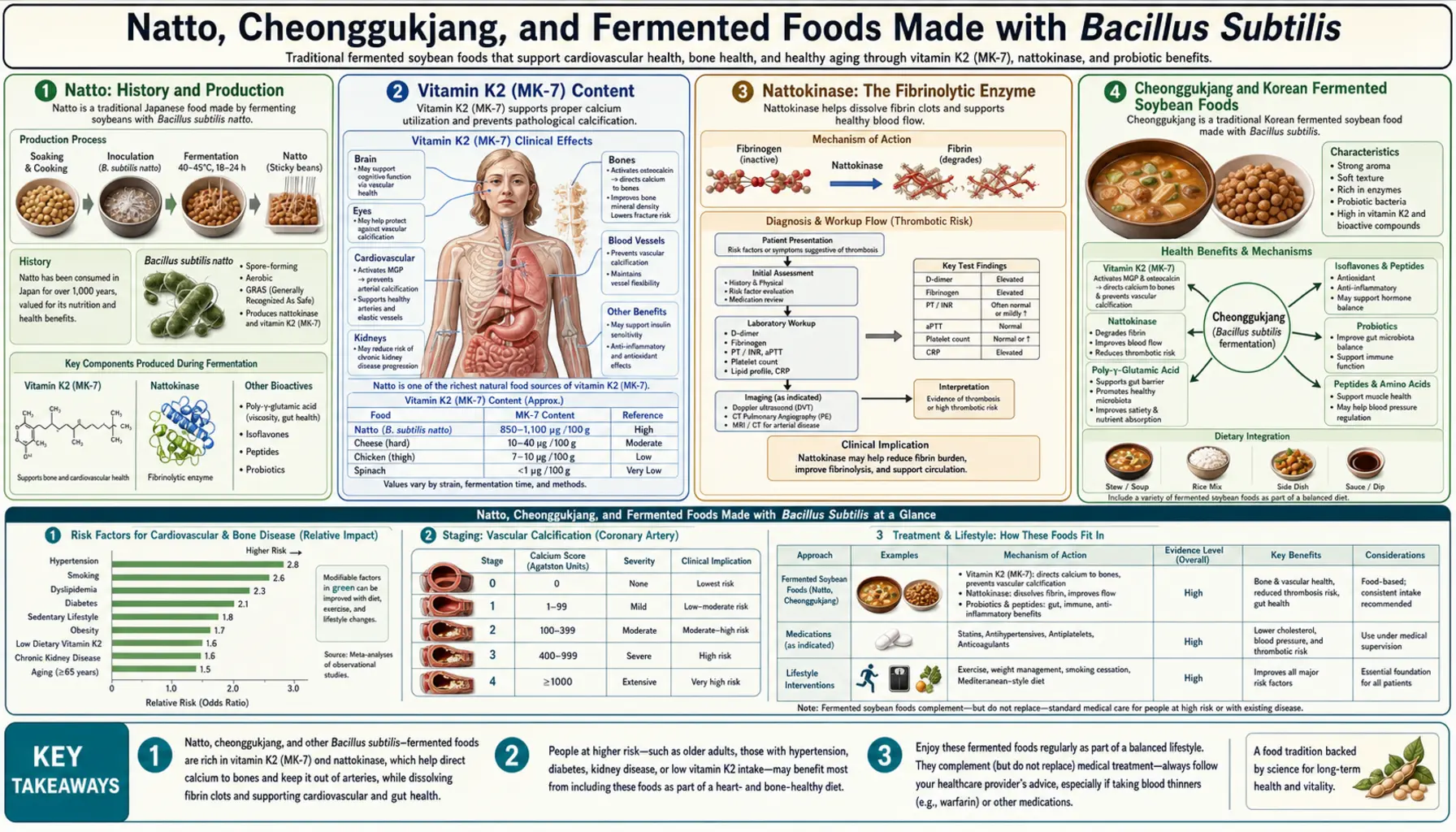
Humans have fermented soybeans and legumes with Bacillus subtilis for over a thousand years, long before anyone knew what a bacterium was. The result — sticky, pungent, intensely flavored foods like Japanese natto and Korean cheonggukjang — turns out to be one of the richest natural sources of vitamin K2 and nattokinase ever documented. These are not acquired tastes for everyone, but the science behind them is genuinely impressive.
Table of Contents
- Natto: History and Production
- Vitamin K2 (MK-7) Content
- Nattokinase: The Fibrinolytic Enzyme
- Cheonggukjang and Korean Fermented Soybean Foods
- How to Make Natto at Home
- Flavor Profile and How to Eat Natto
- Other Global B. subtilis Fermented Foods
- Warfarin Interaction Warning
- Key Research Papers
- Connections
- Featured Videos
Natto: History and Production
Natto (納豆) is a traditional Japanese food made from soybeans fermented with Bacillus subtilis var. natto, a subspecies selected over centuries specifically for food use. Historical records place natto in Japan as early as the Heian period (794–1185 CE), with one origin story crediting the warrior Minamoto no Yoshiie, whose soldiers reportedly discovered the transformation when boiled soybeans left in straw wrappings began to ferment in the warmth of a camp.
That origin story matters more than folklore: rice straw in traditional Japan was naturally colonized by B. subtilis, and steamed soybeans wrapped in straw at body temperature (around 40°C) fermented spontaneously. Today, commercial production uses pure B. subtilis var. natto starter cultures instead of straw, but the core process is the same:
- Soybeans are soaked in water for 12–18 hours.
- They are steamed or pressure-cooked until soft but intact.
- A liquid suspension of B. subtilis var. natto spores is sprayed or mixed in at roughly 107 colony-forming units per gram of soybean.
- The inoculated beans are packed in small containers (traditionally straw bundles, now polystyrene cups) and incubated at 38–42°C for 16–24 hours.
- After fermentation, natto is refrigerated for 24–48 hours to develop its characteristic sticky mucilage (poly-glutamic acid, a polymer produced by the bacteria) and deepen its flavor.
Japan produces approximately 100,000 metric tons of natto annually, and it is consumed mainly in eastern Japan, particularly the Kanto region around Tokyo. Regular consumption is one to three 50 g packs per day.
Vitamin K2 (MK-7) Content
No food on Earth comes close to natto as a source of vitamin K2 in the MK-7 form. A 100 g serving of natto contains approximately 800–1,000 micrograms (mcg) of menaquinone-7 (MK-7), compared with roughly 1–10 mcg found in hard cheeses and egg yolks, which are the next richest animal sources. To put that in context, the adequate intake for vitamin K is 90–120 mcg per day for adults — a single 40 g serving of natto delivers the equivalent of a week's worth of K2 in MK-7 form.
Why does this matter? Vitamin K2 MK-7 is distinct from vitamin K1 (phylloquinone) found in leafy greens. K1 is primarily directed to the liver for clotting factor synthesis. MK-7 has a much longer half-life in blood (approximately 72 hours versus 1–2 hours for K1) and accumulates in tissues outside the liver — specifically in bone and arterial walls — where it activates two critical proteins:
- Osteocalcin: A bone matrix protein that requires K2-dependent carboxylation to bind calcium and incorporate it into bone mineral. Undercarboxylated osteocalcin is a marker of K2 deficiency and is associated with lower bone mineral density.
- Matrix Gla Protein (MGP): The most potent known inhibitor of vascular calcification. K2 activates MGP to prevent calcium from depositing in arterial walls. Unactivated MGP is found in calcified plaques; activated MGP is found in healthy, flexible arteries.
Epidemiological data from the Rotterdam Study (7,983 Dutch adults followed for 10 years) found that the highest intake of K2 — but not K1 — was associated with a 57% lower risk of dying from coronary heart disease and significantly lower aortic calcification scores. MK-7 specifically, because of its longer half-life, appears more effective per microgram than shorter-chain menaquinones like MK-4.
Nattokinase: The Fibrinolytic Enzyme
During fermentation, B. subtilis var. natto secretes a serine protease enzyme called nattokinase (also designated subtilisin NAT or SUBS1). This enzyme was first characterized in 1987 by Dr. Hiroyuki Sumi at the University of Chicago, who noticed that natto placed on a blood-clot fibrin plate dissolved the clot dramatically faster than other fermented foods he was testing — a "eureka" observation made over lunch.
Nattokinase dissolves fibrin clots directly (it cleaves fibrin strands) and also stimulates the body's own fibrinolytic system by degrading plasminogen activator inhibitor-1 (PAI-1) and activating tissue plasminogen activator (t-PA). In laboratory models, nattokinase has been shown to:
- Dissolve existing thrombi in rat arterial occlusion models
- Reduce fibrinogen levels in animal studies
- Lower blood viscosity in vitro
- Reduce factor VIIa levels (a pro-coagulant factor) in human subjects
Human clinical research is growing but still early. A randomized trial in 79 subjects at risk for cardiovascular disease found that nattokinase supplementation (2,000 FU/day for 26 weeks) reduced LDL cholesterol by 9.4% and lipoprotein(a) — a particularly stubborn cardiovascular risk factor — by 7.9%, with a favorable safety profile. A separate study found modest reductions in blood pressure after 8 weeks of nattokinase supplementation.
Important limitation: Nattokinase is not FDA-approved as a drug, and most human trials have been small. Nattokinase from food sources (natto itself) does survive gastric digestion to some extent — animal studies confirm measurable fibrinolytic activity in the blood after oral natto consumption — but the effective dose from food versus supplements differs. People with bleeding disorders, those taking anticoagulants, or those scheduled for surgery should discuss nattokinase with their physician before use.
Cheonggukjang and Korean Fermented Soybean Foods
Korea has its own B. subtilis-fermented soybean tradition, which produces a family of foods with overlapping but distinct characteristics:
Cheonggukjang (청국장) is the closest Korean equivalent to natto. Soybeans are boiled, then fermented at 40–45°C for 2–3 days — a shorter fermentation window than doenjang. The result is a pasty, sticky product with a notably pungent ammonia aroma, similar to natto. Cheonggukjang is typically used in a thick, salty stew (cheonggukjang jjigae) with kimchi, tofu, and vegetables. It is less processed and considered more nutritionally potent than long-fermented pastes.
Laboratory analyses of cheonggukjang have confirmed the presence of nattokinase-like fibrinolytic enzymes produced by B. subtilis strains native to Korean fermentation environments. One study isolated 11 B. subtilis strains from traditional cheonggukjang with fibrinolytic activity comparable to commercial nattokinase preparations.
Doenjang (된장) is a fermented soybean paste more similar in appearance to Japanese miso, but made without rice or barley grain additions and fermented for months to years. The extended aging and different microbial ecology (including molds) results in lower concentrations of nattokinase and MK-7 compared to cheonggukjang, but doenjang retains significant quantities of isoflavones, short-chain peptides, and bioactive compounds associated with its own health research portfolio, including blood pressure reduction in hypertensive rats and anti-inflammatory effects in cell culture models.
South Korean per-capita consumption of fermented soybean products is among the highest in the world, and epidemiological comparisons between Korean and Western populations have prompted research into whether these foods contribute to the relatively lower rates of cardiovascular mortality historically observed in Korea — though diet, lifestyle, and genetic factors all interact.
How to Make Natto at Home
Making natto at home is genuinely achievable with modest equipment. The key inputs are dry soybeans, a B. subtilis var. natto starter culture (available online in freeze-dried form), and a way to maintain ~40°C for 24 hours (a yogurt maker, Instant Pot on "yogurt" setting, or a warm oven with the light on all work).
Basic procedure:
- Soak: Rinse 250 g dry soybeans. Cover with 3× their volume of cold water and soak 18–24 hours (they will roughly double in size).
- Cook: Drain and pressure-cook for 20–25 minutes at high pressure, or steam for 3–4 hours until a bean squishes easily between your fingers without feeling grainy inside. The beans must be fully cooked — undercooked beans inhibit fermentation.
- Inoculate: While beans are still hot (above 70°C), transfer to a sterilized bowl. Let them cool to about 50°C (too hot will kill the starter). Dissolve a small amount of natto starter (typically 0.1 g per 250 g beans, as directed by your brand) in 2 tablespoons of sterile warm water. Pour over the beans and mix thoroughly with a sterilized spoon.
- Ferment: Spread beans in a shallow, sterilized tray to a depth of about 2 cm. Cover loosely with plastic wrap (poke holes to allow gas exchange) or a clean cloth. Place in your warm environment at 38–42°C. Maintain this temperature for 20–24 hours.
- Check: After 20 hours, look for a white powdery surface film (the bacterial growth layer) and the characteristic sticky strings when you pull a bean away with a fork. The smell will be ammonia-forward and strong — that's correct.
- Age: Refrigerate for 24–48 hours before eating. This rest period develops fuller flavor, softens the ammonia edge slightly, and allows the poly-glutamic acid mucilage to fully set.
Practical tips: Cleanliness matters more than sterility — the main risk is mold contamination if fermentation temperature is too low or beans sit wet. If you see green, black, or pink mold, discard the batch. A yogurt maker with a removable tray set to 40°C is the most reliable home setup. Small-batch experimenters often find that storing natto in individual single-serving portions and freezing any excess preserves flavor and enzyme activity well for up to 3 months.
Flavor Profile and How to Eat Natto
Natto is polarizing, and it is worth being honest about that. First-timers frequently describe three sensory challenges: the stringy, mucilaginous texture (the poly-glutamic acid threads stretch several centimeters), a pungent ammonia-and-fermented-soy smell reminiscent of aged cheese pushed to the extreme, and a bitter aftertaste with a faint earthiness. People either adapt to it within a few tries or find it genuinely difficult to tolerate, and both responses are normal.
Traditional Japanese serving: A small pack of natto (approximately 40–50 g) is served over a bowl of steamed short-grain rice, with the following added in the package or alongside:
- A small packet of tare (a sweetened soy sauce blend)
- A packet of prepared yellow mustard (karashi), which cuts through the ammonia note
- Thinly sliced green onions (negi)
The beans are stirred vigorously before serving — some practitioners insist on 50+ stirs — which develops and aerates the sticky threads and blends the seasonings. Many Japanese people eat natto at breakfast.
Making it more approachable: For newcomers, mixing natto with a raw egg yolk softens the texture considerably. Adding kimchi masks the ammonia note with fermented spice. Natto toast with avocado and a drizzle of ponzu is popular in Japanese-American communities as an introduction. Starting with small amounts (one tablespoon) on rice and building tolerance gradually works better than eating a full pack on the first attempt.
Frozen natto is widely sold in Japanese grocery stores and retains most of its vitamin K2 and nattokinase activity after thawing. Heating natto above approximately 70°C will denature nattokinase, so adding it to dishes after cooking or serving it cold over hot rice preserves the enzyme.
Other Global B. subtilis Fermented Foods
The discovery that fermenting legumes with B. subtilis creates edible, protein-rich, shelf-stable food appears to have occurred independently in multiple cultures across Asia and Africa:
Kinema — Made in Nepal, India's Sikkim and Darjeeling regions, and parts of Bhutan. Soybeans (or sometimes other legumes) are boiled and wrapped in fern leaves or bamboo, then fermented at ambient temperatures for 2–3 days. The resulting product has a sticky texture and strong smell similar to natto. B. subtilis is consistently the dominant fermenting organism. Kinema is typically used in curries and stews and is an important protein source in highland communities where refrigeration and meat are scarce.
Thua nao — A traditional fermented soybean product of northern Thailand and parts of Myanmar. Soybeans are cooked and fermented in banana leaves for 2–3 days. The final product is pressed into flat discs and sun-dried for preservation. B. subtilis strains are the primary fermenting organisms. Thua nao is used as a flavoring paste (similar to miso or soybean paste) in local dishes. Studies have confirmed fibrinolytic activity in thua nao comparable to natto, though MK-7 content data are limited.
Dawadawa (also called sumbala, iru, or locust bean seasoning) — Made across the Sahel and West Africa (Ghana, Nigeria, Burkina Faso, Senegal, and others) from the seeds of the African locust bean tree (Parkia biglobosa). Seeds are boiled, dehulled, and fermented in sealed pots for 2–4 days at ambient tropical temperatures. B. subtilis and related Bacillaceae dominate the fermentation. Dawadawa is used as a flavor-enhancing condiment — a small ball of it is added to soups and stews much like a bouillon cube — and is a critical source of protein, riboflavin, and essential amino acids for populations with limited access to animal protein. Research has confirmed nattokinase-like fibrinolytic enzymes in dawadawa extracts.
The convergent independent discovery of B. subtilis-fermented legumes on three continents reflects how well-suited this bacterium is to warm, protein-rich, anaerobic environments — and how universal the nutritional challenge of preserving and concentrating plant protein has been across human history.
Warfarin Interaction Warning
This is the most clinically important safety note on this page: people taking warfarin (Coumadin) or other vitamin K-sensitive anticoagulants must approach natto with extreme caution, and most anticoagulation specialists advise complete avoidance.
Warfarin works by blocking vitamin K-dependent clotting factor synthesis (factors II, VII, IX, X, and proteins C and S). The therapeutic dose is calibrated against a patient's baseline vitamin K intake, monitored via the INR (International Normalized Ratio) blood test. When vitamin K intake changes dramatically, the warfarin dose that was keeping INR in the therapeutic range (typically 2.0–3.0) may suddenly undershoot or overshoot.
A single 100 g serving of natto contains 800–1,000 mcg of vitamin K2 as MK-7. MK-7's long half-life (approximately 72 hours) means that a single serving of natto can significantly elevate circulating vitamin K2 for three days or more — far longer than the K1 in a plate of spinach, which clears in hours. Case reports in the literature document dramatic INR drops (from therapeutic 2.5 to subtherapeutic 1.1) within 48 hours of natto consumption in patients on stable warfarin doses. A subtherapeutic INR in a patient with atrial fibrillation or a mechanical heart valve raises the risk of stroke.
Practical guidance:
- If you take warfarin and wish to eat natto regularly, discuss it first with the physician or anticoagulation clinic managing your therapy. It is theoretically possible to maintain stable INR on warfarin with consistent, predictable natto intake — but inconsistent consumption (natto some weeks, not others) makes INR management very difficult.
- Nattokinase supplements present a separate concern for warfarin users: nattokinase has independent fibrinolytic activity, meaning it could enhance bleeding risk when combined with anticoagulants. This is a different mechanism from the vitamin K interaction and requires separate attention.
- Newer direct oral anticoagulants (DOACs) such as apixaban (Eliquis), rivaroxaban (Xarelto), and dabigatran (Pradaxa) do not work through the vitamin K pathway, so the vitamin K2 in natto does not directly interfere with their mechanism. However, nattokinase's fibrinolytic properties could theoretically increase bleeding risk with any anticoagulant — discuss with your prescriber before adding nattokinase to your diet while on DOACs.
For people not on anticoagulants, high vitamin K2 intake from natto has not been shown to cause hypercoagulation in healthy individuals — the body's clotting cascade has sufficient regulatory mechanisms to prevent this in the absence of drug interference.
Key Research Papers
- Sumi H et al. A novel fibrinolytic enzyme (nattokinase) in the vegetable cheese Natto; a typical and popular soybean food in the Japanese diet. Experientia. 1987 — Search PubMed
- Geleijnse JM et al. Dietary intake of menaquinone is associated with a reduced risk of coronary heart disease: the Rotterdam Study. J Nutr. 2004 — Search PubMed
- Kurosawa Y et al. A single-dose of oral nattokinase potentiates thrombolysis and anti-coagulation profiles. Sci Rep. 2015 — Search PubMed
- Ibe S et al. Determination of vitamin K2 content in Japanese fermented food natto using high-performance liquid chromatography. Food Chem. 2013 — Search PubMed
- Sato T et al. Comparison of menaquinone-4 and menaquinone-7 bioavailability in healthy women. Nutr J. 2012 — Search PubMed
- Jensen GS et al. Consumption of nattokinase is associated with reduced blood pressure and von Willebrand factor: a randomized, double-blind, placebo-controlled, multi-center North American clinical trial. Integr Blood Press Control. 2016 — Search PubMed
- Ren NN et al. A clinical study on the effect of nattokinase on carotid artery atherosclerosis and hyperlipidaemia. Zhonghua Yi Xue Za Zhi. 2017 — Search PubMed
- Rai AK et al. Kinema — a naturally fermented soybean food of the Himalayas: proximate composition, microbiological and in vitro protein digestibility. J Food Sci Technol. 2017 — Search PubMed
- Lammi C et al. Nattokinase: a promising candidate for cardiovascular health. Nutrients. 2019 — Search PubMed
- Yatagai C et al. Nattokinase-promoted tissue plasminogen activator release from human cells. Pathophysiol Haemost Thromb. 2008. PMID 20630999
- Fujita M et al. Nattokinase reduces blood pressure by blocking angiotensin-converting enzyme. Biol Pharm Bull. 2011 — Search PubMed
Connections
- All Bacteria
- Bacillus subtilis — Overview Hub
- B. subtilis Probiotic Uses
- Natto — Food Profile
- Nattokinase — Enzyme Profile
- Fermented Foods Overview
- Vitamin K — Full Guide
- Calcium — Bone and Cardiovascular Health