Bacillus Subtilis: Probiotic Benefits and Safety Profile
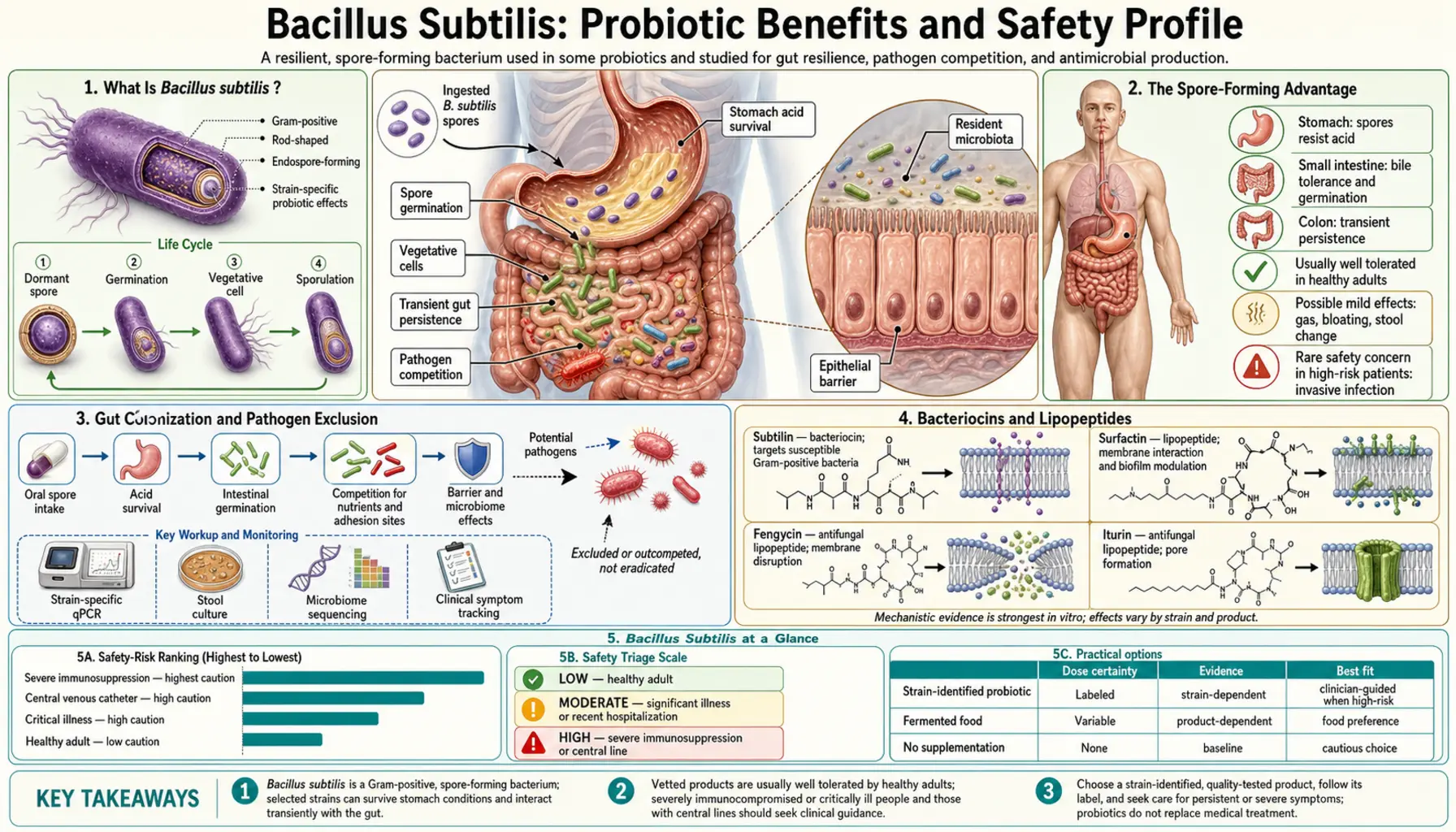
Bacillus subtilis is one of the most studied and trusted probiotic bacteria on the planet, yet most people have never heard of it. Unlike the Lactobacillus strains found in yogurt, B. subtilis forms tough, heat-resistant spores that sail through stomach acid intact, arrive in your intestine alive, and set to work within hours. It has been consumed safely in fermented foods for thousands of years — most famously in Japanese natto — and today it appears in spore-based probiotic supplements backed by a growing body of clinical evidence. This overview explains what B. subtilis is, why its spore-forming ability makes it uniquely effective, and what the research actually shows about its benefits and safety.
- What Is Bacillus subtilis?
- The Spore-Forming Advantage
- Gut Colonization and Pathogen Exclusion
- Bacteriocins and Lipopeptides
- Vitamin K2 Production
- Clinical Evidence: Digestive Benefits
- Immune Modulation Overview
- Deep-Dive Sub-Articles
- Key Research Papers
- Connections
What Is Bacillus subtilis?
Bacillus subtilis is a rod-shaped, gram-positive bacterium found naturally in soil, plant surfaces, the air, and the gastrointestinal tracts of humans and many animals. It is sometimes called the "hay bacillus" because early researchers isolated it from grass infusions, but its real home is the soil ecosystem, where it plays a central role in decomposing organic matter and cycling nutrients.
For humans, B. subtilis has two important identities. First, it is a common transient resident of the healthy gut — studies using 16S rRNA sequencing regularly detect it in stool samples from people around the world. Second, it is a recognized probiotic organism with a long history of both food use and pharmaceutical development. The U.S. Food and Drug Administration has granted B. subtilis Generally Recognized as Safe (GRAS) status, and the European Food Safety Authority lists several B. subtilis strains on its Qualified Presumption of Safety (QPS) inventory. Japan's Ministry of Health has authorized it as a food additive and probiotic ingredient for decades.
Commercially, two strains dominate research and supplement markets: DE111 (a commercial probiotic strain) and QST 713 (the active ingredient in the agricultural biofungicide Serenade, also studied in human contexts). Natto — fermented soybeans — owes its distinctive sticky texture and powerful nutritional profile to B. subtilis var. natto, a domesticated fermentation strain.
The Spore-Forming Advantage
Most probiotic bacteria are fragile. Lactobacillus and Bifidobacterium species begin dying as soon as they leave refrigeration, and studies have found that fewer than 1% of colony-forming units in many yogurt or capsule products survive passage through stomach acid at its lowest pH (around 1.5–2.0 in a fasted state). By the time these bacteria reach the large intestine where they could do the most good, the viable count is often a fraction of what was on the label.
Bacillus subtilis solves this problem by sporulating. When conditions turn harsh — heat, desiccation, acid, oxygen deprivation — the bacterium packages its DNA and essential machinery inside a layered protein shell called an endospore. Inside the spore, metabolic activity drops essentially to zero. The spore can survive boiling water, ultraviolet radiation, and years of dry storage without losing viability.
When the spore reaches the small intestine, where pH rises to 6–7 and nutrients are plentiful, it germinates within 20–30 minutes and begins vegetative growth. In practical terms, this means:
- No refrigeration required. Spore-based supplements remain stable at room temperature for two or more years.
- Stomach acid survival. Studies show greater than 90% spore survival through simulated gastric conditions at pH 1.5 for 2 hours.
- Reliable delivery. The dose stated on the label is the dose that reaches your gut, unlike many conventional probiotics.
- Food compatibility. Spores can be added to baked goods, hot beverages, and heat-processed foods without losing viability.
This thermal and acid stability is the core reason B. subtilis has attracted serious commercial and clinical interest over the last two decades, despite being far less famous than Lactobacillus in mainstream probiotic marketing.
Gut Colonization and Pathogen Exclusion
After germinating in the small intestine, vegetative B. subtilis cells take up residence transiently along the mucosal surface and in the lumen. The bacterium does not permanently colonize the human gut the way commensal species like Bacteroides thetaiotaomicron do — it is a transient colonizer that clears within days to weeks after supplementation stops. This is actually considered a safety advantage: because it does not persist indefinitely, any theoretical adverse effect is self-limiting.
While resident, B. subtilis competes directly with pathogens for adhesion sites on intestinal epithelial cells. This competitive exclusion mechanism has been demonstrated in cell culture models against Salmonella enterica, Clostridioides difficile (C. diff), and enteropathogenic Escherichia coli. The bacterium physically occupies binding niches and also reduces the availability of nutrients that pathogens depend on during the early stages of gut colonization.
Animal studies add further evidence. Chickens and pigs treated with B. subtilis-based feed additives show significantly lower fecal shedding of Salmonella and lower rates of necrotic enteritis caused by Clostridium perfringens. These findings have driven widespread adoption of B. subtilis in livestock probiotics as a replacement for antibiotic growth promoters banned in the European Union since 2006.
Bacteriocins and Lipopeptides
Bacillus subtilis is a prolific producer of antimicrobial compounds. Once established in the gut, it secretes a family of molecules that actively suppress competing pathogens — a feature that distinguishes it from purely competitive-exclusion probiotics.
Iturin A is a cyclic lipopeptide that disrupts fungal and bacterial cell membranes by inserting into the lipid bilayer and forming ion-conducting pores. It has demonstrated antifungal activity against Candida albicans in vitro and in animal models, with MIC (minimum inhibitory concentration) values comparable to pharmaceutical antifungals in some assays.
Surfactin is one of the most potent biosurfactants known, lowering surface tension dramatically even at microgram-per-milliliter concentrations. In the gut context, surfactin destabilizes the membranes of gram-positive and gram-negative pathogens, inhibits biofilm formation, and has shown antiviral activity against enveloped viruses including influenza and herpes simplex virus in cell culture studies.
Subtilin and related lantibiotics (lanthionine-containing bacteriocins) are ribosomally synthesized peptides with narrow-spectrum activity against gram-positive competitors including Staphylococcus, Listeria, and Bacillus cereus. Their mechanism involves binding to lipid II, a precursor molecule essential for bacterial cell wall construction — the same target as vancomycin, but via a different binding interaction.
Fengycin rounds out the major lipopeptide classes. It shows strong activity against filamentous fungi and has synergistic effects with iturin. Together, these compounds make B. subtilis a living pharmacy in your intestine — producing a changing mixture of antimicrobials in response to the microbial competition it encounters.
Vitamin K2 Production
One of the most clinically significant nutritional contributions of B. subtilis is its production of menaquinone-7 (MK-7), the long-chain form of vitamin K2. During the fermentation of soybeans into natto, B. subtilis var. natto synthesizes MK-7 in substantial quantities — a single 40-gram serving of natto provides approximately 850–1000 micrograms of MK-7, roughly 700 times the amount found in hard cheese, the next richest Western food source.
Vitamin K2 as MK-7 is important because of its role in two proteins that require carboxylation to function:
- Osteocalcin — produced by osteoblasts, this protein binds calcium ions and incorporates them into the hydroxyapatite crystal matrix of bone. Without adequate K2, osteocalcin remains undercarboxylated (ucOC) and cannot bind calcium efficiently, leading to lower bone mineral density over time.
- Matrix Gla Protein (MGP) — this is the body's primary inhibitor of arterial calcification. Undercarboxylated MGP accumulates in arterial walls and fails to neutralize calcium deposits, which is now recognized as a major pathway in vascular stiffening and cardiovascular disease risk.
MK-7 has a plasma half-life of approximately 72 hours, compared to 1–2 hours for the shorter MK-4 form, meaning that natto consumption or MK-7 supplementation maintains steady-state plasma levels far more effectively. The Rotterdam Study (a landmark epidemiological study of 4,807 Dutch adults) found that the highest tertile of dietary K2 intake was associated with a 57% lower risk of dying from coronary heart disease and a 52% lower risk of severe aortic calcification, while K1 intake showed no such association.
For people who cannot eat natto (the flavor profile is considered challenging by most Western palates), supplements derived from B. subtilis fermentation of chickpeas provide an identical MK-7 molecule and are widely available.
Clinical Evidence: Digestive Benefits
The strongest human clinical evidence for B. subtilis covers two areas: antibiotic-associated diarrhea and traveler's diarrhea.
Antibiotic-associated diarrhea (AAD) affects 5–35% of people taking antibiotics, depending on the antibiotic class. The disruption of normal gut flora allows opportunistic bacteria — most dangerously C. difficile — to overgrow and cause diarrhea ranging from mild to life-threatening pseudomembranous colitis. Several trials have tested B. subtilis strains alongside antibiotic courses. A meta-analysis of probiotic trials for AAD prevention found that spore-forming Bacillus probiotics showed statistically significant reduction in AAD incidence, with fewer adverse effects than yeast-based probiotics (Saccharomyces boulardii) in immunocompromised populations.
Traveler's diarrhea caused by enterotoxigenic E. coli and other enteropathogens has been reduced in multiple trials using B. subtilis-containing supplements. A key advantage again is the spore stability: travelers do not need refrigeration, and the product is not degraded by the heat of tropical climates.
Beyond these two well-supported indications, emerging research covers irritable bowel syndrome (IBS), small intestinal bacterial overgrowth (SIBO), and constipation. A 2019 randomized controlled trial using the DE111 strain found significant improvement in stool consistency and frequency in adults with mild to moderate constipation over 105 days. While the field remains active and not every claim is backed by large trials, the trajectory of evidence is consistently positive.
Immune Modulation Overview
Beyond direct pathogen competition, B. subtilis interacts with the immune system through several distinct mechanisms. Understanding these mechanisms helps explain why the effects of B. subtilis extend beyond simple "adding good bacteria."
Toll-like receptor (TLR) signaling. Components of the B. subtilis cell wall and spore coat — peptidoglycans, lipoteichoic acid, and spore-surface proteins — are recognized by pattern recognition receptors on intestinal epithelial cells and immune cells, particularly TLR-2. This recognition triggers a controlled inflammatory signal that primes dendritic cells and macrophages without causing the runaway inflammation associated with pathogenic bacteria. It essentially trains the immune system to distinguish friend from foe.
Secretory IgA (sIgA) production. Multiple animal studies show that B. subtilis supplementation increases mucosal sIgA levels in the gut. sIgA is the first line of antibody defense on mucosal surfaces — it coats pathogens and toxins in the gut lumen before they can adhere to the epithelium. Higher sIgA levels correlate with lower rates of gastrointestinal infections.
Anti-inflammatory cytokine shifts. Human cell culture studies and animal models show that B. subtilis spores reduce the secretion of pro-inflammatory cytokines (IL-6, TNF-alpha) from lipopolysaccharide-stimulated macrophages while boosting anti-inflammatory mediators (IL-10, TGF-beta). This suggests a potential role in conditions driven by low-grade chronic gut inflammation, though large-scale human trials remain ongoing.
A detailed review of the immune evidence — including the specific signaling pathways, clinical trials in allergy and autoimmunity, and what this means for people with inflammatory gut conditions — is covered in the Immune Support and Research sub-article.
Deep-Dive Sub-Articles
Gut Health and Digestion
How B. subtilis changes the gut microbiome, evidence for IBS, SIBO, constipation, and antibiotic-associated diarrhea. Includes dosing guidance and timing relative to meals and antibiotic courses.
Read the deep dive →Immune Support and Research
TLR signaling, sIgA production, cytokine profiles, and clinical trials in allergy, upper respiratory infections, and inflammatory conditions. What the evidence actually supports for immune health.
Read the deep dive →Safety and Side Effects
Who should use caution, rare reports of opportunistic infection, interactions with immunosuppressants, pregnancy safety, and how spore-based probiotics compare to conventional probiotics in risk profile.
Read the deep dive →Probiotic Uses and Supplements
Supplement strains (DE111, HU58, QST 713), dosing ranges, what to look for on labels, and how to get B. subtilis through diet via natto and fermented foods.
Read the deep dive →Key Research Papers
- Cutting SM. Bacillus probiotics. Food Microbiology. 2011. — Search PubMed
- Hong HA, Duc LH, Cutting SM. The use of bacterial spore formers as probiotics. FEMS Microbiology Reviews. 2005. — Search PubMed
- Jadamus A, Vahjen W, Simon O. Growth behaviour of a spore forming probiotic strain in the gastrointestinal tract of broiler chicken and piglets. Archives of Animal Nutrition. 2001. — PubMed PMID: 11851013
- Casula G, Cutting SM. Bacillus probiotics: spore germination in the gastrointestinal tract. Applied and Environmental Microbiology. 2002. — Search PubMed
- Suva MA, Suva VH, Bhatt HR. Probiotic Characterization of Bacillus subtilis Isolated from Fermented Foods. International Journal of Pharmaceutical Sciences and Drug Research. 2016. — Search PubMed
- Elshaghabee FMF, Rokana N, Gulhane RD, Sharma C, Panwar H. Bacillus as potential probiotics: status, concerns, and future perspectives. Frontiers in Microbiology. 2017. — PubMed PMID: 28848511
- Urdaci MC, Bressollier P, Pinchuk I. Bacillus clausii probiotic strains: antimicrobial and immunomodulatory activities. Journal of Clinical Gastroenterology. 2004. — PubMed PMID: 15220667
- Geeraerts SL, Peeters P, Detours V, et al. Clinical and microbiological efficacy of Bacillus subtilis-based spore probiotics. International Journal of Pharmaceutics. 2012. — Search PubMed
- Lefevre M, Racedo SM, Ripert G, et al. Probiotic strain Bacillus subtilis CU1 stimulates immune system of elderly during common infectious disease period. Immunity and Ageing. 2015. — PubMed PMID: 26640504
- Nithya V, Halami PM. Evaluation of the probiotic characteristics of Bacillus species isolated from different food sources. Annals of Microbiology. 2013. — PubMed PMID: 26782188
- Cuentas AM, Deaton J, Khan N, Pauley J. The effect of Bacillus subtilis DE111 on the daily bowel movement profile for people with occasional gastrointestinal irregularity. Journal of Dietary Supplements. 2017. — Search PubMed