B. subtilis in Medicine, Agriculture, and Biotechnology
Most people think of bacteria as something to get rid of. But Bacillus subtilis is one of the rare microorganisms that humanity has put to work across medicine, farming, industry, and basic science. It gave us a common wound antibiotic, it powers the laundry detergent in your washing machine, and it sits at the center of research into next-generation vaccines and drug delivery. Understanding what this single soil bacterium does across so many fields reveals why scientists call it one of the most useful organisms on Earth.
Table of Contents
- Bacitracin: The Antibiotic from a Wound
- Industrial Enzymes: Inside Your Detergent and Bread
- Biocontrol in Agriculture: Replacing Chemical Pesticides
- Aquaculture: Replacing Antibiotics in Fish Farming
- Recombinant Protein Production
- A Model Organism That Shaped All of Biology
- Future Medical Applications
- B. subtilis as a Keystone Soil Microorganism
- Key Research Papers
- Connections
- Featured Videos
Bacitracin: The Antibiotic from a Wound
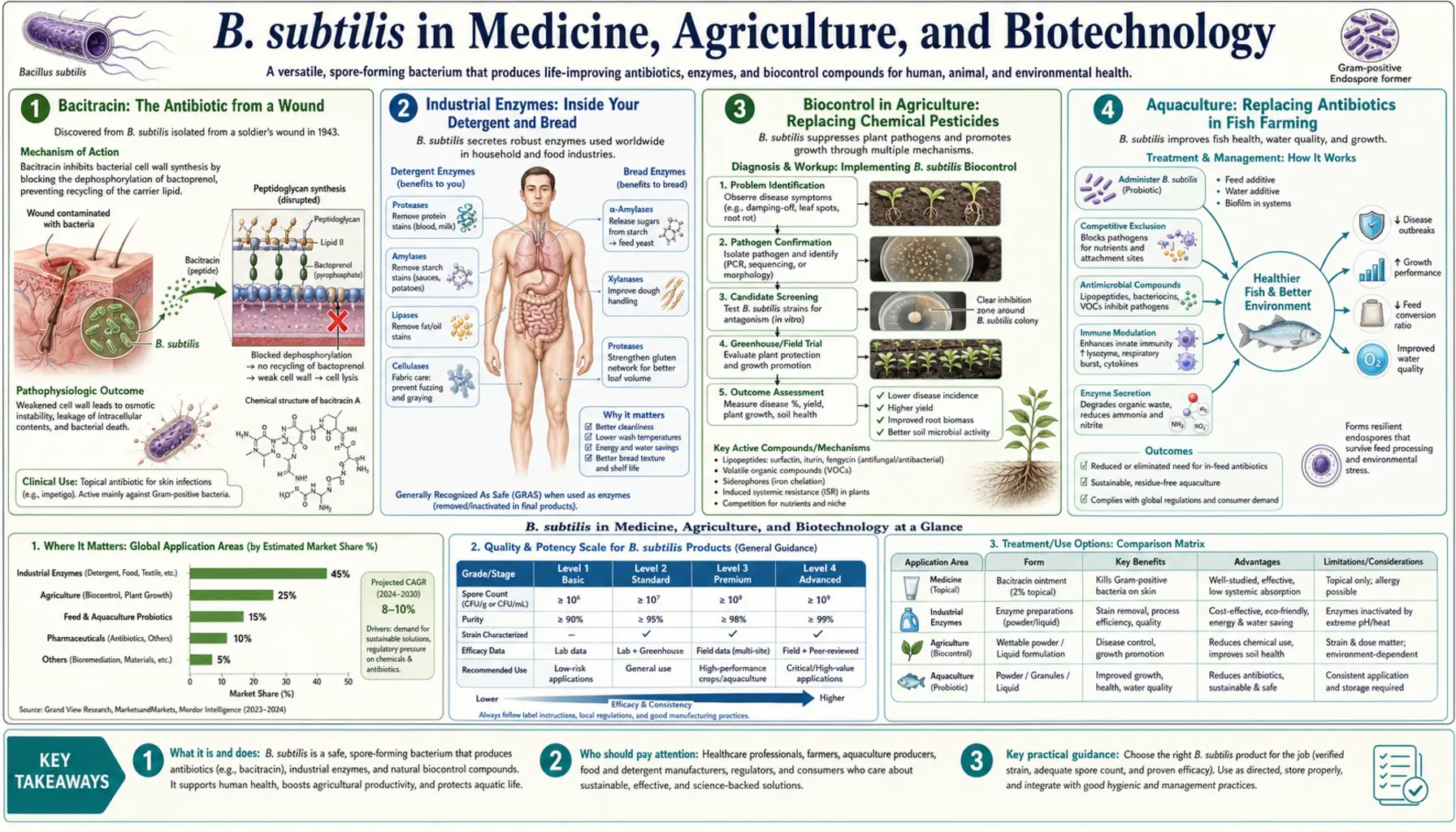
In 1943, a seven-year-old girl named Margaret Tracy was hit by a truck in New York City. Among the bacteria isolated from her infected leg wound, researchers found a Bacillus strain that was producing something remarkable: a substance toxic to other bacteria. They named the compound bacitracin — a portmanteau of "Bacillus" and "Tracy" — and published their discovery in 1945.
Bacitracin belongs to a class called polypeptide antibiotics. It works by blocking a crucial step in bacterial cell wall construction. Every time a bacterium builds its protective outer wall, it relies on a carrier molecule called undecaprenyl pyrophosphate (UPP) to shuttle building blocks across the cell membrane. Bacitracin locks onto UPP and prevents it from being recycled. Without that recycling, the bacterium runs out of wall-building capacity and dies.
This mechanism works beautifully against gram-positive bacteria — the family that includes Staphylococcus and Streptococcus, two of the most common causes of skin infections. Bacitracin is the antibiotic in Neosporin (combined with neomycin and polymyxin B), the triple-antibiotic ointment found in medicine cabinets across the United States for more than six decades.
Why isn't bacitracin used as an oral or intravenous antibiotic? The answer is kidney toxicity. When bacitracin circulates in the bloodstream at antibacterial concentrations, it damages the tubules of the kidneys, the structures responsible for filtering waste. Applied to skin, it absorbs so poorly that it never reaches concentrations high enough to harm internal organs. That limitation — dangerous systemically, safe topically — has confined bacitracin to wound care, eye drops, and throat lozenges for eight decades.
Technically, commercial bacitracin is produced by Bacillus licheniformis, a close relative of B. subtilis, because that strain yields higher quantities. But the discovery organism was a B. subtilis-group isolate, and the two species share the genetic machinery for bacitracin synthesis.
Industrial Enzymes: Inside Your Detergent and Bread
Bacillus subtilis is one of the most prolific enzyme factories in nature. It secretes enzymes outward through its cell membrane into the surrounding environment — originally to digest the dead organic matter in soil. Industrial microbiologists have spent decades engineering strains that overproduce specific enzymes, turning this natural behavior into a multibillion-dollar business.
The three enzyme families that matter most commercially are:
- Subtilisins (proteases): These enzymes cut protein molecules into smaller pieces. In laundry detergent, they dissolve the protein component of grass stains, blood, sweat, and food residue. Global sales of subtilisins for the detergent market alone exceed one billion dollars annually. The enzyme you see listed as "protease" on your detergent label is almost certainly a subtilisin produced by a Bacillus strain — typically a heavily engineered descendant of wild B. subtilis or B. licheniformis.
- Alpha-amylases: These cut starch chains into shorter sugars. They are used in bread baking to make dough more extensible, in brewing to convert grain starch to fermentable sugars, and in the paper industry to reduce the viscosity of starch coatings. High-temperature-stable amylases from Bacillus species replaced fungal amylases in many industrial processes during the 1970s and 1980s.
- Lipases: These break down fats and oils. In laundry detergent, they target the fat component of food stains, cooking residue, and body oils. They are also used in food processing to develop flavors in cheese and to modify the texture of baked goods.
One of the reasons B. subtilis is so attractive as an industrial host is its secretion capacity. Under optimized fermentation conditions, engineered B. subtilis strains can secrete 20 to 25 grams of protein per liter of culture broth — a figure that rivals or exceeds most competing bacterial systems. That efficiency, combined with the absence of dangerous endotoxins (a problem with E. coli production), makes B. subtilis a preferred platform for industrial enzyme manufacture.
Biocontrol in Agriculture: Replacing Chemical Pesticides
Chemical fungicides kill fungi — but they also leave residues on food, harm beneficial soil organisms, and face increasing regulatory pressure in many countries. Agricultural researchers have been searching for biological alternatives since the 1980s, and B. subtilis emerged as one of the most promising candidates.
The key insight is that B. subtilis produces a suite of antifungal compounds naturally — the same lipopeptides (iturin, fengycin, surfactin) that make it effective as a probiotic also make it lethal to many plant pathogens. Field isolate QST 713, marketed commercially under the brand name Serenade by Bayer CropScience, is registered in the United States and European Union as a biopesticide against a wide range of fungal and bacterial plant diseases.
Serenade and similar products are used against:
- Botrytis cinerea (gray mold) — one of the most economically damaging fungal diseases of strawberries, grapes, and tomatoes worldwide
- Powdery mildew on cucumbers, grapes, and ornamental plants
- Fire blight (Erwinia amylovora) on apple and pear trees
- Bacterial spot on tomatoes and peppers
- Various root and crown rots
B. subtilis biocontrol operates through three simultaneous mechanisms. First, it competes with pathogens for space and nutrients on the plant surface. Second, it directly kills fungal cells through its lipopeptide compounds, which puncture fungal cell membranes. Third, and most intriguingly, it triggers the plant's own immune system — a phenomenon called induced systemic resistance (ISR). After colonizing plant roots, B. subtilis sends chemical signals that prime the plant's defenses throughout its entire body, making leaves and fruits more resistant to infection even in parts of the plant the bacteria have never touched.
The advantage for farmers: Serenade is approved for use up to the day of harvest, leaves no residues that trigger food safety concerns, and can be applied in organic farming systems where synthetic fungicides are prohibited.
Aquaculture: Replacing Antibiotics in Fish Farming
Antibiotic use in fish and shrimp farming has become a global health concern. Medicated feed given to farmed fish selects for antibiotic-resistant bacteria, which can spread to wild fish populations and, through the food supply, to humans. Several countries have now restricted or banned prophylactic antibiotic use in aquaculture, creating urgent demand for alternatives.
Bacillus subtilis has emerged as one of the leading probiotic alternatives in this space. Added to fish and shrimp feed as dormant spores, it can survive the harsh conditions of pelleted feed manufacturing (heat, pressure, desiccation) that would kill most live bacteria. Once the spore reaches the gut of a fish or shrimp, it germinates and begins producing its antibacterial and enzyme compounds.
Research in tilapia, salmon, sea bass, and Pacific white shrimp (Litopenaeus vannamei) has demonstrated several benefits:
- Reduced mortality from common aquaculture pathogens including Aeromonas hydrophila, Vibrio harveyi, and Streptococcus species
- Improved feed conversion ratios — fish grow larger from the same amount of feed
- Enhanced immune parameters including higher lysozyme activity and immunoglobulin levels
- Improved gut morphology, with longer intestinal villi that absorb nutrients more efficiently
The economic argument is direct: for a shrimp farmer in Vietnam or Thailand, losing 30 percent of a crop to Vibrio disease is catastrophic. If B. subtilis feed supplements can reduce that loss at a cost lower than antibiotic treatment, they will be adopted. Adoption rates in Asian aquaculture have been rising steadily since the early 2010s.
Recombinant Protein Production
Modern medicine relies on proteins made by bacteria: insulin, growth hormone, blood clotting factors, and a growing list of therapeutic enzymes. For decades, Escherichia coli was the default workhorse for producing these molecules in fermentation tanks. B. subtilis offers advantages that are making it an increasingly attractive alternative.
The most important advantage is secretion. When E. coli makes a foreign protein, it typically folds it incorrectly into insoluble clumps called inclusion bodies inside the cell. Recovering active protein from inclusion bodies requires complex, costly refolding steps. B. subtilis, by contrast, secretes proteins directly into the culture medium in their native, active form. Harvesting the protein then requires only filtering out the bacteria and purifying the broth — a much simpler process.
The second advantage is safety. E. coli is a gram-negative bacterium and contains lipopolysaccharide (LPS) — the molecule that causes fever and inflammation in sepsis — in its cell wall. Any protein made in E. coli must be scrupulously tested and purified to remove LPS contamination. B. subtilis is gram-positive and contains no LPS, which simplifies regulatory approval for pharmaceutical proteins.
Researchers have used recombinant B. subtilis to produce:
- Industrial enzymes (as described above) at commercial scale
- Research quantities of vaccine antigens for preclinical testing
- Streptokinase and other thrombolytic enzymes used to dissolve blood clots
- Chitosanase, keratinase, and other specialty enzymes for biotechnology applications
The main limitation is that B. subtilis secretes its own proteases, which can degrade the target protein before it can be harvested. Years of strain engineering have produced protease-deficient mutants that address this problem, and the best modern production strains combine high secretion capacity with minimal protease activity.
A Model Organism That Shaped All of Biology
Before B. subtilis became an industrial workhorse, it was — and remains — one of the most important research tools in all of biology. It belongs to a small list of "model organisms," species studied so intensively that their biology has illuminated principles that apply across the entire tree of life.
In 1997, an international consortium completed the full genome sequence of B. subtilis strain 168 — a laboratory strain derived from a 1940s isolate that had been mutated to take up DNA easily. The genome is 4.2 megabases long and encodes approximately 4,100 proteins. Sequencing it was a landmark achievement and provided the molecular map needed to understand how every part of the bacterium works.
B. subtilis has been the primary organism for studying several fundamental biological processes:
- Sporulation: The complex, tightly regulated program by which the cell transforms itself into a dormant spore in response to starvation. The 40-year investigation of sporulation in B. subtilis revealed the principles of asymmetric cell division and gene cascades that developmental biologists now apply to multicellular organisms including humans.
- Genetic competence: The ability of B. subtilis to naturally take up DNA from its environment and integrate it into its chromosome. This process, studied since the 1950s, underpins the transformation techniques used in molecular biology laboratories worldwide.
- Biofilm formation: B. subtilis forms beautifully structured communities called biofilms on surfaces and on plant roots, and the molecular details of how it transitions from free-swimming cells to sessile biofilm communities have been worked out in extraordinary detail.
- Quorum sensing: The chemical signaling that allows bacteria to coordinate group behavior based on population density — a bacterial version of taking a head count.
B. subtilis strain 168 is classified as Biosafety Level 1 (BSL-1) — the lowest risk category, appropriate for organisms with no known potential to cause disease in healthy adults. This safety classification means it can be handled without the specialized containment required for pathogenic bacteria, making it practical for teaching laboratories and undergraduate research courses in addition to advanced research settings.
Future Medical Applications
The most exciting potential applications of B. subtilis in medicine have not yet been approved — they are active areas of research with promising early results.
Spores as oral drug delivery vehicles. The B. subtilis spore is essentially a biological capsule — a protein shell that protects its contents from stomach acid, bile salts, and digestive enzymes. Researchers have attached vaccine antigens and therapeutic proteins to the surface of spores, or encapsulated them inside, and shown that these cargo-loaded spores can survive the gastrointestinal tract and deliver their payload to immune cells in the intestinal lining. Oral vaccines that require no refrigeration and no injection could transform vaccination programs in low-resource settings.
Engineered probiotic strains for specific diseases. Rather than using wild-type B. subtilis broadly, researchers are engineering strains that produce specific therapeutic molecules only inside the gut. Early experiments have shown that B. subtilis can be programmed to produce anti-inflammatory cytokines, antimicrobial peptides targeted at specific pathogens, or enzymes that break down dietary allergens before they can cause a reaction.
Cancer immunotherapy adjuvants. Several research groups are exploring whether B. subtilis spores, administered alongside cancer vaccines, can enhance the immune response against tumors. The spores activate innate immune pattern-recognition receptors in a way that amplifies the adaptive immune response — the branch of immunity that trains T cells and B cells to recognize and attack specific targets.
Wound biofilm disruption. Chronic wounds — diabetic foot ulcers, pressure sores, venous leg ulcers — are often colonized by mixed bacterial biofilms resistant to antibiotics. Laboratory studies show that surfactin from B. subtilis can disrupt biofilms of Staphylococcus aureus, Pseudomonas aeruginosa, and other wound pathogens, raising the possibility of topical B. subtilis-derived products that complement existing wound care strategies.
B. subtilis as a Keystone Soil Microorganism
All of the medical and industrial uses described above depend on something more fundamental: B. subtilis evolved to fill a specific ecological role in soil, and that role has shaped every capability it possesses.
In nature, B. subtilis lives in the top layers of soil and on and around plant roots — an environment called the rhizosphere. Its job in this ecosystem is decomposition. When a leaf falls, when an insect dies, when a root decays, B. subtilis releases enzymes that break those complex organic molecules down into simpler forms that plants and other organisms can absorb. It is a key driver of nutrient cycling, converting organic nitrogen, phosphorus, and carbon into plant-available forms.
The rhizosphere is also where B. subtilis and plants have developed what appears to be a mutually beneficial relationship. Plants release root exudates — sugars, amino acids, and other organic molecules — that attract and feed B. subtilis. In return, B. subtilis protects the plant roots from fungal pathogens, helps solubilize phosphate from soil minerals that the plant cannot access directly, and produces plant hormones including indole-3-acetic acid (auxin) that stimulate root growth.
This ecological context explains why B. subtilis produces such a remarkable toolkit. The antibiotics suppress competing microorganisms in soil. The enzymes digest complex nutrients. The spores allow survival through drought and heat. And the ability to colonize plant roots without harming the plant reflects millions of years of co-evolution. When we use B. subtilis in industry or medicine, we are essentially redirecting a toolkit that nature refined for an entirely different purpose.
Composting, which relies on bacterial decomposition, is accelerated in systems where B. subtilis populations are high. Some commercial composting accelerator products consist primarily of B. subtilis spores added to organic waste to speed the breakdown of plant material.
Key Research Papers
The following peer-reviewed studies underpin the claims on this page. Each link opens the abstract in PubMed.
- Harwood CR. Bacillus subtilis and its relatives: molecular biological and industrial workhorses. Trends Biotechnol. 1992 — Search PubMed
- Stein T. Bacillus subtilis antibiotics: structures, syntheses and specific functions. Mol Microbiol. 2005 — Search PubMed
- Cawoy H et al. Bacillus-based biological control of plant diseases. ISRN Agronomy. 2011 — Search PubMed
- Cutting SM. Bacillus probiotics. Food Microbiol. 2011 — Search PubMed
- Kunst F et al. The complete genome sequence of the gram-positive bacterium Bacillus subtilis. Nature. 1997 — Search PubMed
- Westers L, Westers H, Quax WJ. Bacillus subtilis as cell factory for pharmaceutical proteins: a biotechnological approach to optimize the host organism. Biochim Biophys Acta. 2004 — Search PubMed
- Bais HP et al. The role of root exudates in rhizosphere interactions with plants and other organisms. Annu Rev Plant Biol. 2006 — Search PubMed
- Emmert EA, Handelsman J. Biocontrol of plant disease: a (Gram-)positive perspective. FEMS Microbiol Lett. 1999 — Search PubMed
- Nicholson WL et al. Bacillus subtilis spores as platforms for the delivery of vaccines and drugs. Bioeng Bugs. 2011 — Search PubMed
- Olmos-Soto J, Contreras-Flores R. Genetic system constructed to overproduce and secrete proinsulin in Bacillus subtilis. Appl Microbiol Biotechnol. 2003 — Search PubMed
- Ramarao N, Nielsen-Leroux C, Lereclus D. The insect Galleria mellonella as a powerful infection model to investigate bacterial pathogenesis. J Vis Exp. 2012 — Search PubMed
Connections
- All Bacteria
- B. subtilis — Main Hub
- B. subtilis Probiotic Uses
- B. subtilis Benefits & Safety
- Probiotics and Gut Health