Zeaxanthin — Benefits Deep Dive
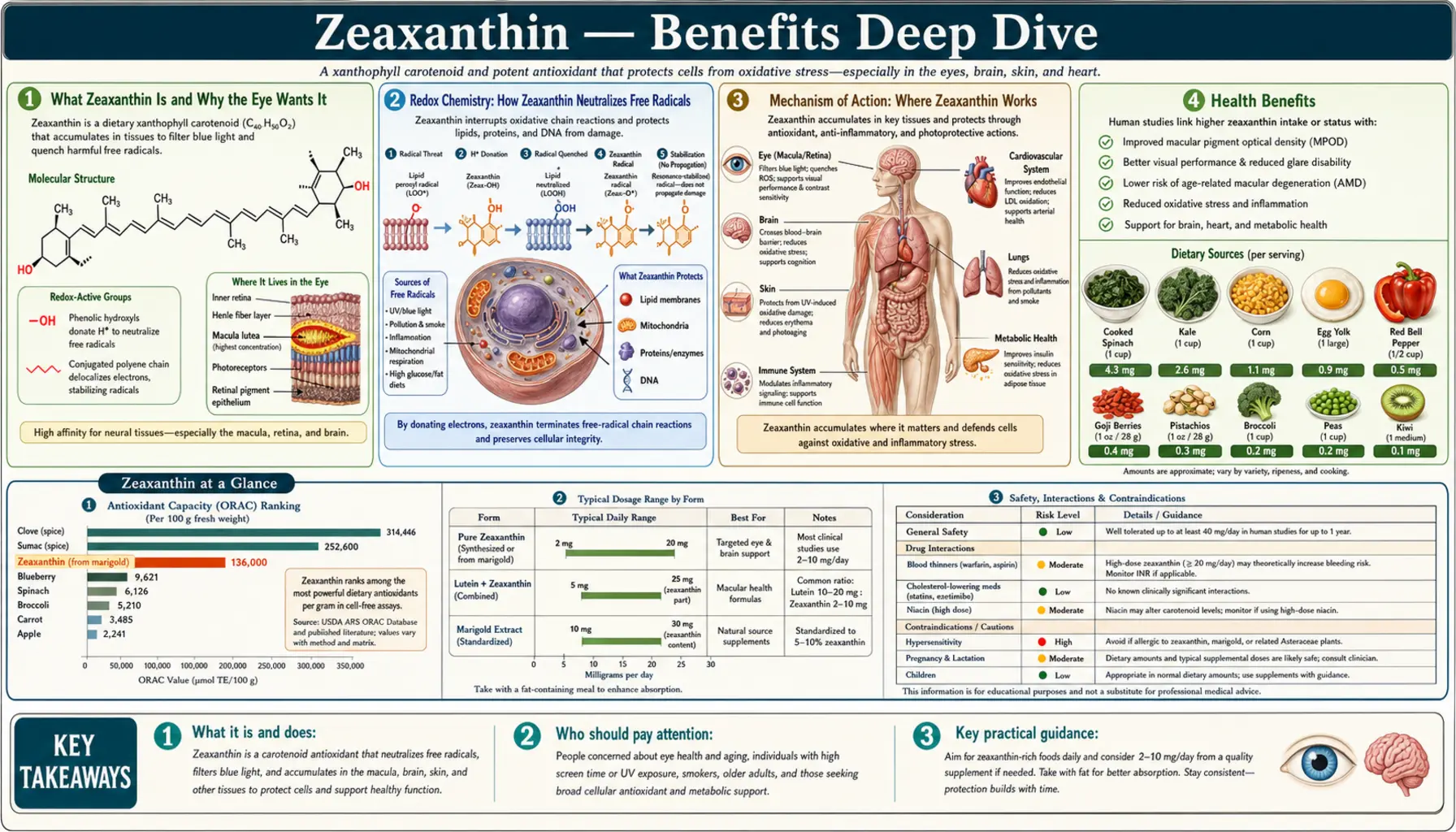
Zeaxanthin is one of only three carotenoids the human eye deliberately concentrates into a single spot the width of a pinhead — the macula, the patch of retina responsible for your sharpest central vision. Together with its structural twin lutein, zeaxanthin forms the yellow "macular pigment," and it is the dominant pigment at the very center of that center, the foveola, where reading vision is generated. The body cannot make zeaxanthin; every molecule in your retina came from food. These four deep-dive pages cover where zeaxanthin does the most measurable good — protecting the aging macula, filtering the harshest blue wavelengths and steadying vision under glare, its emerging (and still preliminary) roles in skin and brain, and the specific foods that actually deliver it.
Deep-Dive Articles
Eye & Macular Health
Why zeaxanthin owns the foveal center, how the macular pigment protects photoreceptors, what the landmark AREDS2 trial actually found (and did not find), and an honest look at zeaxanthin's role in slowing age-related macular degeneration in people already at risk.
Blue Light Protection
The optical filter your retina builds for itself: how macular pigment absorbs short-wavelength blue light, the trials showing improved glare tolerance, photostress recovery and contrast sensitivity — and a realistic take on the "screen blue light" marketing claims.
Skin & Brain
Beyond the eye, carotenoids accumulate in skin and neural tissue. The small human trials on skin photoprotection, hydration and elasticity, and the preliminary but intriguing research linking macular pigment to memory and cognitive performance across the lifespan.
Food Sources & Absorption
The foods that actually deliver zeaxanthin — goji berries, orange peppers, corn, egg yolk and leafy greens — why egg yolk punches above its weight, and how to eat carotenoids so your body absorbs them (fat matters).
Table of Contents
- Deep-Dive Articles
- What Zeaxanthin Is and Why the Eye Wants It
- Research Papers: Macular Pigment & AMD
- Research Papers: Blue Light & Visual Performance
- Research Papers: Skin & Brain
- Research Papers: Food Sources & Bioavailability
- Research Papers: Cross-Cutting (Biology & Safety)
- External Authoritative Resources
- Connections
- Featured Videos
What Zeaxanthin Is and Why the Eye Wants It
Zeaxanthin is a xanthophyll — an oxygen-containing carotenoid — and it is chemically almost identical to lutein. The two molecules share the same formula and differ only in the position of a single double bond on one of the ring ends. That tiny difference matters: zeaxanthin carries a fully conjugated chain of double bonds spanning both ring ends, which makes it a slightly more efficient absorber of blue light and a robust quencher of reactive oxygen species. Humans, like all animals, cannot synthesize either molecule; both must be eaten.
What makes zeaxanthin remarkable is not that it is an antioxidant — many compounds are — but where the body puts it. Of the roughly 50 carotenoids in a typical diet and the dozen or so that circulate in blood, only three end up in the macula: lutein, zeaxanthin, and meso-zeaxanthin (a stereoisomer the retina makes from lutein on site). These three form the macular pigment, a yellow screen laid down in front of the photoreceptors. Their distribution across the macula is not uniform, and this is the single most important fact about zeaxanthin:
- The foveal center (foveola) — the pinpoint of retina that produces your sharpest reading vision — is dominated by zeaxanthin and meso-zeaxanthin, which outnumber lutein by roughly two to one.
- The periphery of the macula flips the ratio: there lutein dominates and zeaxanthin fades.
In other words, zeaxanthin is lutein's partner, but it is the partner stationed at the epicenter, guarding the exact photoreceptors you rely on to read this sentence. This is why zeaxanthin deserves its own treatment rather than being folded into the lutein story. The four deep-dive pages below explore what that central positioning buys you.
A note on honesty that runs through every page here: zeaxanthin is almost always studied alongside lutein, because they travel together in food and in the retina. Very few trials isolate zeaxanthin by itself. Where a benefit is well supported (macular pigment density, glare and photostress performance, slowing progression of established macular degeneration in high-risk people) we say so. Where the evidence is preliminary or where popular claims outrun the data (screen "blue-light damage," dementia prevention, dramatic skin rejuvenation) we say that plainly too.
Research Papers: Macular Pigment & AMD
- Age-Related Eye Disease Study 2 (AREDS2) Research Group (2013). Lutein + zeaxanthin and omega-3 fatty acids for age-related macular degeneration: the AREDS2 randomized clinical trial. JAMA. — PMID 23644932
- Chew EY et al. (2022). Long-term outcomes of adding lutein/zeaxanthin and ω-3 fatty acids to the AREDS supplements on AMD progression: AREDS2 Report 28. JAMA Ophthalmology. — PMID 35653117
- Agrón E et al. (2021). Dietary nutrient intake and progression to late age-related macular degeneration in AREDS 1 and 2. Ophthalmology. — PMID 32858063
- Ma L et al. (2012). Lutein and zeaxanthin intake and the risk of age-related macular degeneration: a systematic review and meta-analysis. British Journal of Nutrition. — PMID 21899805
- Bone RA et al. (2000). Lutein and zeaxanthin in the eyes, serum and diet of human subjects. Experimental Eye Research. — PMID 10973733
- Wilson LM et al. (2021). The effect of lutein/zeaxanthin intake on human macular pigment optical density: a systematic review and meta-analysis. Advances in Nutrition. — PMID 34157098
- Scripsema NK et al. (2015). Lutein, zeaxanthin, and meso-zeaxanthin in the clinical management of eye disease. Journal of Ophthalmology. — PMID 26819755
- Keenan TDL et al. (2025). Oral antioxidant and lutein/zeaxanthin supplements slow geographic atrophy progression to the fovea in AMD. Ophthalmology. — PMID 39025435
- Evans JR, Lawrenson JG (2023). Antioxidant vitamin and mineral supplements for slowing the progression of age-related macular degeneration. Cochrane Database of Systematic Reviews. — PMID 37702300
- Nolan JM et al. (2007). The relationships between macular pigment optical density and its constituent carotenoids in diet and serum. Investigative Ophthalmology & Visual Science. — PMID 17251452
- Beatty S et al. (2004). Macular pigment optical density and its relationship with serum and dietary levels of lutein and zeaxanthin. Archives of Biochemistry and Biophysics. — PMID 15325913
Research Papers: Blue Light & Visual Performance
- Stringham JM, Hammond BR (2008). Macular pigment and visual performance under glare conditions. Optometry and Vision Science. — PMID 18296924
- Stringham JM, Hammond BR (2011). Macular pigment and visual performance in glare: benefits for photostress recovery, disability glare, and visual discomfort. Investigative Ophthalmology & Visual Science. — PMID 21296819
- Hammond BR et al. (2014). A double-blind, placebo-controlled study on the effects of lutein and zeaxanthin on photostress recovery, glare disability, and chromatic contrast. Investigative Ophthalmology & Visual Science. — PMID 25468896
- Nolan JM et al. (2016). Enrichment of macular pigment enhances contrast sensitivity in subjects free of retinal disease: CREST Report 1. Investigative Ophthalmology & Visual Science. — PMID 27367585
- Stringham JM et al. (2016). Macular carotenoid supplementation improves disability glare performance and dynamics of photostress recovery. Eye and Vision. — PMID 27857944
- Hammond BR Jr et al. (2012). Influence of the dietary carotenoids lutein and zeaxanthin on visual performance: application to baseball. American Journal of Clinical Nutrition. — PMID 23053558
- Arnault E et al. (2013). Phototoxic action spectrum on a retinal pigment epithelium model of AMD exposed to sunlight-normalized conditions. PLoS One. — PMID 24058402
- Arunkumar R et al. (2023). Macular pigment carotenoids and bisretinoid A2E. Advances in Experimental Medicine and Biology. — PMID 37440008
- Johnson EJ et al. (2021). The association between macular pigment optical density and visual function outcomes: a systematic review and meta-analysis. Eye (London). — PMID 32792595
Research Papers: Skin & Brain
- Roberts RL et al. (2009). Lutein and zeaxanthin in eye and skin health. Clinics in Dermatology. — PMID 19168000
- Palombo P et al. (2007). Beneficial long-term effects of combined oral/topical antioxidant treatment with the carotenoids lutein and zeaxanthin on human skin: a double-blind, placebo-controlled study. Skin Pharmacology and Physiology. — PMID 17446716
- Johnson EJ et al. (2012). A possible role for lutein and zeaxanthin in cognitive function in the elderly. American Journal of Clinical Nutrition. — PMID 23053547
- Lindbergh CA et al. (2018). Lutein and zeaxanthin influence brain function in older adults: a randomized controlled trial. Journal of the International Neuropsychological Society. — PMID 28695791
- Power R et al. (2018). Supplemental retinal carotenoids enhance memory in healthy individuals with low levels of macular pigment in a randomized, double-blind, placebo-controlled clinical trial. Journal of Alzheimer's Disease. — PMID 29332050
- Vishwanathan R et al. (2014). Macular pigment optical density is related to cognitive function in older people. Age and Ageing. — PMID 24435852
- Lopresti AL et al. (2022). The effects of lutein and zeaxanthin supplementation on cognitive function in adults with self-reported mild cognitive complaints: a randomized, double-blind, placebo-controlled study. Frontiers in Nutrition. — PMID 35252311
- Stahl W, Sies H (2002). Carotenoids and protection against solar UV radiation. Skin Pharmacology and Applied Skin Physiology. — PMID 12239422
Research Papers: Food Sources & Bioavailability
- Sommerburg O et al. (1998). Fruits and vegetables that are sources for lutein and zeaxanthin: the macular pigment in human eyes. British Journal of Ophthalmology. — PMID 9828775
- Handelman GJ et al. (1999). Lutein and zeaxanthin concentrations in plasma after dietary supplementation with egg yolk. American Journal of Clinical Nutrition. — PMID 10426702
- Eisenhauer B et al. (2017). Lutein and zeaxanthin — food sources, bioavailability and dietary variety in age-related macular degeneration protection. Nutrients. — PMID 28208784
- van het Hof KH et al. (2000). Dietary factors that affect the bioavailability of carotenoids. Journal of Nutrition. — PMID 10702576
- Yao Y et al. (2023). Effects of dietary fat type and emulsification on carotenoid absorption: a randomized crossover trial. American Journal of Clinical Nutrition. — PMID 36921903
- Borel P, Desmarchelier C (2018). Bioavailability of fat-soluble vitamins and phytochemicals in humans: effects of genetic variation. Annual Review of Nutrition. — PMID 30130464
- Hempel J et al. (2017). Ultrastructural deposition forms and bioaccessibility of carotenoids and carotenoid esters from goji berries. Food Chemistry. — PMID 27719945
- Hendrickson SJ et al. (2013). Food predictors of plasma carotenoids. Nutrients. — PMID 24152746
Research Papers: Cross-Cutting (Biology & Safety)
- Ma L et al. (2016). Lutein, zeaxanthin and meso-zeaxanthin supplementation associated with macular pigment optical density. Nutrients. — PMID 27420092
- Johnson EJ (2014). Role of lutein and zeaxanthin in visual and cognitive function throughout the lifespan. Nutrition Reviews. — PMID 25109868
- Eggersdorfer M, Wyss A (2018). Carotenoids in human nutrition and health. Archives of Biochemistry and Biophysics. — PMID 29885291
- Balić A, Mokos M (2019). Do we utilize our knowledge of the skin protective effects of carotenoids enough? Antioxidants. — PMID 31370257
- Choo YM et al. (2025). Lutein and zeaxanthin for reducing morbidity and mortality in preterm infants. Cochrane Database of Systematic Reviews. — PMID 40292760
- Gazzolo D et al. (2021). Early pediatric benefit of lutein for maturing eyes and brain — an overview. Nutrients. — PMID 34579116
PubMed Topic Searches
- PubMed: Zeaxanthin macular pigment
- PubMed: L/Z and AMD
- PubMed: Blue light and glare
- PubMed: L/Z and cognition
- PubMed: Sources & bioavailability
- PubMed: Meso-zeaxanthin
External Authoritative Resources
- NIH Office of Dietary Supplements — Dietary Supplement Fact Sheets (carotenoids and eye-health supplements)
- National Eye Institute — Age-Related Macular Degeneration (AREDS/AREDS2 background)
- Linus Pauling Institute — Carotenoids Micronutrient Information Center
- USDA FoodData Central (lutein + zeaxanthin values per food)
- PubMed — All research on zeaxanthin
Connections
- Zeaxanthin (Main Page)
- Zeaxanthin for Eye & Macular Health
- Zeaxanthin & Blue Light Protection
- Zeaxanthin for Skin & Brain
- Zeaxanthin Food Sources
- Lutein (Its Partner Carotenoid)
- Lutein Benefits Hub
- Beta-Carotene
- Astaxanthin
- All Antioxidants
- Vitamin A for Vision
- Macular Degeneration
- Cataracts
- Eggs (Bioavailable Zeaxanthin)
- Kale
- Zinc (AREDS Cofactor)