Pycnogenol — Benefits Deep Dive
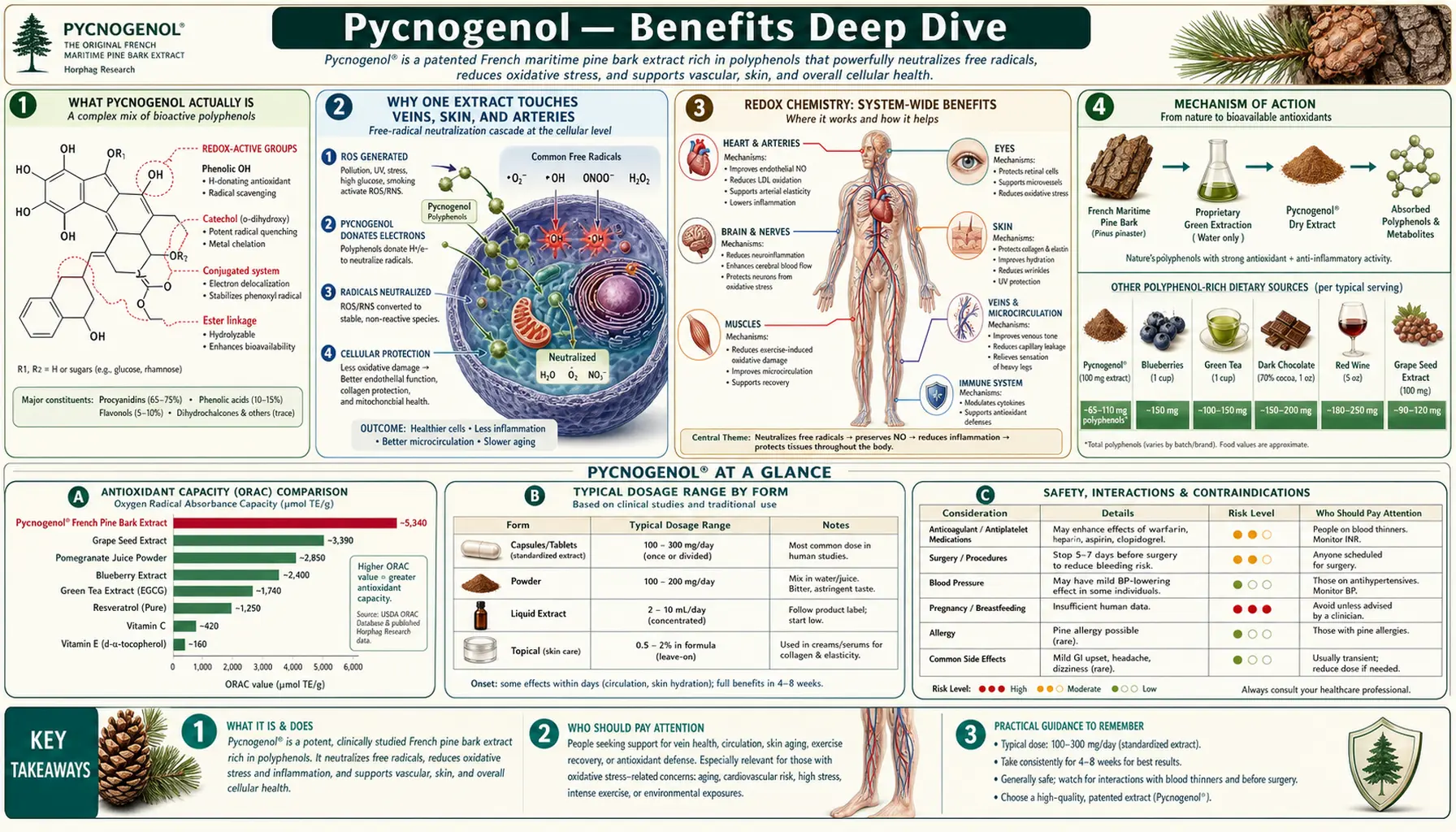
Pycnogenol is not a plant — it is a specific, standardized, brand-name extract of the bark of the French maritime pine (Pinus pinaster), trademarked by a single Swiss company and standardized to 65–75% procyanidins. That single fact shapes everything on this page. The procyanidins (chains of catechin and epicatechin, the same family of compounds found in grape seed, cocoa, and green tea) give the extract antioxidant, nitric-oxide-boosting, and anti-inflammatory activity, which is why one preparation shows up in trials for such different problems — heavy, swollen legs; aging skin; and blood pressure. The four deep-dive pages below walk through where the evidence is strongest (chronic venous insufficiency), where it is promising but smaller (skin elasticity and blood pressure), and the crucial caveat that runs through the whole literature: most Pycnogenol trials are small, and many were funded or conducted by the manufacturer, so the honest verdict is “plausible and often positive, but not yet proven to a high standard.”
Deep-Dive Articles
Circulation & Veins
The best-evidenced use. Chronic venous insufficiency (heavy, aching, swollen legs and varicose veins), leg edema, capillary permeability, venous ulcers, and the long-haul-flight edema and clot-prevention trials. How procyanidins are thought to seal leaky capillaries and strengthen the vein wall — and what the 2020 Cochrane review actually concluded about the quality of that evidence.
Skin Health
Skin elasticity and hydration, the trial showing increased collagen I and hyaluronic-acid-synthase gene expression, oral photoprotection against UV-induced erythema, and two randomized trials in melasma (facial pigmentation). Where the skin evidence is genuinely interesting and where it is still preliminary.
Blood Pressure & Heart
Endothelial function and nitric oxide, modest blood-pressure lowering (with two meta-analyses), platelet effects in smokers, effects on LDL and cardiovascular risk factors in type 2 diabetes, and the independent Swiss coronary-artery-disease trial. Why “improves the artery lining” is better supported than “lowers blood pressure a lot.”
Standardization & Safety
The most important page for a smart consumer. Why the evidence is tied to this specific branded extract and does not automatically transfer to cheap “pine bark extract” capsules, typical dosing, the good safety and tolerability record, drug interactions (blood thinners, blood-pressure drugs, surgery), pregnancy, and the industry-funding problem that colors the whole field.
Table of Contents
- Deep-Dive Articles
- What Pycnogenol Actually Is
- Why One Extract Touches Veins, Skin, and Arteries
- Research Papers: Circulation & Veins
- Research Papers: Skin Health
- Research Papers: Blood Pressure & Heart
- Research Papers: Mechanism, Composition & Pharmacokinetics
- Research Papers: Evidence Quality, Safety & Other Uses
- External Authoritative Resources
- Connections
- Featured Videos
What Pycnogenol Actually Is
Pycnogenol is a registered trademark (owned by Horphag Research) for a patented, standardized extract made from the bark of the French maritime pine, Pinus pinaster, harvested from a single managed forest — the Landes de Gascogne in southwest France. It is produced to a fixed specification: roughly 65–75% procyanidins (also called oligomeric proanthocyanidins, or OPCs), which are chains of the flavonoid building blocks catechin and epicatechin, plus smaller amounts of phenolic acids (such as ferulic and caffeic acid), taxifolin, and catechin monomers.
The word “standardized” is the key to the whole topic. Botanical extracts vary enormously from batch to batch and brand to brand. Pycnogenol is manufactured to hit the same procyanidin percentage every time, and essentially all of the clinical research is done on this one product. That is a genuine scientific strength — you know what was actually tested — but it is also a commercial one, because it means a generic “pine bark extract” on a shelf may not match the composition of the extract that was studied. The Standardization & Safety page explores this in depth.
Why One Extract Touches Veins, Skin, and Arteries
It can seem suspicious that a single supplement is studied for legs, faces, and hearts alike. The explanation is that all three tissues depend on the same underlying biology — small blood vessels, connective tissue, and the balance between oxidation and repair — and procyanidins act on shared control points rather than on one organ. Four proposed mechanisms recur throughout the research:
- Antioxidant free-radical scavenging. Procyanidins neutralize reactive oxygen species and help regenerate other antioxidants such as vitamin C and vitamin E. Packer and colleagues characterized this activity in detail in 1999. Oxidative stress damages vein walls, skin collagen, and the artery lining alike, so an antioxidant effect can plausibly touch all three.
- Nitric oxide and the endothelium. The extract appears to stimulate endothelial nitric oxide synthase (eNOS), increasing production of nitric oxide, the molecule that relaxes and widens blood vessels. This is the leading explanation for the endothelial and blood-pressure effects, and it also improves microcirculation in the legs and retina.
- Reduced inflammation (NF-κB). Procyanidins dampen the NF-κB inflammatory signaling pathway, lowering inflammatory mediators. This matters for the achiness of venous disease, for UV-triggered skin inflammation, and for the low-grade inflammation of metabolic disease.
- Capillary sealing and connective-tissue binding. OPCs bind to and appear to protect collagen and elastin, and they reduce capillary permeability — the tendency of small vessels to leak fluid into tissue. Less leakage means less swelling in the legs and, potentially, firmer skin.
These mechanisms are well-documented in laboratory and small human studies. The honest limitation, repeated throughout these pages, is that a plausible mechanism plus a positive small trial is not the same as proof. The 2020 Cochrane systematic review of pine bark extract concluded that across many conditions the evidence remains limited and of low quality, and that larger, independent, well-designed trials are still needed.
Research Papers: Circulation & Veins
- Petrassi C, Mastromarino A, Spartera C (2000). Pycnogenol in chronic venous insufficiency. Phytomedicine. — Search PubMed
- Cesarone MR et al. (2006). Comparison of Pycnogenol and Daflon in treating chronic venous insufficiency: a prospective, controlled study. Clinical and Applied Thrombosis/Hemostasis. — PubMed
- Cesarone MR et al. (2010). Improvement of signs and symptoms of chronic venous insufficiency and microangiopathy with Pycnogenol: a prospective, controlled study. Phytomedicine. — PubMed
- Belcaro G et al. (2005). Prevention of edema in long flights with Pycnogenol. Clinical and Applied Thrombosis/Hemostasis. — PubMed
- Belcaro G et al. (2004). Prevention of venous thrombosis and thrombophlebitis in long-haul flights with Pycnogenol. Clinical and Applied Thrombosis/Hemostasis. — PubMed
- Toledo RR et al. (2017). Effect of Pycnogenol on the healing of venous ulcers. Annals of Vascular Surgery. — PubMed
- Gulati OP (2014). Pycnogenol in chronic venous insufficiency and related venous disorders. Phytotherapy Research. — PubMed
Research Papers: Skin Health
- Marini A et al. (2012). Pycnogenol effects on skin elasticity and hydration coincide with increased gene expressions of collagen type I and hyaluronic acid synthase in women. Skin Pharmacology and Physiology. — PubMed
- Saliou C et al. (2001). Solar ultraviolet-induced erythema in human skin and NF-κB-dependent gene expression in keratinocytes are modulated by a French maritime pine bark extract. Free Radical Biology and Medicine. — PubMed
- Ni Z, Mu Y, Gulati O (2002). Treatment of melasma with Pycnogenol. Phytotherapy Research. — PubMed
- Lima PB et al. (2021). French maritime pine bark extract (Pycnogenol) with triple combination cream for facial melasma: a double-blind, randomized, placebo-controlled trial. JEADV. — PubMed
- Di Cerbo A et al. (2015). A dietary supplement improves facial photoaging and skin sebum, hydration and tonicity. Journal of Photochemistry and Photobiology B. — PubMed
Research Papers: Blood Pressure & Heart
- Liu X et al. (2004). Pycnogenol, French maritime pine bark extract, improves endothelial function of hypertensive patients. Life Sciences. — PubMed
- Enseleit F et al. (2012). Effects of Pycnogenol on endothelial function in patients with stable coronary artery disease: a double-blind, randomized, placebo-controlled, cross-over study. European Heart Journal. — PubMed
- Pourmasoumi M et al. (2020). Effect of pycnogenol supplementation on blood pressure: a systematic review and meta-analysis. Phytotherapy Research. — PubMed
- Fogacci F et al. (2020). Effect of Pycnogenol on blood pressure: a PRISMA-compliant systematic review and meta-analysis. Angiology. — PubMed
- Zibadi S et al. (2008). Reduction of cardiovascular risk factors in subjects with type 2 diabetes by Pycnogenol supplementation. Nutrition Research. — PubMed
- Pütter M et al. (1999). Inhibition of smoking-induced platelet aggregation by aspirin and Pycnogenol. Thrombosis Research. — PubMed
Research Papers: Mechanism, Composition & Pharmacokinetics
- Packer L, Rimbach G, Virgili F (1999). Antioxidant activity and biologic properties of a procyanidin-rich extract from pine (Pinus maritima) bark, Pycnogenol. Free Radical Biology and Medicine. — PubMed
- Rohdewald P (2002). A review of the French maritime pine bark extract (Pycnogenol), a herbal medication with a diverse clinical pharmacology. International Journal of Clinical Pharmacology and Therapeutics. — PubMed
- Maimoona A et al. (2011). A review on biological, nutraceutical and clinical aspects of French maritime pine bark extract. Journal of Ethnopharmacology. — PubMed
- Grimm T et al. (2006). Single and multiple dose pharmacokinetics of maritime pine bark extract (Pycnogenol) after oral administration to healthy volunteers. BMC Clinical Pharmacology. — PubMed
- Fitzpatrick DF, Bing B, Rohdewald P (1998). Endothelium-dependent vascular effects of Pycnogenol. Journal of Cardiovascular Pharmacology. — PubMed
Research Papers: Evidence Quality, Safety & Other Uses
- Robertson NU et al. (2020). Pine bark (Pinus spp.) extract for treating chronic disorders. Cochrane Database of Systematic Reviews. — PubMed
- Schoonees A et al. (2012). Pycnogenol (extract of French maritime pine bark) for the treatment of chronic disorders. Cochrane Database of Systematic Reviews. — PubMed
- Belcaro G et al. (2008). Variations in C-reactive protein, plasma free radicals and fibrinogen values in patients with osteoarthritis treated with Pycnogenol. Redox Report. — PubMed
- Lau BH et al. (2004). Pycnogenol as an adjunct in the management of childhood asthma. Journal of Asthma. — PubMed
- Schönlau F, Rohdewald P (2001). Pycnogenol for diabetic retinopathy: a review. International Ophthalmology. — PubMed
External Authoritative Resources
- Cochrane Review (Robertson et al., 2020) — Pine bark extract for chronic disorders — the most rigorous independent assessment of the overall evidence; conclusions are cautious
- Drugs.com — Pycnogenol (Professional Natural Products monograph) — uses, dosing, interactions, and safety
- Pycnogenol.com (Horphag Research) — the manufacturer's own research database; comprehensive but industry-sponsored, so read alongside the independent sources above
- PubMed — all research on Pycnogenol
Connections
- Pycnogenol for Circulation & Veins
- Pycnogenol for Skin Health
- Pycnogenol for Blood Pressure & Heart
- Pycnogenol: Standardization & Safety
- Pycnogenol (Main Page)
- Grape Seed Extract (related OPCs)
- Resveratrol
- Quercetin
- Arginine (nitric oxide)
- Vitamin C
- Varicose Veins
- Hypertension
- Type 2 Diabetes
- Diabetic Retinopathy
- Melasma
- All Antioxidants