Pycnogenol for Circulation and Vein Health
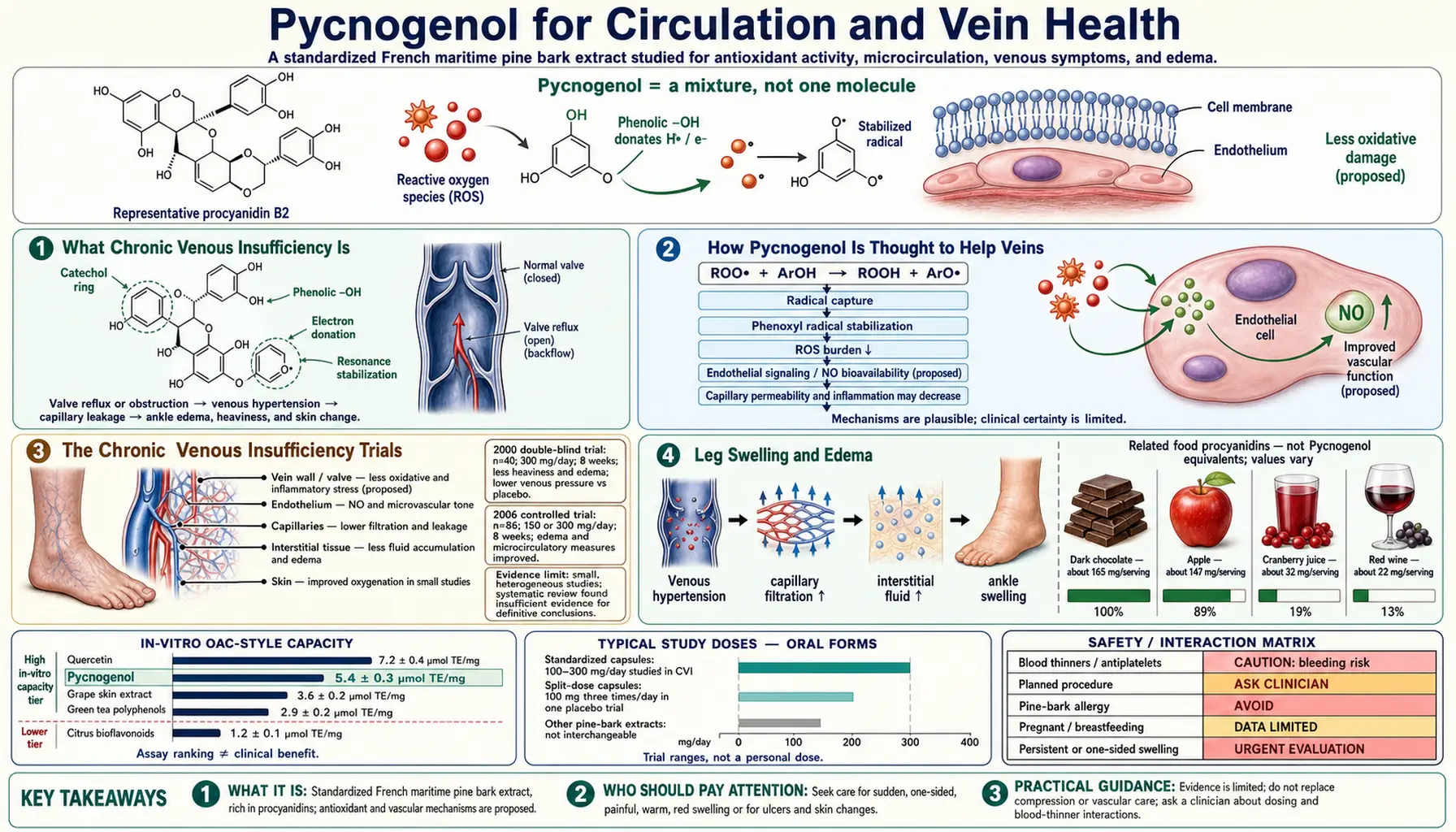
If Pycnogenol has one use where the evidence is strongest and the mechanism makes the most sense, it is heavy, aching, swollen legs — the everyday face of chronic venous insufficiency. Procyanidins are thought to seal leaky capillaries, strengthen the vein wall, and improve blood flow through the smallest vessels, and a series of controlled trials report less swelling, less heaviness, and less pain. This page walks through what venous insufficiency is, how the extract is believed to work, the trial evidence (including head-to-head comparisons with compression stockings and with the prescription venotonic Daflon), the long-haul-flight studies, and the honest limits of that evidence — because even here, the 2020 Cochrane review judged the overall quality of the research to be low.
Table of Contents
- What Chronic Venous Insufficiency Is
- How Pycnogenol Is Thought to Help Veins
- The Chronic Venous Insufficiency Trials
- Leg Swelling and Edema
- Compared With Compression and Other Venotonics
- Long-Haul Flights: Edema and Clots
- Venous Leg Ulcers and Microcirculation
- Beyond the Legs: Retinal Microcirculation
- Practical Use: Dose, Timing, Expectations
- Cautions and the Evidence Caveat
- Key Research Papers
- External Resources
- Connections
- Featured Videos
What Chronic Venous Insufficiency Is
Veins carry blood back to the heart against gravity. In the legs, that job depends on two things: the squeeze of the calf muscles (the “muscle pump”) and a series of one-way valves inside the veins that stop blood from falling back down. When those valves weaken or the vein walls stretch, blood pools in the lower legs — a condition called chronic venous insufficiency (CVI). It is extremely common, especially with age, pregnancy, prolonged standing, and being overweight.
The pooling raises pressure inside the tiny capillaries, and that pressure forces fluid out into the surrounding tissue. The result is the familiar cluster of symptoms: swelling (edema) around the ankles that is worse by evening, a feeling of heaviness or tiredness in the legs, aching, cramping, itching, restless legs, and visible varicose veins. In more advanced disease the skin can darken, harden, and eventually break down into a slow-healing venous ulcer.
Standard care is compression (stockings), leg elevation, exercise, weight management, and in selected cases procedures to close faulty veins. “Venotonic” or “phlebotonic” agents — oral compounds meant to firm the vein and reduce leakage — are widely used in Europe as an add-on. Pycnogenol sits in this venotonic category, and CVI is the setting where it has been studied the most.
How Pycnogenol Is Thought to Help Veins
The proposed mechanisms map neatly onto the problem of a leaky, poorly toned venous system:
- Reducing capillary permeability. The central idea is that oligomeric procyanidins reduce the leakiness of capillaries — the exact step that turns venous back-pressure into visible ankle swelling. Less leakage means less fluid escaping into the tissue.
- Protecting collagen and elastin. Procyanidins bind to these connective-tissue proteins, which form the scaffolding of the vein wall and the capillary basement membrane. By resisting their breakdown by enzymes and free radicals, the extract may help the vessel keep its structure and tone.
- Improving microcirculation and nitric oxide. By supporting endothelial nitric oxide, Pycnogenol may improve flow through the smallest vessels, helping clear the congestion that makes legs feel heavy. Improved microcirculation is a recurring measured outcome in the trials.
- Calming inflammation. Venous disease has an inflammatory component; the anti-inflammatory (NF-κB-dampening) action may contribute to reduced aching and swelling.
These are the same four mechanisms described on the Benefits hub. What makes the venous story relatively convincing is that the mechanism (sealing leaky capillaries) and the measured outcome (less edema) line up directly.
The Chronic Venous Insufficiency Trials
Several controlled studies have tested Pycnogenol in CVI. Petrassi and colleagues (2000) reported that supplementation reduced symptoms and signs of venous insufficiency compared with placebo. Cesarone and colleagues (2010) ran a prospective controlled study in CVI with microangiopathy (small-vessel disease) and reported improvement in both symptoms and objective microcirculatory measures, including reduced ankle swelling and improved capillary filtration.
Across this body of work, the consistent findings are reduced edema, less leg heaviness and pain, and improvements in laboratory measures of microcirculation. Reported effect sizes are often meaningful. The important qualifier is that many of these studies come from a single research group in Italy (the Pescara investigators, chiefly Belcaro, Cesarone, and Gulati), are not always double-blinded or independently replicated, and are frequently linked to the manufacturer. That does not make the results wrong, but it means they should be read as promising rather than definitive — a point the Standardization & Safety page returns to.
Leg Swelling and Edema
Ankle and lower-leg swelling is the symptom Pycnogenol most reliably moves in the studies. Edema is measured objectively — by ankle circumference, by water displacement, or by a technique called capillary filtration rate that gauges how fast fluid leaks into tissue. Trials in CVI patients report reductions in these measures alongside patients' own reports of lighter, less swollen legs.
The edema effect is also what underlies the long-haul-flight studies discussed below, where the “condition” is not a disease at all but the ordinary swelling healthy people get from sitting still for many hours in a low-pressure cabin. Because the mechanism is about capillary leakage rather than a specific disease, the anti-edema effect appears in several settings.
Compared With Compression and Other Venotonics
Some of the more useful trials put Pycnogenol head-to-head with established treatments rather than only against placebo:
- Versus Daflon (micronized purified flavonoid fraction, a prescription venotonic widely used in Europe). Cesarone and colleagues (2006) compared the two in CVI and reported that Pycnogenol produced at least comparable — in their data, somewhat greater — symptom and edema improvement.
- Versus compression stockings. Comparative studies (including Belcaro's 2015 comparison with Antistax and stockings, and a 2024 study alongside elastic compression) suggest Pycnogenol can improve edema and microcirculation, sometimes in the same range as compression. This is not a reason to abandon stockings, which remain first-line and inexpensive, but it points to a possible role as an add-on or an option for people who cannot tolerate compression.
The honest reading is that Pycnogenol behaves like a legitimate venotonic in these comparisons. Whether it is truly equal or superior to compression cannot be settled from small, mostly single-group studies — but the signal is consistent.
Long-Haul Flights: Edema and Clots
A distinctive line of research looked at long-haul air travel, where immobility, dehydration, and cabin pressure combine to swell the legs and, in higher-risk travelers, raise the odds of a clot (deep vein thrombosis). Cesarone and colleagues (2005) reported that Pycnogenol reduced flight-related leg edema compared with placebo. Belcaro and colleagues (2004) reported fewer episodes of venous thrombosis and superficial thrombophlebitis in higher-risk long-haul passengers taking the extract.
These findings are intriguing and consistent with the anti-edema and mild antiplatelet effects, but they should be treated cautiously: they come from the same investigator group, and clot prevention is a serious claim that would need large, independent, randomized confirmation before anyone relies on a supplement in place of proven measures. For genuinely high-risk travelers, established advice — moving regularly, hydration, compression stockings, and medical anticoagulation when indicated — remains the standard, and Pycnogenol should not replace it.
Venous Leg Ulcers and Microcirculation
At the severe end of venous disease, chronically congested skin can break down into a venous leg ulcer that heals very slowly. Toledo and colleagues (2017) studied Pycnogenol (oral, with and without a topical form) as an adjunct to standard ulcer care and reported faster healing, consistent with the microcirculatory and anti-inflammatory mechanism. Belcaro's group has similarly reported microcirculatory improvements in diabetic and venous microangiopathy.
Venous ulcers are a medical problem that requires proper wound care and compression; any supplement here is strictly an add-on to be discussed with a clinician, not a stand-alone treatment. But the direction of the evidence — better microcirculation, faster healing — fits the rest of the venous story.
Beyond the Legs: Retinal Microcirculation
The same “seal the leaky small vessels” mechanism has been studied in the eye. Steigerwalt and colleagues (2009) reported that Pycnogenol improved retinal microcirculation, reduced retinal edema, and improved visual acuity in people with early diabetic retinopathy — a disease of leaky retinal capillaries that is, in a sense, the eye's version of what happens in the legs. Earlier reviews (Schönlau and Rohdewald, 2001) summarized similar signals for vascular retinopathies.
This is early evidence in a serious eye condition, and diabetic retinopathy must be managed by an ophthalmologist. It is included here because it illustrates the unifying theme: wherever tiny blood vessels leak, the procyanidin mechanism has been tested, with generally positive but preliminary results.
Practical Use: Dose, Timing, Expectations
In the venous trials, Pycnogenol has typically been used at roughly 100–360 mg per day, most often 150–300 mg divided into two or three doses with meals. It is taken by mouth as tablets or capsules. Benefits build over weeks rather than days — most studies ran for four to twelve weeks, and reduced heaviness and swelling tend to appear gradually over that window.
Realistic expectations matter. Pycnogenol is a symptom-and-comfort intervention for venous disease: it may make legs feel lighter and look less swollen, and it may complement compression. It does not repair failed valves or make varicose veins disappear, and it is not a substitute for compression, exercise, weight management, or, when indicated, a vein procedure. Anyone with new or one-sided leg swelling, calf pain, or a leg ulcer should be evaluated by a clinician first — those can signal a clot or other problem that needs medical attention, not a supplement.
Cautions and the Evidence Caveat
- Evidence quality. The 2020 Cochrane review (Robertson et al.) of pine bark extract concluded the overall evidence across conditions was limited and of low quality; the 2012 Cochrane review (Schoonees et al.) reached a similar cautious verdict. Much of the venous research is single-group and industry-linked. Treat positive results as encouraging, not settled.
- Bleeding and blood thinners. Because Pycnogenol may modestly reduce platelet stickiness, use caution if you take anticoagulants (warfarin, apixaban) or antiplatelet drugs (aspirin, clopidogrel), and stop it before surgery. Discuss with your clinician.
- Blood pressure. The extract can nudge blood pressure down; if you take antihypertensives, monitor for additive effects.
- Red-flag symptoms are not for self-treatment. Sudden one-sided leg swelling, warmth, and pain can indicate a deep vein thrombosis — a medical emergency. Do not treat these with a supplement; seek care.
- Pregnancy. Some venous studies were done in late pregnancy, but data are limited; use only with medical advice. See the Standardization & Safety page.
Key Research Papers
- Petrassi C, Mastromarino A, Spartera C (2000). Pycnogenol in chronic venous insufficiency. Phytomedicine. — Search PubMed
- Cesarone MR et al. (2006). Comparison of Pycnogenol and Daflon in treating chronic venous insufficiency: a prospective, controlled study. Clinical and Applied Thrombosis/Hemostasis. — PubMed
- Cesarone MR et al. (2010). Improvement of signs and symptoms of chronic venous insufficiency and microangiopathy with Pycnogenol: a prospective, controlled study. Phytomedicine. — PubMed
- Belcaro G (2015). A clinical comparison of Pycnogenol, Antistax, and stocking in chronic venous insufficiency. International Journal of Angiology. — PubMed
- Belcaro G et al. (2024). Improvements in edema and microcirculation in chronic venous insufficiency with Pycnogenol or elastic compression. Minerva Surgery. — PubMed
- Cesarone MR et al. (2005). Prevention of edema in long flights with Pycnogenol. Clinical and Applied Thrombosis/Hemostasis. — PubMed
- Belcaro G et al. (2004). Prevention of venous thrombosis and thrombophlebitis in long-haul flights with Pycnogenol. Clinical and Applied Thrombosis/Hemostasis. — PubMed
- Toledo RR et al. (2017). Effect of Pycnogenol on the healing of venous ulcers. Annals of Vascular Surgery. — PubMed
- Belcaro G et al. (2017). Postpartum varicose veins: supplementation with Pycnogenol or elastic compression — a 12-month follow-up. International Journal of Angiology. — PubMed
- Steigerwalt R et al. (2009). Pycnogenol improves microcirculation, retinal edema, and visual acuity in early diabetic retinopathy. Journal of Ocular Pharmacology and Therapeutics. — PubMed
- Gulati OP (2014). Pycnogenol in chronic venous insufficiency and related venous disorders. Phytotherapy Research. — PubMed
- Schoonees A et al. (2012). Pycnogenol (extract of French maritime pine bark) for the treatment of chronic disorders. Cochrane Database of Systematic Reviews. — PubMed
PubMed Topic Searches
- PubMed: Pycnogenol chronic venous insufficiency
- PubMed: Pycnogenol edema / leg swelling
- PubMed: Pycnogenol microcirculation
- PubMed: Pycnogenol venous ulcer
- PubMed: Pycnogenol long flights / thrombosis
External Resources
- Cochrane Review (2020) — Pine bark extract for chronic disorders (independent, cautious assessment)
- Drugs.com — Pycnogenol monograph (uses, dosing, interactions)
- PubMed — Pycnogenol and venous disease
Connections
- Pycnogenol Benefits Hub
- Pycnogenol for Blood Pressure & Heart
- Pycnogenol: Standardization & Safety
- Pycnogenol (Main Page)
- Varicose Veins
- Diabetic Retinopathy
- Atherosclerosis
- Grape Seed Extract (related OPCs)
- Arginine (nitric oxide)
- Quercetin
- Vitamin C
- All Antioxidants