Resveratrol — Benefits Deep Dive

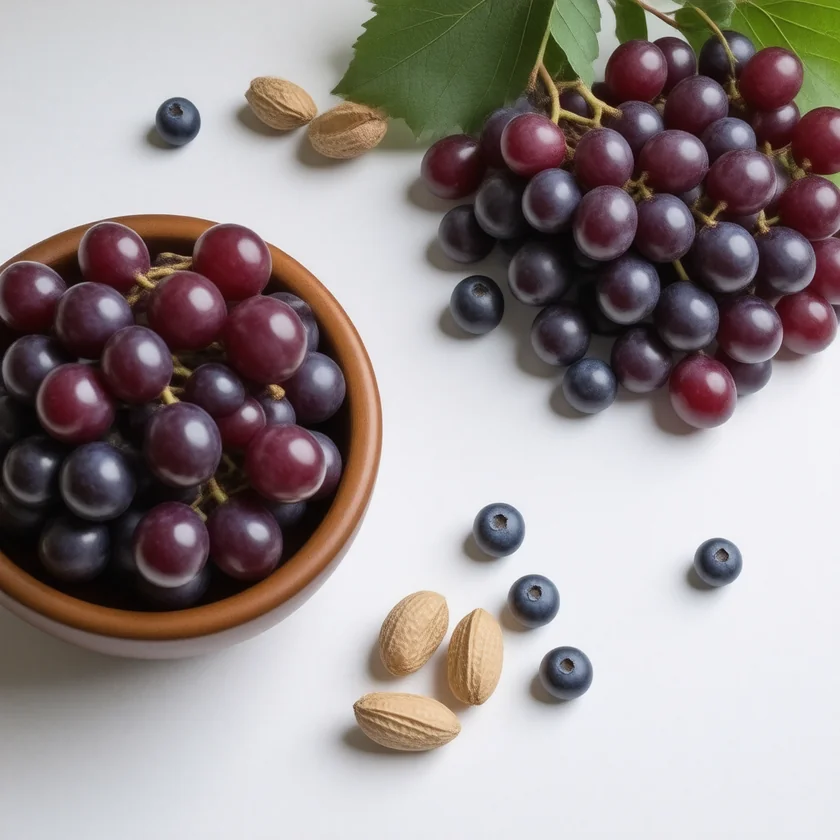
Resveratrol is one of the most studied and most oversold molecules in nutritional science. It is a real compound with real biology — a plant stress signal (a stilbenoid phytoalexin) that grapevines, peanuts, and berries make to defend against fungal attack, and that switches on a genuinely interesting set of cellular stress-response pathways when animals eat it. But the gap between the laboratory story and the human evidence is unusually wide. Yeast lived longer; mice on junk-food diets lived longer; the biotech story raised hundreds of millions of dollars — and then the careful human trials came back mixed, modest, or null, and the "molecule of the century" turned out to have a serious bioavailability problem. These four pages tell that story honestly: what resveratrol actually does, where the human evidence is real, and where the hype ran far ahead of the data.
Deep-Dive Articles
Heart & Circulation
The cardiovascular claims that made resveratrol famous, and how much survives scrutiny. The "French paradox" (largely a statistical artifact of how French death certificates were coded, not a wine miracle), endothelial and nitric-oxide effects on surrogate markers, a blood-pressure meta-analysis where only the highest doses moved systolic pressure, inconsistent lipid effects, and small grape-extract trials in coronary patients.
Read the deep dive →Longevity & Sirtuins
The full, honest sirtuin story: the electrifying 2003 yeast result, the "resveratrol mimics calorie restriction" hypothesis, the 2006 mouse studies that made headlines — and the crucial caveats that the same lab found no lifespan extension in mice on a normal diet, that resveratrol may not even be a direct SIRT1 activator (a fluorophore assay artifact), that no human longevity data exist, and that almost none of it survives first-pass metabolism.
Read the deep dive →Metabolic & Blood Sugar
The AMP-activated protein kinase (AMPK) / SIRT1 / mitochondrial-biogenesis rationale, the encouraging small trials in type-2 diabetics and obese men (insulin sensitivity, a calorie-restriction-like metabolic signature), and the equally rigorous trials that found nothing at all in healthy non-obese people. Why the population you study seems to determine the answer — and what that means for who might benefit.
Read the deep dive →Antioxidant & Cellular Protection
What resveratrol is at the molecular level, why it is only a modest direct radical scavenger but a more interesting indirect one (Nrf2, NF-κB, endogenous antioxidant enzymes), the xenohormesis idea, and an honest accounting of dietary sources — including why the amount in a glass of red wine is far too small to matter and why supplements are extracted from Japanese knotweed, not grapes.
Read the deep dive →Table of Contents
- Deep-Dive Articles
- Why One Molecule Generated So Many Claims
- Resveratrol and the Brain
- Research Papers: Longevity & Sirtuins
- Research Papers: Heart & Circulation
- Research Papers: Metabolic & Blood Sugar
- Research Papers: Antioxidant, Sources & Bioavailability
- External Authoritative Resources
- Connections
- Featured Videos
Why One Molecule Generated So Many Claims
Resveratrol (3,5,4'-trihydroxy-trans-stilbene) is a phytoalexin — a defensive compound that certain plants synthesize in response to injury, ultraviolet light, or fungal infection. Grapevines make it in the skin of the grape; peanuts, blueberries, and the root of Japanese knotweed make it too. Because it is a plant stress signal, it interacts with a cluster of cellular pathways that animals also use to sense and respond to stress. That single fact is the root of every benefit claim you will read: resveratrol nudges the same molecular machinery — sirtuins, AMP-activated protein kinase (AMPK), the transcription factors Nrf2 and NF-κB, and mitochondrial biogenesis regulators — that is engaged by exercise and by calorie restriction, two interventions with genuinely robust health effects.
The problem is that "engages the same pathway as calorie restriction" is not the same as "reproduces the benefits of calorie restriction in humans." Three things stand between the mechanism and the medicine, and they recur on every page below:
- The species gap. The dramatic results were in yeast, worms, flies, and mice — and even in mice, the biggest survival effect required an unhealthy high-calorie diet as the backdrop. On a normal diet, resveratrol improved healthspan markers but did not extend lifespan. Humans have never been tested for longevity, and cannot practically be.
- The bioavailability problem. Resveratrol is well absorbed but almost entirely converted to glucuronide and sulfate metabolites during first-pass metabolism, so the concentration of free resveratrol reaching your tissues is a tiny fraction of the dose. In a 2004 study of six volunteers, at least 70% of a 25 mg oral dose was absorbed, yet only trace amounts of unchanged resveratrol (under 5 ng/mL) could be found in the blood, because the gut and liver attach sulfate groups to it extremely fast. Many of the striking cell-culture effects used concentrations that are simply unreachable by mouth.
- The dose gap. The amounts used in positive human trials (hundreds of milligrams to grams per day) are orders of magnitude more than any diet delivers. A glass of red wine contains roughly a fraction of a milligram — the wine-as-medicine story does not survive the arithmetic.
The pooled human trials show how narrow the firm results are. A 2015 meta-analysis of six blood-pressure trials (247 people) found that resveratrol did not lower blood pressure overall; only in the subgroup taking 150 mg a day or more did systolic pressure fall, by about 11.9 mmHg, and diastolic pressure did not change. A 2026 umbrella review of 45 systematic reviews of human trials found 35 statistically significant effects, but only four were backed by high-certainty evidence: a small drop in waist size (0.8 cm), lower total cholesterol in overweight adults (0.19 mmol/L), and lower blood pressure in people with type 2 diabetes (systolic about 8 mmHg, diastolic about 3.6 mmHg). Effects on blood sugar, kidney function, blood-vessel lining, working memory, fatty liver and inflammation were rated only moderate certainty. A second 2026 umbrella review, pooling 10 meta-analyses in type 2 diabetes, found no significant effect on fasting blood sugar, HbA1c (glycated hemoglobin, a three-month blood-sugar average), insulin or insulin resistance; only LDL cholesterol fell in one type of analysis, and the authors did not consider resveratrol a beneficial agent for blood sugar or blood fats in type 2 diabetes.
None of this means resveratrol does nothing. It means the honest benefits are narrower, more conditional, and more modest than the marketing suggests. The four deep-dive pages walk through each domain — cardiovascular, longevity and sirtuins, metabolic and blood sugar, and antioxidant and cellular protection — and separate what the human evidence actually supports from what it does not.
Resveratrol and the Brain
The largest test of resveratrol in the brain was a 52-week randomized, placebo-controlled trial published in 2015 in 119 people with mild to moderate Alzheimer disease. Doses started at 500 mg once a day and rose every 13 weeks, ending at 1,000 mg twice a day. Resveratrol and its main breakdown products were measurable in the blood and in the fluid around the brain and spinal cord, showing that it crosses into the brain. Levels of one amyloid marker (amyloid-beta 40) fell less on resveratrol than on placebo, but brain volume loss on MRI scans was greater with resveratrol than with placebo, and the authors wrote that further studies are needed to interpret these changes. Nausea, diarrhea and weight loss were the most common side effects; the authors judged the drug safe and well tolerated.
Research Papers: Longevity & Sirtuins
- Howitz KT, Sinclair DA, et al. (2003). Small molecule activators of sirtuins extend Saccharomyces cerevisiae lifespan. Nature — PubMed PMID: 12939617
- Baur JA, Sinclair DA, et al. (2006). Resveratrol improves health and survival of mice on a high-calorie diet. Nature — PubMed PMID: 17086191
- Pearson KJ, et al. (2008). Resveratrol delays age-related deterioration and mimics transcriptional aspects of dietary restriction without extending life span. Cell Metabolism — PubMed PMID: 18599363
- Pacholec M, et al. (2010). SRT1720, SRT2183, SRT1460, and resveratrol are not direct activators of SIRT1. Journal of Biological Chemistry — PubMed PMID: 20061378
- Semba RD, et al. (2014). Resveratrol levels and all-cause mortality in older community-dwelling adults. JAMA Internal Medicine — PubMed PMID: 24819981
Research Papers: Heart & Circulation
- Renaud S, de Lorgeril M (1992). Wine, alcohol, platelets, and the French paradox for coronary heart disease. The Lancet — PubMed PMID: 1351198
- Liu Y, et al. (2015). Effect of resveratrol on blood pressure: a meta-analysis of randomized controlled trials. Clinical Nutrition — PubMed PMID: 24731650
- Tomé-Carneiro J, et al. (2012). Consumption of a grape extract supplement containing resveratrol decreases oxidized LDL and ApoB in patients undergoing primary prevention of cardiovascular disease: a triple-blind, 6-month follow-up, placebo-controlled, randomized trial. Molecular Nutrition & Food Research — PubMed PMID: 22648627
- Tomé-Carneiro J, et al. (2013). One-year supplementation with a grape extract containing resveratrol modulates inflammatory-related microRNAs and cytokines expression in peripheral blood mononuclear cells of type 2 diabetes and hypertensive patients with coronary artery disease. Pharmacological Research — PubMed PMID: 23557933
- Resveratrol and endothelial / flow-mediated dilation — PubMed: resveratrol & endothelial function
Research Papers: Metabolic & Blood Sugar
- Timmers S, et al. (2011). Calorie restriction-like effects of 30 days of resveratrol supplementation on energy metabolism and metabolic profile in obese humans. Cell Metabolism. — PubMed PMID: 22055504
- Brasnyó P, et al. (2011). Resveratrol improves insulin sensitivity, reduces oxidative stress and activates the Akt pathway in type 2 diabetic patients. British Journal of Nutrition. — PubMed PMID: 21385509
- Poulsen MM, et al. (2013). High-dose resveratrol supplementation in obese men: a randomized, placebo-controlled trial. Diabetes. — PubMed PMID: 23193181
- Yoshino J, et al. (2012). Resveratrol supplementation does not improve metabolic function in nonobese women with normal glucose tolerance. Cell Metabolism. — PubMed PMID: 23102619
- Sun JN, et al. (2026). Effects of resveratrol supplementation on multiple health outcomes: an umbrella review of systematic reviews and meta-analyses of randomized controlled trials. Nutrition Journal. — PubMed PMID: 41987155
- Ghalichi F, et al. (2026). The effects of resveratrol on glycemic indices and lipid profile in patients with type 2 diabetes: an umbrella review and meta-analysis. DARU Journal of Pharmaceutical Sciences. — PubMed PMID: 42268476
- Resveratrol and glycemic control meta-analyses — PubMed: resveratrol glycemic control
Research Papers: Antioxidant, Sources & Bioavailability
- Walle T, et al. (2004). High absorption but very low bioavailability of oral resveratrol in humans. Drug Metabolism and Disposition. — PubMed PMID: 15333514
- Boocock DJ, et al. (2007). Phase I dose escalation pharmacokinetic study of resveratrol in healthy volunteers. Cancer Epidemiology, Biomarkers & Prevention. — PubMed PMID: 17548692
- Kaeberlein M, et al. (2005). Substrate-specific activation of sirtuins by resveratrol. Journal of Biological Chemistry. — PubMed PMID: 15684413
- Turner RS, et al. (2015). A randomized, double-blind, placebo-controlled trial of resveratrol for Alzheimer disease. Neurology. — PubMed PMID: 26362286
- Resveratrol and the Nrf2 antioxidant-response pathway — PubMed: resveratrol & Nrf2
- Resveratrol content of red wine, grapes and peanuts — PubMed: dietary resveratrol sources
External Authoritative Resources
- Linus Pauling Institute — Resveratrol Micronutrient Information Center — the most balanced scientific summary, including the bioavailability and human-evidence caveats
- National Institute on Aging — "Resveratrol does not affect health, longevity in population study" (the InCHIANTI finding, in plain language)
- Memorial Sloan Kettering — About Herbs: Resveratrol (evidence, interactions, and cautions)
- U.S. National Institutes of Health (NIH) Office of Dietary Supplements — Dietary Supplement Fact Sheets
- PubMed — Resveratrol human clinical trials
Connections
- Resveratrol (Main Page)
- Resveratrol History & Discovery
- Resveratrol for Heart & Circulation
- Resveratrol, Longevity & Sirtuins
- Resveratrol for Metabolic & Blood Sugar
- Resveratrol Antioxidant & Cellular Protection
- All Antioxidants
- Grape Seed Extract
- Nicotinamide Adenine Dinucleotide / Nicotinamide Mononucleotide (Sirtuin Fuel)
- Spermidine (Autophagy)
- Fisetin (Senolytic)
- Quercetin
- Cardiology
- Type 2 Diabetes
- Blueberries
- Dark Chocolate (Polyphenols)