Resveratrol: Antioxidant & Cellular Protection
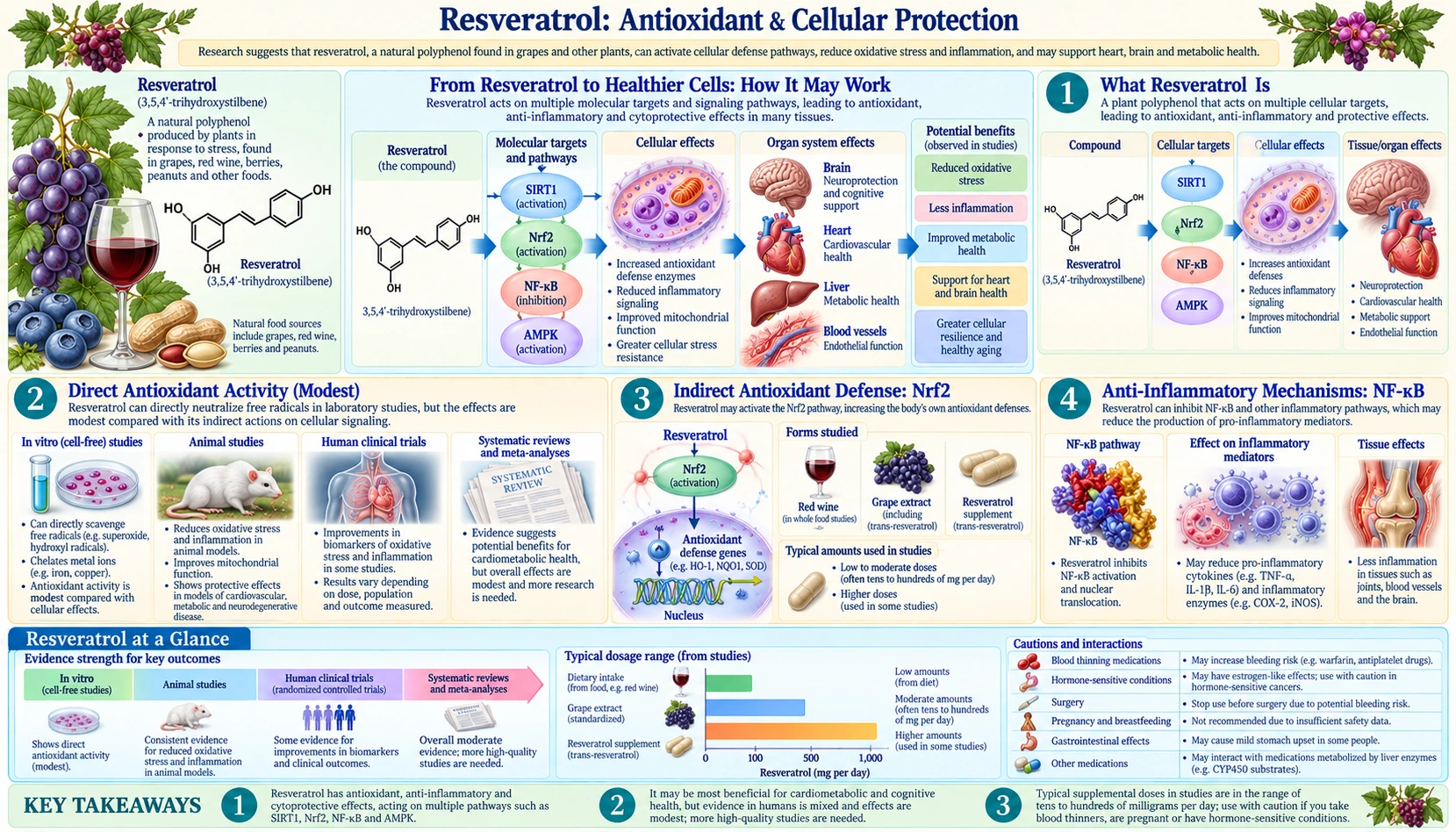
Resveratrol is filed under "antioxidants," but the label is only half right — and the half that is right is not the half most people assume. As a direct free-radical scavenger resveratrol is fairly ordinary; its more interesting activity is indirect, switching on the cell's own antioxidant and anti-inflammatory defenses (the Nrf2 pathway) and quieting inflammatory signaling (NF-κB). This page explains those mechanisms plainly, then gives an honest accounting of where resveratrol comes from: red wine, grapes, peanuts, and berries contain it, but in amounts so small that the wine-as-medicine idea collapses on arithmetic — which is why supplements use resveratrol extracted from the root of Japanese knotweed, or made synthetically, rather than resveratrol from grapes. It closes with the pharmacokinetics that constrain all of the above, and with safety.
Table of Contents
- What Resveratrol Is
- Direct Antioxidant Activity (Modest)
- Indirect Antioxidant Defense: Nrf2
- Anti-Inflammatory Mechanisms: NF-κB
- Hormesis and the Xenohormesis Idea
- Dietary Sources — and the Wine Arithmetic
- Supplements: Trans-Resveratrol and Knotweed
- The Bioavailability Problem in Detail
- Honest Bottom Line
- Safety, Tolerability & Interactions
- Key Research Papers
- Connections
- Featured Videos
What Resveratrol Is
Resveratrol is a stilbenoid — a small polyphenol built on a two-ring stilbene skeleton with three hydroxyl (–OH) groups, formally 3,5,4'-trihydroxy-trans-stilbene. Plants make it as a phytoalexin, a chemical shield deployed against fungal infection, ultraviolet radiation, and injury. It exists in two geometric forms: the biologically important trans isomer (what supplements and studies use) and a less-active cis isomer; light and heat can convert trans to cis, which is why quality supplements are protected from light. In plants much of it is stored as a glucoside called piceid (resveratrol with a sugar attached), which the body must cleave before absorption. Those hydroxyl groups let resveratrol donate electrons — the basis of its antioxidant chemistry — and also let it interact with numerous enzymes and receptors, which is why its biology is so sprawling.
Direct Antioxidant Activity (Modest)
As a direct scavenger of reactive oxygen species, resveratrol is real but unremarkable. In test-tube assays it neutralizes radicals and can chelate metal ions that catalyze oxidative damage, but on a molecule-for-molecule basis it is not a standout compared with vitamin C, vitamin E, or glutathione. More importantly, the very low tissue concentrations achieved after oral dosing mean that direct radical scavenging by intact resveratrol is unlikely to be its main mechanism in a living human — there simply is not enough free resveratrol circulating to mop up a meaningful share of the body's radical load. This is a crucial honesty point: the popular image of resveratrol as a powerful direct antioxidant flooding the bloodstream is not well supported. The action that matters is indirect.
Indirect Antioxidant Defense: Nrf2
The more compelling antioxidant story is that resveratrol acts as a mild stressor that switches on the cell's own defenses. The key node is Nrf2 (nuclear factor erythroid 2–related factor 2), a transcription factor that, when activated, moves into the nucleus and turns on a battery of protective genes through the antioxidant response element (ARE). These genes encode the endogenous antioxidant enzymes that do the real heavy lifting: superoxide dismutase (SOD), catalase, glutathione peroxidase, glutathione S-transferases, NAD(P)H quinone oxidoreductase 1 (NQO1), and heme oxygenase-1.
By nudging Nrf2, a small amount of resveratrol can produce an antioxidant effect far larger than its own scavenging capacity, because it recruits the cell's enzymatic machinery — catalytic systems that neutralize radicals continuously rather than one-for-one. This "turn on the factory rather than mop the floor yourself" mechanism is shared by many dietary polyphenols (see sulforaphane, one of the most potent Nrf2 activators) and is the most scientifically defensible sense in which resveratrol is an antioxidant. It also connects to the body's master antioxidant, glutathione, whose synthesis and recycling Nrf2 supports.
In human trials, the blood markers of these enzymes have not moved clearly. A 2026 meta-analysis of randomized trials in people with metabolic disorders found that resveratrol produced a small fall in C-reactive protein (CRP), an inflammation marker, across 25 trials (standardized mean difference, SMD, -0.18). It found no significant overall effect on the oxidative-stress markers catalase, malondialdehyde (MDA) or superoxide dismutase, and only a non-significant trend for total antioxidant capacity (SMD 0.63). Changes in interleukin-6 and tumor necrosis factor-α were not significant, and the daily dose showed no significant link with the inflammatory results (Rahmati and colleagues, 2026).
Anti-Inflammatory Mechanisms: NF-κB
Oxidative stress and inflammation are intertwined, and resveratrol's anti-inflammatory action is arguably better supported than its antioxidant one. Its central target is NF-κB (nuclear factor kappa-B), the master switch for inflammatory gene expression. Resveratrol inhibits NF-κB activation (partly through SIRT1-mediated deacetylation of its p65 subunit), reducing the transcription of pro-inflammatory cytokines (tumor necrosis factor-α, interleukin-6 (IL-6), interleukin-1 beta (IL-1β)), adhesion molecules, and the enzymes cyclooxygenase-2 (COX-2) and inducible nitric oxide synthase (iNOS). It also modulates other inflammatory pathways such as the NLRP3 inflammasome.
Because chronic low-grade inflammation underlies so many age-related diseases — atherosclerosis, insulin resistance, neurodegeneration — this anti-inflammatory activity is the thread that plausibly ties together the modest signals seen on the cardiovascular and metabolic pages (recall the reduced inflammatory markers in the Tomé-Carneiro coronary trials). As always, it is demonstrated mostly on biomarkers, and its real-world magnitude is limited by how little active resveratrol reaches tissue.
In people, a 2024 umbrella meta-analysis (19 meta-analyses covering 81 randomized trials with 4,088 participants) found that resveratrol supplements lowered blood C-reactive protein and tumor necrosis factor-α compared with control groups, while the effect on interleukin-6 was not significant (Molani-Gol and Rafraf, 2024). The 2026 meta-analysis limited to people with metabolic disorders, described above, found a small fall in C-reactive protein but no significant change in tumor necrosis factor-α.
Hormesis and the Xenohormesis Idea
A unifying framework for all of the above is hormesis: the principle that a small dose of a stressor triggers an adaptive, protective response that leaves the organism more resilient. Resveratrol is not primarily a nutrient; it is a plant defense chemical, and in small amounts it appears to act on animals as a mild stressor that switches on stress-response programs (Nrf2, sirtuins, AMP-activated protein kinase (AMPK), autophagy).
David Sinclair and Konrad Howitz proposed the related idea of xenohormesis — that animals evolved to sense stress molecules produced by plants under duress (like resveratrol from a fungus-stressed grapevine) as an early-warning signal of deteriorating environmental conditions, pre-emptively activating their own protective pathways. It is an elegant hypothesis and a useful mental model, but it remains a hypothesis, not established fact, and it is sometimes invoked to lend resveratrol more certainty than the human data warrant. Hormesis also implies a dose ceiling: more is not better, and very high doses can flip from protective to harmful.
Dietary Sources — and the Wine Arithmetic
Resveratrol occurs in a handful of foods, almost always in small amounts:
- Red wine — the famous source, and the most misleading. Red wine typically contains only about 0.1 to 2 milligrams of trans-resveratrol per liter (red far exceeds white, because the skins ferment with the juice). A standard 150 mL glass therefore delivers on the order of a few tenths of a milligram. Human trials that saw effects used 75 to 1500 mg per day. To reach even 150 mg from wine you would need to drink roughly a hundred liters — a fatal amount of alcohol many times over. The arithmetic, not the biology, is what kills the wine-as-medicine story.
- Grapes — concentrated in the skin; muscadine and other dark grapes are richer, but whole grapes still provide only small amounts. Grape juice has less than wine because it is not fermented on the skins as long.
- Peanuts and peanut products — contain modest amounts (roughly on the order of tenths of a microgram to a couple of micrograms per gram); boiled peanuts and peanut butter contribute a little.
- Berries — blueberries, bilberries, cranberries, and lingonberries contain small quantities.
- Japanese knotweed (Reynoutria japonica, formerly Polygonum cuspidatum) — not a food, but by far the richest natural source, and a raw material for commercial resveratrol supplements; synthetic trans-resveratrol is also made, and the European Food Safety Authority assessed it as a novel food in 2016.
The honest takeaway: no diet delivers a pharmacologically active resveratrol dose. Eating grapes, berries, and peanuts is worthwhile for many reasons — fiber, other polyphenols, vitamins — but not as a resveratrol delivery system. If resveratrol does anything meaningful, it does so only at supplement doses.
A long-term study of diet-level resveratrol points the same way. In the InCHIANTI study of 783 men and women aged 65 or older in the Chianti area of Italy, followed for 9 years, the resveratrol people took in from an ordinary Western diet (measured as resveratrol breakdown products in 24-hour urine) was not associated with inflammation markers, heart and blood-vessel disease or cancer, and did not predict death from any cause; 268 (34.3%) of the participants died during follow-up (Semba and colleagues, 2014).
Supplements: Trans-Resveratrol and Knotweed
Commercial resveratrol is either extracted from Japanese knotweed and standardized to a percentage of trans-resveratrol (the form studies use, as noted above), or made synthetically. In 2016 the European Food Safety Authority (EFSA) assessed synthetic trans-resveratrol with a purity of at least 99% and concluded that the intended intake of 150 mg a day for adults as a food supplement does not raise safety concerns; it noted diarrhoea or other gastrointestinal symptoms in four uncontrolled studies at doses of 1 g a day or higher, and that the breakdown product trans-resveratrol sulfate could inhibit CYP enzymes and may interact with medicines mainly broken down by CYP2C9. Typical supplement doses range from about 100 to 500 mg per day, with some longevity enthusiasts taking more; research doses have gone as high as 1–5 grams in short pharmacokinetic and cancer-chemoprevention studies. Formulation matters more than the label number because of the bioavailability problem below: micronized resveratrol, or resveratrol taken with a fat-containing meal or with piperine (black-pepper extract, which slows its glucuronidation), can raise blood levels relative to a plain-powder capsule. Quality varies widely: the supplement market is poorly policed, and some products under-deliver on their stated content.
The Bioavailability Problem in Detail
This is the single most important fact about resveratrol as a supplement, and it deserves a full accounting. Walle and colleagues (Drug Metabolism and Disposition 2004) traced a labeled oral dose and found that resveratrol is well absorbed from the gut — about 70% crosses the intestinal wall — but that its oral bioavailability as free resveratrol is nearly zero, because the intestine and liver almost instantly conjugate it into resveratrol glucuronides and sulfates. Peak plasma concentrations of unchanged resveratrol are very low and short-lived; the conjugates dominate. Boocock and colleagues (2007) confirmed that even doses up to 5 grams produce only micromolar-and-below peaks of free resveratrol. High doses can cause gastrointestinal side effects (see the EFSA note above).
Two caveats keep the door open a crack. First, the glucuronide and sulfate metabolites are not necessarily inert — some may be transported into tissues and cleaved back to free resveratrol locally, acting as a slow-release reservoir. Second, the gut itself is exposed to high resveratrol concentrations before absorption, which is why the most plausible direct effects may be in the gastrointestinal tract. But the overarching reality stands: the tens-of-micromolar concentrations that produce dramatic effects in a petri dish are far above what oral resveratrol achieves in human tissue, and any honest reading of resveratrol's benefits must live inside that ceiling. It is the thread connecting the disappointments on every other page.
Honest Bottom Line
- Resveratrol is a modest direct antioxidant but a more interesting indirect one, activating the Nrf2 pathway and the cell's own antioxidant enzymes.
- Its anti-inflammatory action (NF-κB inhibition) is arguably its best-supported mechanism and likely underlies the modest signals seen elsewhere.
- Hormesis / xenohormesis is a useful framework but remains hypothesis, and implies a dose ceiling — more is not better.
- Dietary sources are token: a glass of red wine has a few tenths of a milligram; supplements use resveratrol extracted from Japanese knotweed or made synthetically, not resveratrol from grapes; no diet delivers an active dose.
- Bioavailability is very low — the central limitation on everything resveratrol is claimed to do.
- Berries, grapes and peanuts supply fiber, vitamins and other polyphenols, but not a meaningful resveratrol dose; the supplement studies used trans-resveratrol, and the effects measured in people have been modest.
Safety, Tolerability & Interactions
- Generally well tolerated at common supplement doses (up to a few hundred milligrams per day). High doses (1–5 g) can cause nausea, abdominal discomfort, and diarrhea.
- Bleeding risk. Resveratrol's antiplatelet activity adds to the effect of anticoagulant and antiplatelet drugs (warfarin, direct oral anticoagulants (DOACs), clopidogrel, aspirin) and blood-thinning supplements (fish oil, ginkgo, high-dose vitamin E), and raises a bleeding concern around surgery.
- Drug-metabolism interactions. In a study of 42 healthy volunteers taking 1 g of resveratrol a day for 4 weeks, resveratrol inhibited the cytochrome P450 enzymes CYP3A4, CYP2D6 and CYP2C9 and induced (sped up) CYP1A2, so it can raise or lower levels of drugs cleared by these enzymes. The authors wrote that pharmacologic doses “could potentially lead to increased adverse drug reactions or altered drug efficacy” — a real concern with narrow-therapeutic-index medications (Chow and colleagues, 2010).
- Phytoestrogen activity. Resveratrol binds estrogen receptors; the research raises a concern for people with hormone-sensitive cancers and conditions.
- Pregnancy and breastfeeding: there is no established safety data for supplemental doses.
- No proven replacement: resveratrol has not been shown to replace proven therapy in any condition discussed across these pages.
Key Research Papers
- Walle T, Hsieh F, DeLegge MH, Oatis JE, Walle UK (2004). High absorption but very low bioavailability of oral resveratrol in humans. Drug Metabolism and Disposition, 32(12), 1377–1382. — PubMed PMID: 15333514
- Boocock DJ, et al. (2007). Phase I dose escalation pharmacokinetic study of resveratrol in healthy volunteers. Cancer Epidemiology, Biomarkers & Prevention, 16(6), 1246–1252. — PubMed PMID: 17548692
- Renaud S, de Lorgeril M (1992). Wine, alcohol, platelets, and the French paradox for coronary heart disease. The Lancet, 339(8808), 1523–1526. — PubMed PMID: 1351198
- Howitz KT, Sinclair DA, et al. (2003). Small molecule activators of sirtuins extend Saccharomyces cerevisiae lifespan. Nature, 425(6954), 191–196. — PubMed PMID: 12939617
- Kaeberlein M, et al. (2005). Substrate-specific activation of sirtuins by resveratrol. Journal of Biological Chemistry, 280(17), 17038–17045. — PubMed PMID: 15684413
- Semba RD, et al. (2014). Resveratrol levels and all-cause mortality in older community-dwelling adults. JAMA Internal Medicine, 174(7), 1077–1084. — PubMed PMID: 24819981
- Chow HH, Garland LL, Hsu CH, Vining DR, Chew WM, Miller JA, Perloff M, Crowell JA, Alberts DS (2010). Resveratrol modulates drug- and carcinogen-metabolizing enzymes in a healthy volunteer study. Cancer Prevention Research, 3(9), 1168–1175. — PubMed PMID: 20716633
- EFSA Panel on Dietetic Products, Nutrition and Allergies (NDA) (2016). Safety of synthetic trans-resveratrol as a novel food pursuant to Regulation (EC) No 258/97. EFSA Journal, 14(1). — doi:10.2903/j.efsa.2016.4368
- Molani-Gol R, Rafraf M (2024). Effects of resveratrol on the anthropometric indices and inflammatory markers: an umbrella meta-analysis. European Journal of Nutrition, 63(4), 1023–1040. — PubMed PMID: 38374352
- Rahmati S, Imani D, Alizadeh Z, Hassani L, Dashti N, Nikseresht A, Aslani S (2026). Effects of resveratrol supplementation on inflammatory and oxidative stress biomarkers in metabolic disorders: a systematic review and dose-response meta-analysis of randomized controlled trials. Inflammopharmacology, 34(11), 6899–6914. — PubMed PMID: 42891800